Can Fernando Mendoza Turn Around the Raiders? 2026 Rookies QBs—Tiers 16

The first player off the board in the 2026 draft will be a QB: Fernando Mendoza. That's meaningful. NFL teams consistently add a draft premium to their scouting grades for quarterbacks. But that still doesn't guarantee that a QB will go No. 1. For example, in 2022, the first QB didn't go off the board until Pick 20: Kenny Pickett, Steelers. The next QB wasn't selected until Pick 74: Desmond Ridder, Falcons.
So... although this QB class isn't very good, we've seen worse.
In some ways, this QB class looks similar to last year's. We have a flawed but intriguing QB at No. 1. We also have a QB generally thought to be in Round 1 consideration that looks more like a 5th-round-level bet—in other words, Shedeur Sanders, who actually gets draft capital. We also have a rushing threat who, while having no shot for Round 1, could get drafted higher than expected, a player you might call FCS Jaxson Dart. We also have a pocket passer with a shaky college resume that a team could end up talking themselves into on Day 2, à la Tyler Shough. There's also a handful of interesting Day 3 type fliers.
Compared to last year, my QB model is pretty interested in several of this year's prospects... until it finds out where they are expected to get drafted. Here's where this class stands compared to 2023 and 2024, with draft capital stripped out.
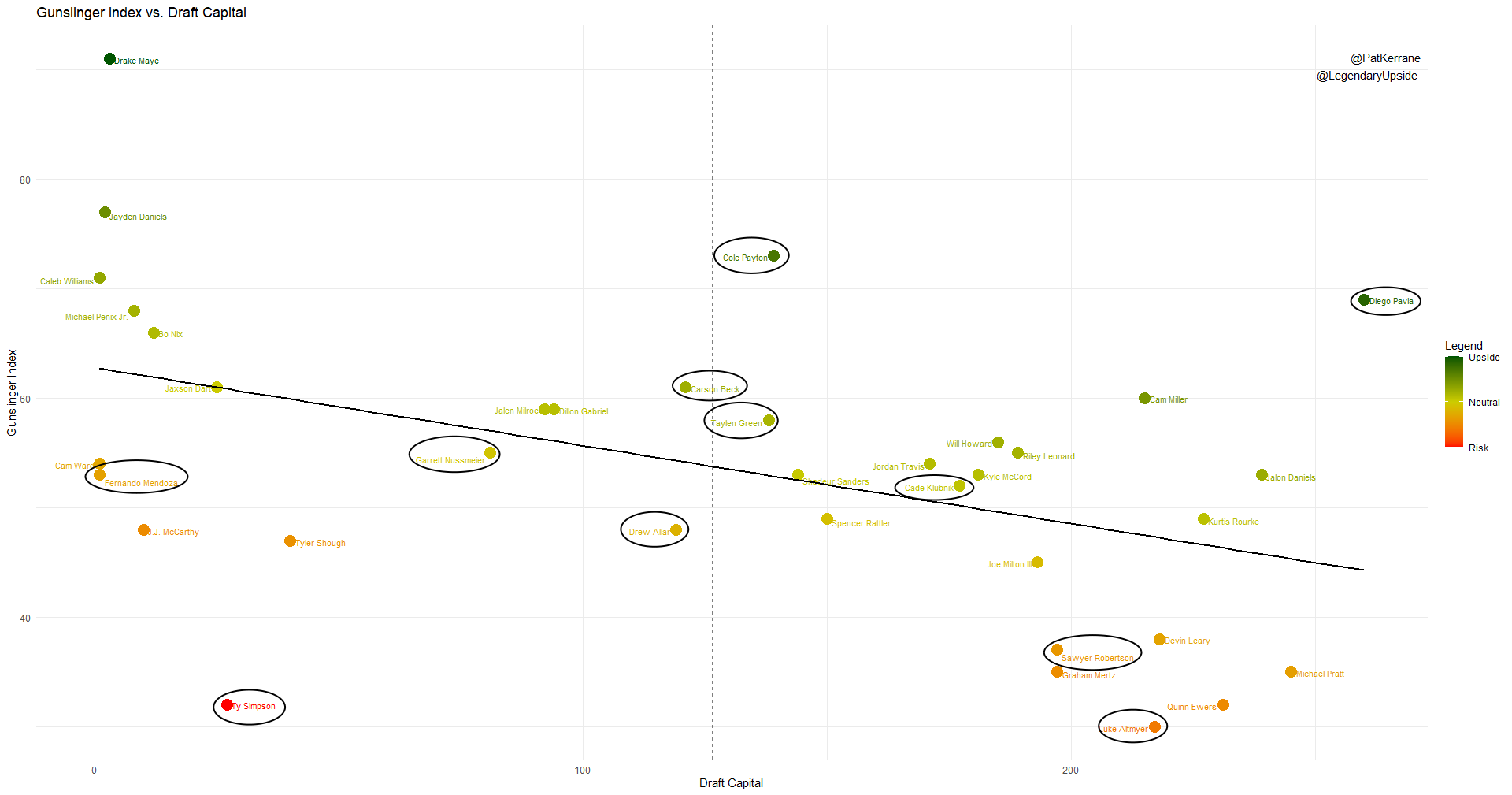
With draft capital plugged in... things get dicey. Feranado Mendoza is the only QB who rates as worth more than a 3rd-round pick in Superflex.
But... we don't know for sure which teams these QBs will land on (other than Mendoza). One of these guys could bink a path to 2026 playing time, providing potential for cheap QB production over the next year or two (or maybe even more).
Previously Covered:
 Pat Kerrane
 Pat Kerrane
Tier 1 - Day 1 Starter
Fernando Mendoza
At a Glance
Mendoza is coming off an incredibly successful 2025 campaign and is a mortal lock to be the No. 1 pick in the draft. Even by NFL standards, he's a big QB and generally looks like a fit for Klint Kubiak's offense in Las Vegas. However, Mendoza has a number of statistical red flags that keep him from being a slam-dunk fantasy bet.
Positive Indicators
Fernando Mendoza is coming off a Heisman-winning and National Championship-winning 2025 season. As you would expect, this was a very efficient year for Mendoza. Including the playoffs, Mendoza posted a 90.3 QBR, the highest mark in the nation. Mendoza also led the country with 41 TD passes and with a 10.78 adjusted yards per attempt.
After his remarkable 2025 season, Mendoza's draft capital is about as locked in as it gets. He will be selected No. 1 overall.
As we'll get to, Mendoza's game isn't overly fantasy-friendly. But he has a good chance of translating to the NFL as a solid real-life starter.
Mendoza is helped by his solid build. Measuring 6-foot-5 and 236 pounds at the Combine, Mendoza is built very similarly to Justin Herbert, who measured in at 6-foot-6, 236 pounds at the Combine.
Traditional QB size isn't a must in the modern NFL, but it's still preferable—and Mendoza is built like a traditional NFL pocket passer. He literally has the same build as Vinny Testaverde (6-foot-5, 233)—the No. 1 overall pick in 1987.
And it's not like Mendoza is a statue. He rushed for 13 yards per game over his career, inclusive of lost sack yardage. Mendoza also rushed for 11 career TDs. He was very similar to Mitch Trubisky (13 rushing yards per game, 8 career rushing TDs), Blake Bortles (15/15), and Justin Herbert (13/13) by those numbers. Mendoza isn't a dual threat by any means, but he can definitely add with his legs. This should help him extend drives and ease his early-career learning curve.
Mendoza was also a very productive passer in college.
In 2024, he passed for 3,004 yards in 11 games at Cal. In 2025, he played 16 games and passed for 3,535 yards. So his passing yards per game actually dropped from 273 to 221. But Mendoza jumped from 16 TD passes in 2024 to 41 in 2025, the most in the FBS.
In the advanced stats, Mendoza also pops as a fast processor against the blitz, with a quick 2.48-second time to throw on blitzed dropbacks.
Red Flags
Mendoza's 2025 season was impressive and highly efficient, but unfortunately, it's the only such season on his resume. In 2024, Mendoza threw for over 3,000 yards, but he posted just a 63.8 QBR, finishing 55th in the nation. In 2023, he was at just 60.1 (65th). From an EPA-driven efficiency standpoint, he's a one-year wonder.
When looking at his career numbers, Mendoza doesn't have any single glaring red flag. But he has a variety of minor red flags that, when taken together, look pretty concerning.
First, even in his impressive 2025 season, Mendoza was not a high-volume passer. He and Carson Beck were the only QBs to play in 16 games last year. Beck posted 525 dropbacks, ranking 8th in the FBS. Mendzoa recorded 441 dropbacks (28 per game), ranking 36th. That lack of volume is a red flag.
By comparison, in his final season, JJ McCarthy posted a very strong 88.2 QBR, the third-best mark in the country behind only Jayden Daniels (95.6) and Bo Nix (91.2). But McCarthy averaged just 25 dropbacks per game in his title-winning season at Michigan. McCarthy's lack of volume was a big enough issue that I covered it in detail in his rookie profile.
Fortunately, Mendoza's volume issues aren't on that level. McCarthy played only one fewer game than Mendoza in 2025, yet McCarthy posted 71 fewer dropbacks. There's low volume... and then there's low volume. I mention McCarthy primarily to illustrate that low college volume has been a helpful bear signal. For Mendoza, fortunately, this is just a minor red flag.
Unfortunately, if Mendoza ends up being a lower-volume NFL passer, he might not be especially fun for fantasy. For one thing, he's not a particularly aggressive downfield thrower.
Mendoza posted just an 11.4 aDOT under pressure, below players like Geno Smith (11.8), Kenny Pickett (11.8), Marcus Mariota (11.8), and Sam Bradford (11.6), who aren't exactly known for their aggressive quarterbacking. On its own, this is a pretty minor red flag. But Mendoza also had just a 3.5% big time deep throw rate, which is tied with Mitch Trubisky, Nick Foles, Shedeur Sanders, and Quinn Ewers. He's likely to have some great NFL throws, but he's not a great bet to consistently challenge deep.
Mendoza was also unimpressive when throwing 10+ yards downfield and over the middle—the splash zone—which is an area of the field that yields YAC and big plays at a high rate. Mendoza also wasn't all that impressive as a thrower when scrambling, which is another path to generating big plays in the NFL.
And although Mendoza offers some functional mobility, akin to Justin Herbert's, he's definitely not a dual-threat. He's going to need to win from the pocket to succeed in the NFL. And that makes his pocket presence critical... which makes his pressure-to-sack rate a concern. At 21%, Mendoza's pressure-to-sack rate is only just below Joe Burrow (22%) and Zach Wilson (22%). Burrow has proven that this is a manageable issue. But even for him, it's a drawback to his playstyle. For Mendoza, who is unlikely to have Burrow's elite passing ability, it could compound other issues.
Statistical Comps
- Sam Bradford
- Justin Herbert
- Blake Bortles
- Jameis Winston
- Dwayne Haskins
- Carson Wentz
Fantasy Outlook
Mendoza profiles as a big toolsy pocket passer, falling somewhere along the Blake Bortles, Carson Wentz, Justin Herbert spectrum.
Sam Bradord being his top comp... is not very fun. But Bradford was the No. 1 overall pick in 2010 and threw for 3,500+ yards and 18+ TDs in four different seasons. For a player like Mendoza, who doesn't really check many boxes in the advanced stats, a Bradford-esque career strikes me as pretty realistic.
If it sounds like I'm having trouble getting excited about Mendoza, it's because I am. Last year, Cam Ward came in with the lowest rating in my QB model of any No. 1 overall pick. That honor now belongs to Fernando Mendoza (who comes in just behind Ward).
Mendoza is mostly a bet on size and draft capital.
However, draft capital is extremely important, especially at quarterback. And it's not like the NFL is waffling on Mendoza's profile. He's the locked-in No. 1 overall pick. The Jets would do disgusting things for his draft rights. The Raiders have been ready to turn in the card since January.
But his statistical profile indicates Mendoza is more raw than is generally understood. I think that, like Ward did last year, rookie-year Mendoza will struggle if asked to operate a high-volume passing game without a strong running game.
Fortunately, Mendoza lands in Las Vegas with Klint Kubiak at the helm. With both Derek Carr and Sam Darnold, Kubiak has shown a strong desire to lean on the ground game, using the passing game as a deadly counterpunch when defenses overplay the run.
With Ashton Jeanty at running back, a rookie QB, and a tight end as his only impressive pass catcher, Kubiak is very unlikely to break the mold this year. Mendoza will likely be tasked with making plays in a low-volume passing attack—but one that will be well-designed and features Brock Bowers as a play action and YAC weapon.
On the other hand, the Raiders' offensive line was a disaster last year. Granted, it should be significantly better with star LT Kolton Miller returning from injury. But this line finished 28th in PFF's pass blocking grades and dead last in PFF's run blocking grades. They were 22nd in both pass block and run block win rate. Even with Miller back, Jeanty could have trouble consistently churning out yards, leaving Mendoza further exposed behind a weak pass blocking line.
To begin his career, Mendoza is likely to operate as a low-volume, big-play-dependent QB. His final college season supports the idea that he can help the Raiders win games in that exact role. But he's unlikely to drive the Raiders' success. Rather, the hope—at least early on—is that he can effectively operate the Klint Kubiak system and facilitate production for his talented tight end and running back.
But even if Mendoza is good enough to keep the Raiders offense on track, his own fantasy-scoring profile isn't very exciting. For Mendoza to score as a high-end fantasy QB, we need the Raiders offense, which was awful last year, to take a huge step forward. Mendoza can definitely be a key part of that turnaround, but he profiles more as a stabilizer than a franchise-altering talent.
Best Ball Recommendation
Mendoza is a viable pick around the 150s, but he's not a strong target.
Superflex Rookie Draft Grade
Mid-late 1st.
Tier 2 - Because the NFL Seems Interested
Ty Simpson
At a Glance
Simpson has the statistical profile of a Day 3 QB. But the NFL seems into him, which matters.
Positive Indicators
Ty Simpson started only one year at Alabama, but in 2025, he led the SEC in both pass attempts and pass completions. Kalen DeBoer wasn't hiding Simpson; he featured him.
Simpson declared for the 2026 draft after starting just one year, and that decision looks likely to pay off, at least initially. Grinding the mocks has him as a late Round 1 pick. And with several NFL teams desperately needing a light at the end of the QB tunnel, I would be surprised if Simpson falls outside of the top 50 picks.
He's not likely to be drafted in franchise QB territory, but Simpson will probably be making starts in the back half of the 2026 season as a team evaluates him against their potential options in the 2027 QB market.
In the advanced stats, Simpson profiles as a decent thrower to the splash zone, making him a potential fit for a Shanahan-style offense. For example, he'd be an interesting fit in Mike LaFleur's system in Arizona.
Red Flags
Ty Simpson only started one year at Alabama, and unfortunately, he was not very impressive from a QBR perspective. Including the playoffs, Simpson posted a QBR of 76. Simpson wasn't embarrassingly bad here, but it's definitely a red flag.
In my database, I have 56 FBS QBs with Round 1-2 draft capital.
For comparison, Fernando Mendoza ranks 13th in peak QBR among these QBs. He might not have a particularly fantasy-friendly profile, but Mendoza was truly excellent in his final college season.
Simpson ranks just 45th among these 56 QBs in peak-season QBR.
The player just ahead of Mendoza, with a peak season of 76.6, offers some potential hope here. Derek Carr, like Simpson, wasn't a top-10-pick-level QB prospect, but he was drafted in the early 2nd round (Pick 36) and went on to have a successful career. Could Simpson be similarly undervalued even if he wasn't especially efficient in college?
Maybe... but not in the same way that Carr was. Derek Carr was extremely aggressive under pressure at Fresno State. His 6.9 aDOT from a clean pocket (QB55) jumped to 13.6 under pressure (QB17). That profile generally indicates a player who is buying something by taking on pressure. Carr was able to get the ball out quickly, but he was also willing to hang in the pocket with the intention of unlocking shot plays. And, even as a QB willing to keep his eyes downfield under pressure, Carr was not a sack taker; he posted an elite 8% pressure-to-sack rate (QB3). Carr's ability to avoid sacks was likely related to his ability to diagnose blitzes and get the ball out quickly; he posted a 2.27-second time to throw against the blitz (QB6). When Carr did attack deep, he wasn't just chucking up prayers. He had a big time deep throw on 4.5% of his career dropbacks (QB21), just below Caleb Williams (4.6%) and Jameis Winston (4.5%).
Now let's look at Simpson. Simpson posted an 8.4 aDOT (QB37) from a clean pocket and then jumped to just a 10.0 aDOT (QB56, dead last) under pressure. Only seven other QBs have been drafted in the top 50 with an under-pressure aDOT below 11: Cam Ward (10.9), Brandon Weeden (10.8), Ryan Tannehill (10.8), Paxton Lynch (10.7), Kyle Trask (10.6), Brock Osweiler (10.6), Daniel Jones (10.6), Josh Rosen (10.4), and Dwayne Haskins (10.1).
Even while playing conservatively under pressure, Simpson was a sack taker at Alabama, with a 19% pressure-to-sack rate (QB41), matching Caleb Williams and Daniel Jones.
This tendency to take sacks was probably related to slow recognition of the blitz. With a 2.80-second time to throw on blitzed dropbacks (QB45), Simpson was only slightly quicker than JJ McCarthy (2.83) and Zach Wilson (2.85).
When Simpson did attack deep, he wasn't impressive. His 3.3% big time deep throw rate (QB39) ranks just behind Tyler Shough (3.4%), Dwayne Haskins (3.4%), and Marcus Mariota (3.4%).
Ok, so Simpson isn't Derek Carr. But that's fine, there are other paths to value.
Unfortunately, the most predictable path is one that Simpson doesn't look like a fit for either. Simpson was a reasonably willing scrambler. His 4.1% kept-clean scramble rate (QB23) is just behind Baker Mayfield and Joe Burrow. He offers some mobility. But Simpson ranks just QB44 in rushing yards per game and fundamentally, profiles as a pocket passer. He has low odds of becoming a borderline dual threat, unlike fellow conservative passer Daniel Jones, who ranks 12th of 56 in rushing yards per game.
Statistical Comps
- Teddy Bridgewater
- Brandon Allen
- Geno Smith
- Cody Kessler
- Brock Purdy
- J.J. McCarthy
Fantasy Outlook
Simpson's profile has very few true highlights. But he is break-even in a couple of important areas I haven't touched on. In addition to being a reasonably willing scrambler, he was a decent thrower on the move. That combination makes his comp to Brock Purdy more realistic. This trait combo also highlights that his top comp—Teddy Bridgewater—isn't as negative as it might seem. Drafted in 2014, Bridgewater averaged 14 rushing yards per game before dislocating his knee in the summer of 2016. He was moderately mobile to begin his career.
Geno Smith, an unexciting but often effective pocket passer who was drafted in Round 2, is another reasonably bullish name to have on the comp list.
But, all in all, Simpson does not look like a strong bet. With the same draft capital, he comes out a tier below Tyler Shough in my QB model. Currently, Simpson rates as a 3rd-round rookie pick for me, but that's because I expect him to be drafted in late Round 1. If he goes 40th, for example, Simpson would come out as a 4th round rookie pick. And as the 40th overall pick last year, Tyler Shough rates as a 3rd round rookie pick. So, controlling for draft capital, Shough looks like the stronger statistical prospect. And Shough... was not a strong statistical prospect.
The good news is that Simpson is live to go Round 1, and 1st round draft capital is not something we can ignore at QB. We can discount it, and for a prospect like Simpson, I think we absolutely need to do that. But still, assuming he goes Round 1, or even early Round 2, we're talking about a player who is likely to make starts this year, and could surprise as an effective game manager from the pocket.
Best Ball Recommendation
Desperation bailout option, as a bet that he's starting by the fantasy playoffs.
Superflex Rookie Draft Grade
3rd-4th round.