Carnell Tate, Downfield Alpha. 2026 Rooke WRs—Tiers 1-2

Overall... as you may have heard, the 2026 rookie class is not very strong. But there are some bright spots. Jeremiyah Love is a great prospect, the type of RB prospect you can't expect to see every year. And, after Love, the WRs look like the biggest silver lining of this rookie class.
Per my WR model, we have four WRs worthy of a late 1st or better. That's actually better than last year, when we only had three rate that well after the draft (Tetairoa McMillan, Travis Hunter, and Emeka Egbuka).
After those top four WRs—three of which I'll cover in this article—2026's WR depth is still somewhat dependent on how the draft shakes out. But we're likely to see something like 6-7 additional WRs rated as worth a late 2nd or better, and another 2-4 WRs in the 3rd round tier. By comparison, last year's class included eight WRs in the 2nd round range, and three more in the 3rd. So from a depth perspective, this class is similar to last year's.
Granted, last year's class was generally seen as solid rather than particularly strong. It wasn't anything like 2024's class, which included two genuinely elite WR prospects in Marvin Harrison Jr. and Malik Nabers, followed by elite depth.
But this is a perfectly cromulent WR class. Sure, it's not strong enough to make up for the lack of depth at the other positions... but it's able to stand under the power of its own weight.
Tier 1 - Downfield Alpha
Carnell Tate
At a Glance
There are definitely some holes to poke in Tate's profile. But fundamentally, he's an early declare WR with elite draft capital who broke out next to a truly elite WR prospect. Tate is both a safe bet to become a multi-contract NFL starter and has higher upside than he's sometimes credited with.
Positive Indicators
Carnell Tate fits a clear role—one that the NFL values highly. He is an outside WR who can stretch the field.
Critically, Tate has a production profile that indicates he can produce at a high level in the NFL as well.
In 2024, Tate wasn't especially efficient, with 1.70 yards per team attempt (YPTA) and 1.91 yards per route run (YPRR). But in 2025, his true junior season, Tate took on a bigger role and jumped to impressive marks of 2.74 YPTA and 3.02 YPRR. He also posted a 29% yardage share and a 30% dominator rating (combination of yardage and TD share), delivering a breakout season at under 20 years old. (Tate turned 21 in January).
Tate's final-season production is reasonably impressive for a true-junior WR. But there's additional context here that makes his profile considerably more compelling.
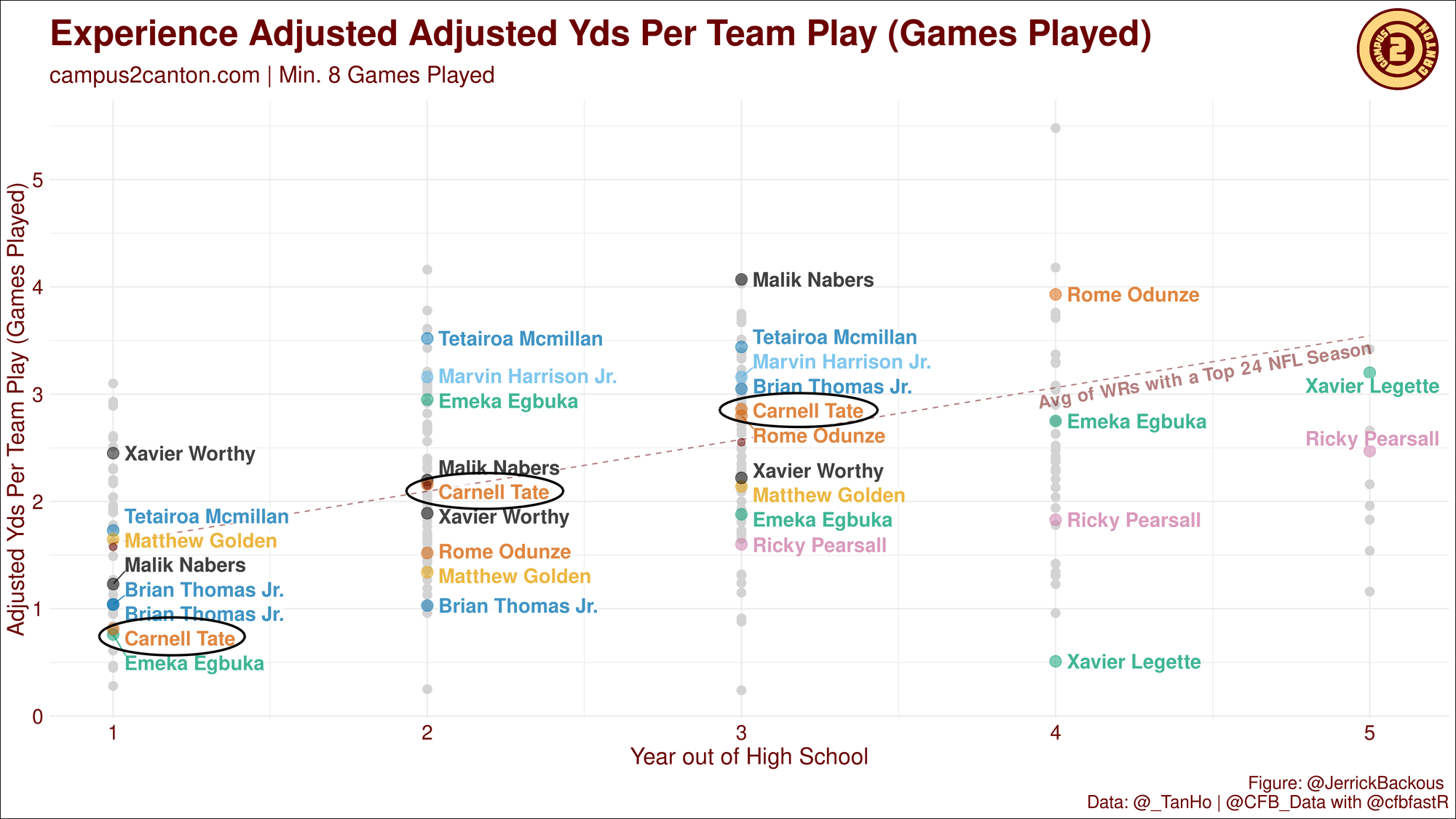
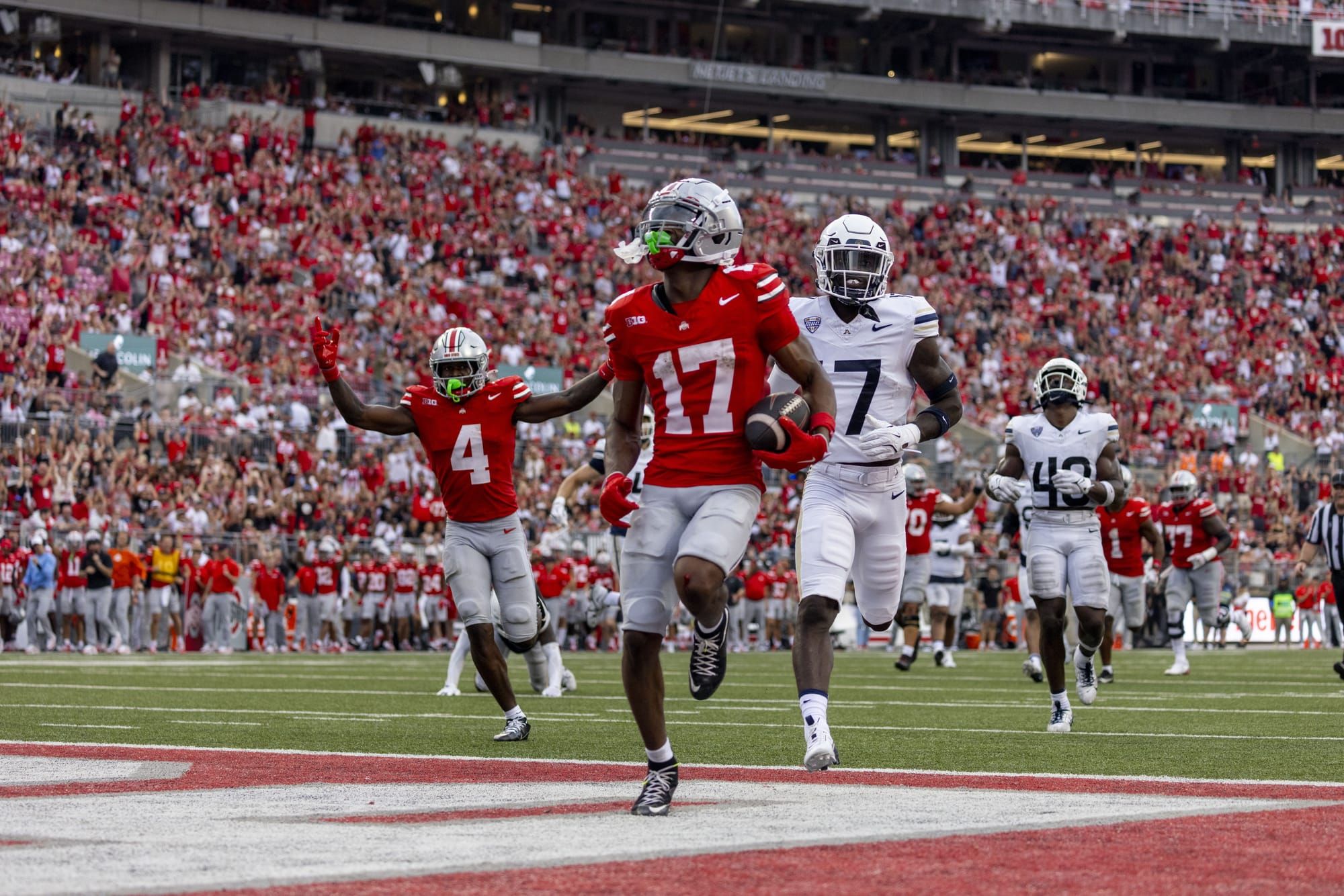
At Ohio State, Tate dealt with a level of target competition that is hard to overstate. In 2023, Tate wasn't productive. But he was a true freshman on a team with junior-year Marvin Harrison Jr., who posted 3.44 YPRR, 3.22 YPTA, and a 45% dominator rating. Future 1st-round pick Emeka Egbuka, also a junior at the time, was held to just 2.01 YPRR, 1.66 YPTA, and a 20% dominator rating. Tate, an 18-year-old true freshman, had to wait his turn.
In 2024, Egbuka, now a senior, posted 2.51 YPRR, 2.22 YPTA, and a 26% dominator rating. This contributed to Tate's uninmpressive 15% dominator rating.
The bigger factor, though, was Jeremiah Smith. In 2024, as a true freshman, Jeremiah Smith turned in a 36% dominator rating with 3.15 YPRR, 2.89 YPTA, and a 36% dominator rating. Smith wasn't just ahead of Tate—he immediately established himself over Egbuka.
Smith didn't come out of nowhere. He was the No. 1 overall recruit in the nation in the 2024 class. He's listed at 6-foot-3, 225 pounds and has elite speed. In 2025, as a true sophomore, Smith posted a 37% dominator rating with 3.22 YPTA and 3.43 YPRR. Jeremiah Smith is, without hyperbole, on track to be one of the best WR prospects of all time.
Even in Carnell Tate's breakout 2025 season, he was a secondary option behind Smith, which could be considered a red flag. But given Smith's ultra-elite profile, I find it impressive that Tate broke out alongside him as an underclassman.
Tate also produced in a way that should translate to the NFL. He profiles as a very traditional NFL WR, who plays primarily outside, sometimes kicking into the slot, and earns both deep and intermediate targets.

Per PFF, Tate played about equally on the left and right when playing outside. For example, in 2025, he played 219 snaps out wide on the left of the formation and 225 on the right. He's versatile in that sense—not someone who only had one role. But he's also not someone who needs a specific role created for him. He'll fit right into a variety of NFL offenses in an important, high-value, high-snap-rate role.
Tate also produces downfield, which is an ability that teams generally prize in their outside WRs.
Over his three-year Ohio State career, Tate turned in 36% of his yards on 20+ yard targets. Among WRs projected to be drafted in the top 100, only Ted Hurst (47%), Chris Brazzell II (43%), and Makai Lemon (41%) are higher.
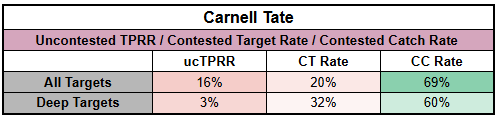
Tate's deep target profile is pretty exciting. He saw a low contested deep target rate and posted an impressive contested catch rate, both overall and on deep targets.
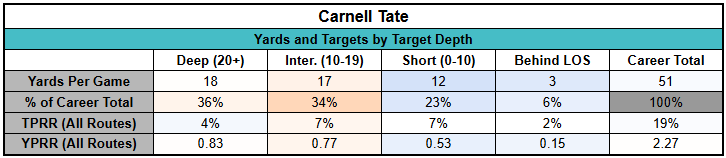
Crucially, Tate isn't just a deep threat. He averaged nearly as many yards per game on targets traveling 10-19 yards downfield as he did on deep targets. His most impressive target rate and YPRR numbers were on intermediate targets as well.
Tate's traditional skill set helps explain why he's expected to be drafted in the top 10 of the NFL draft... as does his route running.
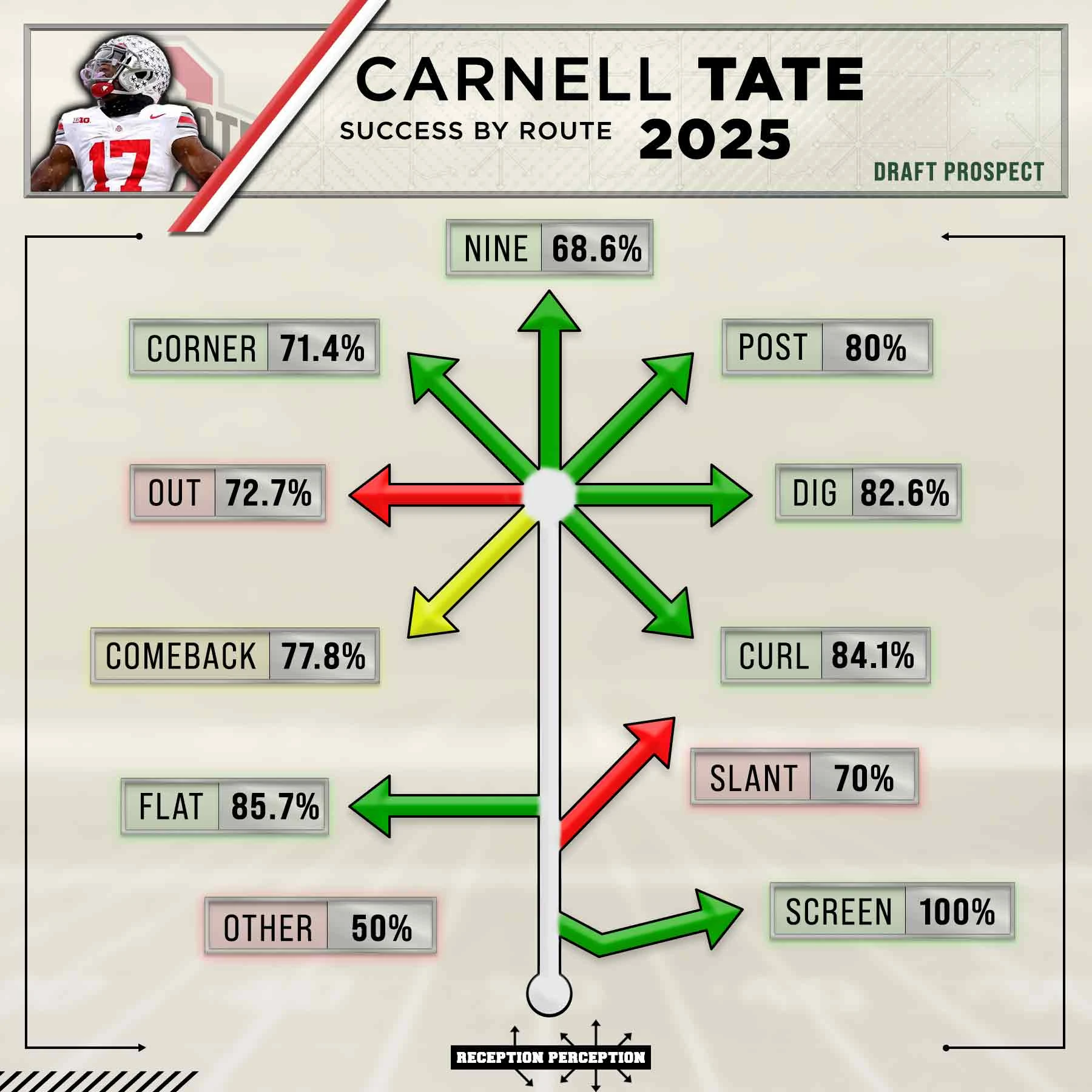
Per Matt Harmon, Tate's route running reinforces his vertical ability. He also shows the ability to use his deep-threat ability to create separation underneath, "reflected in his elite curl route success rate and solid mark on comebacks. That said, Tate can still win at a high level working over the middle on dig and post routes, so he’s not just some static outside option."
Red Flags
Tate profiles as a WR who can earn high-upside downfield targets. That's the good news. The bad news is that if Tate struggles to draw targets at a high rate, he's unlikely to make up for it with a ton of yards after the catch. Tate wasn't a zero as a YAC producer. But it's not a strength.

This creates some fantasy downside, risk that even as a quality NFL starter, some of Tate's value could be in helping to open up targets for other players rather than operating as a big-time yardage producer.
This red flag is elevated by Tate's career TPRR of 19%.
In his breakout 2025, Tate jumped to a 23% TPRR. He also saw a deep target on 6% of his total routes. Those numbers aren't bad, but were talking about peak season numbers for Tate that are less impressive than the career numbers from Jordyn Tyson (31%/7%) and Makai Lemon (28%/6%). If Tyson and Lemon are quality NFL starters, it's hard to see how that doesn't involve a healthy dose of targets. It's easier to project Tate bringing value to an NFL offense, but without stuffing the stat sheet.
Tate is also not a lock to actually be a quality NFL starter.
Tate was widely expected to run well at the Combine. Honestly, it seemed hard to believe that he wouldn't. Tate did not need to run; he was projected to go early in Round 1, whether he tested or not. His participation in the 40 looked, from the outside, like a flex. It was a flop.
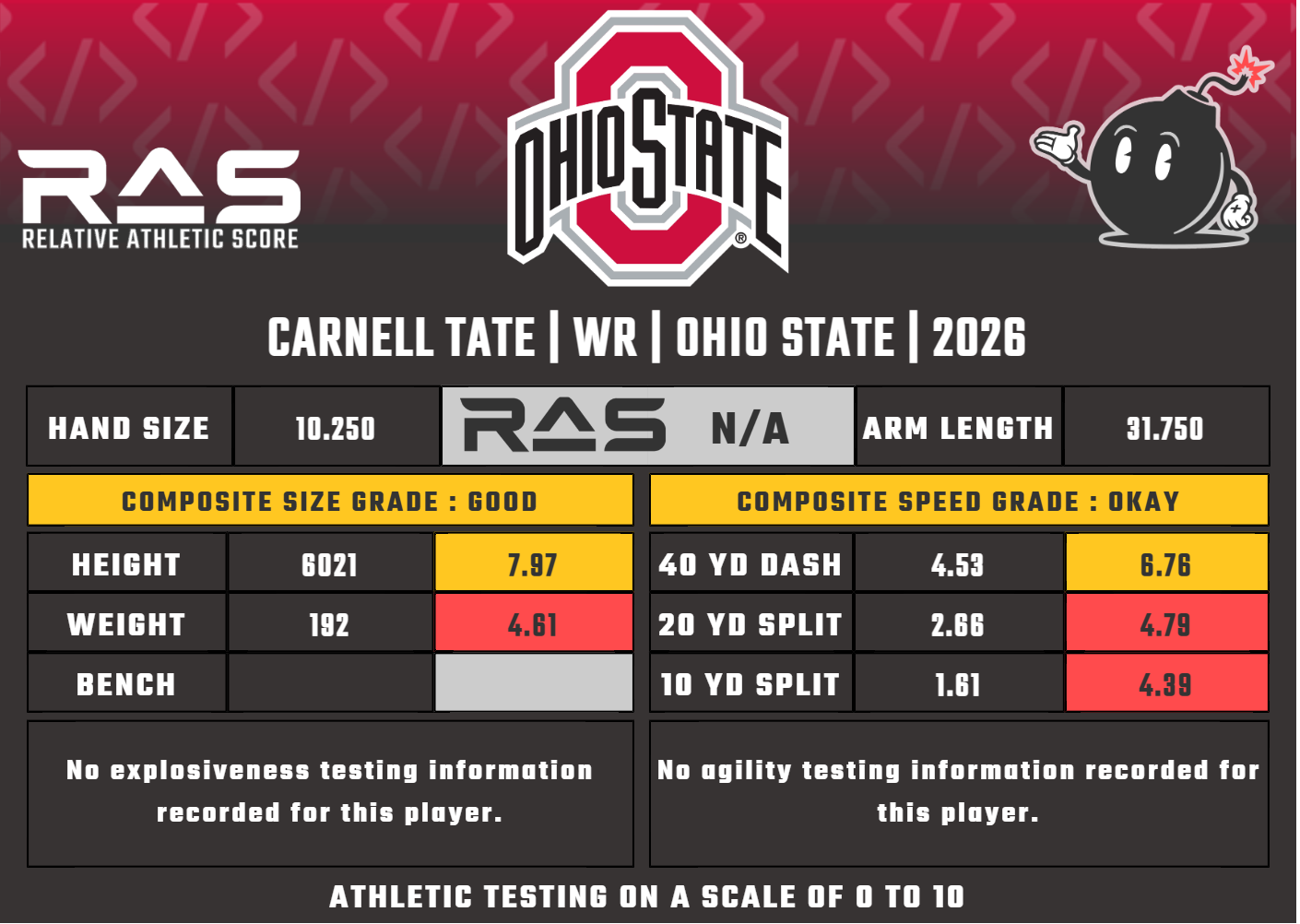
Tate's 4.53 40 and 1.61 10-yard split don't appear to have affected his draft capital, which is the main reason to care. Elite speed would have been nice, but if he still lands top-15 draft capital, as expected, without elite speed, that's actually a pretty bullish signal on scouts' evaluation of him as a traditional WR.
Still, it's possible that Tate's lack of high-end athleticism ends up being a limiting factor. It's also possible he slides further in the draft than expected.
Tate has additional risks as well. He only has one strong season of college production. And he achieved that as the No. 2 on his own team.
Tate was impressively efficient in that final season, but in the context of playing for an excellent team with strong QB play. His final-season efficiency may overstate his individual contribution.
Statistical Comps
- Garrett Wilson
- CeeDee Lamb
- Chris Olave
- Brian Thomas Jr.
Fantasy Outlook
Tate's top statistical comps, Garrett Wilson and CeeDee Lamb, highlight the upside that comes with a highly efficient true-junior breakout.
His next two comps, Chris Olave and Brian Thomas, strike me as more realistic, given his middling TPRR numbers.
Thomas, at 6-foot-3, 209 pounds, is considerably bigger than Tate. And with 4.33 speed, he's considerably faster. But even with an elite 9.83 RAS, Thomas fell to pick 23. Per Grinding the Mocks, Carnell Tate has the sixth-best draft capital projection in the 2026 class.
Draft capital matters. But draft history strongly supports the idea that highly athletic WRs are more likely to be overdrafted.
To be clear, I would be more excited about Tate if he were an elite athlete. He was already expected to go high. A blazing 40 would have mostly been a bonus. But as disappointing as his Combine was, we can at least take solace in the fact that his NFL draft capital will be driven by on-field factors more highly correlated to NFL success. In other words, Tate is going to be drafted very highly because the NFL likes the way he performed as a receiver, not because of Combine drills.
Tate's 4.53 40 also falls well short of where we'd actually be worried about his NFL upside. At the Combine, CeeDee Lamb posted a 4.50 40 at 198 pounds. At his Pro Day, Jaxon Smith-Njigba posted a 4.52 40 at 196 pounds. If Tate is actually a high-end route runner, as his Reception Perception profile suggests, then his timed speed (Cobmine 40 of 4.53 at 192 pounds) is not likely to get in the way.
But there is downside here. In my view, Tate is a pretty safe bet to secure a starting outside WR job in his rookie season and to hold that job for several years. But, in that role, it's possible he's far from special. Drafting Tate early in a rookie draft could feel similar to what it feels like to have drafted Marvin Harrison Jr. or Rome Odunze a couple of years ago—the feeling of spending Malik Nabers prices for Romeo Doubs-esque production.
I consider Tate very unlikely to quickly wash out of the league, but he could still fall well short of his draft day expectations.
On the other side of his range, though, Tate is more exciting than he's generally given credit for.
Tate is a classic outside WR who produced on intermediate and downfield targets due to impressive route-running chops. And despite elite target competition, he delivered high-end production and efficiency as a true junior. His profile isn't perfect... but he profiles as a natural and immediate fit in the NFL and, as a hit, profiles as a productive No. 1 option in an NFL offense.
Best Ball Recommendation
Tate has been a clear target for me in the mid-late 5th and could move up from there.
Superflex Rookie Draft Grade
Early 1st round.
Tier 2 - High-End Target Upside
Makai Lemon
At a Glance
Lemon didn't fully establish himself at USC until his junior season. But considering that he posted 3.03 YPRR as a true sophomore, that's arguably on his coaches for not realizing what they had. Lemon offers consistent short-area target earning and is a better deep threat than you may realize. In the right situation, he could be a PPR star.
Positive Indicators
Makai Lemon turned in a breakout season in 2025, posting a 79/1,156/11 receiving line for a 32% yardage share, a 44% TD share, and a 38% dominator rating. It was a very impressive season for a 21-year-old true junior. (Lemon turns 22 in June).
And despite just an 18% dominator rating in 2024, he was solidly efficient, with 1.75 YPTA and 3.03 YPRR.
Lemon's per-route efficiency in 2024 was a strong sign that he was underutilized in his sophomore season as part of a crowded WR corps that included Zachariah Branch and Jakobi Lane. Lemon averaged just 21 routes per game over 12 games.
In 2025, Branch transferred to Georgia, and Lemon spiked to 31 routes per game. He was even more efficient on a per-route basis, with 3.13 YPRR. And his YPTA jumped to 2.96.
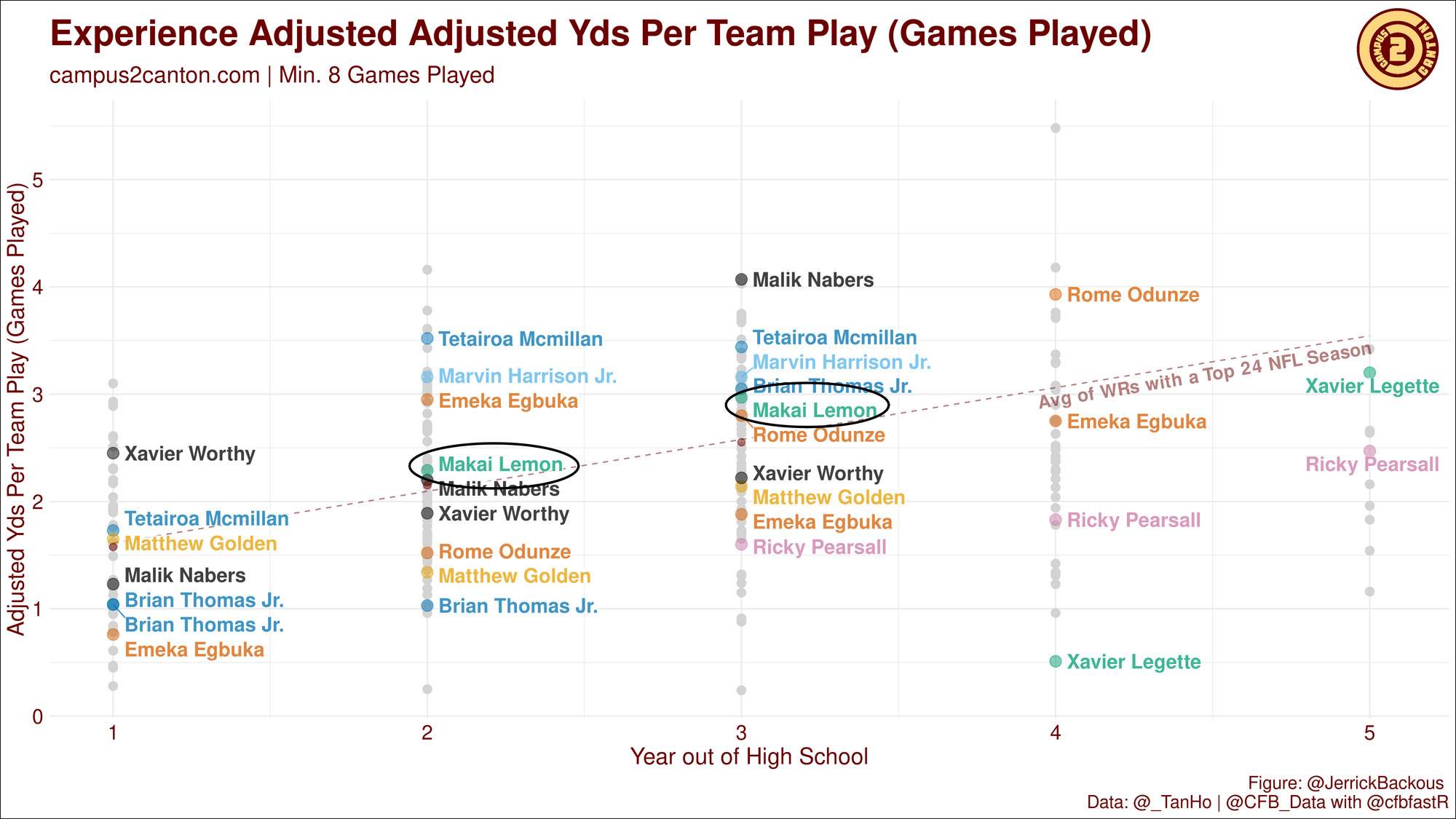
Lemon's junior year efficiency helped him generate a career YPRR of 3.02, which is easily the best among 2026's early declare prospects. Carnell Tate, at just 2.27 YPRR, is second-best.
Lemon's efficiency tells a very bullish story. He was efficient on somewhat limited opportunities, which earned him a bigger role. He was then even more efficient once installed as USC's true No. 1 option.
With a 28% career TPRR, Lemon profiles as a fantasy-friendly bet. If he works out in the NFL, he's very likely to earn his living by earning targets. He's not a field-stretching outside WR who opens up the offense for other WRs; he's on the field to catch the ball.
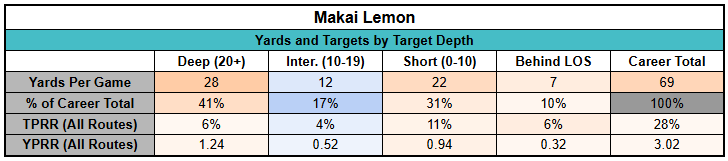
Even better, Lemon wasn't a scammy underneath producer at USC. In college, Lemon was both a consistent target earner and a strong deep threat.
And Lemon's deep ability wasn't a small part of his college game; it was his primary area of production.
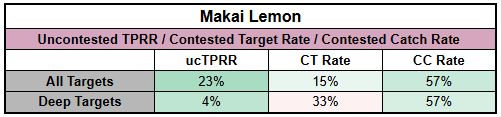
Lemon also showed strong contested catch ability on both deep targets as well as overall. At USC, he was able to earn targets at a variety of depths, while also stepping up in contested catch situations as needed.
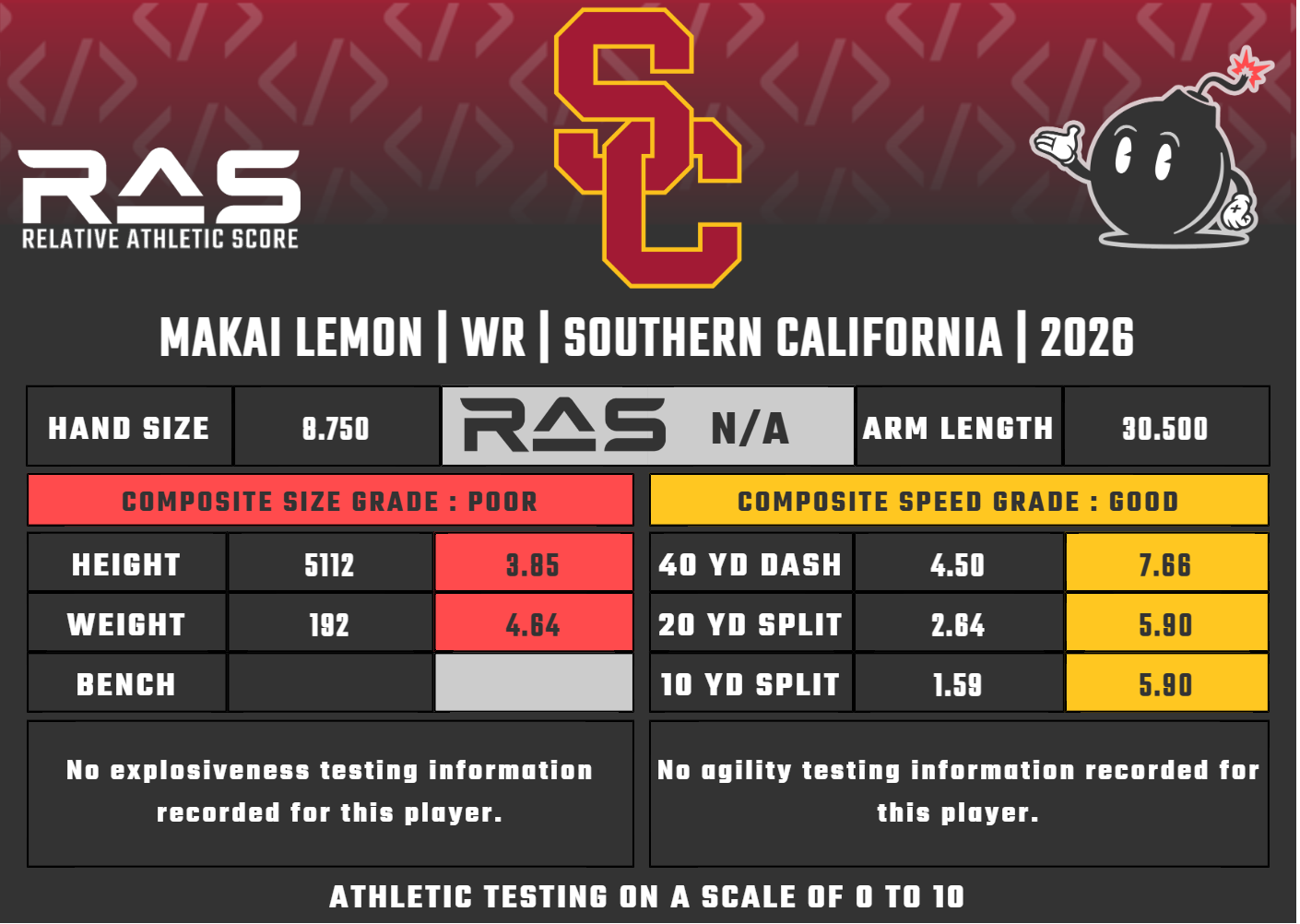
At 5-foot-11, 192 pounds, Lemon is unlikely to be a big-time contested catch winner at the NFL level. But it's still nice to see that he's willing and able to fight for the ball. More importantly, separation doesn't look like it will be a problem.
Lemon's was also a strong target earner in the short area of the field, which is his more realistic path to fantasy value—it's easy to imagine him in an Amon-Ra St. Brown style role. But, sometimes, that type of player gets characterized as being a low upside bet. Lemon's deep ball production undercuts that concern, as does his very strong college production at a young age. I doubt that deep targets will be his bread and butter at the next level, but Lemon can challenge at multiple levels at the very least.
And while, at 5-foot-11, Lemon doesn't have the height of a traditional NFL deep threat, at 192 pounds, he weighs the same as Carnell Tate. Depending on which hand-timed Pro Day 40 number you go with, he might be faster. Regardless, Lemon should have sufficient speed to beat NFL corners when combined with strong route-running ability.
Per Matt Harmon, Lemon is a very impressive route runner on a variety of routes, and profiles as especially effective against zone coverage.
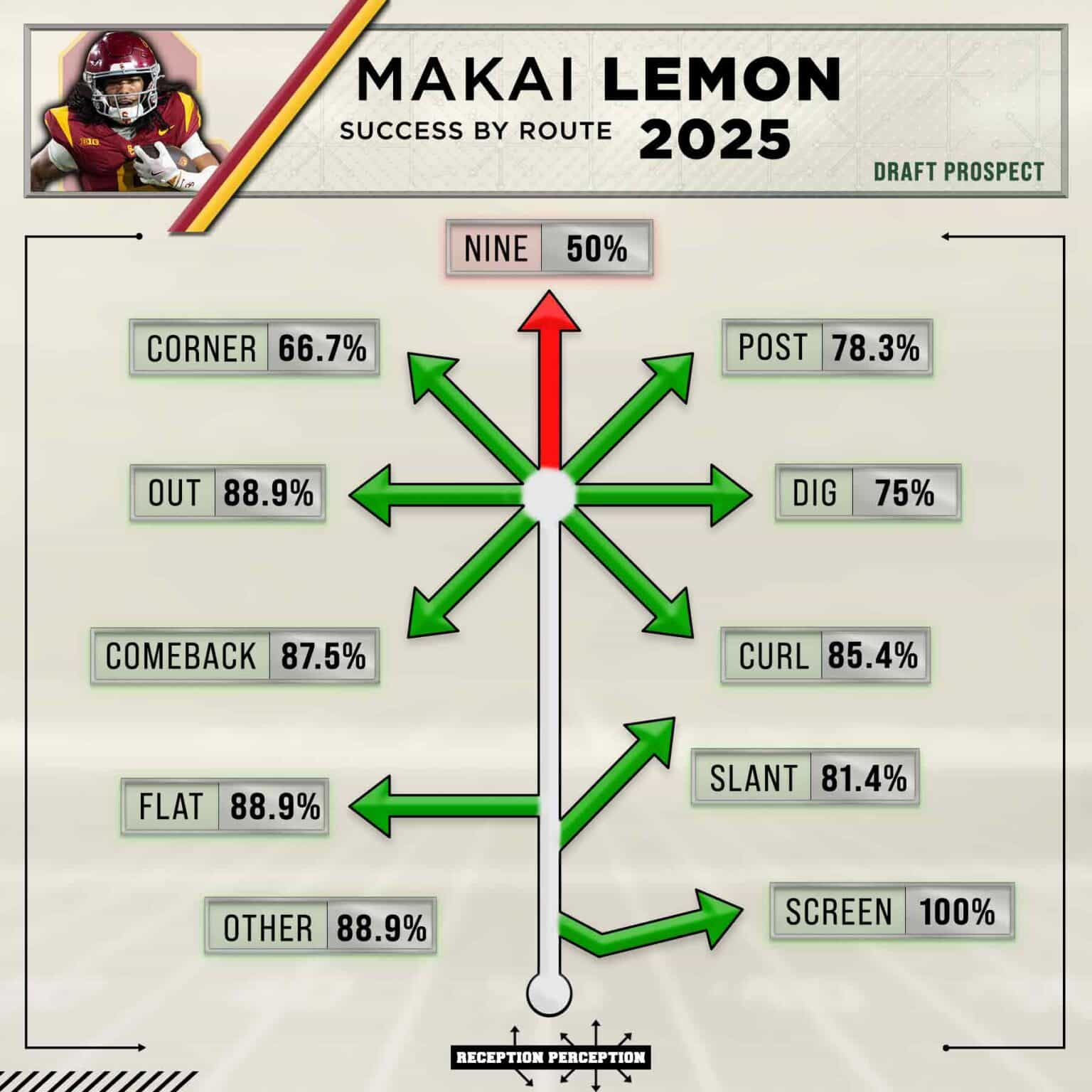
Lemon looks capable of hitting the ground running as a target-earning zone beater, which could yield instant NFL production.
And Lemon's efficiency at USC wasn't just a product of his ability to earn targets; he also generated yards after the catch. In 2025, he finished WR12 in the FBS with 42 YAC per game.

Lemon's upside is definitely magnified by PPR scoring, but he also has plenty of potential for real-life playmaking that can eventually make him the centerpiece of an NFL passing game. And with an expected draft position of 13.5, per Grinding the Mocks, Lemon's ascension could be a quick one.
Red Flags
Lemon played primarily from the slot at USC, which makes some of his deep production a bit suspect. There are examples of NFL WRs who can threaten deep from the slot. But, by and large, the seam-stretching slot WR is a college-level archetype. And with multiple tight end sets currently in vogue, things look to be swinging away from NFL slot WRs rather than toward them... at least for now.

Lemon's unimpressive intermediate-area production is also a bit worrying. In the NFL, No. 1 WRs tend to operate on the outside and dominate in the intermediate area. That doesn't look like Lemon's game on either count.
Lemon is also a bit of a one-year wonder. To be fair, he was impressively efficient in 2024, with 3.03 YPRR. However, he turned in just a 52/764/3 receiving line in 11 games, posting just a 24% yardage share, 13% TD share, and 18% dominator rating. His career marks in yardage share (25%) and dominator rating (24%) aren't bad, but Lemon's profile is primarily a bet on his dominant 2025 season, rather than on his USC production as a whole.
Statistical Comps
- Jaxon Smith-Njigba
- Jerry Jeudy
- Garrett Wilson
- D.J. Moore