Mike Washington, So Hot Right Now. 2026 Rookie RBs—Tiers 3-6

In Part 1 of my RB previews, I covered Jeremiyah Love and Jadarian Price.
I'll now be diving deeper into a class that... doesn't have much depth, but could still offer some diamonds in the rough.
These are flawed prospects, both in terms of the stats and where we can expect them to go in the NFL draft. And while acknowledging that lack of depth isn't super fun, it should help you from overpaying for RBs who could get pushed up after the draft due to good landing spots.
And even though this RB class doesn't have many high-confidence bets, it does have a handful of intruging dart throw profiles. Understanding these dart throw level profiles could also help uncover the next undervalued Day 3 gem at fantasy's most chaotic position.
Tier 3 - Wild Cards
Jonah Coleman
At a Glance
Coleman is a big back who breaks tackles and catches the ball. With sufficient athleticism and draft capital, that can be a very fantasy-friendly profile. Unfortunately, it's not certain that Coleman will clear those athleticism and draft capital hurdles.
Positive Indicators
Jonah Coleman began his career at Arizona. In both seasons there, he operated as a secondary running back. Coleman popped as a tackle breaker, but in a small sample.
However, in his final two seasons (both at Washington), Coleman posted backfield dominator ratings of 73% and 80%. Those big workloads helped him reach the 59th percentile in elusiveness per game. Coleman was even more impressive from a per-touch perspective. His career elusive rating of 129 ranks 92nd percentile.
Even as a committee back at Arizona, Coleman was productive. In 2023, he averaged 89 yards from scrimmage and totaled 6 TDs in 13 games. Then, in 25 games at Washington, he scored 27 TDs and averaged 94 yards from scrimmage.
With a career YPRR of 1.21 (65th percentile), Coleman was also an efficient receiver. And he saw solid pass game usage, with 14 routes per game.
Coleman didn't work out at the Combine, but he measured in at 5-foot-8 and 220 pounds. He's built low to the ground and should be hard for NFL defenders to bring down.
With tackle-breaking, receiving versatility, and size, Coleman has a fantasy-friendly profile if he can earn a starting role at the NFL level.
Red Flags
Coleman's lack of a Combine workout qualifies as a red flag. This is a player who was not expected to work out especially well—we were just looking for him to be sufficiently athletic. Something like what Cam Skattebo did last year would have been perfectly acceptable.
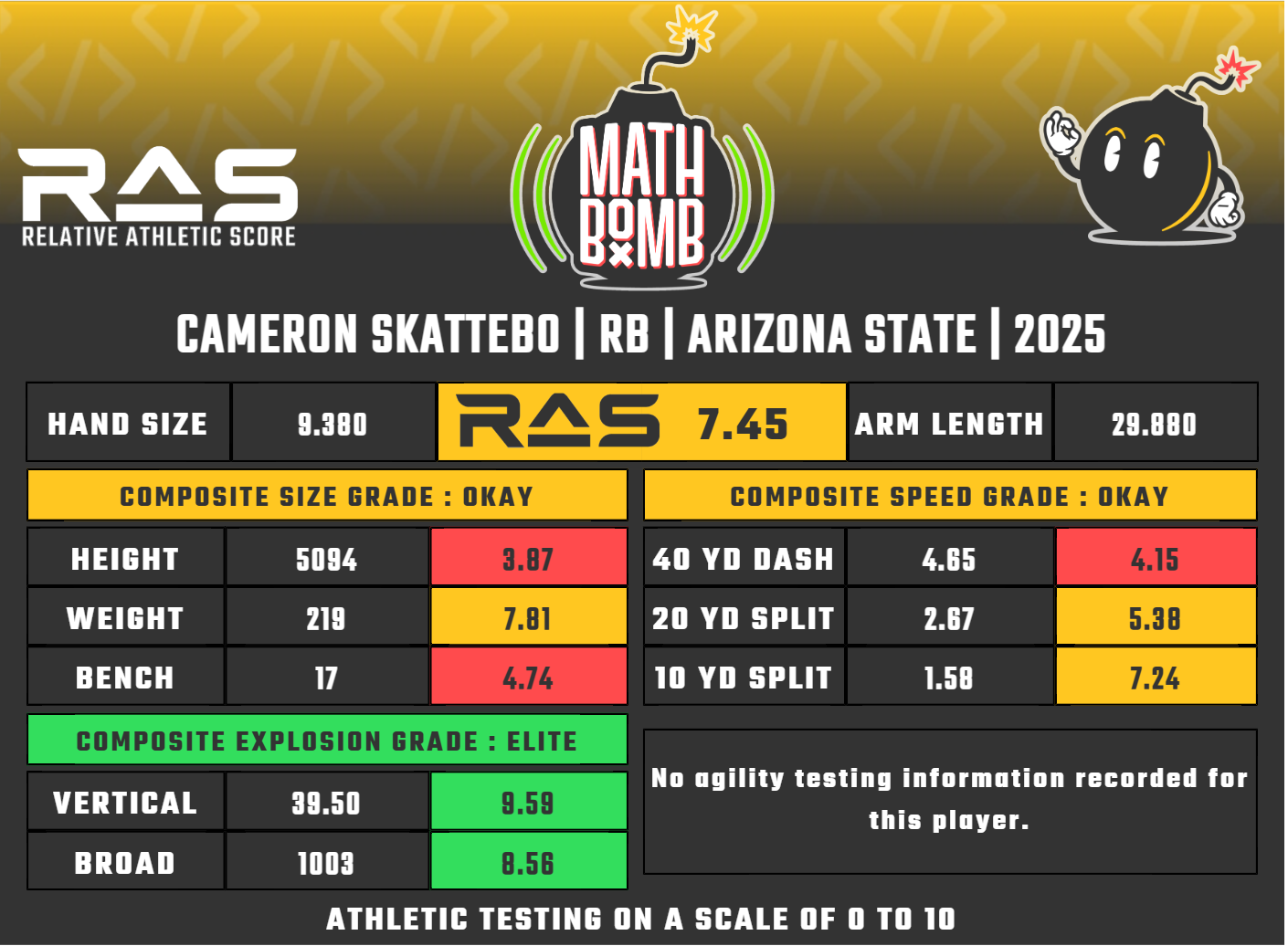
Skattebo fell to the early 4th round in last year's exceptionally deep RB class. In this year's thin class, though, Skattebo would very likely have been a Day 2 pick... even with a 4.65 40.
In other words, Coleman had a fairly low bar for what he needed to clear at the Combine. If he had posted numbers worse than, but in the same ballpark as Skattebo—something like a 120-inch broad jump, a 35-inch vertical, and a 4.66 40—his odds for Day 2 capital would likely have improved. The fact that he opted out underlines existing concerns about his athleticism... and not just for me—NFL teams will have questions as well.
At his March 16th Pro Day, Coleman had another chance to allay fears about his athleticism—and on his home turf. Yet he once again opted not to test, doing only position drills.
At this point, I have strong doubts that Coleman is a sub-4.7 runner. If he were... he likely would have run at his pro day. Because it's not like Coleman's tape put speed concerns to rest. Coleman's (lack of) long speed pops as a red flag on tape (even for a highlight scout like me). It's evident in his production metrics as well.
Coleman posted just a 38% breakaway percentage in college (38th percentile), in line with players like Zack Moss (39%), Cam Akers (38%), Audric Estime (38%), and Zach Charbonnet (37%). And with just 23 breakaway yards per game (31st percentile), Coleman had a worse breakaway profile than the backs above; he's closer to Najee Harris (24) and David Montgomery (24) from that lens. Coleman brings the thunder as a tackle-breaker, but no lightning.
Coleman also posted just a 44% success rate, which is only in the 44th percentile and a concerning mark for a bruiser. This separates him from someone like Cam Skattebo, who had a 98th percentile success rate. In college, Skattebo was an even worse bet to break off long runs than Coleman, but he was ultra-reliable in high-leverage situations. Coleman wasn't a disaster there... but it wasn't a strength. From this lens, Coleman looks more like Quinshon Judkins (36th percentile in success rate) from last year's class. Judkins went on to post a very weak 33% success rate as a rookie... but still turned in 69 rush yards over expected by offering breakaway potential. The downside for Coleman is a similar type of rushing profile to Judkins... but without the explosive plays.
Statistical Comps
- Zack Moss
- Audric Estime
- Blake Corum
- Ray Davis
- Bucky Irving
- Cameron Skattebo
Fantasy Outlook
Even as a Day 2 pick, Coleman would profile as a solid depth piece in most rookie classes—someone outside the top 12 prospects in the class, but offering rookie draft upside early in Round 2.
Early on in the process, Coleman looked like he would cost considerably more than that, potentially requiring a selection in the mid-late 1st round of Superflex rookie drafts.
The good news is that Coleman is likely to be cheaper than that now. He's looking more likely to be a 2nd round rookie pick.
Unfortunately, this price drop is directly related to a pre-draft process that has been seriously concerning. Once thought to be solidly in the Day 2 mix, Coleman now looks likely to fall to Day 3.
Coleman has been falling on the consensus board and is ranked well outside the top 100 by Scouts Inc.
If Coleman does fall to Round 4+, we have to contend with the fact that Coleman fell to Day 3 in a very thin RB class. Last year, I was arguing that Cam Skattebo and Bhayshul Tuten's early 4th-round capital was probably more akin to a mid-3rd-round investment in most seasons. The 2025 RB class was that deep. This year... the RB class is not deep at all. If teams let Coleman slip to Day 3 anyway, that's pretty telling.
Coleman's shaky draft capital projection has forced me to reconsider him as a fantasy bet. A month ago, I would have told you that Coleman and Jadarian Price were in the same tier. At the time, both were looking like mid-late Day 2 picks. But it's becoming clear that Price has the potential to walk into a starting role as a Round 2 pick. Coleman could be fighting for work as a Day 3 dart throw.
I no longer think Coleman is in the same tier as Price. But I still have him tiered as a premium dart throw—he's an intriguing player who has enough talent to be very fun if things break his way. And if I'm wrong about his draft capital, if he still goes Day 2, he could potentially end up very close to Price in my post-draft rookie rankings.
Ultimately, Coleman is not an especially exciting prospect, not someone I want to pay a ton for. But he's a big tackle breaker who can catch passes and handle a lot of touches. And at his current price, he can pay off even as a contingent/committee back, which many of his comps ultimately are/were.
If you really want to dream, even as an early Day 3 pick, he profiles a little bit like a bigger Bucky Irving.
Best Ball Recommendation
Coleman looked like a clear target in the early double-digit rounds when Day 2 looked more realistic. He's still a viable pick on RB-needy teams, but I'm only targeting him in Round 12+.
Superflex Rookie Draft Grade
Early 2nd - Early 3rd (Depending on draft capital).
Mike Washington
At a Glance
Washington is a bet on athleticism over on-field production. But he's such a strong athlete that the bet might actually pay off. Critically, it looks increasingly plausible that an NFL team will wager a Round 2 pick on him.
Positive Indicators
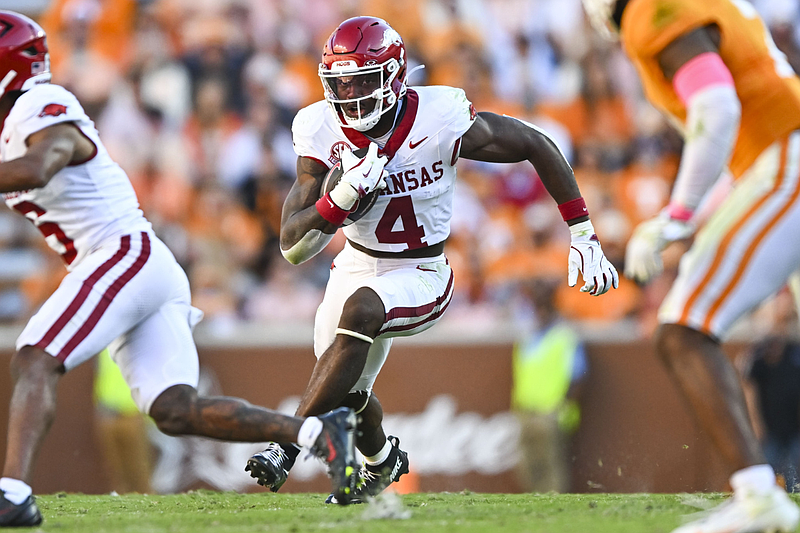
Mike Washington is coming off a productive final season at Arkansas. He rushed 167 times for 1,070 yards and eight TDs, adding 28 receptions for 226 yards and one TD. Washington dominated the Arkansas backfield, with an 80% backfield dominator rating.
Washington then weighed in at the Combine at 6-foot-1, 223, and posted a perfect 10 RAS.
Washington stood on his elite Combine workout at his Pro Day, but opted to do the agility drills. He now "only" has a 9.87 RAS.
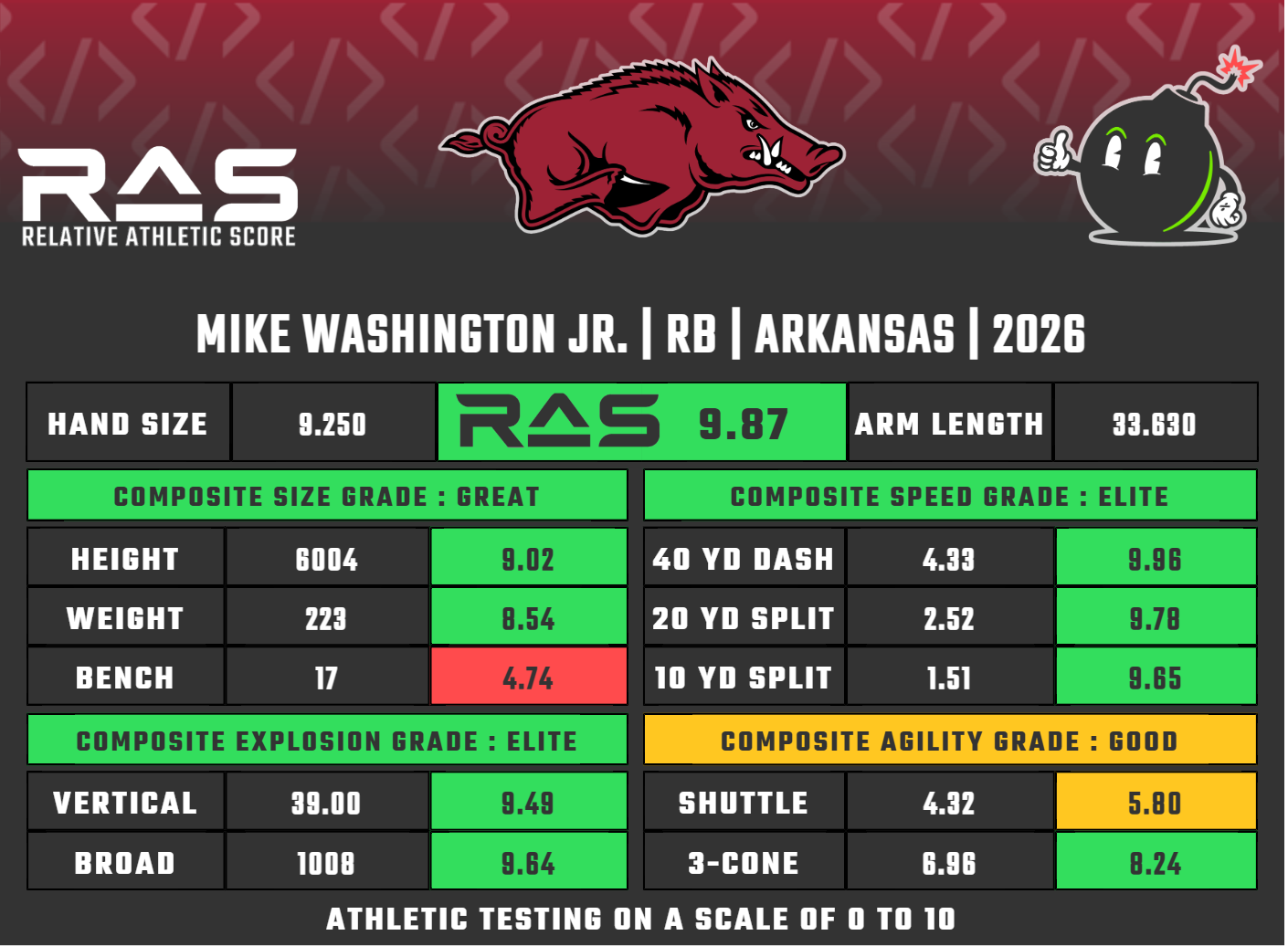
As we'll get to, Washington's profile boils down to "big guy, runs fast." But... he's a big guy. And he runs fast.
Red Flags
Before Washington's 2025 season at Arkansas, he spent three seasons at Buffalo and another year at New Mexico State. He peaked with just 713 rushing yards, despite logging three seasons of 11+ games. He also failed to hit 100+ receiving yards in any of those seasons.
Before Arkansas, Washington was a committee back, peaking with just a 52% backfield dominator rating. It's nice that he personified the Arkansas backfield in his final season, but that doesn't reflect his career as a whole.
And from a career perspective, Washington's advanced rushing and receiving metrics are rough.
Washington might have elite speed, but he wasn't a breakaway runner. His 36% breakaway percentage is in just the 26th percentile, and he finished just 22nd percentile in breakaway yards per game.
And while Washington might have elite burst, he doesn't look like much of a tackle breaker or like a consistent chunk-play runner. He finished just 12th percentile in elusive rating, 23rd percentile in elusiveness per game, 21st percentile in success rate, and 29th percentile in successful runs per game.
In the receiving game, Washington also failed to impress, with a 0.77 YPRR that ranks in the 21st percentile.
Statistical Comps
- La'Mical Perine
- Kalen Ballage
- Roschon Johnson
- Jeremy Langford
- Matt Jones
- Cam Akers
Fantasy Outlook
Before the Combine, Washington was expected to test well, but I was skeptical he'd test well enough to counteract his otherwise weak profile.
But Washington didn't just test well... he tested insanely well. He tested at a level that is very likely to impact his NFL draft capital. Previously, Washington profiled as a Day 3 back. Now, I wouldn't be surprised if he's the second running back selected after Jeremiyah Love. He's not just live for Day 2, he's live for Round 2.
That kind of draft stock increase has a big impact on a player's fantasy outlook. Sure, even as a starter, I expect Washington to be disappointing. But we're now talking about a player who is much more likely to earn a starting role in the first place, relative to where things stood a month ago.
There's also the fact that some running backs end up being better as pros than they were in college. Isiah Pacheco had an extremely weak college profile and, ultimately, a fairly short window of NFL production. But, as long as you got him cheaply, Pacheco was still a huge win as a bet on athleticism and opportunity.
After the Combine, Washington's price has risen dramatically. The days of truly getting him cheaply are over. However, it's possible he rises even more significantly from now until the end of the summer. Imagine if he's selected by the Seahawks at Pick 64—which is not exactly implausible for a player currently at 67 on the consensus big board. If that happens, good luck getting Washington anywhere near his current 12th-round price.
On the other hand, Washington—a very athletic person who doesn't appear to be particularly good at football—already costs enough that it's hard to justify loading up on him in the hopes that he hits the landing spot jackpot. Because, even as a Round 3 pick with reasonably weak depth chart competition—say the Titans, Texans, or Steelers—a Kaleb Johnson-esque redshirt rookie season is very much on the table.
In dynasty, I have a hard time imagining the combination of events that would lead to me being overweight on Washington after the draft. If Washington goes Round 2 to an open depth chart, sure, I'll move him up. But I won't be ranking him over Love (obviously), the top 3 WRs, or Mendoza. I'll probably have a really tough time even getting him ahead of Concepcion or Sadiq. And I'm pretty sure, as the presumed starter in Seattle, someone in my rookie drafts will be taking him before the 1.08.
If Washington doesn't go on Day 2, I will view that pretty negatively. The bet here is the combination of athleticism and draft capital. If Washington's near-perfect RAS can't get him Day 2 draft capital, that would tell us a lot about the NFL's talent evaluation of him as an actual RB.
Perhaps if Washington goes Round 3 to a somewhat murky situation, I'll be in at a more reasonable cost. But, even then, given his athleticism, I'm guessing most will be higher than me.
In best ball (compared dynasty, at least), I'm more likely to shift to a bullish stance on a positive draft day outcome. Washington is the type of player who should literally hit the ground running in an NFL offense as a two-down superathlete. If he can play, we should see it quickly.
Best Ball Recommendation
Washington is a solid pick from a closing line value standpoint, and a viable production-based bet on RB-needy teams. But I'm not treating him as a target after his ADP rise.
Given Washington's weak statistical profile, I'd prefer to know for sure that he comes with high-end NFL investment and a clear path to playing time. Post-draft—with a good landing spot and draft capital—I'm willing to get more bullish.
Superflex Rookie Draft Grade
Late 2nd - Early 3rd.
Nicholas Singleton
At a Glance
Singleton has a number of very intriguing elements to his profile, but also comes with genuinely concerning red flags. Singleton looks most likely to be an NFL committee back, but has three-down potential if he can carve out a big enough rushing role.
Positive Indicators
Singleton joined Penn State in 2022 and immediately turned in a 1,000-yard rushing campaign, turning 155 carries into 1,052 yards and 12 TDs in 13 games. He was quiet as a receiver, with just an 11/85/1 receiving line. But it was still a very nice season from a true freshman.
In his sophomore campaign, Singleton turned in another 1,000+ yards from scrimmage. This time, he rushed for only 752 yards and eight TDs on 171 carries. He picked up the slack as a receiving threat with a 26/308/2 receiving line in 13 games.
In 2024, Singleton returned to strong rushing production with 172 carries for 1,099 yards and 12 TDs, adding a 41/375/5 receiving line in 15 games played for an excellent Penn State team.
We'll talk about the rest of his largely disappointing senior season later... but in 2025, there were some bright spots. Singleton rushed for a career-high 13 TDs and posted another solid receiving line, going 24/219/1 in 12 games.
Overall, at Penn State, Singleton profiled as an exciting runner with receiving versatility. And he was a difference-maker in college at just 18 years old.
From a career perspective, Singleton also pops a bit as a receiver. He finished with 1.39 YPRR (74th percentile) on a solid 13 routes per game.
Singleton's receiving ability is his most exciting trait, but he's far from a satellite back. He weighed in at 6-foot, 219 at the Combine. He has traditional lead-back size and offers a PPR-friendly profile if he can secure a starting job.
As we'll get to, Singleton has some usage red flags. Given that, it's encouraging to see that he returned 48 kicks in 53 career games, averaging 23.7 yards per return and scoring one TD. Penn State was clearly interested in getting the ball in Singleton's hands in a variety of ways, and he rewarded that usage with a well-rounded efficiency profile.
Red Flags
Singleton opted to return to school in 2025 rather than enter a crowded 2024 RB draft. To be fair, he was likely factoring in the potential of another Penn State playoff run. Unfortunately, the 2025 Penn State season imploded, with Drew Allar breaking his ankle and playing in just six games. Penn State finished just 7-6, and Singleton finished with just 549 rushing yards on 123 carries. He did at least rush for 13 TDs in those 12 games.
But it wasn't just that Singleton was inefficient on his 2025 carries—he was not Penn State's lead runner.
In 2024, Singleton formed a committee with Kaytron Allen. Allen averaged 14.9 touches per game, with Singleton at 14.2. But even while seeing slightly less work, Singleton was significantly more productive, averaging 98 scrimmage yards per game and totaling 17 TDs. Allen averaged 79 scrimmage yards and totaled 10 TDs.
In 2025, things changed. Singleton dropped to just 12.3 touches per game. And he averaged just 64 yards from scrimmage. Meanwhile, Allen jumped to 19 touches and 114 yards from scrimmage per game.
Even with 14 total TDs, Singleton was outpaced by Allen, who totaled 15 TDs (all on the ground) in his final season.
Singleton's final season dropoff is especially concerning in light of his underwhelming rushing peripherals.
Over his 4-year career, Singleton finished 49th percentile in success rate, 45th percentile in breakaway percentage, and 20th percentile in elusive rating. His per-game metrics are similarly underwhelming: 44th percentile in successful runs per game, 41st percentile in breakaway yards per game, and 29th percentile in elusiveness per game. Singleton's standout rushing trait is a negative—he doesn't really break tackles. Otherwise, he doesn't really pop as a runner either way.
Heading into the offseason, Singleton was expected to raise his stock with strong athletic testing. Unfortunately, he broke his foot at the Senior Bowl. We won't see him run in the offseason, and teams will have to evaluate him at less than full health, muddying his draft picture.
Statistical Comps
- La'Mical Perine
- Dameon Pierce
- Israel Abanikanda
- Jay Ajayi
- Damien Harris
- Zach Charbonnet