Quick Slant: Christmas, pt. 1 - How Major Tuddy Stole Christmas

Mat Irby’s Quick Slant
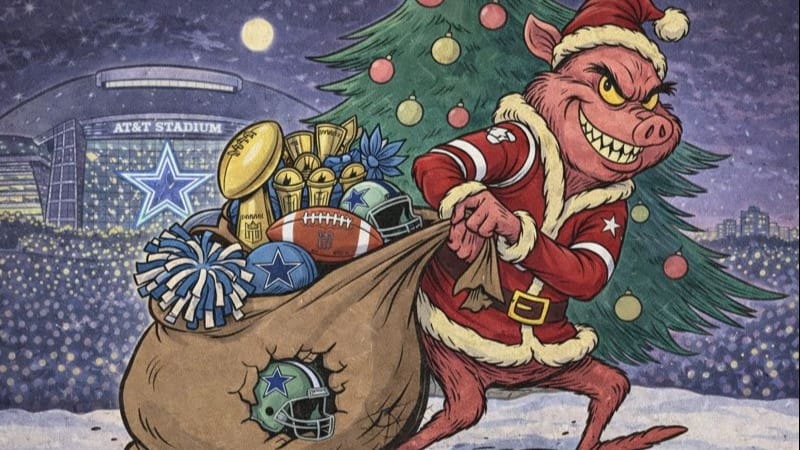
Every fan down in Big D liked the Cowboys a lot, but Major Tuddy, who lived just north of Rockville, did NOT! The Hog hated Dallas, the whole football season. Now, please don’t ask why; no one quite knows the reason. It could be his helmet wasn’t screwed on just right. It could be, perhaps, that his cleats were too tight. But I think that the most likely reason of all may have been that his heart was two sizes too small.
Whatever the reason, his heart or his cleats, he stood there on Christmas, hating fans in blue seats, frowning down from the beltway, a sour, hoggy frown at the shiny glass palace below in their town. For he knew every fan there in star logo sheets slept while VCRs played ‘93 on repeat. “And they’re polishing trophies!” he snarled with a sneer. “Bloviating already: ‘Next year is our year!’” Then, with ham-handed tapping, gave a slop-hearted jeer, “Since losing won't stop them, I'll take things they hold dear!”
He took eighty-one south with a grin full of spite, I-forty to thirty, till the lights grew real bright. The night held its breath; every shadow was oozing as he crept to this shiny museum of losing. He snuck past the gates with a sausage-fat grin, and it wouldn’t cost him half a G to get in. “Ho, ho, ho,” laughed the Hog, “this place worships the past. Let’s see how they cheer when the past doesn’t last.”
First, he walked the high catwalks up to the rafters, took Super Bowl banners, and division ones after. From the cheer-locker hall, stole white go-go boots, blue pom-poms, short jackets, and bright Daisy Dukes. Then he shattered the cases; it made quite a racket. He decided to start with Troy Aikman’s gold jacket. He scooped up Coach Landry’s fedora and tie, Smith’s MVP, White’s DPOY. He snatched five Lombardis, all shiny and smug, which were tossed in a sack by the snorting pink thug.
He went to the gift shop and tore through the racks, took 88, 4, and a Romo throwback. Mini-helmets and keychains and Mitchell and Nesses, koozies and jackets and toddler-sized dresses. Then on to concessions, he took cotton candy, hot dogs and burgers, fine cognac and brandy. Cash wraps and kicking tees, signs on the fenceposts, paint for the hashmarks, and the flags on goal posts. Turnstiles and stanchions, velvet rope colored scarlet, and even some art that was commissioned by Charlotte. He packed it all up into one bulging sack, then slung it with pride on his broad, hoggy back.
But he stopped, and he smirked, and he gave a low sneer. "That screen is too big for one pig; that is clear! And besides," laughed the Hog, with a twitch of his snout, "if I take it, what else would they bluster about? I’ll leave it right there, like a great HD curse, so they’re forced to watch every play getting worse! Let them watch their own hope as it starts to decoil,” then the Tud walked away, clutching tight to his spoils.
On toward the beltway he hauled it with glee, every banner and bauble and trophy and key. “Now wake up,” he snickered, “and see what you’ve got when Christmas is here and your history’s not!”
But back in Big D, as the morning bells rang, up from their blue-and-white sheets the fans sprang. They looked in the cases. They looked at the walls. They looked all around and saw nothing at all. No trophies, no banners, no names on the wall, not even the warmer that warms up the balls. Not turnstiles or stanchions, velvet ropes colored scarlet, not even the art that was commissioned by Charlotte. Then, they remembered the stories that the things represented. They recalled their memories, which had been cemented. “We don’t need the trophies to remember all five, our memories act as a mighty archive.” (To which Cindy-Lou said, she wasn’t alive).
And they all laughed together, not angry or pained, then went on making snacks to enjoy for the game. They went on making breakfast, not one of them shaken, they made pancakes and hash browns and two strips of bacon. They hoped. They complained. They argued the same. They said, “This is dumb, but we love this dumb game.”
And high on the roadway, the Hog felt a twitch, a faint little thump, a slight little itch. What happened then? Well, in Dallas, they say that Tuddy’s small heart grew three sizes that day. And he thought of a problem that made his grin fade, a thought got attention that hadn’t been paid. “If their pride is wrong, then mine’s just indecent; for how long it's been, theirs is four years more recent. Maybe football is for more than awards and parades. Maybe sometimes football is... just... for today?”
Then Tud did a U-ey and sped back toward Dallas, right back down I-thirty, right back to that palace. He rehung the banners, returned Landry’s suit, the pylons, the hot dogs, the white go-go boots. The jerseys, the kicking tees, ropes colored scarlet, and even the art that was commissioned by Charlotte. And then, just before he slunk back out of sight, he paused by the tunnel in soft Christmas light. Then he paused on a thought that filled him with cheer. “Maybe,” Tud thought, “Next year is our year.”
Cowboys
Implied Team Total: 28.75
We’re officially here with the Cowboys. They are a mediocre team. For the longest time, their undeniably good offense held them up despite one of the worst defenses in recent memory, but even that hasn’t been quite as potent as it was earlier this season.
The Commanders are almost as bad on defense, but worse on offense, even at full strength. They won’t be at full strength this Christmas; they are down to their third-string QB, as is the case for one team in each of the three games.
Both teams are below average according to Pythagorean expected wins.
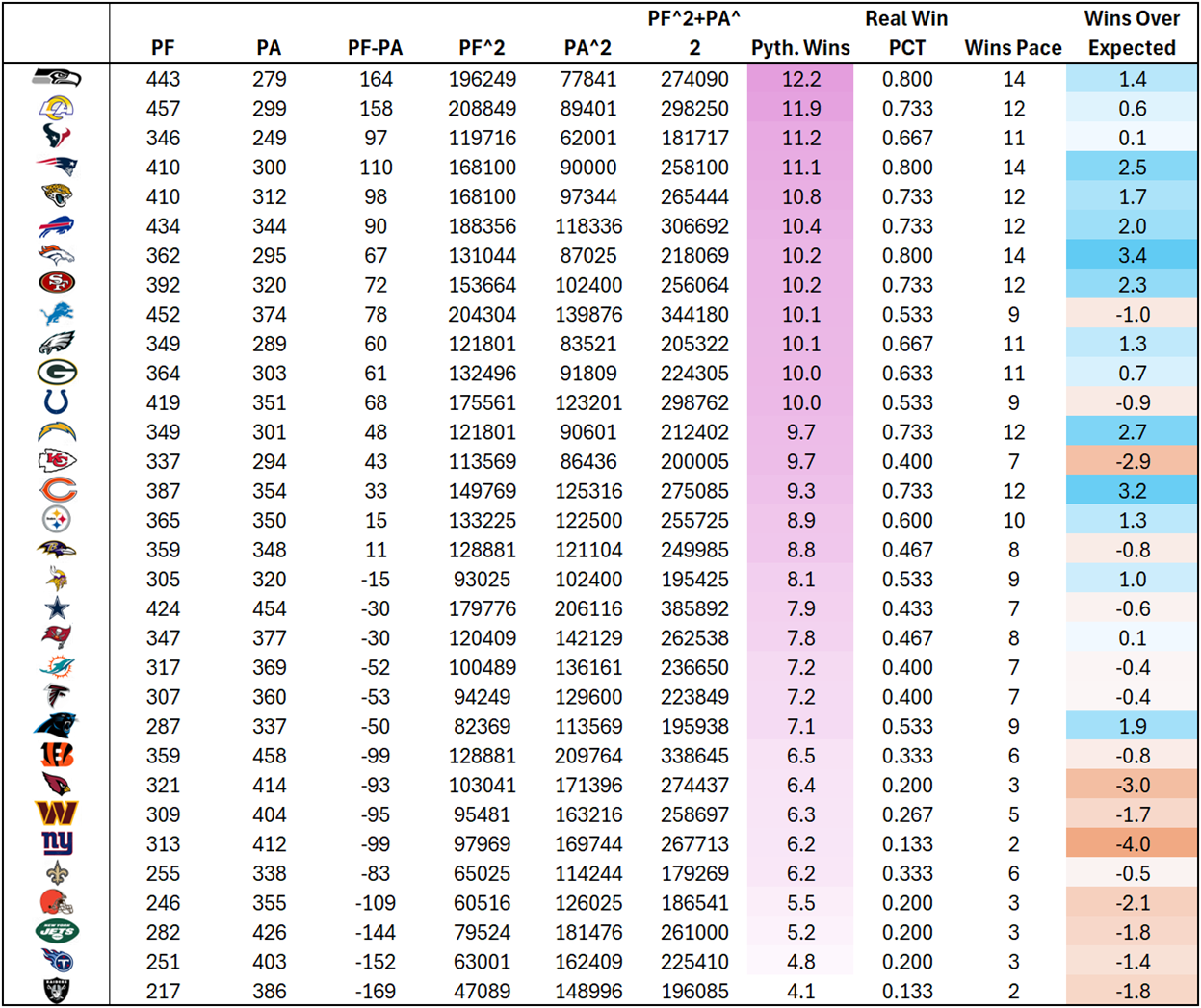
As I already alluded to, the Cowboys are well above average in offensive EPA and dead last in defensive EPA allowed.

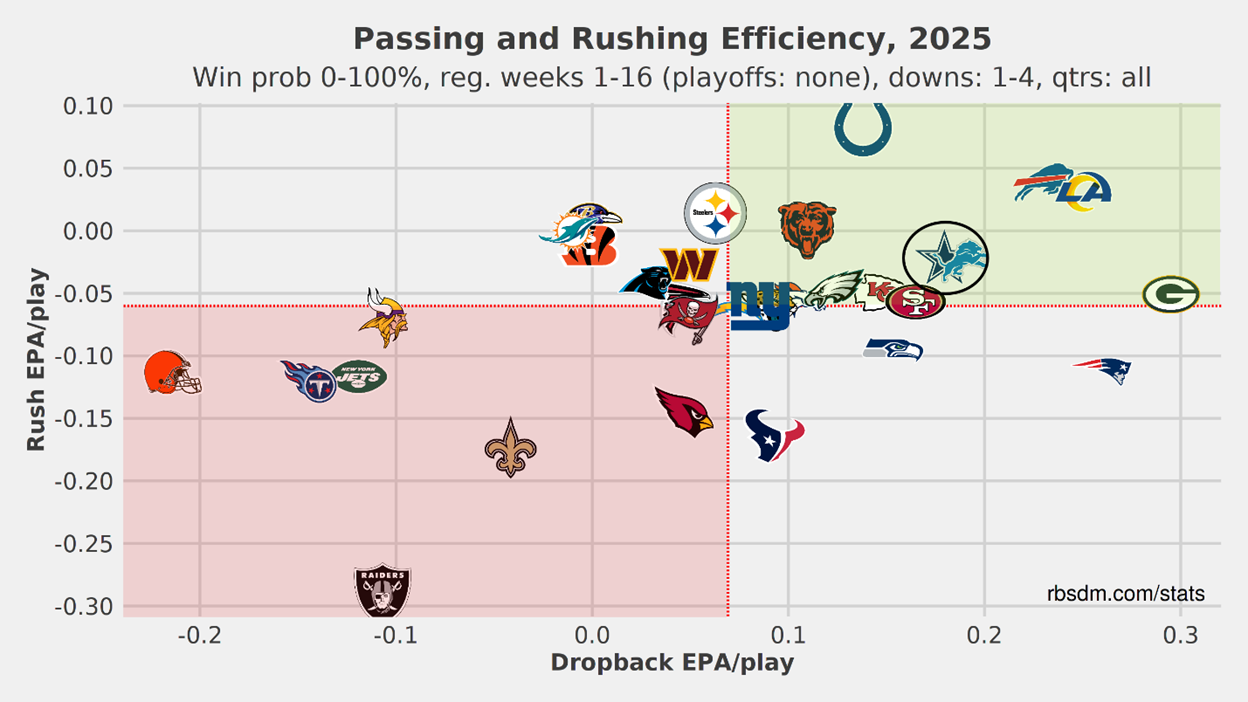
Offensively, the Cowboys are well above average at dropback EPA and slightly above average in rush EPA. Having both teams be good on offense and bad on defense generally creates a good environment for scoring, and it is the main reason for the high over/under.
The Cowboys rank sixth in offensive EPA per play and offensive success rate.
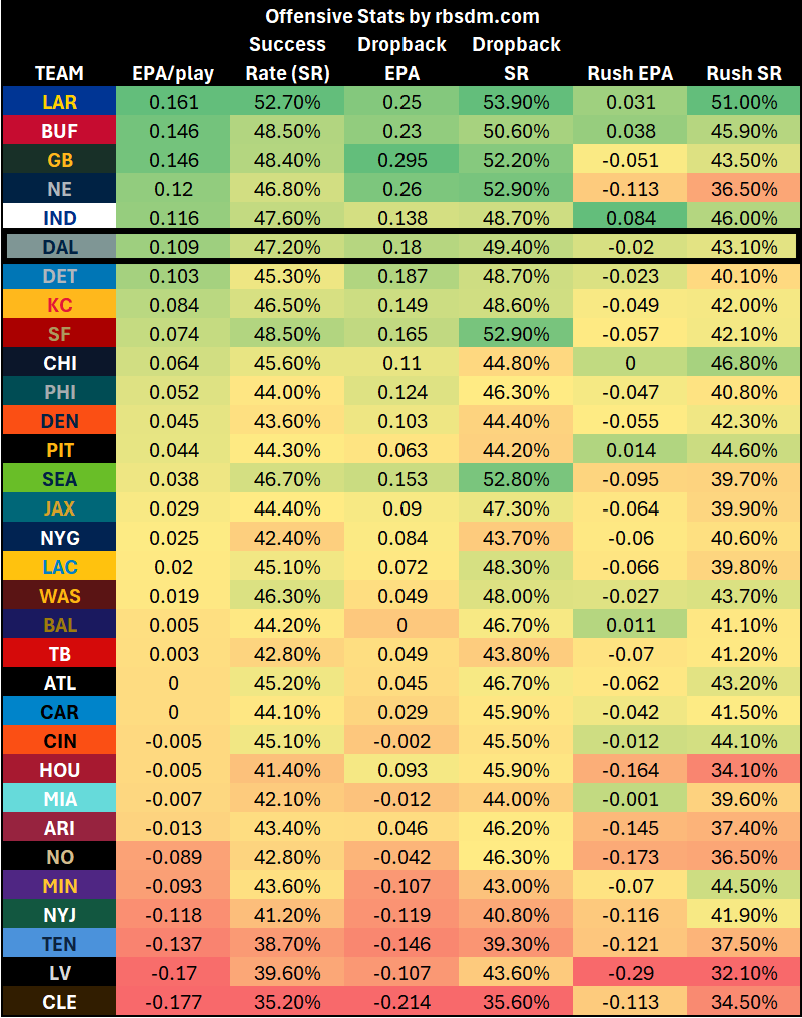
They rank sixth in offensive EPA per dropback and seventh in offensive success rate on dropbacks.
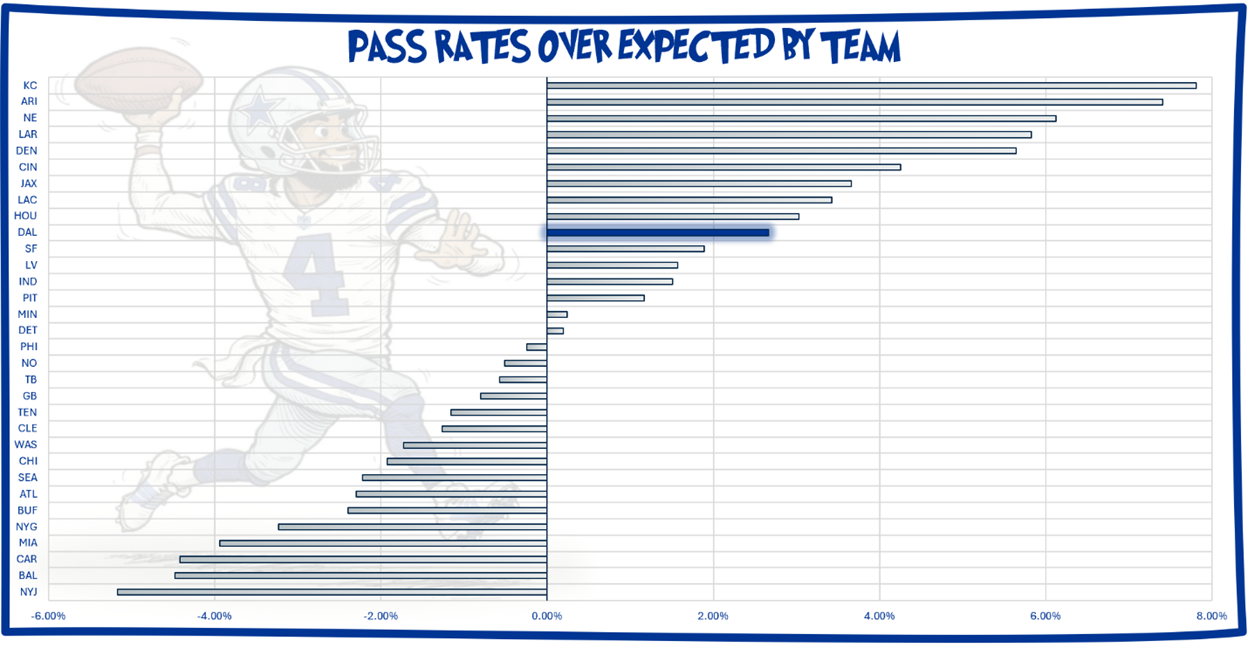
The Cowboys average 25.4 seconds per offensive snap (2nd). They have a pass rate of 61% (T-5th). Their pass rate over expected is 2.66% (10th), so their default calibration is to pass.
QB Dak Prescott was recently in the MVP conversation, but after two straight losses, that won’t happen. He has still had a terrific year, though, ranking in the top 10 in several of the most significant passing categories.
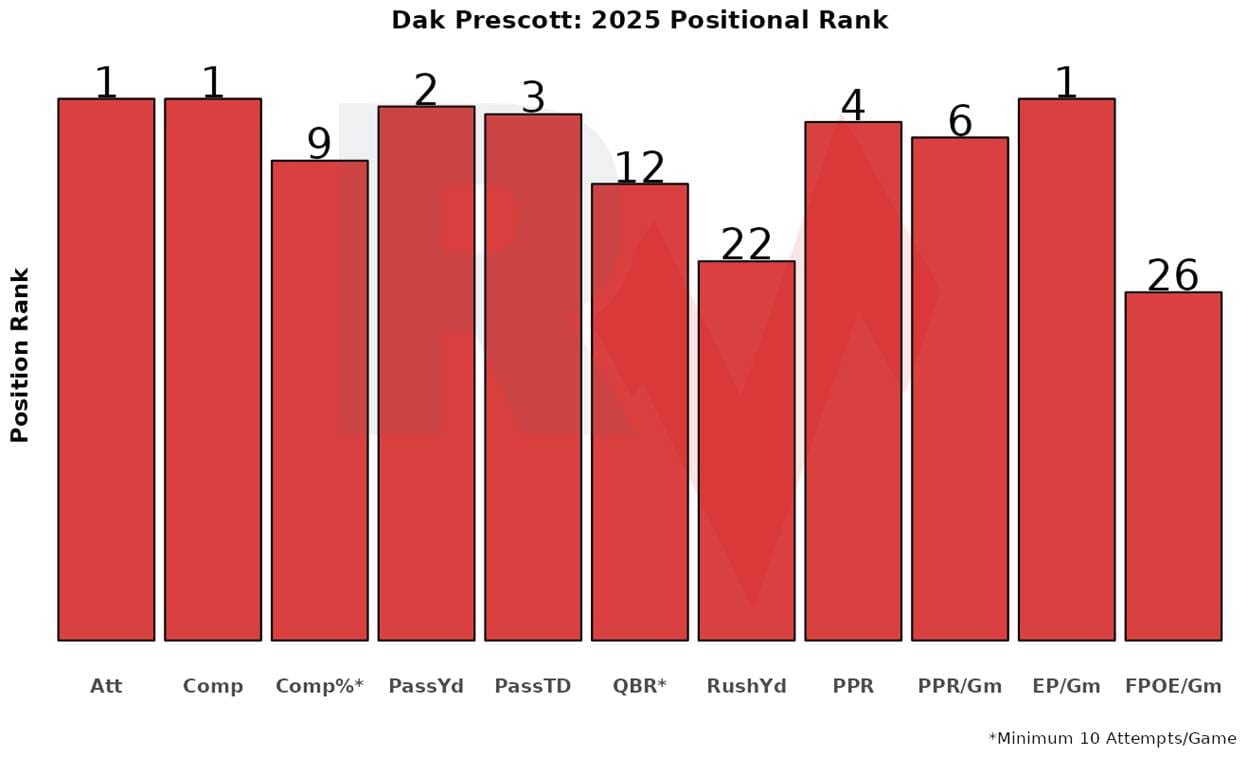
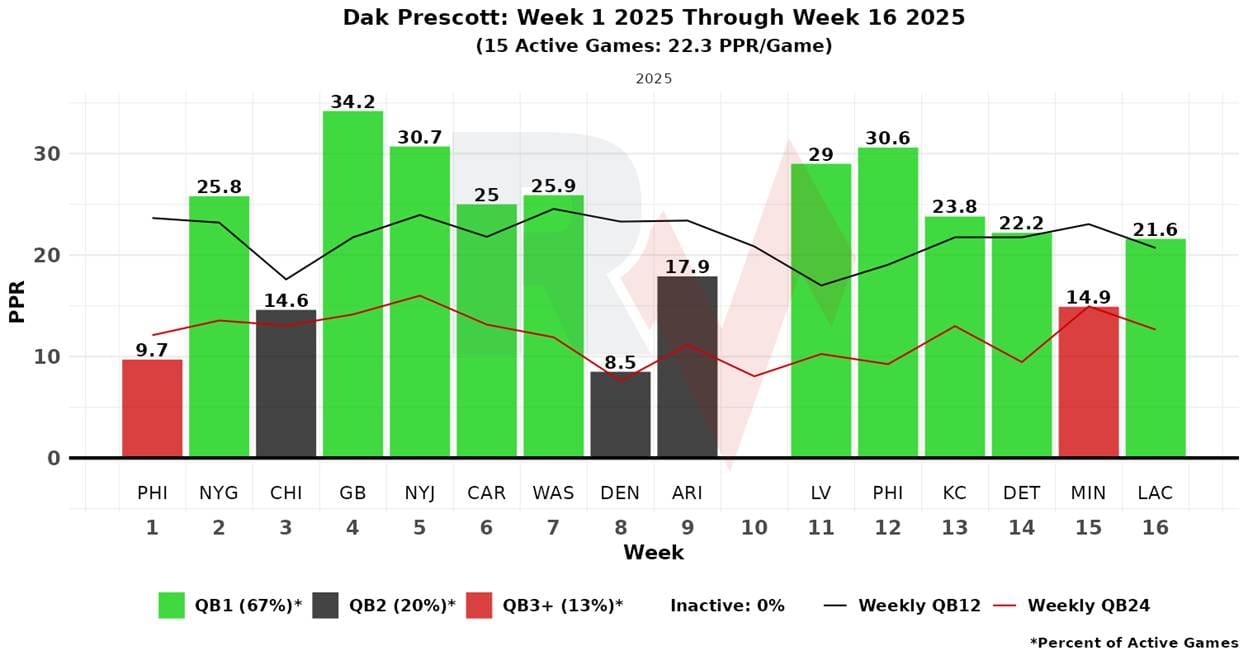
Precott has had 603 dropbacks (1st), converting them into 552 passing attempts (1st). He lacks the rushing platform he once had, but the offense generates so much volume—specifically passing volume—that he has maintained a consistent floor and ceiling; Prescott has been a QB1 in 10 of 15 games, with only two single-digit fantasy outputs.
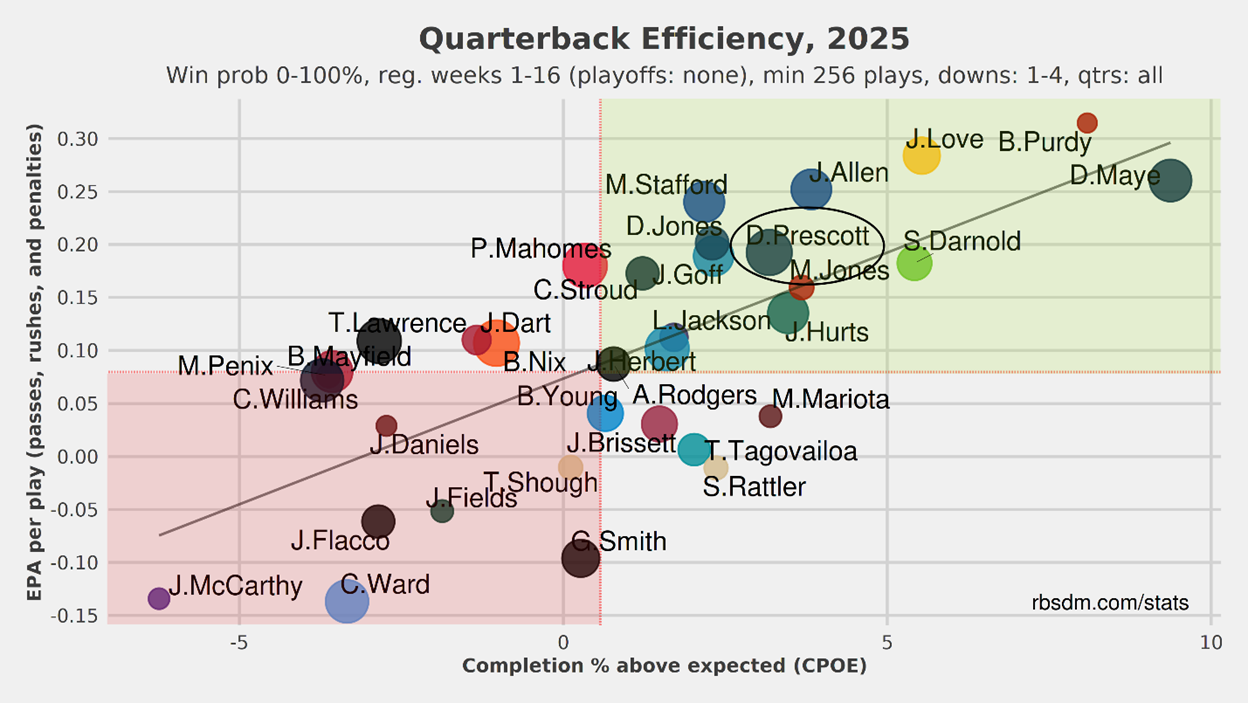
Prescott is well above average in dropback EPA and CPOE.
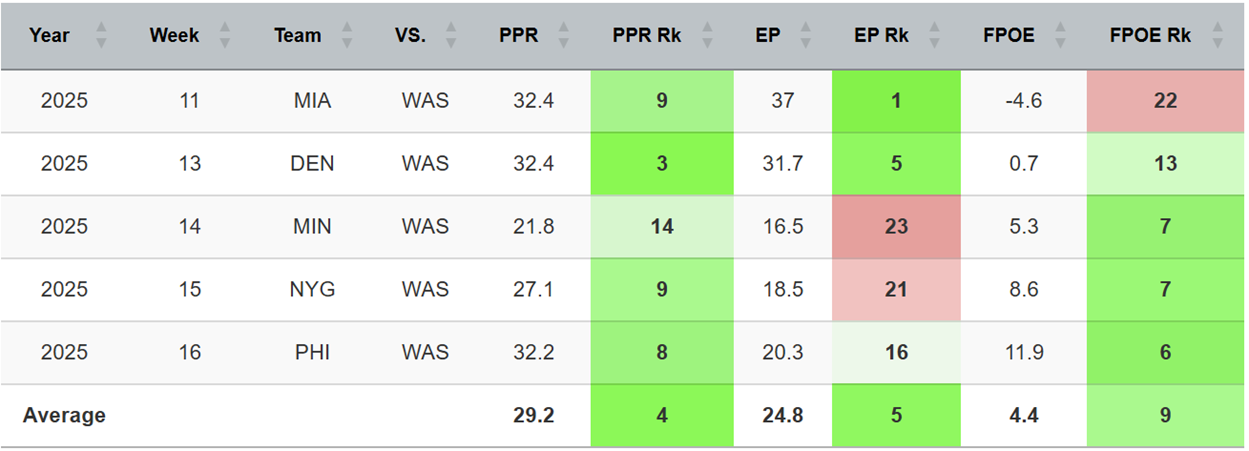
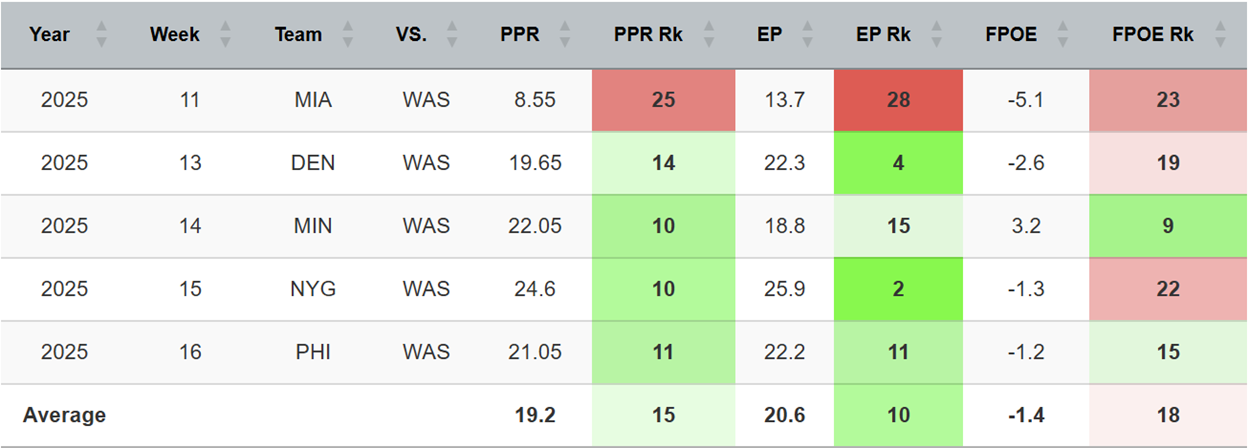
The Commanders have allowed the 15th-most fantasy points to opposing QBs in their last five games.
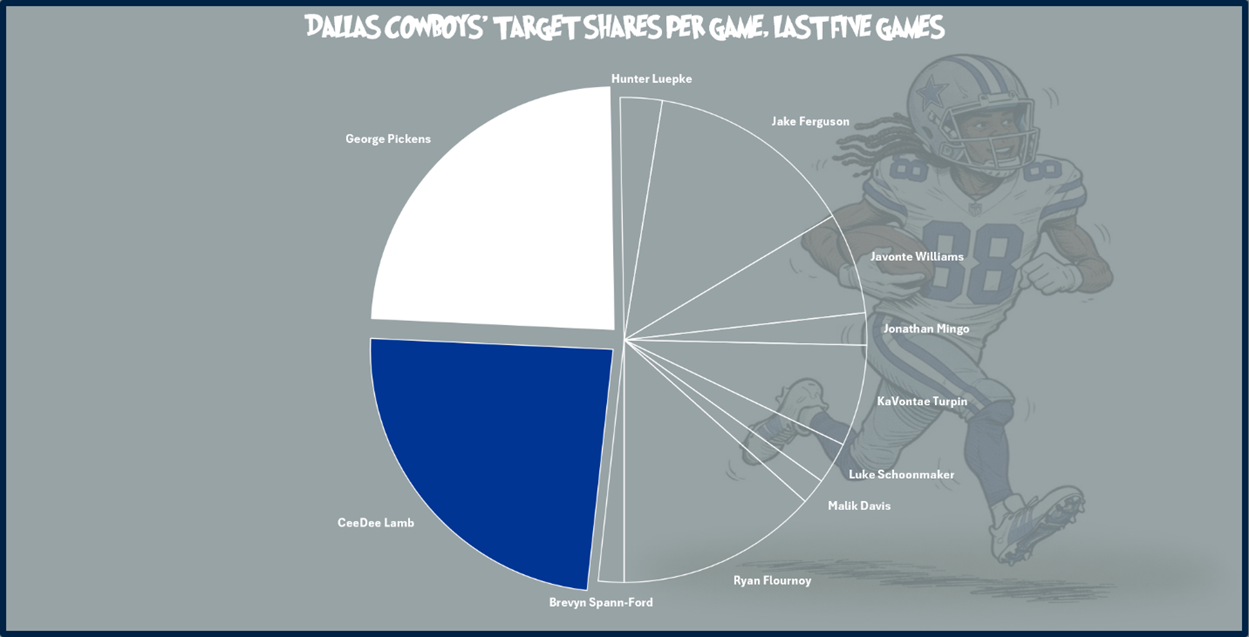
The Cowboys have two players who have at least a 15% target share per game rate in their last five games: WRs CeeDee Lamb and George Pickens (%), who have an equal 22.4% target share in that time.
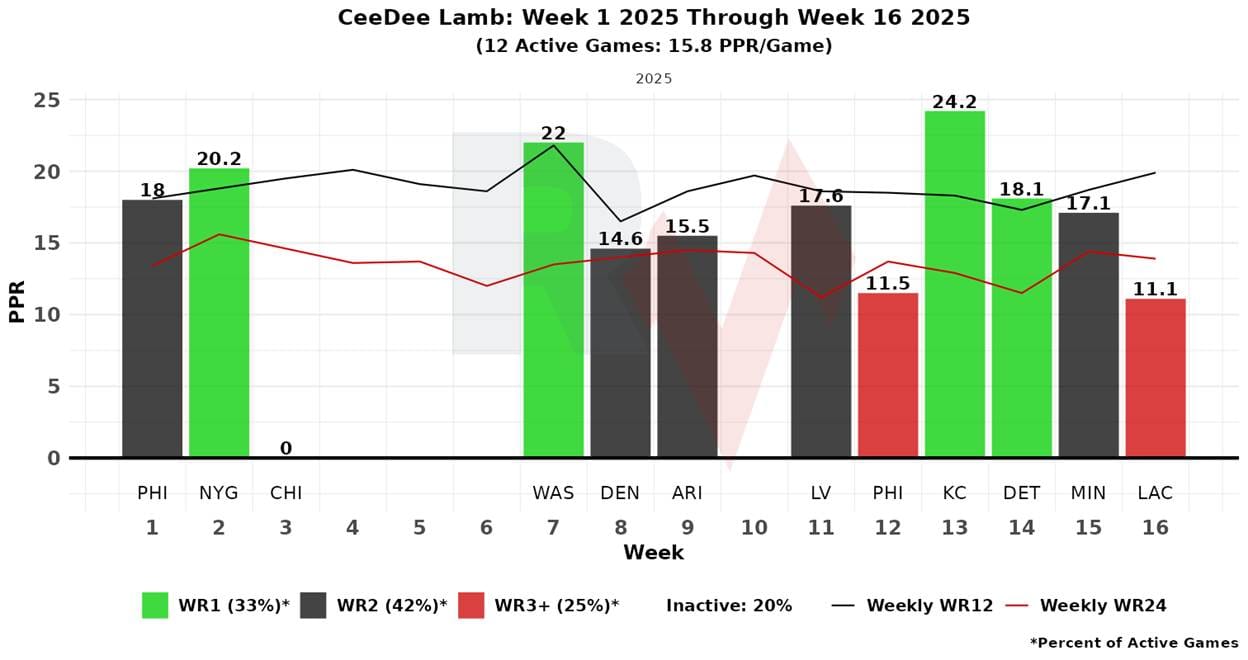
Lamb has long been perceived as the alpha in the room; he was fantasy’s WR1 overall two seasons ago. In the time when he has played, he has outperformed Pickens, and coming into last week’s game, it seemed as if Lamb was asserting himself atop the list of preferred targets yet again, but last week, they had a role reversal, which probably emphasizes that each is an excellent player. Each will have weeks when they outperform the other, and we should think of them more like a Nacua/Adams, Chase/Higgins, or Brown/Smith pairing.
Lamb had an ankle sprain that cost him time; he has played in 11 games, finishing as a WR1 four times. He has not had a single-digit performance other than in Week 3, which he exited early (although he was already having a bad game).
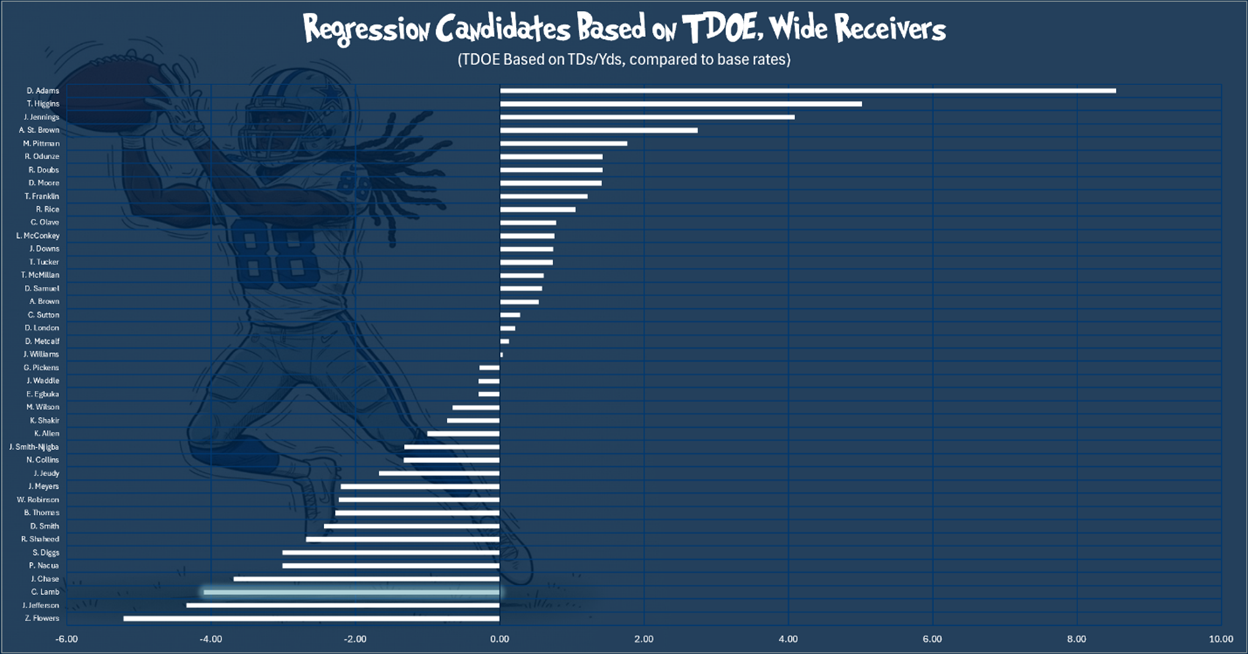
One thing going in Lamb’s favor is that he is probably a positive TD regression candidate. I use a formula that divides TDs/Yds to find each qualified player’s average rate, then compare the player’s pace against the league base rates for the position. It’s not a perfect science, but among the outliers, it can give us some signals to look out for. In that TDs over expected (TDOE) model, Lamb shows up with some of the worst TD luck of the year.
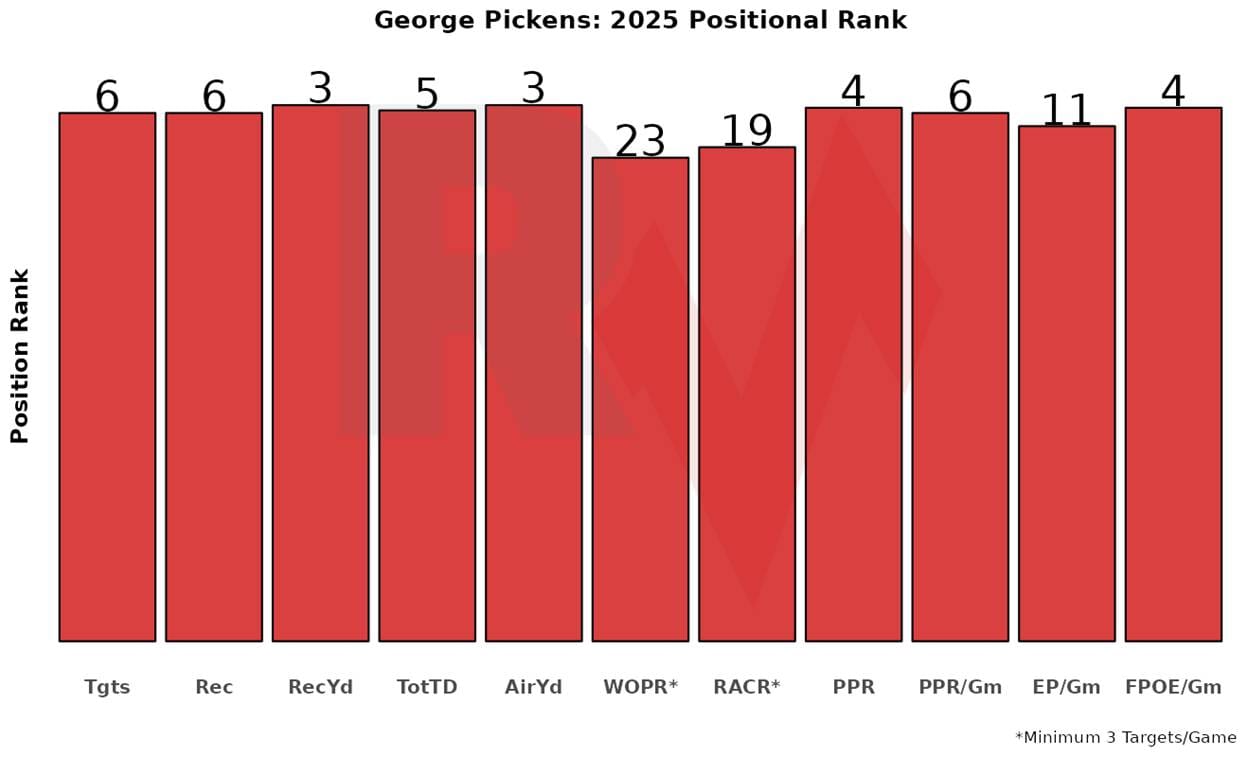
Pickens looks better in the overall counting stats because he has played the whole season without any absences. Pickens still ranks fourth in PPR points among WRs, ranking at or near the top five in several statistical categories.
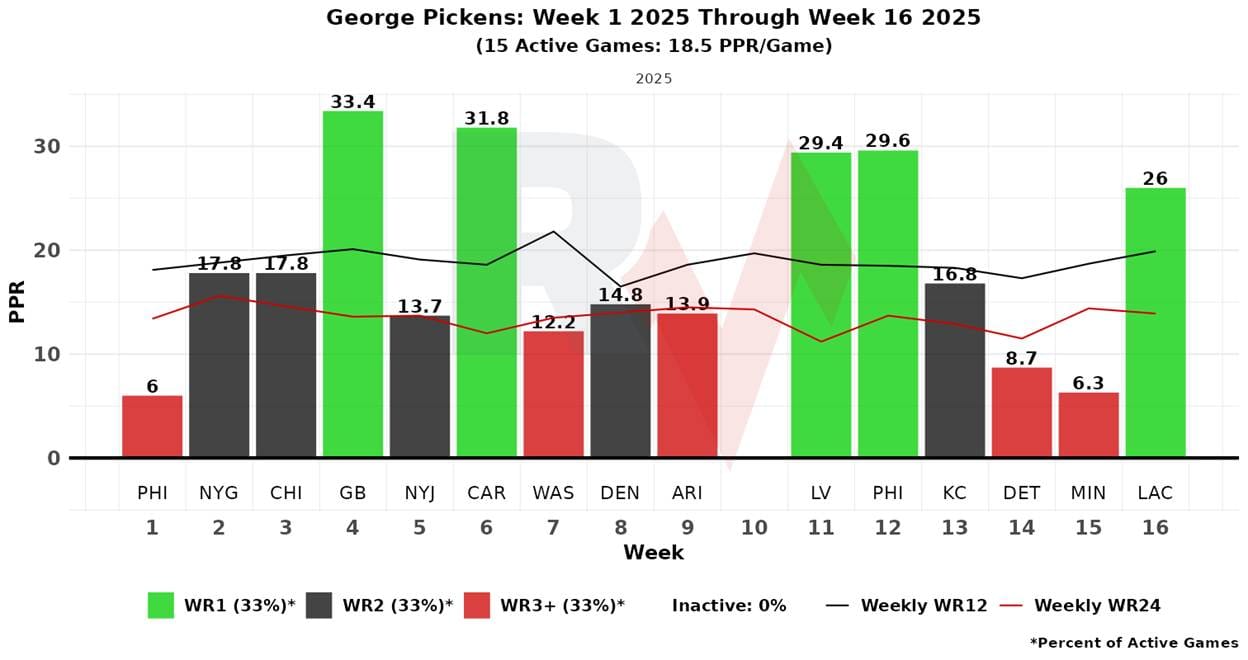
Pickens has exhibited a higher single-game upside (which we like), having hit between 25 and 35 PPR points five times. The inverse, of course, is that he’s been slightly more vulnerable to downside, but we’ll take it. The amount he outpaces the field at his highs is more significant than the amount he trails at his lows, so he’s a good bet.
One player who has been increasingly involved as the clear third WR is WR Ryan Flournoy. Flournoy’s best games have coincided with the absences or hardships of other players; when the Cowboys come into a game with a full house at WR, we should expect less.
That said, in the deepest of PPR formats, he may have some appeal with such a fantasy-friendly implied total. Additionally, if the Cowboys burst out to a massive lead, which is possible, they may be inclined to scale back Lamb or Pickens, which would only help Flournoy. I like Flournoy for the deeper PPR leagues if you’re in a real bind.
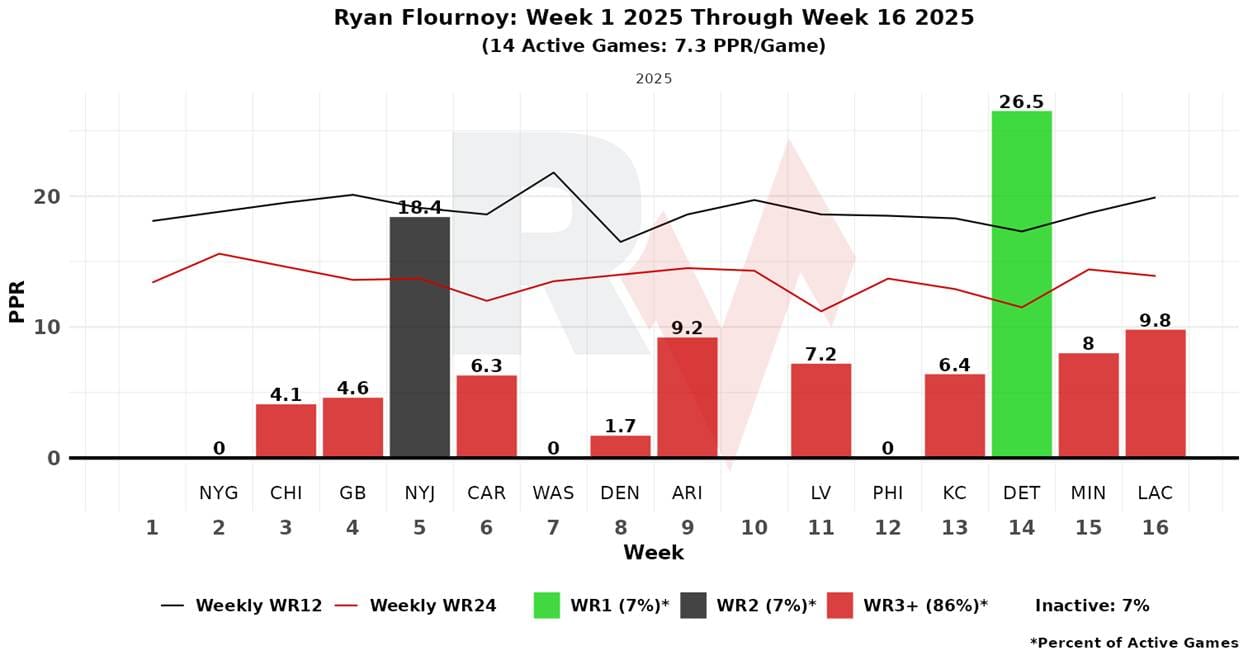
Side note: If you’re in a dynasty league where he isn’t claimed and you can still make pick-ups, I like stashing Flournoy. He’s been awfully good when given his chances, and the Cowboys may have a contract situation brewing with Pickens. Just food for thought.
The Commanders have been a little bit stingier against WRs of late, trimming the fantasy points over expected (FPOE) of their opponents to a rank of 30th in their last five games. This has been despite the opposing WRs being quality players.
The Commanders have been awful all season in dropback EPA, but HC Dan Quinn took over play-calling in November, and we should recognize that it may not be the same as before. We are, by now, trained to play our passing-game weapons against Washington no matter what, but they have notably improved of late, allowing the 23rd-most fantasy points to WRs in their last five games, which may coincide with Quinn taking over. Of course, we aren’t sitting Lamb or Pickens in managed leagues; just temper expectations.
As the entire offense started with a pile of fantasy points in the first half of the season, only to see it all fall to a more moderate amount of points in the second, TE Jack Ferguson has been a microcosm. His per-game chart looks like the profile of a snail crawling to our right.
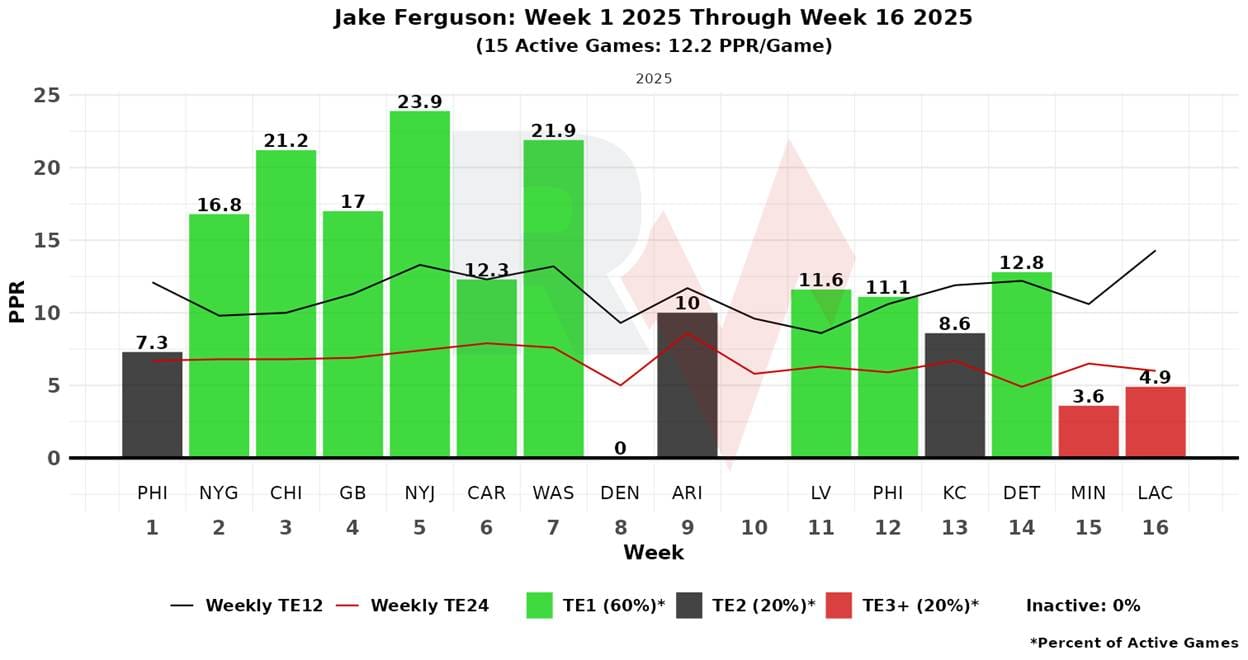
The most obvious pattern we could recognize is that most of his best stuff came in the weeks when Lamb was out and shortly thereafter.
Digging into the numbers, Ferguson has had a target share-per-game rate north of 15% all year, but it is now officially under that mark for the year (13%).
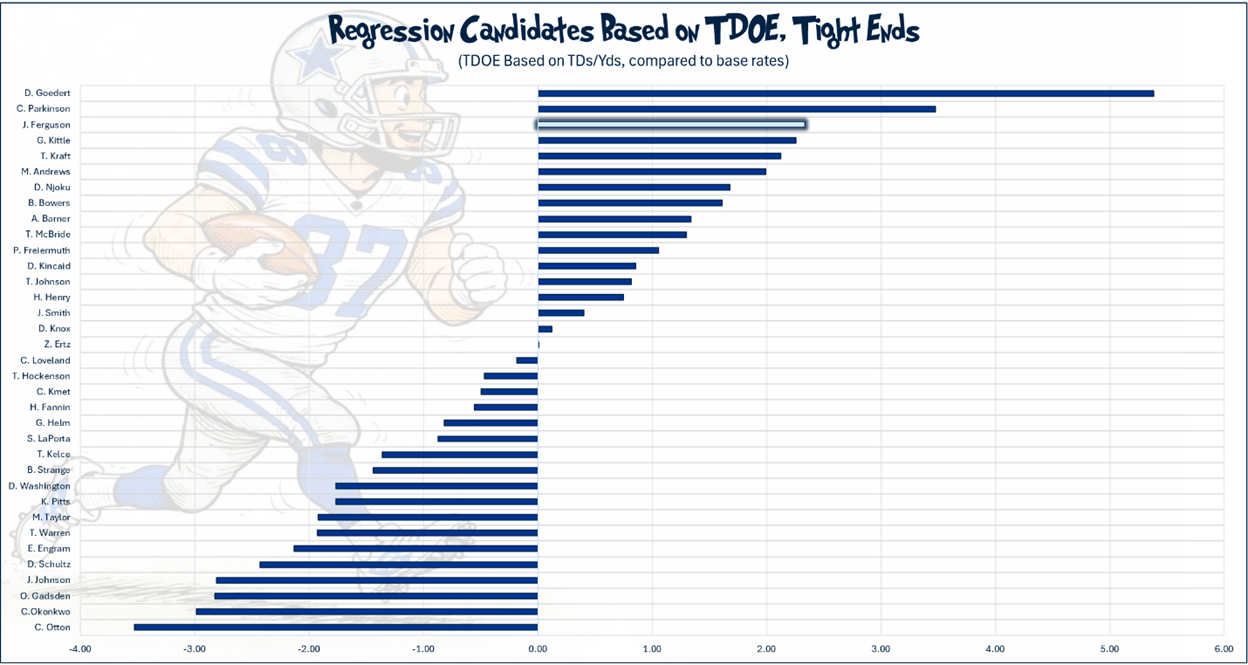
And he was already a significant negative TD regression candidate based on TDOE before the slump; unfortunately, though he’s less of an overheating engine ready to blow than he used to be, he’s still probably due for even more negative regression from here.
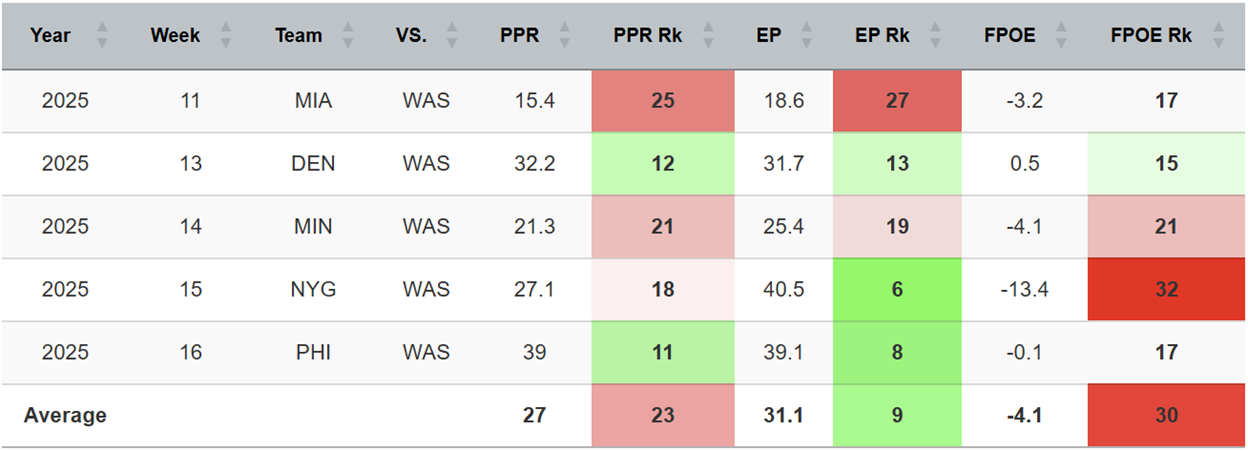
The Commanders are friendly to opposing TEs, to whom they’ve allowed the seventh-most PPR points in their last five games, so you never know. But Ferg’s tough to trust while both Lamb and Pickens are in the lineup.
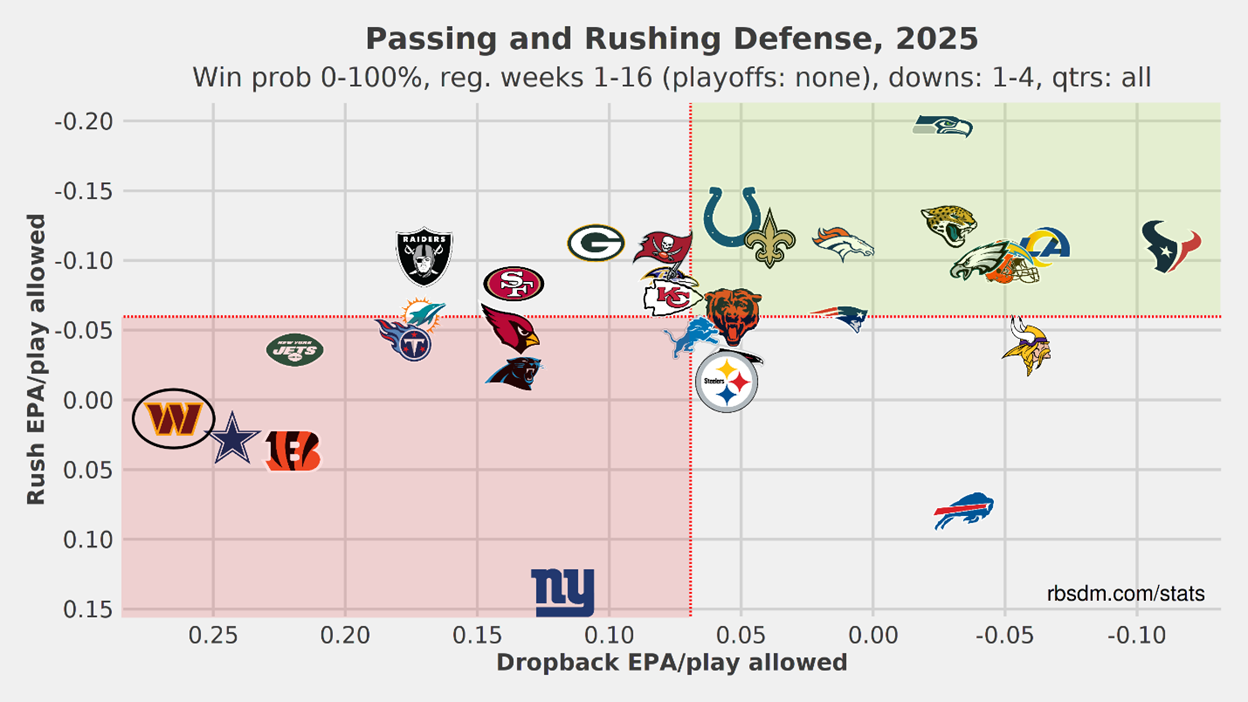
The Commanders’ defense is the worst in the league in dropback EPA allowed and below average in rush EPA allowed.
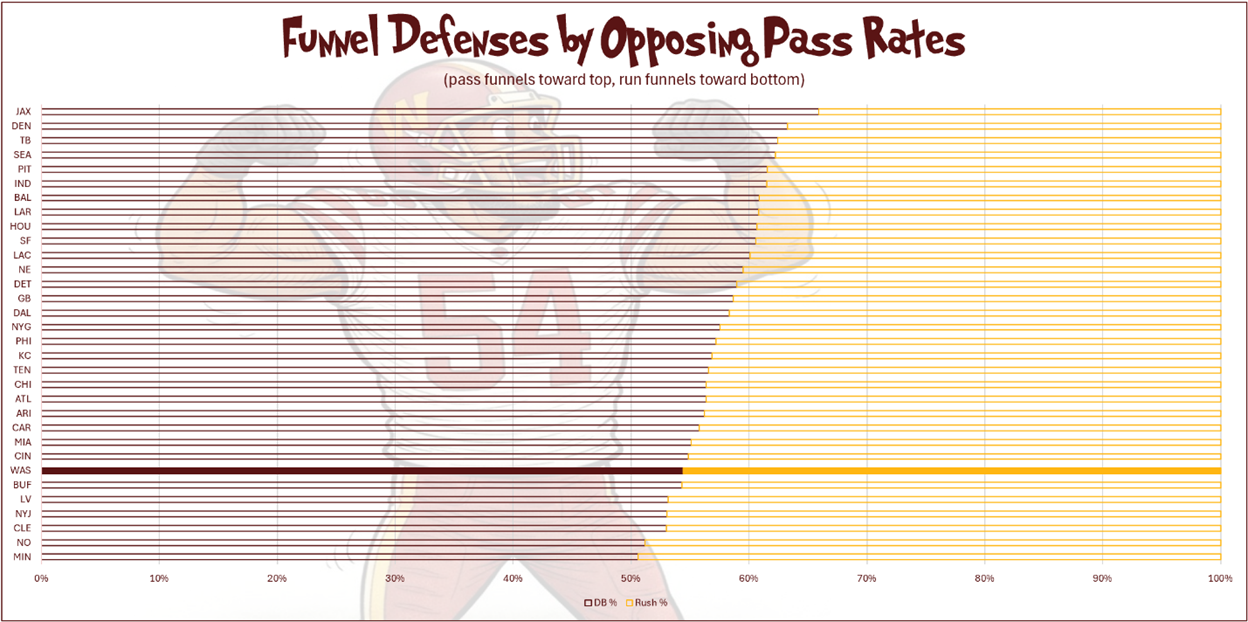
Most teams end up running on the Commanders a significant amount; their opponents’ 54.4% pass rate ranks 26th in the league. This reveals Washington as a run funnel.
The Commanders rank 31st in EPA per play allowed and 27th in defensive success rate. They rank dead last in offensive EPA per dropback allowed and 29th in defensive success rate on dropbacks.

The Commanders run zone at a rate of 66.8% (22nd). They have run Cover 1 only 50.7% (19th), a remarkably low number for a Quinn-coached defense. His two most preferred alignments are still Cover 3 (26.4%) and Cover 1 (22.6%). The Commanders’ blitz rate is at 23.3%, which is middle of the pack. Quinn has been more man-heavy and blitz-heavy (which correlate) in recent seasons; he just doesn’t have the personnel to do this, so he’s probably grown more conservative to minimize the damage.
Fantasy Points’ coverage matchup tool assigns a zero-based matchup grade to each pass-catcher based on their opponent’s use of specific types and rates of coverage and how that pass-catcher performs against them. Positive numbers indicate a favorable matchup and negative numbers indicate an unfavorable one.
Based on this model, Lamb (-2.3%) and Flournoy (-0.9%) have slightly unfavorable matchups; Pickens (+4.9%) and Ferguson (+0.2%) have slightly favorable ones.
PFF’s matchup tool is player-based, pitting the PFF ratings of individual players against each other for an expected number of plays based on historical tendencies and rating on a scale from great to poor.
Based on this model, all three WRs receive a grade of great, while Ferguson receives a grade of fair.
The Cowboys’ offense has a pass rate over expected (PrROE) allowed of 4.45% (13th), while the Commanders’ defense has a PrROE generated of 8.18%. (13th). This makes for a neutral matchup when the Cowboys are in pass protection.
As for run blocking, it is relative weakness against relative weakness. The Cowboys generate 2.04 adjusted yards before contact per attempt (adj. YBC/Att, 20th). The Commanders allow 2.37 adj. YBC/Att defensively (24th). The matchup is slightly in Dallas’ favor when they are run blocking.

The Cowboys rank ninth in offensive EPA per rush and 11th in offensive success rate on rushes.
RB Javonte Williams has had a sturdy role all year. He has a 65% snap share, a 7% target share, and 59% of the team’s rush attempts in his last five games.

Williams, like the others, had a better first half than second. He hasn’t been an RB1 since Week 8; last week’s 6.3 PPR points were his lowest output of the season.
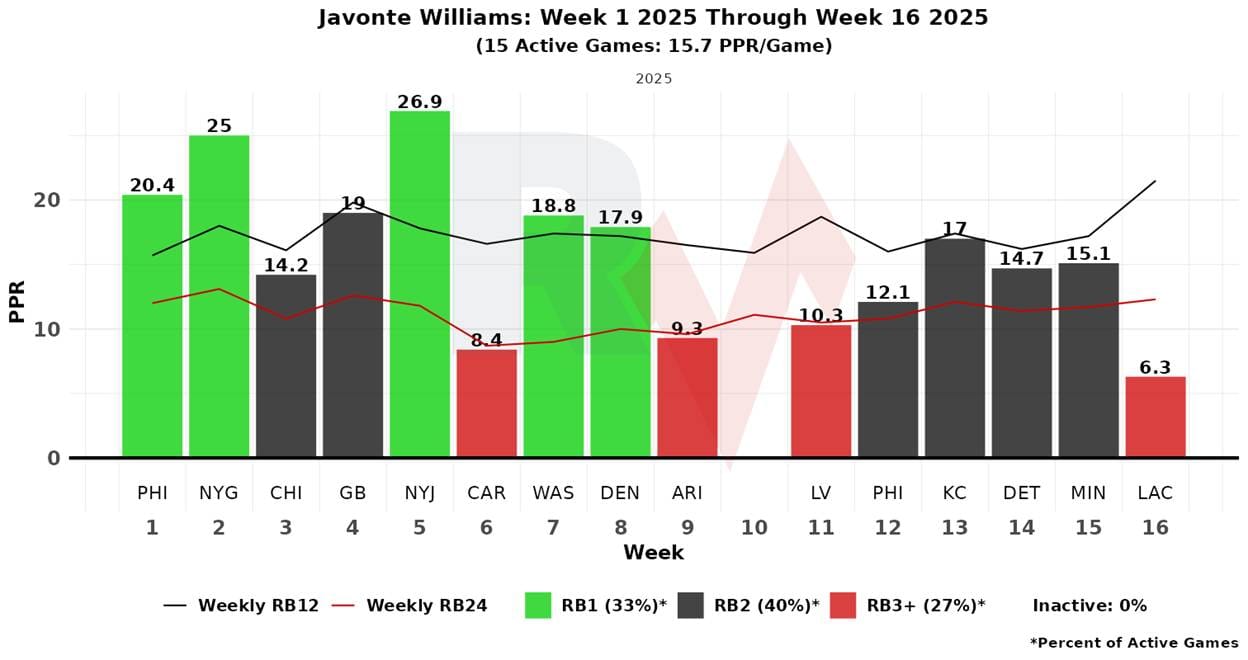
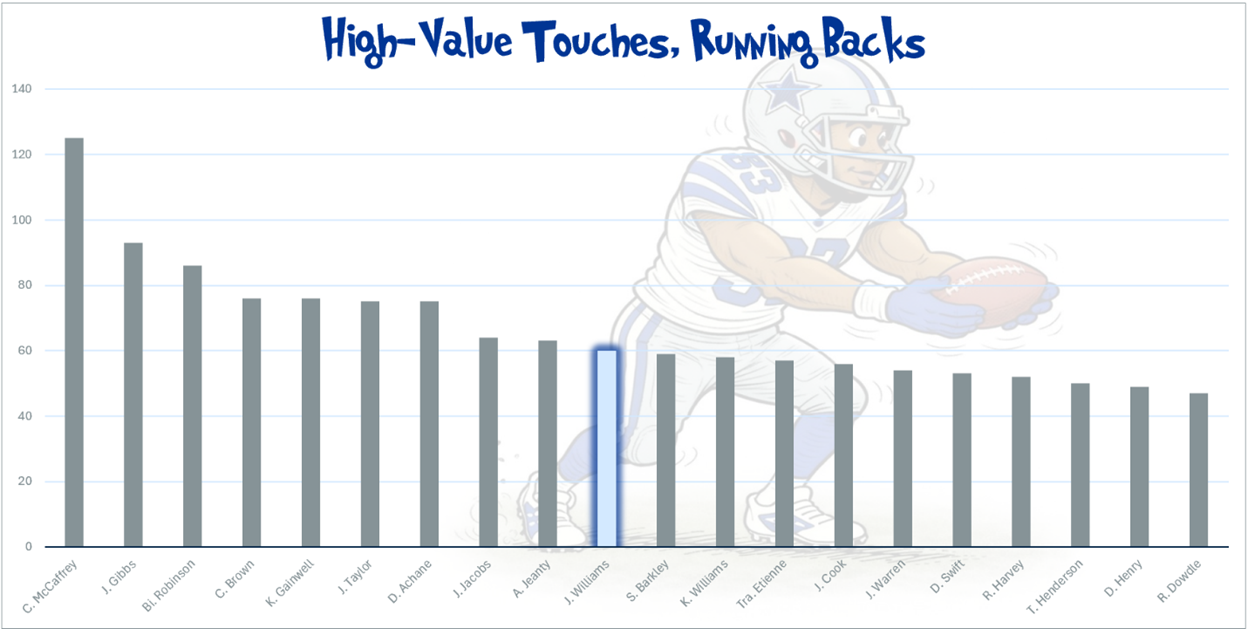
Williams hasn’t had an invisible passing game involvement, but it is certainly nothing to write home about. He has a very healthy goal line usage, however, and the Cowboys have a lot of volume, so he still ranks in the top 10 in high-value touches (HVTs), which is the sum of green zone carries and receptions, where fantasy points are often scored.
The Commanders rank 28th in EPA per rush allowed and 26th in defensive success rate on rushes.
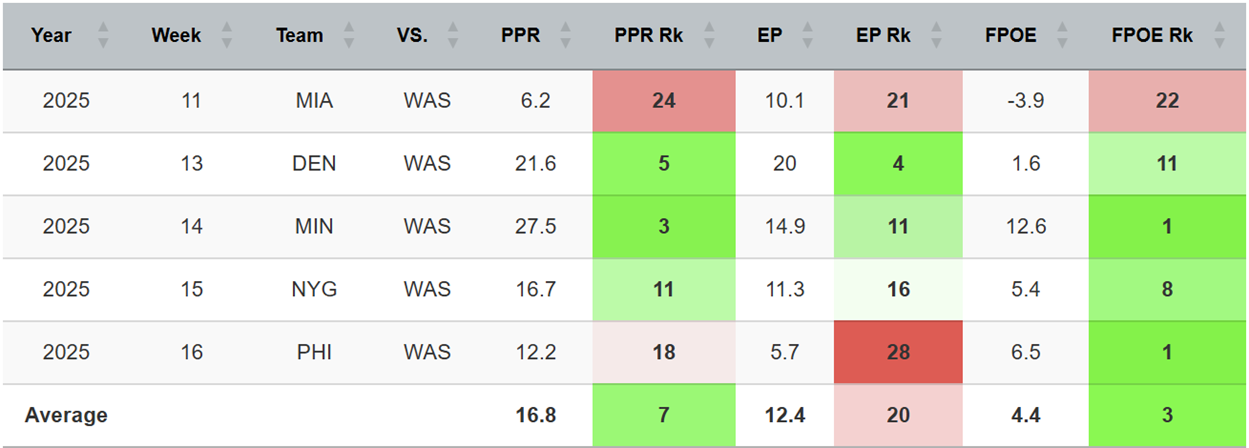
They have allowed the fourth-most fantasy points to RBs in their last four games. Between this and the expected game script, Williams feels like a pretty good bet this week.