Quick Slant: MNF - Take Nothing For Granted

Mat Irby’s Quick Slant
When the clock hit double zeroes in the Meadowlands on December 29, 2007, two things felt equally absolute: the Patriots, fresh off the first 16-0 regular season in NFL history, were an undeniable team of destiny; their opponent, the Giants, who had backed into a wild card slot after losing two of their last three, were chum in the water for the real sharks of the NFL.
A month later, they met again in Glendale, this time for Lombardi. The Patriots had fulfilled their calling by scaling the AFC; the Giants had bucked and kicked, and all that flailing had earned them their first Super Bowl appearance since the last time they had snuck in as a wild card and ran into the league’s most dominant team—an appearance that ended in a 34-7 humiliation at the hands of the 2000 Ravens.
One last hurdle stood between the 18-0 Patriots and eternity, and the football gods offered what looked like a mere formality: dispatch the lowly Giants again, as they had weeks earlier, and the 2007 Patriots would achieve immortality—the first undefeated season under the 16-game schedule. Nick Buoniconti, eat your heart out.
But as we all know, the great author of the NFL story—whether you believe in Football Moses or shadowy league-appointed scriptwriters—chose that moment for a plot twist. Eli Manning, grabbed twice by the collar as he scrambled like a free-range chicken, planted and floated a half-focused duck with enough air under it for Rodney Harrison to converge. David Tyree—an NFL NPC outside this singular moment—pinned a round ball to his round helmet with one hand and somehow maintained possession through contact as he slammed to the turf as stiff as a toppled statue. Half of New York calls The Helmet Catch the greatest ever (the other half chooses Beckham’s one-hander, which actually is[1]).
Moments later, a Plaxico Burress sluggo unplugged a defending Ellis Hobbs’s hard drive and produced a pitch-and-catch TD to seal it. And just like that, the 2007 Patriots went from the automatic answer to the question of the greatest team ever to a supporting role in the fairy-tale-come-true of the 2007 Giants.
Flash forward to February 2012—four years later. The Patriots, 13-3, again found their way to the Super Bowl—this version more cerebral, methodical, less talented. Neither their offense nor their defense matched what they’d been in the winter of 2008. Their play-calling was built on leverage, on chopping down the tree one swipe at a time. Their defense was opportunistic, prone to generating life-saving turnovers. Nonetheless, they finished with the best record in the AFC.
And again, in strolled New York—Eli, the trench monsters, and not much else. Again, they barely made the postseason, and again they defied expectations to represent the NFC in the Super Bowl despite a single-digit win total. This was New England’s perfect chance at redemption.
Yet, somehow, the Giants did it again. Another defensive clinic. Another incredible catch on a late drive—this time Mario Manningham on the sideline, shoved by two defenders like a medicine ball dressed in a Giants’ no. 82 jersey. The game-winning TD was a sea-parting surrender by New England, a moment where Ahmad Bradshaw recognized the trap he’d wandered into just as he crossed the goal line and fought his own momentum in an attempt not to score, but failed.
That left Brady enough time for one last drive, which ended with a Hail Mary falling harmlessly onto blue paint in the visitor’s end zone. The wild-card Giants had sunk the dynastic Patriots once again.
This Monday, the stakes aren’t as high, but the Giants still aim to spoil the Patriots’ plans. As New England footraces Denver for the AFC’s best record, the Giants look like a going-out-of-business sale, having fired their coach and turned their eyes toward 2026.
But their QB is plucky, undeterred by the perceptual imbalance, and dangerous enough to break the establishment in any given week. The Giants don’t have Lombardi to gain, but they would love to carry momentum into the offseason, setting the foundation for a Patriots-like turn toward legitimacy next year.
The Patriots, meanwhile, are led by HC Mike Vrabel, who wore a Pats uniform in ’08 and understands what lurks beneath certainty. And for whatever confidence outsiders may have about this game, Vrabel remembers, as do the fans in Massachusetts. One strange bounce, a turnover, a sack—an ill wind begins to blow—and a deluge of fear can rush right back. When it comes to New York, the Patriots take nothing for granted.
Giants
Implied Team Total: 19.5
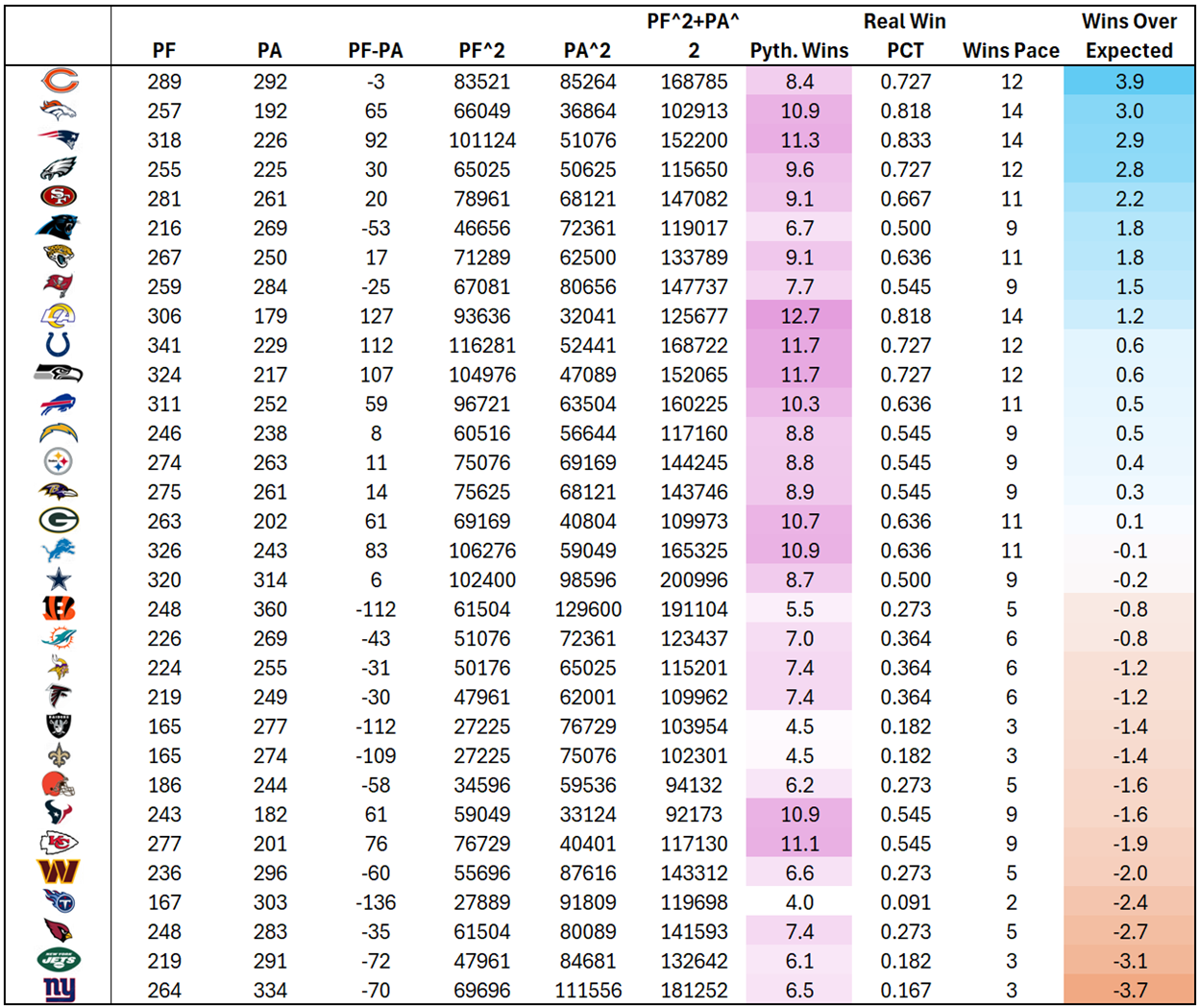
The Giants are just 2-10, but they are pacing at about 3.7 wins under expectation, the worst in the league. They feel like a greater threat than their record suggests.
The Giants are above average in offensive EPA and below average in defensive EPA allowed, putting them in the fantasy sweet spot. We like teams with good offenses and bad defenses, as this combination raises play counts and scoring chances.
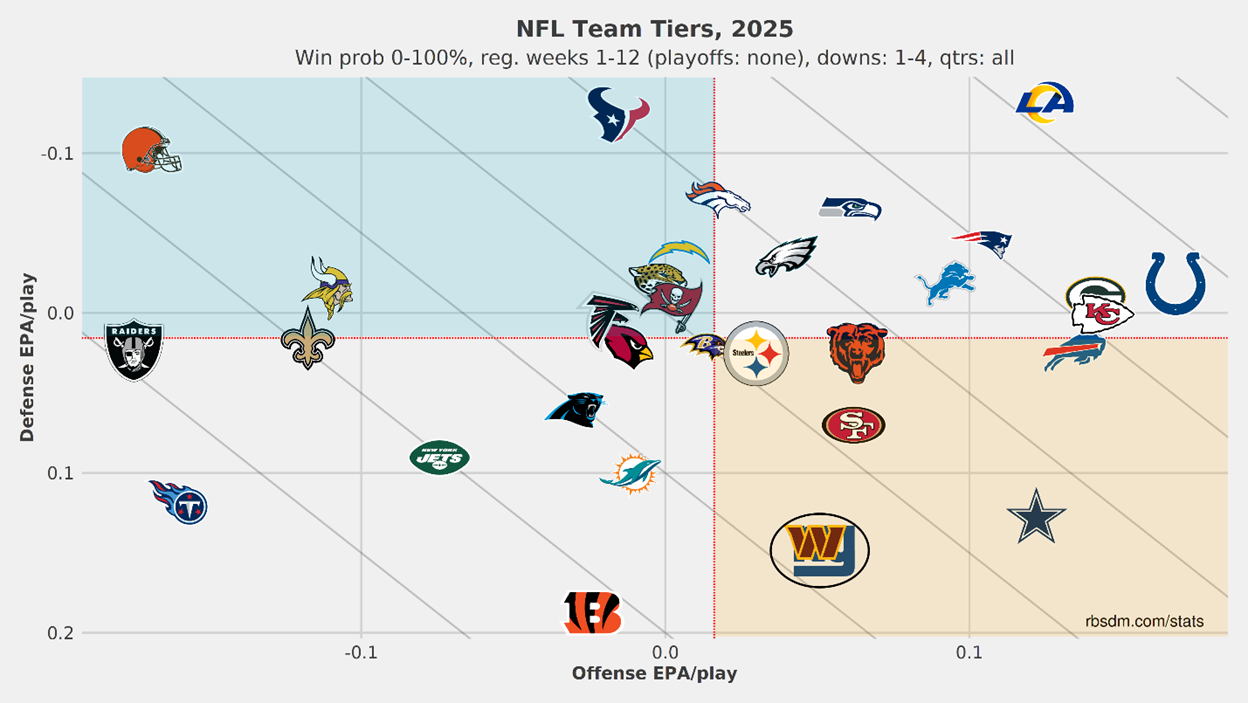
Offensively, they are above average in dropback EPA and about average in rush EPA.
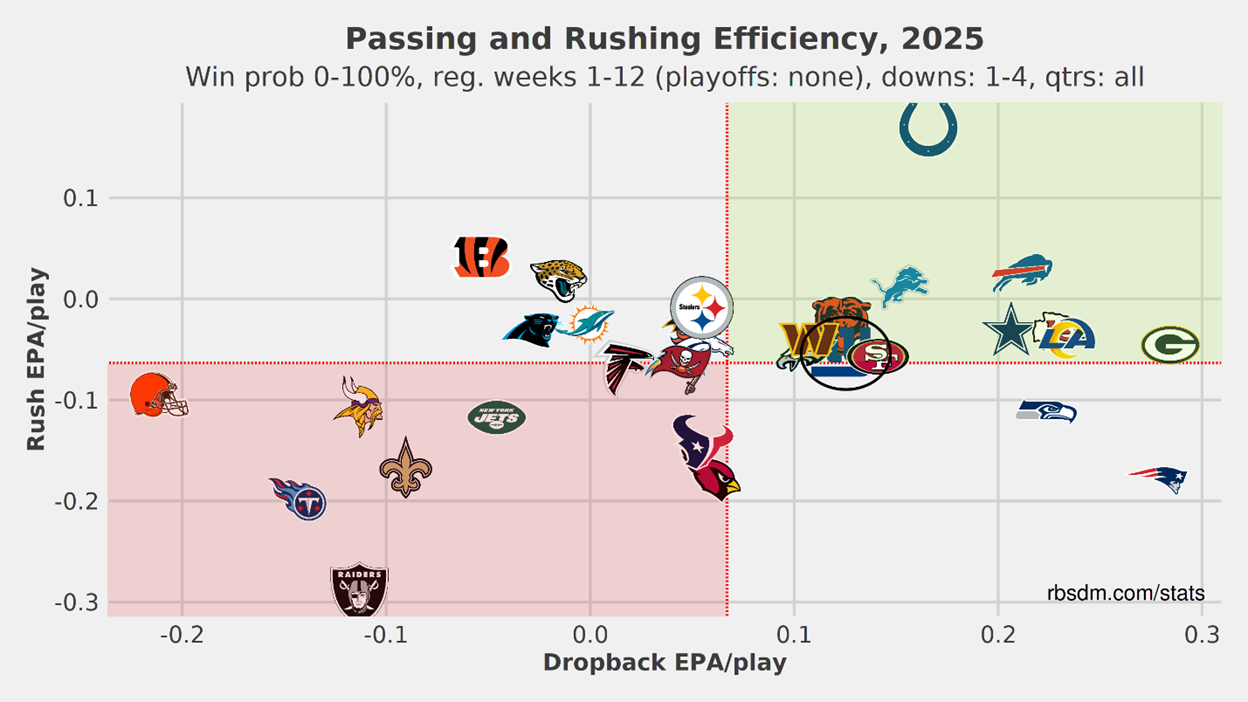
The Giants average 26.4 seconds per snap (11th). Their pass rate is 55% (T-22nd). The Giants have spent 247 plays trailing by seven or more points (13th), and in these instances, their pass rate has risen to 66%. They are naturally inclined to run, posting a pass rate over expected of -1.67 (26th). They run an average of 67 offensive plays per 60 minutes (T-4th). This is a decent environment for fantasy production.
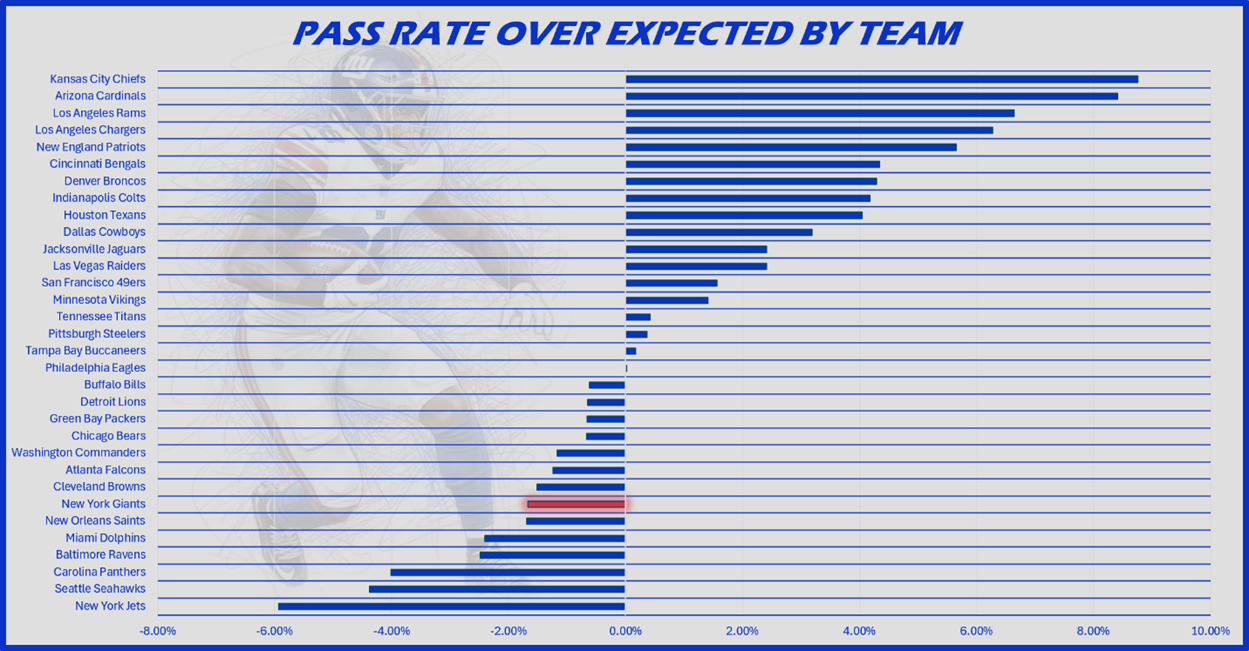
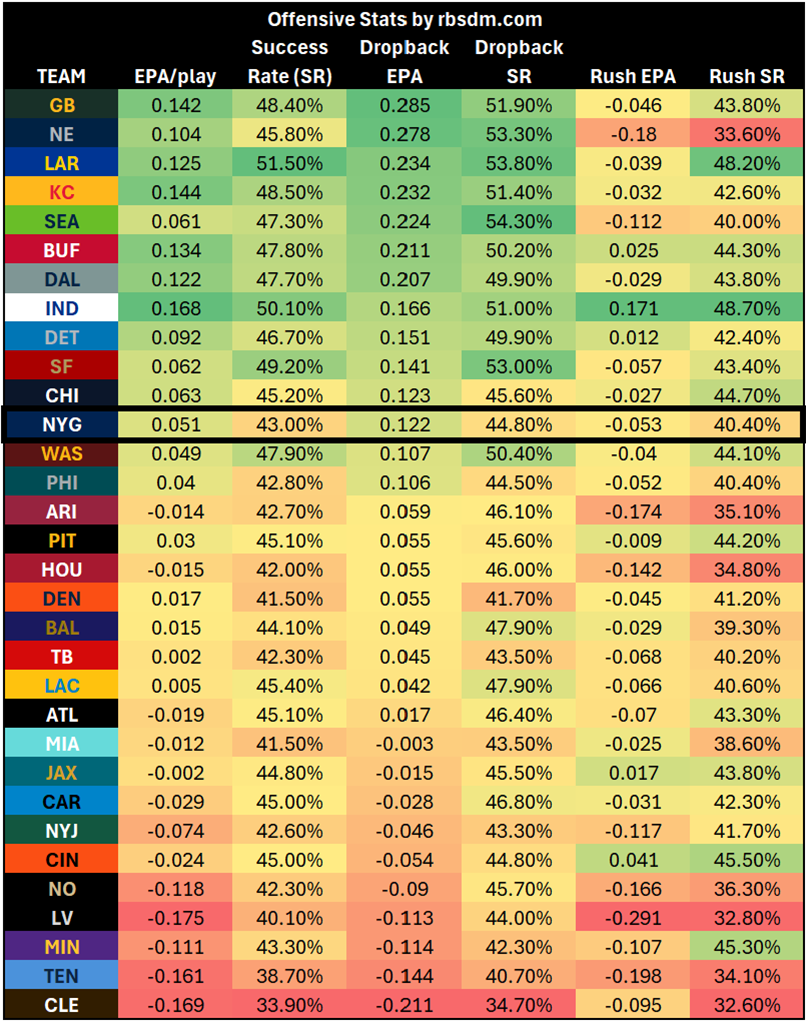
The Giants are 12th in offensive EPA per play and 21st in offensive success rate, indicating they are more likely to hit explosives and less likely to run long, sustained drives. They rank 12th in offensive EPA per dropback and 22nd in offensive success rate on dropbacks.
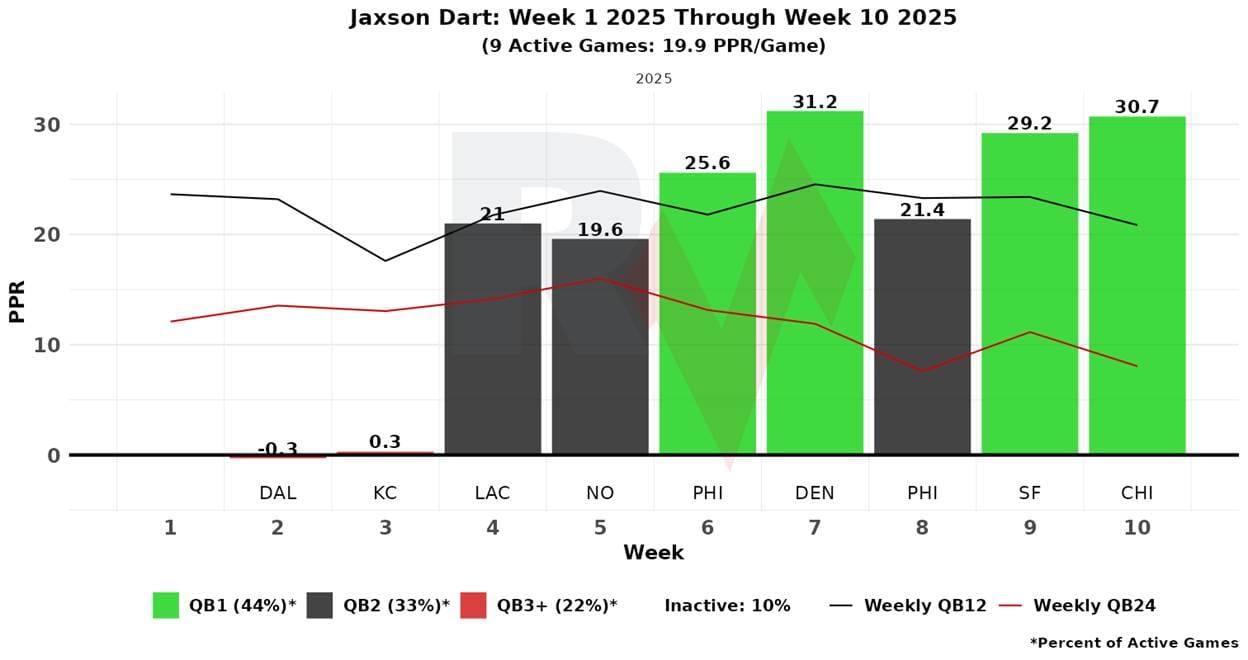
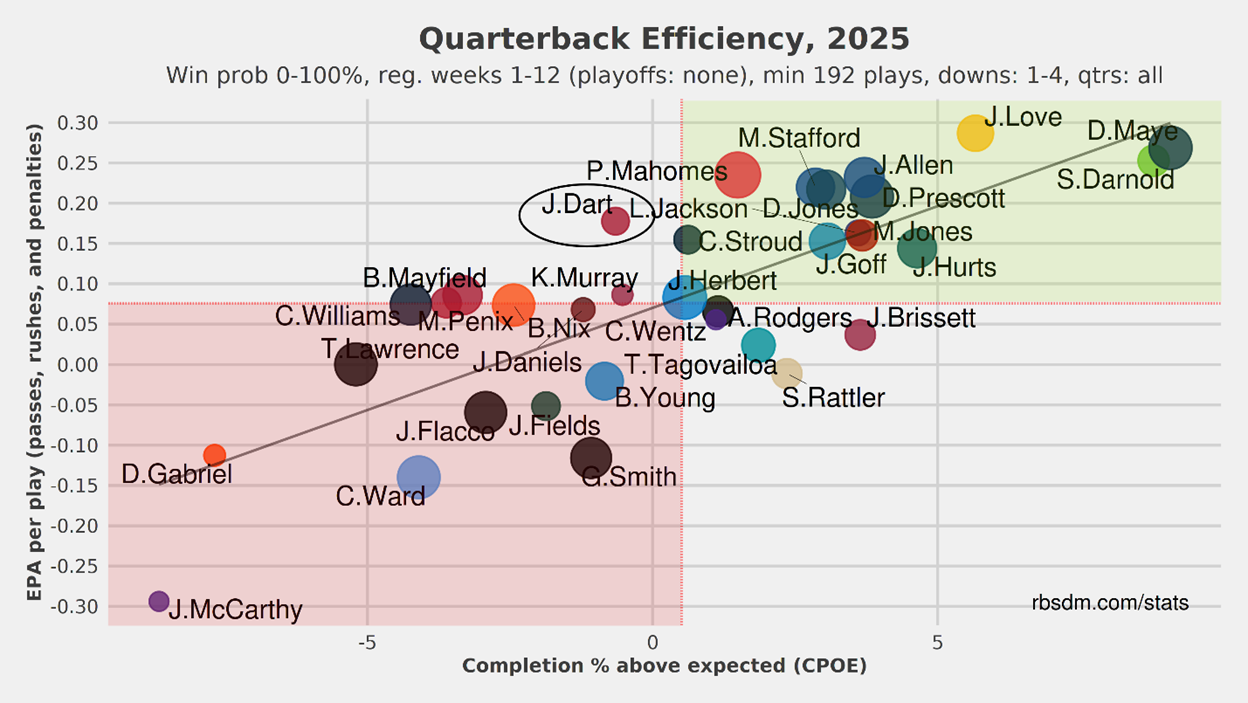
The Giants made the switch early from veteran QB Russell Wilson to rookie first-round QB Jaxson Dart, but a concussion three weeks ago has caused him to cede starts to veteran QB Jameis Winston. Dart returns this week. He has been a reliable force for fantasy football, posting top 12 numbers in four of his last five games, including some very high outputs. Even his misses have been near the QB1/QB2 border.
Dart is buoyed by excellent rushing acumen, which bolsters both his floor and his ceiling. Dart ranks third among all QBs in rushing yards per game, and first among the 32 QBs that will start in the NFL this week. He is reliable and has high upside, regardless of how he throws the football.
As a passer, Dart is efficient but not necessarily consistent. Considering he is a rookie, we’ll take this. Dart ranks above average in EPA per dropback and below average in CPOE.
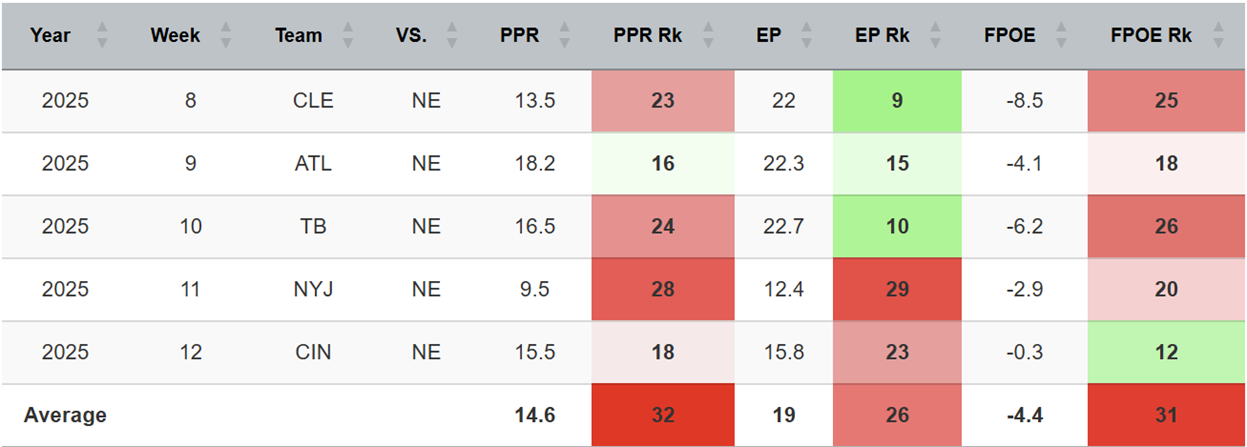
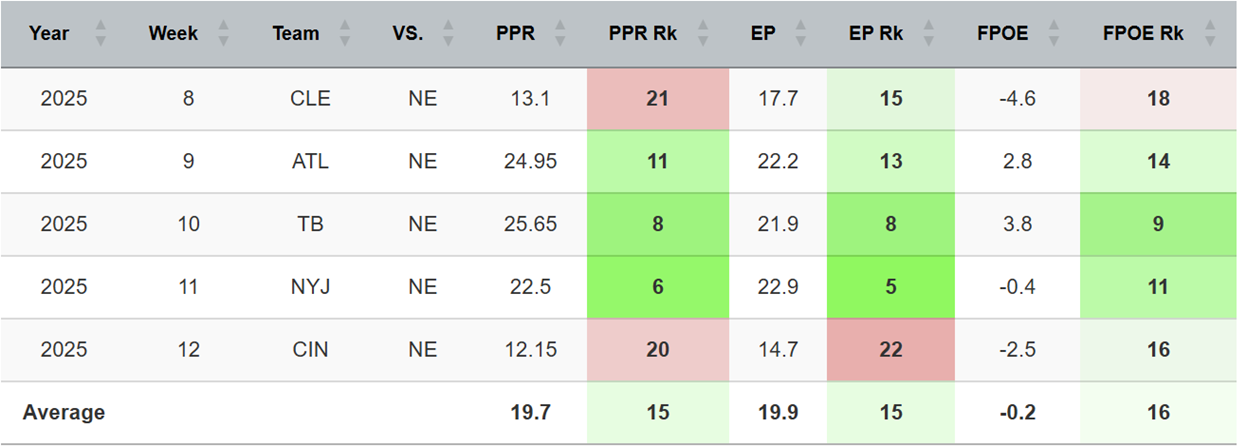
The Patriots have surrendered the 15th-most fantasy points to WRs in their last five games. They have ceded both expected points (EP) and fantasy points over expected (FPOE).
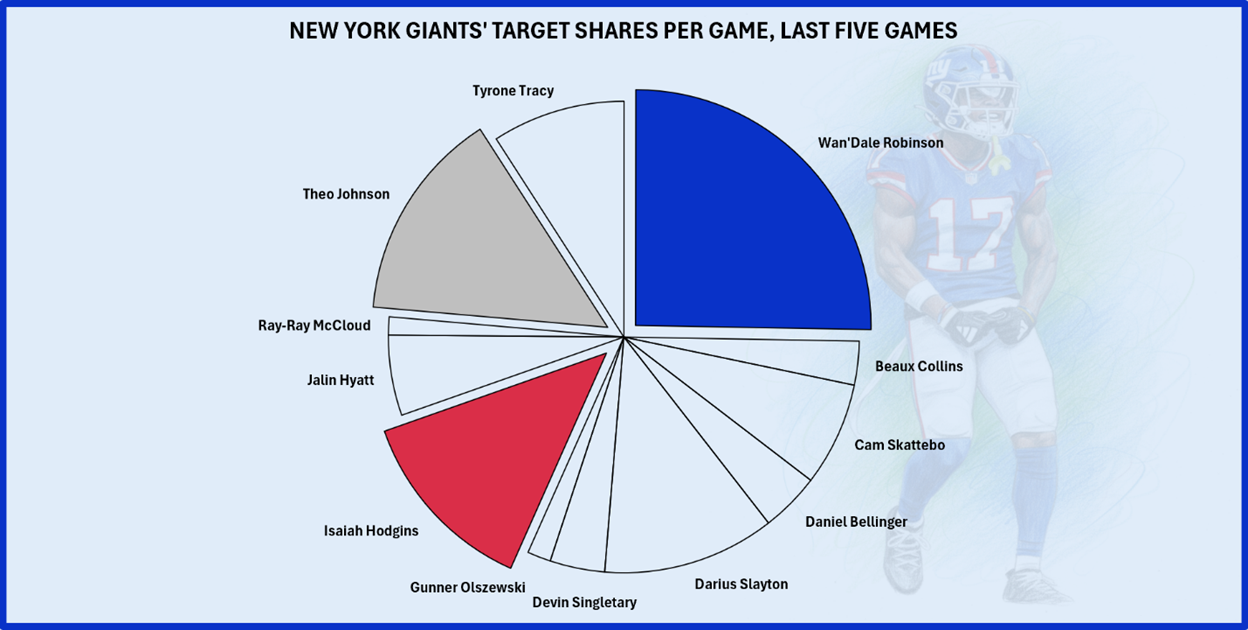
The Giants have three pass-catchers with a target share per game rate over 15% in the last five games: WRs Wan’Dale Robinson and Isaiah Hodgins, and TE Theo Johnson. Hodgins’ target share is drawn from a one-game sample, so this is not a telling portrait of what Hodgins’ usage will be like going forward. He’s a non-factor for fantasy.
Robinson is coming off an incredible game in which he finished as the fantasy WR2 overall. He has had two enormous blow-up games and three total WR1 games. Inversely, Robinson has been outside of the top 24 for eight of his 12 games this season.
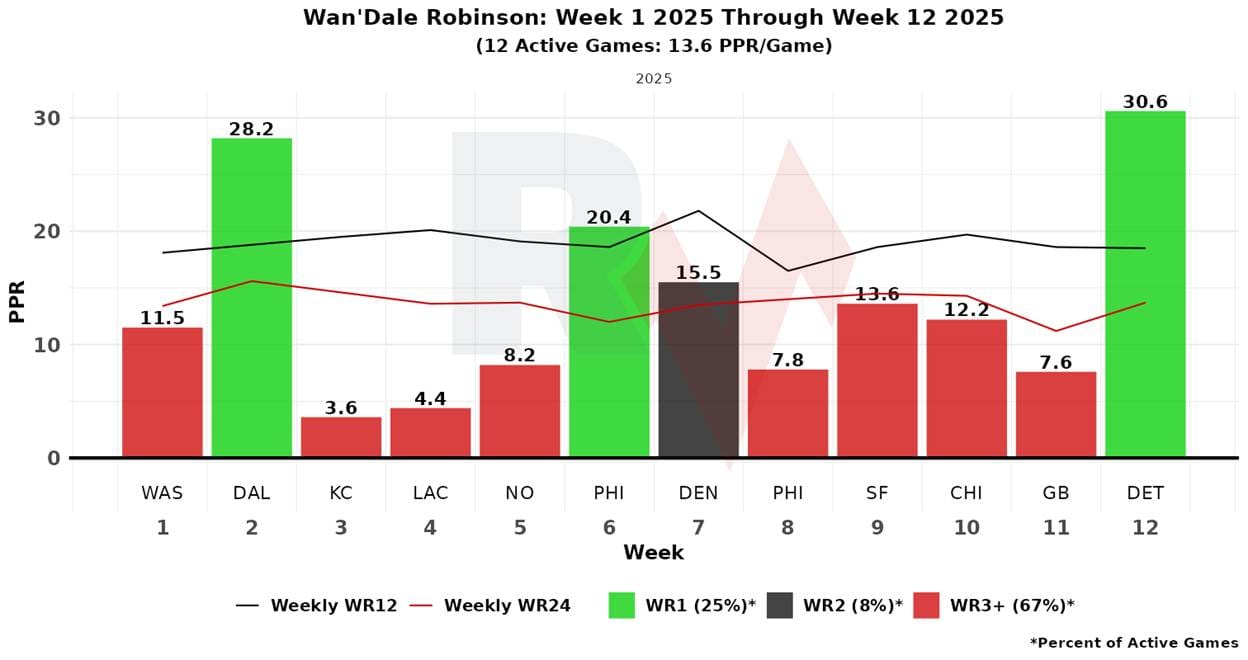
Robinson didn’t profile as a high-upside boom/bust type of guy (although his role has grown and changed with WR Malik Nabers out for the season). Interestingly enough, although we need the benefit of hindsight to know it, Robinson’s two monster games came under very explainable circumstances.
In Week 2 against Dallas, a massive shootout broke out between two teams with no defensive prowess. At that time, Dallas’ defense, decimated by injuries and straight off a Micah Parsons trade, was possibly the worst in the entire league. The game last week, also a shootout, was with Winston, a long-time WR kingmaker, under center.
In general, regardless of the matchup or any other context, it might be prudent to treat these massive outputs as just two outliers in a season that has otherwise gone pretty much as expected. As such, despite Robinson flashing incredible upside, which is almost all I play for, I’m not super excited about him going forward, because I don’t entirely believe in the sustainability of this ceiling.
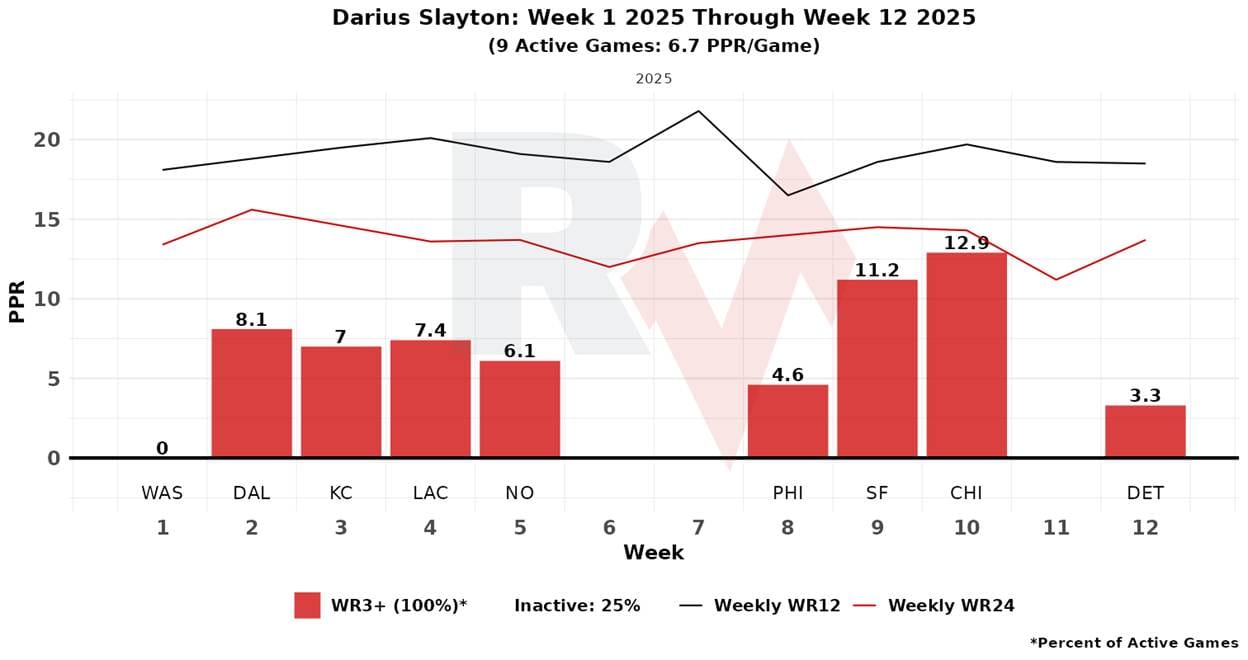
His normal running mate, who has been in and out with injuries throughout the season, is WR Darius Slayton. Slayton has offered no upside. He is unplayable in almost any format.
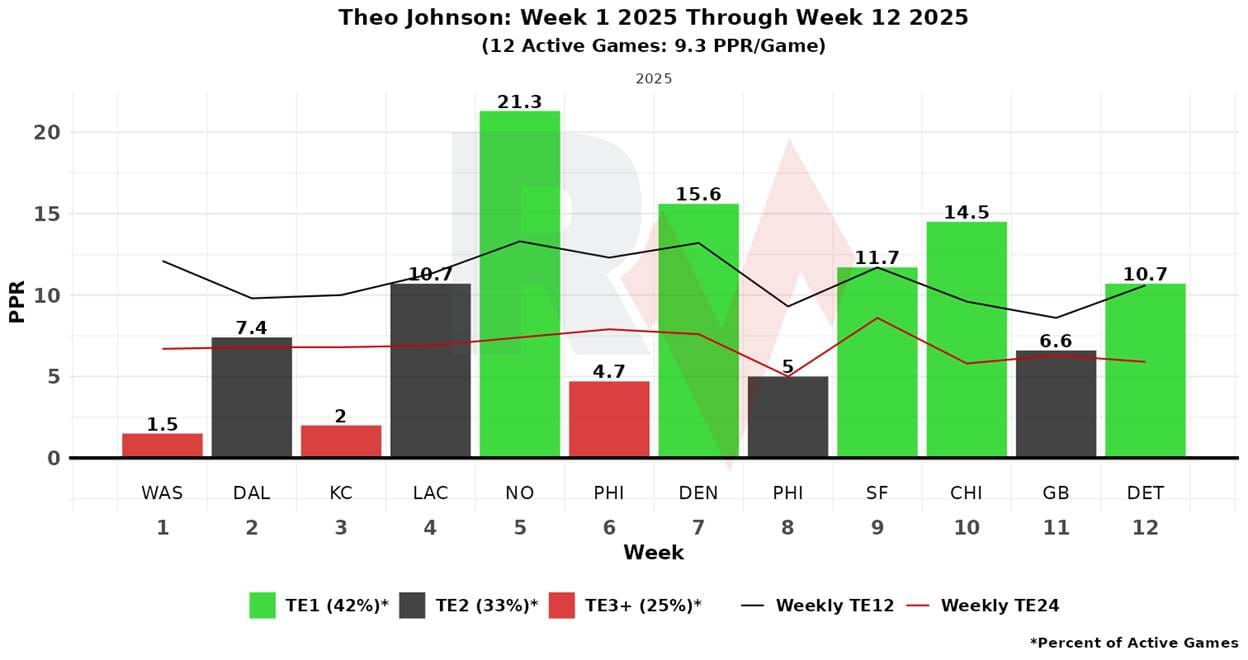
The other weapon of choice in the Giants’ passing game is TE Theo Johnson, who is flirting with a top 12 TE fantasy season. Johnson has been a TE1 more than he has not in the last eight games, putting up five such weeks, including a massive 21.3-point blow-up in Week 5. Johnson’s production has largely been tied to TDs, which have been high but not inordinately so.
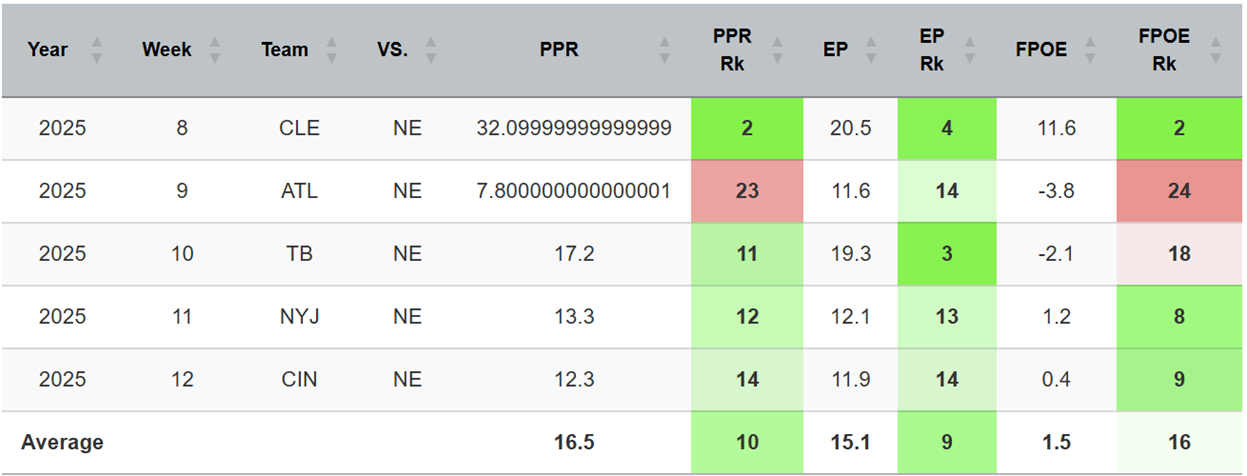
The Patriots have surrendered the 17th-most fantasy points to opposing WRs in their last five games—a sample that is largely pretty weak, considering Ja’Marr Chase’s suspension and Garrett Wilson, Mike Evans’, and Chris Godwin’s injuries.
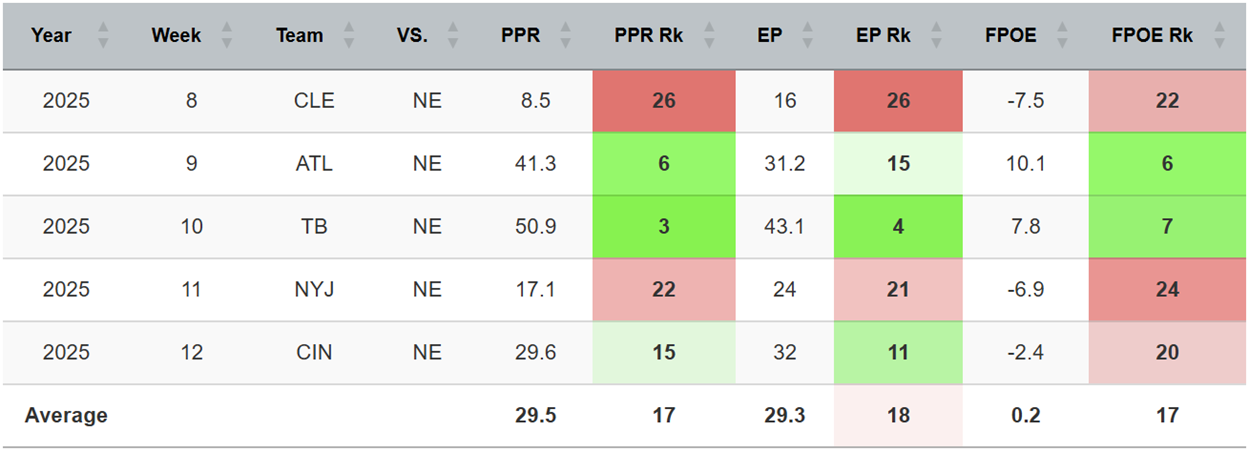
They have also surrendered the 10th-most fantasy points to opposing TEs—another sample without a string of dominant players.
Strictly based on efficiency, the Patriots’ defense is good. They rank above average in both dropback EPA allowed and rush EPA allowed.
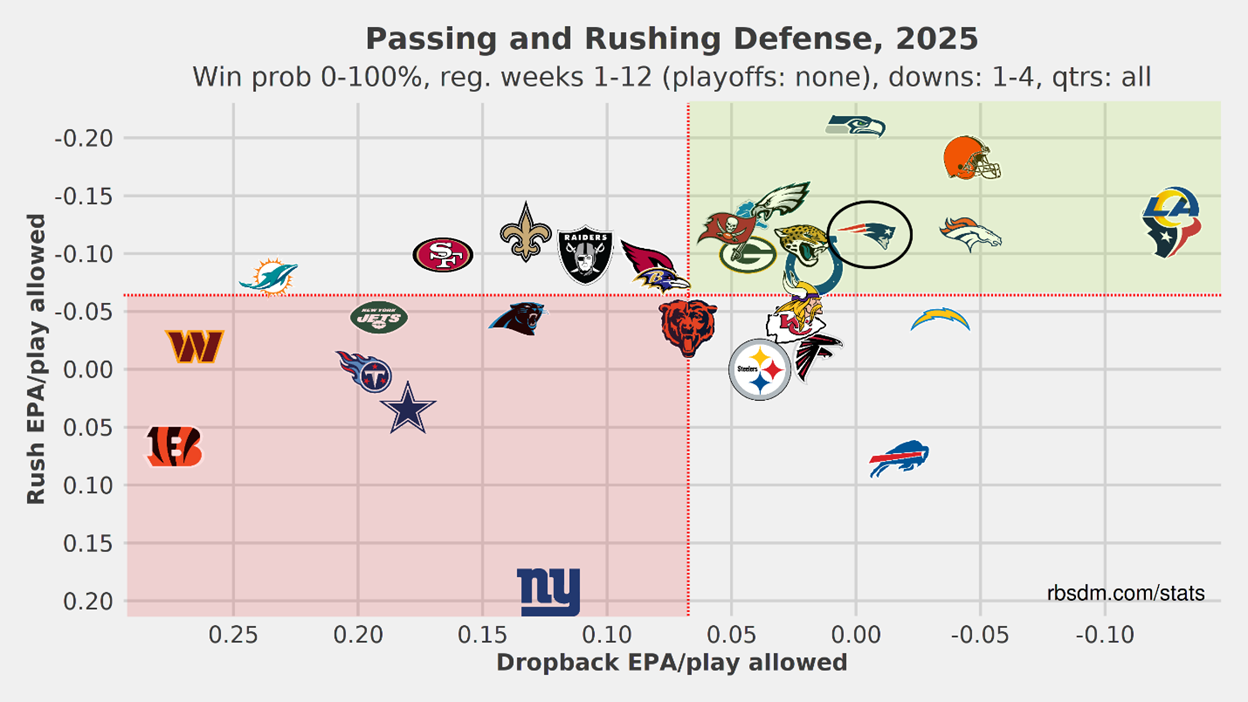
They are, however, imbalanced towards efficiency. The Patriots rank sixth in EPA per play allowed and 20th in defensive success rate. The disparity here means the Patriots are less prone to give up big plays in isolation and more prone to permit long, sustained drives.
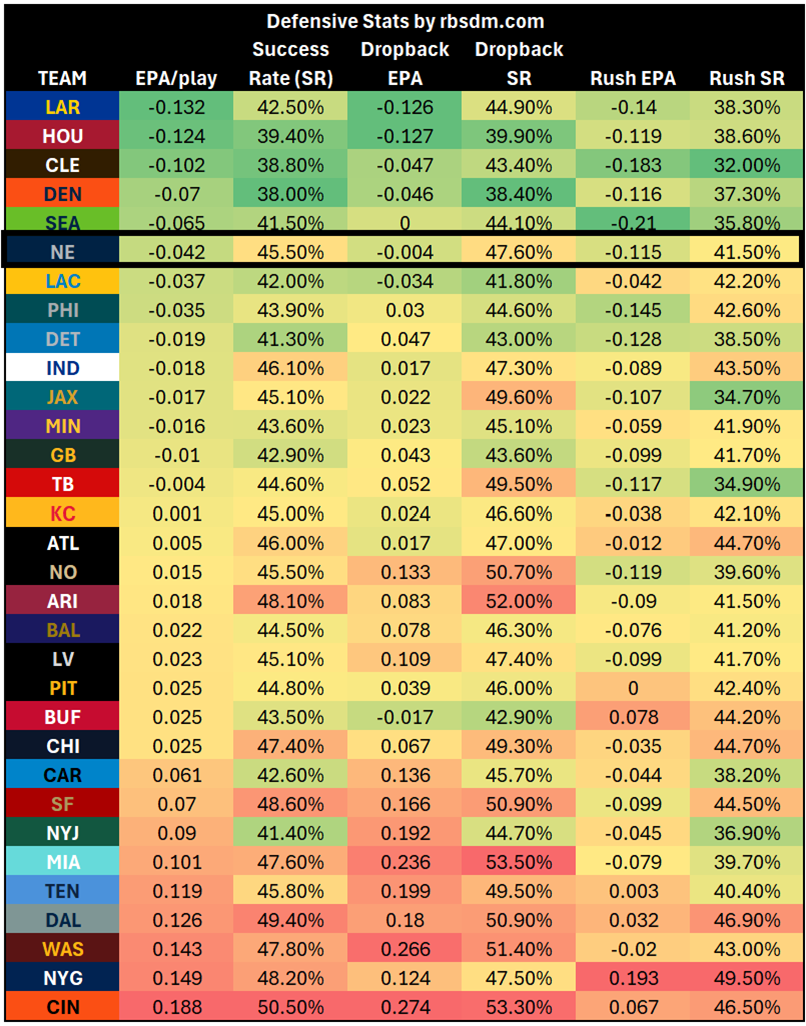
The Patriots rank seventh in EPA per dropback allowed and 21st in defensive success rate on dropbacks.
They run a zone defense just 69.6% of the time (18th), and they run almost an even mix of single-high and two-high safety. They run three alignments more than 20% of the time: Cover 3 (26.8%), Cover 1 (24.0%), and Cover 2 (21.3%). They blitz at a rate of 21.6%, which is below average.
Fantasy Points’ coverage matchup tool assigns a zero-based matchup grade to each pass-catcher based on their opponent’s use of specific types and rates of coverage and how that pass-catcher performs against them. Positive numbers indicate a favorable matchup and negative numbers indicate an unfavorable one.
Based on this tool, both Robinson (+5.2%) and Slayton (+2.0%) have slightly favorable matchups, while Johnson (-2.1%) has a somewhat unfavorable one, although all three are dangerously close to completely neutral.
PFF’s matchup tool is player-based, pitting the PFF ratings of individual players against each other for an expected number of plays based on historical tendencies, then rating them on a scale from great to poor.
According to this model, Johnson’s matchup grades out as fair, while Robinson’s and Slayton’s grade out as poor.
I wouldn't be overly excited to play any New York pass-catcher, although, if the game script goes as it should, they may be chasing. This provides a pathway to a safe floor if it comes to fruition.
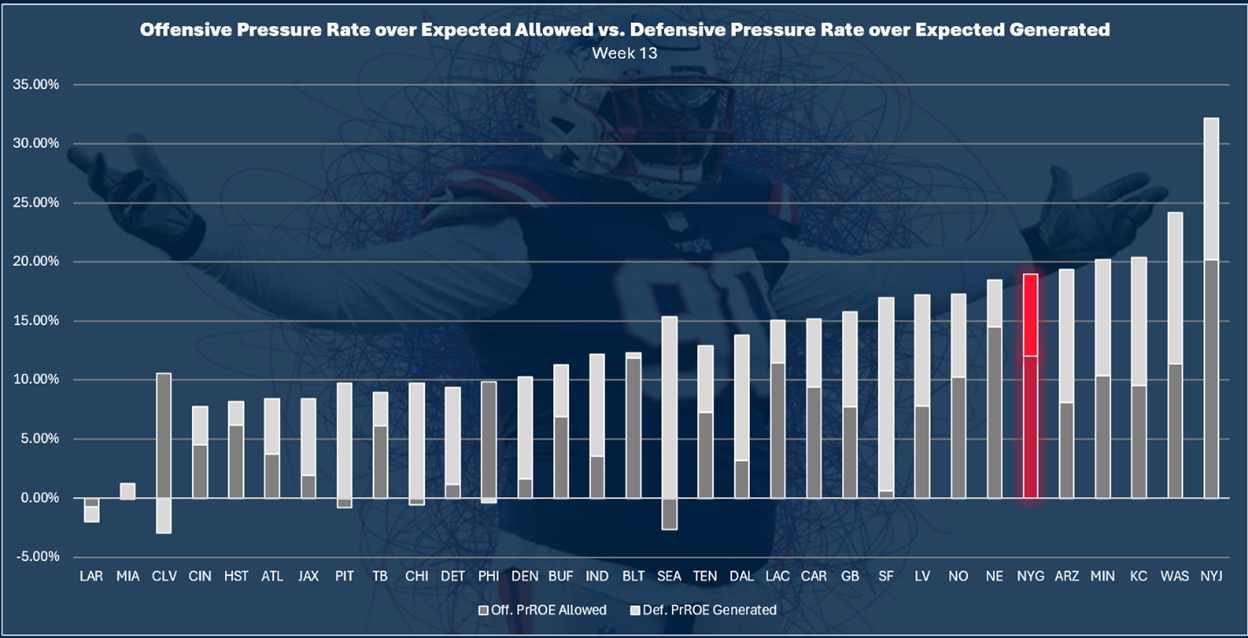
The Giants are poor in pass protection; they have allowed a pressure rate over expected (PrROE) of 12.03%, 30th, only better than two teams, one of which is New England. Defensively, New England is below average, generating only a 3.09% PrROE, but relative to the Giants, it should still have a defensive pass-rush advantage.
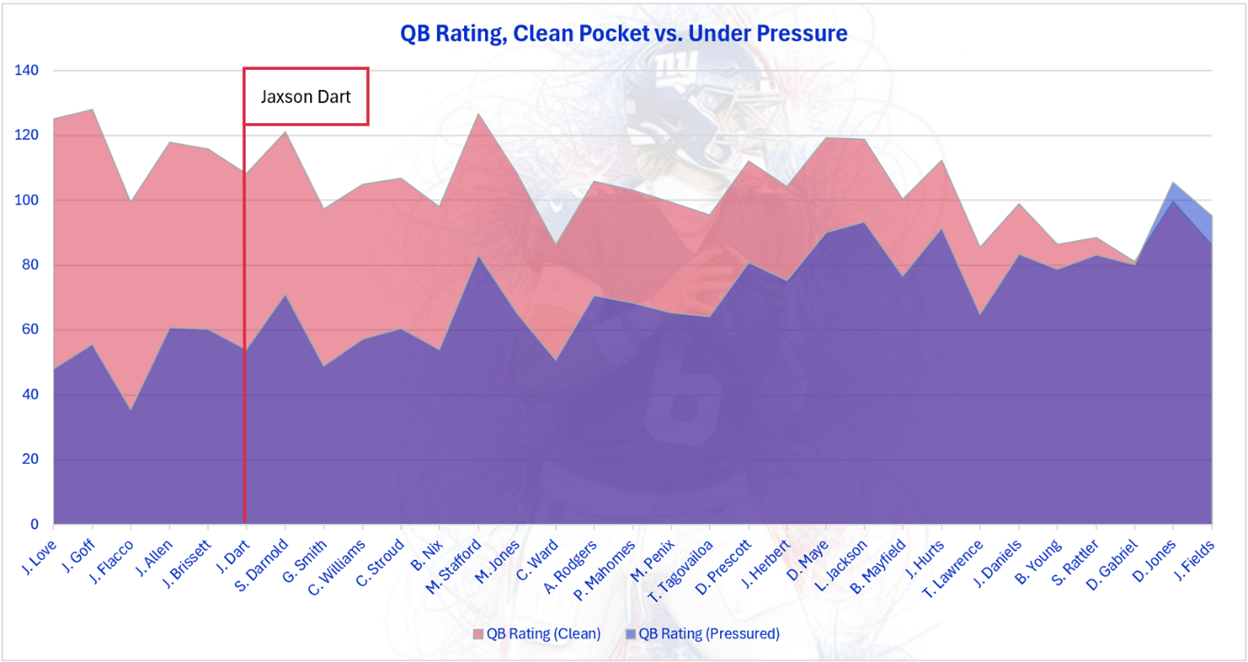
Under pressure, Dart is markedly worse at passing the ball. His QB rating dips by 54.1 points while pressured vs. from a clean pocket. The good news for GMs using Dart is that this is something that happens every week, so his fantasy production should be as it usually is.
The Giants rank 18th in offensive EPA per rush and 21st in offensive success rate on rushes. The Patriots rank 10th in EPA per rush allowed and 15th in defensive success rate on rushes.
They have played four games since rookie RB Cam Skattebo, who had taken control of the backfield, was lost to a season-ending leg injury. In the first of those games, the Giants insisted on a larger share for RB Devin Singletary, but quickly learned the error of their ways and leaned heavily into RB Tyrone Tracy instead.

Tracy has posted back-to-back weeks at the RB1/RB2 edge line. With this usage and this role, he could have more where that came from, especially with a target share above 10%. However, he is tough to trust this week.
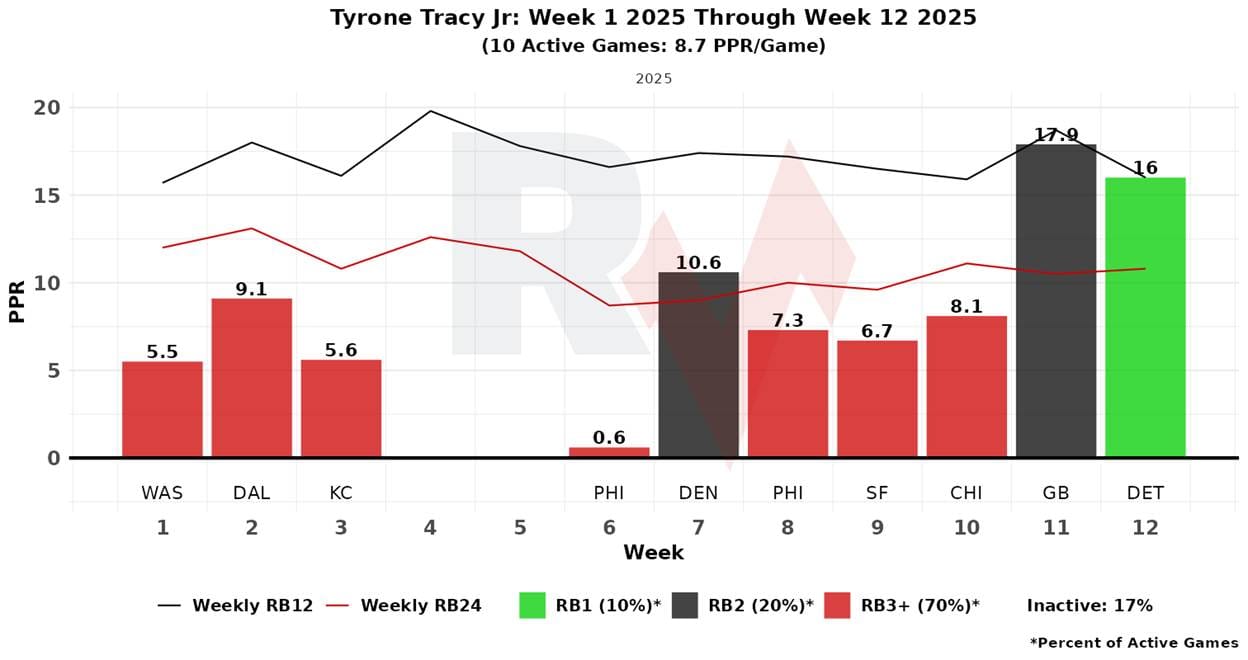
The Patriots’ defense has surrendered the fewest points in the league to RBs—something that they’ve done against some pretty formidable runners. They’ve held the line both in terms of EP and FPOE, so they are simply rock-solid in any context.