Quick Slant: MNF - This Dreadful, Often Painful Cause

Mat Irby’s Quick Slant
I’ve committed an unreasonable amount of my life to sports, and if you’re with me here, odds are you have as well (hell, getting through my intros alone requires the devotion of a Labrador). Still, it’s worth pausing now and then to ask what keeps us coming back.
Oftentimes, the stories written on Sundays are like allegorical accounts of the stories we’ve lived, are living today, or will be tomorrow. There is something innately human that connects us to the successes of those who devote themselves to some incredible task—something that takes more of them than they probably ever thought possible—only to see it all crescendo to a tearful anthem atop a podium or a rush of humanity charging the field the moment a ball hits a glove.
Likewise, we see ourselves in their failures. They strip away the myth and let us see truth. They are communal; any experience connects us with those who are there to share it. Strange as it may sound, we practice the discipline of loss through the failures we experience in sports. When we condition ourselves to feel the sting of loss in a context we are passionate about, but which is ultimately untragic, we are more prepared to experience it when the consequences are graver.
And then there is another thing that losing in sports can become, which is possibly far greater: those occasional but sensational doses of redemption.
There’s a scene in Rocky Balboa (2006) where Rocky’s son challenges him to pull out of a comeback fight against a far younger opponent. He can’t bear the association with Rocky; he knows he has become a laughingstock. Additionally, he blames him for so many of his own failures. It prompts Rocky to interject: “You, me, or nobody is gonna hit as hard as life. But it ain’t about how hard you hit. It’s about how hard you can get hit and keep moving forward. How much you can take and keep moving forward.”
If I may take a personal detour, I’m from Dallas, and I’m 47. In the '90s, the Cowboys delivered me three titles as a teenager as if they were owed to me; in ’99, the Stars, a team I had only known for a short time, brought home the Stanley Cup. These were cool experiences, but as convenient as canned soup.
But with the Mavericks, I bled.
The Mavericks were the worst franchise in American team sports in the ’90s. Others in town absconded, exchanging Mavericks’ green and blue for the reds of the Bulls and Rockets, but I’m not wired that way, so I stuck it out. Through the 2000s, it got better, but the Mavericks were perennial bridesmaids, coming close and falling short time and time again.
But then, one year, it just happened. The final buzzer rang on an improbable run, and Dallas held O’Brien in its outstretched palms. And let me tell you: In that moment, I was rewarded for my loyalty to this dreadful, often painful cause because all of it became a pretext to the impossible. In that moment, as the confetti finally rained down in 2011, the very notion of impossible was defeated. And in that, life in general seemed a little more conquerable, too. Through sports—this silly little distraction I so often feel unduly obsessed with—I learned that fewer dreams than I had previously realized should be viewed as off-limits. This lesson is pervasive in sports to varying degrees.[1]
This summer, the world was convinced that Steelers QB Aaron Rodgers was washed up. This fall, his team is in first place in the AFC North, and Rodgers is instrumental in that.
Five weeks ago, Dolphins HC Mike McDaniel was set for a Monday morning firing after a 2–7 start; he was inexplicably spared. The Dolphins haven’t lost since and are now in the wild-card hunt.
And as they meet, these survivors who have taken the hits life had for them—who have moved forward and kept moving forward—one will fail. And by that failure, the likelihood that they sit at home while the NFL story is written without them this January grows increasingly overwhelming. And this loss will be added to the sum of a fanbase’s shared trauma.
But one will win; in that victory, the community will become a little less divided, galvanizing around a common good. In it, they will realize they were worthy all along. In it, there will still be a nearby tomorrow with hope for something special that could restore a city's whole hope in humanity.
Dolphins
Team Implied Total: 19.25
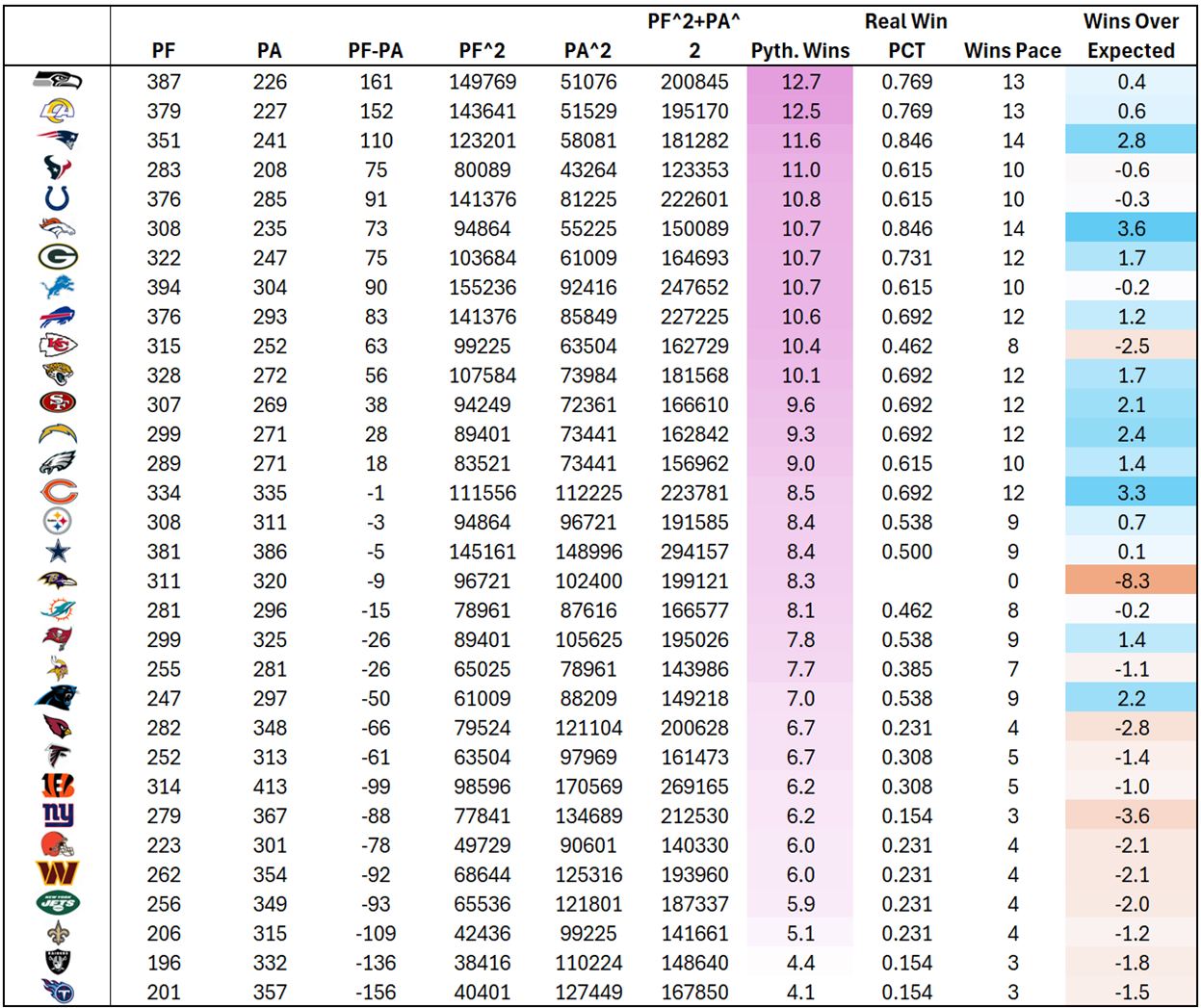
The Dolphins and Steelers’ records seem to match their quality; they are each on pace for about the same number of actual wins as expected wins—both around eight.
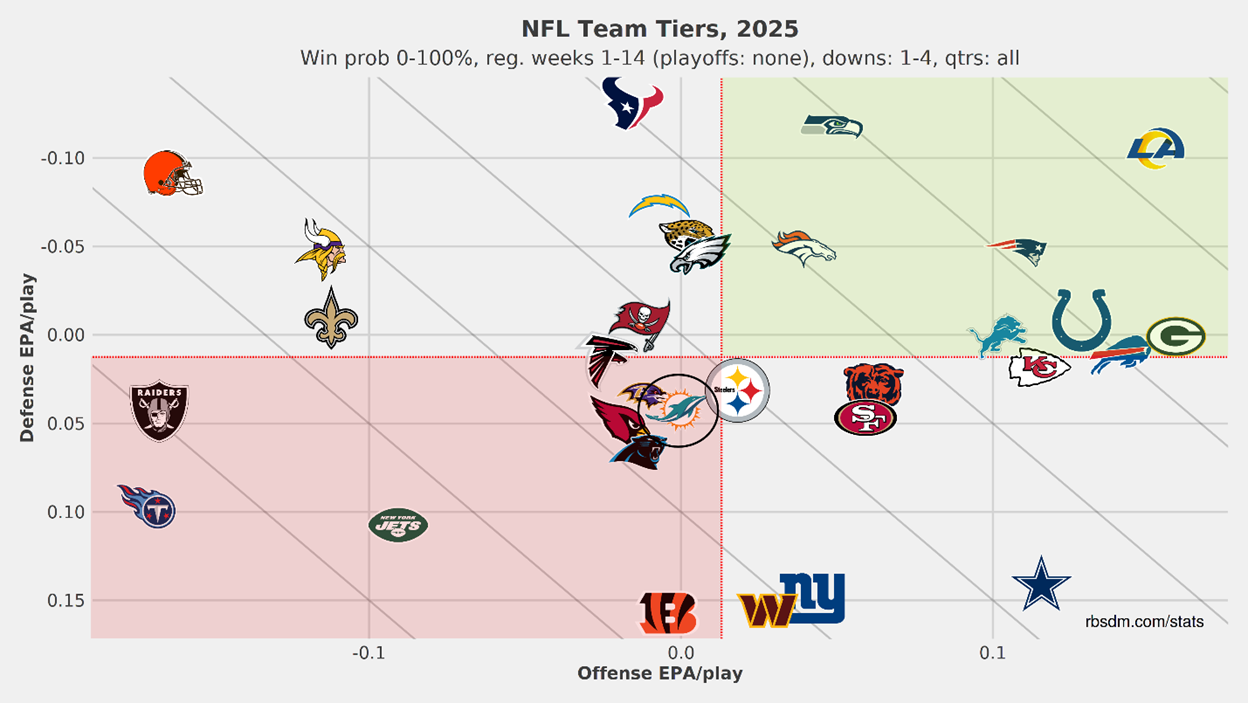
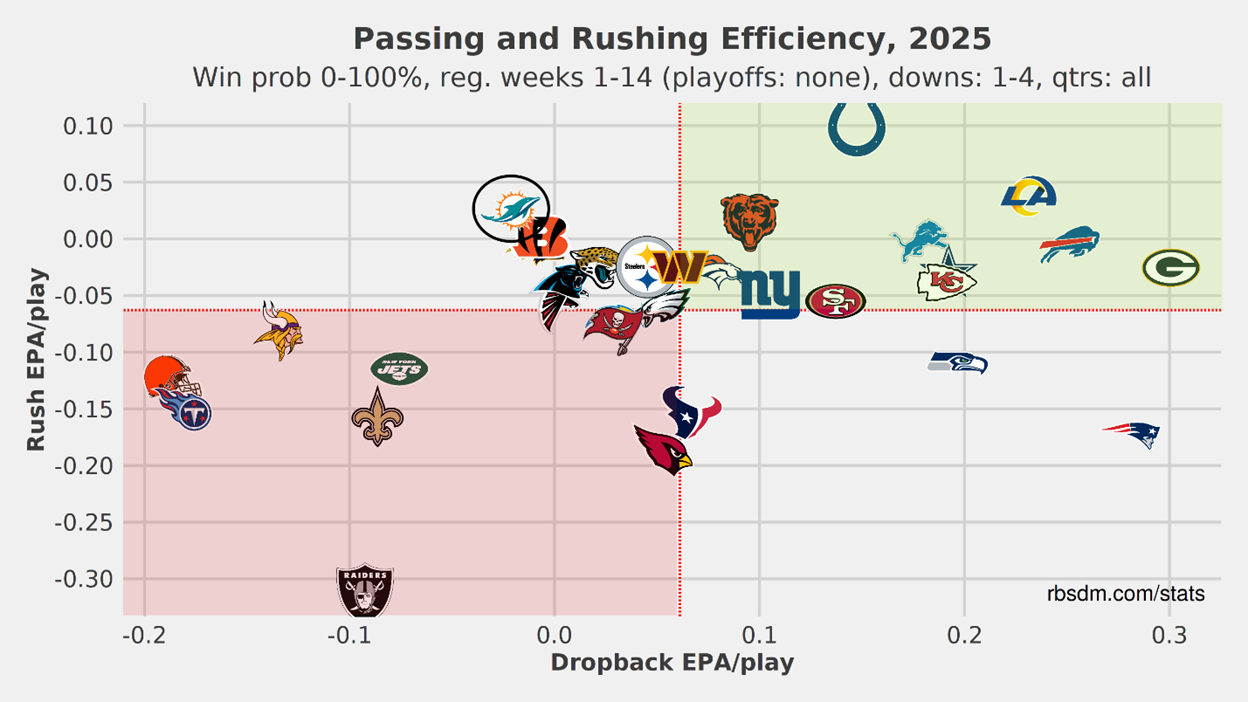
The Dolphins are a little below average in both offensive and defensive EPA.
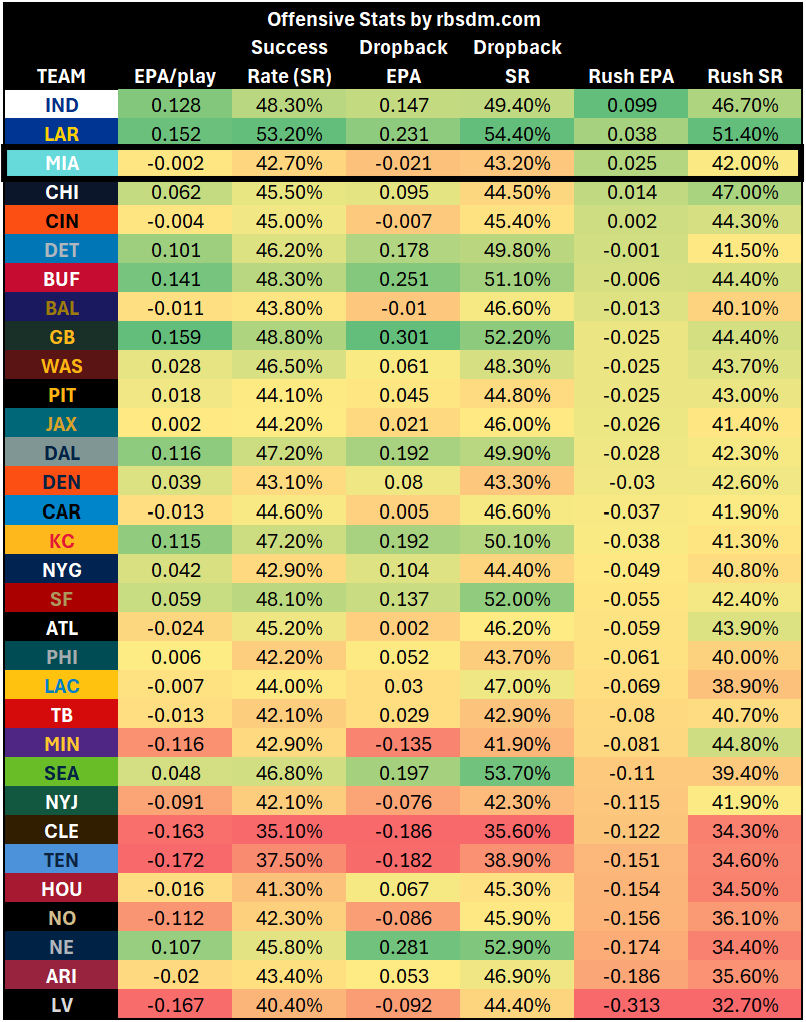
Offensively, the Dolphins are below average in dropback EPA and above average in rush EPA.
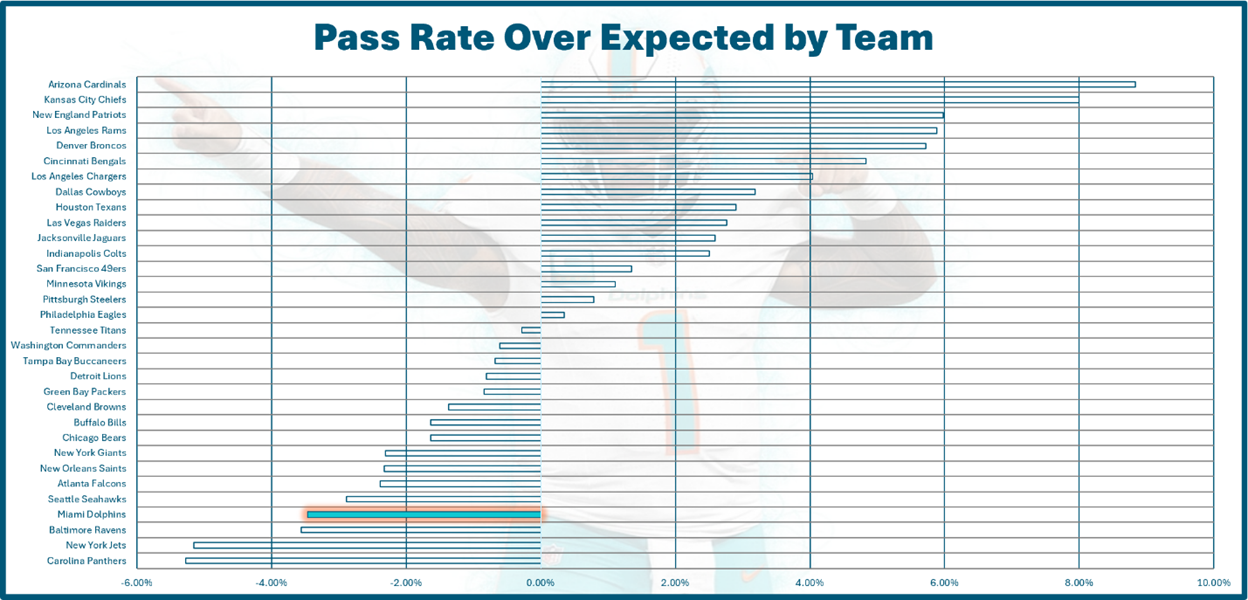
The Dolphins are a Shanahan system, which are traditionally slow at the line of scrimmage. The Dolphins average 28.8 seconds per offensive snap (31st). They have a 56% pass rate (T-19th). Their pass rate over expected (PROE) is -3.46% (29th). All in, they have just 413 team dropbacks (31st); only the Seahawks have fewer.
The Dolphins rank 18th in offensive EPA per play and 24th in offensive success rate. They rank 26th in offensive EPA per dropback and 27th in offensive success rate on dropbacks.
They are led by QB Tua Tagovailoa, who has 406 dropbacks (20th), converting them into 356 passing attempts (20th). Tagovailoa in the McDaniel system has historically had a low average depth of target (aDOT) and short time to throw (TTT); both are true this season. Tagovailoa has an aDOT of 7.3 (37th) and a TTT of 2.48 (1st).
In the past, this has been sustainable because Tagovailoa's teammates were so efficient. With WRs Tyreek Hill and Jaylen Waddle, RB De’Von Achane, and TE Jonnu Smith—all yards after catch (YAC) mavens carrying high yards per route run (YPRR) averages—the quick game worked to create more first downs, longer sustained drives, and more TDs. Tagovailoa even led the NFL in passing yardage in 2023, running a similar system.
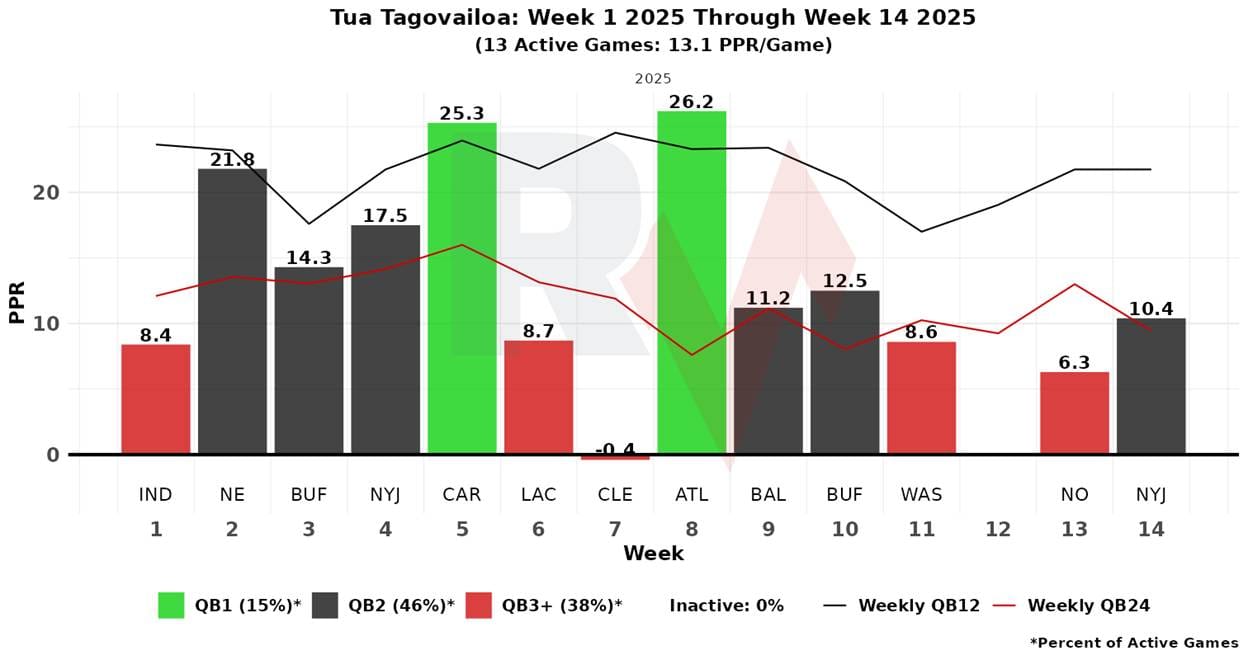
The current iteration of the Dolphins is less efficient. With less dependable volume, yardage totals, and TD production, Tagovailoa has become a pretty poor fantasy asset. With no real rushing component to lift his floor and ceiling, a low-volume Tagovailoa relies upon TDs more than ever, and they’re not coming often enough (18, T-17th). Tagovailoa has only been a QB1 twice all season, and even then, only barely. He has never demonstrated high upside. He has finished outside of the fantasy top 24 five times.
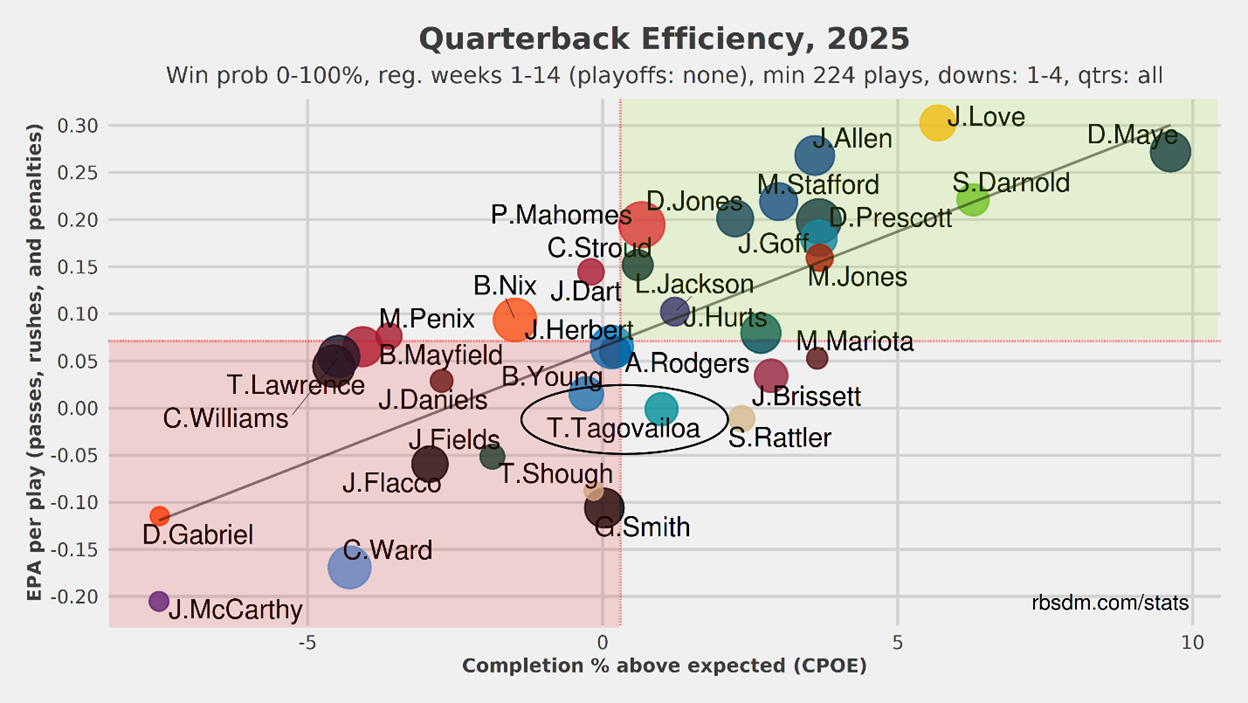
Tagovailoa is still above average in CPOE; his EPA is below average, reinforcing all of this.
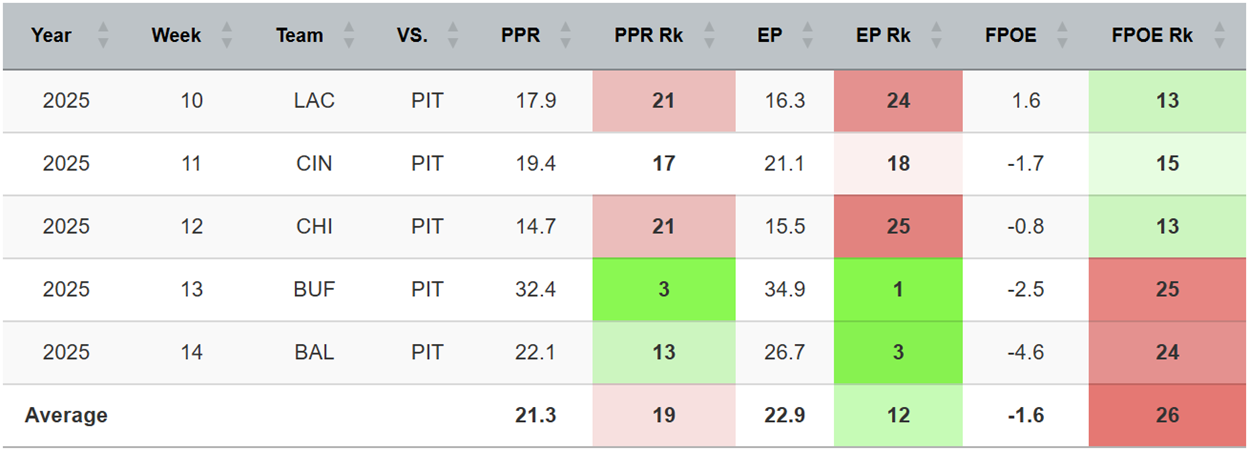
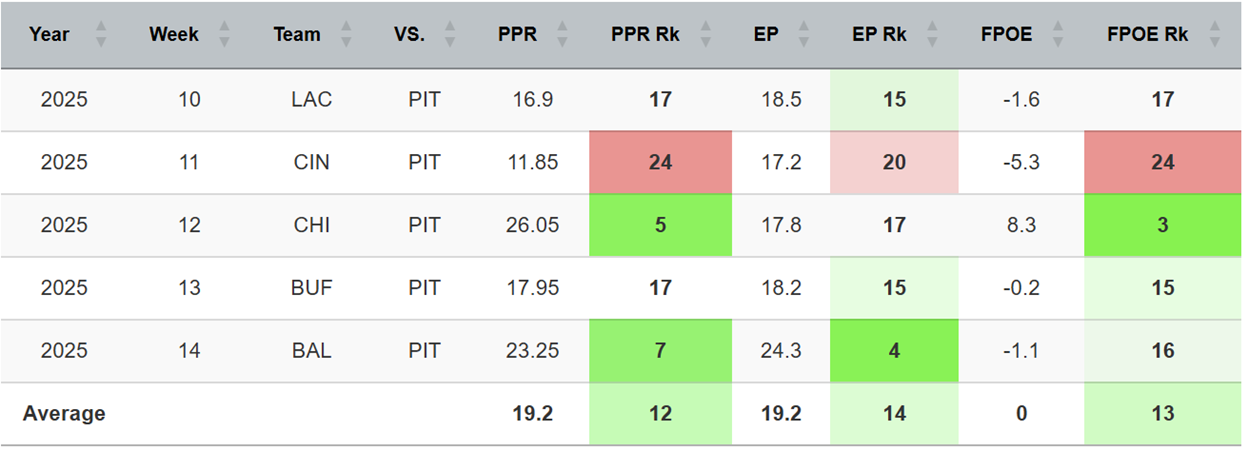
The Steelers have allowed opposing QBs the 12th-most fantasy points in their last five games. This has included Justin Herbert, Caleb Williams, Josh Allen, and Lamar Jackson—some decently heavy hitters (Joe Burrow was not yet back from his injury in Week 11).
One of the main differences in this version of the Dolphins and the ’23 version, which led the NFL in total yardage, is that the ’23 version had WR Tyreek Hill at the height of his powers, averaging 3.72 YPRR. This season marks Hill’s second lost season in a row after a gruesome knee injury he suffered in Week 4; at age 31 and so dependent upon raw athleticism, Hill will probably never return to what he was.
Without Hill, the Dolphins have leaned on Jaylen Waddle, who has a target share per game rate of 28.0% in his last five games. The only other Dolphins player to have a target share per game rate greater than 15% over that same span is Achane (18.4%).
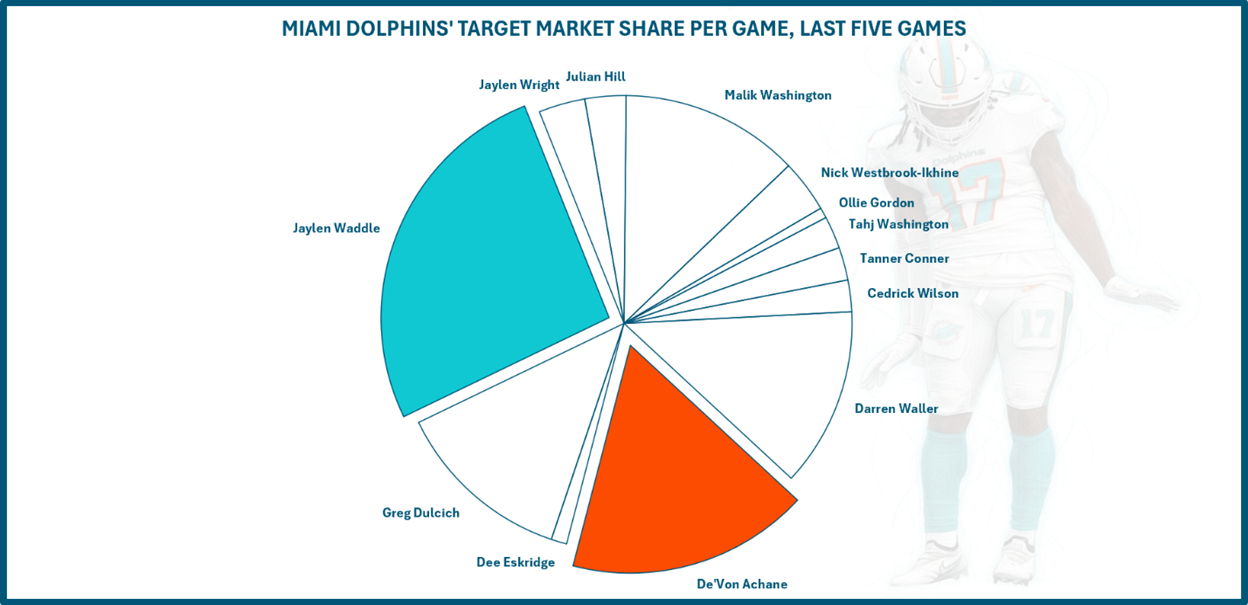
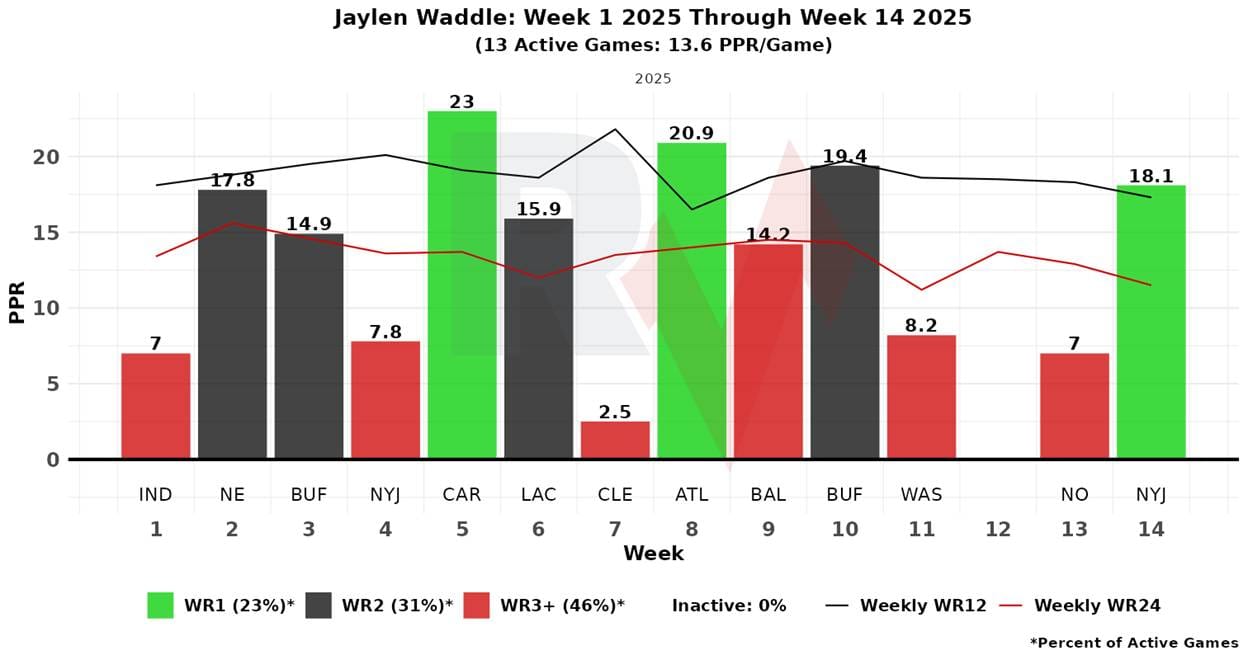
The fact that the target share is so concentrated on a small number of players is good since the Dolphins’ passing volume is down this season. A high target share has kept Waddle in the fantasy conversation, drawing 85 targets (25th). Waddle is still a high-efficiency player with a 2.29 YPRR (12th), so he can overachieve from that base and regularly end up as a WR1 (three times) or a WR2 (four times). Waddle is a bit volatile, probably due to the Dolphins’ low total play volume, hitting single-digit PPR scores five times. In general, the upside is probably worth the downside in most managed builds.
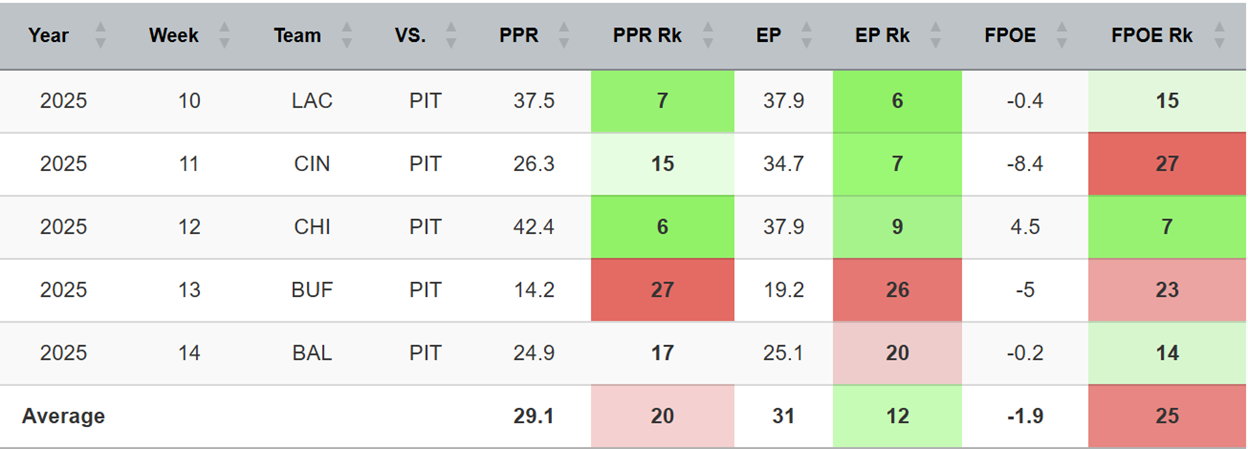
The Steelers have surrendered the 20th-most PPR points to opposing WRs this season. The disparity between their expected points (EP) rank and fantasy points over expected (FPOE) rank indicates that they are frequently thrown upon, but the Steelers are pretty decent at holding their own defensively.
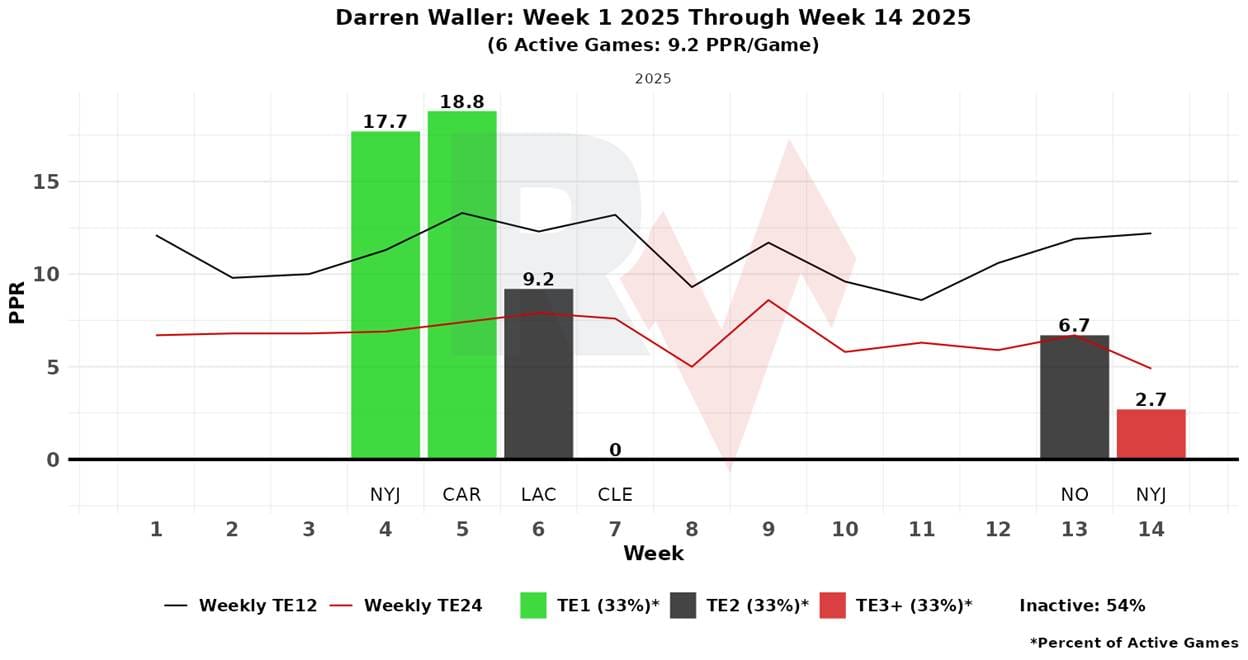
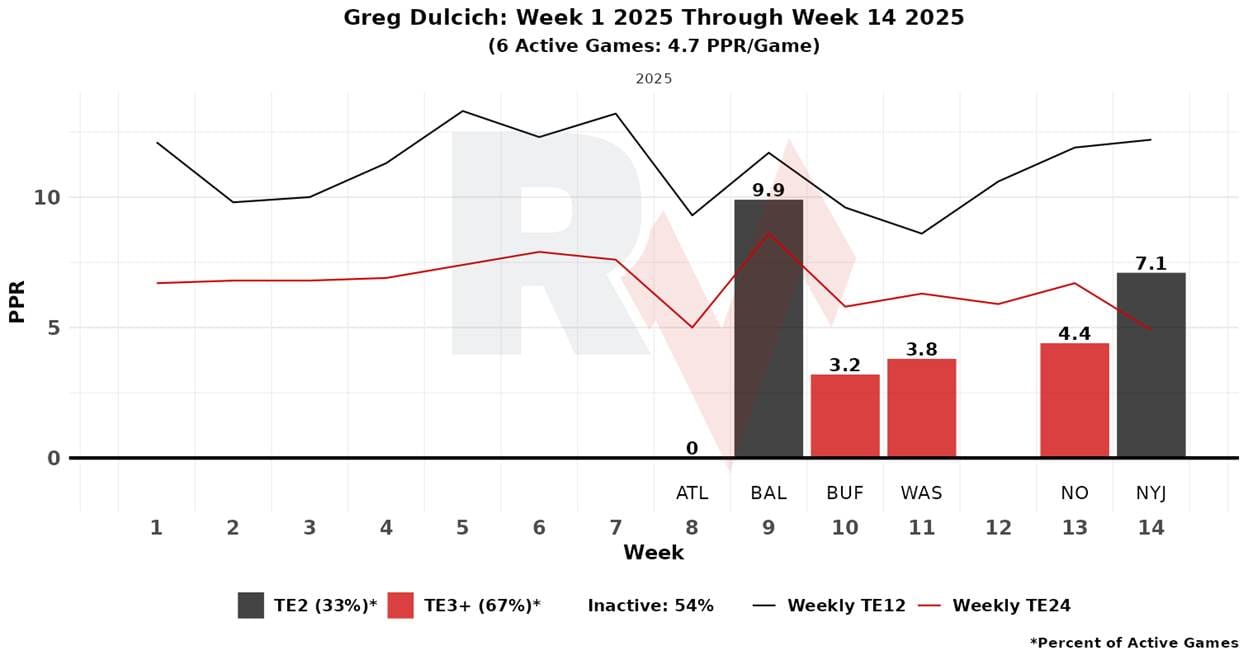
Miami signed TE Darren Waller off the street this offseason after trading Jonnu Smith to Pittsburgh. He performed well in two of his first three games, and like that, he was gone with an injury. While he was away, TE Greg Dulcich operated as the team’s de facto receiving TE; since Waller returned two weeks ago, Dulcich has maintained a larger snap share (although not as high as TE Julian Hill’s, a blocking TE who has run five routes). Still, Waller has run more routes, 31-21, and drawn six targets to Dulcich’s five. This is not a very sustainable amount of work for either.

It has to be assumed that Waller is the lead TE at this point. He would seemingly be entirely dependent on a TD for fantasy production.
Dulcich is no great shakes, although for the desperate in two-TE or TE-premium formats, one might be able to use him as a sneaky under-the-radar play. This is a low-floor, low-ceiling option, which we avoid when we can.
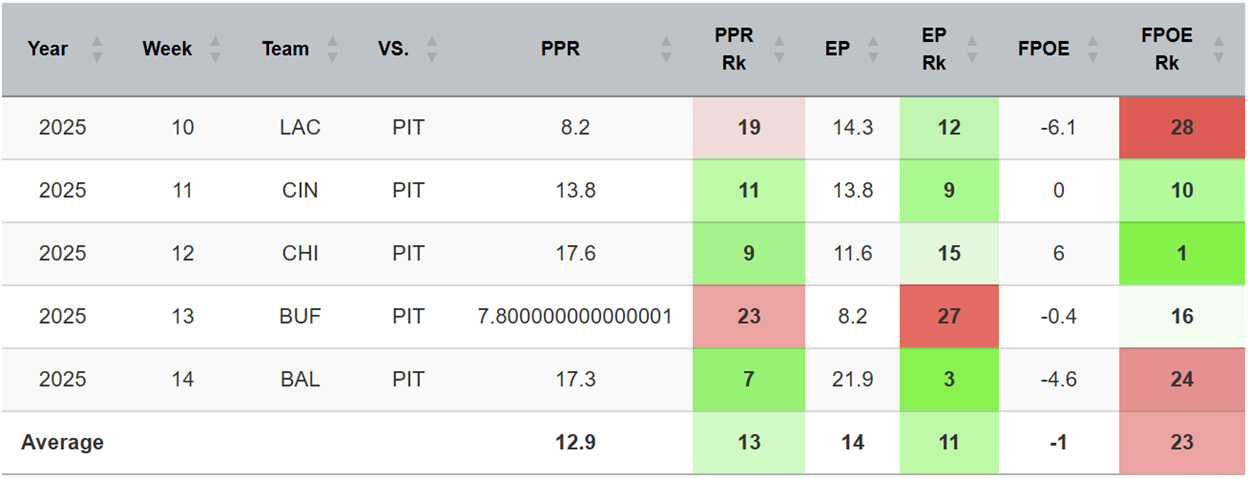
The Steelers have given up the 13th-most fantasy points to TEs in their last five games. As with WRs, they have been stricter about FPOE allowed vs. EP allowed.
Pittsburgh ranks 19th in EPA per play allowed and 18th in defensive success rate. They rank 13th in EPA per dropback allowed and defensive success rate on dropbacks.
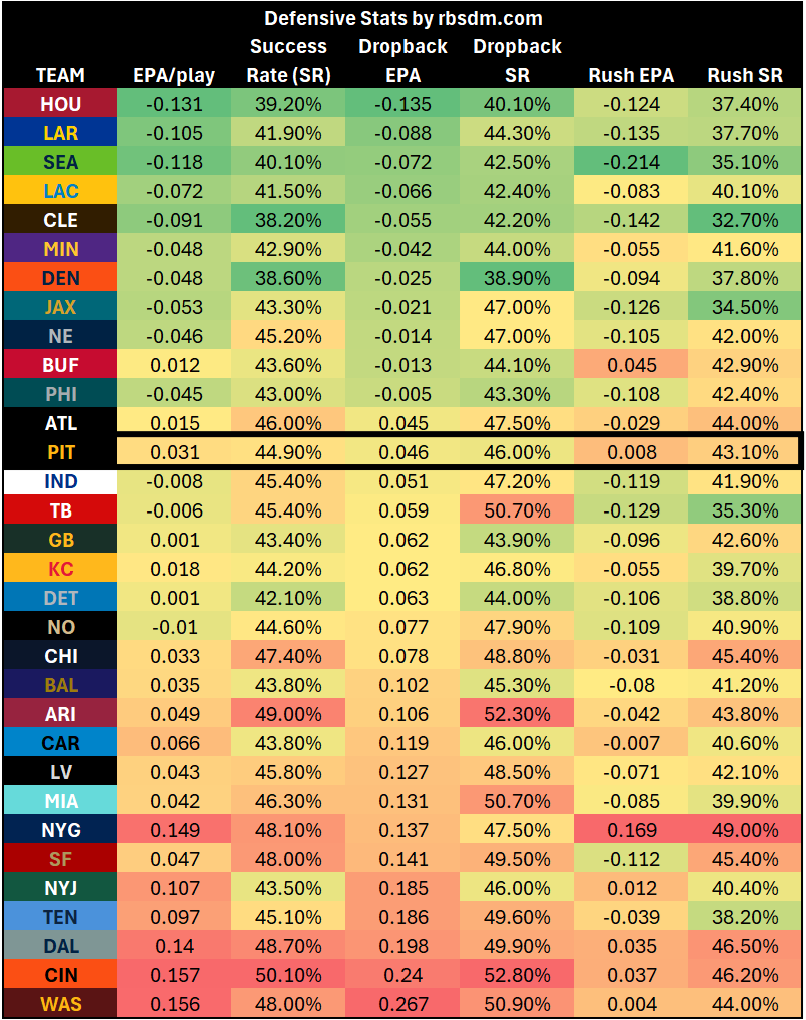
The Steelers are above average in dropback EPA allowed and below average in rush EPA allowed.
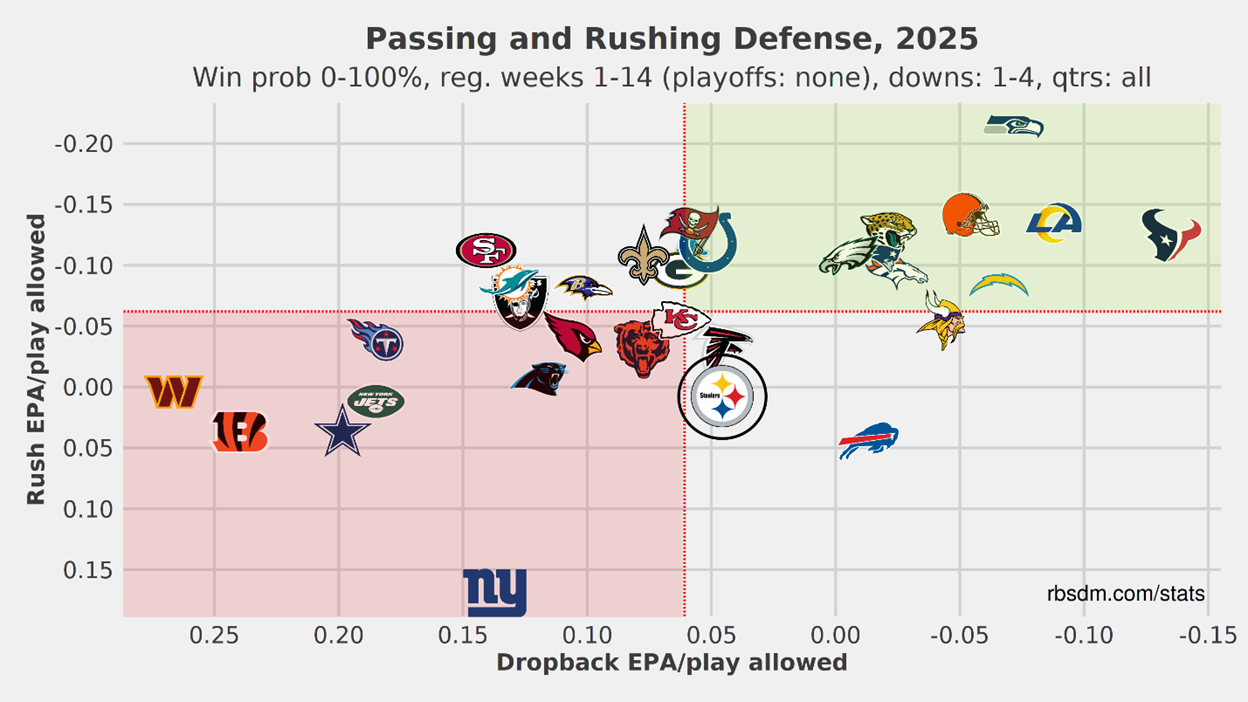
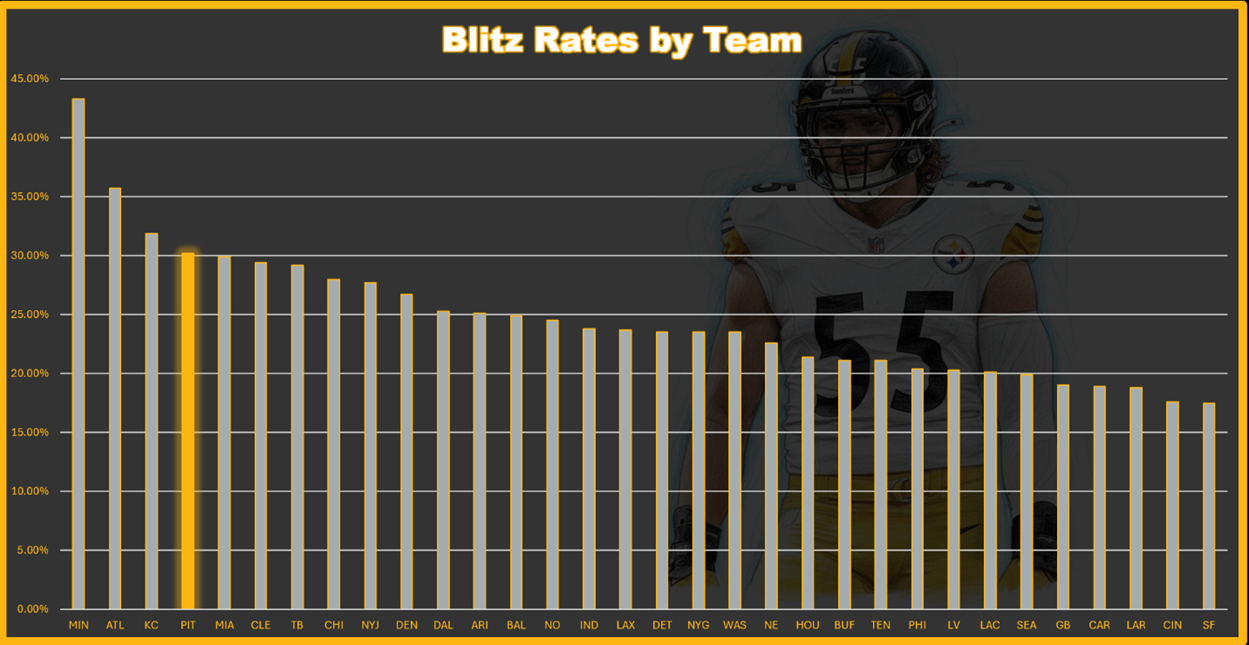
The Steelers use man coverage on 34.2% of their defensive plays (7th) and single-high safety on 58.5% of their plays (6th). Their most common alignments are Cover 3 (31.9%) and Cover 1 (26.2%). They blitz at a rate of 30.2% (4th).
Fantasy Points’ coverage matchup tool assigns a zero-based matchup grade to each pass-catcher based on their opponent’s use of specific types and rates of coverage and how that pass-catcher performs against them. Positive numbers indicate a favorable matchup and negative numbers indicate an unfavorable one.
Based on this, Waddle (+2.7%), Achane (+8.1%), and Dulcich (+1.2%) all grade out as favorable matchups; Waller’s (+34.4%) grades out as a highly favorable matchup.
PFF’s matchup tool is player-based, pitting the PFF ratings of individual players against each other for an expected number of plays based on historical tendencies and rating on a scale from great to poor.
Based on the specific player matchups, Waddle’s matchup grades out as great, while Waller’s grades out as fair, and Dulcich’s grades out as poor.
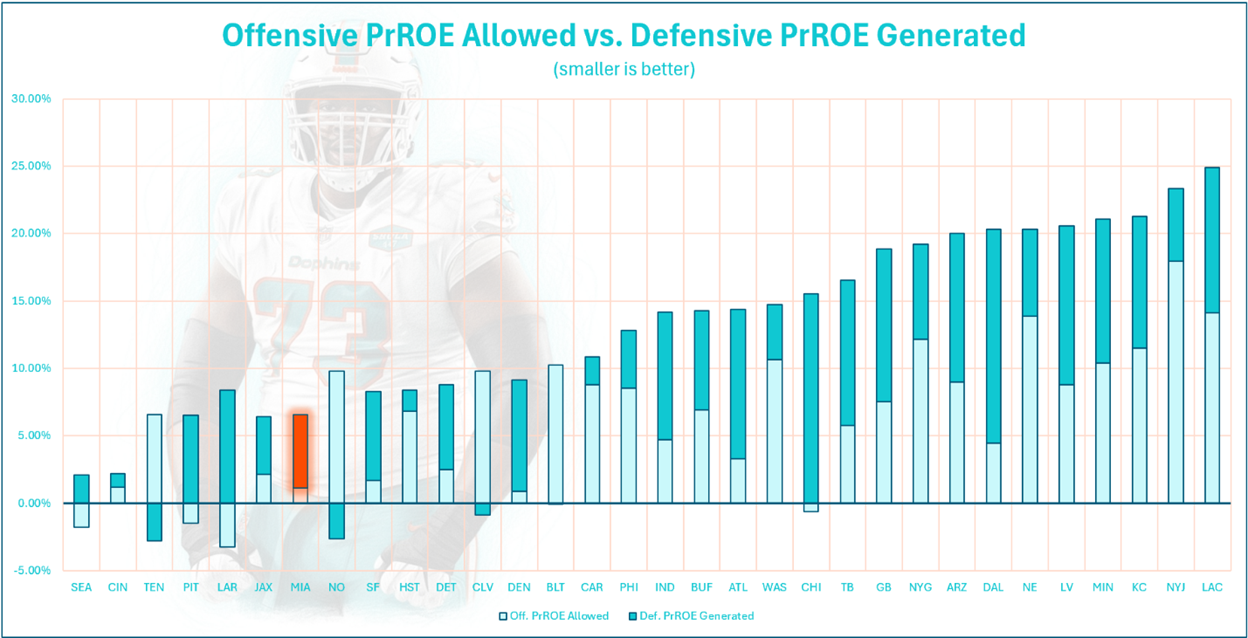
The Dolphins show up as excellent in pass protection, though their quick, short-passing scheme makes it difficult to know where the players end and where the scheme begins. As it is, they only allow a pressure rate over expected (PrROE) of 1.12% (6th). The Steelers generate a 5.43% PrROE defensively (20th), giving the Dolphins a hefty advantage in pass blocking.
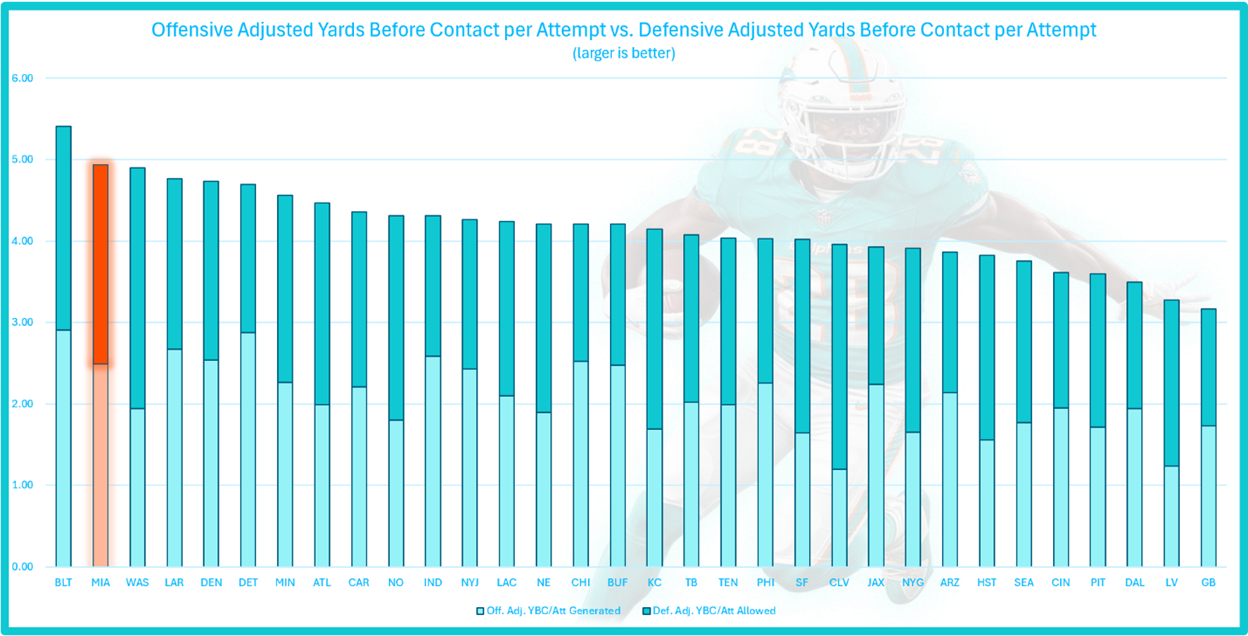
The Dolphins also generate 2.49 adjusted yards before contact per attempt (adj. YBC/Att, 7th). The Steelers allow 2.45 adj. YBC/Att). This is the second most significant run blocking advantage of the week, in favor of Miami’s offense.
The Dolphins rank third in offensive EPA per rush and 14th in offensive success rate on rushes. This is intuitive because Achane is small but incredibly explosive.
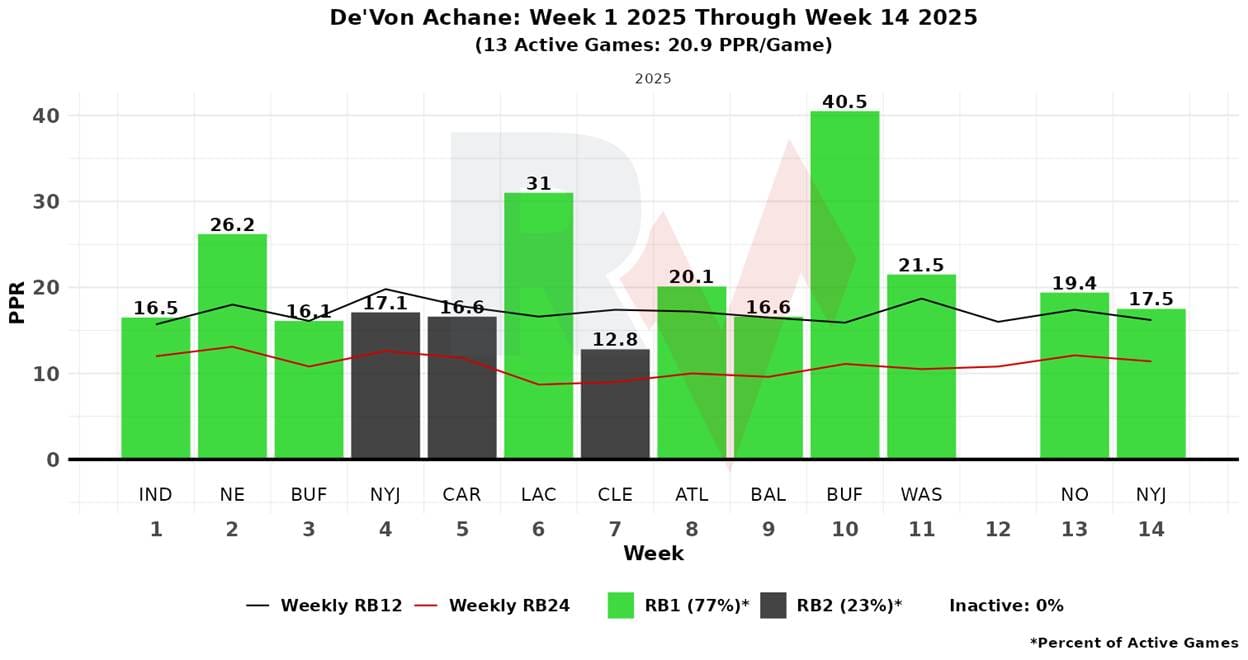
Achane is one of the highest floor/highest upside RBs in fantasy. He has been an RB1 in 10 of 13 games, and an RB2 in the other three.
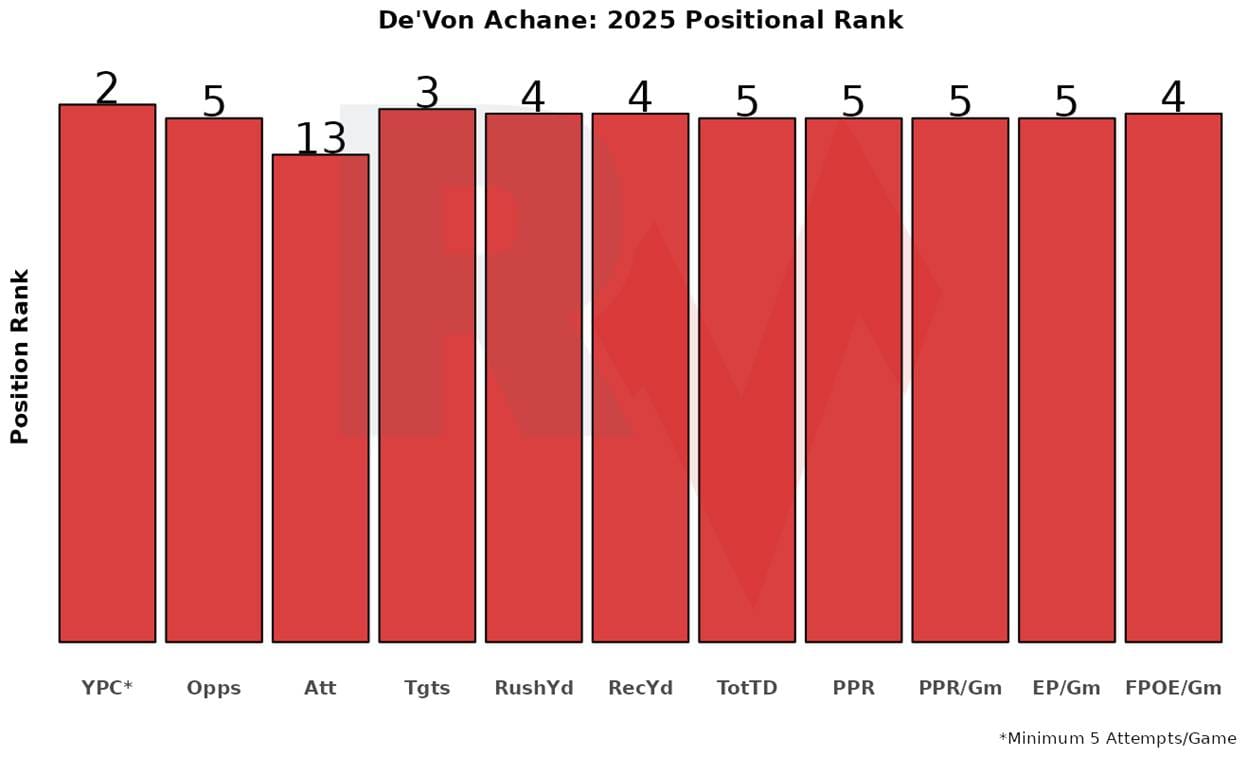
Achane is among the best RBs in the NFL in almost every notable statistical category. He ranks in the top five in opportunities, rushing yards, receiving yards, total TDs, EP, and FPOE. He ranks third in rushing yards over expected (RYOE), one of the most predictive upside stats for RBs. He has rare speed; among players with at least 100 rush attempts, Achane is first in percentage of runs going for 15 yards or more (10.4%) and 20 yards or more (6.2%), and is third in runs going for 30 or more yards (2.6%).
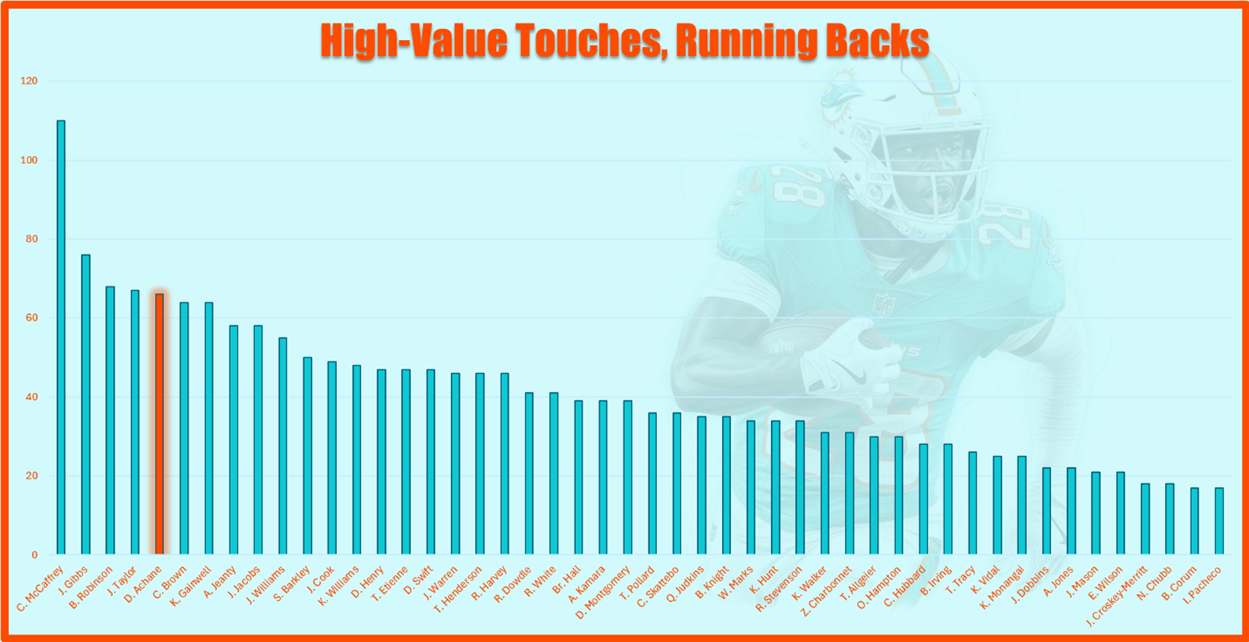
Achane is also an elite pass-catching RB, hauling in the second-highest target share (19.5%) among RBs for the season behind only Christian McCaffrey, and the fourth-highest YAC (458). Achane has 66 high-value touches (HVTs, 5th).
Achane will be active for Sunday night’s game, but he did leave last week’s game early. As we know, injury aggravations occur; if Achane were to miss time, it seems apparent, based on their usage while he was out last week, that RB Jaylen Wright is the direct handcuff. Using Wright this week wouldn’t be recommended. But if he’s out there in your managed league, he could have an effective role, so if you feel you need another handcuff or two to stash, you could consider him.

Pittsburgh ranks 27th in EPA per rush allowed and 24th in defensive success rate on rushes. They have allowed the 19th-most fantasy points to RBs. Same as it ever was. There is a disparity between EP and FPOE.