Quick Slant: Saturday Edition - Conquering on Their Minds

Mat Irby’s Quick Slant
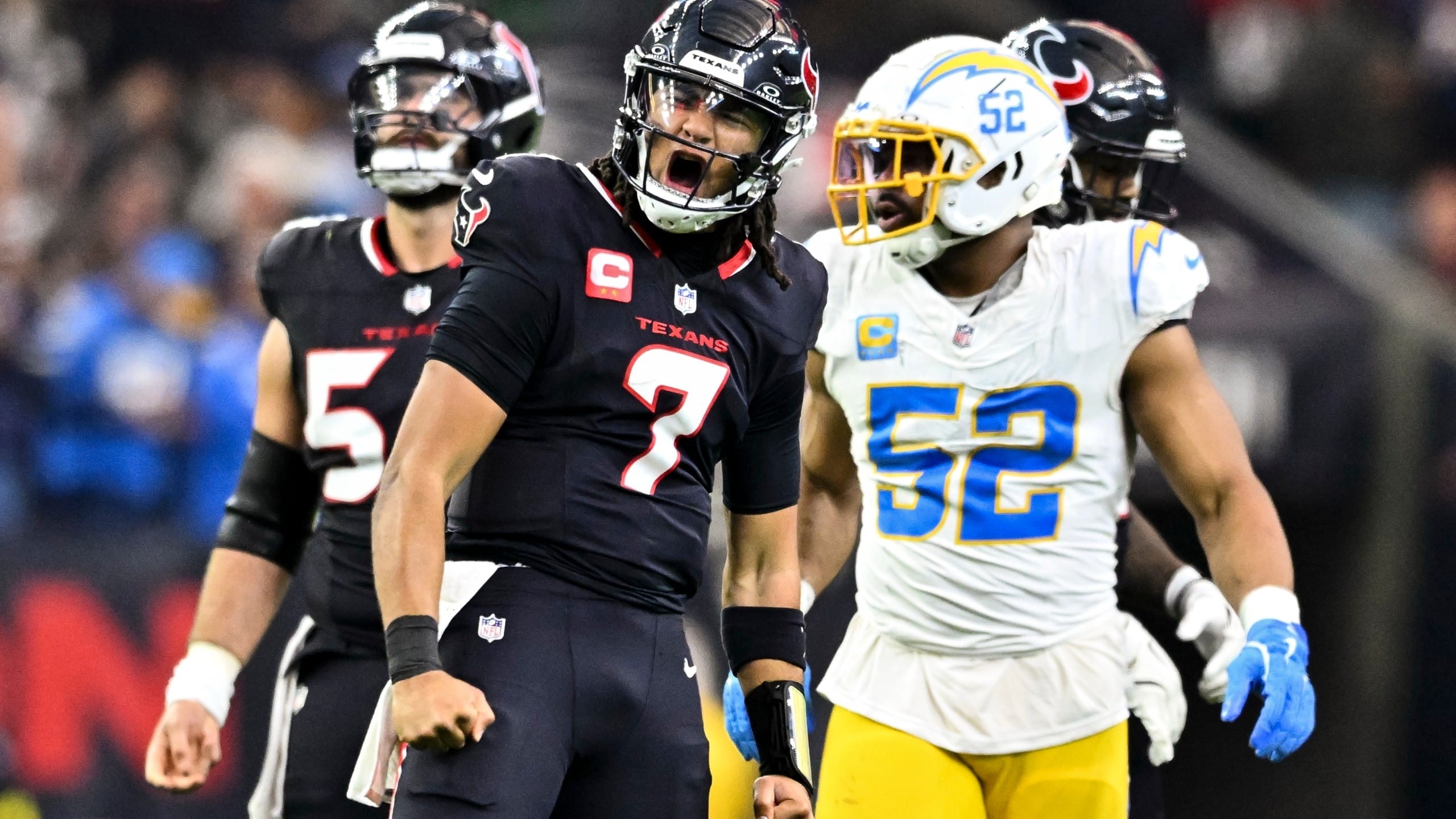
With 6:15 left in the second quarter, the Texans came out in Deuce Close; the Chargers were up 6-0. Stroud took the snap, whipped around counterclockwise, and handed off to Mixon. Tuli Tuipulotu was ushered past the hoop, too far upfield, and Mixon took the cutback right, finding daylight, before banging into a cluster of defenders and imposing his will for two extra yards. Removed from the back-against-wall sensation of starting from the one-yard line, presented some measure of liberty. On his way back to the huddle, Mixon took an exasperated gulp of air that said so much; this was a steep hill, and there was so much unpleasant work yet to be done.
By the time Metchie snagged an arrow route to the left of the hash, turned upfield and out of bounds, claiming Houston’s second first down, the immovable object was starting to release a thin spill of dirt along its edges—evidence of movement under the mantle, yet undetectable by consciousness.
Two plays later, a tripping penalty on Howard washed away all hope—a drive-killer if there ever was one. The coach, Ryans’ face—a contortion registering somewhere along the spectrum of frustration and catching a finger with the swing of a hammer—confirmed as much. One five-yard reception later, on third-and-sixteen, the next 12 seconds became representative of the entire 3,600—a single play became the point of criticality from which the entire story of the game should be told.
Stroud held out his arms from Shotgun, as if pleading. When the ball was snapped, it went high, breaching the tips of his outstretched fingers and sending the ball on an unpredictable set of hops--wrong-footed, jittery, like something dropped on a staircase—all the way to the five, where Stroud was able to trap it on the run somehow. By then, he had no choice but to keep running to his right, arcing slightly forward as he found the laces with the fingers on his right hand, scanning whatever was left of the routes his pass-catchers had begun some time ago to see if his jazz and theirs could merge and make Coltrane.
And just as three defenders converged from different flanks like Carthaginians at the Battle of Cannae, Stroud torqued his hips and fired; there was nothing left to do. The ball traveled far enough that the primary camera on the telecast had to pan left to reveal its result—some 30 yards downfield, where it found Hutchinson, alone by ten yards in every direction. Hutchinson jumped anyway, though the catch was uncontested and at his waist—excitement perhaps—spinning the rest of the way ‘round and running straight forward until he determined the best way to run into someone, which he then did.
Two plays later, Collins took a 20-yard catch to the left for an extra 20 by evading defenders, finally being caught at the Chargers’ 12-yard line. Three plays after that, Collins took a slant to the house, and the Texans never looked back.
Their first five drives produced 70 yards and zero points; this one netted 99 yards and a score, irreversibly tipping the game's tenor. The Texans became the bullies on both sides of the ball, turning Herbert over four times, one more than he’d had all season, and converting all their extra chances into 32 points. In the end, they won going away.
Saturday’s game hits like another playoff. Each team is one game back of its division leader. In the Chargers’ case, they play the Broncos next week; a win this week would set up a winner-take-all battle for the AFC West crown. The Texans, who have been on a remarkable run after an 0-3 start (they were also at one point 3-5), could still technically miss the playoffs.
Furthermore, this feels like a second chapter in a book of many, as the Chargers and Texans seem poised to be pillars of the AFC for years to come. But for now, they’ll settle for Saturday, where two relative analogs—bone-rattling physicality, superstar coaches, young star QBs—will meet with conquering on their minds.
Texans
Implied Team Total: 19
There are a lot of awful football games on the Week 17 docket; we already endured some on Thursday. Though there are playoff implications in the other Saturday game, between the Ravens and Packers, it will be contested by two backup QBs.
The Chargers and Texans are relatively healthy for teams that have been through 16 weeks of NFL football; each is almost cemented for the playoffs, and the stakes are high. But these are also two imbalanced teams that have been far better on defense than on offense of late, and the over/under is 39.5 (one of four games with a sub-40 over/under). The last time they met was in the wild-card round last January.
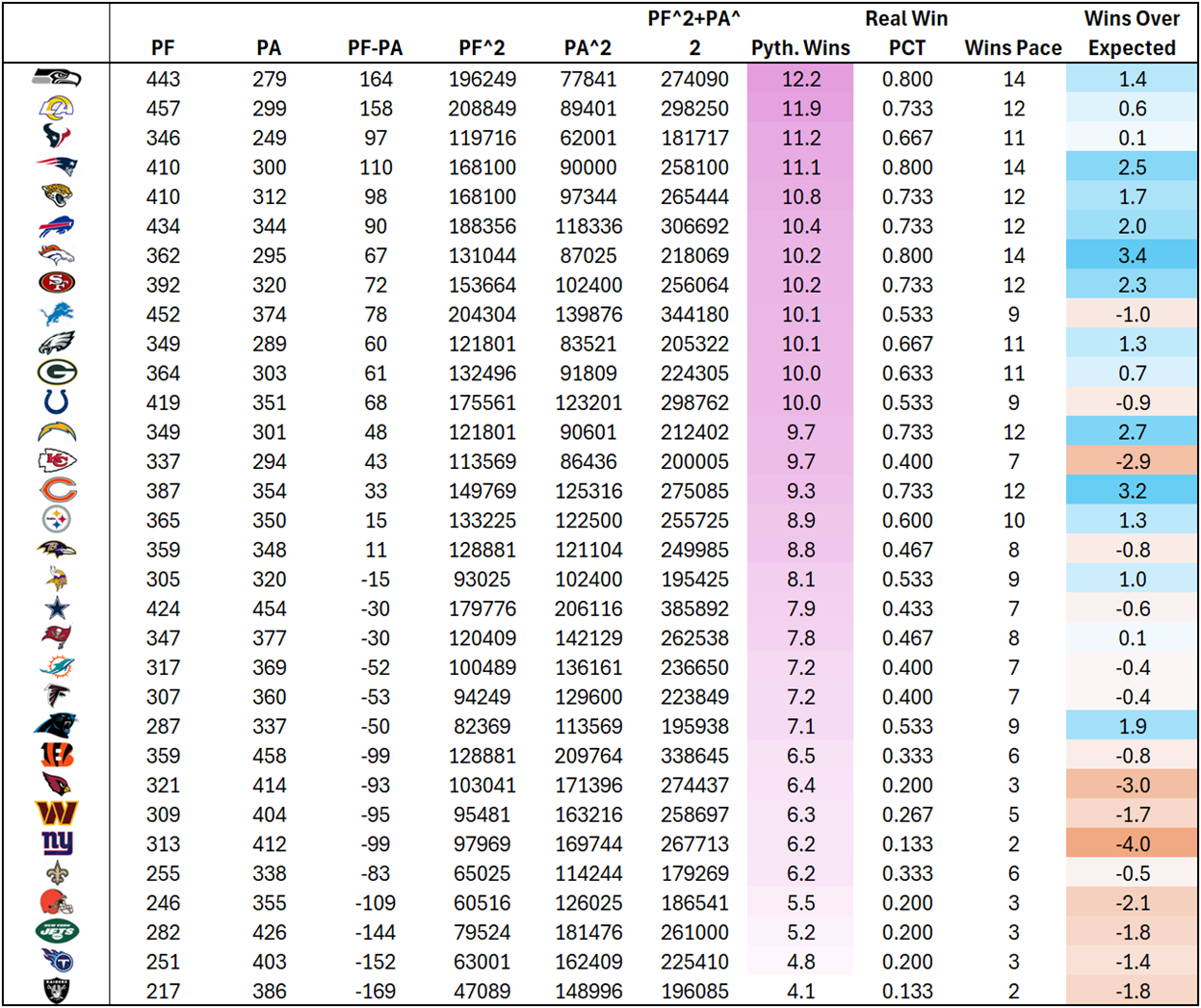
But make no mistake, these are good teams. The Texans are on a seven-game winning streak and rank third in Pythagorean expected wins.
The Texans rank first in EPA per play allowed; they probably have the best defense in the league. They are slightly below average in offensive EPA.
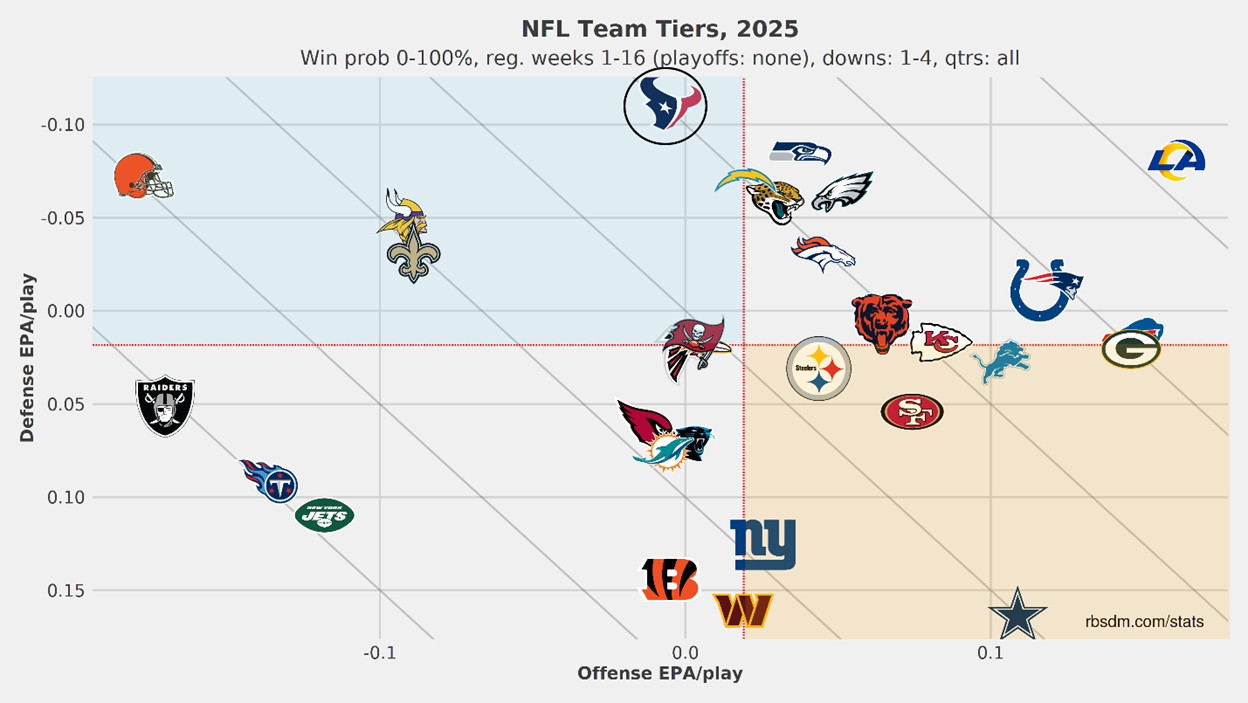
Offensively, they are slightly above average in dropback EPA and below average in rush EPA.
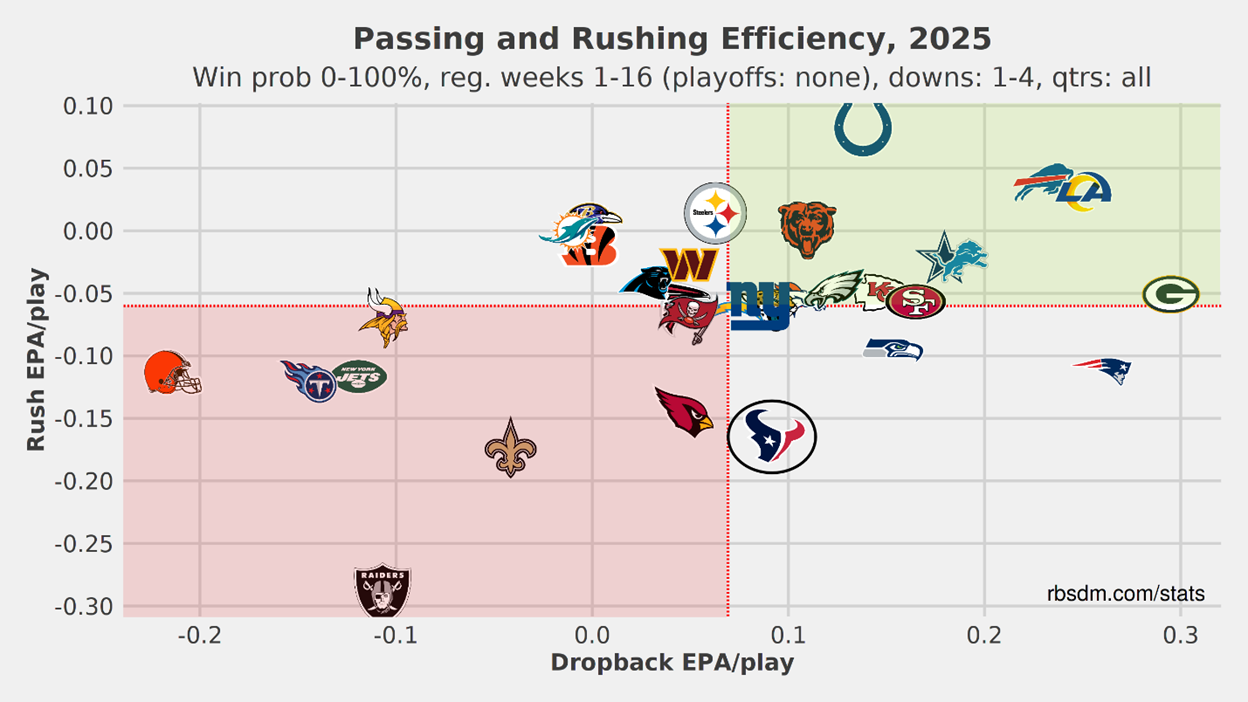
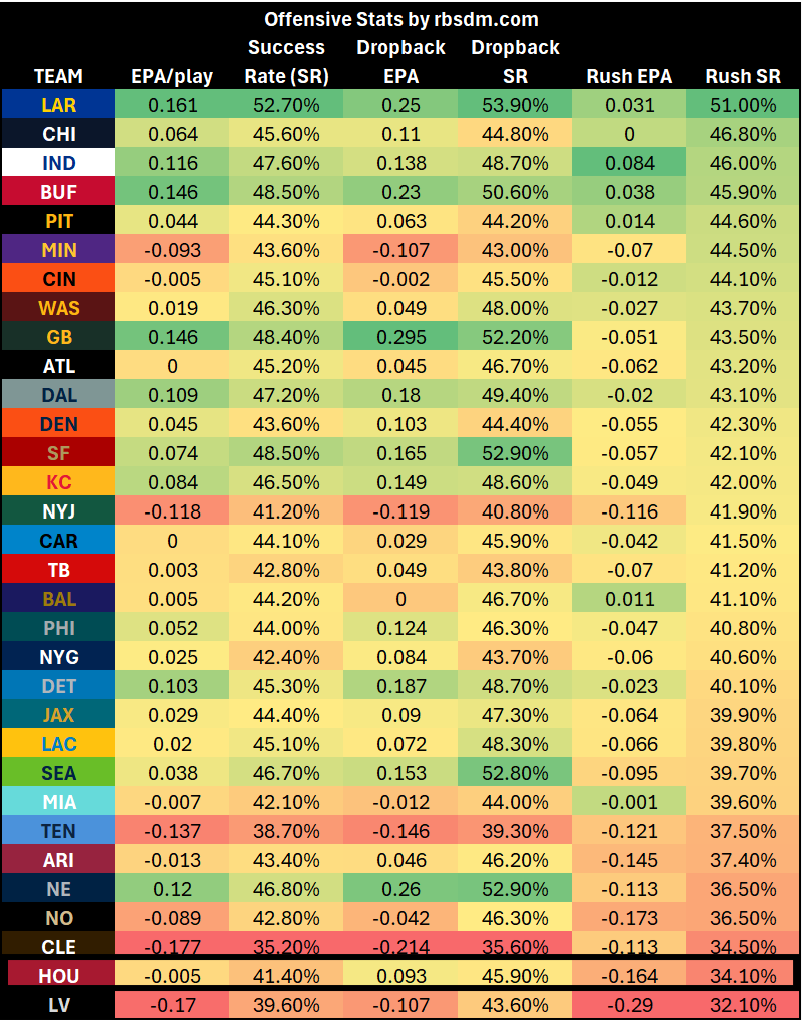
The Texans rank 24th in offensive EPA per play and 28th in offensive success rate. They rank 14th in offensive EPA per dropback and 19th in offensive success rate on dropbacks.
The Texans average 27.1 seconds to snap (T-16th). Their pass rate is 58% (T-13th). Their pass rate over expected (PROE) is 3.03% (9th). Houston averages 68 offensive plays per 60 minutes, tied for the league lead. They have led for 470 plays (5th).
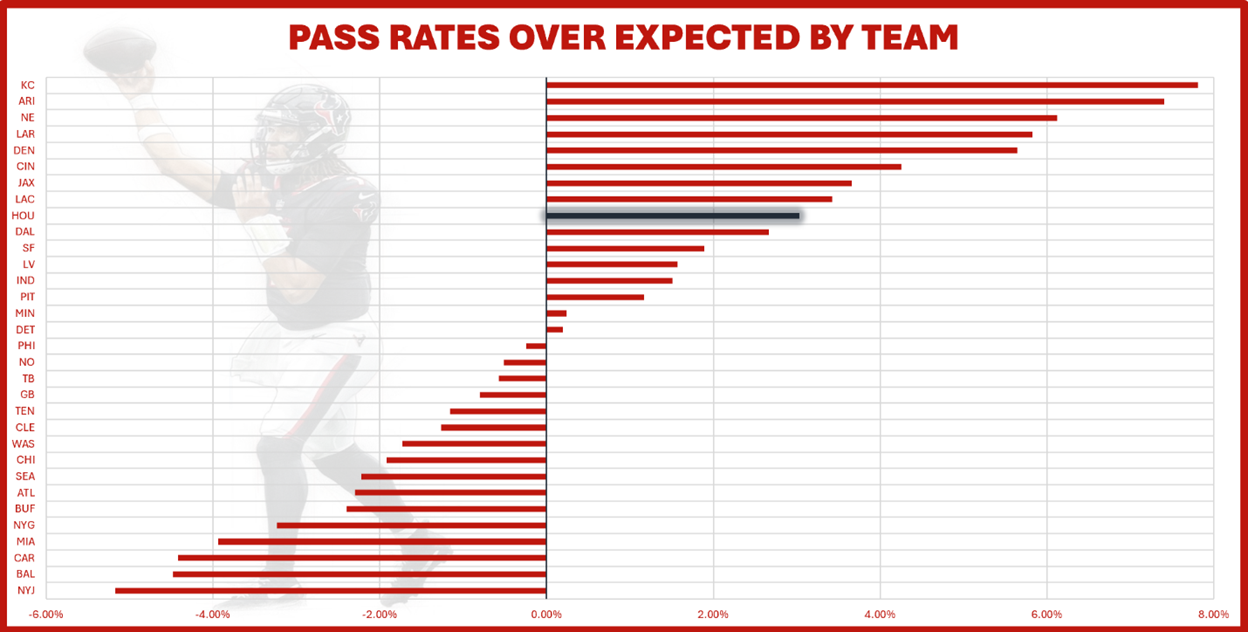
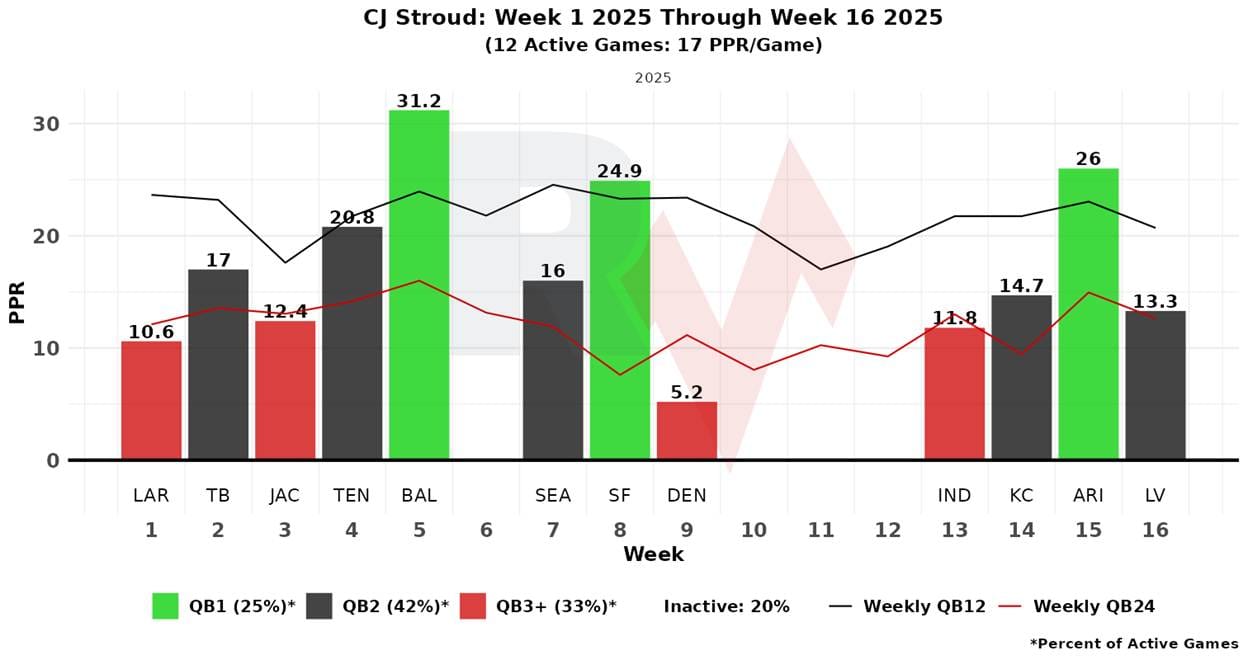
Even so, QB C.J. Stroud averages 35 dropbacks (17th) and 31 pass attempts per game (16th). It sounds weird, but Stroud left the Denver game with a concussion in the second quarter; he had only 10 attempts. If we take that one game out, his per-game attempt average jumps from 31.0 to 32.9. (10th), pretty much in line with where he should be. In the three games Stroud missed following that concussion, QB Davis Mills averaged 38.7 pass attempts per game, raising the team pass rate and total pass play volume but leaving Stroud’s averages behind.
Stroud has been a QB1 three times, hitting one true spike in Week 5. He has been a QB2 five times and fallen outside the top 24 four times, including the Denver game when he left early.
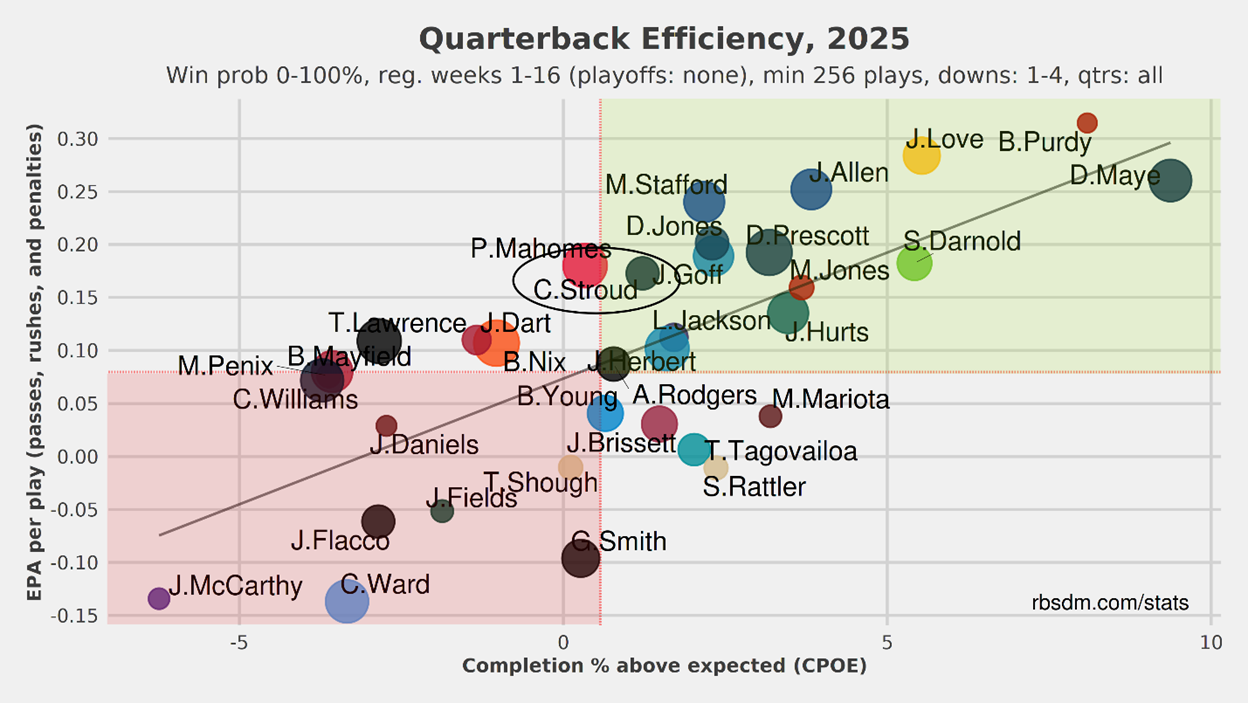
Stroud has 3.5 rushing attempts per game (21st) and 17 rushing yards per game (22nd), so his rushing doesn’t add a notable platform to his game. He is above average in dropback EPA and slightly below average in CPOE.
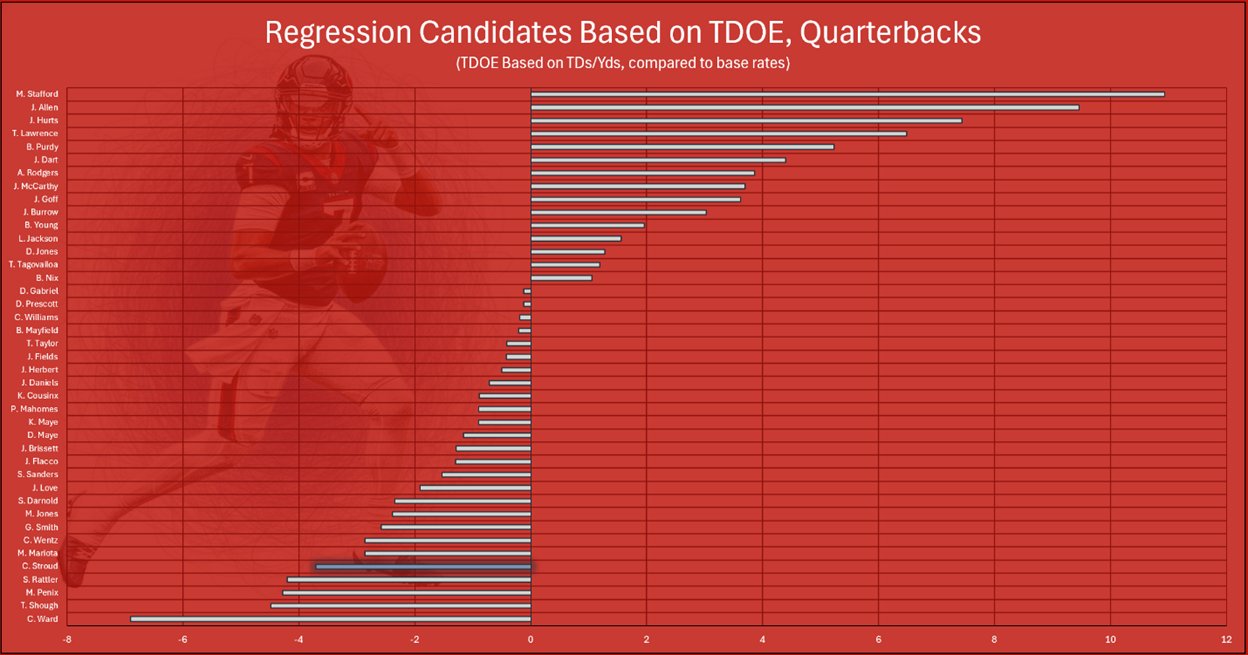
I have a simple touchdowns-over-expected model (TDOE). I divide each player's TDs by his yards, find the average TDs/Yds rate of all qualified players, then determine expected TDs by multiplying that average base rate by each player’s yards. Then, I subtract the expected TDs from the actual TDs. As the season progresses, this becomes increasingly more informative, as we can spot regression candidates. The players in the middle are less susceptible to sudden changes in tendency, but those at the extremes are at real risk of seeing their rates regress toward the mean.
Stroud shows up with a very low TDOE, indicating he is a candidate for positive TD regression.
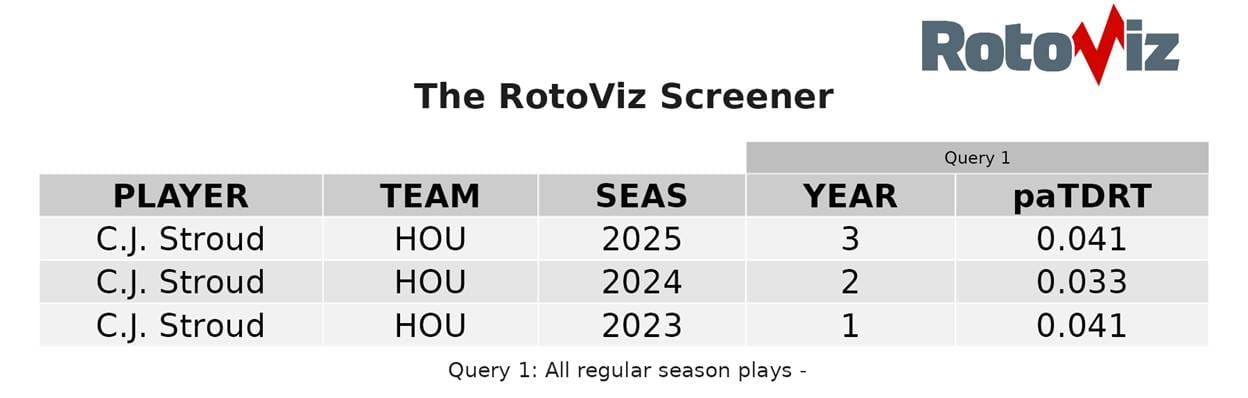
Sadly, this is now an annual tradition. Stroud’s 4.1% passing TD rate is tied for the highest rate of his career (2023). His career TD rate is 3.8%. These are modest TD rates for an NFL QB (league average, from what I can tell, is usually somewhere between 4.5%-5.5%), but after three years of it and two play-callers, it feels like this might be a Stroud thing. If so, without a significant TD upside or rushing upside, he’s like the QB equivalent of a between-the-20s RB.
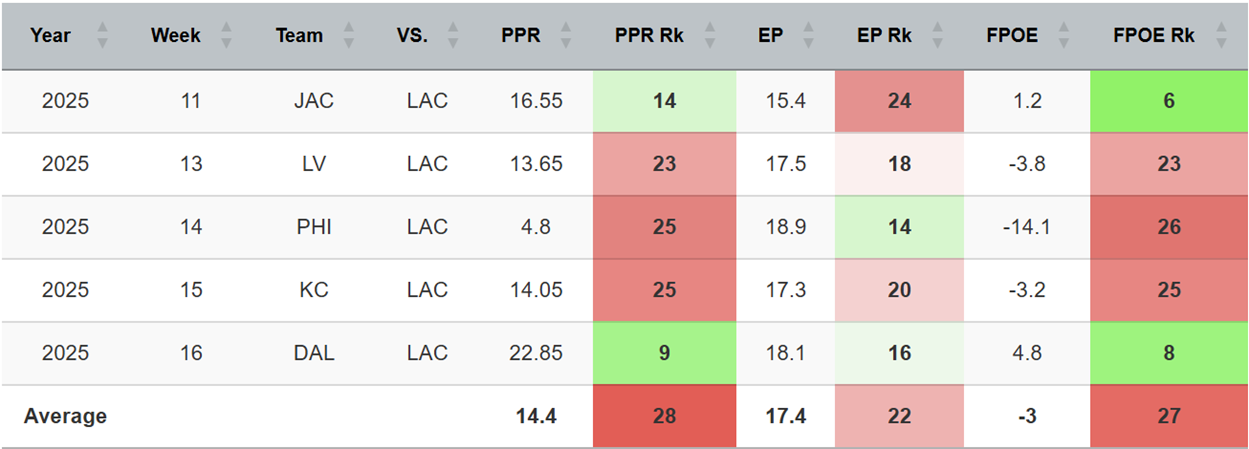
Over the last five games, the Chargers rank 28th in fantasy points allowed to opposing QBs.
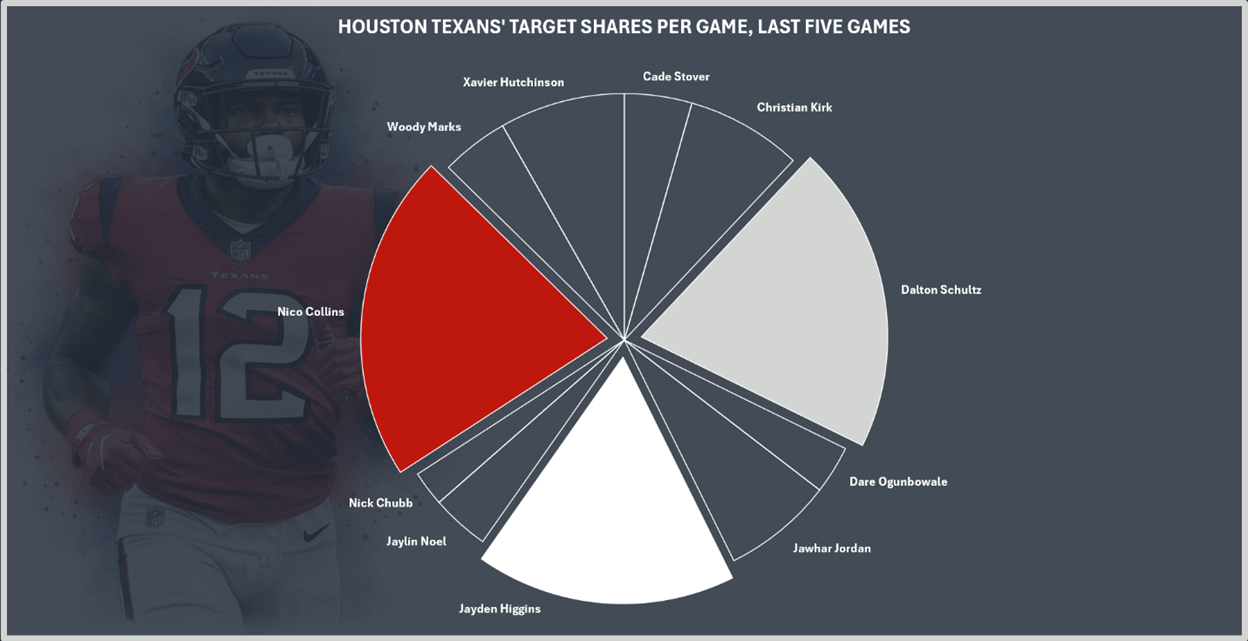
The Texans have three players with at least a 15% target share per game rate over their last five games: WRs Nico Collins (20.5%) and Jayden Higgins (16.3%), and TE Dalton Schultz (19.3%).
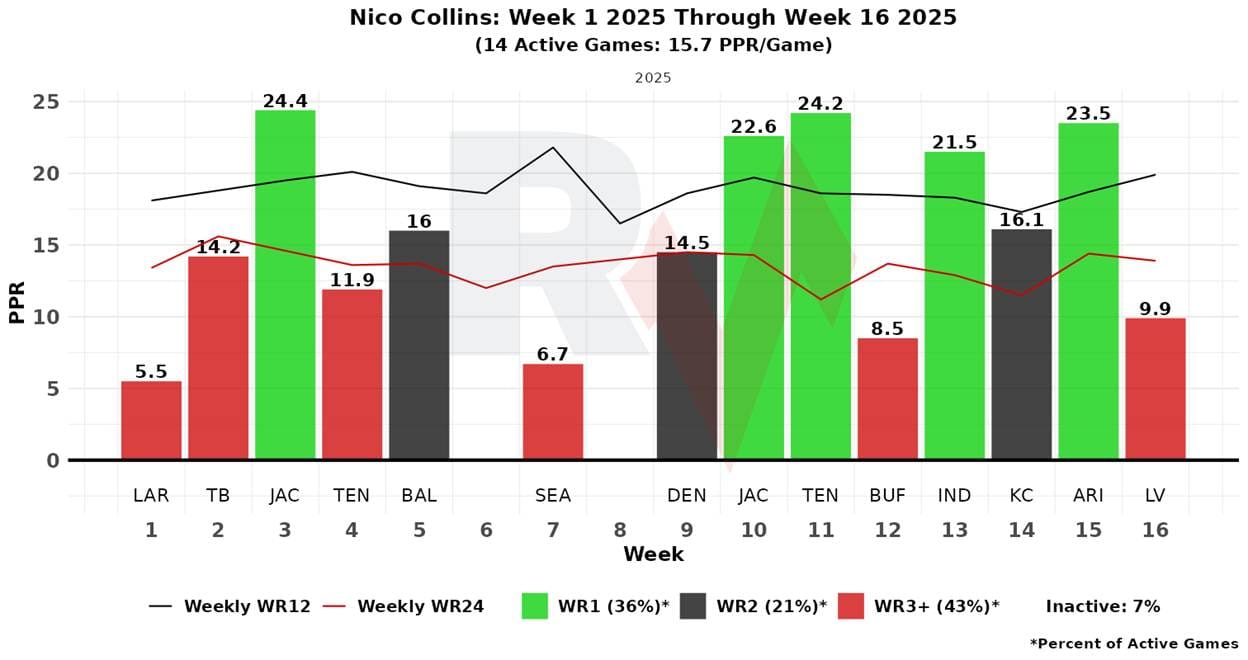
Collins ranks as the overall WR8 in PPR. He has five WR1 outputs, never surpassing 25 PPR points, and he has four single-digit outputs.
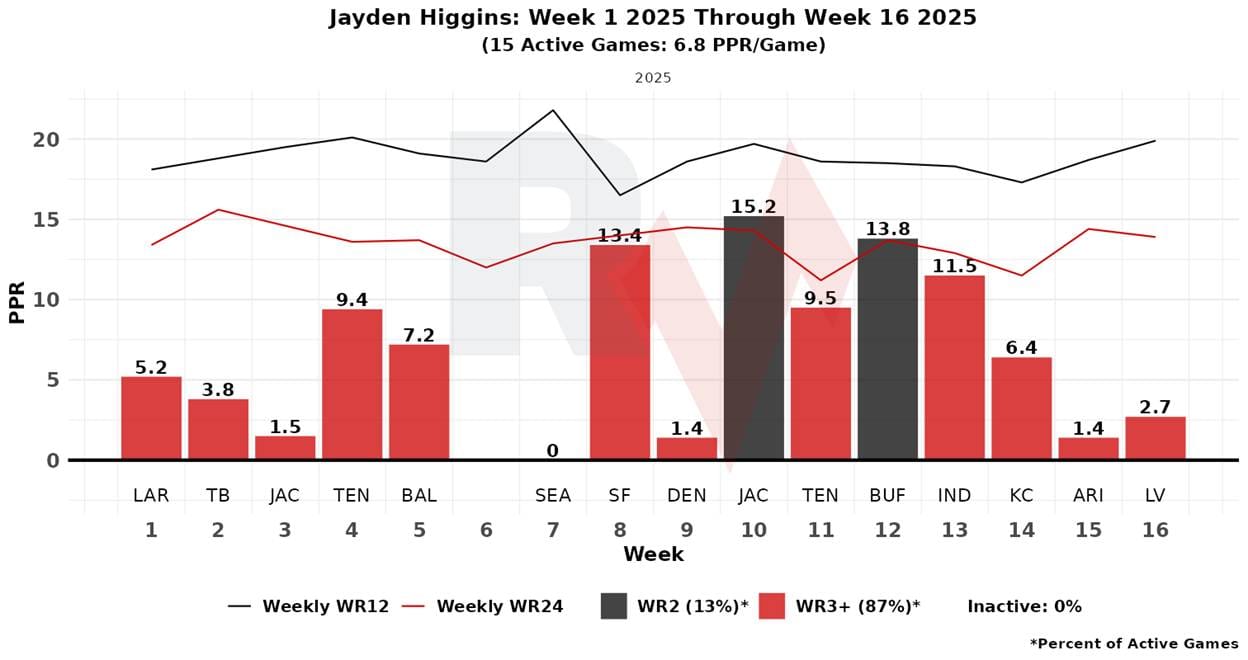
Higgins has had an encouraging rookie season, but he clearly demonstrates a lower floor and ceiling. He has had four/five weeks around the WR2/WR3 fringe, but that’s as good as it has gotten. He definitely has his utility in deeper PPR leagues, but he’s not a good bet for week-winning upside in a game against one of the league’s better pass defenses.
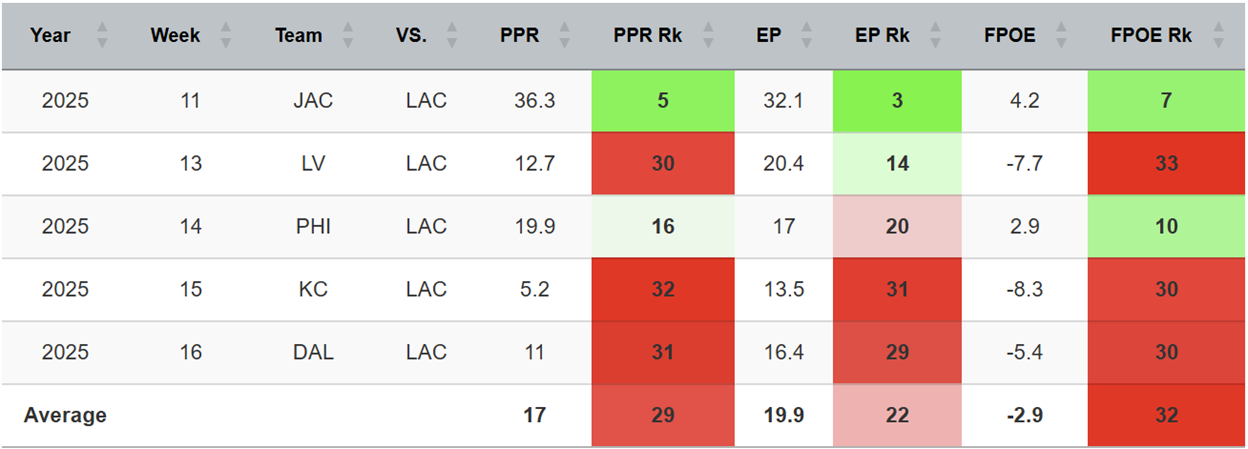
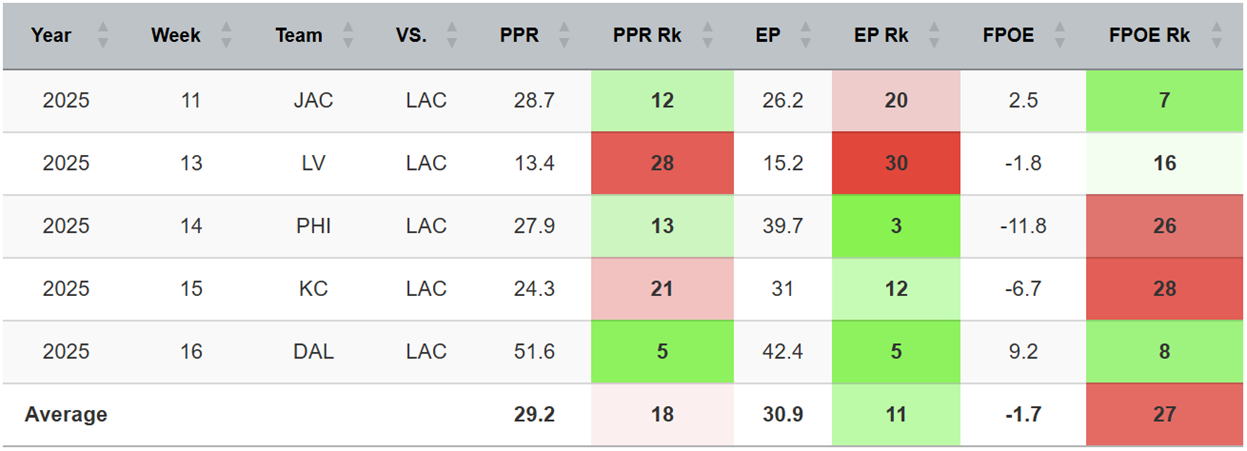
The Chargers rank 18th in fantasy points allowed to WRs in their last five games. This split shows a disparity between the expected points (EP) rank and fantasy points over expected (FPOE) rank, emphasizing that teams are trying to throw to WRs against L.A., but they are largely unsuccessful.
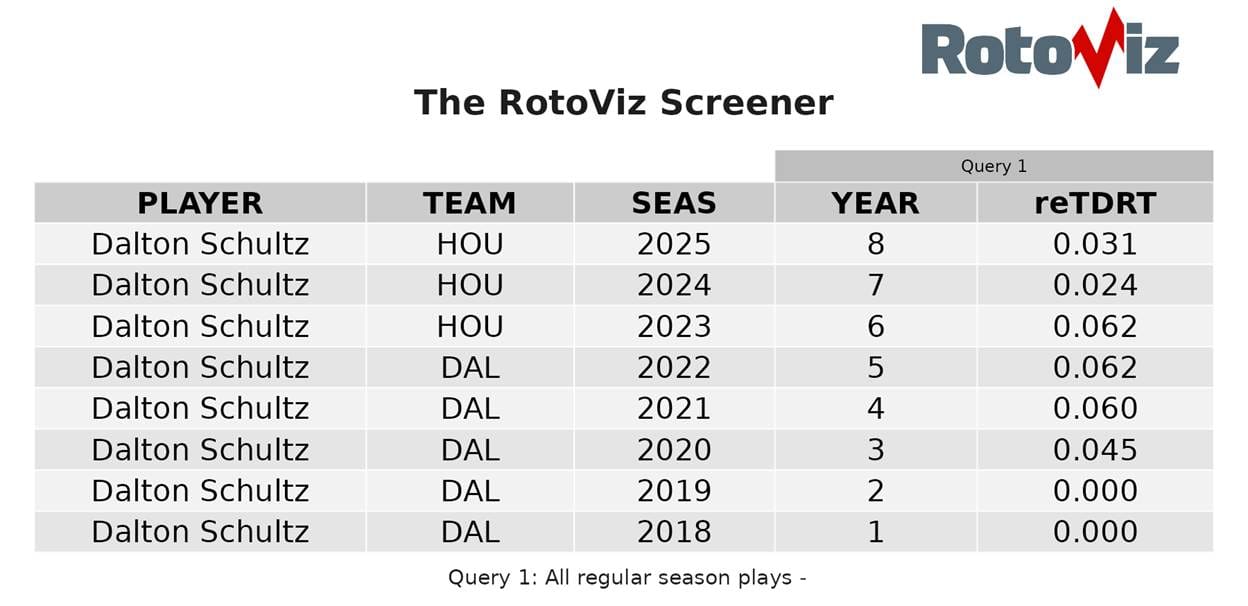
TE Dalton Schultz has probably been one of the league’s most underrated fantasy TEs, but since the break in Week 6, he has been a TE1 seven of ten games, hitting near or above 20 PPR points three times. Since Week 7, he has been the TE5.
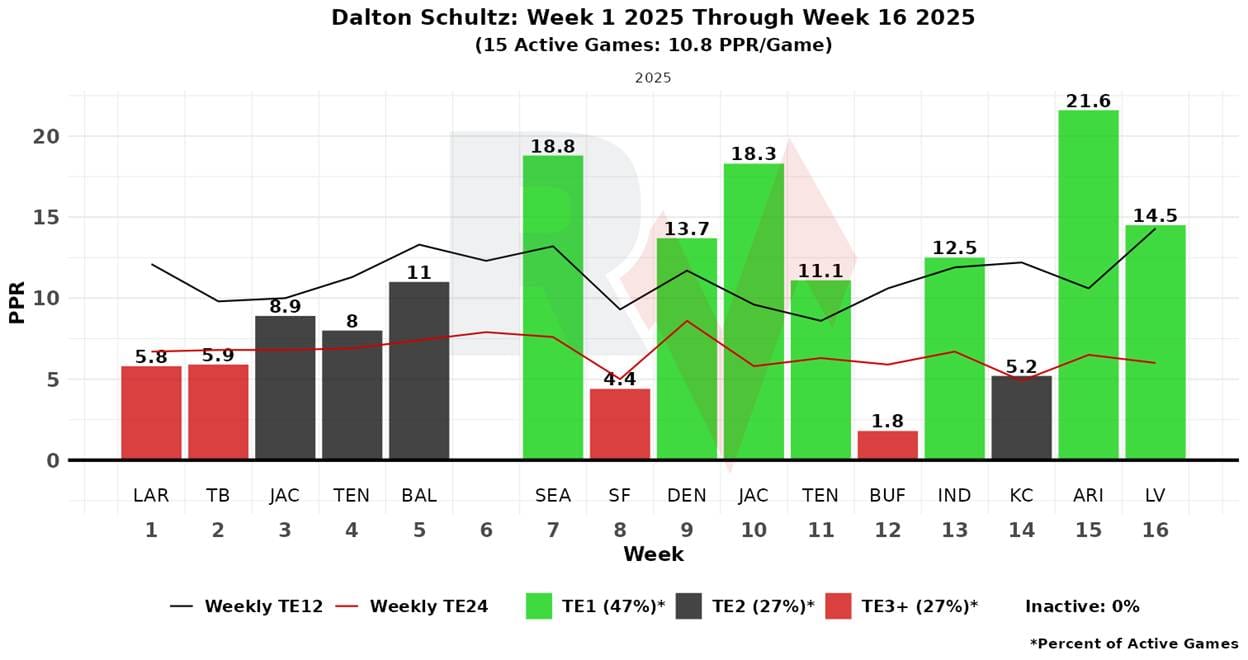
Even with how well he’s performed for fantasy, there is room for more. Based on my TDs/Yds TDOE model, Schultz is one of the most significant underperformers in terms of TD luck.
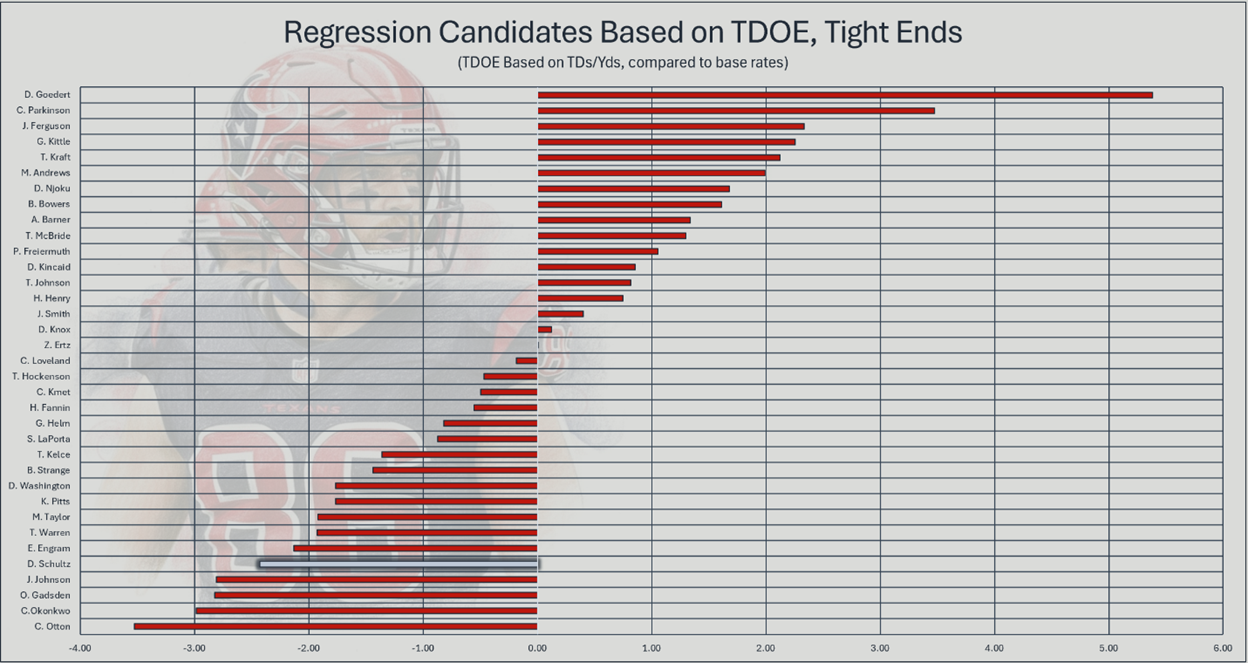
Schultz’s 3.1% TD rate is the second-lowest of his career and trails his 4.5% career rate. However, it is second only to 2024, when he had a 2.4% rate while playing with Stroud in Houston; his dysfunction may be tied to Stroud’s when it comes to scoring TDs.
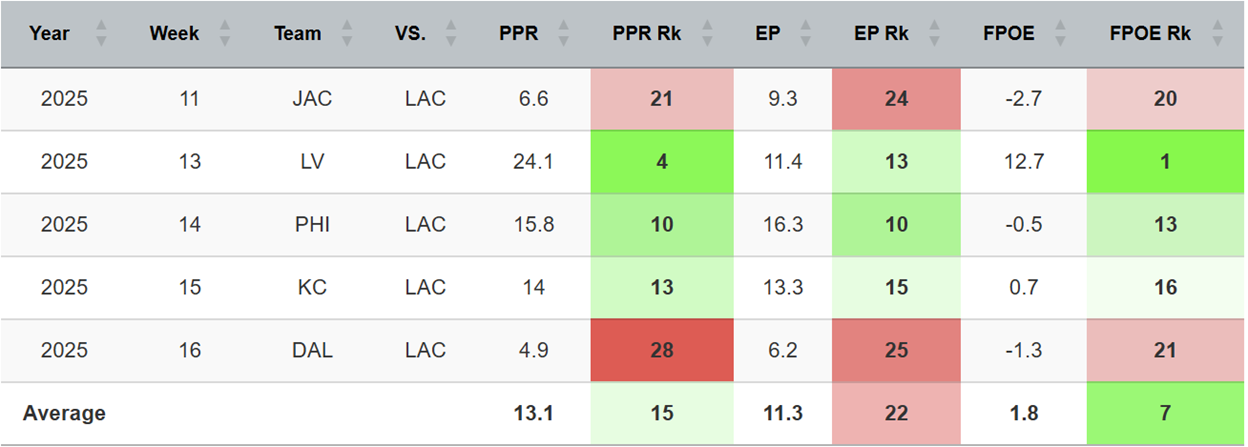
The Chargers rank 15th in fantasy points allowed to TEs in their last five games. In this sample, we see the inverse of what we see with WRs: the Chargers give up more efficiency in lower volume. This helps explain why the QB-allowed splits are more even. The sample includes Brock Bowers, Dallas Goedert, Travis Kelce, and Jake Ferguson.
The Chargers’ defense is above average in dropback EPA allowed and rush EPA allowed.
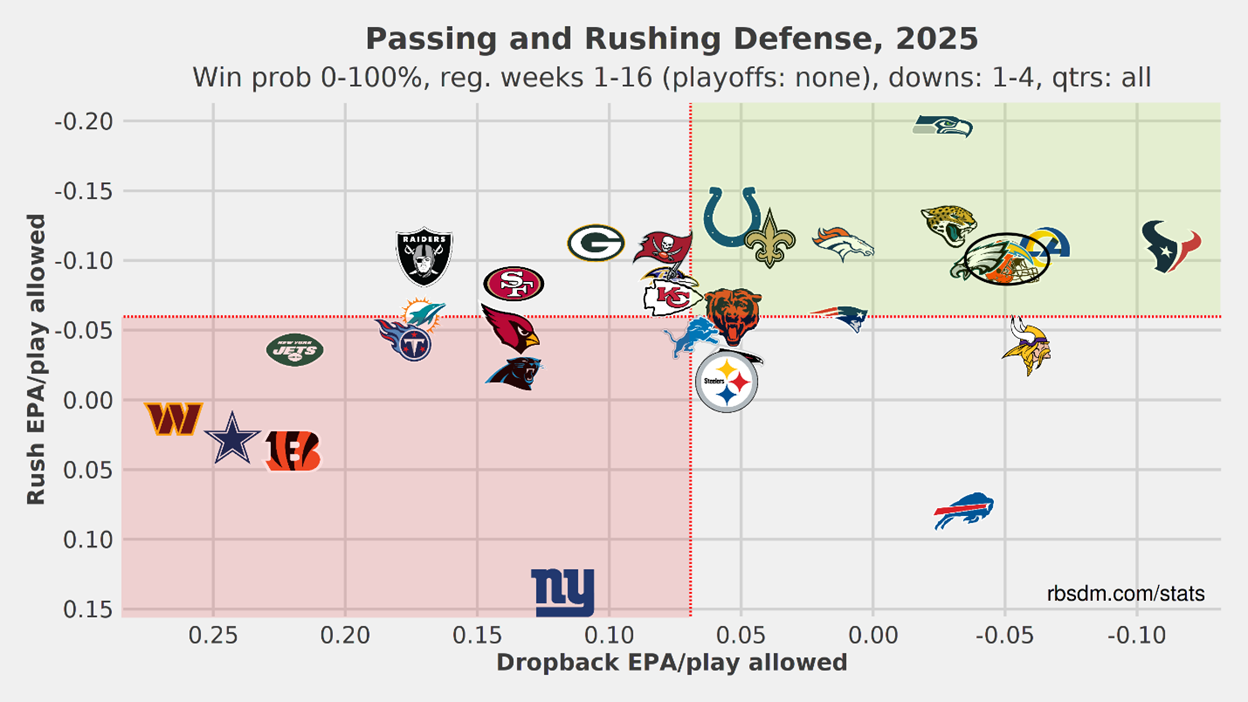
The Chargers rank fifth in EPA per play allowed and sixth in defensive success rate.
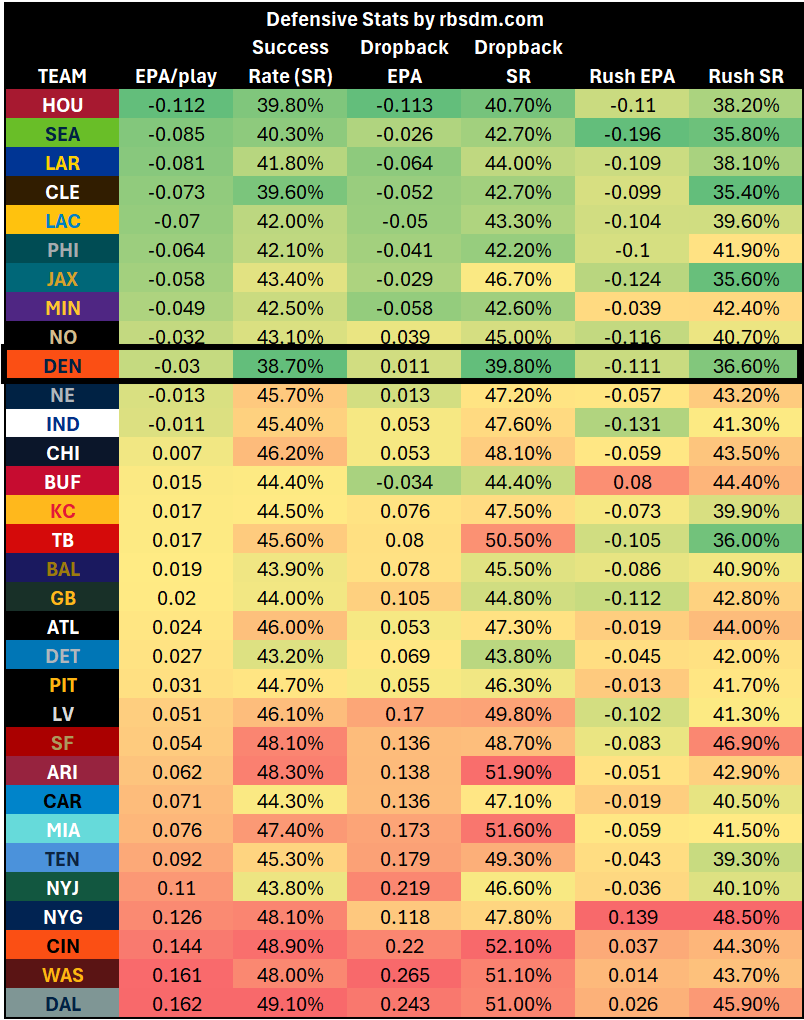
They rank fifth in EPA per dropback allowed and seventh in defensive success rate on dropbacks.
The Chargers use zone at a rate of 76.9% (7th) and shell coverage at a rate of 57.8%. Their preferred alignments are Cover 3 (32.8%) and Cover 4 (22.9%), which they use the third-most. They blitz at a rate of 18.1%, the third-lowest in the league.
Fantasy Points’ coverage matchup tool assigns a zero-based matchup grade to each pass-catcher based on their opponent’s use of specific types and rates of coverage and how that pass-catcher performs against them. Positive numbers indicate a favorable matchup and negative numbers indicate an unfavorable one.
Based on this model, Collins has a slightly favorable matchup (+1.6%), while Higgins (-3.3%) and Schultz (-1.1%) have an unfavorable one. Tendencies support this, as the Chargers surrender a slot target rate of 30.3% (20th), an inline target rate of 9.5% (27th), and a wide target rate of 44.3% (5th). Collins lines up out wide on 79.8% of his routes, which leads the team.
PFF’s matchup tool is player-based, pitting the PFF ratings of individual players against each other for an expected number of plays based on historical tendencies and rating on a scale from great to poor.
Based on this model, Collins’ matchup grades out as good, while Higgins’ and Schultz’s grade out as fair.
The Texans’ offense allows a 6.08% pressure rate over expected (PrROE, 16th). The Chargers’ defense generates a 9.50% PrROE (9th). In the aggregate, the matchup is relatively neutral.
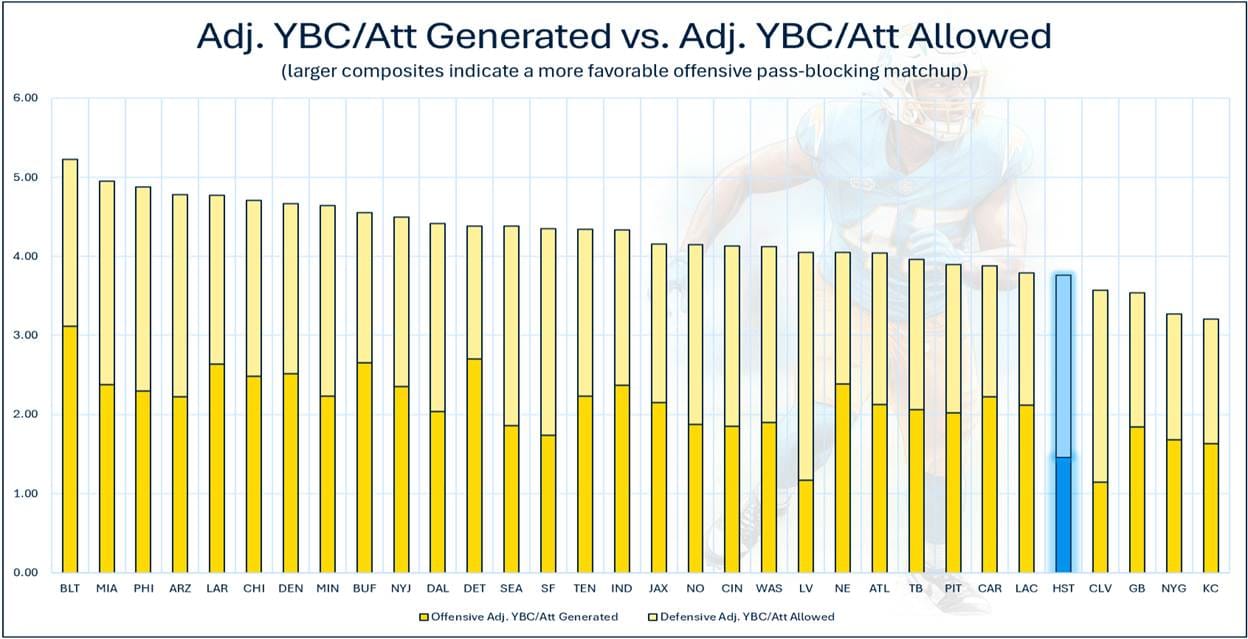
The Texans’ offense generates 1.46 adjusted yards before contact per attempt (adj. YBC/Att, 30th). The Chargers’ defense allows a 2.30 adj. YBC/Att (22nd). The composite creates a top-five disadvantage in run blocking for the Texans on offense this week.
The Texans rank 30th in offensive EPA per rush and 31st in offensive success rate on rushes.
Woody Marks has taken over in per-game usage. Over the last five games, Marks leads in snap share per game and percentage of team rush attempts per game.
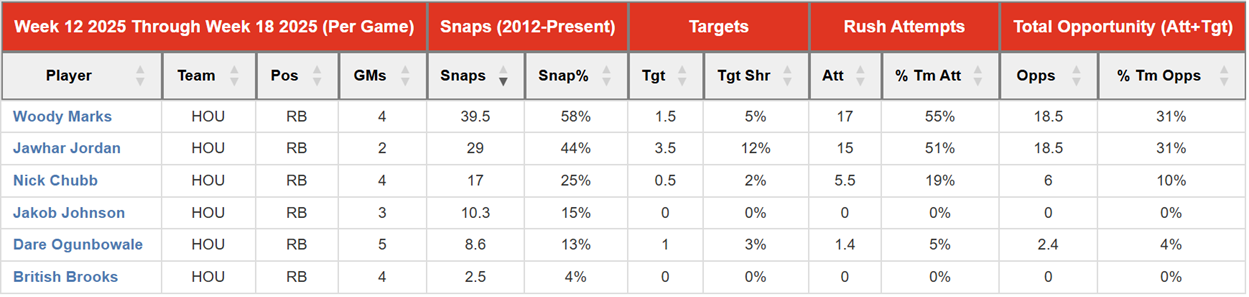
Marks has been an RB1 twice with one spike week. He’s had single-digit outputs far more—eight times in 14 weeks. This is because of a few things: the Texans have only 409 rush attempts (20th); his share of the team's rush attempts is the best on the team, but still not exceptional; he doesn’t catch many passes; and the team doesn’t score many TDs.
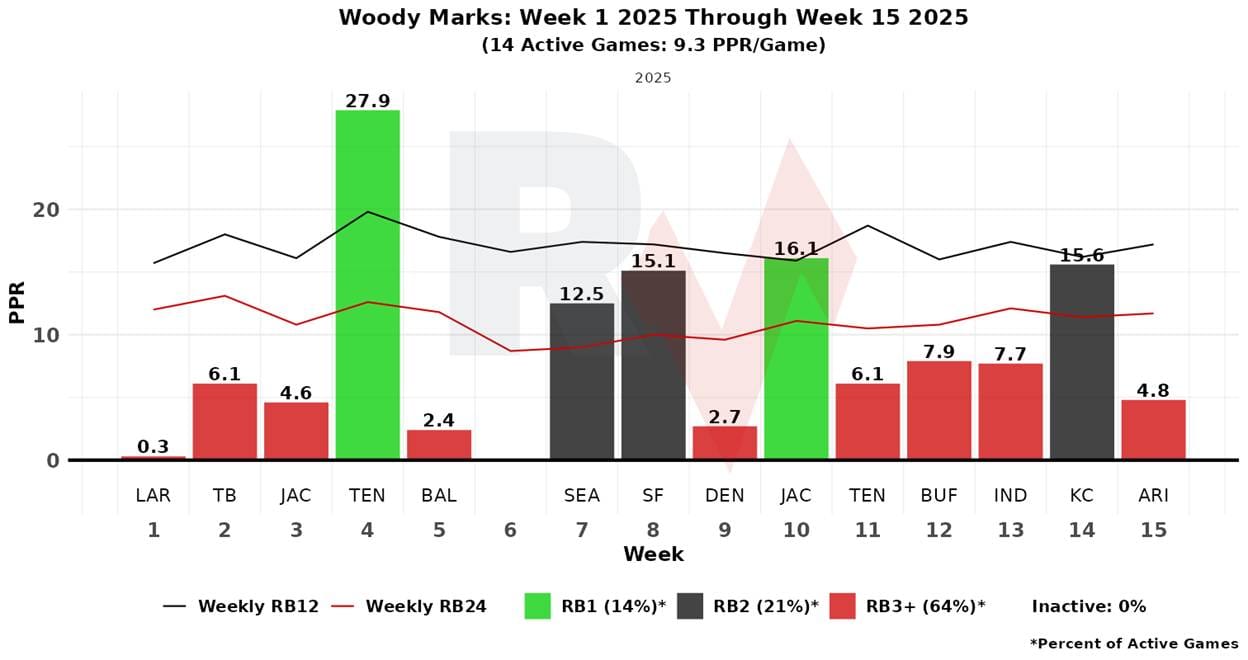
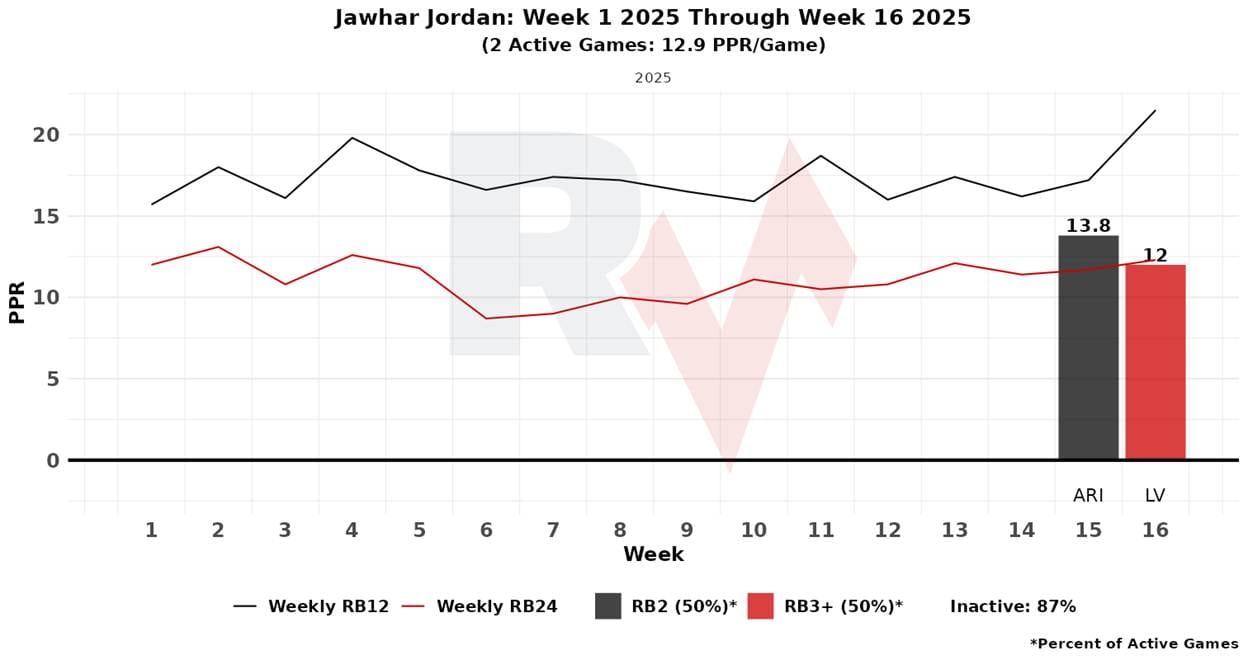
Marks’ absence for an extended period in Week 14 led to fellow rookie RB Jawhar Jordan gaining over 100 yards. Jordan remained involved last week and outscored Marks. This is an interesting storyline to follow to see if this holds; if so, and if Jordan is involved in the passing game as much as he’s been, he could end up having more fantasy juice than Marks. Of course, there isn't enough time for the scientific method on this, since this is the last game in most managed leagues.
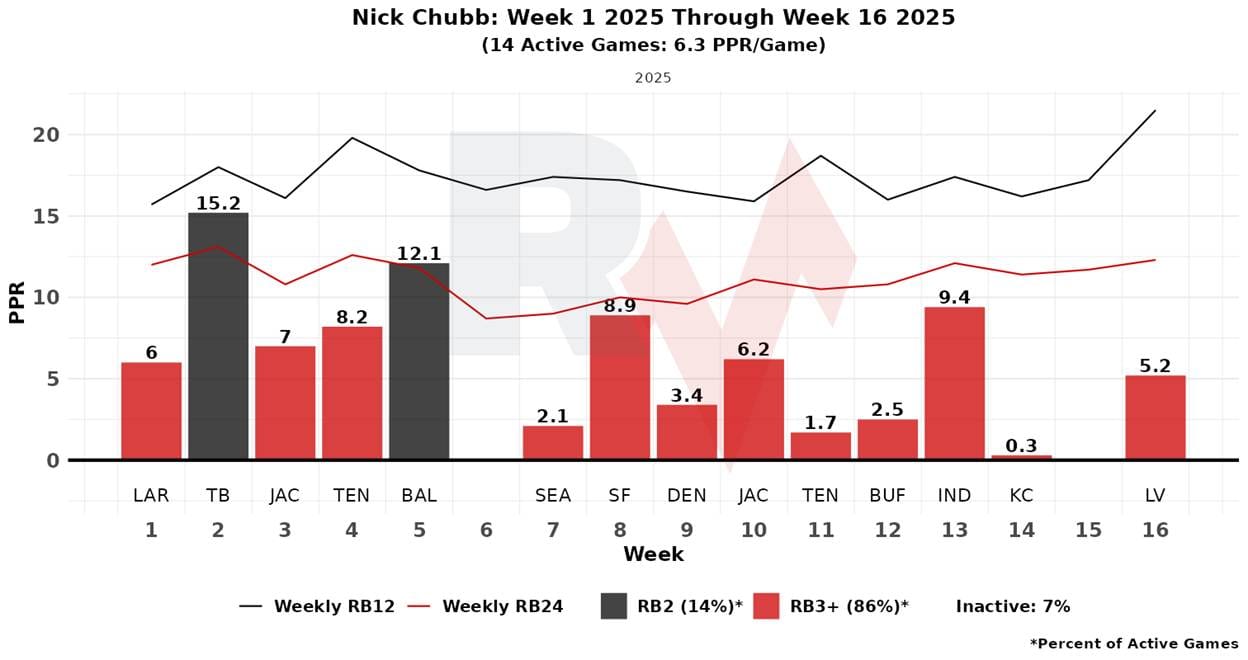
RB Nick Chubb is really useless for fantasy. He has not exceeded single-digits in any game since the bye.
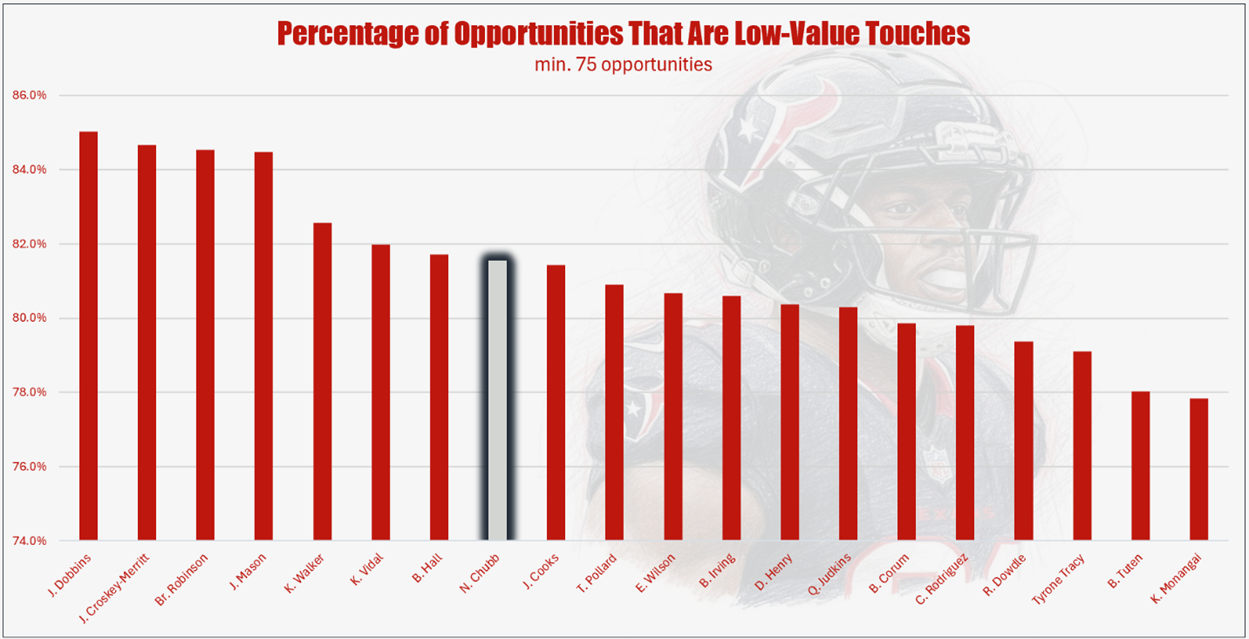
Of players with 75 opportunities (attempts + targets), Chubb has the eighth-highest percentage of his opportunities go for low-value touches (LVTs). So, he’s not getting much usage anymore; he’s in an offense that doesn’t score a lot, that doesn’t run a lot, and he gets the highest percentage of LVTs. Sadly, this is likely the death rattle of an excellent career.
The Chargers rank 10th in EPA per rush allowed and ninth in defensive success rate on rushes. They rank 29th in fantasy points allowed to RBs in their last five games. They allowed the lowest efficiency in the NFL during that time.