Quick Slant: Saturday Edition - To Reclaim Winning as Their Default Calibration

Mat Irby's Quick Slant
In social cognitive psychology, a loss of confidence can often be traced to a decline in self-efficacy, a term coined by Albert Bandura in a 1977 article for Psychological Review. Simply put, self-efficacy is the belief that one can do what is being asked of them. When repeated failures stack up—a shooting slump, a losing streak—that belief erodes. The most reliable way back to normal isn’t always a singular breakthrough, but often a mastery experience: deliberately choosing small, easily manageable tasks and completing them as expected.
A slumping shooter, for instance, looks for easier shots—free throws or layups, for example—just to see the ball go in the hole. This breaks the illusory barrier at the rim and allows the shooter to witness their goal repeatedly achieved.
In everyday life, someone caught in a demoralizing spiral might start by making the bed or emptying the dishwasher—tasks they’ve already mastered, knowing they can do them well. These minor successes build internal credibility and create psychological momentum.
Once the muscle memory of competence reframes someone with low self-efficacy's outlook, the next task feels less intimidating. Then the next, and the one after that, until confidence can be restored. Stated plainly, a quiet accumulation of small wins can rebuild belief from the inside out.
Stated plainer, the Eagles lost three games in a row, kinda had the yips, then got just what the doctor ordered, a date with the Raiders, whom they beat 31–3. This week, they face the 4-10 Commanders, then face them again in Week 18. Even with the Bills wedged in between, the Eagles have a unique opportunity to push aside the adversity that has challenged them all year, reclaim winning as their default calibration, and coast into the playoffs with much-needed momentum.
The Eagles’ contrast with Washington couldn’t be greater. Last year, these two teams met in the NFC Championship; this year, the Commanders are far closer to the cellar floor than the final four. Their brutal season was already a fait accompli a week ago. And yet, to punctuate how over it really is, they agreed Monday to shut down the reigning OROY, QB Jayden Daniels, after a year plagued by injuries. They turn now to QB Marcus Mariota, a former Eagle, for the remainder of this tortured season.
And yet, the notion that Washington will roll over for Philadelphia would be naive. Even in a modern sport where players play musical chairs with laundry, seeing a common opponent twice a year quickly builds spite. The bloodlust of the fans seeps into the psyche of players who are ultimately gladiators with crowds to please. There’s the jealousy aspect, too; the Eagles collect golden adornments and have their names engraved in history year after year, while the Commanders spend most seasons dodging local criticism. And they are professionals, hungry for a mark that might propel them forward for a few more years in a lucrative career with a shelf life.
And another underrated force is that misery simply loves company. As teams sink toward the bottom, it is human nature to rage against failure. In sports, where vindictiveness can be justifiably cloaked as competition, what better way to gain catharsis than to punch the Super Bowl champs in the nose? People would blame it on resolve, not pettiness (our little secret).
And above all, it is never too early to reestablish a winning culture. Not only can this propel a team toward greater success in the near future, but it might be the very thing that saves that future altogether. Of course, this is a staff, haughty and adorned with the laurels of accomplishment only months ago, now living in a perpetual loop of uncertainty. A mini-run to end the year would go a long way toward giving them one more quarter to push into the coin slot to gain another turn.
Eagles
Implied Team Total: 25.75
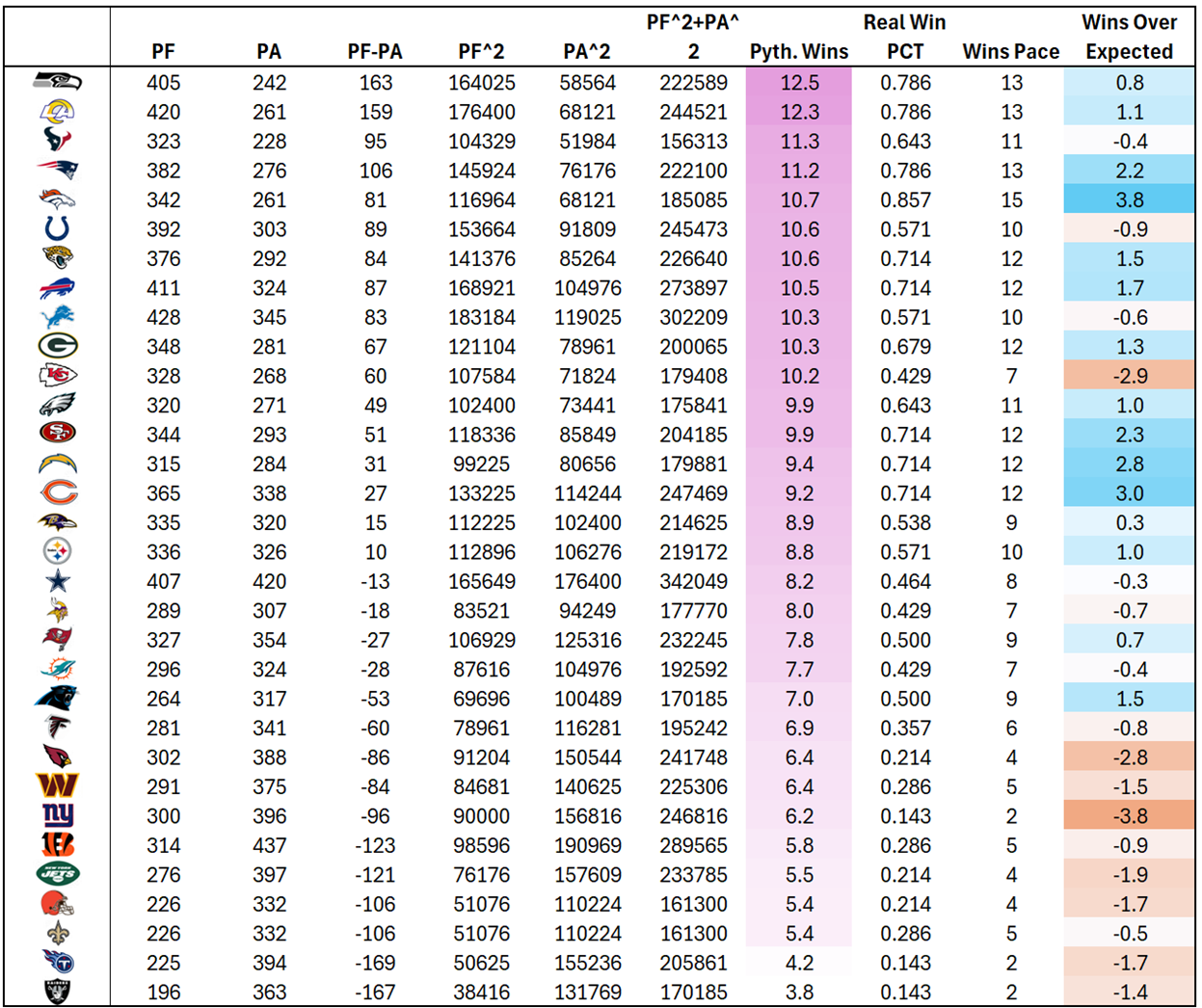
According to Pythagorean expected wins, the Eagles are among the better teams in the NFL; they have won nearly three more games than expected, though.
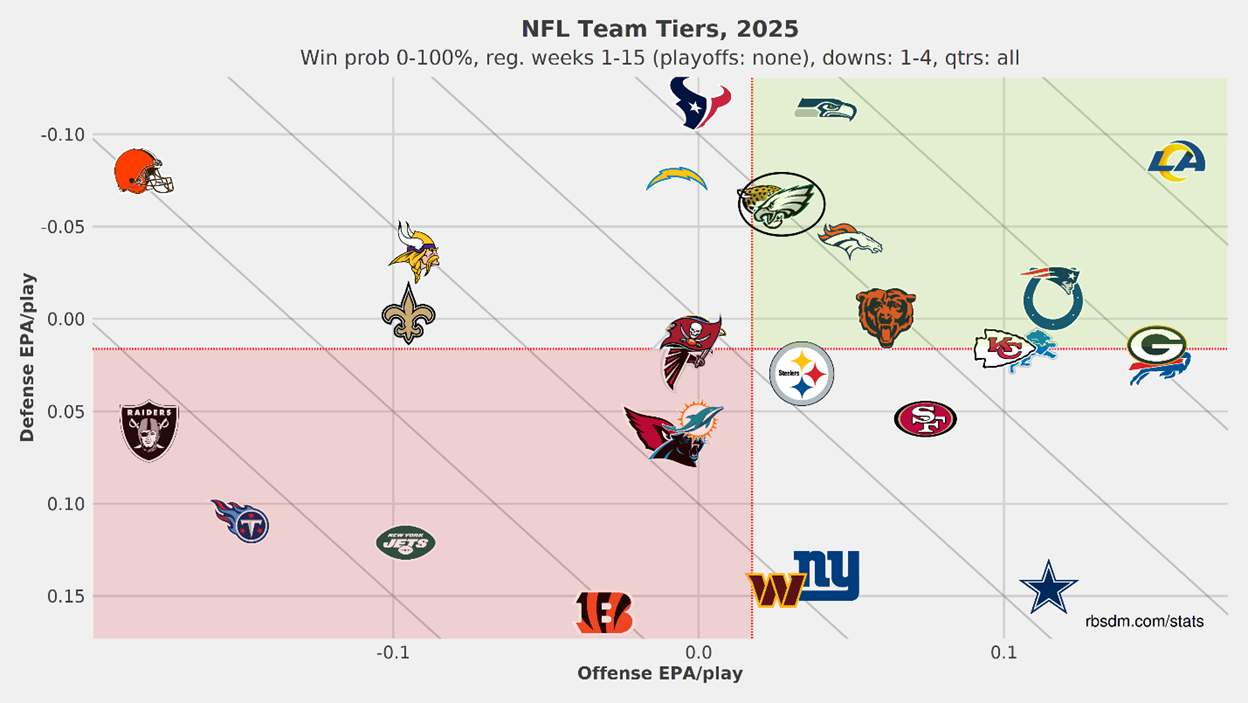
They are slightly above average in offensive EPA and well above average in defensive EPA.
Offensively, the Eagles are slightly above average in offensive EPA per dropback and slightly below average in EPA per rush.
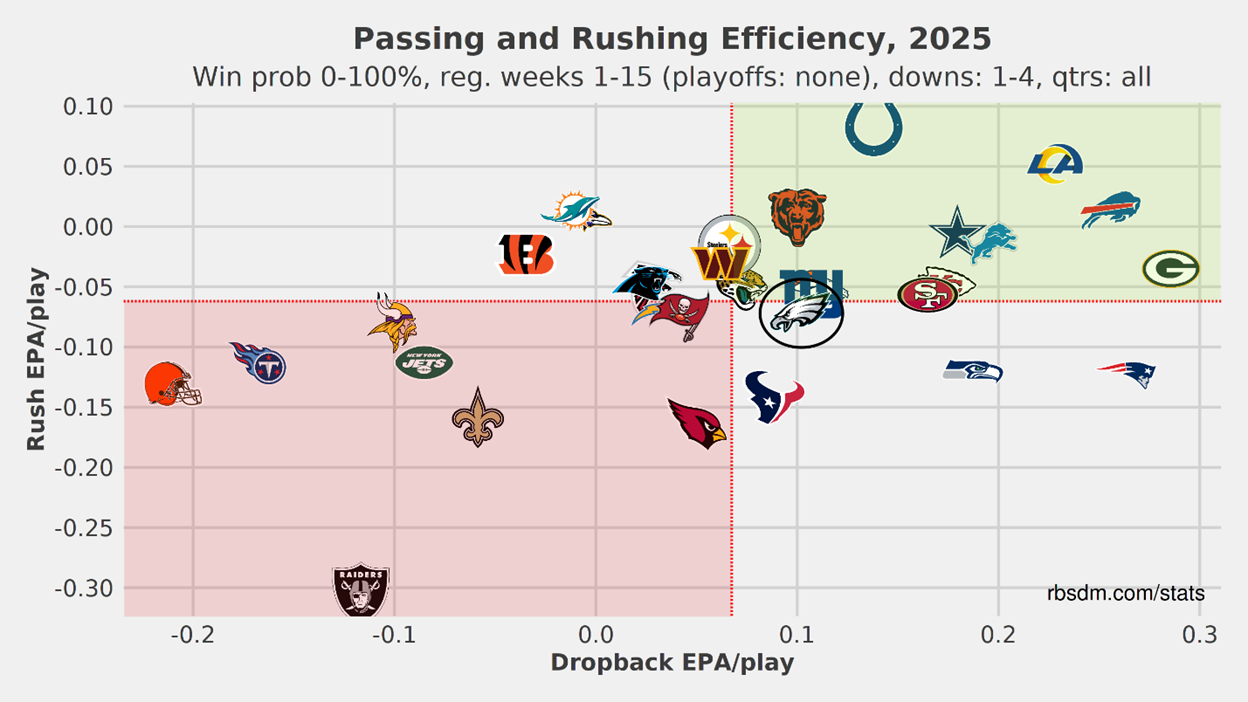
Philadelphia has been among the slower teams in seconds to snap (28.4, 30th). Their pass rate is 52% (T-29th). Their pass rate over expected (PROE) is -0.7% (T-18th). They have run 61 offensive plays per 60 minutes (24th). They have led by seven or more points for 40 offensive snaps per 60 minutes (T-5th). In these situations, their pass rate has been at 49%, which is only slightly lower than their normal pass rate. The reduction of three percentage points in these instances is unusually low and could explain why the Eagles rank so low in base run rate but toward the middle in PROE.
Philadelphia ranks 15th in offensive EPA per play and 22nd in offensive success rate.
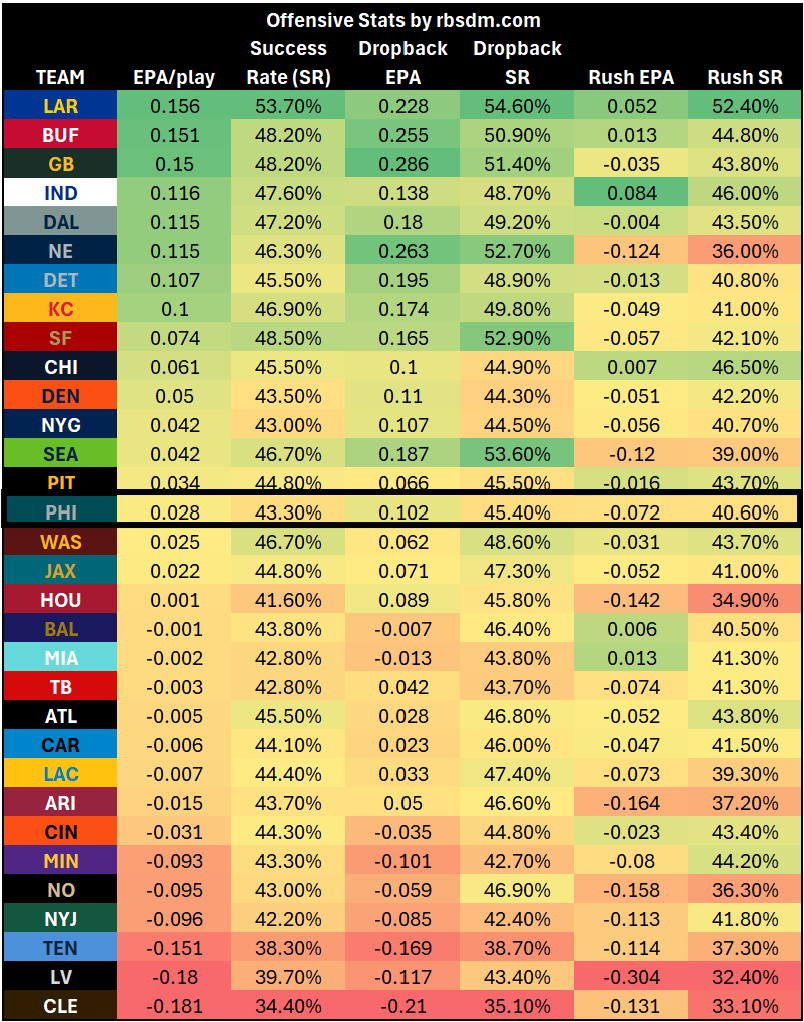
It ranks 13th in offensive EPA per dropback and 21st in offensive success rate on dropbacks.
QB Jalen Hurts has dropped back 465 times (14th) and attempted 390 passes (15th).
He has a famously good rushing component, which improves his floor and ceiling. This season, he has 95 attempts (2nd), resulting in 376 yards (6th). His YPC tends to be somewhat smaller, but as we know, he is called upon for an inordinate amount of QB sneaks, so this is normal. He ranks second among all QBs in first downs (36) and TDs (8) because, even if these runs don't produce yardage, they accomplish what they intend.
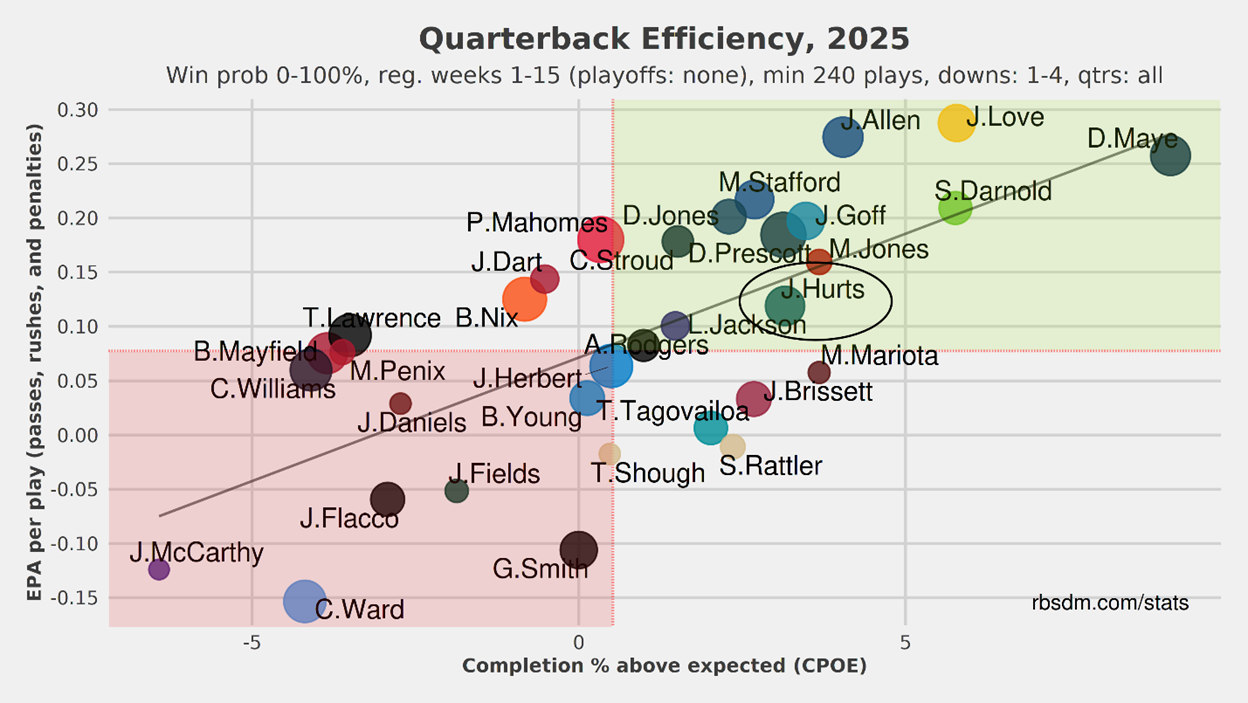
Hurts is not only a good runner; he is also a plus-passer, ranking above average in EPA per dropback and CPOE.
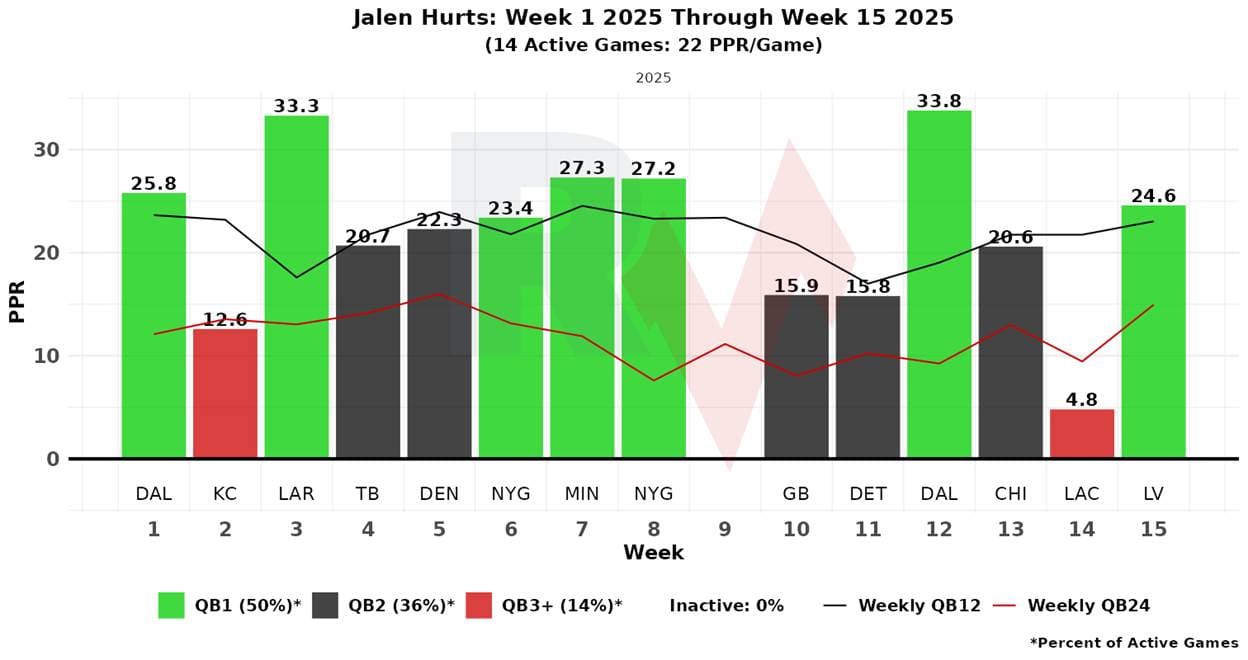
Hurts has been a top 12 QB in seven of 14 games; he’s been right on the QB1/QB2 edge an additional four times. He’s had only one game with a single-digit fantasy points. While he’s not having his best fantasy year, he has still been rock-solid for the most part.
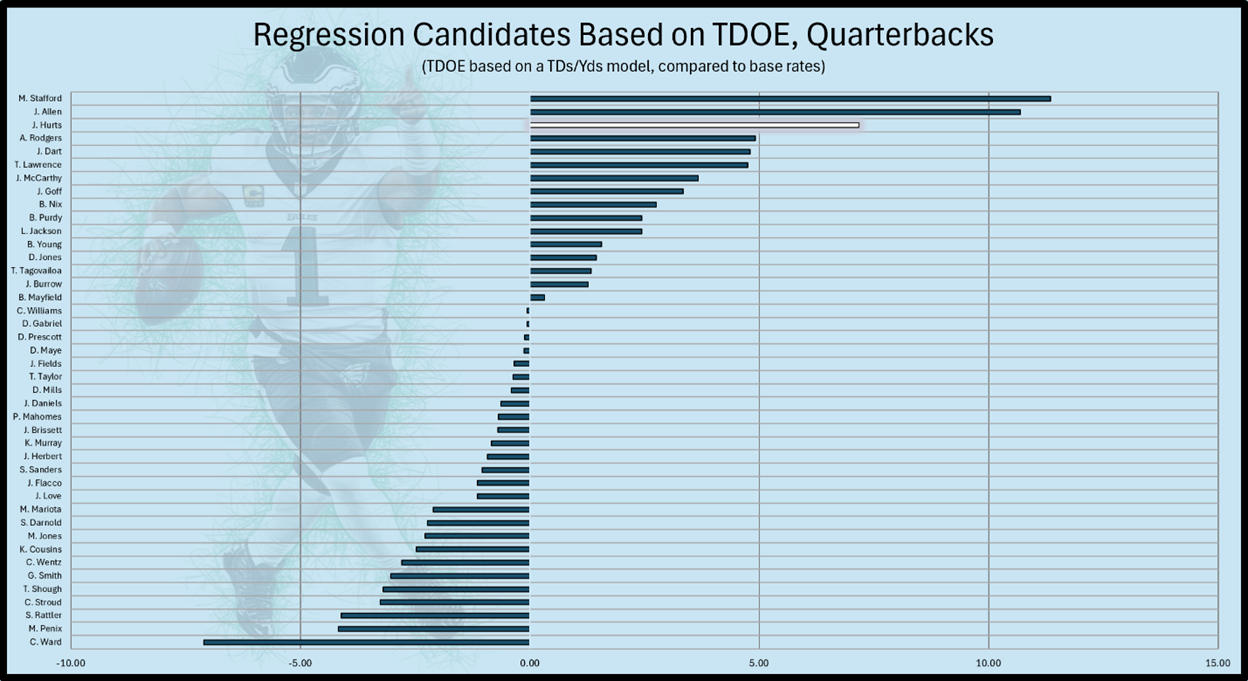
Anchored to TDs/Yds, I can create an expected TDs model by determining the league base rates and comparing them to individual players' TDs/Yds. Based on this simple model, Hurts shows up as a significant negative regression candidate, as he is currently sitting at 7.8 touchdowns over expected (TDOE, 3rd).
This is tricky because the model aggregates players’ passing and rushing production; rushing TDs tend to be more stable than passing TDs, and 27% of Hurts’ TDs this year have come from rushing. His passing TD rate of 5.2% is ahead of his career 4.4% rate and may see a modest reduction, but this doesn’t seem like the kind of number that is redlining and set to blow. His 8.4% rushing rate is right in line with his career 8.3% rate and actually down from his 2023 (9.7%) and 2024 (9.3%) rates, so some of that passing TDOE is offset anyway.
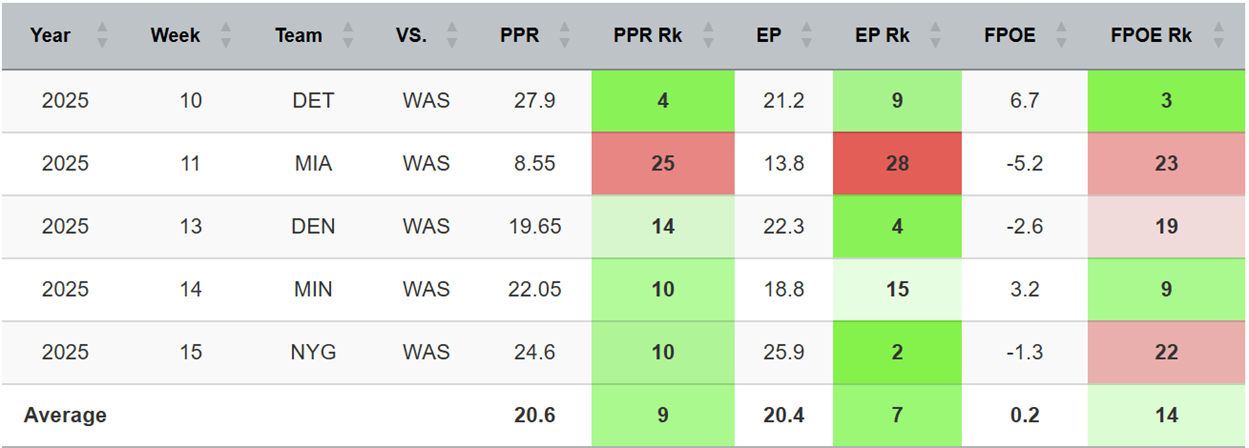
The Commanders are an easy target for fantasy QBs, surrendering the ninth-most fantasy points to opposing QBs in their last five games. To be clear, they are a choose-your-own-adventure book and accommodate whatever offensive approach teams wish to take.
The Eagles have three pass-catchers with at least a 15% target share per game rate: WRs A.J. Brown (30.2%) and Devonta Smith (20.8%), and TE Dallas Goedert (17.6%).
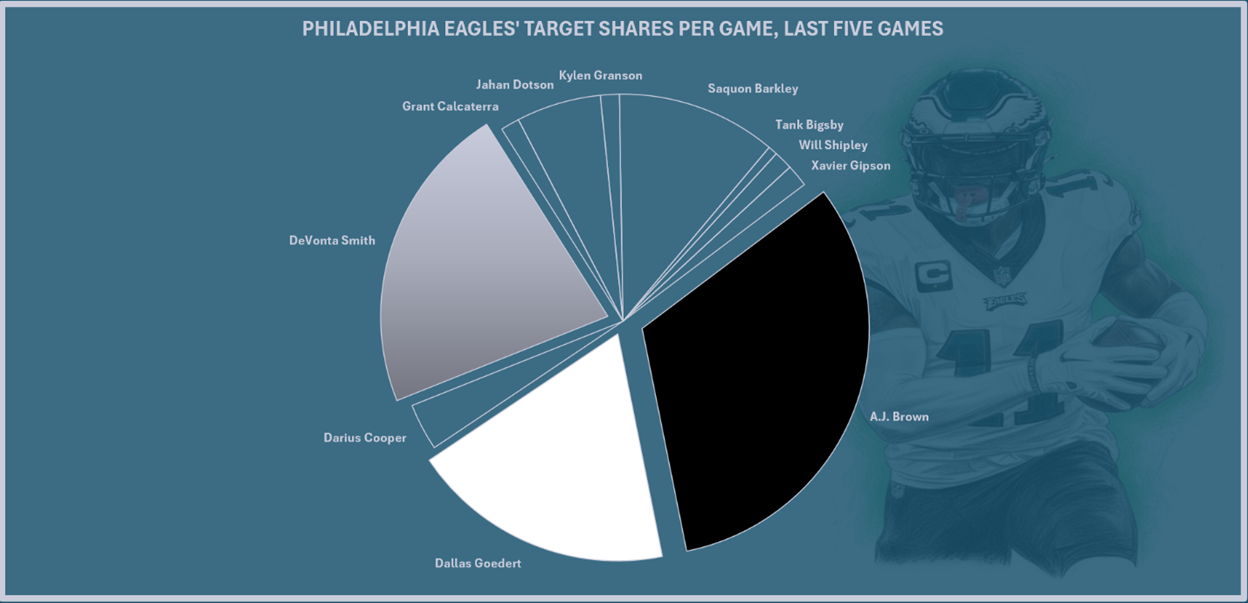
The Eagles’ passing attack has a medium amount of volume, so shares like Smith’s and Goedert’s recent rates are usable week-to-week in most leagues, but neither is really in auto-start territory, depending on what other options are on a GM’s bench.
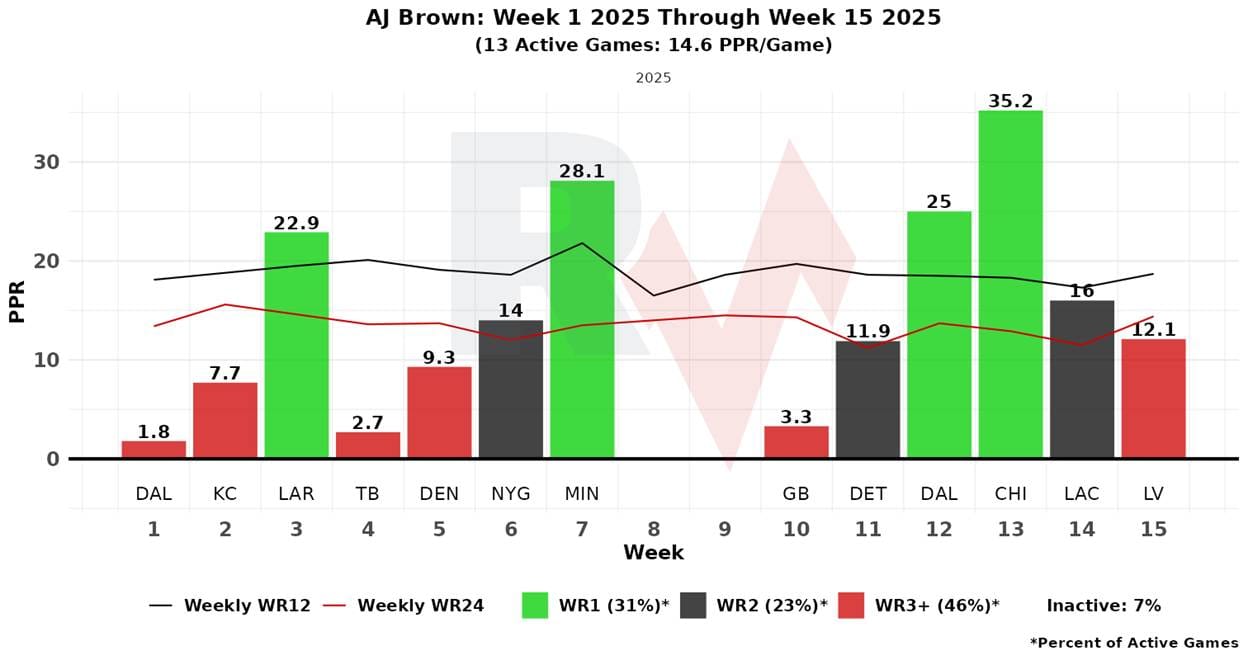
Brown’s +30% share can’t be justifiably left out of lineups, but still, he’s been uneven as a fantasy entity. His highs have been incredibly high, as we’ve seen him have three games with more than 25 PPR points, including a 35.2-point blowup against Chicago on Black Friday. He can’t be benched, but playing Brown comes with a dose of torture, as GMs have also endured five single-digit PPR outputs.
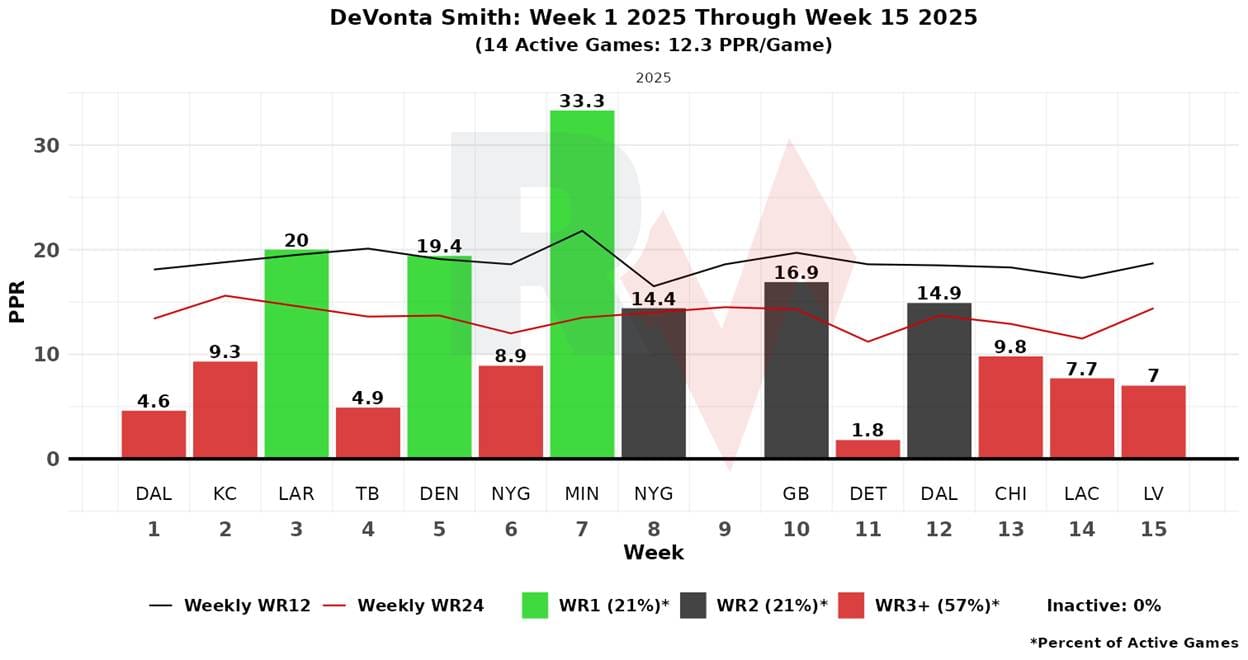
Smith’s patterns are similar across the year: he’s had three WR1 weeks, including a 33.3 PPR-point spike, and three WR2 games. The other nine games have resulted in disappointing single-digit outputs, including in four of his last five games. More managers are probably fatigued by Smith than Brown, as he so frequently returns a detrimentally low value (and he hasn't had a spike game for a while). Still, it is worth remembering that Smith has a high ceiling; single-game ceiling is more tied to wins than the floor is to losses.
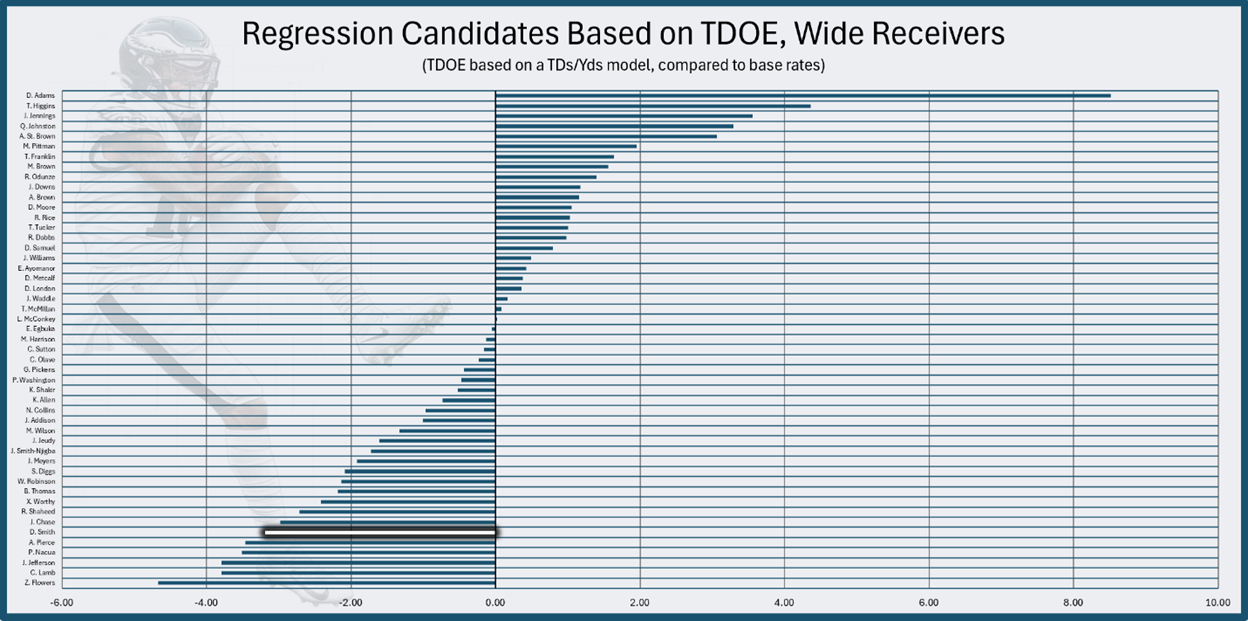
Smith has a -3.19 TDOE based on TDs/Yds (44th), among the lowest rates in the league among qualified WRs. As it is, Smith is 30th in PPR scoring; with just an average TDs/Yds rate, he would be 21st, and perception would be more aligned with how he has been viewed for years.
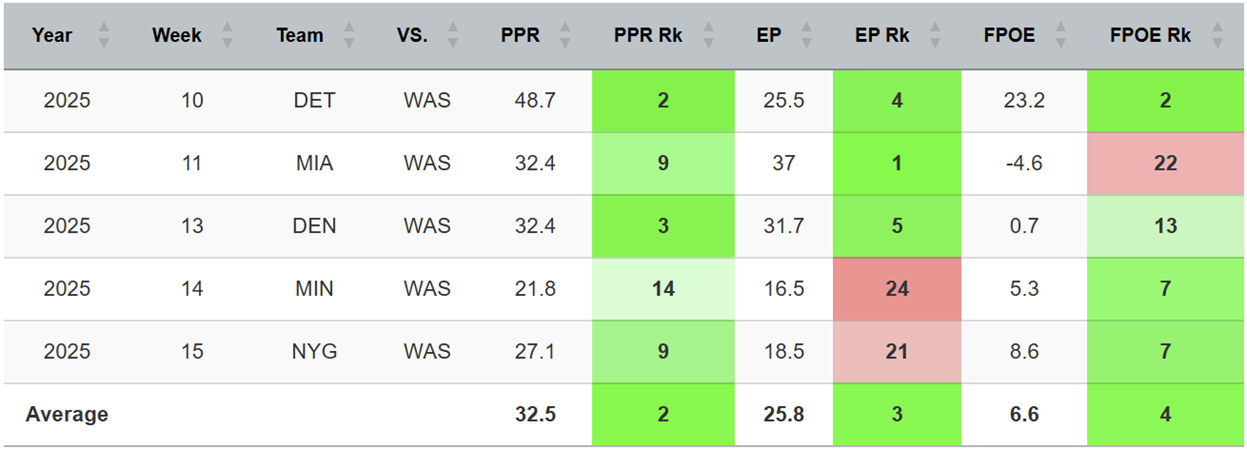
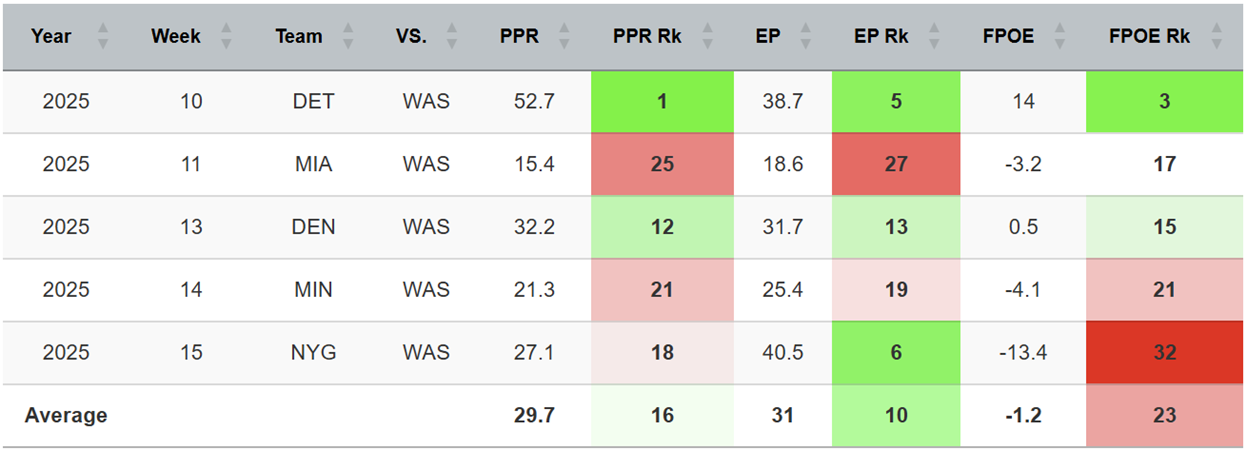
Teams can beat Washington with their WRs, but Washington shows up stronger against opposing WRs, allowing the 16th-most PPR points to WRs in their last five games (still not the ’85 Bears, as it turns out). Among these, Detroit's WR corps ranked first in Week 10 with 52.7 combined PPR points.
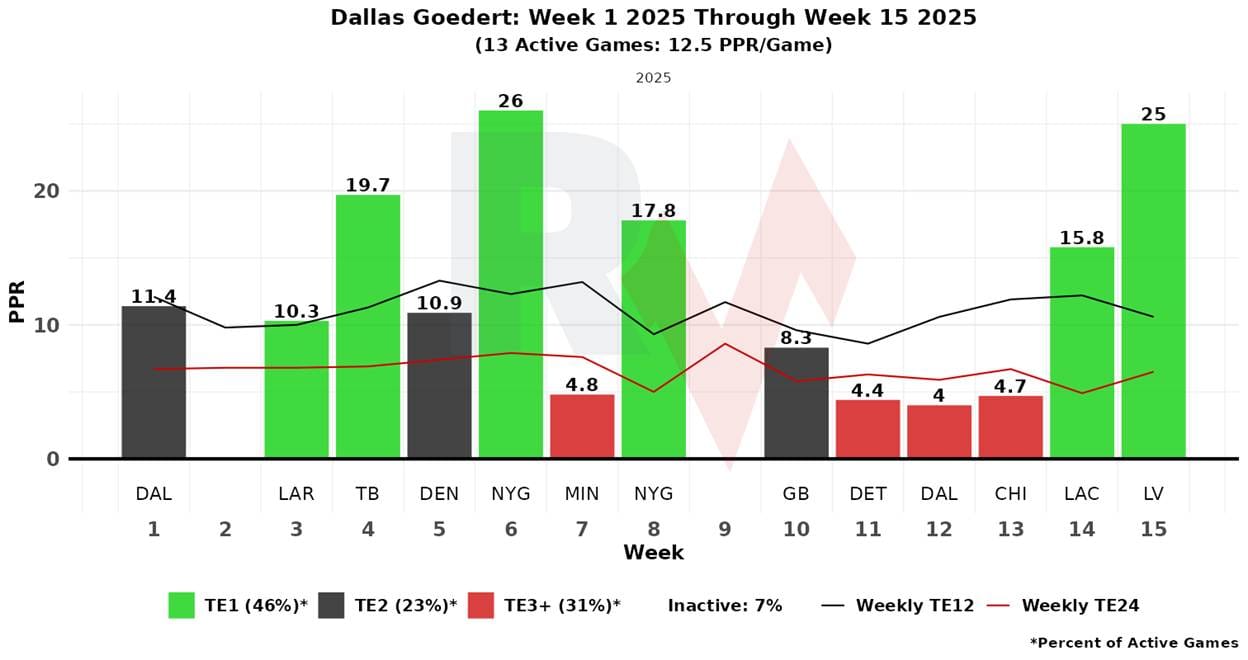
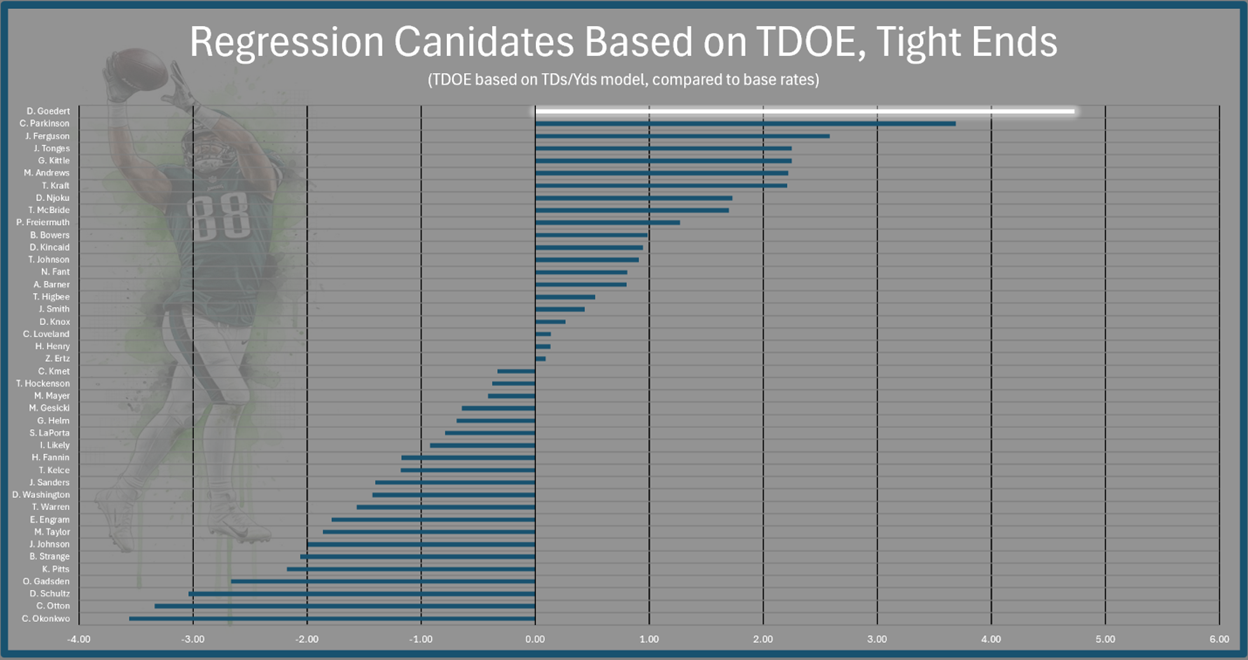
TE Dallas Goedert is the TE8 in PPR/G. He has been a TE1 six times this season, including in each of his last two games. Goedert is reliant upon TDs to keep him so fantasy relevant, something he’s done well. His nine TDs trail only Trey McBride, who has ten; McBride, on the other hand, has roughly twice as many yards. Ultimately, that means McBride is scoring at the TD pace he should, while Goedert is running incredibly hot in this category.
Goedert is far and away the most significant negative TD regression candidate among TEs, having scored nearly five TDOE. He may still be a GM’s best option, but beware chasing the kind of fantasy scoring he’s been providing, as it feels somewhat unsustainable given how he’s doing it.
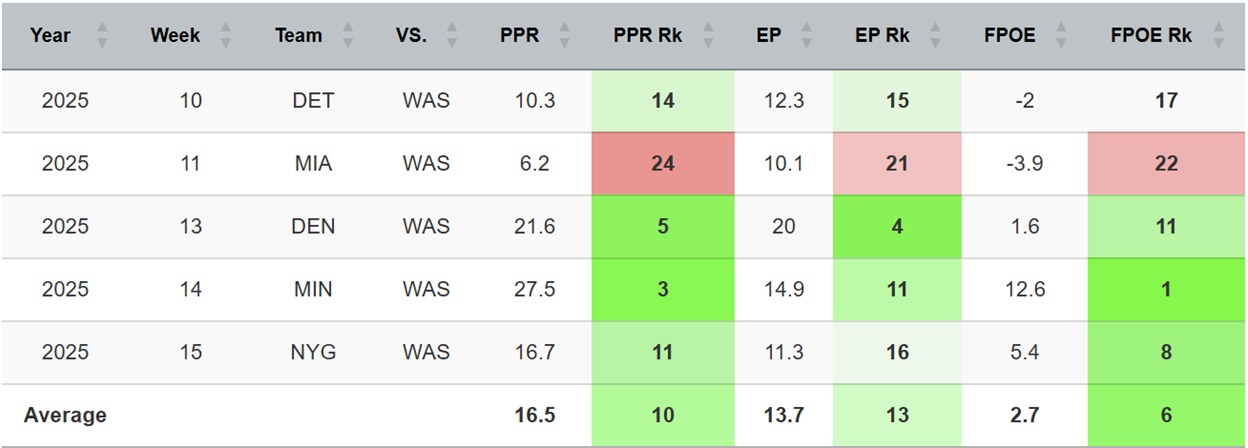
The Commanders’ defense is beatable against TEs, too. They’ve surrendered the 10th-most PPR fantasy points to TEs in their last five games.
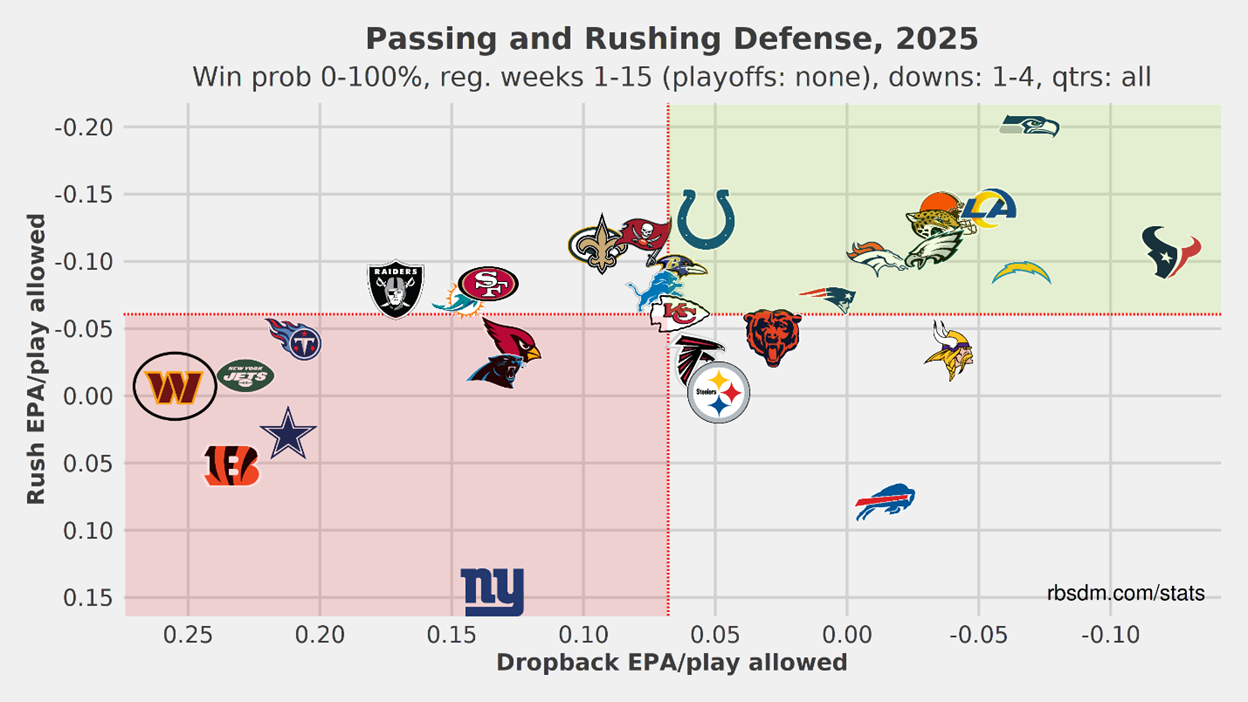
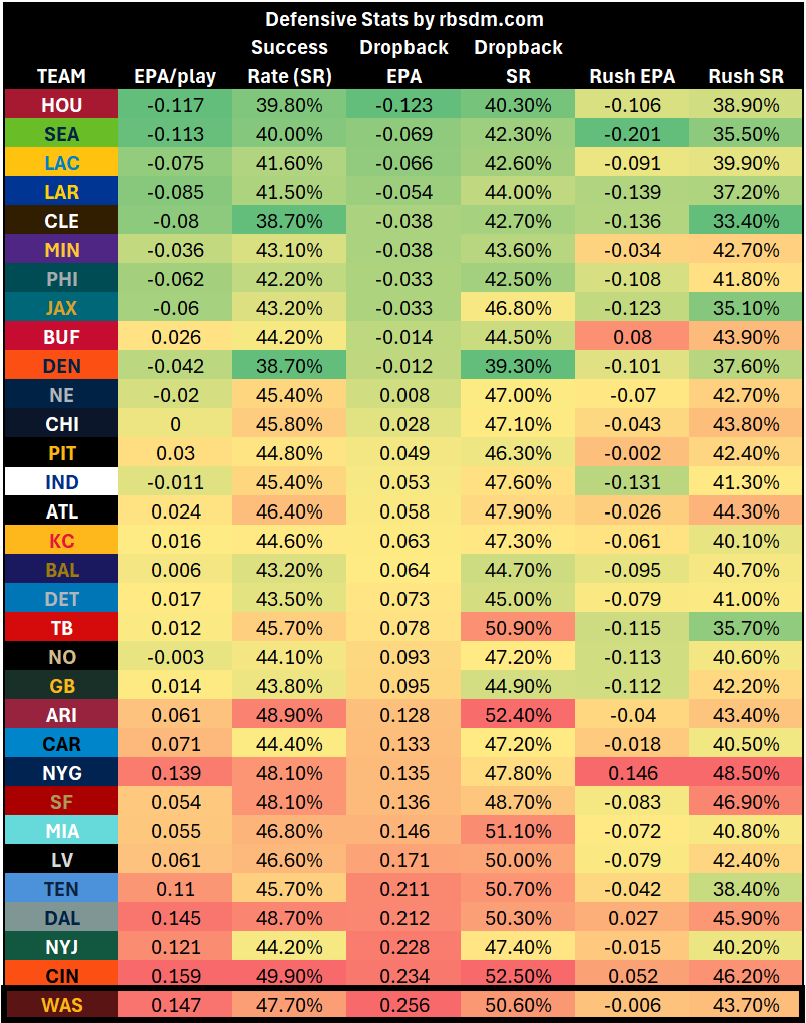
The Commanders have a poor defense in terms of dropback EPA and rush EPA allowed.
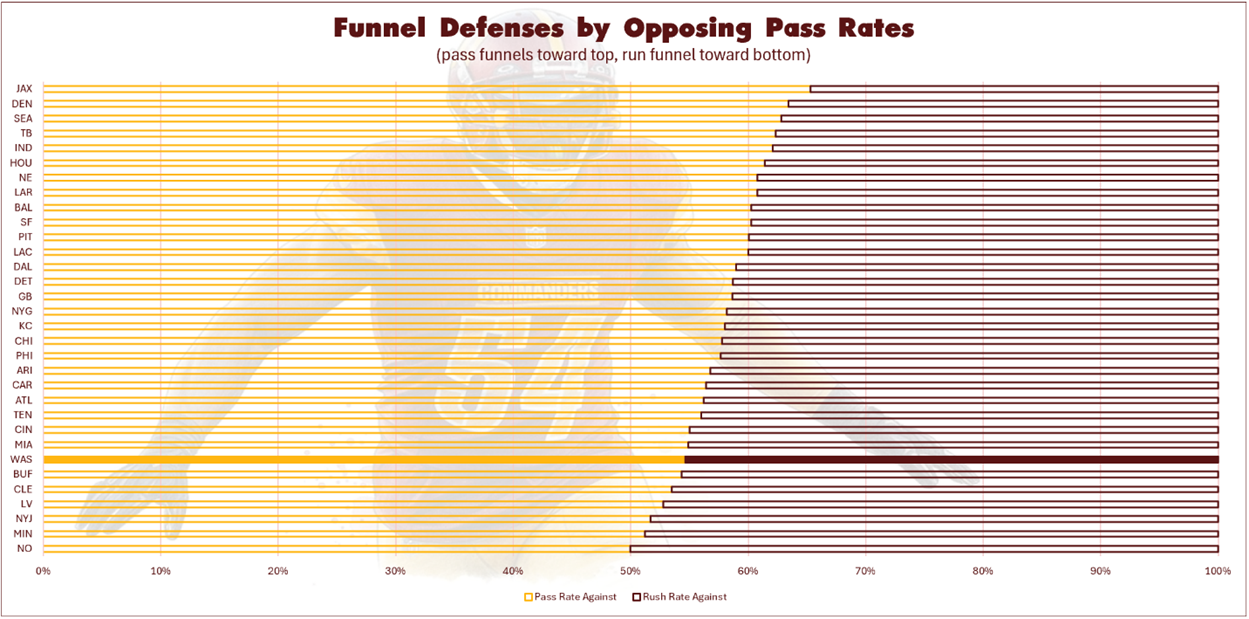
Despite being slightly more efficient against rushing plays than passing plays, the Commanders have seen a 54.6% pass rate against (26th). This makes them appear as a bit of a run funnel. Part of it is that they’ve been behind by seven or more points for 45 plays per 60 minutes; their opponents are inclined to run down the clock and preserve a lead in this scenario.
The Commanders rank 31st in EPA per play allowed and 27th in defensive success rate. They rank dead last in EPA per dropback allowed and 27th in defensive success rate on dropbacks.
Washington uses a zone defense at a rate of 65.7% (14th). They use Cover 1 just 51.8% (13th), a little low considering HC Dan Quinn’s history using the Pete Carroll/Legion of Boom defense, which was always predicated on single-high safety (and the answer may be that they have no Earl Thomas-type figure to play that role, or it could signify a philosophical shift in a dynamic NFL that is constantly evolving). What is unsurprising is that their top defensive alignments of choice are Cover 3 (27.1%) and Cover 1 (23.1%), which are ultimately zone and man equivalents of the single-high scheme. They blitz at only a 23.1% rate, which is below average.
Fantasy Points’ coverage matchup tool assigns a zero-based matchup grade to each pass-catcher based on their opponent’s use of specific types and rates of coverage and how that pass-catcher performs against them. Positive numbers indicate a favorable matchup and negative numbers indicate an unfavorable one.
No matchup stands out in this model as abjectly favorable, but Goedert (+0.9%) and Brown (+0.8%) have essentially neutral matchups based on coverage types and rates. Smith’s matchup, however, is slightly unfavorable (-4.4%).
PFF’s matchup tool is player-based, pitting the PFF ratings of individual players against each other for an expected number of plays based on historical tendencies and rating on a scale from great to poor.
Based on this, Goedert’s matchup grades out as great, while Brown and Smith’s grade out as good.
Philadelphia’s offense allows a pressure rate over expected (PrROE) of 8.23% (19th), while Washington’s defense generates an 8.17% PrROE (12th), so the matchup is decidedly neutral for Philadelphia’s pass blocking unit based on the numbers.
As for run-blocking, the Eagles generate 2.13 adjusted yards before contact per attempt (adj. YBC/Att, 16th). The Commanders allow 2.22 adj. YBC/Att defensively (12th). This is also a relatively neutral matchup.
The Eagles have been playing without RT Lane Johnson since Week 11 against Detroit, and he has already been ruled out for Saturday. The Eagles’ splits with and without Johnson are staggering. I’ve shared this each week I’ve had Eagles write-ups since Johnson has been out, but I will continue to show it because it is so unbelievable that any non-QB could have such a dramatic impact on an entire team.
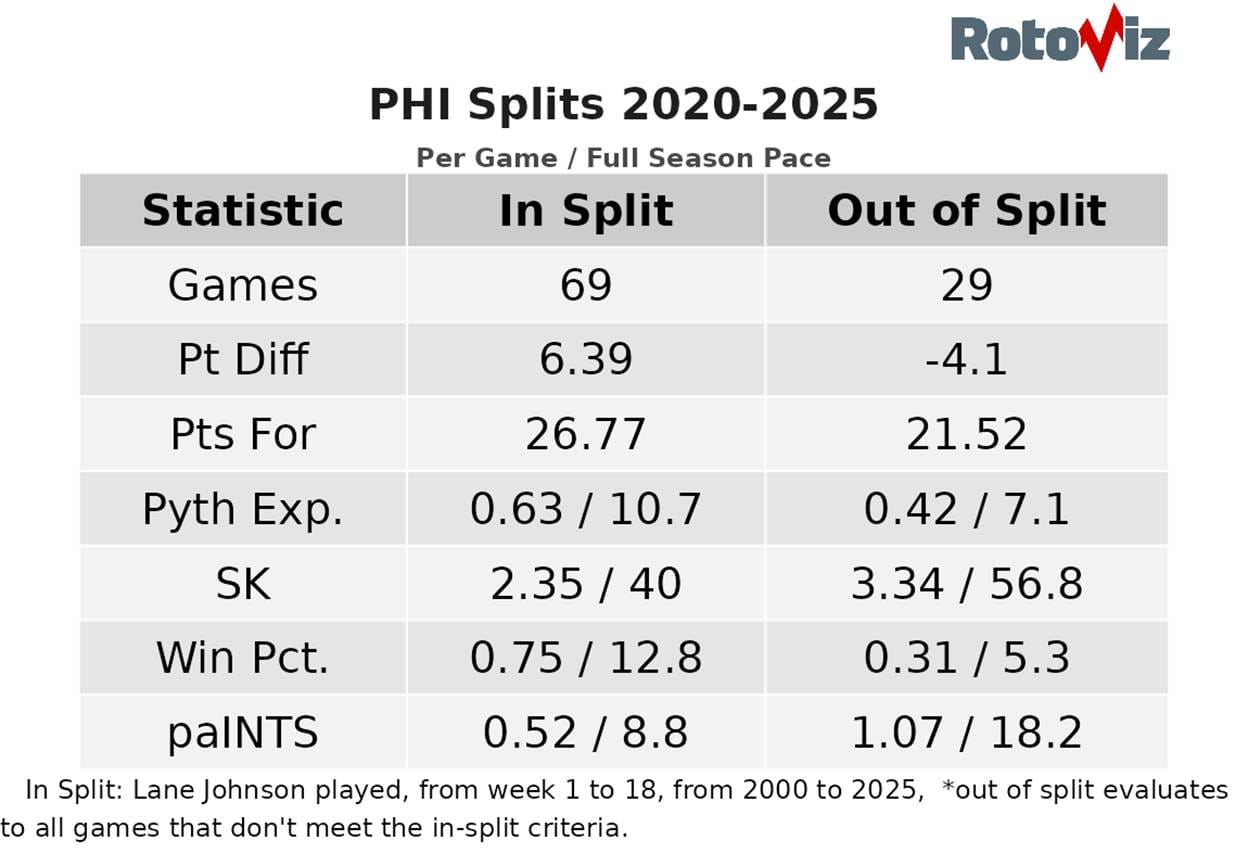
Even in the four games Johnson has missed this season, the Eagles have won only one; in the ten games he’s played, they’ve won eight.
The Eagles rank 20th in offensive EPA per rush and 22nd in offensive success rate on rushes.
RB Saquon Barkley is one of the most bell-cow-iest of bell cows, drawing 78% of the Eagles’ snaps, 11% target share, and 62% of the team’s rush attempts (made even more impressive by the fact that Hurts is their QB).

Much has been made of Barkley failing to get the volume of receiving work he got when he was with the Giants—most of this, presumably, based on the Eagles’ offensive personnel, especially Hurts, who is a mobile QB. And of course, Hurts takes a lot of the goal-line rushing away from him because of the Tush Push.
Barkley ranks 11th in high-value touches (HVTs); this would be great except that everything else about his usage says Barkley should be getting more. This HVT volume is really only swamped by Christian McCaffrey’s unreal HVTs, but it is in range with a lot of his RB1 compatriots. And, of course, this was just as much the issue last year, when Barkley finished as fantasy’s overall RB1.
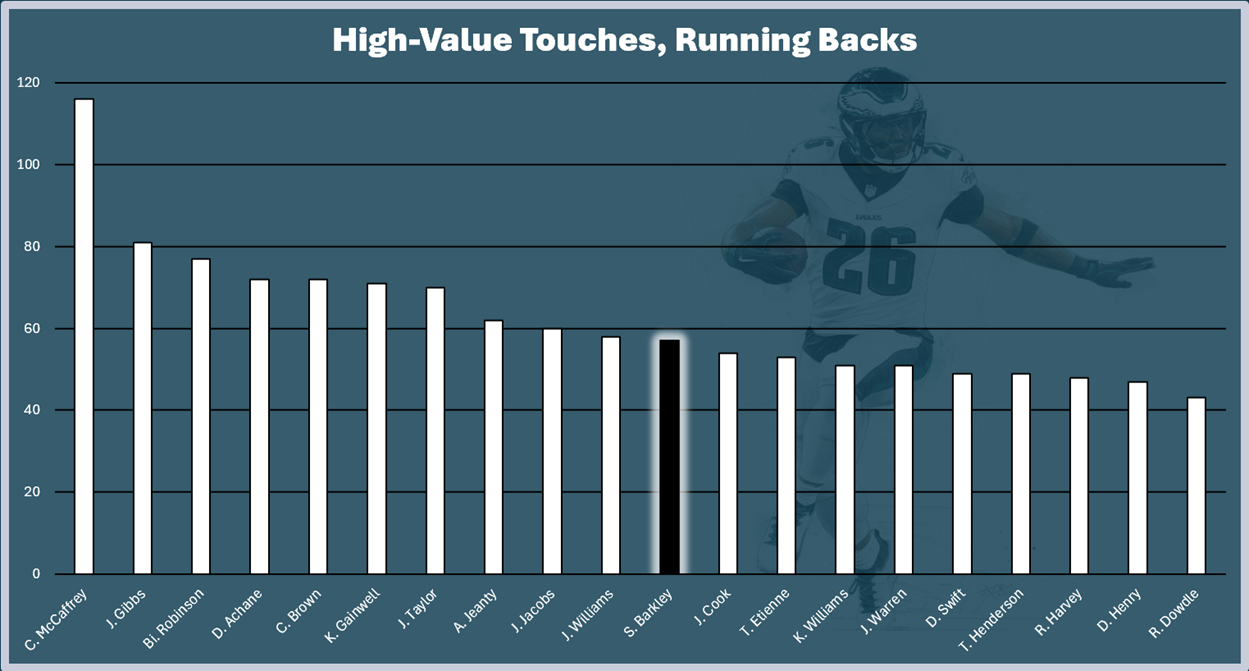
Two things are prohibiting a repeat as fantasy's overall RB1. For one, again, McCaffrey has such a high number of HVTs, as he always does; he was injured for much of last year, so he wasn’t there to box Barkley out.
But also, Barkley’s efficiency is down across the board. His YPC has fallen from 5.8 to 3.9, his rush yards over expected per attempt (RYOE/Att, NextGen Stats) from 1.77 (2nd) to 0.16 (32nd), his fantasy points over expected per game (FPOE/G, RotoViz) from 5.7 (4th) to zero (65th), and his expected points added per play (EPA/play, Sümer Sports) from +0.10 (T-4th) to -0.12 (T-45th).
Yards per carry is the most straightforward metric, and it treats a short gain on third-and-short the same as one on third-and-long. RYOE uses tracking data to estimate how many yards an average runner should have gained based on defender positioning, with positive values showing the back outperformed his blocking. FPOE compares a player’s actual fantasy output to what a typical player would score with the same workload, flagging efficiency or good fortune. EPA/play measures how much each rush changes a team’s expected points based on down, distance, and field position, distinguishing productive short gains from empty ones.
As we know, the Eagles’ run blocking hasn’t been what it was a year ago, so it’s tempting to brush off Barkley’s struggles and pin them entirely on the offensive line. But that would be disingenuous. Line play heavily affects metrics like YPC and EPA, and moderately affects FPOE. RYOE, however, is derived from player-tracking data, using electronics, chips, and AI, allowing it to isolate which responsibility ultimately lies with the ball carrier more effectively.
The point is that each metric captures a different facet of efficiency, and the conclusions they draw can vary widely. The fact that Barkley’s efficiency has cratered so broadly across all of them paints a clear picture that he is at least partly responsible. Is this the Curse of 370? Short answer, maybe. I generally downplay oversimplified narratives that try to explain complex outcomes (although Aaron Schatz’s original 2012 article on 370 was grounded in solid research; lesser analysts have since globbed onto 370 and wielded it less responsibly). Still, at some point, Barkley’s downturn becomes difficult to explain away, and 370 can’t be ruled out as a suspect.
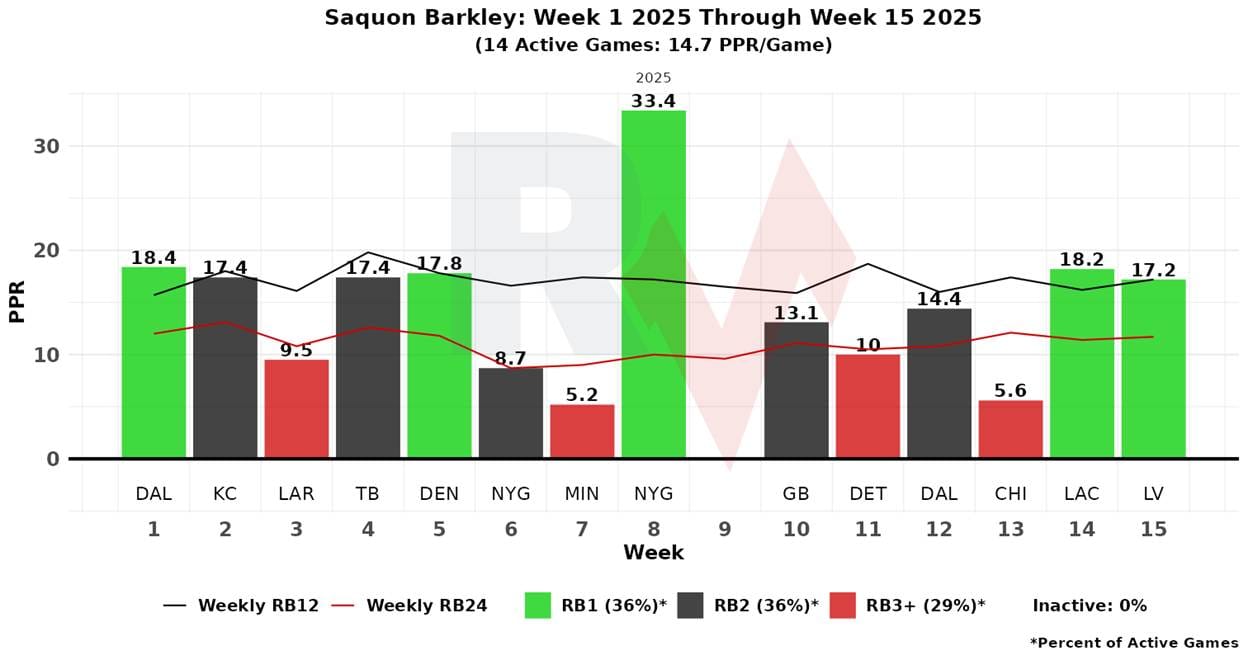
The Commanders rank 27th in EPA per rush allowed and 25th in defensive success rate on rushes. They have allowed the second-most fantasy points to opposing RBs in their last five games. This is a good matchup for Barkley; the game script is favorable, and the team is somewhat prone to running. I expect Barkley to perform well on Saturday.