
Quick Slant: SNF - A Ball Arcing Into Winter

Mat Irby’s Quick Slant
Gray mounds of shoveled-off snow were still bunched in the corners of Bloomington’s Metropolitan Stadium; it was 28 degrees. Brent McClanahan barreled over the thin, yellowing grass, barely blanketing a firmament of soft brown mud, and fell into the end zone, and the Vikings reclaimed the lead. Steam rolled off the lips of every smile, every cheer, every scream of elation, so the bleachers looked like Gotham City sewers erupting plumes of warm vapor along cold concrete streets.
Bud Grant patrolled the sidelines with the austere calculation of a chess grandmaster balancing his checkbook, gloveless, coat half flung open, no frills, just a purple ball cap and windbreaker as usual. He had the build of a plainsman, lean and wind-shaped, with a posture that suggested horseback more than sideline. Long after his hair had begun to go white, his menacing eyebrows remained dark, while eyes of pale blue, stern, always ascetic, were framed beneath them, a composite of Michael Keaton and a White Walker, adorned in Champion. His expression conveyed a controlled intensity that cut through winter, as if he required no leash for his team, and they followed at his heels anyway.
Tom Landry, the malar prominence of a four-star general, patrolled the opposing sideline in Brooks Brothers—fedora, tie, lined trenchcoat, leather gloves, the plaid on his scarf serving as the limit of his wild side. If Grant was austere, Landry was load-bearing. When Philip K. Dick wrote Do Androids Dream of Electric Sleep?, the source material for Blade Runner, in 1968, perhaps he was imagining a man like Landry taking the Voigt-Kampff Empathy Test, so immaculate in his construction that warmth was optional, human insofar as the costume required, his default emotion calibrated to dead serious.
This was 1975, and it was the year the Vikings, the greatest dynasty that never was, were set to finally win it all. At 12–2, they were the best team in football. The Purple People Eaters, two bound for Canton, another frequently listed among its glaring omissions, were among the most relentless defensive lines ever to rush a passer.
But none of them could traverse the cold, hard earth through obstacles dressed in silver and blue to reach Roger Staubach, who took five exhausted steps backward from shotgun. He planted and fired a moonshot at 45 degrees, putting everything into it that his frozen hands could manage. On the other end, 55 yards away, young Drew Pearson was hand-fighting with Nate Wright. Wright fell, cutting off the course of Paul Krause, who was converging. Left suddenly alone, Pearson, who had slightly overrun it, reached back, emulating the shape of a bucket with his arms and capturing it, then holstered the ball on his right hip and crossed the stripe.
Krause pointed at Pearson, accusing him of pass interference, while Pearson launched the football over the scoreboard. The sounds in the bleachers turned to boos, and debris flung from every direction onto the field, as Vikings fans turned into Millwall hooligans. To this day, the debate over pass interference on that play lives on, Pearson maintaining his innocence, Minnesota fans counting it as grand theft of their best chance at Lombardi.
After the game, when questioned, the famously straight-laced Staubach said of the throw that he “closed (his) eyes and said a Hail Mary.” It was the first time anyone had ever said that phrase in reference to a football play; now Hail Mary is as familiar to football vernacular as “illegal motion.”
Not only did the moment effectively TKO the Vikings’ long run of legitimacy as an NFL power in the ’70s, but it also marked the quick regeneration of the Cowboys, who rebuilt in seemingly one year and rose right back to Super Bowl contention with a crop of rookies known as the Dirty Dozen. It was a pivotal moment in the Cowboys’ bridging of generations, as an unchanging pillar that was always there at the end of every season, growing the team’s ultimate nationwide popularity.
It has been nearly fifty years to the day, and there is still no wound between these teams deeper than December 28, 1975. Randy Moss’s Thanksgiving revenge over Dallas has receded into trivia. Their most recent meeting, a 40–3 Dallas demolition of the 2022 Vikings, failed to live up to the hype of an 8–2 team hosting a 7–3 one. Truly, the bloodline ends here, in 1975, frozen in place, steam rising, a ball arcing into winter.
Vikings
Implied Team Total: 20.5
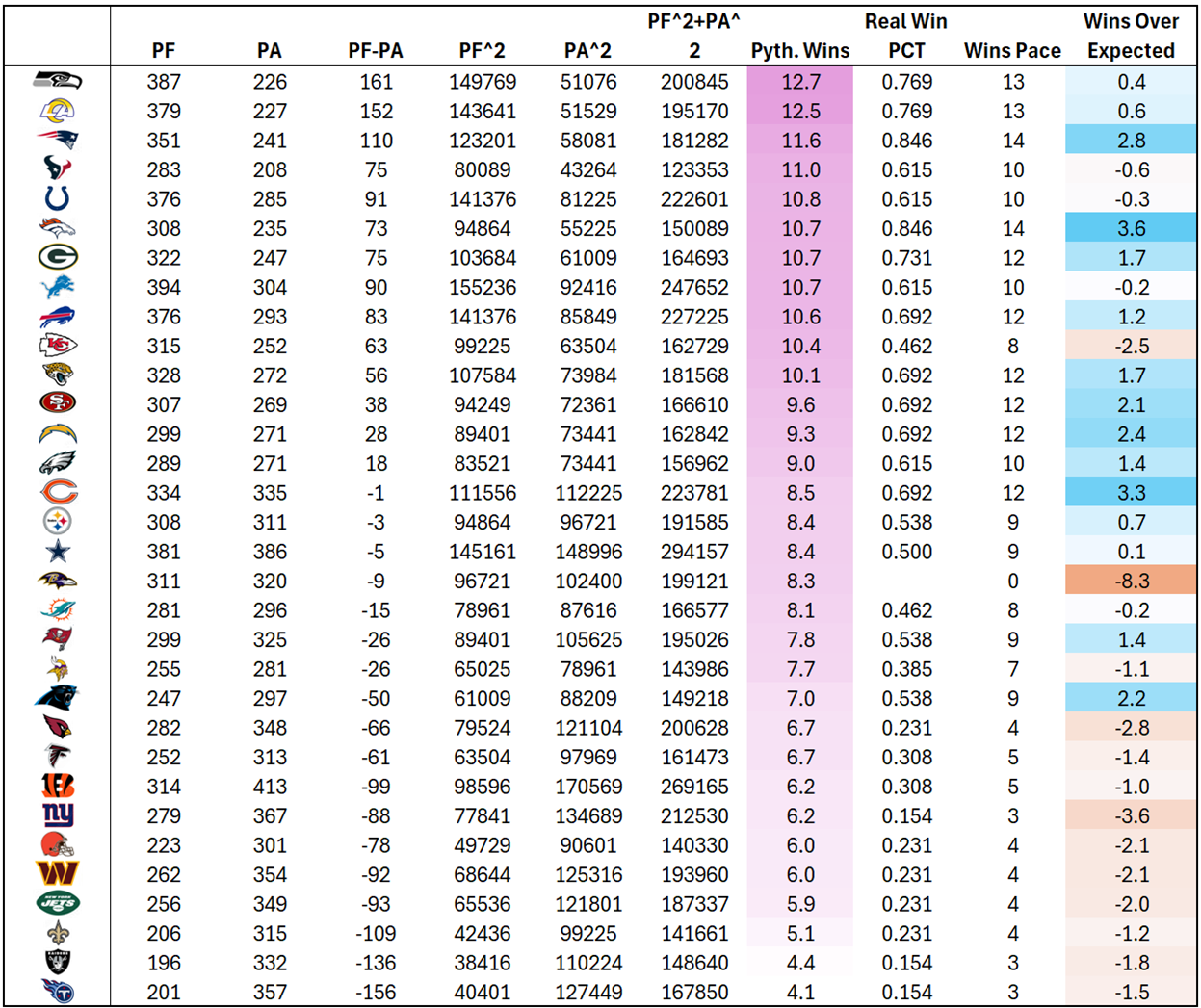
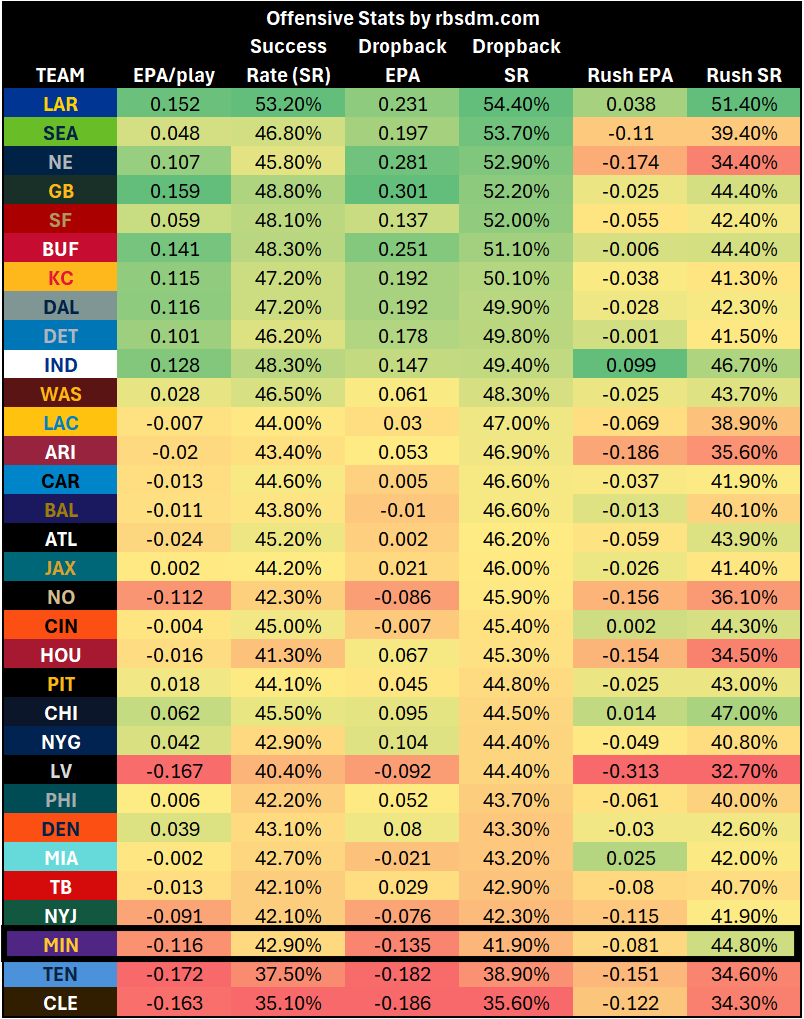
The Vikings have been one of the most significant disappointments in the NFL this season, with a 5-8 record, on pace for about 6.5. Based on Pythagorean expected wins, they are underperforming and should be on pace for closer to 7.7 wins.
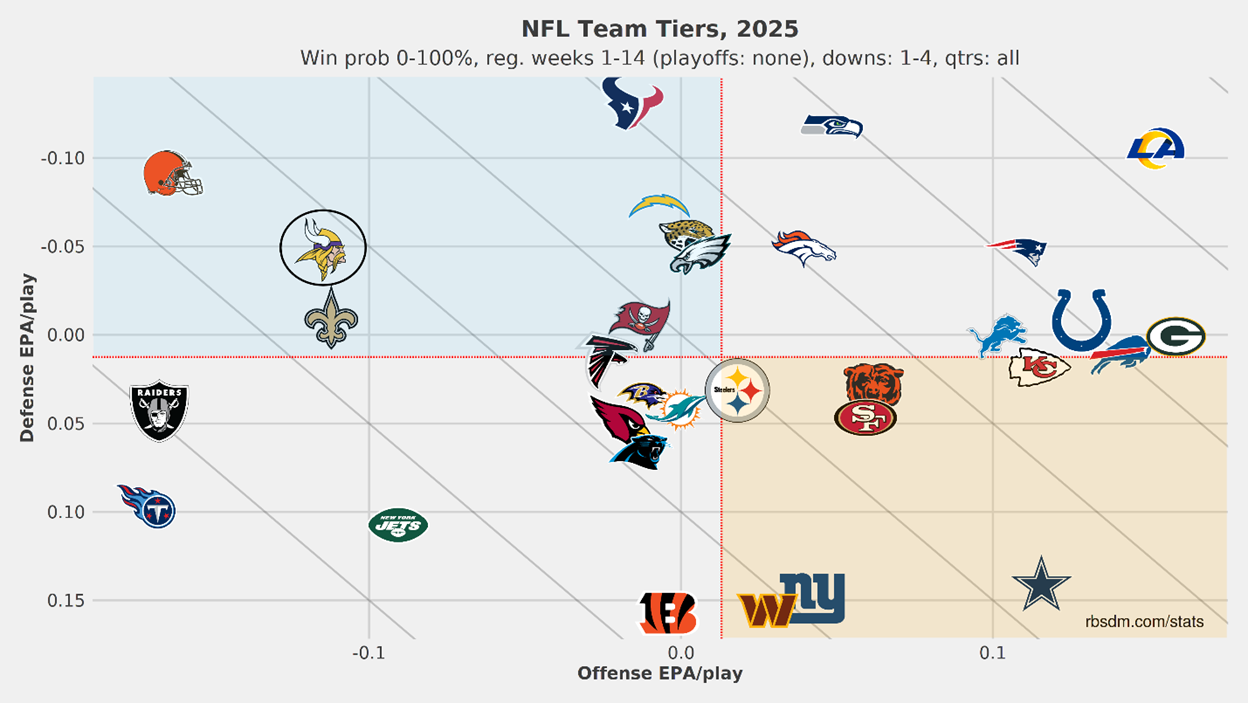
The Vikings are a highly imbalanced team, much better in defensive EPA than in offensive EPA.
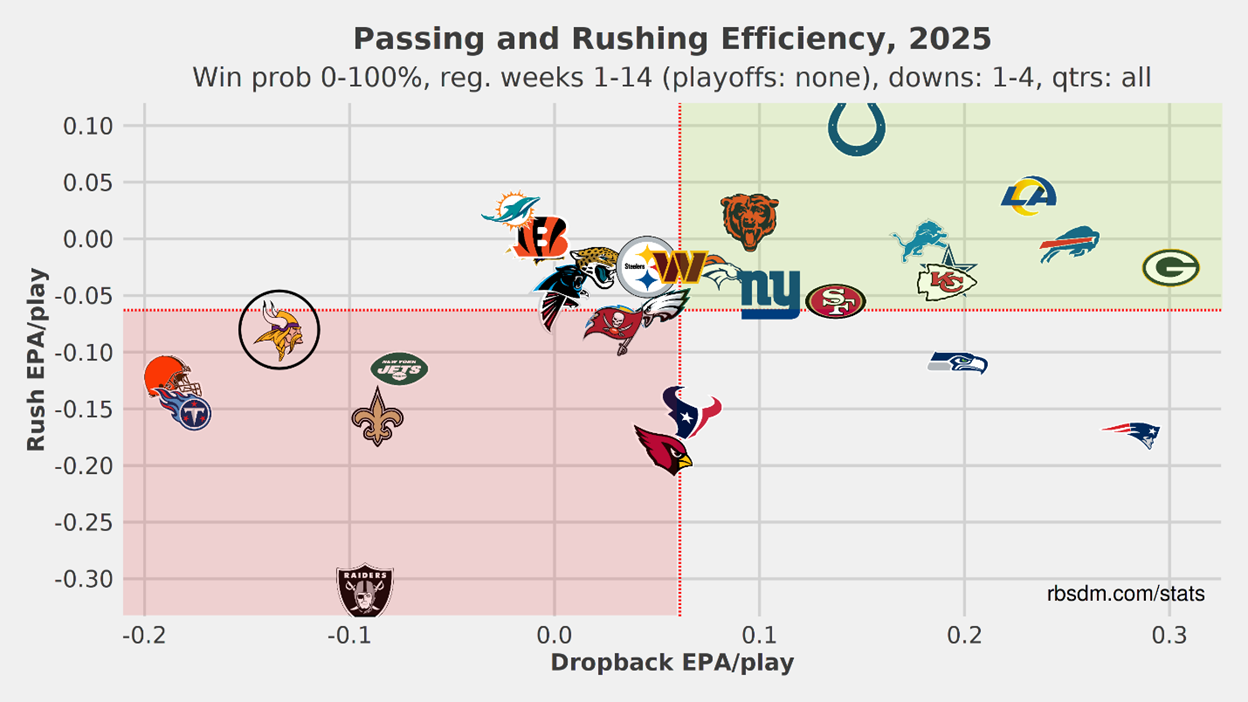
On offense, they are far better at rush EPA, where they are nearly average, than dropback EPA, where they are third from the bottom.
The Vikings have a 60% pass rate (T-7th), and they get plays off in 27 seconds per snap on average. Both rates are down from the Vikings’ averages under HC Kevin O’Connell. They are substantially down in each area while in a neutral script. Their pass rate over expected (PROE) is 1.10%, which is somewhat neutral. Minnesota QBs have combined for 458 dropbacks (22nd).
Minnesota ranks 29th in offensive EPA per play and 23rd in defensive success rate. They rank 30th in offensive EPA per dropback and offensive success rate on dropbacks.
Sophomore QB J.J. McCarthy has been a real cause for concern. After being a first-round draft pick in 2024, he missed his entire rookie season last year with a torn meniscus. This year, as a fantasy asset, he has fluctuated between low-end QB1 and completely untenable.
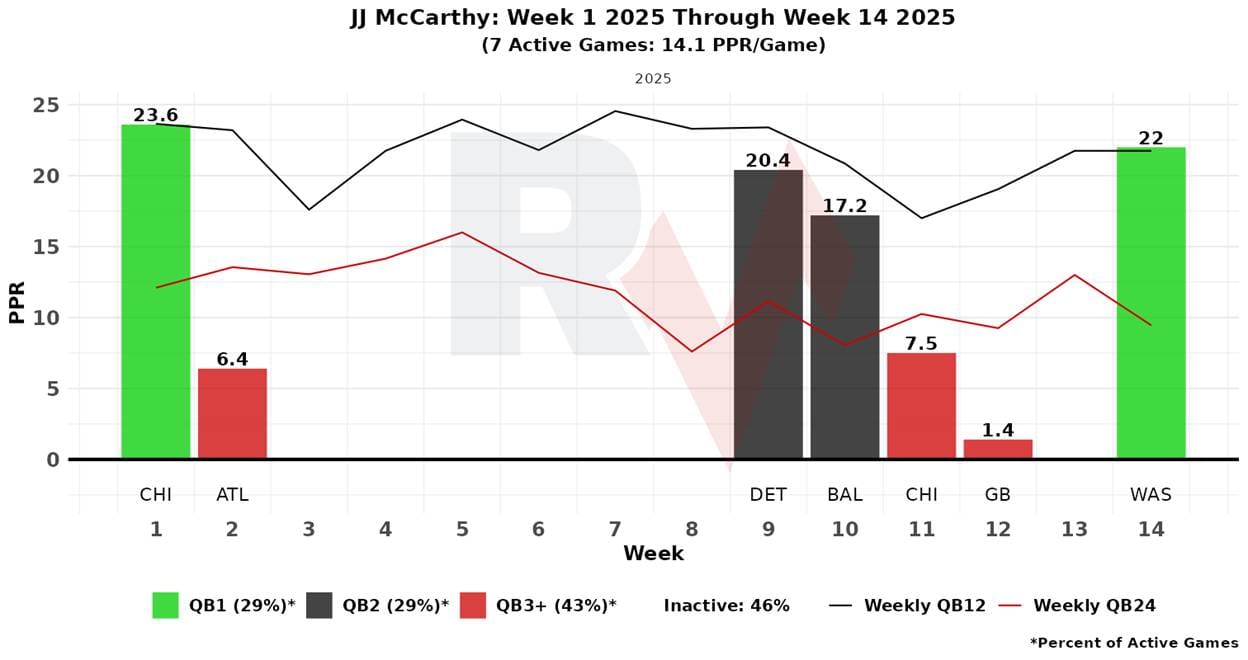
His best fantasy performances have been motivated by TD production: two in Week 1 and Week 9, and three last week against Washington. His three best games have been Weeks 1, 9, and 14—all with better than 20 fantasy points—each driven by three combined passing and rushing TDs. His lows are dreadful, but his highs aren’t too bad. He’s much better for two-QB or superflex than single-QB, where he’d be a matchup-specific streamer, but denying he has any fantasy utility at all is a little misguided.
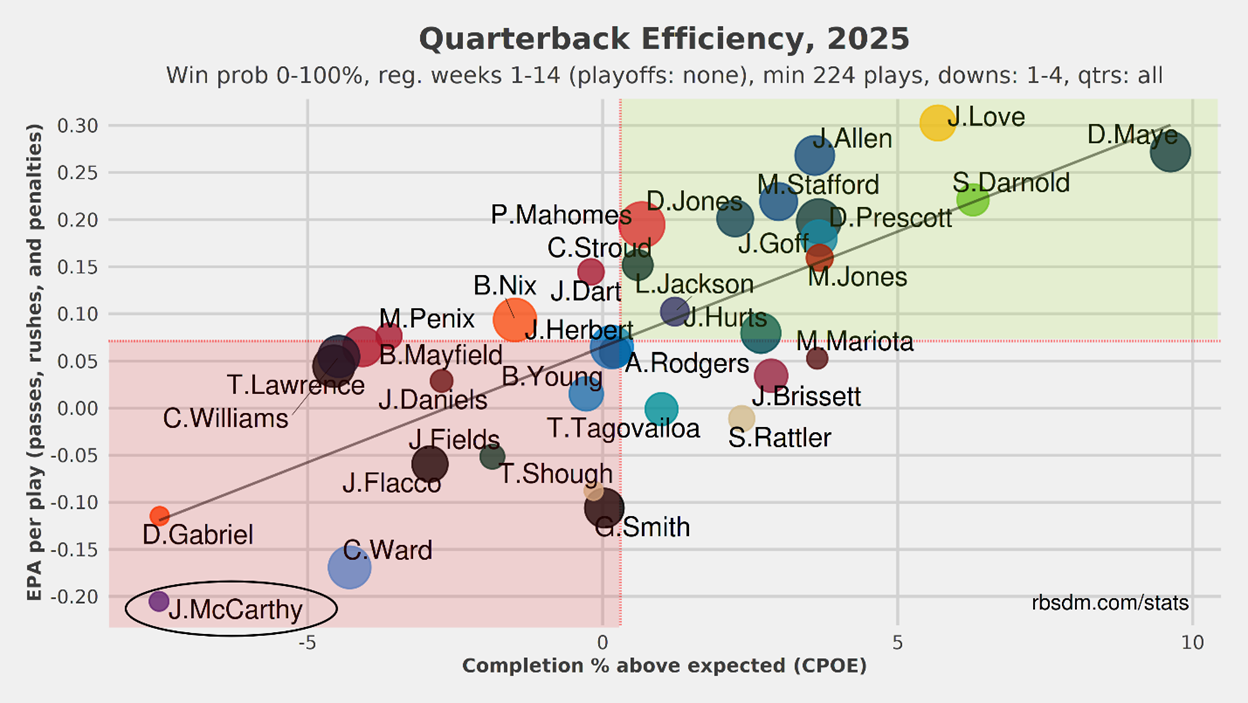
As a real-life QB, McCarthy is likely far worse. It is still early in McCarthy’s career, but we must remember a few things: he has decent rushing chops, which elevate him in fantasy; this probably improves how we perceive him. Also, he plays in a traditionally QB-friendly offensive system behind a satisfactory offensive line, with good weapons in the passing game. The fact that he has all of that and is distantly last in EPA + CPOE composite is not a great sign for him as a QB prospect.
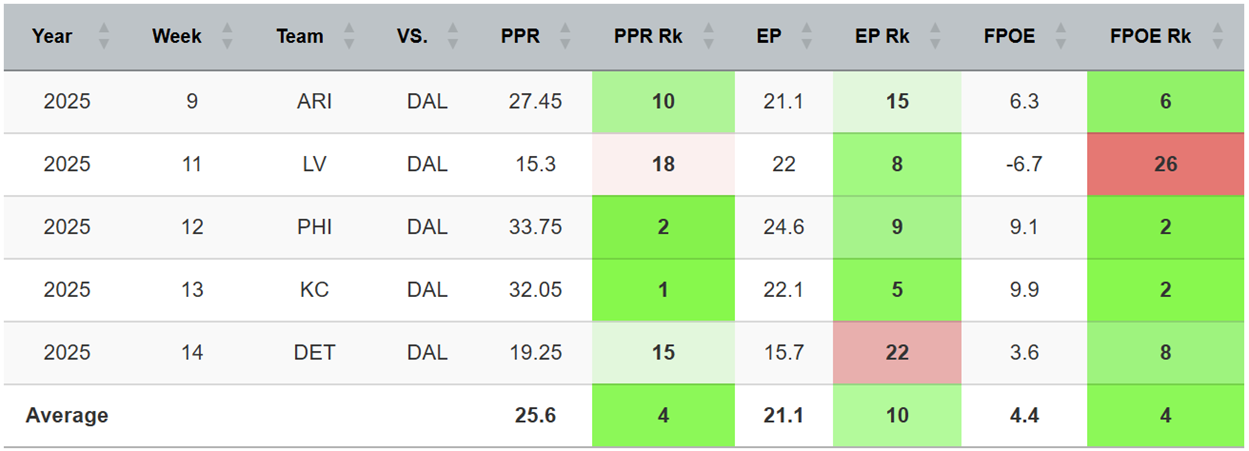
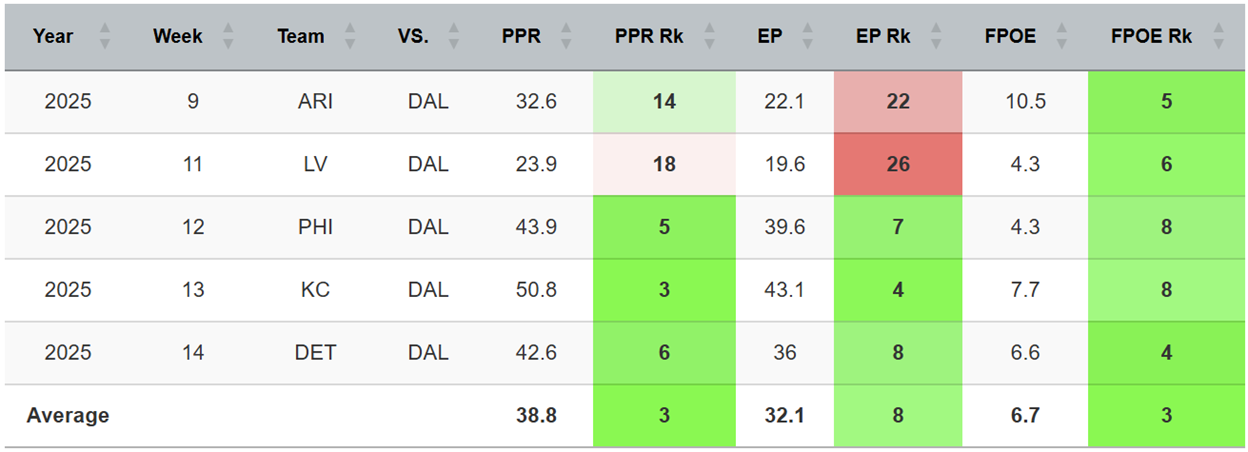
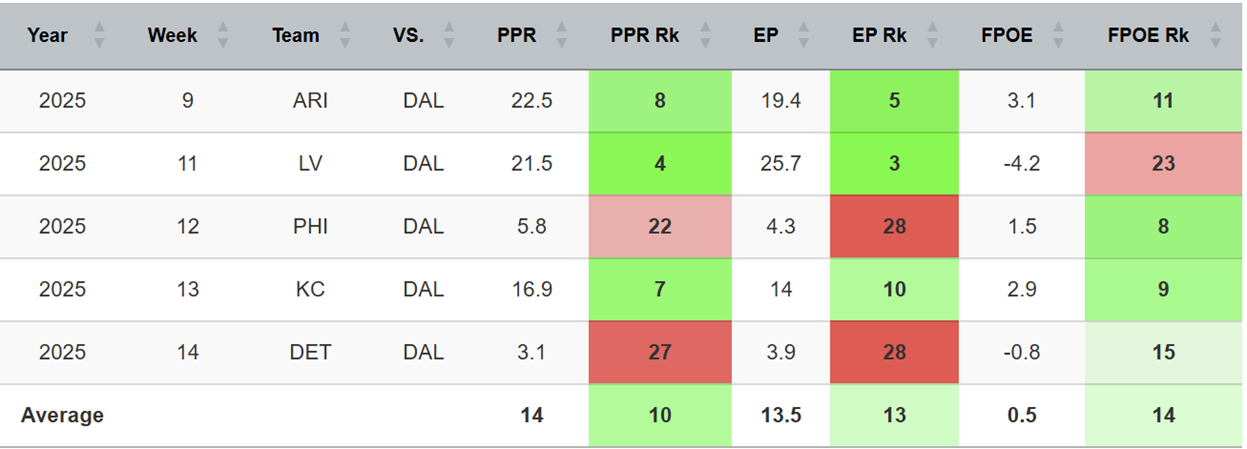
If there were an instance to consider McCarthy a matchup-based streamer, this is it. Dallas is dreadful at defense in every area, and they may actually be a good enough offense to put up points against Minnesota’s tough defense. This combination has served both the Cowboys’ fantasy pieces and their opponents' fantasy pieces quite well. In their last five games, the Cowboys have surrendered the fourth-most fantasy points to opposing QBs.
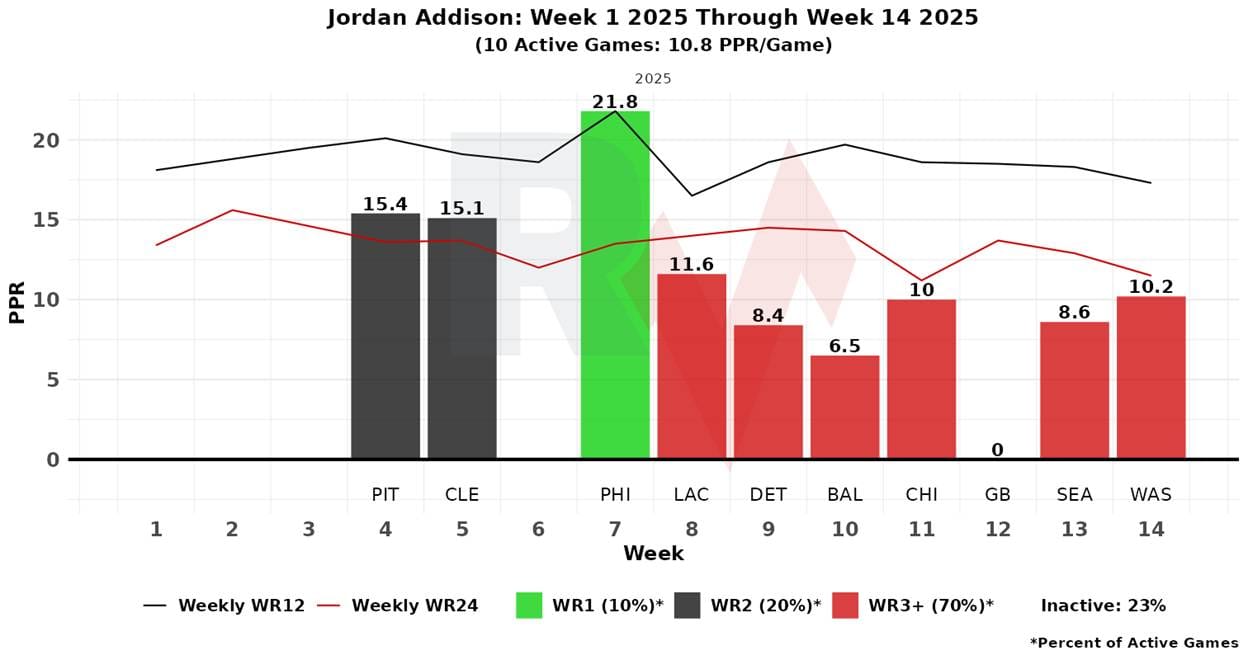
The Vikings have only two players with a target share above 15%: WRs Justin Jefferson (25.3%) and Jordan Addison (21.2%).
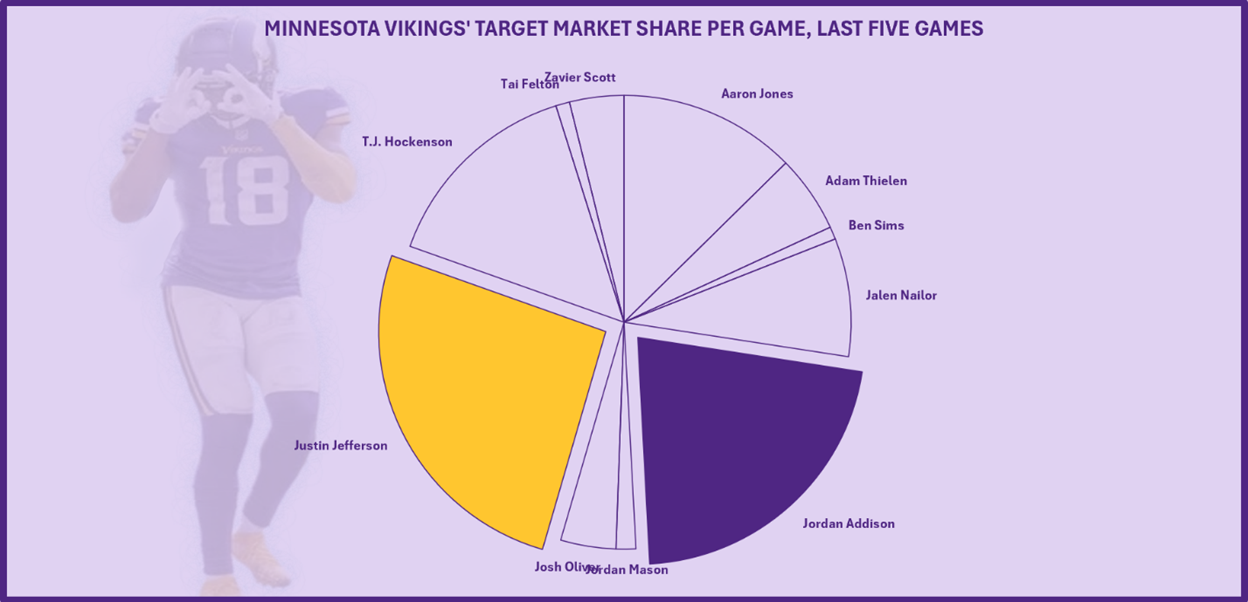
Jefferson has been one of the most reliable fantasy assets of the last five years, but this season, he has only two WR1 weeks and three WR2 weeks. He ranks only as the WR33 overall in PPR per game scoring—worst of his career by leaps and bounds (his previous low in PPR/G was WR9, his rookie season).
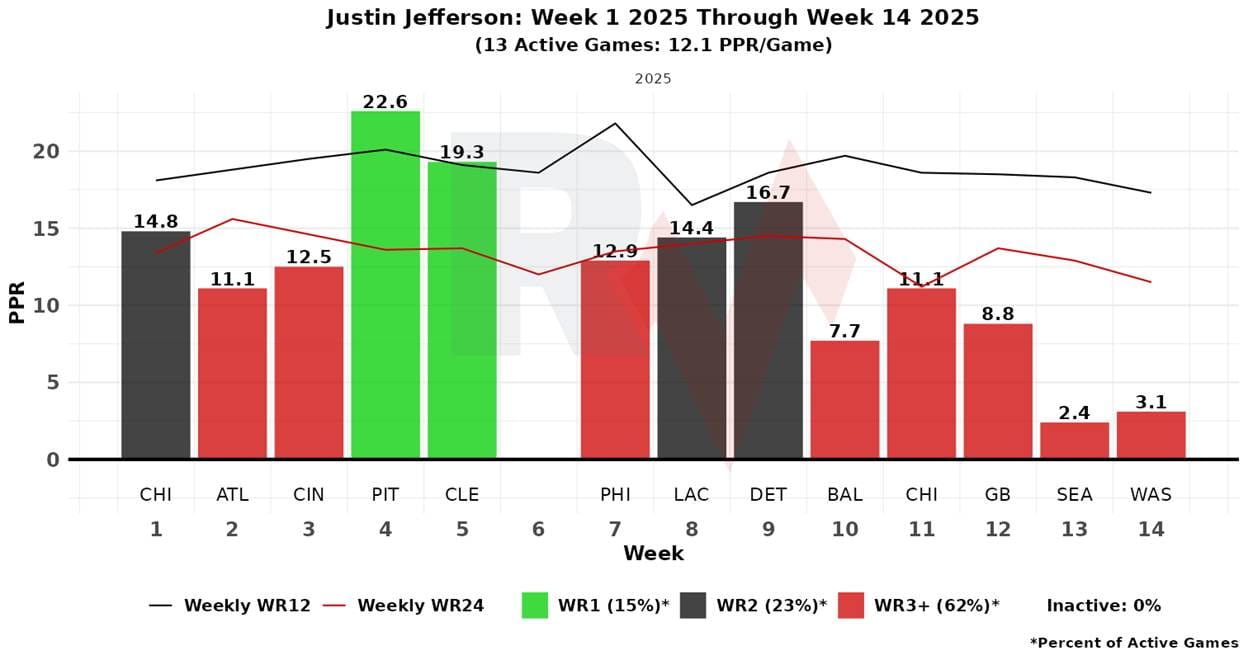
We should pause and diagnose Jefferson’s substantial downturn in 2025. For starters, the Vikings’ PROE, overall pass rate, and pace have all reduced. As a consequence, the Vikings’ pass plays per 60 minutes are at 35. From 2022 to 2024, under O’Connell, they averaged 41.
For the entire season, Jefferson’s target share is 27.9%, which is actually in line with his career rates. Target share is not the issue. However, the quality of those targets is an issue.
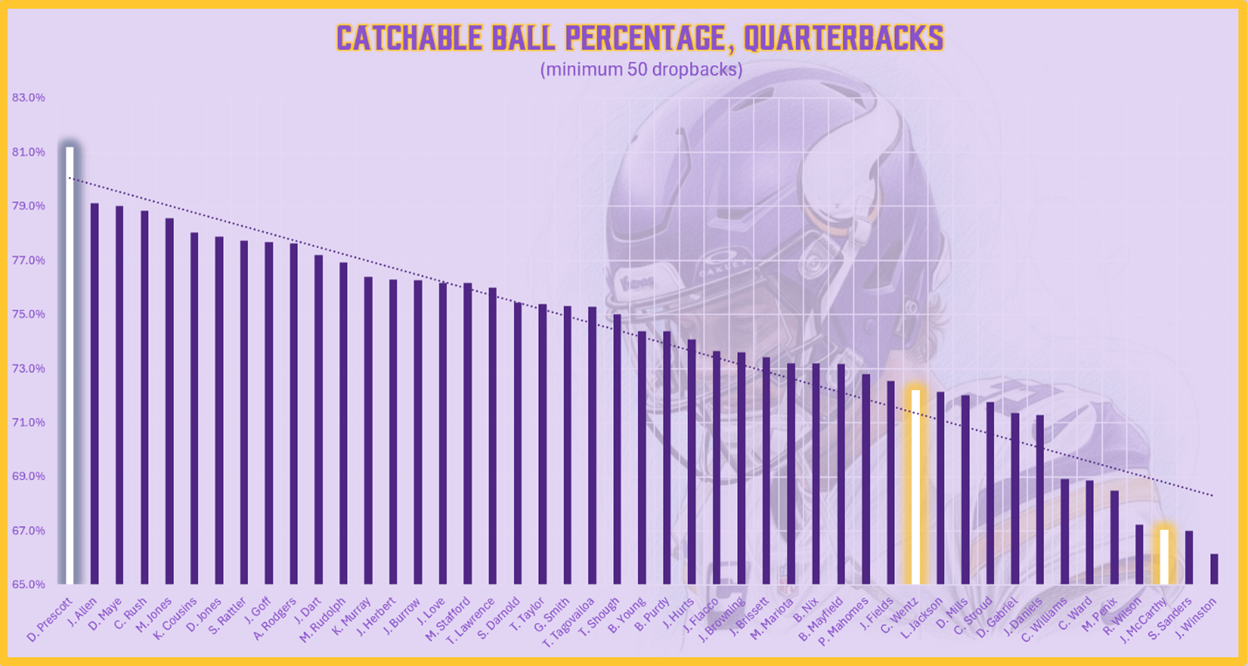
For starters, McCarthy has only a 67% catchable ball rate, 45th out of 47 QBs with at least 50 dropbacks (by contrast, Cowboys QB Dak Prescott has the best catchable ball rate). QB Carson Wentz, who started five games, was at 72.2% (35th) before his season-ending shoulder injury. Long story short, a lot of Jefferson’s targets have not been realistic opportunities for success.
Jefferson’s receptions have been of lower quality, too; he has a 12.7 yards per reception, the weakest of his career by a whole yard. His 5.1 yards after catch/reception (YAC/rec) is tied for the highest of his career. However, we usually see higher YAC/rec when players have lower average depth of target (aDOT); that is the case here. Jefferson’s aDOT is 11.5, the second-lowest rate of his career. As a consequence, Jefferson’s efficiency is down overall: his yards per route run (YPRR) are at 1.82, well below his career average of 2.49.
Moreover, Jefferson’s TD rate is comfortably the worst of his career at 1.8%. His career rate leading up to this year was 5.5%, which is by no means elite, but still substantially different from 1.8% over a whole season.
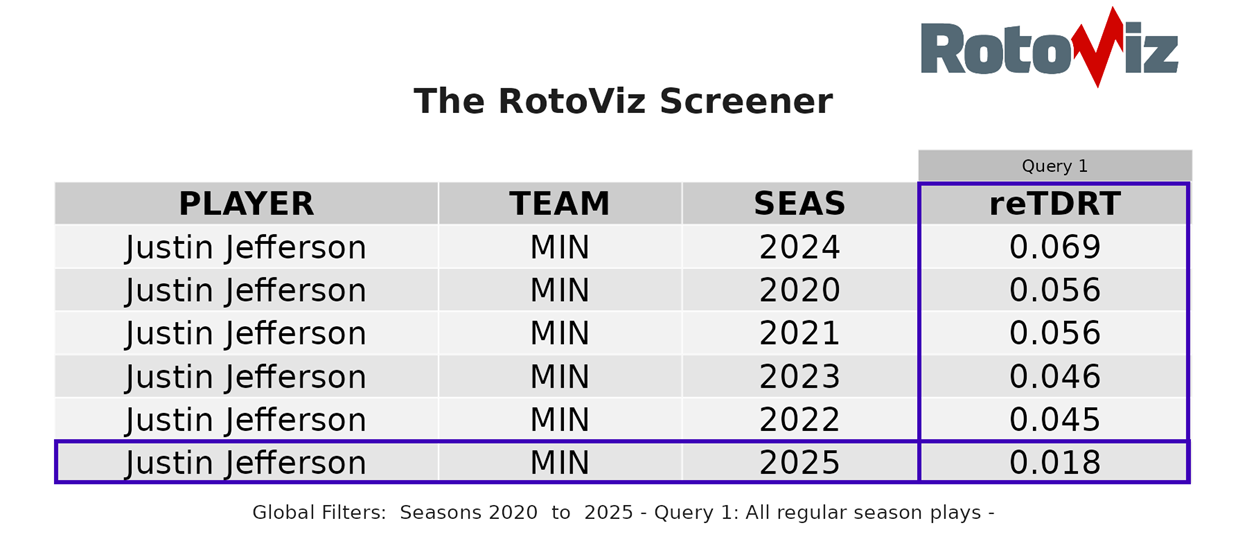
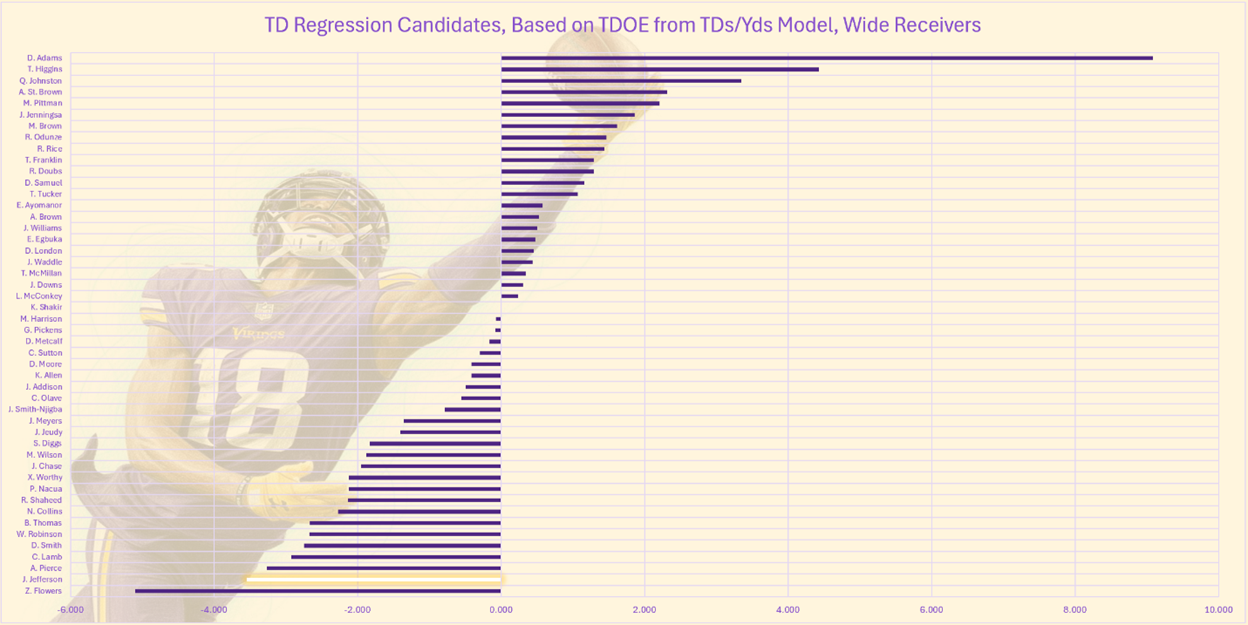
Based on a simple TDs/Yds regression model, we can see that Jefferson is nearly 4 TDs below expectation (TDOE) based on league base rates, the second-worst TDOE among WRs. Even based solely on this, Jefferson has been substantially less efficient than usual, as his career fantasy points over expected per game (FPOE/G) were +3.2 from 2020-2024, and this year it is -1.9. He is a positive TD regression candidate.
Addison is also underperforming because QB inconsistencies have affected everyone on the Vikings. He has not had a WR1 game since Week 7, with seven straight weeks outside of the top 24 fantasy WRs. He has played six games this season with McCarthy, all of which fall into that woeful streak.
Much like with McCarthy, we should see the game against Dallas as an opportunity for the Vikings’ WRs to right the ship. Dallas’ defense has allowed the third-most PPR points to opposing WRs in its last five games. It’s disappointing that we are finding good opportunities to play Jefferson and Addison, who should be no-brainer auto-starts, but here we are.
TE T.J. Hockenson is not drawing a target share of 15% or greater in his last five games, but he’s at 15.4% for the season. He’s had two TE1 weeks and seven TE2 weeks (although most of those were closer to the TE2/TE3 edge than the TE1/TE2 side). In single-QB leagues, Hockenson is borderline playable, but in the right matchup, he should be on our radar.
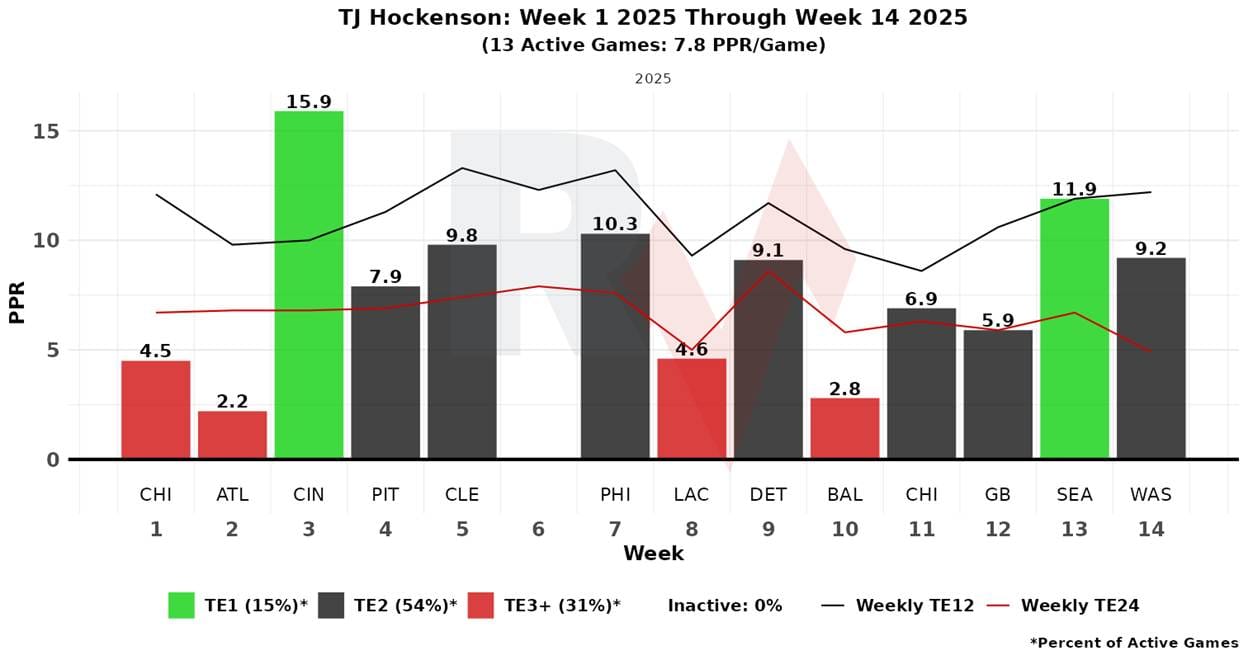
This should be the right matchup. As with the other pieces of the Vikings’ passing game, if you’re looking for a chance to use Hockenson, this may be it. The Cowboys have allowed the 10th-most fantasy points to TEs in their last five games.
Dallas ranks 29th in EPA per play allowed and 30th in defensive success rate.
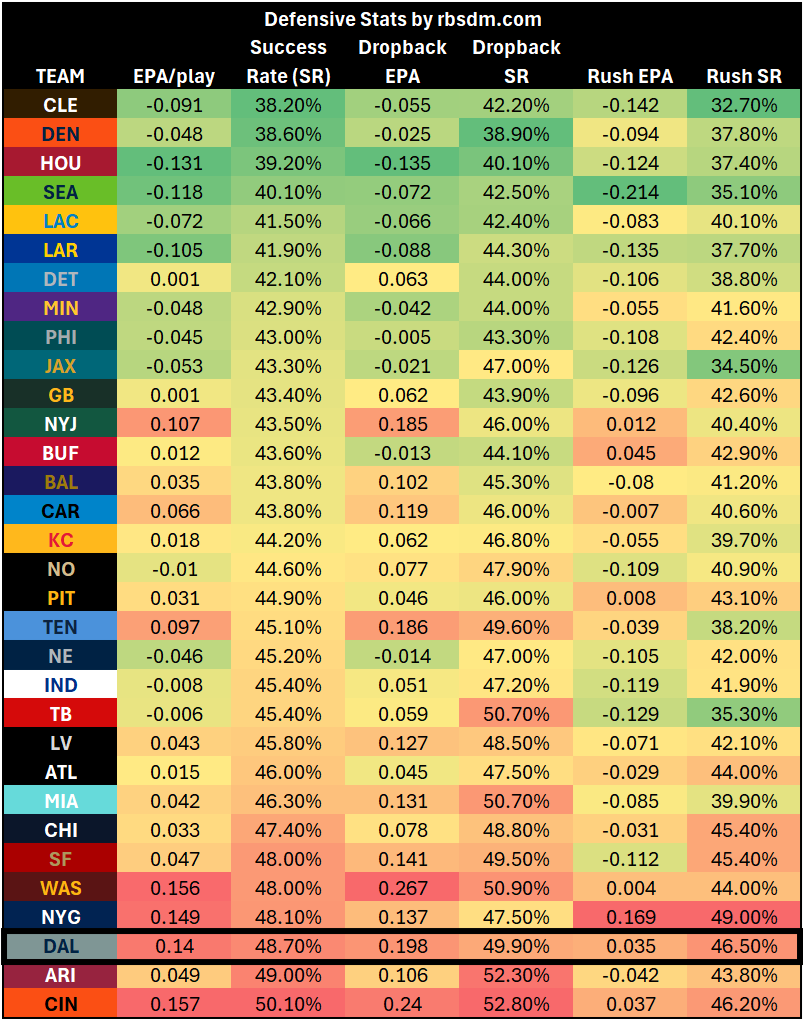
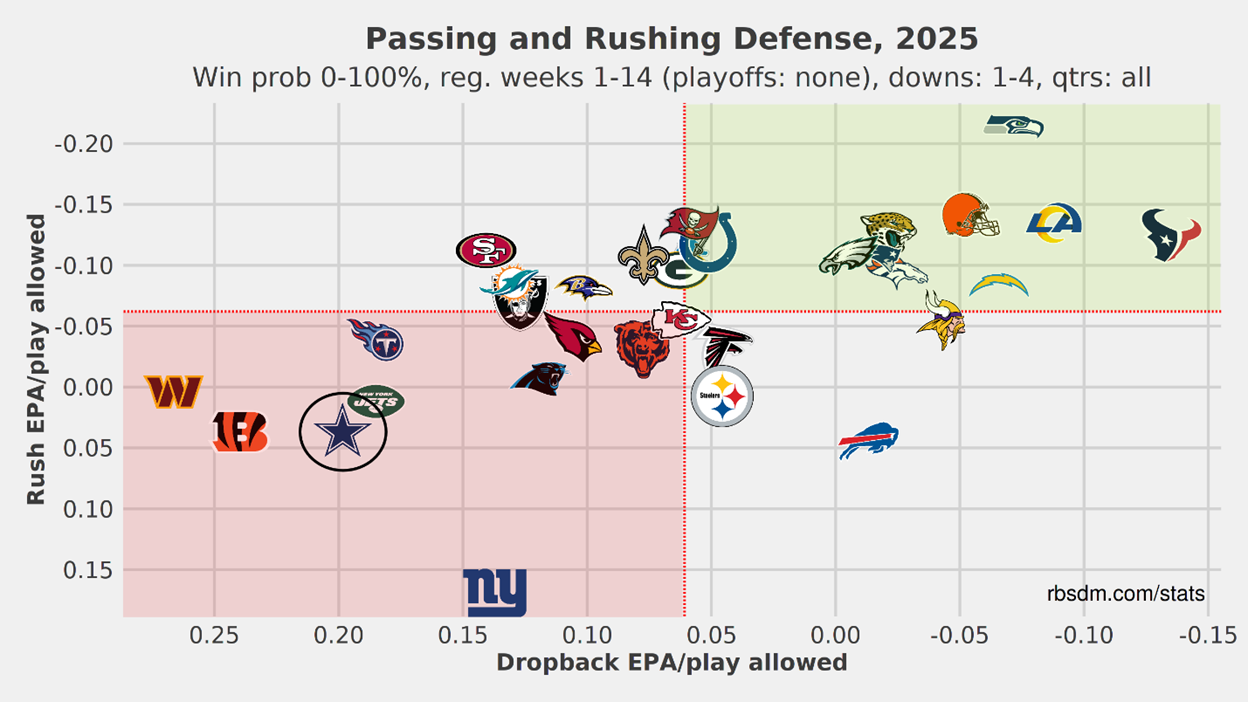
They rank 30th in EPA per dropback allowed and 27th in defensive success rate on dropbacks. They are well below average in both dropback EPA and rush EPA.
The Cowboys use zone 78.5% of the time (4th), and single-high and two-high almost in equal amounts. Their primary alignment is Cover 3 (37.1%), and the only other alignment they use more than 20% is Cover 2 (21.3%). They blitz at a rate of 25.3%, slightly above average.
Fantasy Points’ coverage matchup tool assigns a zero-based matchup grade to each pass-catcher based on their opponent’s use of specific types and rates of coverage and how that pass-catcher performs against them. Positive numbers indicate a favorable matchup and negative numbers indicate an unfavorable one.
According to the tool, Addison’s matchup is highly unfavorable (-15.1%), while Jefferson’s is favorable (+4.5%), and Hockenson’s is highly favorable (+17.2%).
PFF’s matchup tool is player-based, pitting the PFF ratings of individual players against each other for an expected number of plays based on historical tendencies and rating on a scale from great to poor.
According to PFF’s tool, Jefferson’s matchup grades out as good, while Addison’s and Hockenson’s grade out as fair.
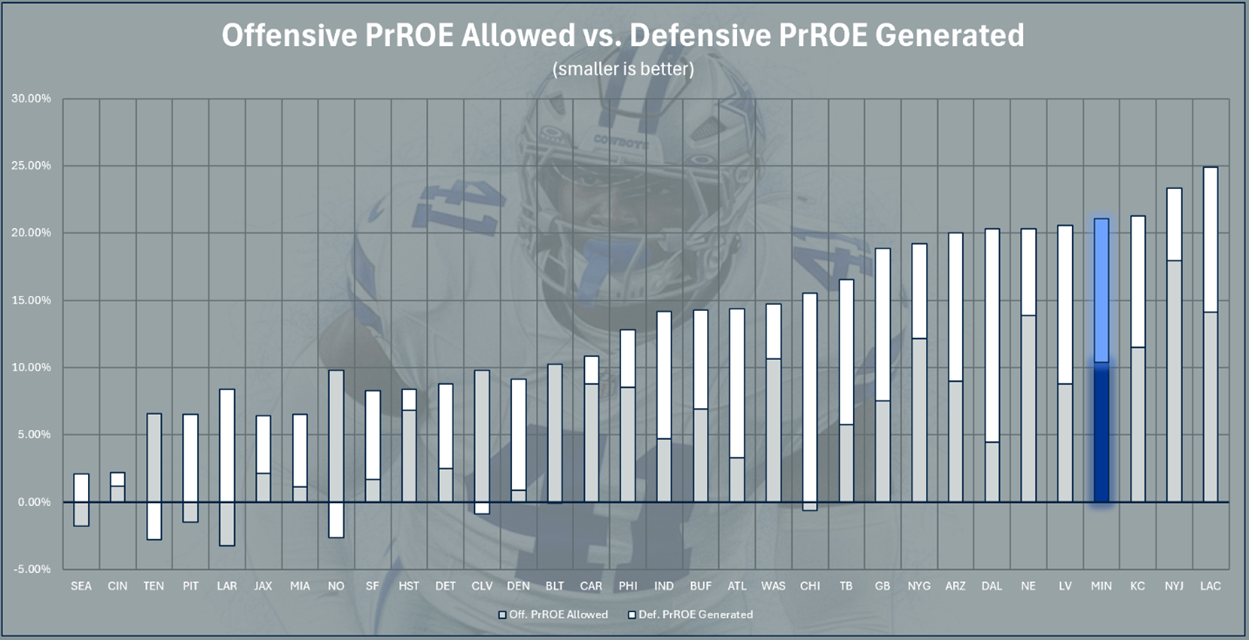
The Vikings allow a +10.41% pressure rate over expected (PrROE) offensively (25th). The Cowboys generate a +10.68% PrROE defensively (7th). When combined, the Cowboys’ defensive front would appear to have a significant advantage over the Vikings' pass-blocking unit.
Pretty much every QB performs worse under pressure than they do from a clean pocket, but the reduction in McCarthy’s passing is somewhat minimal relative to most. A 22.0 QB rating delta ranks only 28th among qualified QBs; notably, McCarthy’s rating is already the lowest in the league from a clean pocket (74.6), so despite this, his 52.4 QB rating under pressure is still the sixth-lowest.
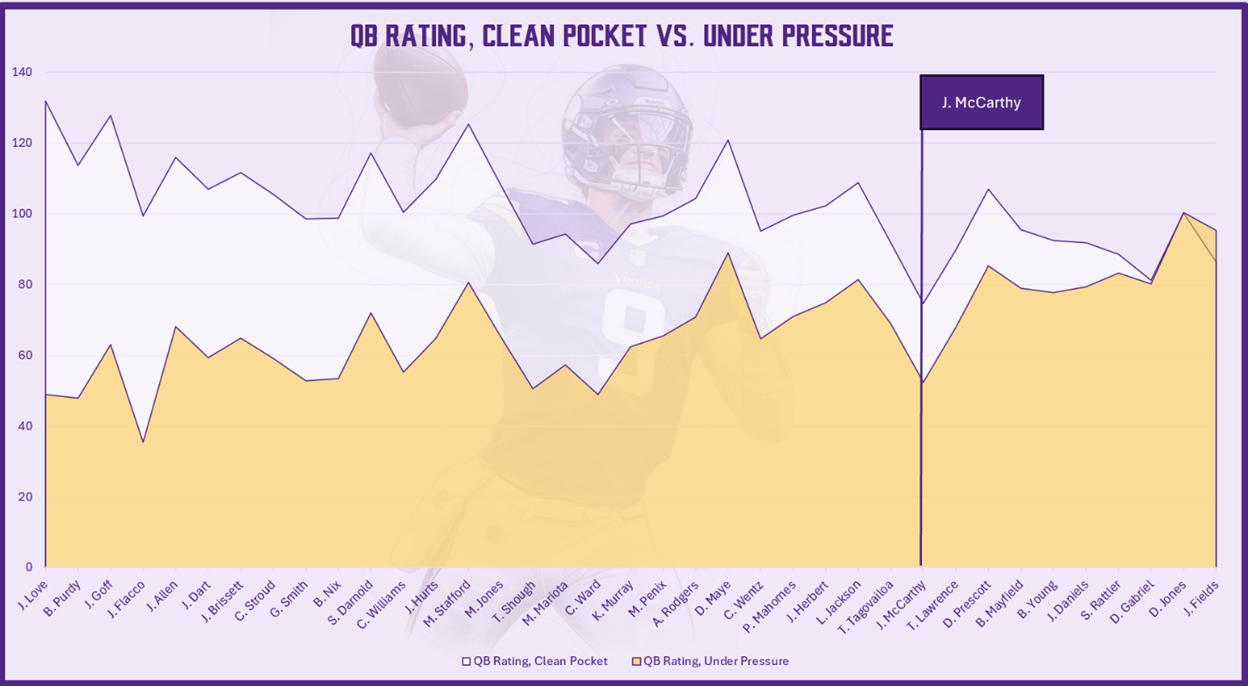
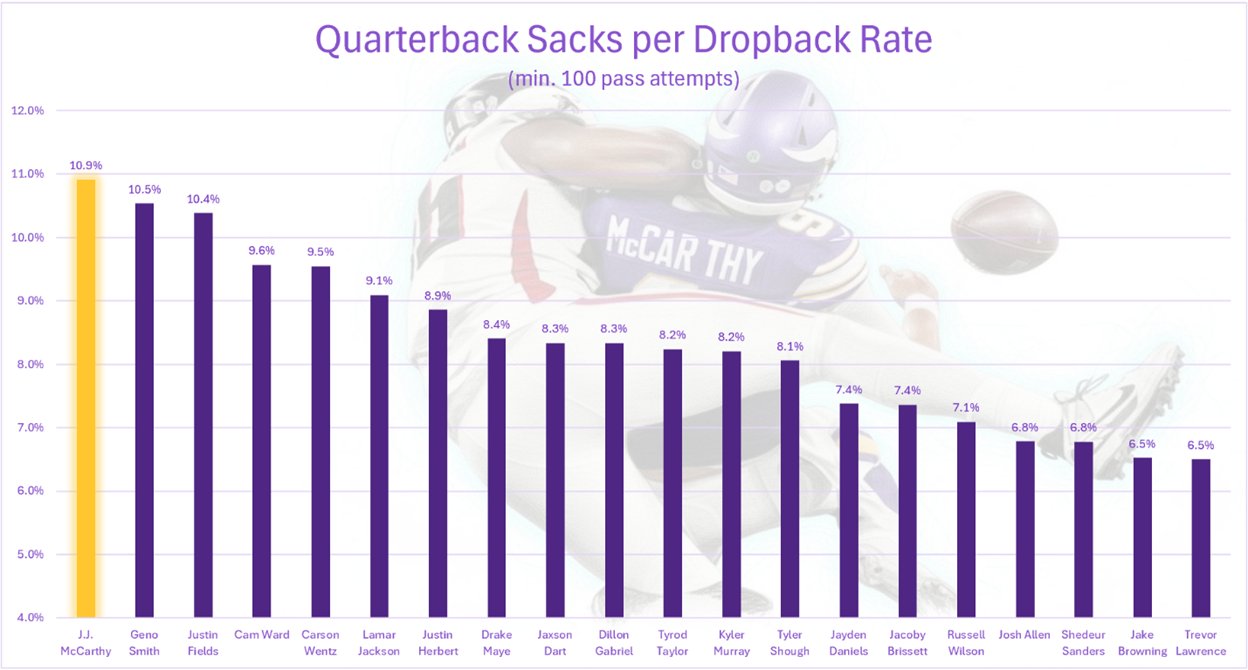
The real downside to McCarthy being pressured is that he is prone to being sacked. His pressure-to-sack rate is 26.4%, second-worst among qualified QBs, and he has the absolute highest sacks-per-dropback rate (10.9%).
The Vikings have been better at run blocking this season, averaging 2.27 adjusted yards before contact per attempt (adj. YBC/Att, 10th), while the Cowboys have allowed 2.30 adj. YBC/Att defensively (23rd). This makes for a neutral run-blocking matchup when the Vikings are on offense.
The Vikings rank 23rd in offensive EPA per rush but fourth in offensive success rate on rushes. For all their dysfunction, the Vikings’ offensive success rate on rushes stands out like a sore thumb. This indicates that the Vikings are actually prone to stringing together efficient, on-schedule runs that consistently put the offense in manageable down-and-distance situations, even if those gains rarely flip field position or juice the scoreboard.
The Cowboys rank 29th in EPA per rush allowed and 31st in defensive success rate on rushes.
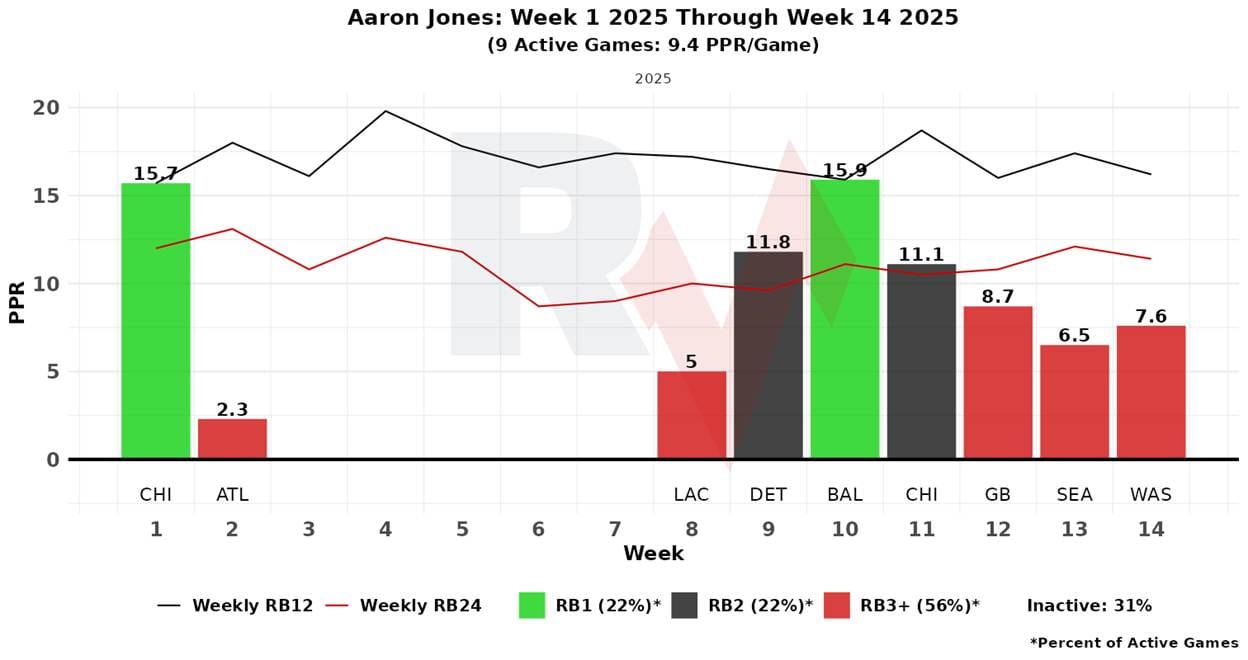
In their last five games, the Vikings have given RB Aaron Jones a 57% snap share, 15% target share, and 49% of the team’s rush attempts. These are reasonably acceptable rates, but the Vikings have only 292 team rush attempts this season (29th) and score 19.6 points per game (27th), so the opportunities for meaningful fantasy production are still somewhat limited.

Jones has been an RB1 only once (barely), and an RB2 twice (barely) in his last seven games. Lacking high upside, Jones would be acceptable as a flex, but not preferred. RB Jordan Mason can’t be used any longer, as his role is too small to count on in a low-volume, low-scoring offense.
The Cowboys added DT Quinnen Williams and LB Logan Wilson via trade in Week 10, which was their bye week. They also activated injured LB Damarion Overshown at that time. In their last five games, the Cowboys have been substantially better against the run, although they were gashed last week against Detroit’s RBs, who scored four TDs between them.
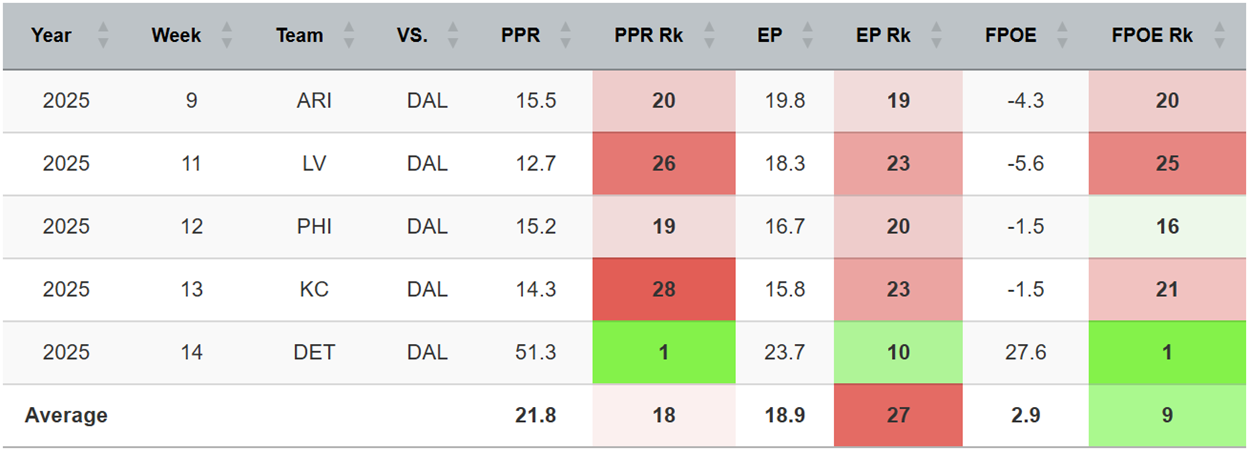
The significant disparity between the Cowboys’ defense’s expected points (EP) rank and its FPOE rank indicates that opponents are not often attempting to run on the Cowboys. However, when they do, they are successful. One theory is that their opponents are frequently prone to shootouts with the Cowboys, feeling pressured to keep up through the air.