Quick Slant: SNF - As Perennial as Peonies

Mat Irby’s Quick Slant
Where the Ravens under HC John Harbaugh stand is somewhat unfamiliar. They are a franchise that always seems to maintain their cool—a thoughtful, measured, and steady team that is almost always in the mix come playoff time. The Ravens blend toughness and tenacity with pure Harvard; they consistently make good personnel choices, and with their full rosters, they inject brains into brawn—at the forefront of analytics, also conditioned to impose their will with physicality, athleticism, and endurance.
At 6-7, they find themselves backed into a corner—something all the more unexpected by the weakness of the division around them, usually among the strongest.
But they have their justifications. It began almost immediately, with what felt like the entire defense licking wounds by Labor Day. Injuries turned to catastrophe: Madubuike, Wiggins, Humphrey, Smith, Washington, Buchanan, some lost for the year. Their offensive line, typically strength, became a rotating cast of starters, revealing itself as weakness. Constantly on the run and absorbing punishment, the injury bug eventually found QB Lamar Jackson, who hurt his ankle and hamstring just as the team teetered at 1–5. The absences cost him only a little time, but seemingly far more than that. Jackson has never looked right since returning. And, of course, the problem they’ve wrestled with throughout Jackson’s tenure remains: even when he gets the ball out, his receivers are often in the wrong place, or they drop the ball.
Cornered and flailing, the Ravens welcome one of the best, most surprising teams in football Sunday night: the New England Patriots.
Of course, we know that the Patriots had two decades of pure dominance, appearing in nine Super Bowls and winning six from 2001-2018. Many teams toil near the bottom for years after a run like that (to be clear, that hasn’t really been any other runs like that), but the Patriots stayed underwater like an inflated beach ball, popping back to life like some new Jason Voorhies movie.
Back to prolong the joy or haunt your dreams, depending on your perspective, the Patriots’ reemergence feels real. First, they drafted QB Drake Maye a year ago; after a promising rookie season, he’s leveled up and been the best QB of the lauded 2024 class. HC Mike Vrabel was the perfect hire at the ideal time, last-laughing Jerod Mayo by replacing him (Mayo had replaced Vrabel as a New England LB in 2008). Together, they’ve combined for the second-best record in football; Maye is among the favorites for MVP, and Vrabel is the favorite for coach of the year.
In some ways, Sunday night’s game feels like the establishment versus the upstart, as the Ravens, under the leadership of HC John Harbaugh and QB Lamar Jackson, have been as perennial as peonies. Meanwhile, the Patriots have languished in mediocrity since Brady departed. If that is the narrative, the David character is already boding for a first-round bye, and the Goliath character is clutching to maintain playoff life at all; so, for the purposes of a game, the scenario reverses, and Baltimore aims to win back territory. To Baltimore fans long tortured by the Patriots as an AFC giant, this may feel more natural anyway.
On the other hand, Sunday night feels as much like two teams that have always been a part of the establishment. Since 2008, the start of the John Harbaugh era in Baltimore, the Patriots and Ravens rank first and fourth in winning percentage and second and fourth in playoff appearances. They embody winning culture; they regenerate, slower around QB—sure—but with a constant revolving door that breeds talent on talent. This one is for Sunday; this one is for 2025. But, as presently constructed, this is one of many for years to come.
Patriots
Implied Team Total: 23
The Ravens are slightly favored; they are the home team, so there is a little in that. But based on their records, they are not the same. And based on Pythagorean expected wins, the assessment that they are not the same gains validation. The Ravens should be pacing for about 8.9 wins according to Pythagorean wins, while New England should be pacing for 11.2.
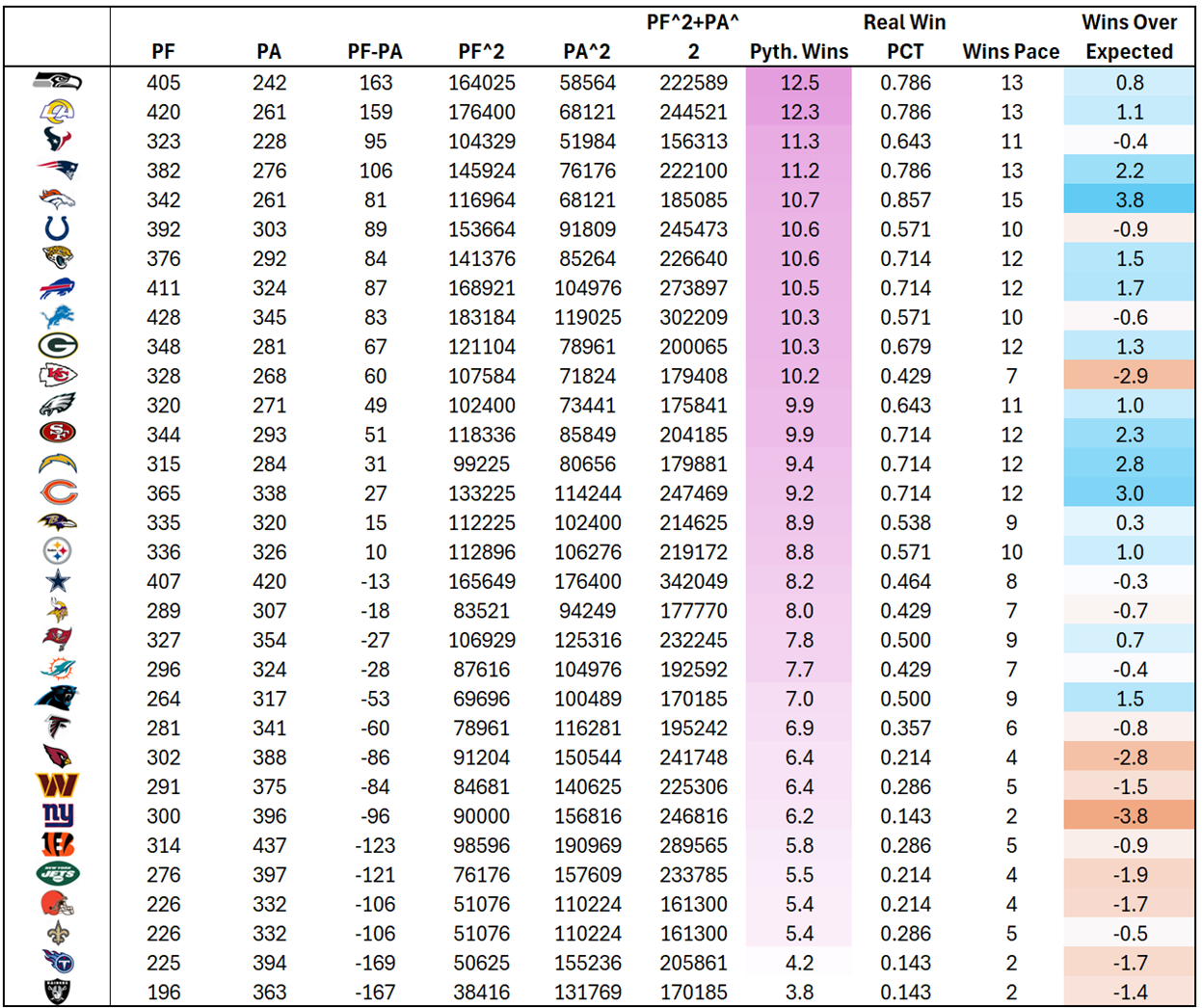
The most logical explanation is that anchoring bias propels favoritism for Baltimore, as we’ve seen Harbaugh and Jackson answer the bell at this stage before. In contrast, at least Maye is an unknown quantity as the lights grow brighter.
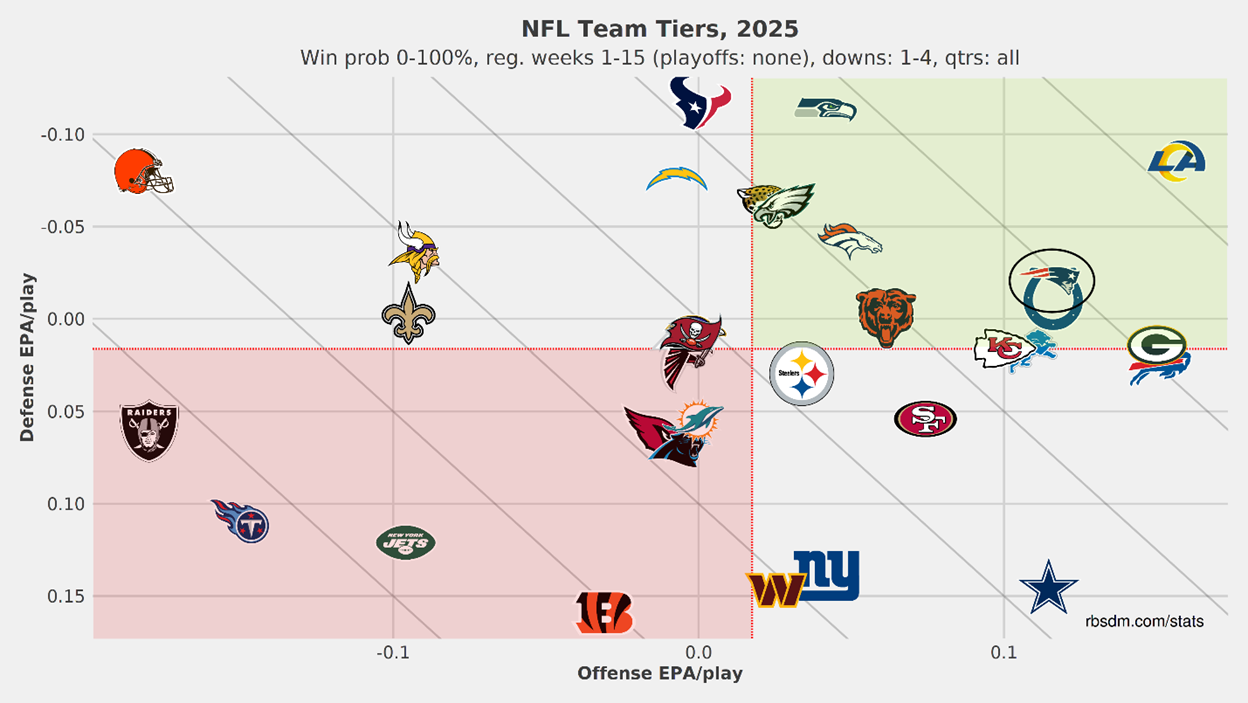
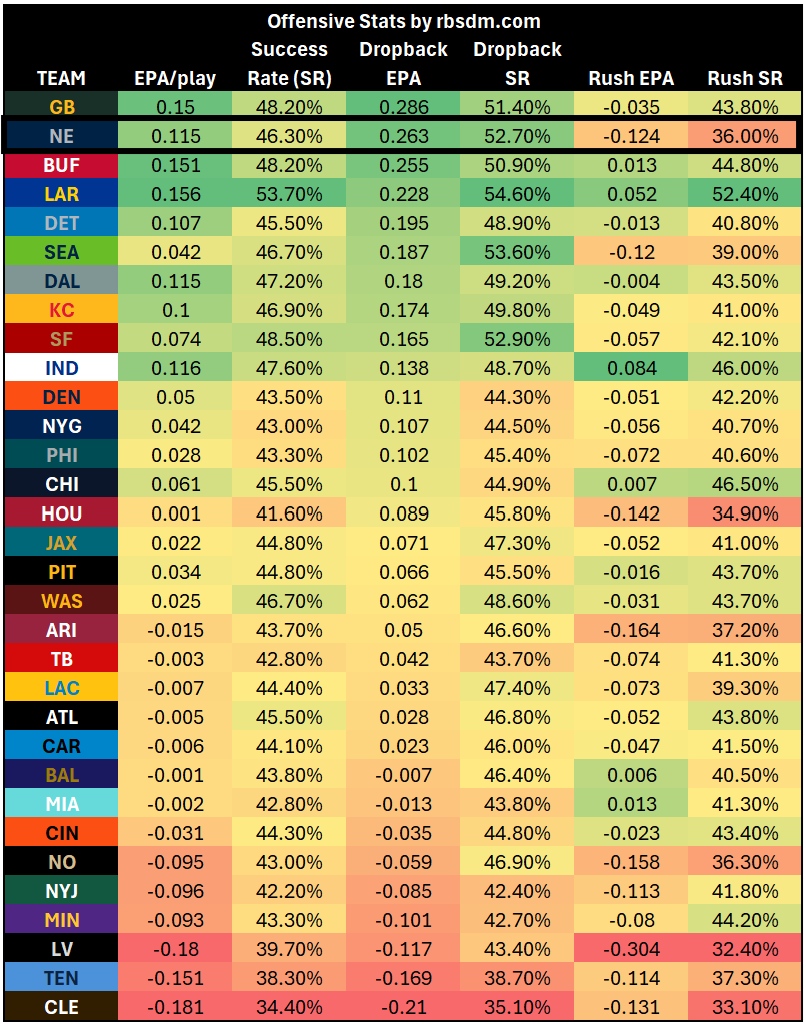
As it is, the Patriots are well above average in offensive EPA and above average in defensive EPA allowed.
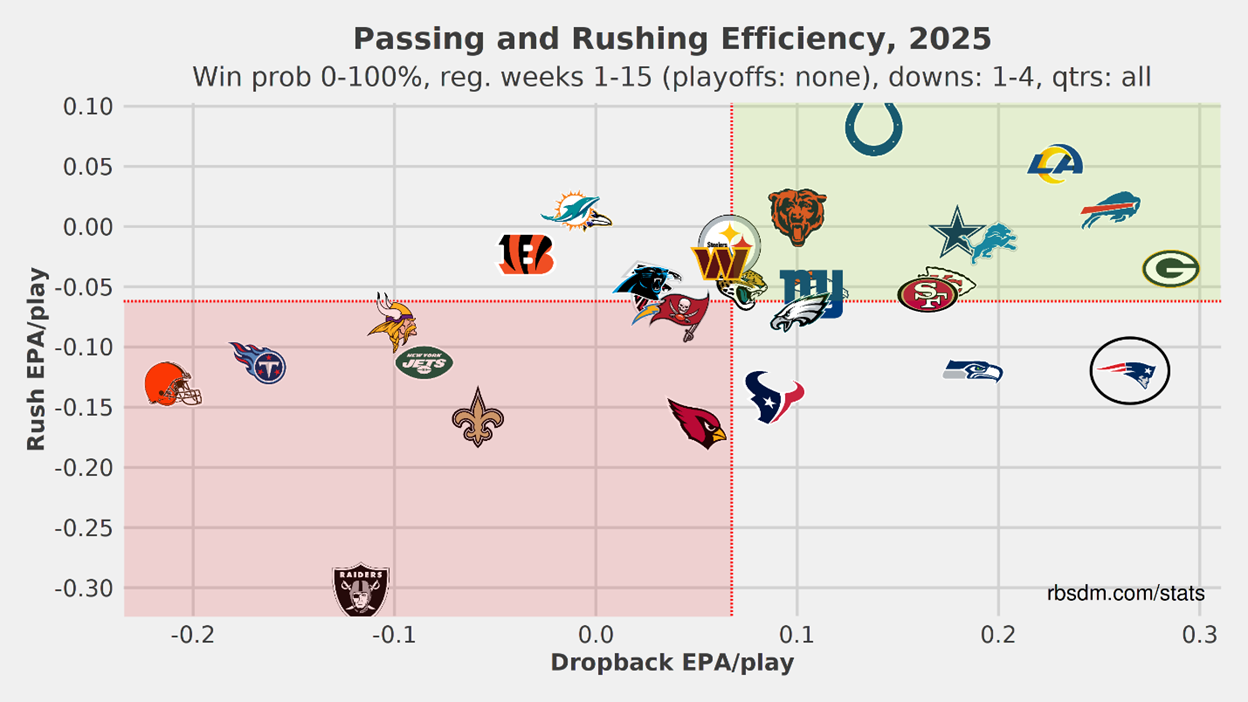
Offensively, they are well above average in dropback EPA and below average in rush EPA.
The Patriots rank sixth in offensive EPA per play and 10th in offensive success rate. They rank second in offensive EPA per dropback and fourth in offensive success rate on dropbacks.
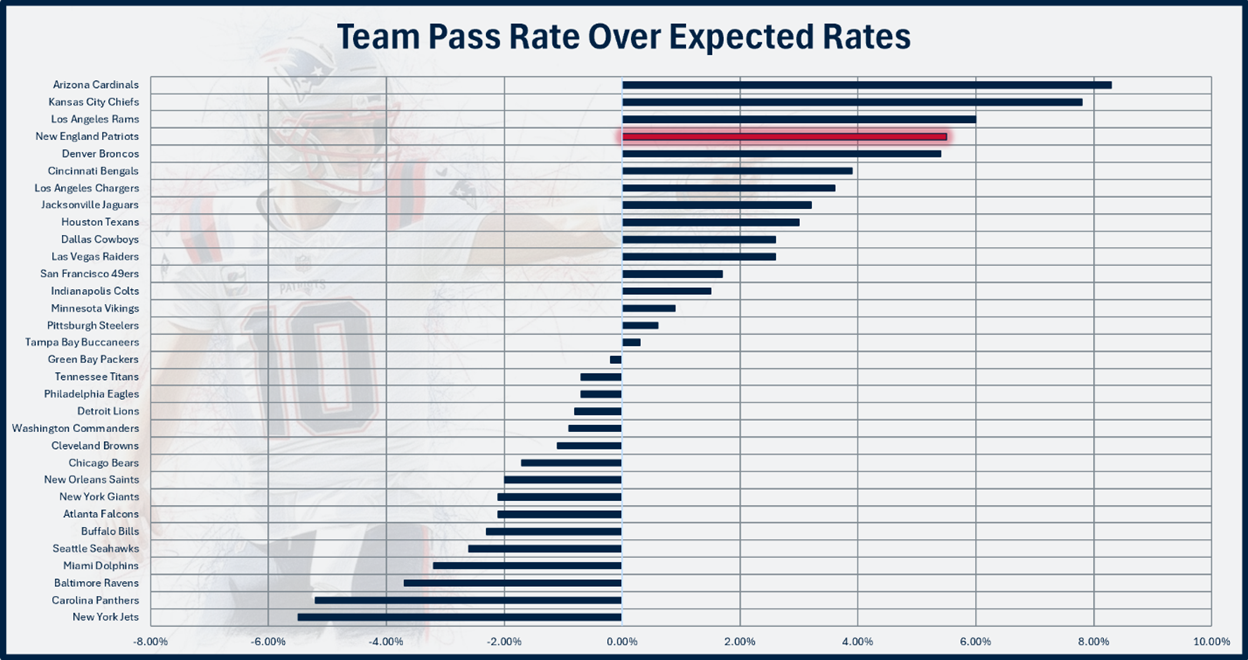
The Patriots average 28.4 seconds to snap (T-29th) and maintain a pass rate of 54% (T-24th). They spend a bulk of their plays in a neutral script but spend almost the rest of their time at a lead of seven or more points. They have rarely trailed by seven or more points. When leading by as much, their pass rate falls to 47%, which helps explain why their pass rate over expected (PROE) can still be +5.50% (4th) despite a lower overall pass rate.
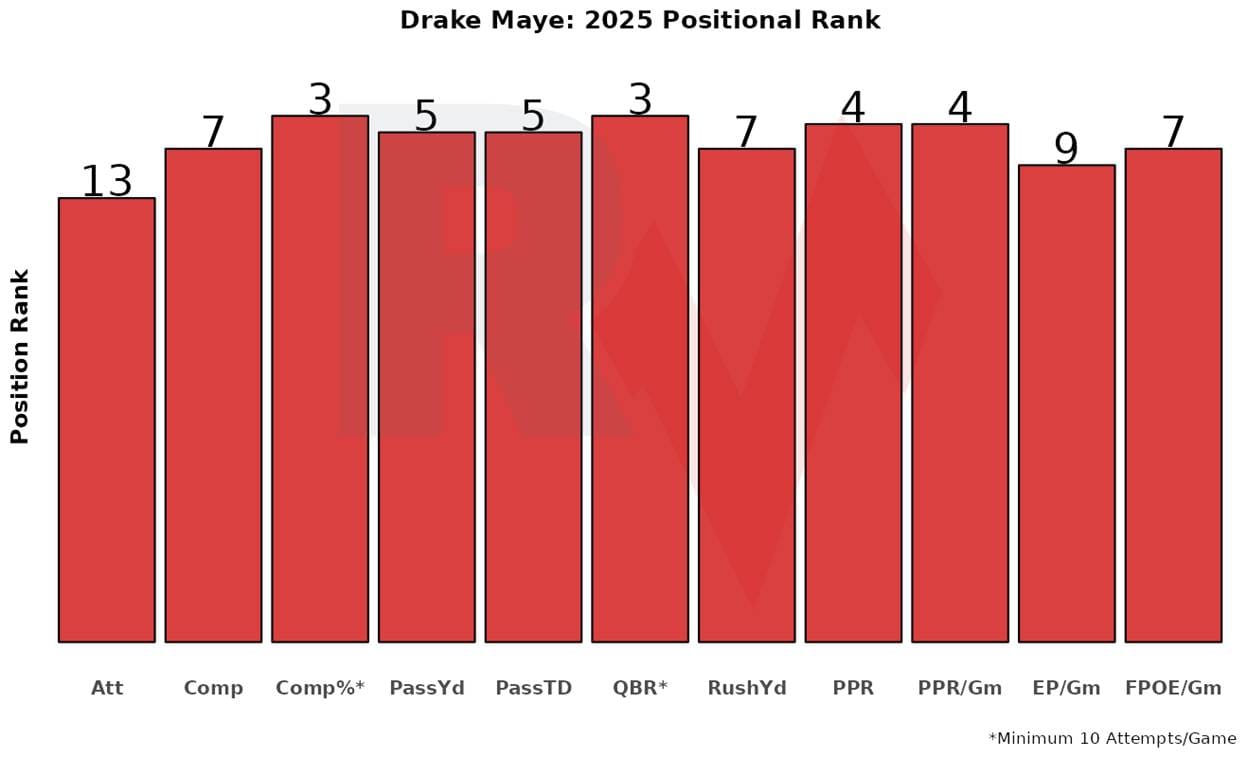
Maye has taken a massive leap in his second season. He has 504 dropbacks (10th) but has only converted these into 409 attempts. This is the most significant delta between dropback and attempts of any QB in the league by far. The reason? The other dropbacks have converted to scrambles, of which Maye has 51 (2nd), and sacks, of which Maye has taken 43 (4th).
The good news is that, in fantasy football, sacks are less harmful than positive rushing gains are helpful. Maye’s scrambles have produced 349 of his 362 rushing yards (7th), adding yardage that gives him a heightened floor and ceiling.
When we analyze his statistical categories, many of which are in the top five, it reads like an efficient player suffering from a lack of high-end volume. We have to remember that so many of these missing attempts are actually being spent elsewhere, for greater profit.
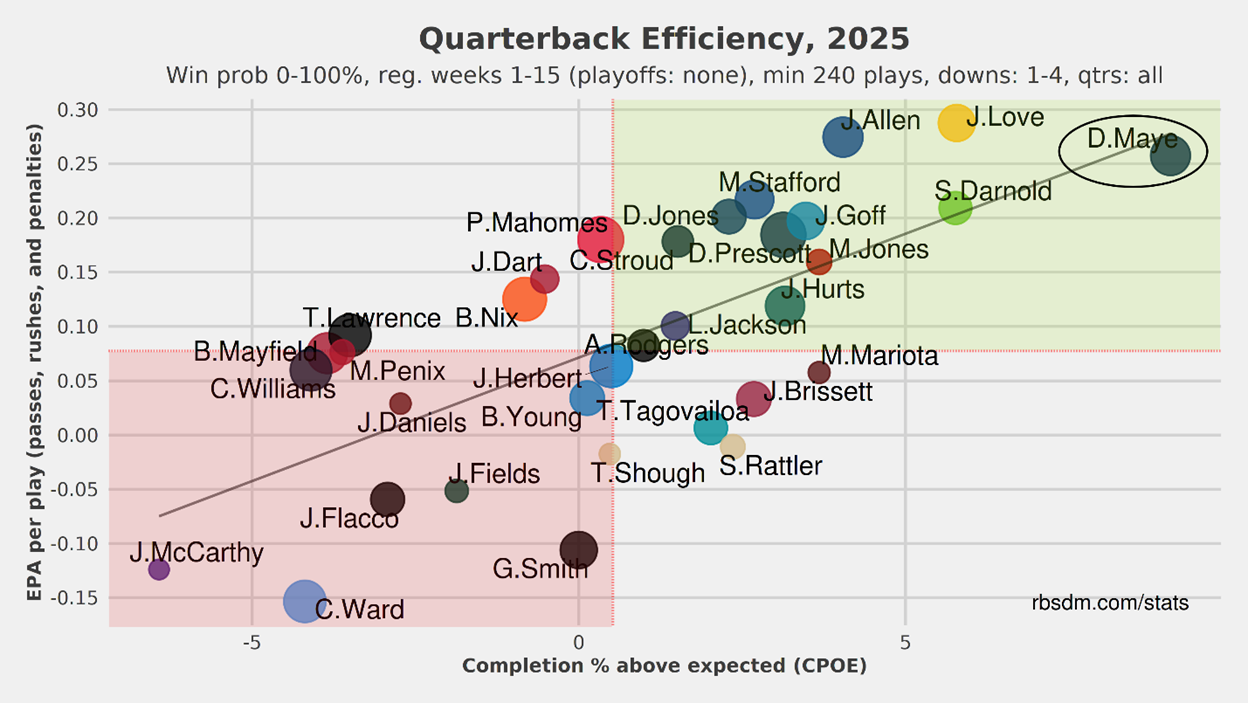
Maye is, in fact, an efficient passer. He leads the NFL in EPA + CPOE composite.
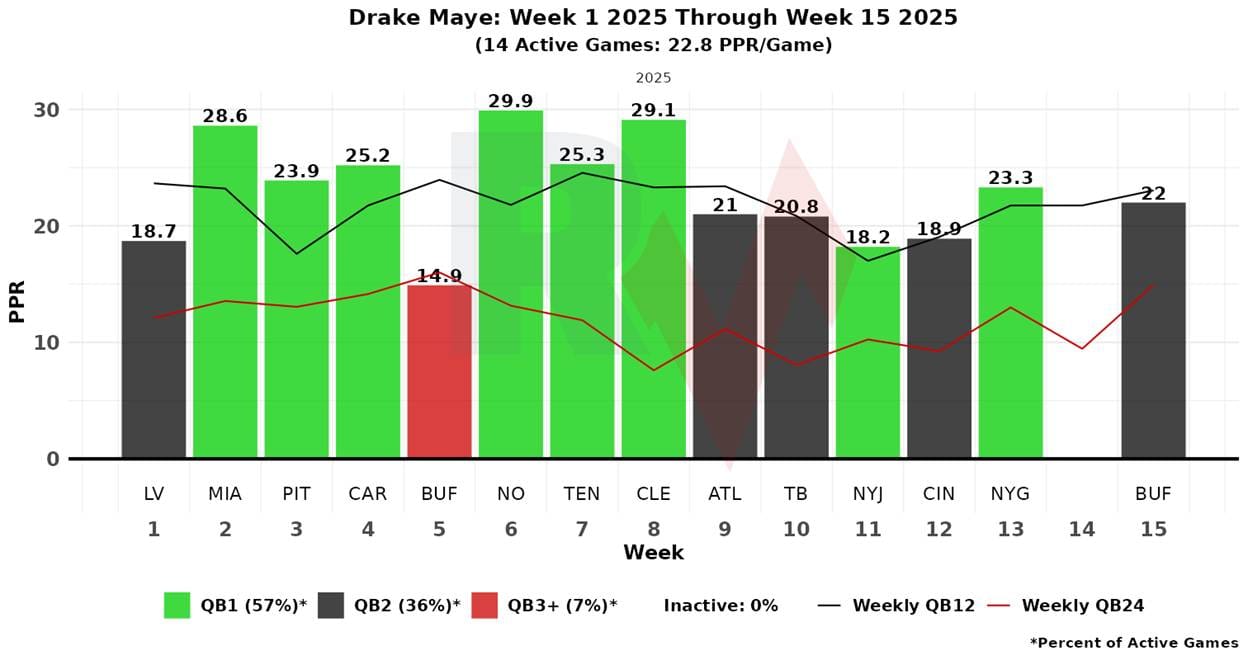
Maye has returned eight QB1 weeks in 14 games. He has never scored fewer than 14.9 points, an incredibly stable floor. Maye has had three occasions when he has scored near 30 fantasy points, indicating he is capable of a ceiling as well.
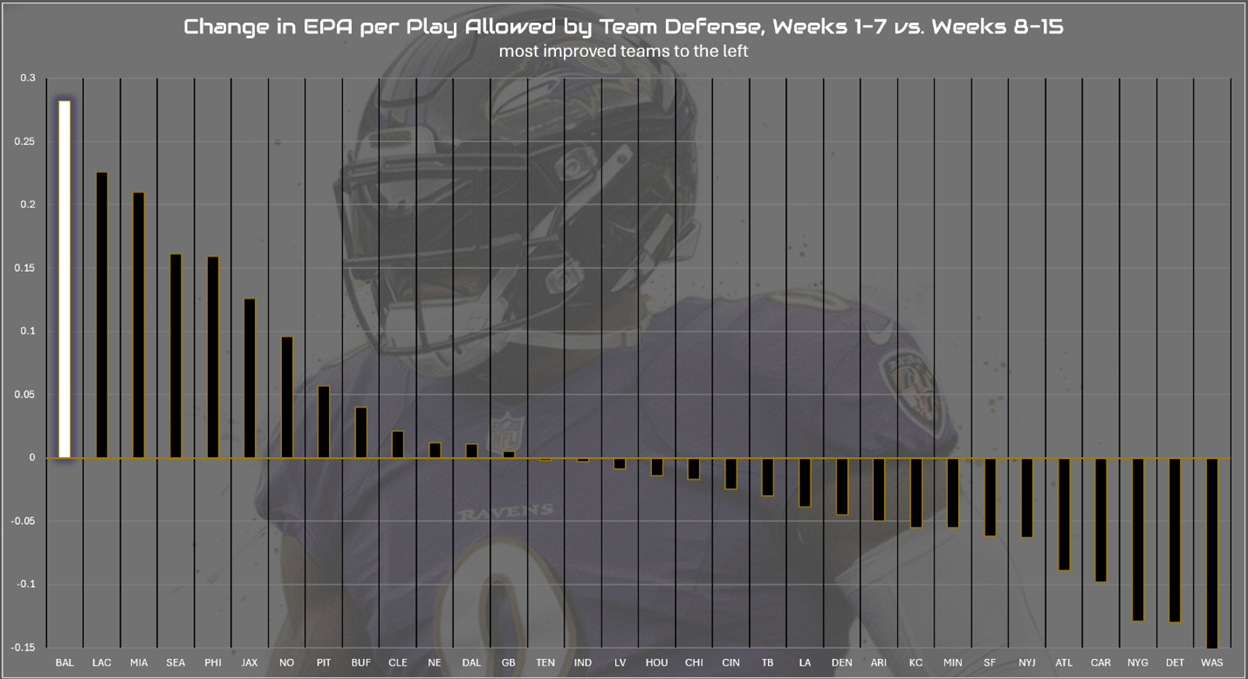
The Ravens’ defense started the season slowly, but they’ve righted the ship. After the first seven games, the Ravens’ defense was dead last in EPA per play allowed; since Week 8, they’ve been fifth. The swing in EPA per play allowed during that time is the most significant in the league.
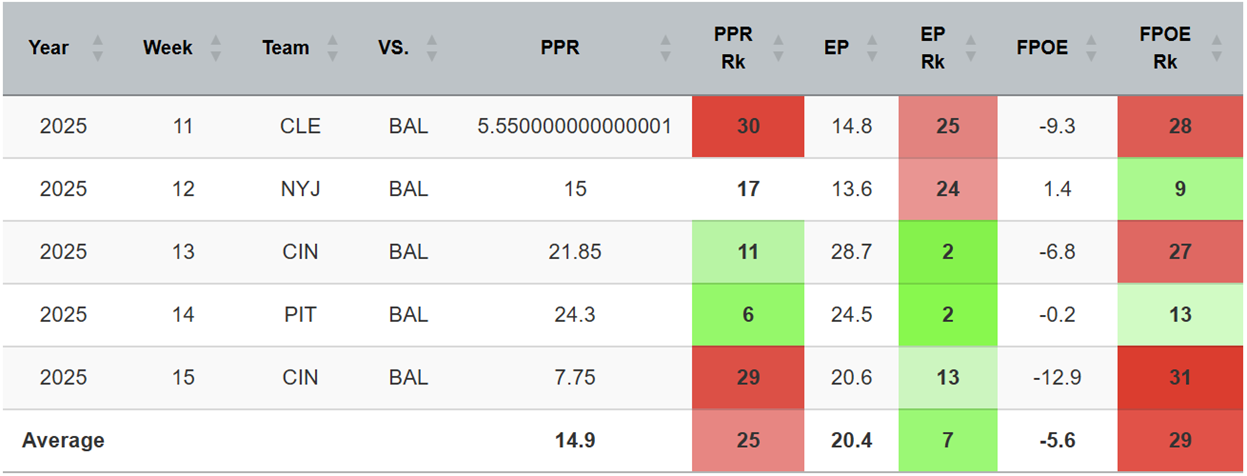
The Ravens have held opposing QBs to the 25th-most fantasy points in their last five games. This includes effectively shutting down Joe Burrow last week.
The Patriots have three pass-catchers with target-share per-game rates of at least 15% in their last five games: WRs Mack Hollins (21.4%) and Stefon Diggs (18.2%), and TE Hunter Henry (18.2%).
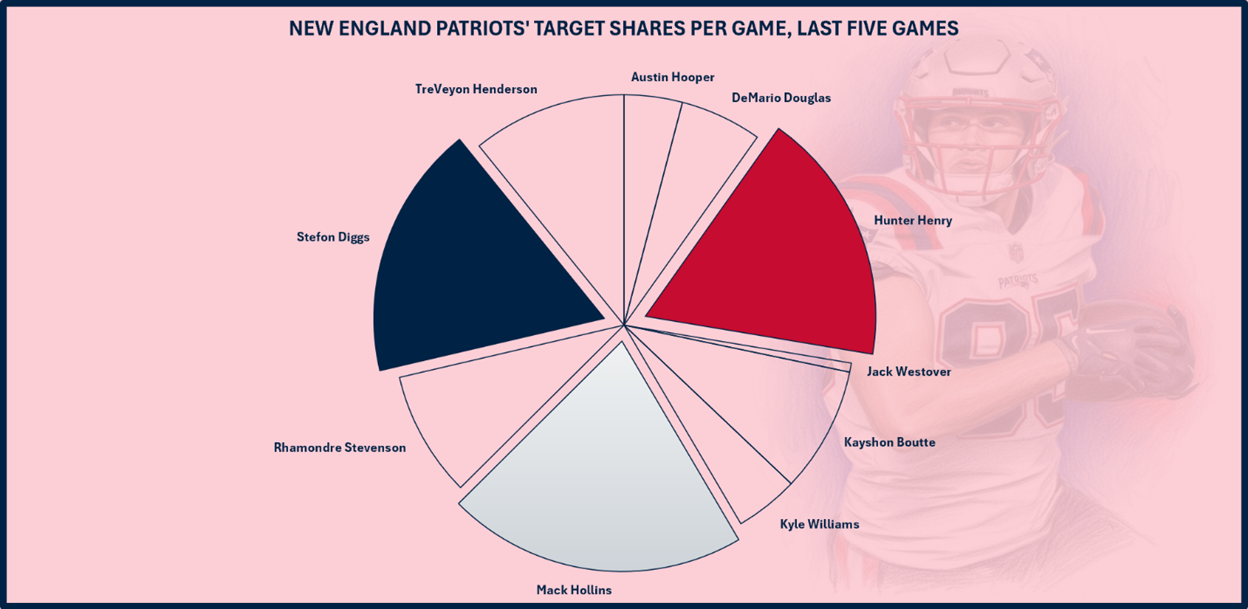
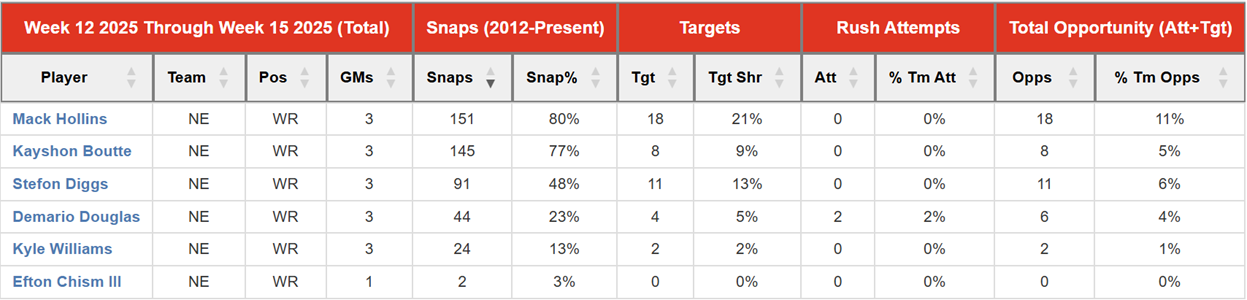
It may surprise people to realize that Hollins has had a higher target share per game rate in his last five games than Diggs, who is widely perceived as their top fantasy receiver. Three of Diggs’ four worst fantasy outputs have come in the last three games he’s played.
This is tied to a steep reduction in opportunity; Diggs has only had a 48% snap share in his last three games, trailing Hollins and WR Kayshon Boutte for the team WR lead. Diggs’ route rate is down to 54.8% during that time, down from 64.1% in the first ten weeks of the season.
So what gives? It seems the Patriots have decided to transition Diggs to a primary slot role, as his slot percentage has jumped to 77.2% in his last three games. It actually first ramped up sharply in Week 11, when Diggs drew a 68.6% slot rate—a half-measure; before Week 11, he was never in the slot more than 51.7% in any single game, and he averaged 44.4% slot rate for the first ten weeks.
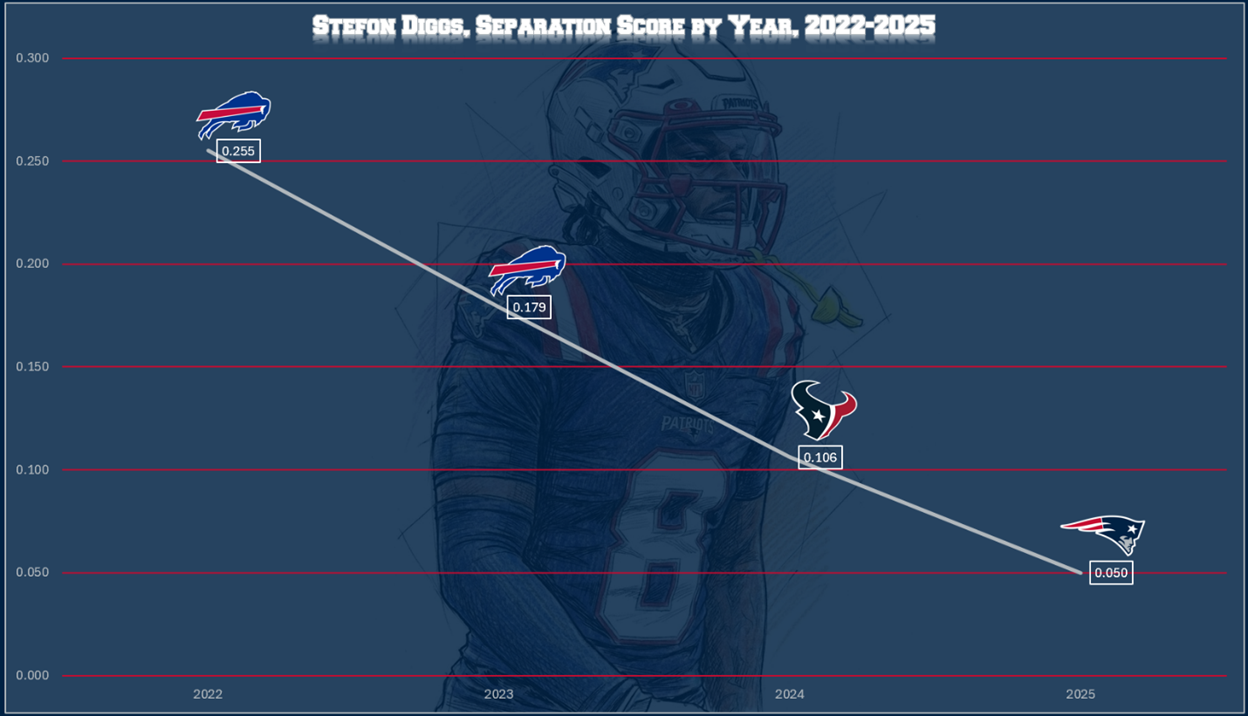
This is where Diggs’ effectiveness as a WR comes in. Diggs, 32, was an elite separator in his prime, but he has declined sharply in the past four years, seeing his separation score dip from an elite 0.255 in 2022 to 0.050 in 2025 (for context, among WRs with at least 150 routes this year, Davante Adams leads the NFL with a separation score of 0.187).
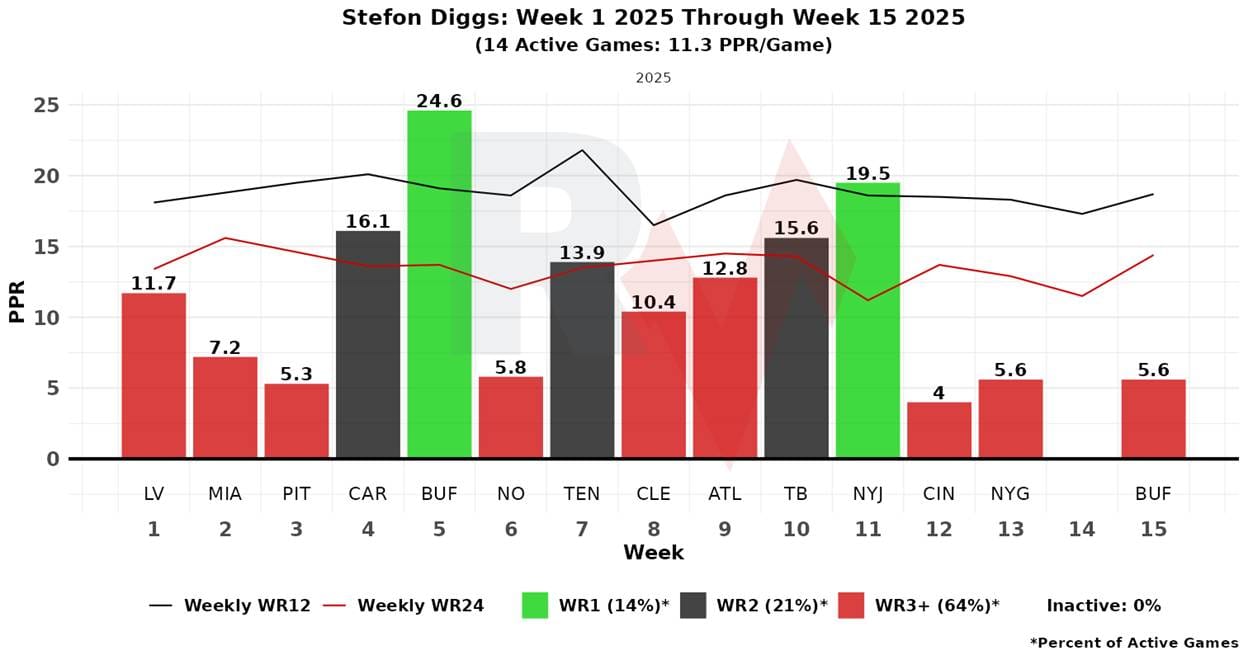
Diggs had some utility before Week 11, mostly floating in the WR2/WR3 range for much of the year, but with his new role, he will be hard to trust and probably has zero upside. He is essentially in the role Demario Douglas held before Week 12 (as an extension, Douglas is now unplayable).
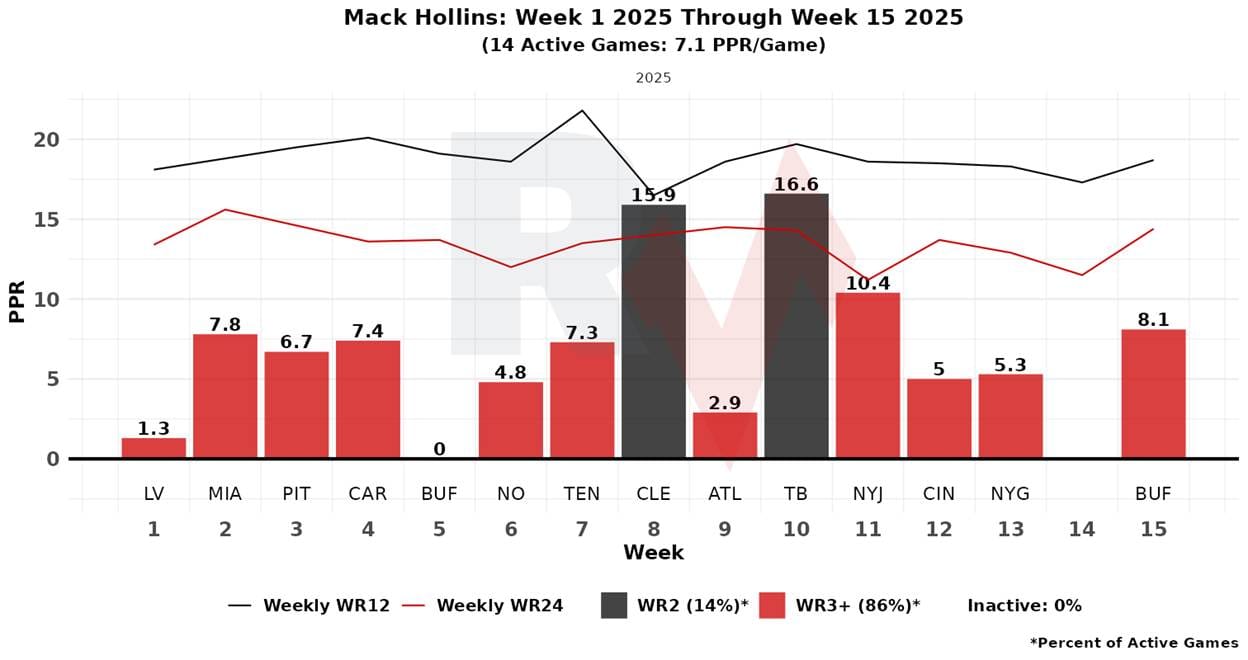
The natural reaction is to assume that Hollins, as the recent target share leader, would be playable. Hollins is the type of player who does things coaches like; he is not an overly dynamic receiver. By volume alone, he carries a bit of a floor that may be usable in deep PPR leagues where up to 4-5 WRs can be played, but expect no upside at all. This is not my preferred type of flex, of course, but there can be an application.
As for Boutte, he’s been used primarily as a field-stretcher this season, with a higher aDOT and a heavy diet of vertical routes. This type of player is volatile; if he connects on deep shots and/or scores TDs, he produces meaningful fantasy points, and if he doesn’t, he disappears. Pinning down when those spike weeks hit is difficult, although it improves Boutte’s chances that the Ravens defense uses a single-high safety on a vast majority of its plays.
I generally view WRs in this archetype as useful parachutes when you’ve run out of options and are scouring the waiver wire for streamers, given the upside that comes with their explosiveness. But outside of the elite players in this mold (Christian Watson, Alec Pierce), I can usually find a more reliable option most weeks.
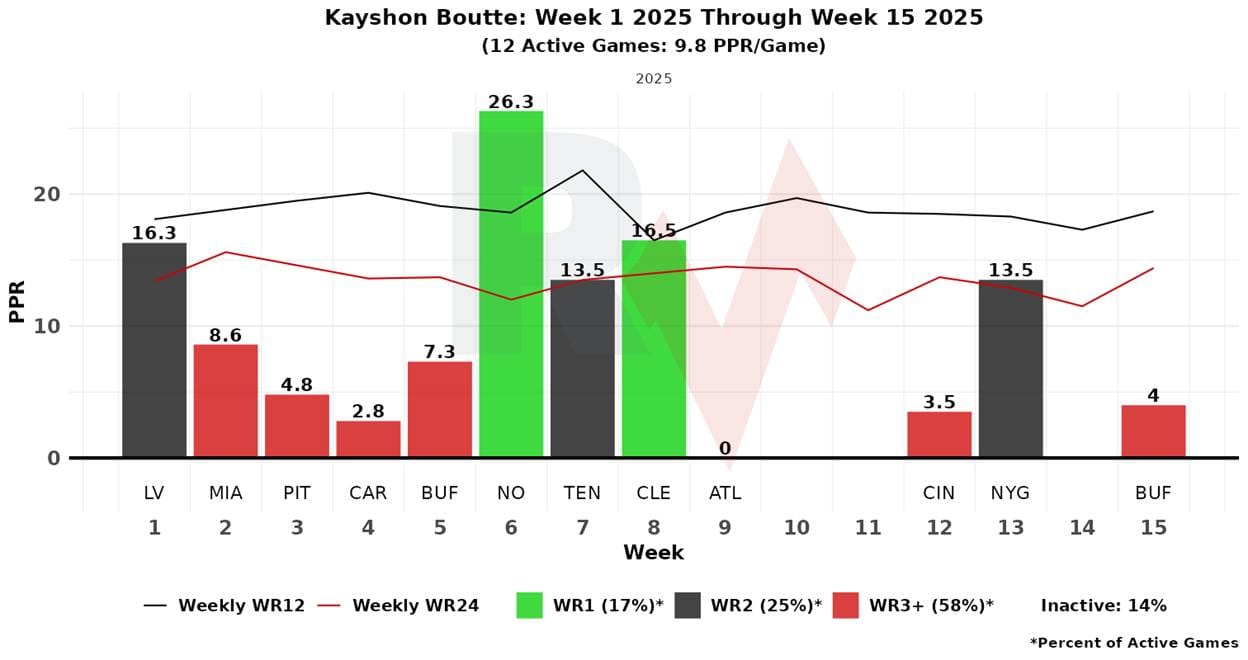
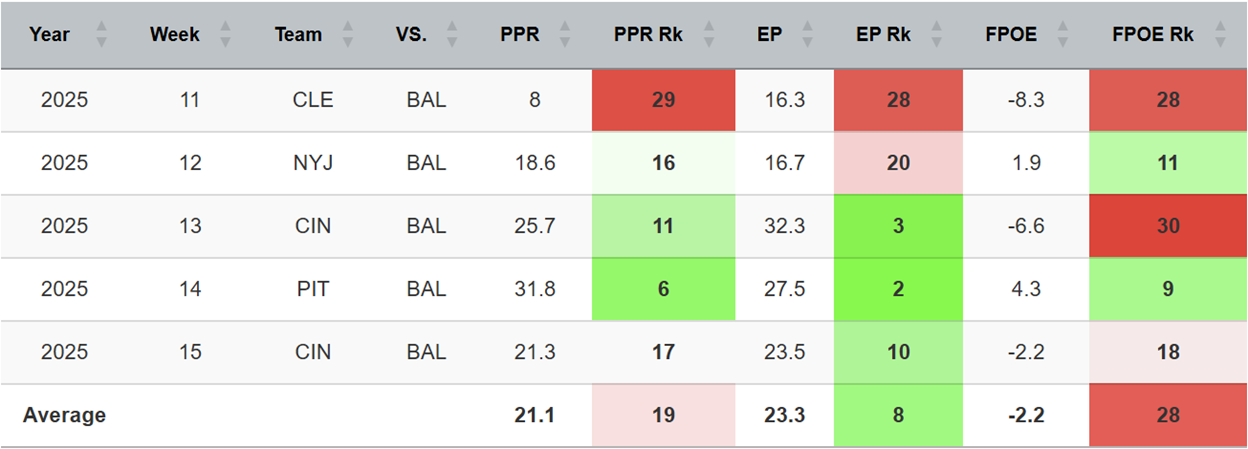
The Ravens have surrendered the 22nd-most fantasy points to WRs in their last five games. The disparity between their expected points (EP) and fantasy points over expected (FPOE) ranks indicates that teams are trying to pass on them, but they are not overly effective at it.
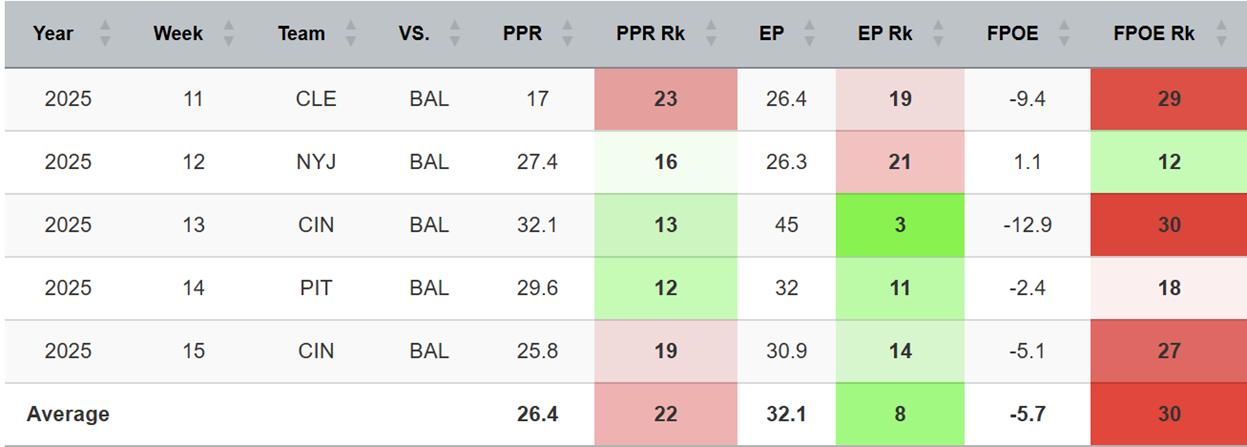
Henry has had his moments with two spike weeks, but he generally lives in the TE2/TE3 fringe, which is not a great place to be in any format. His upside is entirely dependent on TDs; hitting on that type of player in a fantasy matchup requires more luck than skill.
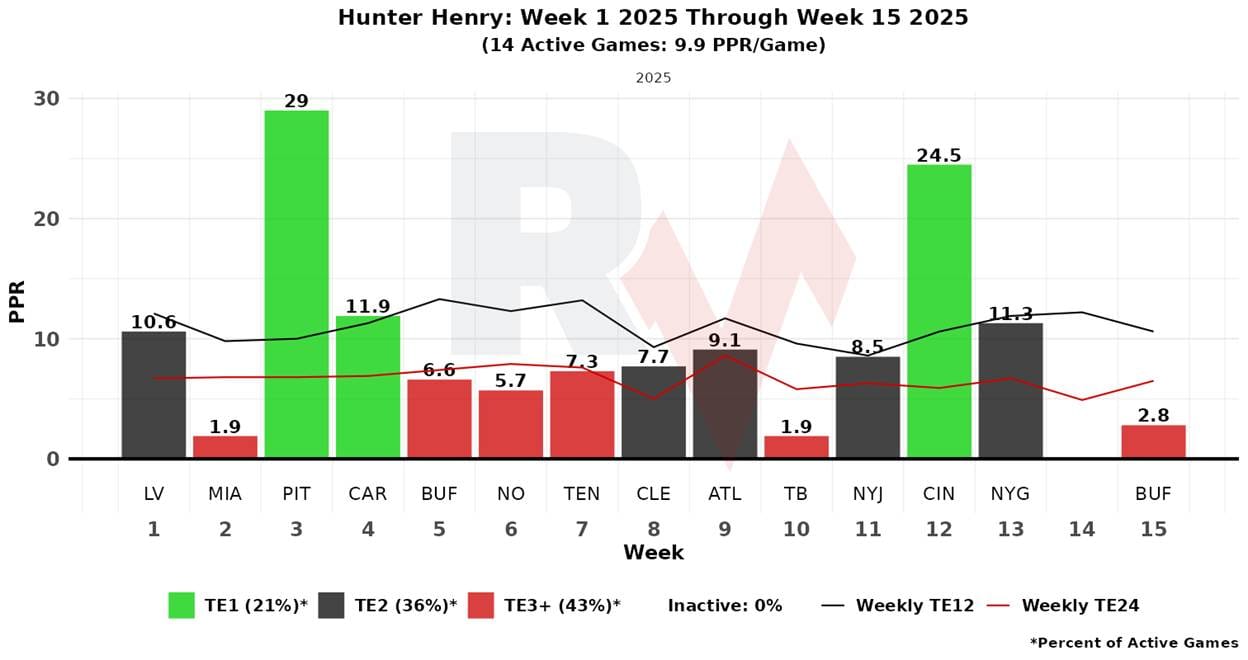
The Ravens are also stingy against TEs, surrendering the 27th-most fantasy points in their last five games. Notably, this is not the most significant grouping of TEs there could be.

The Ravens’ defense has climbed so far up the EPA ranks that they are now slightly above average in dropback EPA allowed and above average in rush EPA allowed.

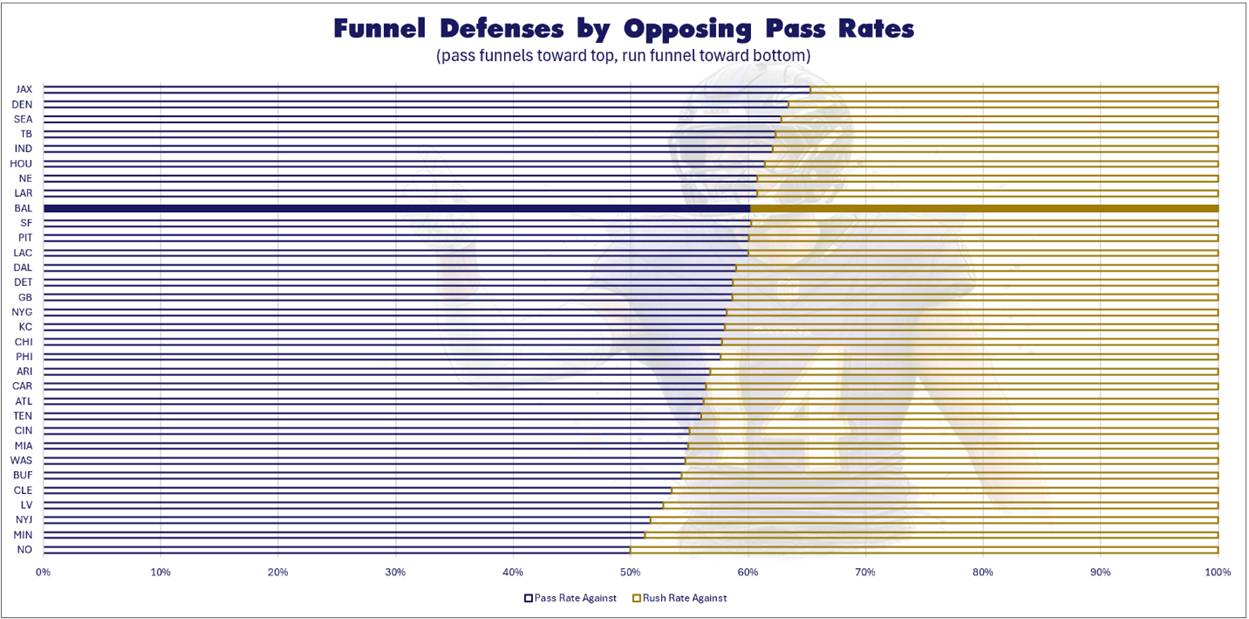
Based on their season-long opposing pass rates, the Ravens come off as a slight pass funnel; this should not be overstated, as this tends to matter more at the extremes, but it’s at least interesting, especially when paired with New England’s offensive dropback EPA and rush EPA disproportion.
The Ravens rank 14th in EPA per play allowed and 10th in defensive success rate. They rank 17th in EPA per dropback allowed and 10th in defensive success rate on dropbacks.
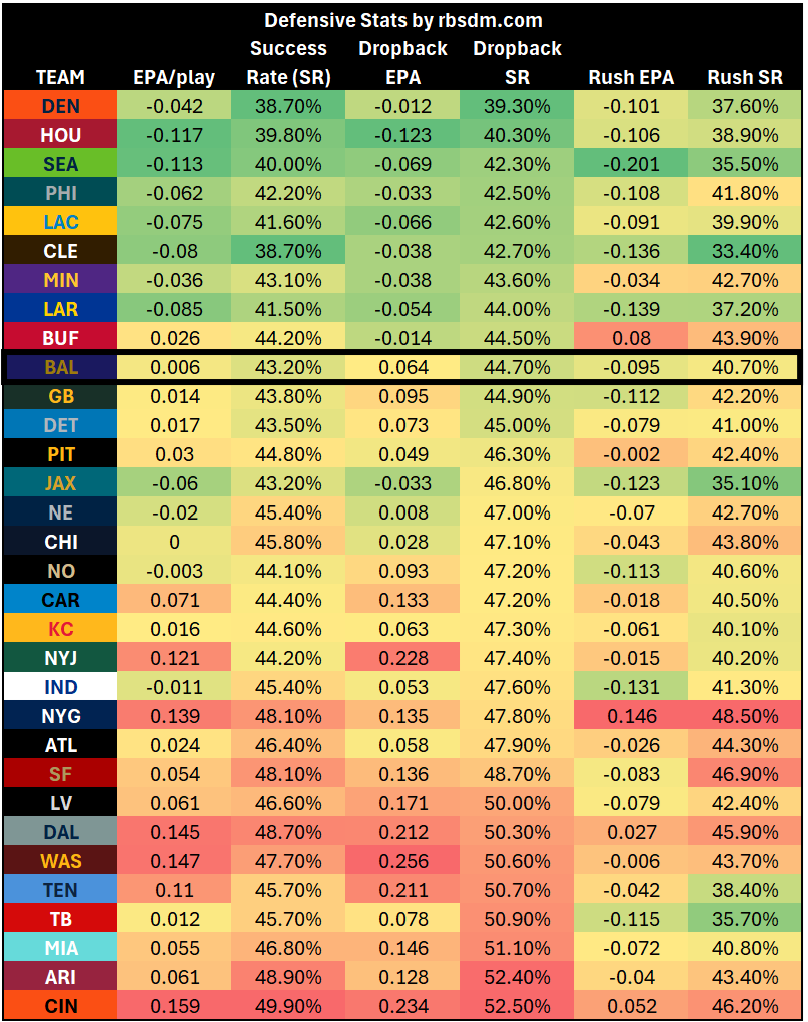
The Ravens use man defense at a rate of 34.6% (6th) and single-high safety at 60.4% (3rd). Their most popular alignments are Cover 3 (32.8%) and Cover 1 (26.9%), which are essentially the zone- and man-coverage versions of the same defense. They blitz at a rate of 23.3%, right at the league average.
Fantasy Points’ coverage matchup tool assigns a zero-based matchup grade to each pass-catcher based on their opponent’s use of specific types and rates of coverage and how that pass-catcher performs against them. Positive numbers indicate a favorable matchup and negative numbers indicate an unfavorable one.
Based on the model, Diggs (+0.4%) and Henry (+3.4%) have slightly favorable matchups, while Hollins (-3.5%%) and Boutte (-0.7%) have somewhat unfavorable ones.
PFF’s matchup tool is player-based, pitting the PFF ratings of individual players against each other for an expected number of plays based on historical tendencies and rating on a scale from great to poor.
Based on this model, Boutte’s matchup grades out as good, but everyone else’s shows up as fair.
The Patriots’ offense has allowed a pressure rate over expected (PrROE) of 13.48% (30th), but the Ravens only generate 2.66% PrROE (26th). It’s weakness on weakness, so the matchup is neutral in the aggregate.
The Patriots’ offensive run blocking is far better. They generate 2.33 adjusted yards before contact per attempt (adj. YBC/Att, 10th) offensively. The Ravens only allow 1.62 adj. YBC/Att defensively (2nd). The matchup here is almost the inverse: strength-on-strength; the result is the same: a relatively neutral matchup.
The Patriots rank 28th in offensive EPA per rush and 29th in offensive success rate on rushes.
It took a while to get here, but RB TreVeyon Henderson has become the RB to own in New England. He has had spikes in Weeks 10 and 11, each of which fellow RB Rhamondre Stevenson missed, and again last week.
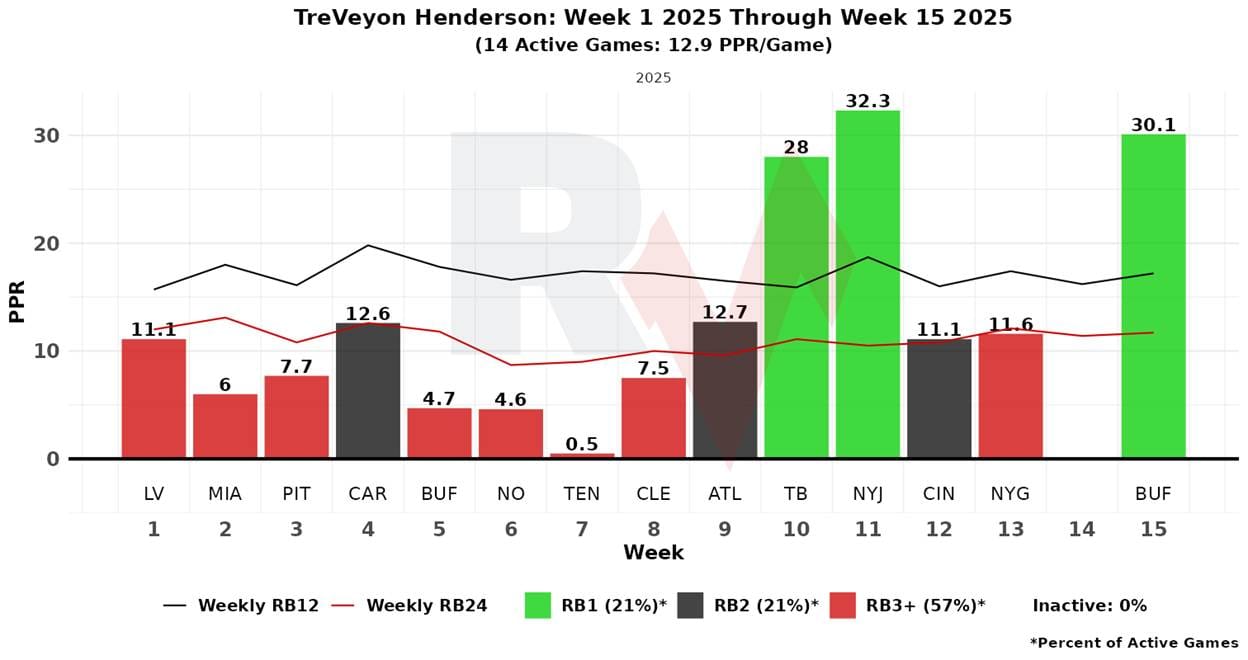
In the last five games, Henderson has jumped up to a 67% snap share, a 12% target share, and 55% of the team’s rush attempts. Notably, however, his snap share was 84% and 88% in Weeks 10 and 11 while Stevenson was out. In Week 12, the first week Stevenson returned, Henderson earned only a 63% snap share, and he has been under 50% in each of his last two games, less than Stevenson.
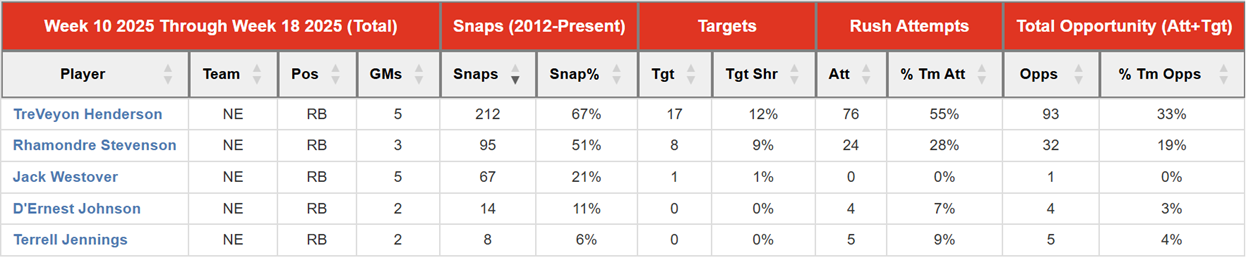
The words “not how I would do it” come to the lips of many of Henderson’s fantasy GMs when they discover this, as they have already long demanded that Henderson be made into the clear lead back. Their argument is justifiable, as Henderson has been unleashed twice and has been incredible each time. Meanwhile, Stevenson has been mediocre in efficiency metrics that Henderson has dominated.
But the long and short of it is that Henderson’s game last week was not a byproduct of the same formula as Weeks 10 and 11, as he was entrusted with roughly half the snaps. He is still consistently earning a greater share of the team’s rush attempts and opportunities, but he has not been made the Gibbs to Stevenson’s David Montgomery.
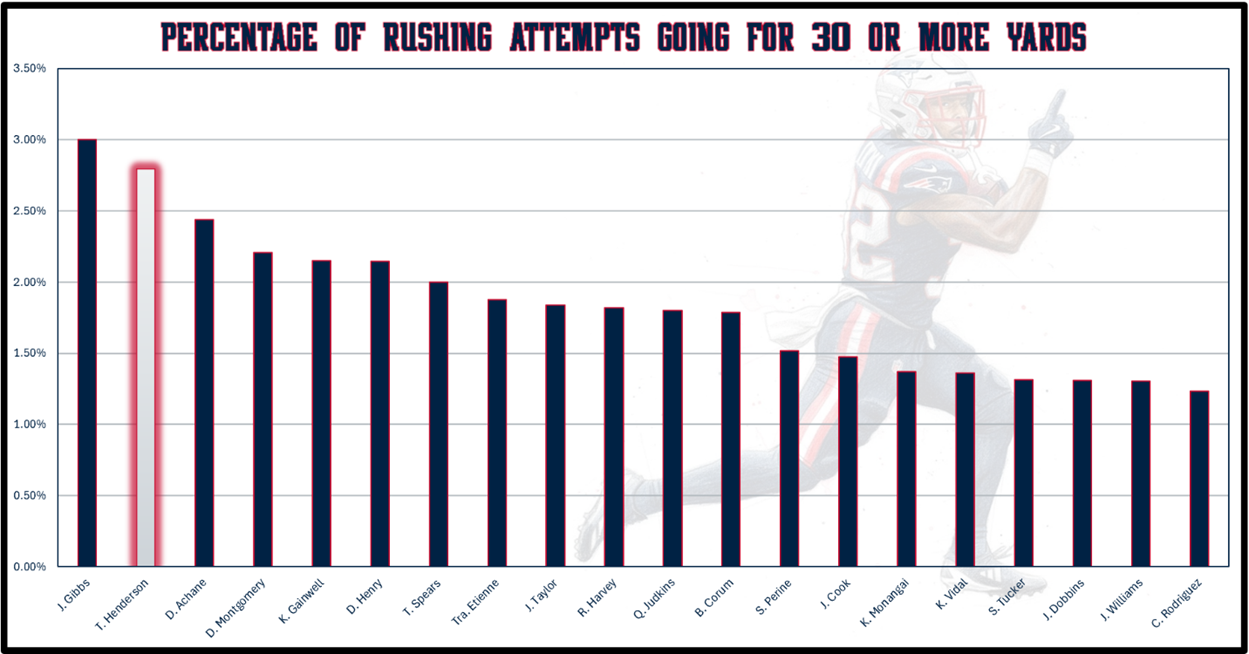
Henderson can score from anywhere on the field. He has the second-highest percentage of rushing attempts going for 30 or more yards, behind only Jahmyr Gibbs, who was one of his most common comps heading into the NFL draft. When Stevenson was injured, and Vrabel was forced to give Henderson an extended look, he demonstrated valuable explosiveness that couldn’t be justifiably left off the field.
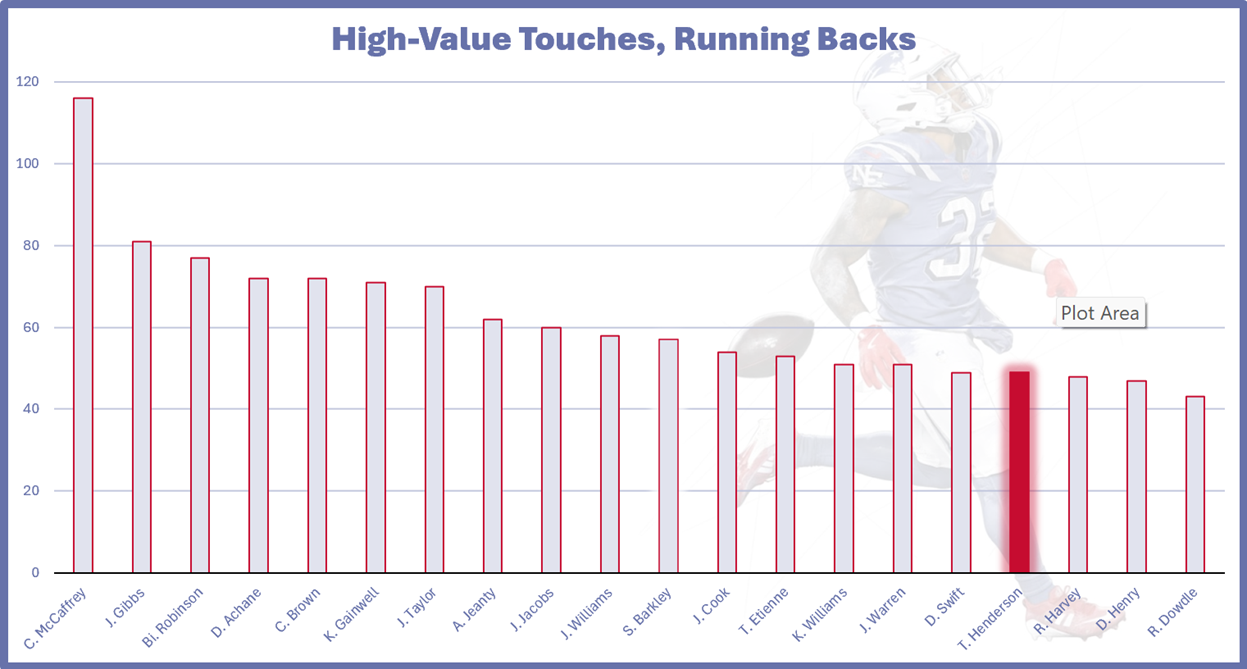
Henderson is given more high-value touches (HVTs) than Stevenson as well. Despite a minority share in a committee for much of the season, Henderson ranks 17th in HVTs.
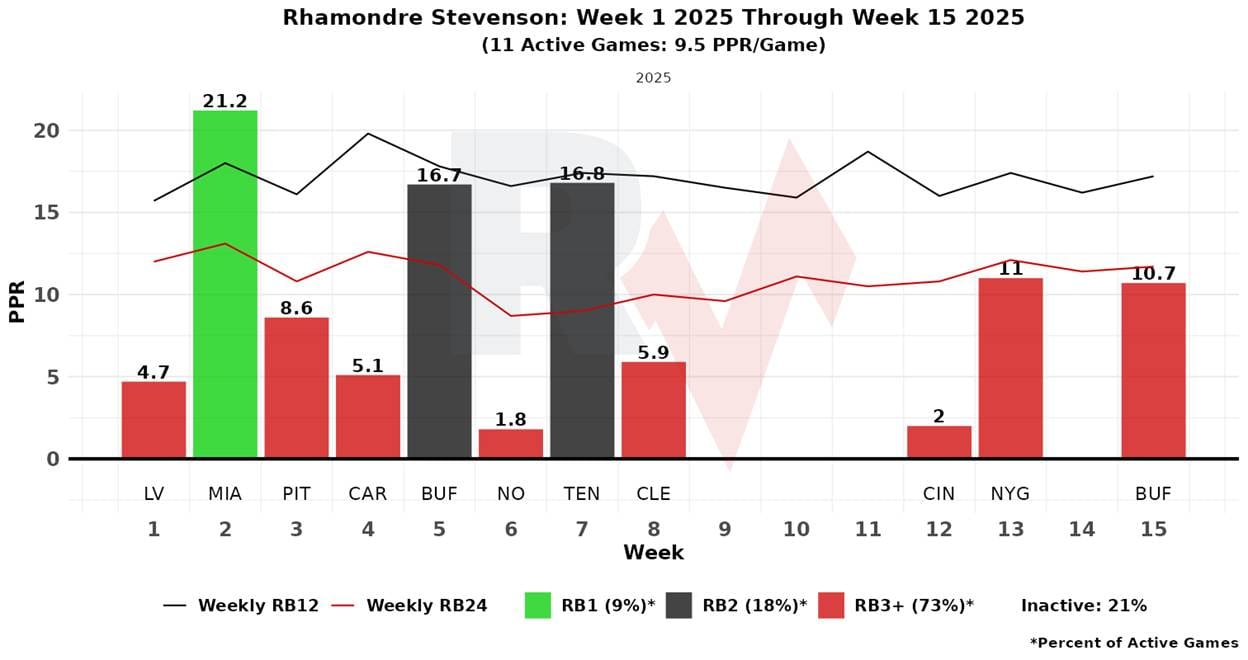
Stevenson seems like a pretty underwhelming play right now because it has been a while since he’s made an impact. Admittedly, if we accept Week 12 as a ramp up from injury and Weeks 13 and 15 as the first two games fully back from injury, it doesn’t seem quite so bad; he was right on the RB2/RB3 edge in each game—flex territory—and the only real reason he has been out of that range since Week 7 is related to his injury and absence, as well as the Patriots’ bye.
The Ravens rank 12th in EPA per rush allowed and 14th in defensive success rate on rushes. They have only allowed opposing RBs to score the 19th-most fantasy points against them in their last five games. This is where they are seemingly most vulnerable, but this is also the Patriots’ most significant offensive weakness.