
Quick Slant: SNF - Wild Carolina: Big Cats on the Piedmont

Mat Irby’s Quick Slant
Night falls on the Carolina Piedmont. Summer has come to a close, and autumn trudges on toward bitter winter. Golden strands of sunset peek above yellowing trees and the glassy waters of Lake Wylie. Darkness settles, and the black panther is once again on the move.
To the west, the Catawba River system serves as a natural barrier, but a panther’s territory can stretch for hundreds of miles. For this solitary hunter, the edges of his kingdom extend eastward to the Rocky River and its tributaries, southward to the woods, creeks, and ridges of the Waxhaw region, and back north, where Lake Norman cuts off the land, sprawling across four counties.
The panther sleeps, hidden during daylight, but when the sun falls, he patrols his territory: the dotted foothills of a fading Appalachia, rolling and stretching toward a flatter South, an area he’s covered hundreds of times. He drinks from his streams, marks his trees, and checks for predatory threats, secure in the expectation that he will find none.
But tonight is different.
He stops. Frozen. A scent from the north, something on the wind that doesn’t belong. Not one animal, but several. Invaders. Birds scatter; deer flee past in the wrong direction. The panther is no longer hunting. He’s investigating.
A pride of lions travels. Migrating southward through the mountains as autumn advances, they seek the resources needed to survive the coming winter. Every opportunity to feed becomes increasingly critical. In summer, an unsuccessful hunt could be survived and forgotten. Now, with colder months ahead, there is less margin for failure.
The lions are larger, stronger, and they move together. The panther follows their scent alone, slipping south through familiar woods as the last traces of daylight disappear behind him. Retreat remains an option, but surrendering his territory would mean surrendering the resources he needs for the same winter that drives the lions south.
So he keeps moving.
The scent grows stronger. Soon, he can hear them.
The woods give way to a clearing, strangely flat and open; chalky white designs frame a game’s surface, all glowing beneath massive steel trees that cast a wash of white light. One male lion emerges from the north. The panther’s hackles rise; his shoulders tense. For a moment, neither moves.
Crows scatter, flapping feathers; panicked tree branches swing like springs. Violent roars below the tree canopy envelop the silence and shake the Carolina earth. Here, even in October, the stakes are high.
GAME ENVIRONMENT
Detroit Lions (-3.5) at Carolina Panthers
Over/Under: 50.5
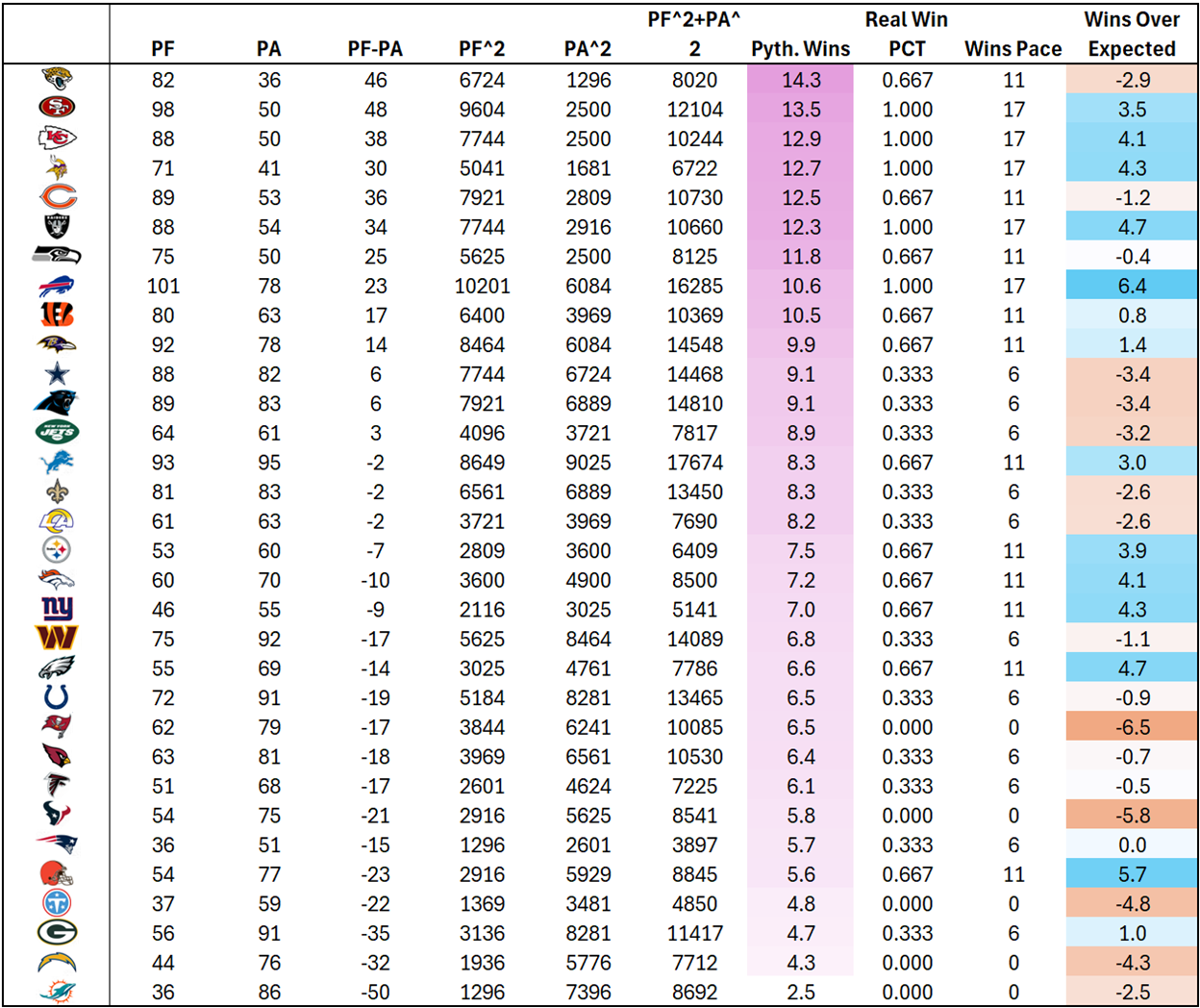
The Lions are the higher-profile team with far better Super Bowl odds (+1800 vs. +12,500, according to FanDuel Sportsbook), but the Panthers are slightly better on a Pythagorean Wins basis, pacing for 9.1, while the Lions are pacing for 8.3.
Detroit paces at 29 seconds per snap from a neutral script (T-13th), while Carolina paces at 29.5 (T-26th). The Lions average 62 plays per 60 minutes (2nd), while the Panthers average 54 (T-30th).
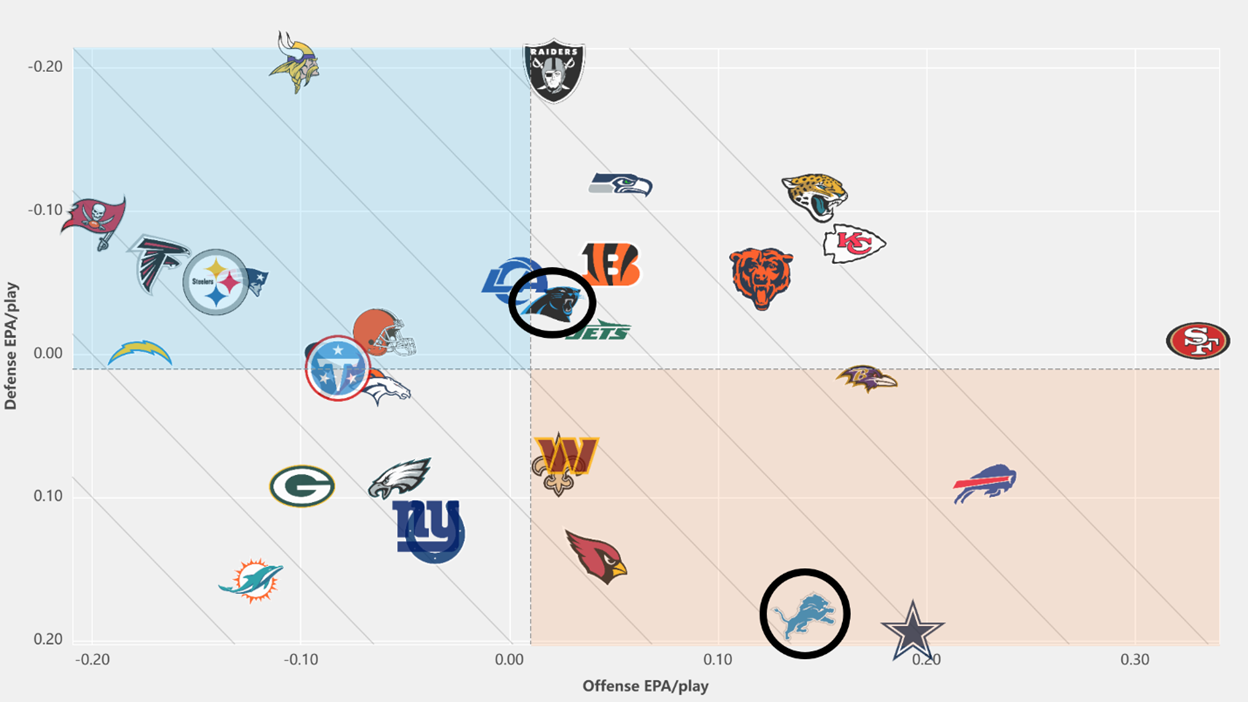
The Lions are well above average in offensive EPA per play but 31st in EPA per play allowed, outperforming only Dallas. The Panthers are slightly above average in both offensive and defensive EPA.
Rain is expected throughout the day in Charlotte on Sunday, though current forecasts suggest most of it could taper off closer to kickoff. That said, there is still a chance for lighter showers periodically throughout. Temperatures should hover around 67° at kickoff, with almost no wind. These conditions shouldn’t make a significant impact.
Lions Key Injuries: Detroit remains without starting S Brian Branch (Achilles) and S Kerby Joseph (knee), who opened the season on PUP and are likely contributing to the Lions’ poor defensive start. Starting C Cade Mays (wrist) remains on IR. OL Ben Bartch (foot) is out after missing all of practice this week. CB D.J. Reed (rib) is questionable after three limited practices; he is Detroit’s only significant game-time concern. Isaih Pacheco (back) is on IR.
Panthers Key Injuries: Carolina is significantly more depleted. Starting CBs Jaycee Horn (quad) and Mike Jackson (groin) were both placed on IR this week, leaving the Panthers without either outside corner. ED Nic Scourton (knee), a projected starter, is on season-ending IR, while DT Tershawn Wharton (neck) remains on PUP.
The offensive line is similarly battered: LT Ikem Ekwonu (knee) remains on PUP, RT Taylor Moton (illness) remains on NFI, and LG Damien Lewis (elbow) has been ruled out. Rookie RT Monroe Freeling (concussion) practiced fully on Friday but remains questionable while completing the concussion protocol. WR Xavier Legette (knee) is out, and RB Jonathon Brooks (core) is on IR.
WR Jalen Coker (quad) is questionable; Coker leads Carolina in receptions and receiving yards, and the Panthers planned to test his quad again Saturday before determining his availability. WR Ja'Seem Reed was called up from the practice squad as a precaution, and Carolina is on bye next week, so I'm operating under the assumption that Coker will miss the game.
LIONS
Implied Team Total: 27
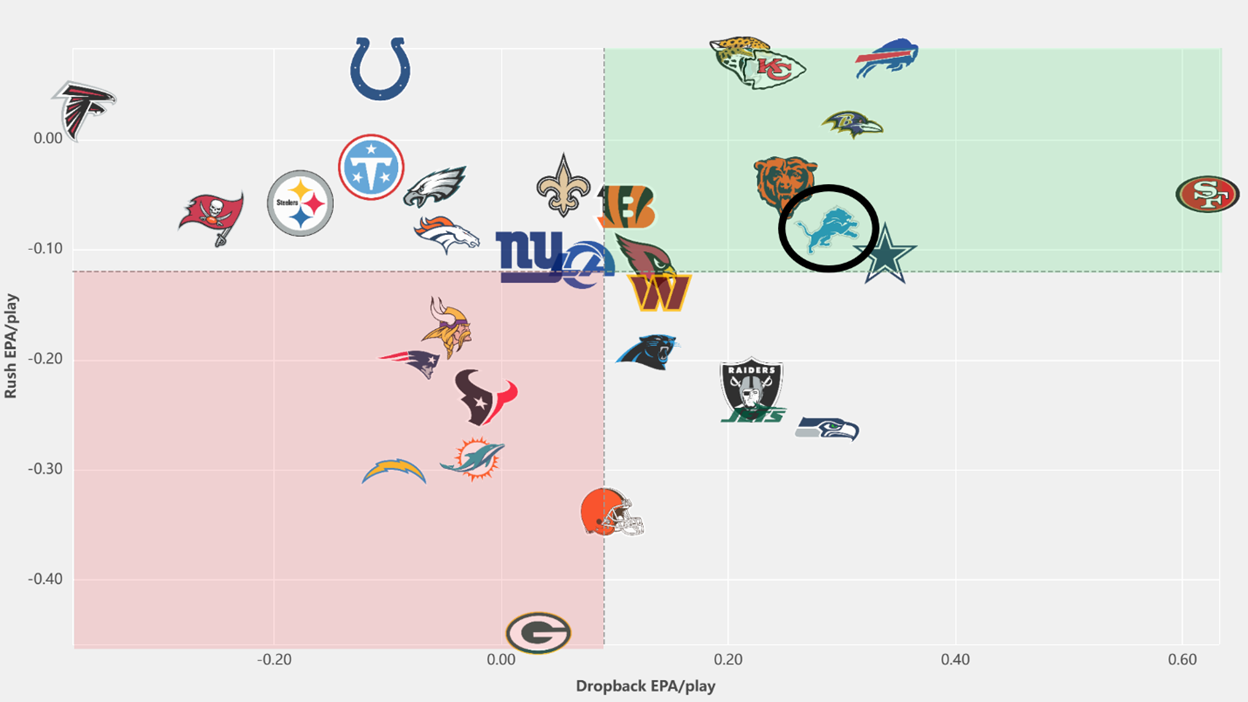
The Lions are one of the most efficient offenses in football through three weeks, ranking well above league average in both dropback EPA per play and rush EPA per play.
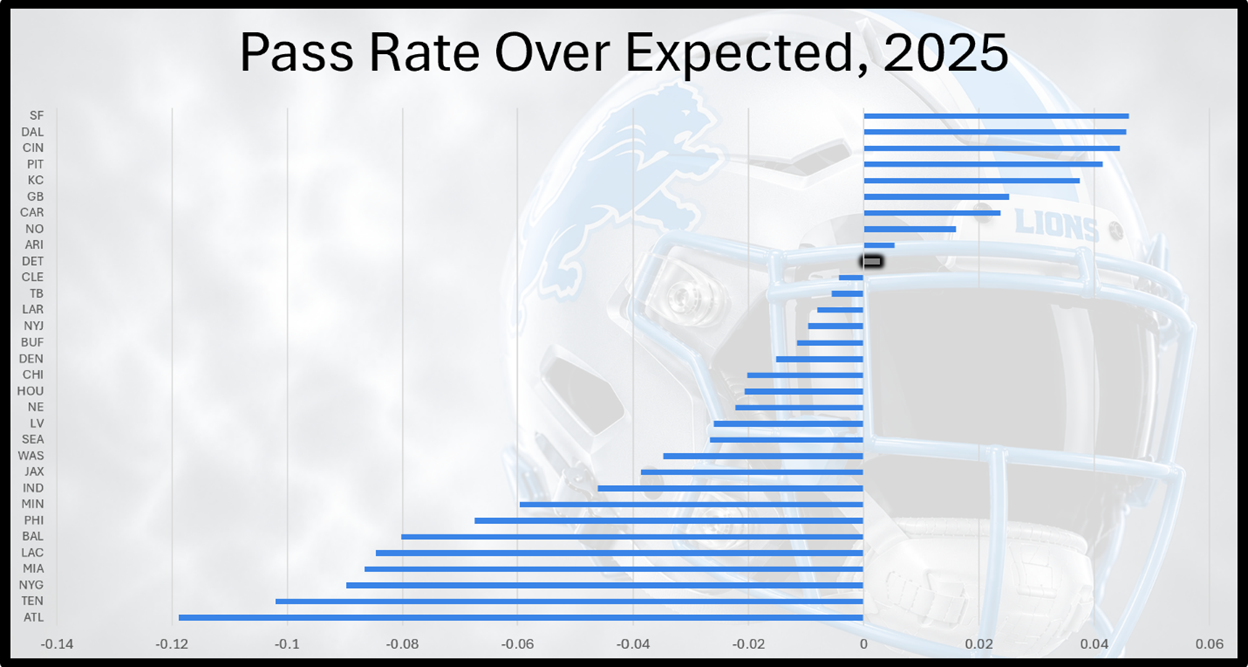
Detroit is essentially neutral in PROE, passing almost exactly as often as expected based on league base rates.
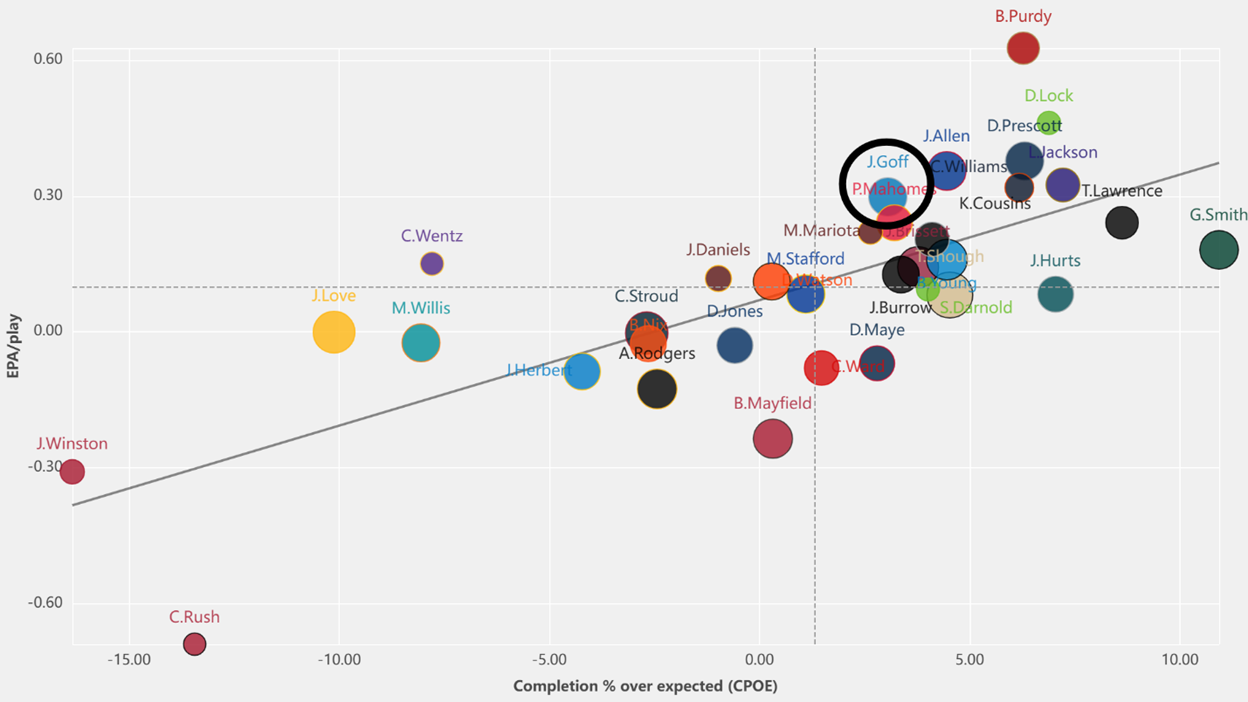
QB Jared Goff has 40.3 dropbacks/G (7ᵗʰ) and 36.3 passing attempts/G (8ᵗʰ) through three weeks. He offers almost nothing as a runner, averaging just 0.5 rushing FP/G (28ᵗʰ), but Detroit has leaned heavily on his arm: Goff is averaging 267.3 passing yards/G (6ᵗʰ) with 2.67 passing TDs/G (T-3ʳᵈ).
As a thrower, Goff has been excellent. His 56.2% positive EPA rate ranks 5ᵗʰ, while his 0.27 EPA per dropback ranks 7ᵗʰ. He’s also been effective regardless of protection, posting a 121.7 QB rating from a clean pocket (7ᵗʰ) and 101.3 under pressure (4ᵗʰ). Goff has yet to throw an INT, and his 3.93 FPOE/G ranks 8ᵗʰ. Through three games, he’s producing like one of the league’s better pure passers.
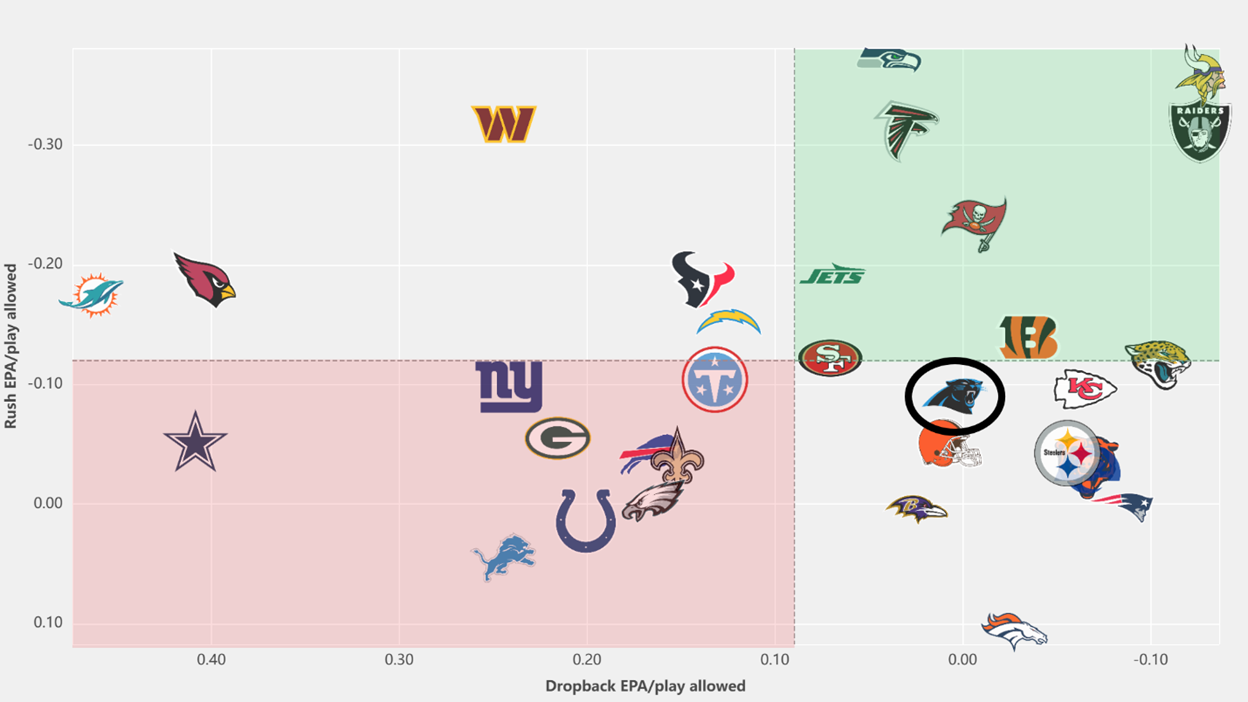
Carolina is playing one of the league’s more zone-heavy defenses under DC Ejiro Evero, using zone on 82.6% of opposing dropbacks (9ᵗʰ). The Panthers have played with a single-high safety on 63.5% of snaps, leaning heavily on Cover 3 (48.7%), while playing man just 14.8% of the time. Carolina blitzes on 31.9% of their defensive plays, an above-average rate.
The results have been solid. Carolina is above league average against both the run and pass through three weeks, allowing roughly -0.01 EPA per dropback and -0.09 EPA per rush.
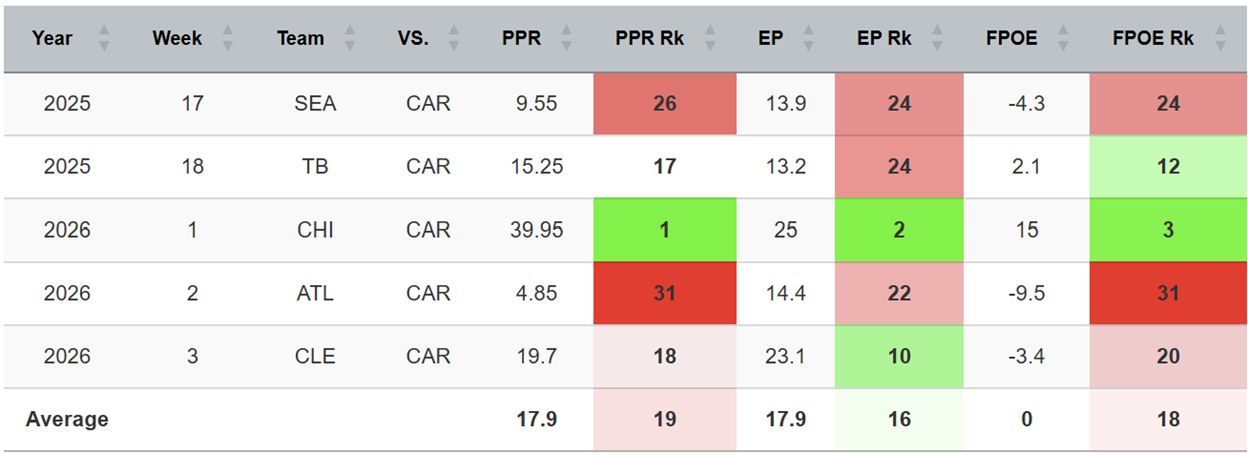
The Panthers’ QB results have been more uneven. Over their last five games, dating back to last season, they’ve allowed 17.9 FP/G to QBs (19ᵗʰ), which is not bad. But context is important; this year, Caleb Williams erupted for 39.95 points in Week 1, and Deshaun Watson scored 19.7 last week, but the Atlanta third- and fourth-string QBs managed just 4.85.
Personnel is a bigger concern heading into Sunday night. Starting CBs Jaycee Horn (quad) and Mike Jackson (groin) were both placed on IR this week, leaving Carolina without either starting outside corner against a Detroit passing game that has been among the league’s most efficient.
Strictly against types and rates the Panthers use on defense, Fantasy Points’ Coverage Matchup Tool predicts just a 1.5% boost for Goff, almost neutral. But based on the personnel matchup, PFF’s matchup tool has Goff’s matchup graded as great.
Given this and the high expected point total, Goff is a good play, despite what the raw numbers say.
WR Amon-Ra St. Brown is dominating Detroit’s passing game, accounting for 33 of the Lions’ targets through three weeks. He has a 30.3% target share (3rd), 30% TPRR (T-7ᵗʰ), and 44.1% first-read target share (2ⁿᵈ), while running a route on 90.1% of Detroit’s dropbacks.
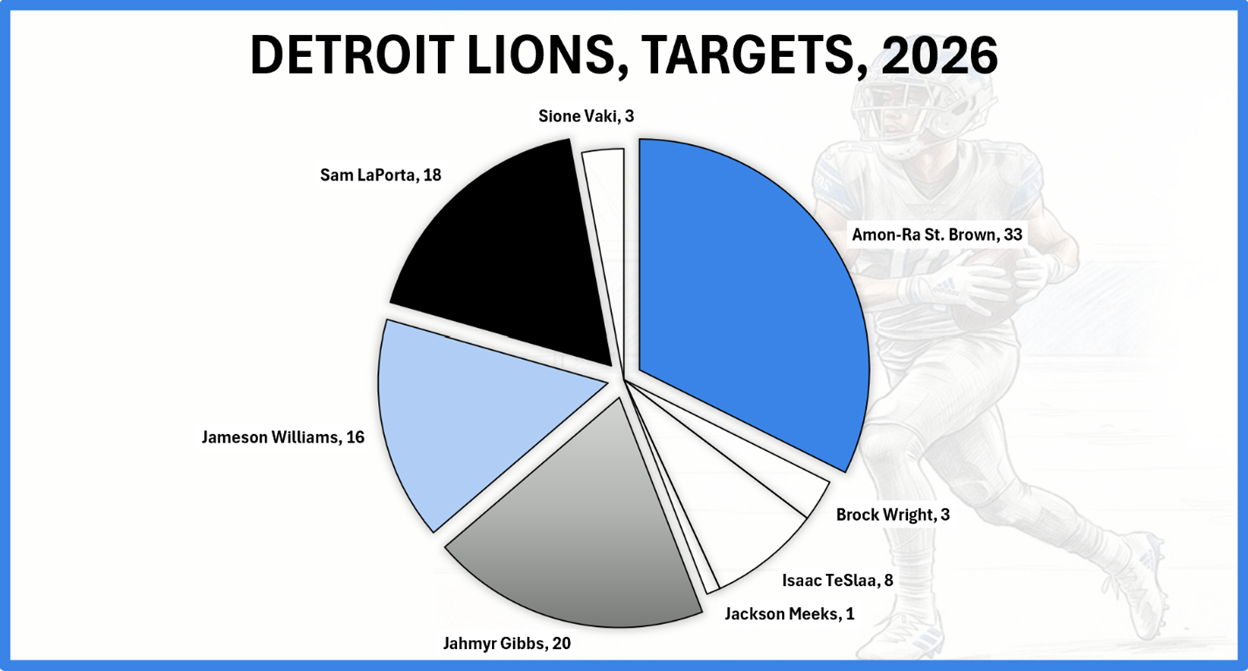
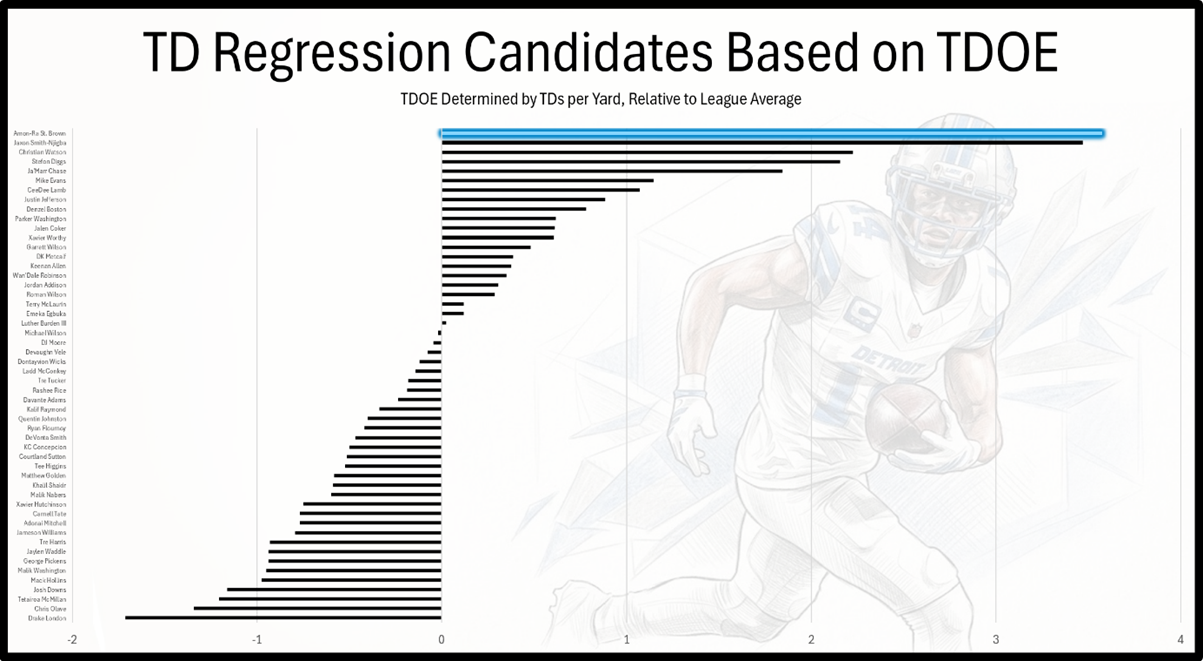
St. Brown has turned that volume into 23 receptions for 228 yards and five TDs, averaging 20.3 XFP/G (4ᵗʰ). The TD production is running extremely hot, however: St. Brown is already the strongest negative TD regression candidate in my TDOE model.
WR Jameson Williams remains the clear No. 2 WR, but the production hasn’t followed the playing time. Williams has an 87.6% route participation rate (10ᵗʰ), but just 17 targets, 10 receptions, and 127 yards. His 15% TPRR ranks T-76ᵗʰ, and he has yet to score a TD.
TE Sam LaPorta has been much more involved, drawing 19 targets and catching 14 for 144 yards and a TD. His 84.3% route participation ranks 2ⁿᵈ among TEs, and his 4.67 receptions/G rank T-7ᵗʰ. RB Jahmyr Gibbs is also a major part of the passing game with 20 targets, leaving Williams fourth on the team behind St. Brown, Gibbs, and LaPorta.
Based on the types and rates of coverage the Panthers use, Fantasy Points’ matchup tool gives WR Amon-Ra St. Brown an expected 8.9% boost in his normal fantasy production. WR Jameson Williams gets a 15.7% downgrade, while TE Sam LaPorta’s matchup is essentially neutral.
PFF’s matchup tool agrees on St. Brown, grading his matchup as good. Williams and WR Isaac TeSlaa draw poor grades, even with Carolina shorthanded, while LaPorta’s matchup also grades as good.
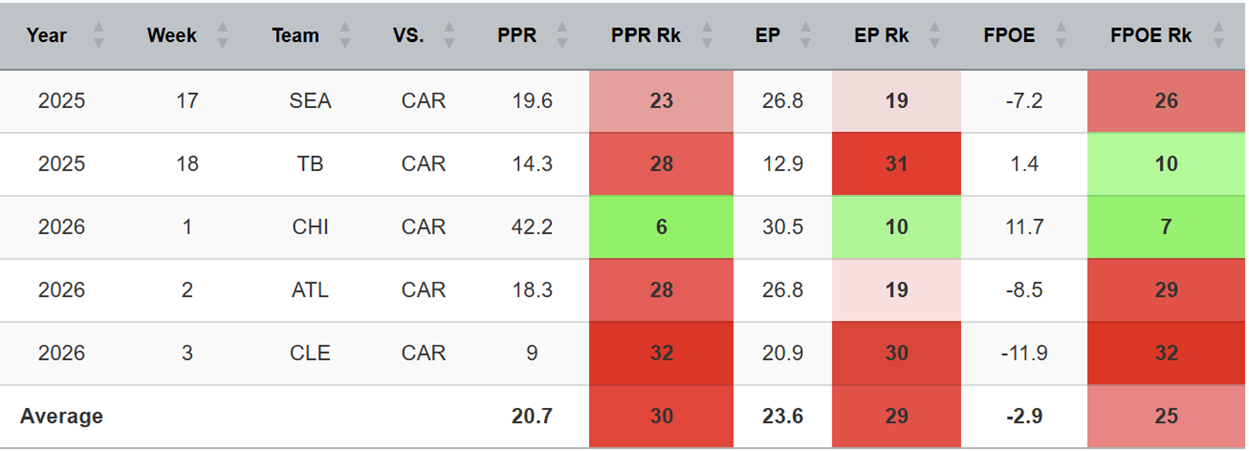
In their last five games, dating back to last year, the Panthers have allowed 20.7 FP/G to WRs (30ᵗʰ), while opponents have averaged 23.6 expected points (29ᵗʰ).
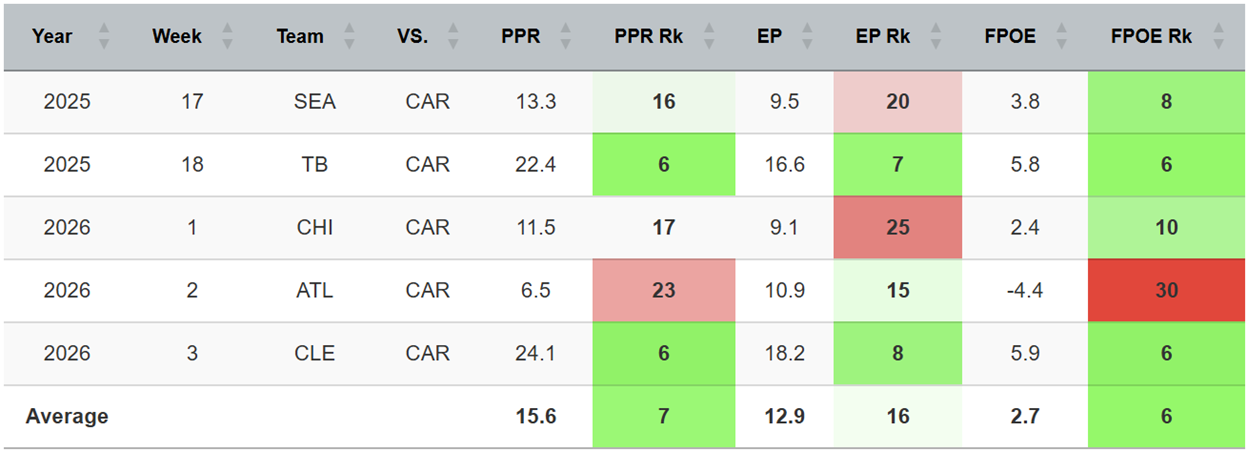
Carolina has been much more permissive against TEs, allowing 15.6 FP/G over its last five games (7ᵗʰ). TEs have also outperformed expectations by 2.7 FP/G against the Panthers during that span (6ᵗʰ).
No one is sitting St. Brown anyway, but this seems like a great spot for him; it’s also probably a good setup for LaPorta. I’d probably try my best to sit Williams again if I had other good options, even with Carolina missing DBs. Of course, he’s so explosive that his matchups matter less; his ship could come in on one 80-yard play against anyone.
When the Lions have the ball, the offensive pass-blocking matchup is pretty neutral. However, their run-blocking should be highly advantageous.
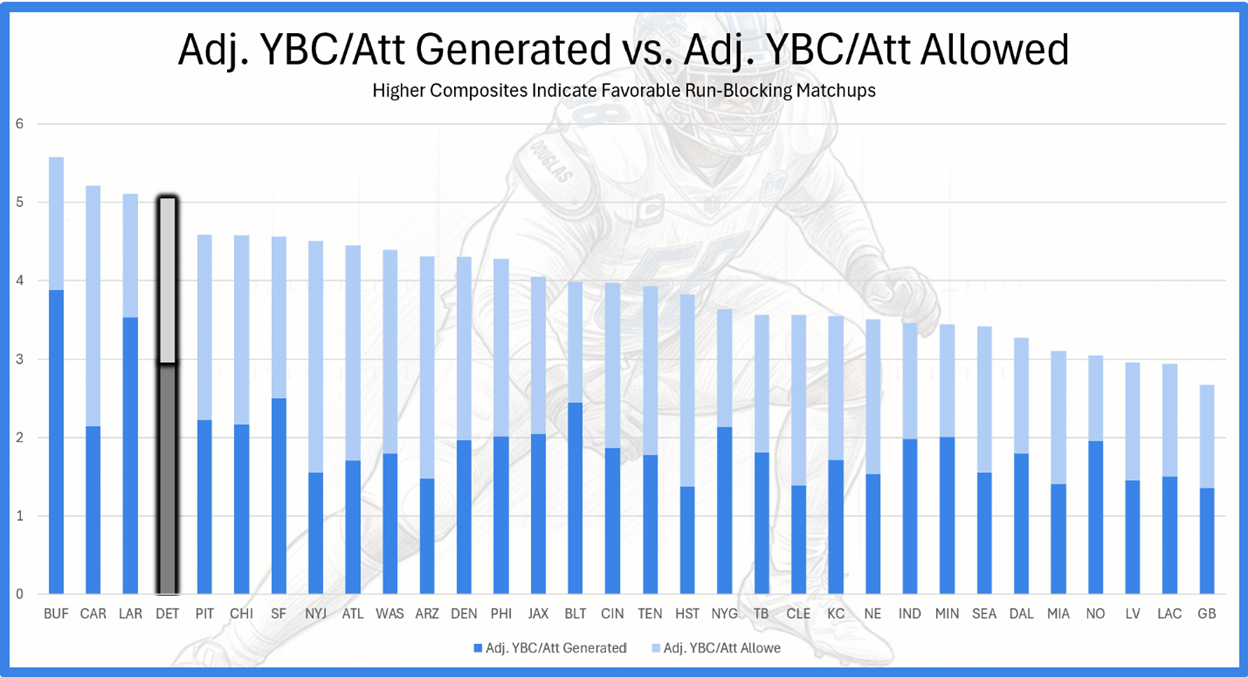
Of course, the most significant single fantasy asset in the game is Detroit RB Jahmyr Gibbs. Gibbs is already producing like one of fantasy's premier players. Over three games, he has 65 carries for 307 yards and four TDs, plus 18 receptions for 156 yards and two more scores.
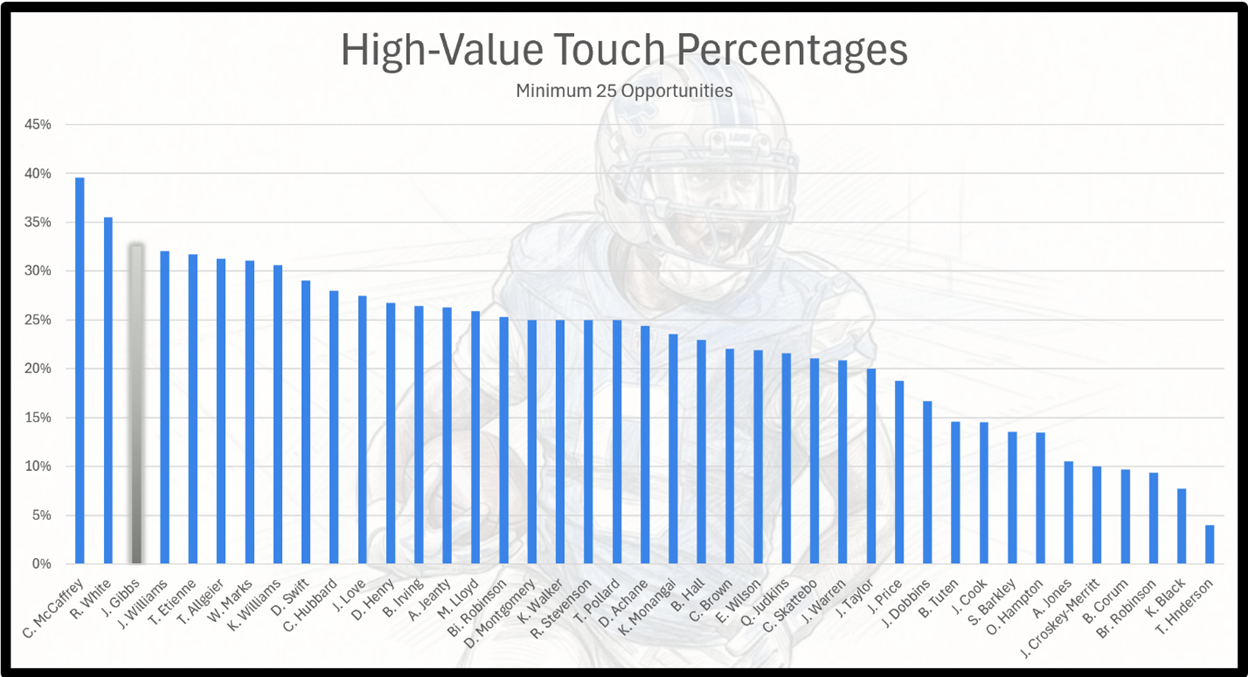
The underlying usage is every bit as impressive. Gibbs is averaging 21.7 carries/G (T-4ᵗʰ), 6.67 targets/G (1ˢᵗ), and 9.0 high-value touches/G (1ˢᵗ). His 32.5% HVT rate ranks 3rd among RBs with 25+ opportunities.
He has also been exceptionally efficient, averaging 6.33 missed tackles forced/G (2ⁿᵈ), 66.3 YACo/G (4ᵗʰ), and 7.67 first downs/G (1ˢᵗ), while his 85.3 PFF rushing grade ranks 2ⁿᵈ. Gibbs leads all RBs in XFP/G (28.6), EP/G (26.2), and FPOE/G (7.23).
Gibbs is excellent, although that level of efficiency probably isn't fully sustainable. Gibbs has scored six TDs through three games and ranks 2ⁿᵈ among RBs in my TDOE model, making him an early negative-TD-regression candidate.
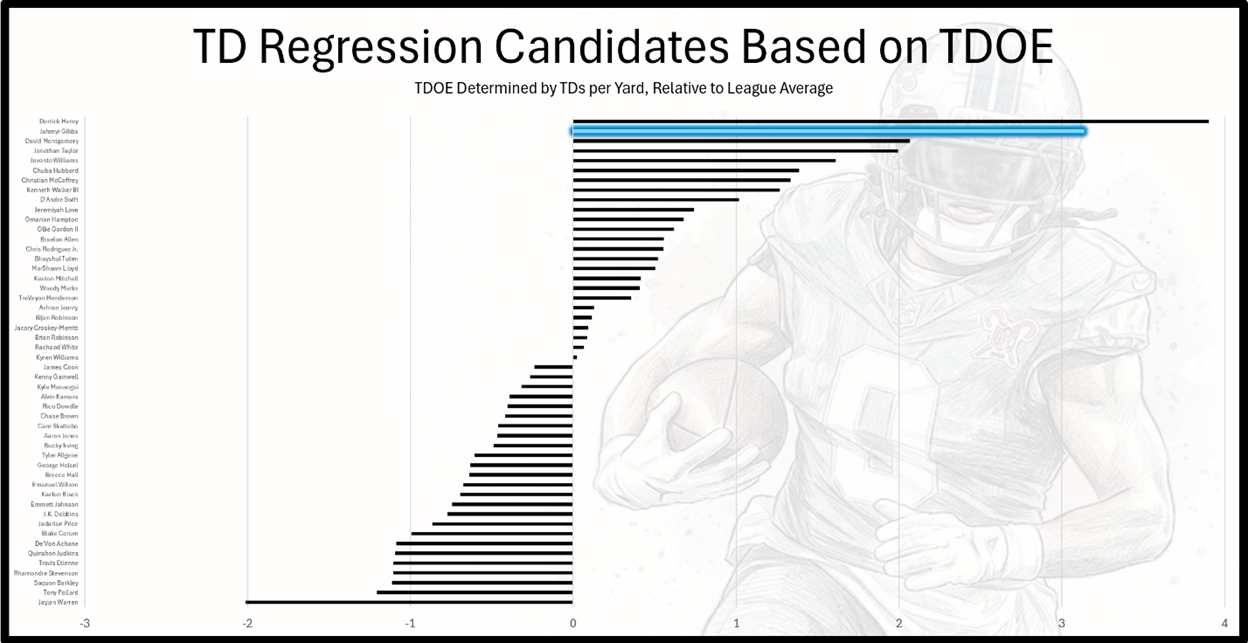
That said, Carolina looks like an awfully inviting place for regression to wait another week.
PFF grades Gibbs' rushing matchup as great, with Carolina's defensive front ranking 26ᵗʰ and its missed-tackle matchup 30ᵗʰ. His receiving matchup grades as good, and Gibbs already leads all RBs with 6.67 targets and six receptions/G.
Over their last five games, the Panthers have allowed 28.4 PPR/G to RBs (5ᵗʰ), including 25.0 expected points/G (4ᵗʰ). Opposing backs have also beaten expectations by 3.4 FP/G during that span (6ᵗʰ).
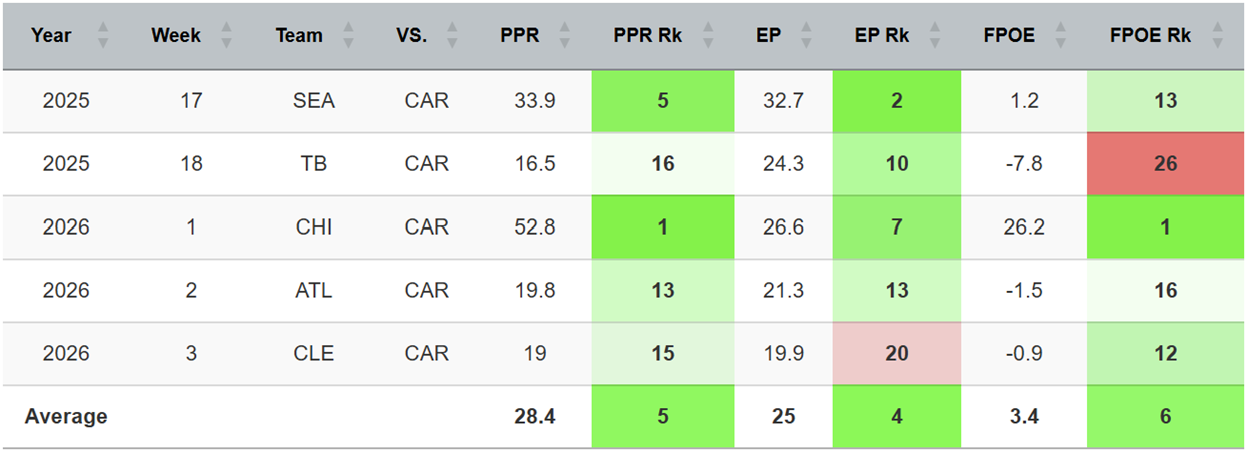
Also, in that span, Carolina has allowed 4.2 receptions for 30 yards to RBs through the air, and Gibbs has been the best receiving back on the planet in 2026. Earning 15.2 FP/G from receiving (1st).
There isn't much to dislike here. Gibbs is getting elite rushing volume and goal-line work, leading the position in receiving usage, and drawing one of the better RB matchups on the slate. The TD pace will come down eventually, but Sunday night doesn't look like a great spot to bet on it.