Quick Slant: TNF - Belief Is Provisional

Mat Irby’s Quick Slant
For the Seahawks, there seemed to be no grand championship plan, just items going off the shelf and replacements shipping in, like retail. Geno Smith was out, DK Metcalf, Tyler Lockett, Dre’Mont Jones. Sam Darnold, Cooper Kupp, DeMarcus Lawrence, and Josh Jones were in. For those watching along at home, there was certainly no sense of a title window. These were just the actions of another rudderless club paddling through dark waters, pressured by the ticking clock of impatience, a plague that has made it impossibly uncertain to take on the task of rebuilding in the NFL, pushing administrators to settle for half-measures and hope.
Tested this past week by a Colts team, surprising in its own way, the Seahawks fell behind after Blake Grupe’s 60-yard field goal with 47 seconds remaining appeared to cap off Philip Rivers’ 36th career game-winning drive, in just his first start since 2021.
But Darnold, once perceived to be lamb-hearted, submitted more evidence of his steely, mature nerve. He calmly collected his darts and started dealing the Colts bad news: a stinging needle to WR Rashid Shaheed (who had set it all up with a 28-yard return) to his left for 17 yards, followed by a spike. Then another, over Shaheed’s left shoulder along the sideline for eight more. And just like that, the Seahawks had what they needed for K Jason Myers to pay that game-winning field goal back. The Seahawks, not the Colts—Darnold, not Rivers—earned the game-winning drive in the end.
Roughly 1,100 miles south, QB Matthew Stafford had a lingering back injury this summer. This alone was not necessarily news; Stafford suffered a spinal cord contusion in 2022 that required surgery. New disc aggravations and spinal cord injections, and epidurals, though, were cause for concern. The Rams had built a formidable roster with a revamped defense to pair with an already electric offense. As a cherry on top, they added Davante Adams, one of the best WRs of a generation, whose style was a perfect match for Stafford’s. But it would all be a body without an engine without the 37-year-old signal caller there to run the machine. We are now through 15 weeks, and not only is Stafford healthy, but he is the favorite for MVP.
Sunday, the Rams drew a challenging foe of their own as a test: the Lions, part of the NFL’s upper crust, cornered and balanced on the razor’s edge of playoff contention. And like the Seahawks, the Rams had every answer. Like the Seahawks, they proved their worth.
The Rams and Seahawks meet on Thursday with the NFC West on their mind, for sure. But each serves as the other’s gatekeeper to the elite, too. With a win, either team will be tangling with the Broncos and Patriots for the best record in football; with a loss, either will be fighting to avoid third place in its own division. These are the moments that matter—proving grounds, character construction, practice for a perfect January. Thursday plays like a primary for some future election.
For Seattle—and, to some extent, Darnold—Thursday is about disproving the obvious read, that this is all temporary competence, a borrowed stretch of nerve before the bottom drops out.
For the Rams, it’s about showing that their window is not only propped open by Stafford’s tolerance for pain, but reinforced by something sturdier, something younger, something that can carry weight for the long haul.
And Thursday is not the conclusion of anything. It’s a vetting. A stress test. A reminder that in this league, belief is provisional, granted week to week, and revoked just as quickly. The Seahawks and Rams have both survived long enough to be here. Now they have to prove why.
Rams
Implied Team Total: 23
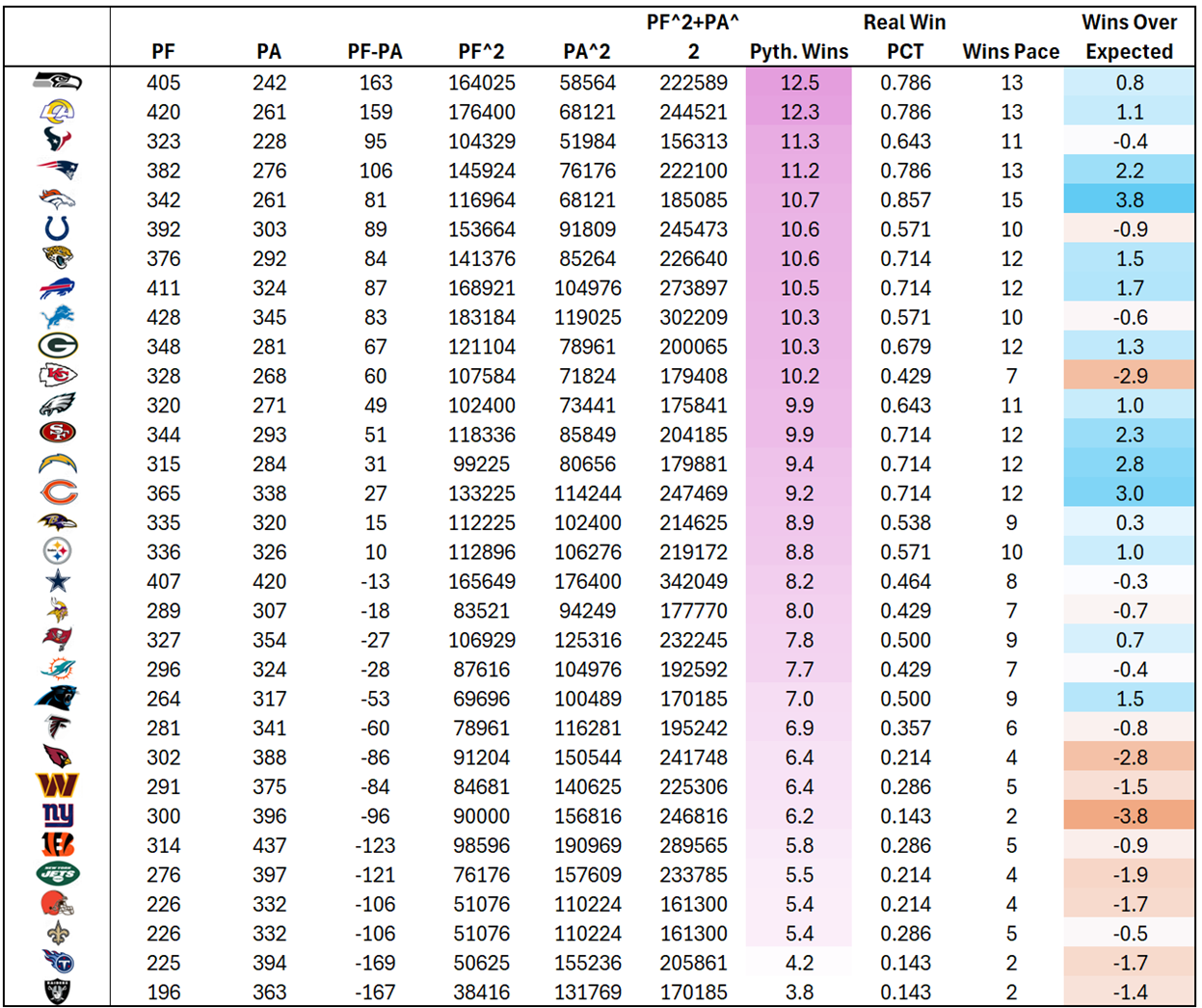
The Rams and Seahawks are recognized as two of the best teams in the NFL. According to Pythagorean expected wins, they are the two best teams in the NFL.
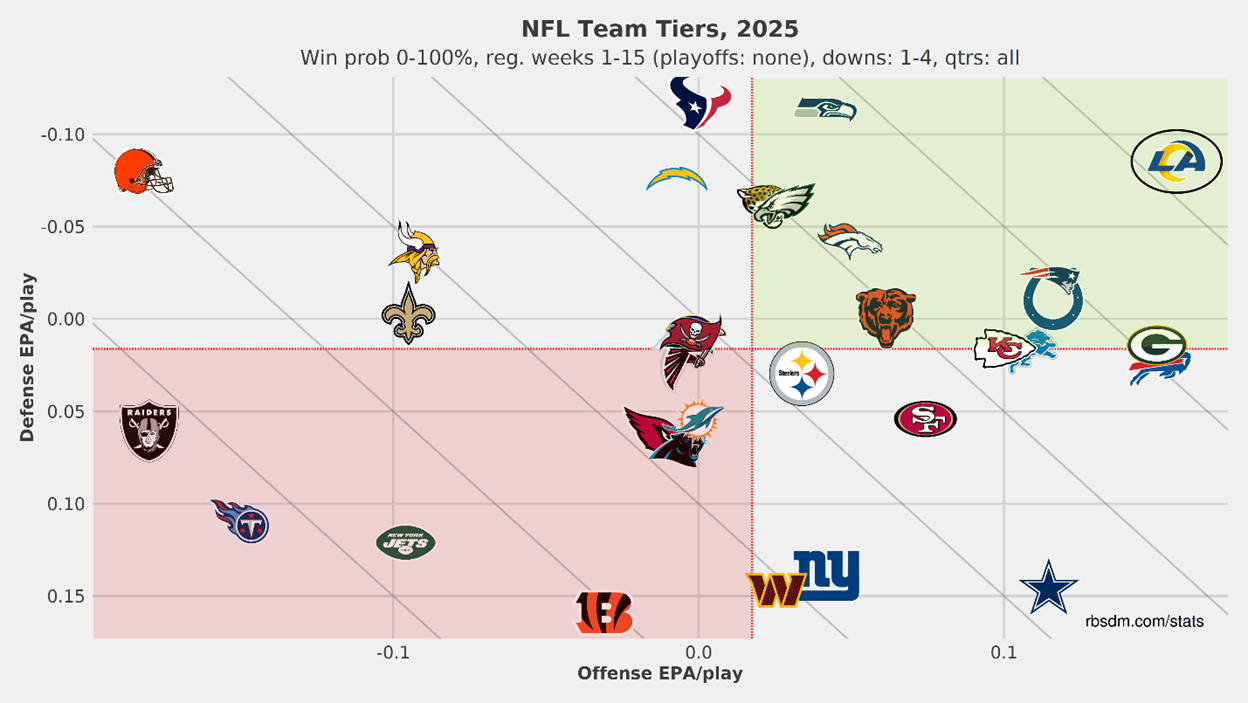
The Rams are far and away the best combination of offensive EPA and defensive EPA in the league.
Offensively, the Rams are strong both in dropback EPA and rush EPA—again, among the best in the league.
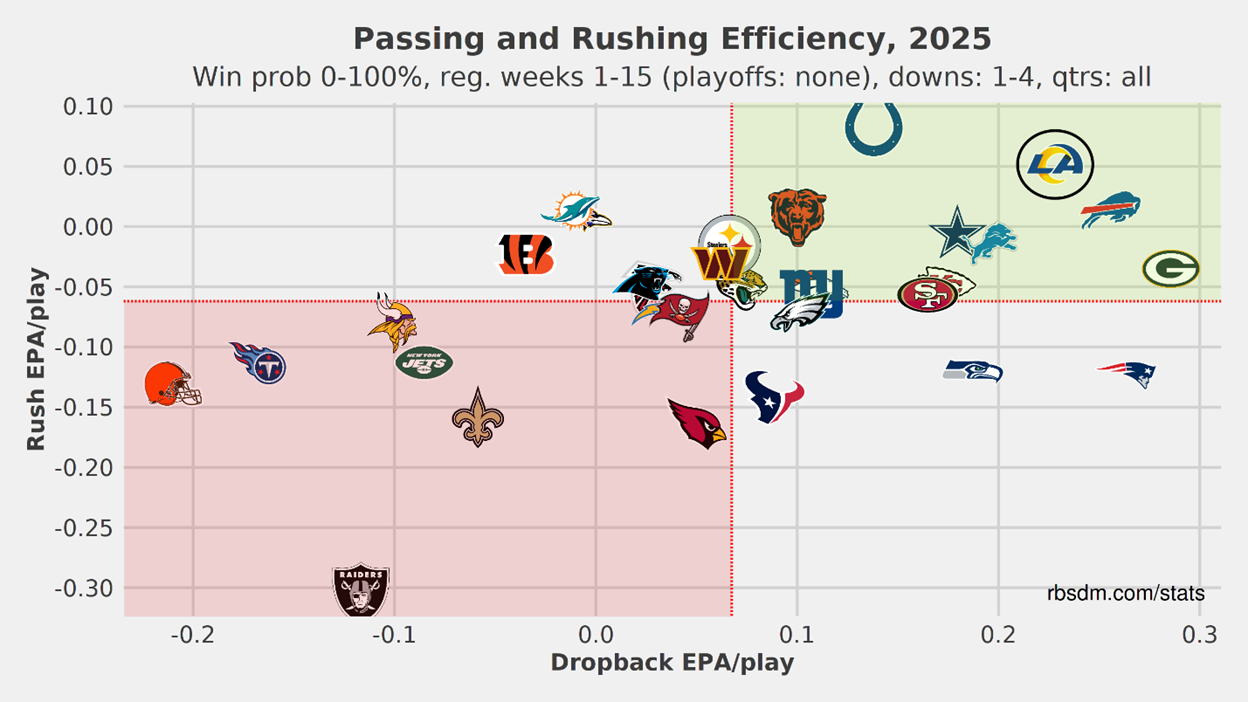
The Rams rank first in offensive EPA per play and offensive success rate.
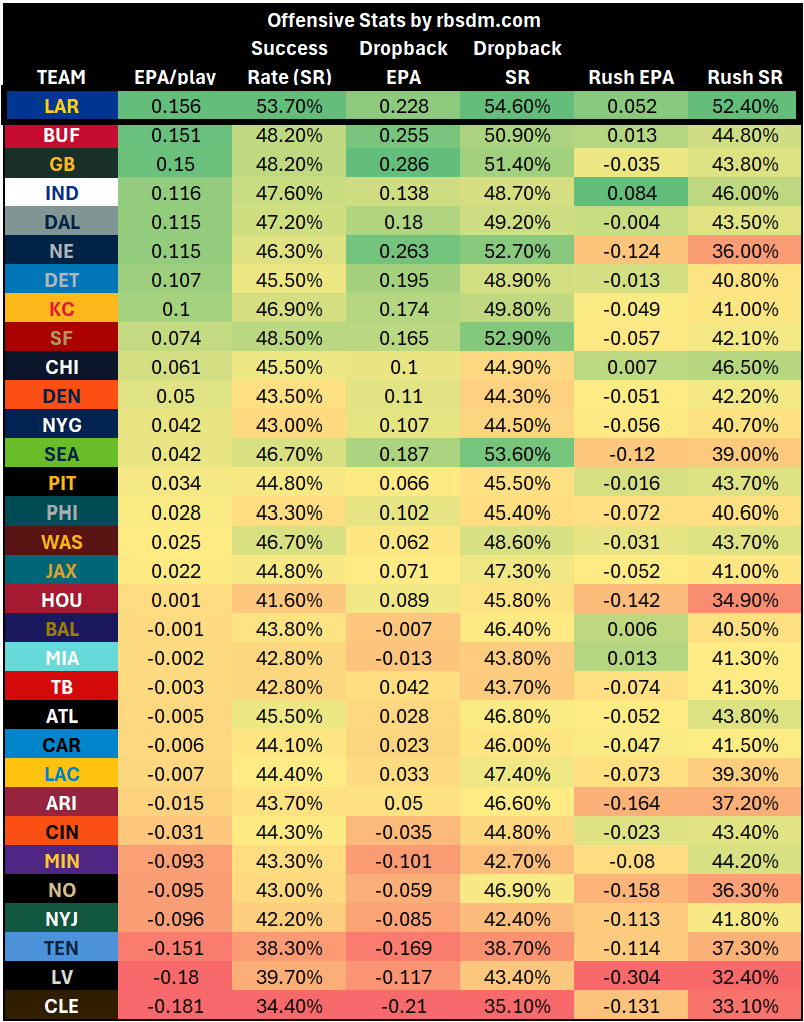
They rank fourth in offensive EPA per dropback and first in offensive success rate on dropbacks.
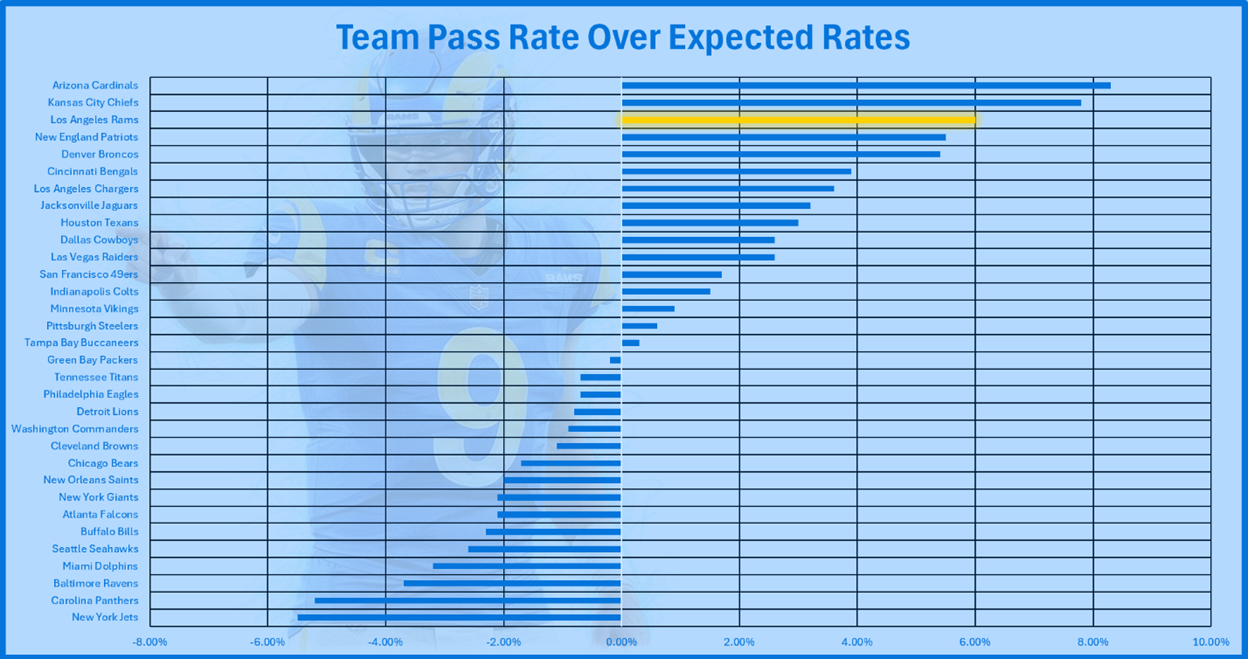
The Rams have a pass rate of 57% (T-14th). Their pass rate over expected (PROE) is +6.0% (3rd), an unusually pass-heavy default for a team coached by HC Sean McVay.
They average 26.9 seconds to snap (14th); this is a considerable departure from the typical slow rate at the line for McVay and most Shanahan-style systems, which have historically run slow.
The reason the Rams or other Shanahan-derived offenses run historically slow is a combination of things: they generally use motion, they have a unique, long-developing pre-snap read and audible arrangement, and they have some of the longest play-calling language in the league.
As for why things are moving faster this season, both Stafford and McVay have hinted that this is an intentional philosophical shift. In a Week 6 presser, Stafford mentioned that pushing the pace will limit the defense’s ability to move around and disguise their coverage. And of course, the more historical reason for pushing the pace, dating back to Marv Levy’s no-huddle base offense with the Bills, is that it limits a defense’s ability to make substitutions.
With the greater volume, Stafford is 10th in dropbacks (493) and fourth in attempts (470). Stafford converts an inordinately high number of dropbacks into attempts because he has a quick release, taking few sacks, and he has zero rushing acumen and won’t scramble. We typically prefer players with a heavier rushing component because it raises the floor and ceiling. Notably, the same effect can be replicated to some extent with offenses that reliably generate a high volume of attempts and TDs.
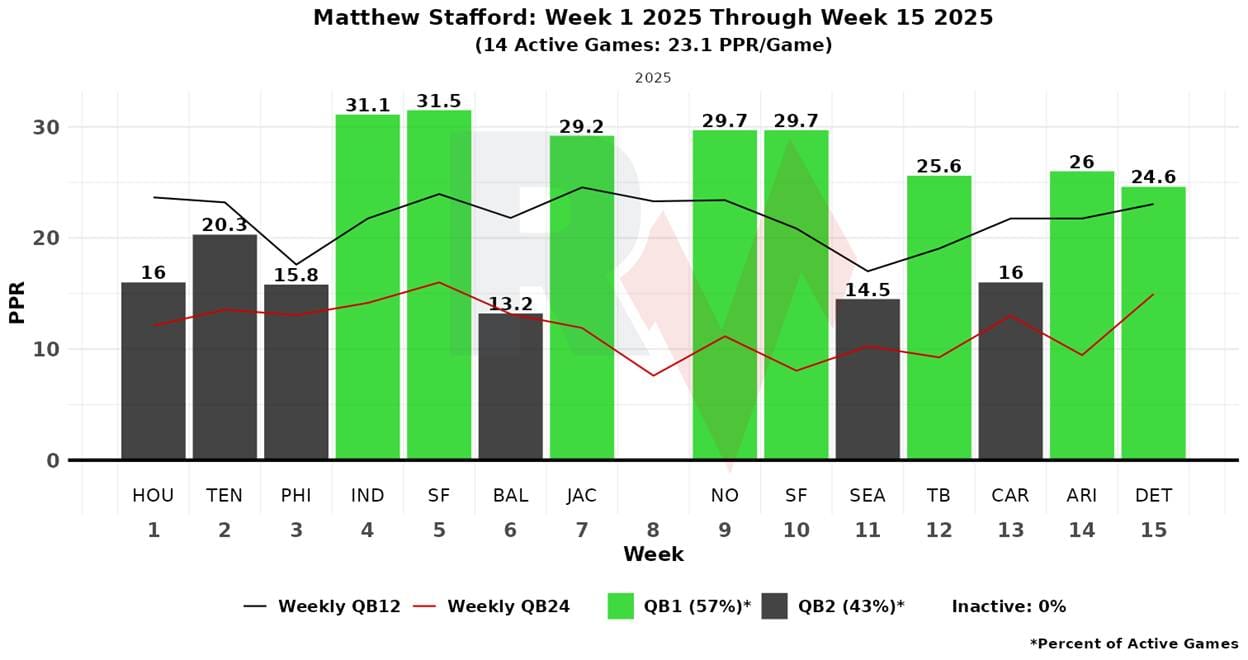
Stafford has finished as a QB1 eight times in 14 games, finishing as a QB2 whenever he hasn’t. He has not scored in single-digit fantasy points even once.
Stafford is well above average both in EPA and CPOE, indicating he is consistent and capable of big gains.
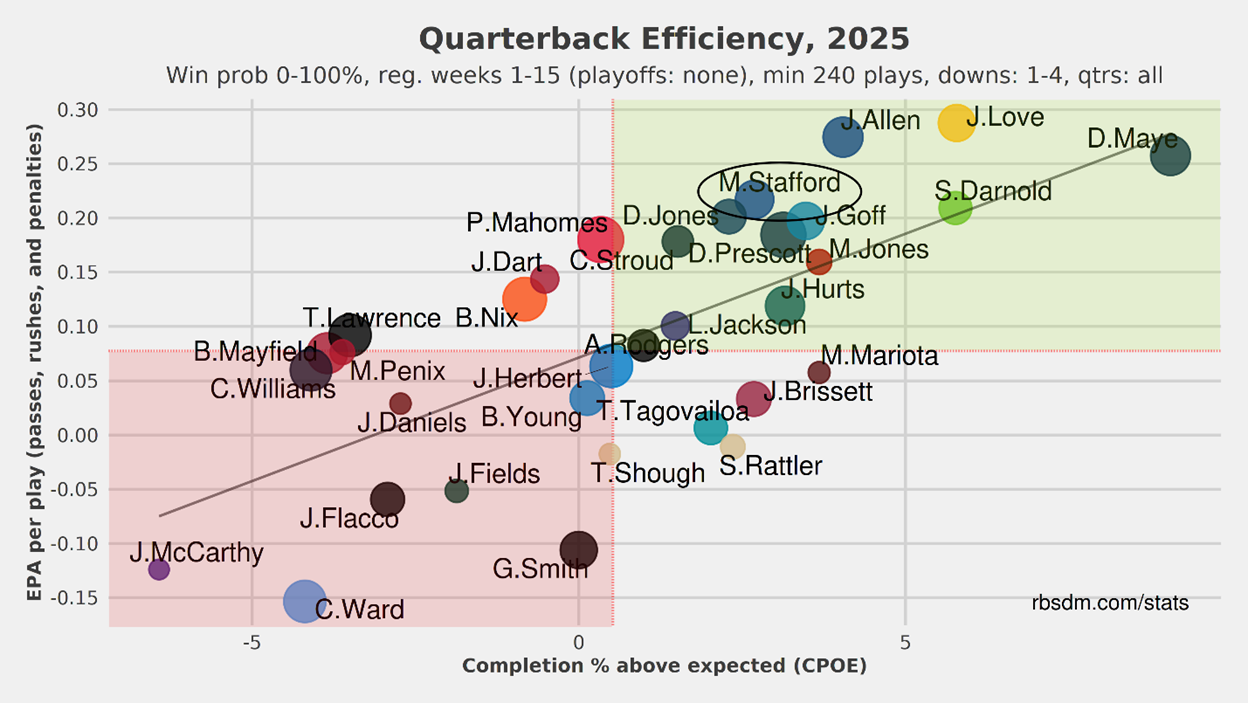
Stafford’s TD rate is at 7.6%, the highest of his career. Last year, his TD rate was at 3.7%. His career TD rate coming into 2025 was at 4.5%. It is easy to fall into these traps, believing that recent changes are the new normal; the reality is that these are the players who usually get hit hard by TD regression.
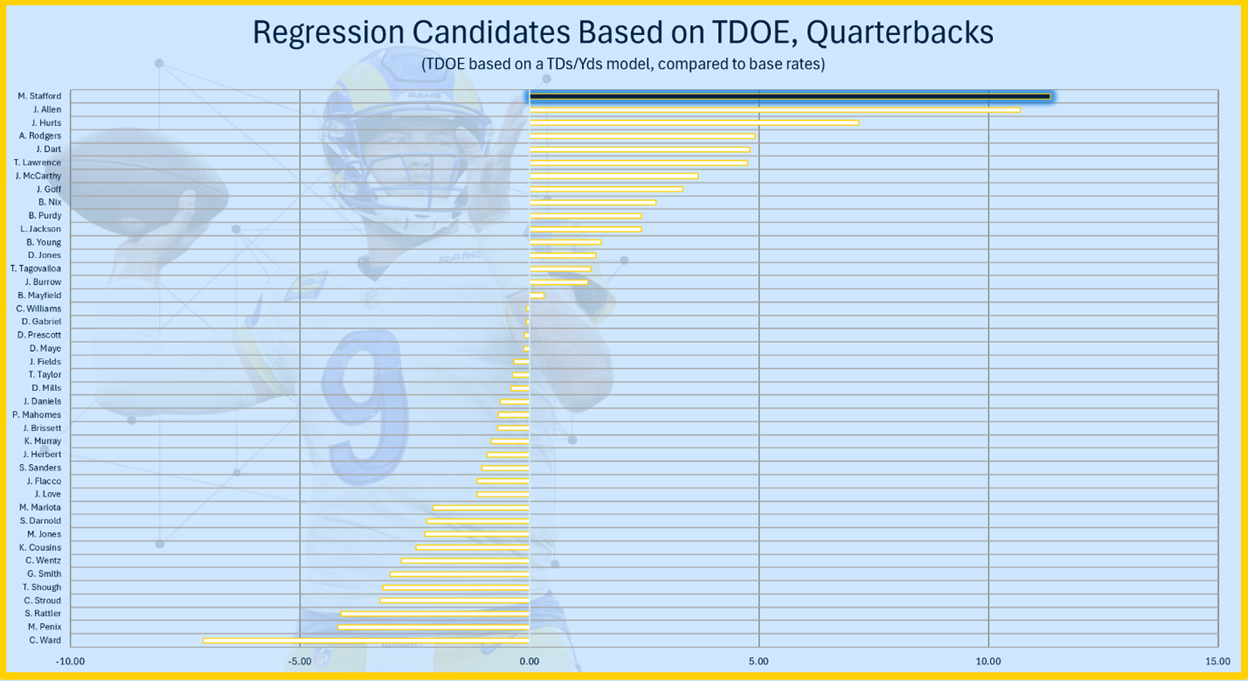
Based on a simple TDs/Yds touchdowns over expected (TDOE) model, Stafford has scored over 11 TDOE. This is the most off-kilter rate of TDOE in the league, and by a long shot if we focus only on pocket passers without a high rushing TD volume (rushing TDOE is more historically stable). The next closest pocket passer in TDOE is Aaron Rodgers, who is nowhere near Stafford’s TDOE pace. Stafford should be viewed as a negative TD regression candidate.
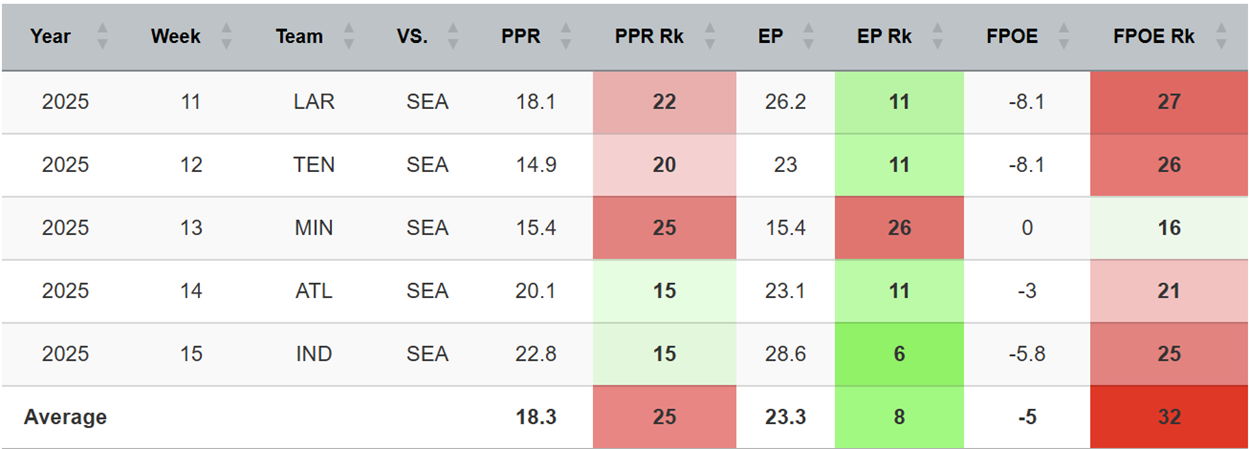
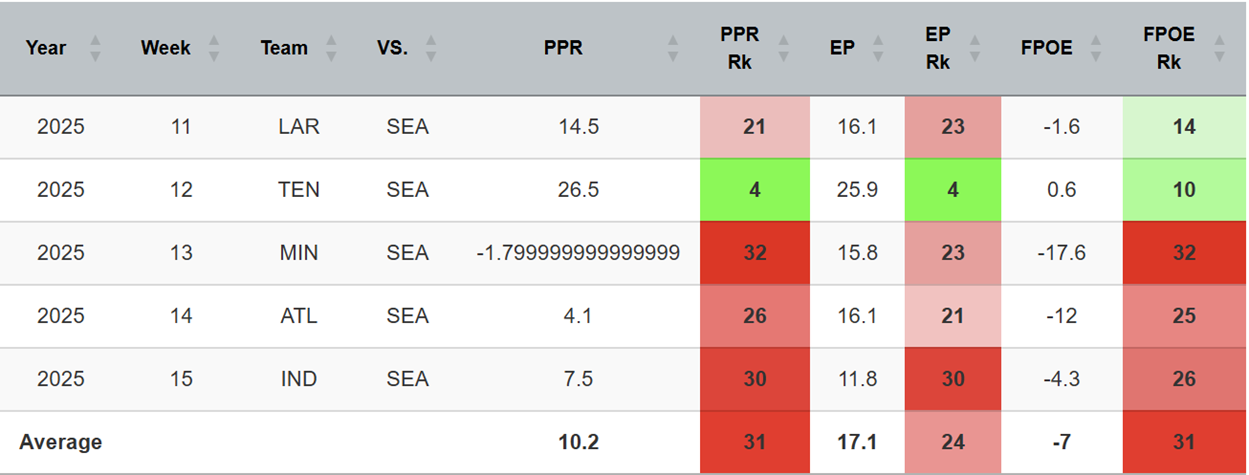
The Seahawks have been excellent in limiting fantasy QBs, holding opposing QBs to 31st in fantasy scoring over their last five games.
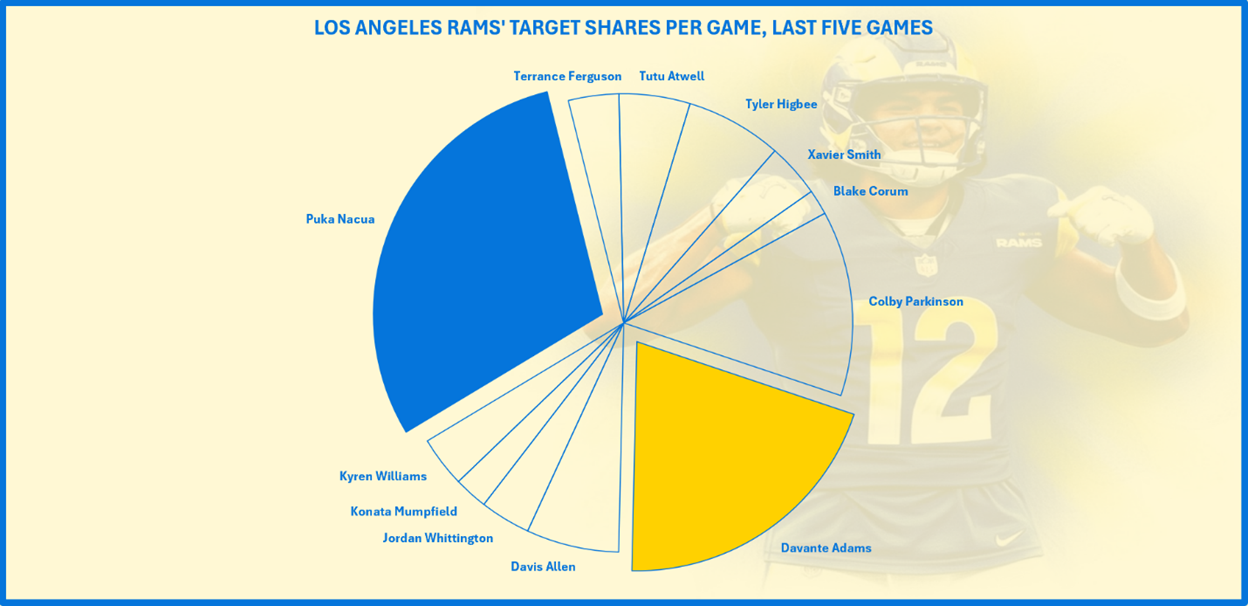
The Rams are pretty hyper-focused in the passing game, with only two pass-catchers earning a target share per game rate of at least 15% in their last five games: WRs Puka Nacua (31.3%) and Adams (21.3%).
The Rams will likely be without Adams on Thursday; Adams hurt his hamstring in the fourth quarter of last week’s game against Detroit and, with the short week, has been listed as doubtful.
Adams is obviously a big part of the Rams’ offense. He is in the top ten in air yards (1,473), Fantasy Points’ expected fantasy points (XP), first downs (51), end zone targets (27), and receiving TDs, where he leads the league (14).
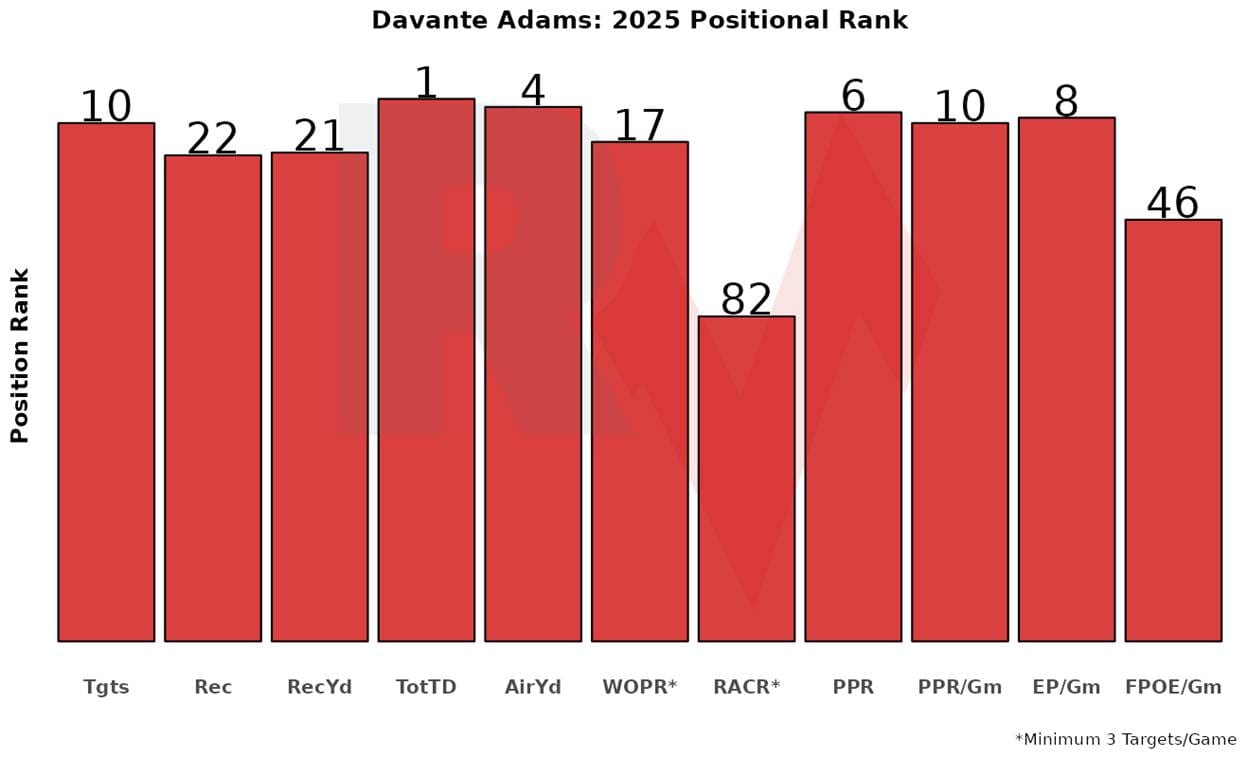
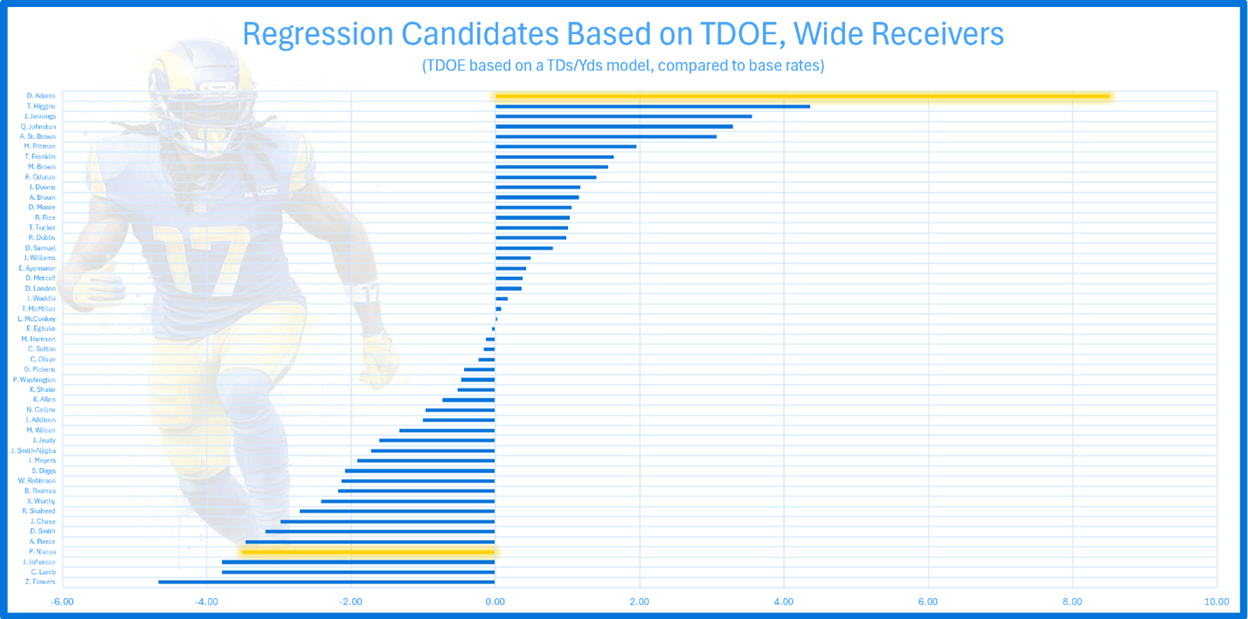
Adams has been in sync with Stafford in the end zone, making both Adams and Stafford the most obvious negative TD regression candidates at their position based on TDOE. Meanwhile, his running-mate, Nacua, is among the WRs with the most out-of-whack negative TDOE and is among the most significant positive TD regression candidates.
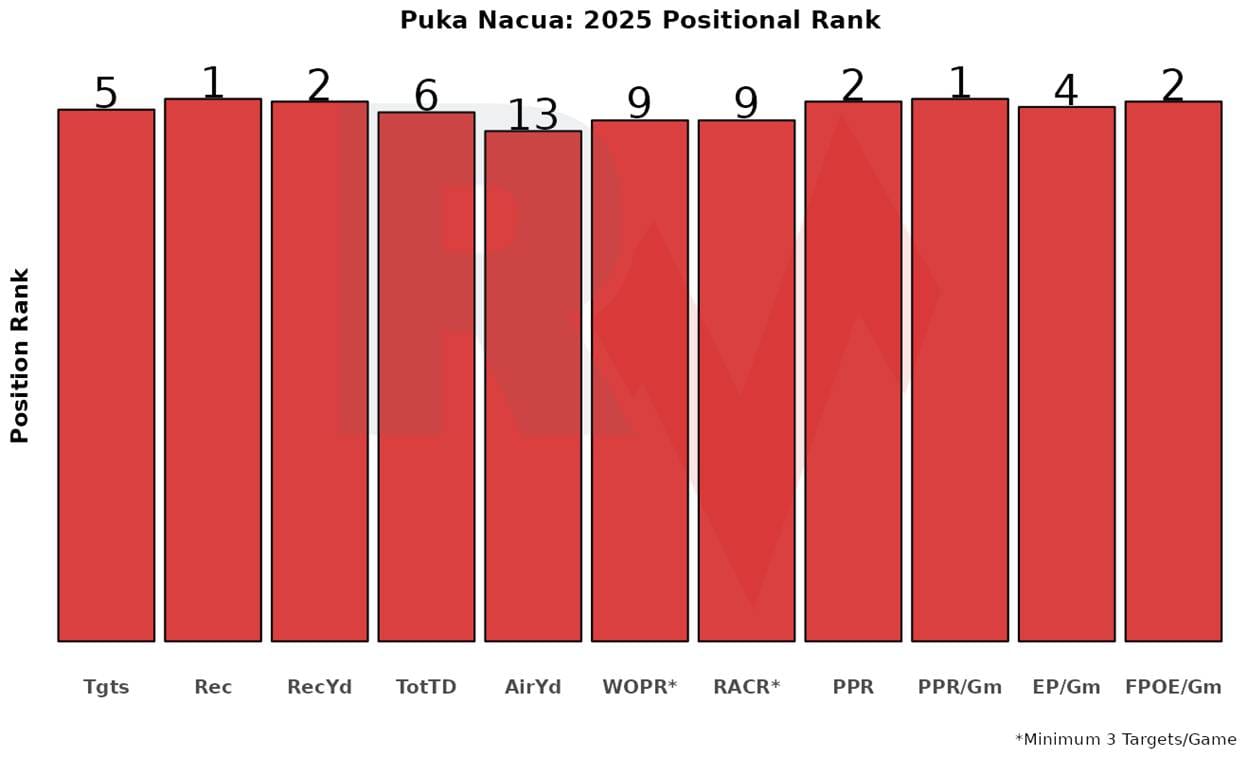
Nacua is already among the best WRs in the NFL. His 29.2% season-long target share is fifth, and he leads all WRs in receptions (102; remarkably, Trey McBride, a TE, leads the league in receptions). He is in the top 5-10 of many significant statistical categories.
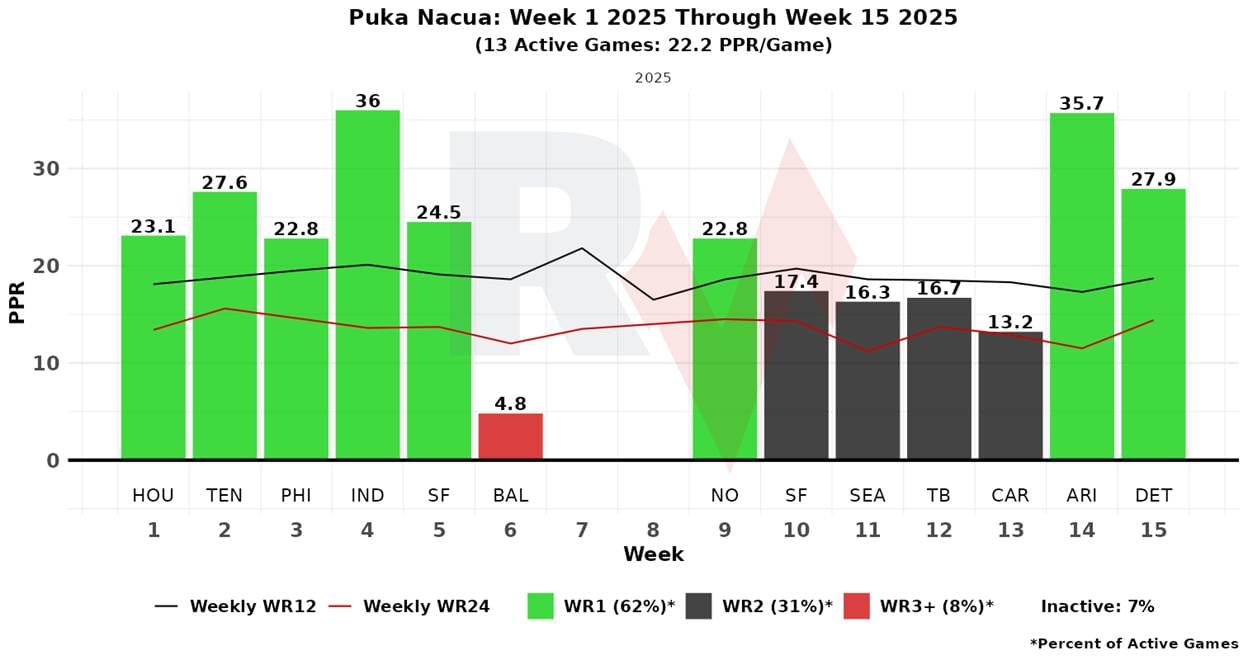
Even without TD production, Nacua has been reliably among the top 12 WRs, something he’s done eight times already, including each of the past two weeks, when he’s been near or above 30 PPR points.
The Seahawks are just as tough against fantasy WRs as they are against fantasy QBs. Opposing WRs have ranked 31st in PPR in their last five games against them.
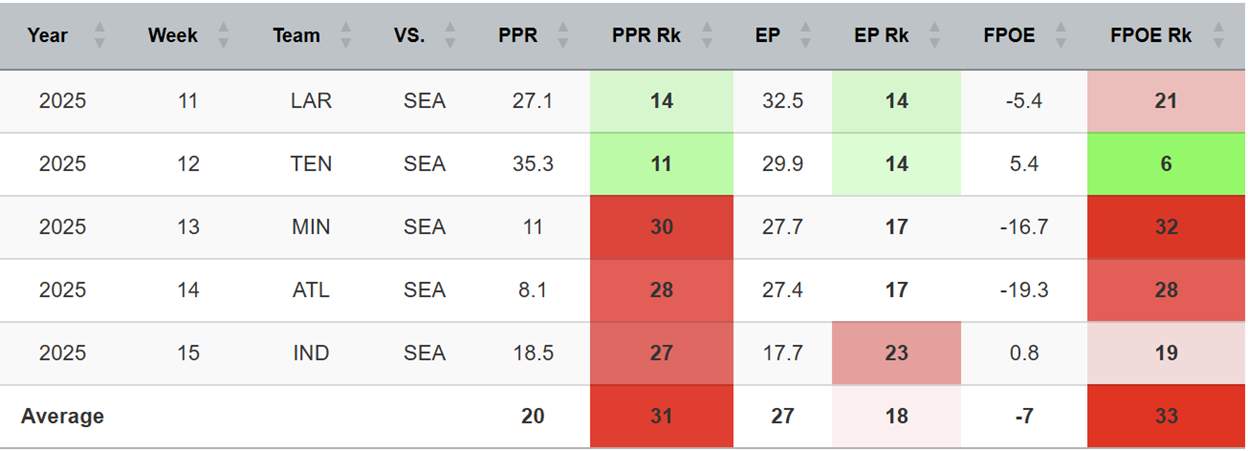
It is unknown precisely what to expect from the Rams if they are without Adams on Thursday Night, which seems likely. We know that McVay has said seventh-round rookie WR Konata Mumfield would be scheduled to take the snaps at the “X” receiver position, a departure from an increase in snaps and routes from WR Jordan Whittington, as we’ve seen when Nacua or Kupp have been out in the last two seasons. This is because Whittington is primarily a slot, while Mumfield mainly lines up outside, as Adams does. We obviously don’t expect Mumfield to replicate Adams’ performance, even if he’s in his position; Adams is probably a Hall of Famer. In fact, the Rams may just play a different way altogether.
The Rams used 13 personnel for every single snap after Adams went down on Sunday, and they used it 46 times throughout the game on Sunday, earning 0.456 EPA per play added on these snaps, so they were wildly effective from it. We may see an increase in usage for TEs Terrance Ferguson, Davis Allen, and, of course, the red-hot Colby Parkinson rather than jamming Mumfield in.
Parkinson has been among the best TEs in fantasy over the last six games. He ranks outside of the top 10 in most meaningful stats during this time, but he is third in yards per route run (YPRR), fifth in yards after catch (YAC), and fourth in first downs, which are each rather meaningful TE stats, and his six TDs in that time lead the league.
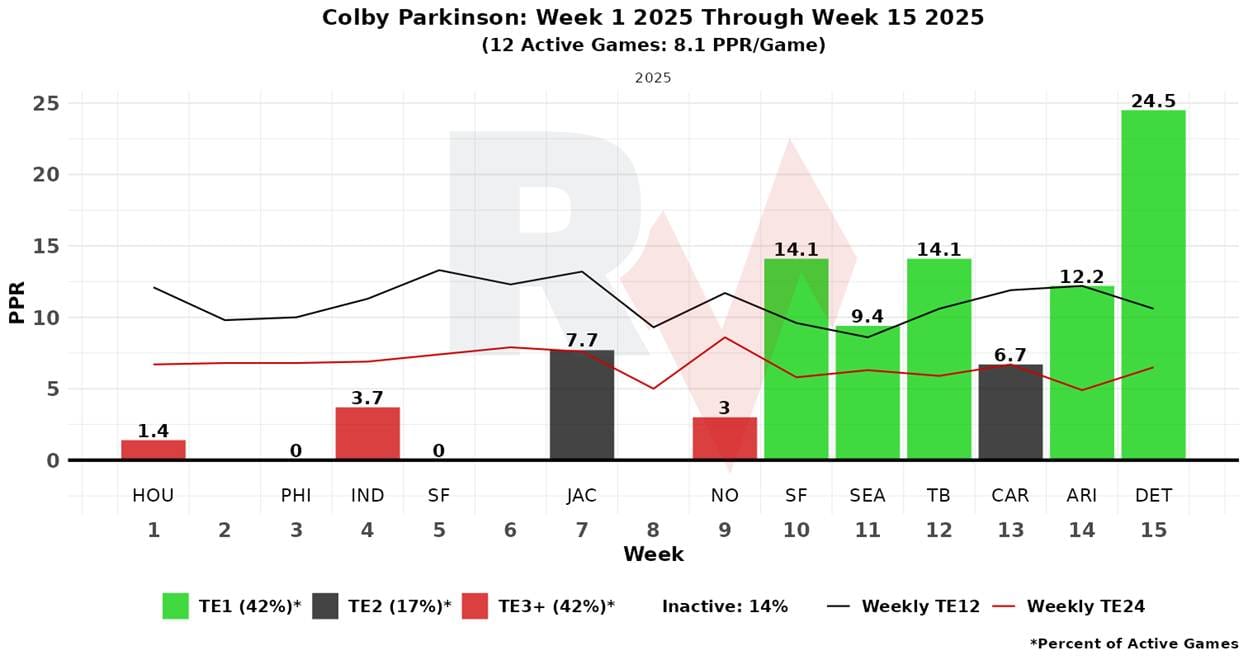
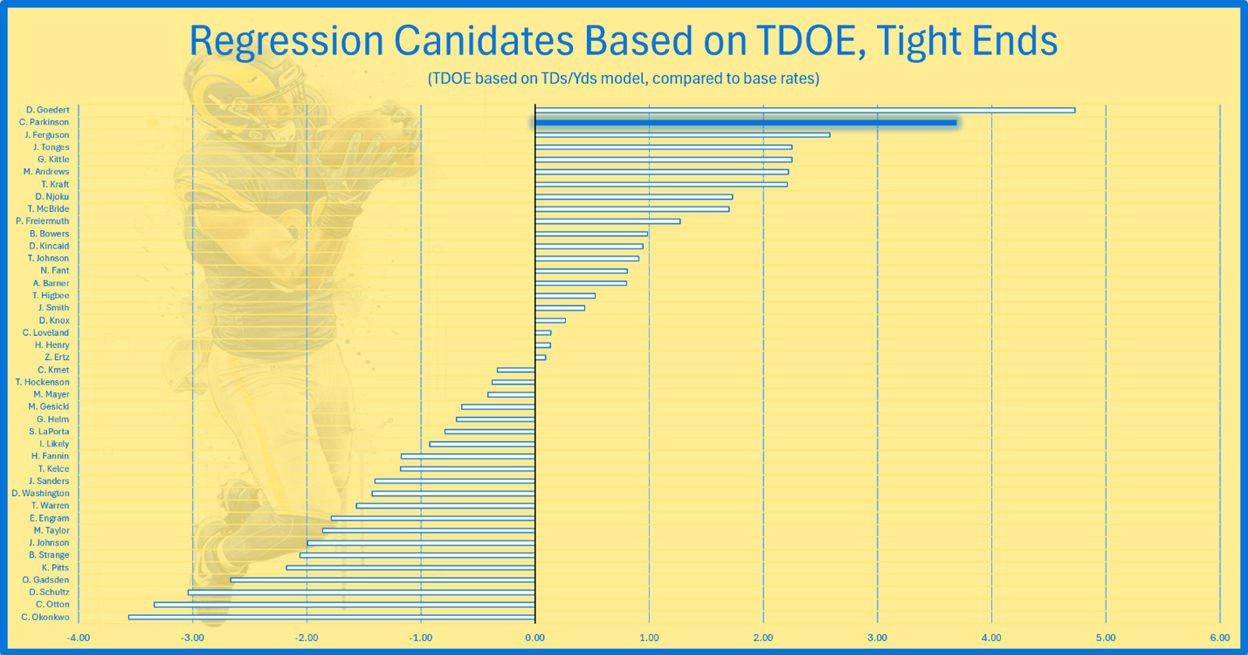
With so much of his production tied to TDs, He is a significant negative TD regression candidate. This may be a tough week to fade him, however, because, if his volume goes up without Adams, it would negate the effect of Parkinson’s TDOE returning closer to league base rates.
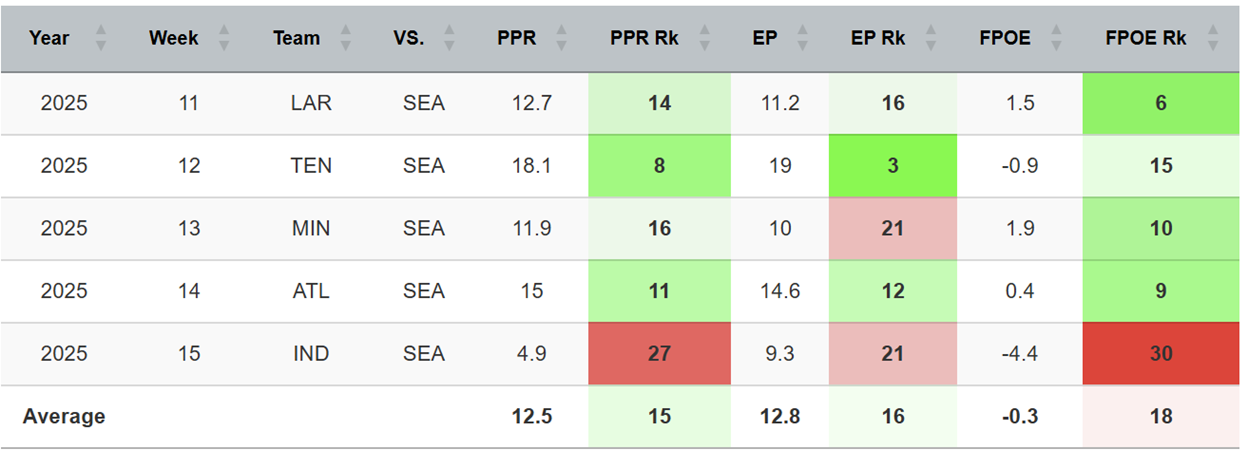
The Seahawks, who are tough all over their defense, are a bit more vulnerable to TEs in their last five, surrendering the 15th-most PPR points to opposing TEs in that time.
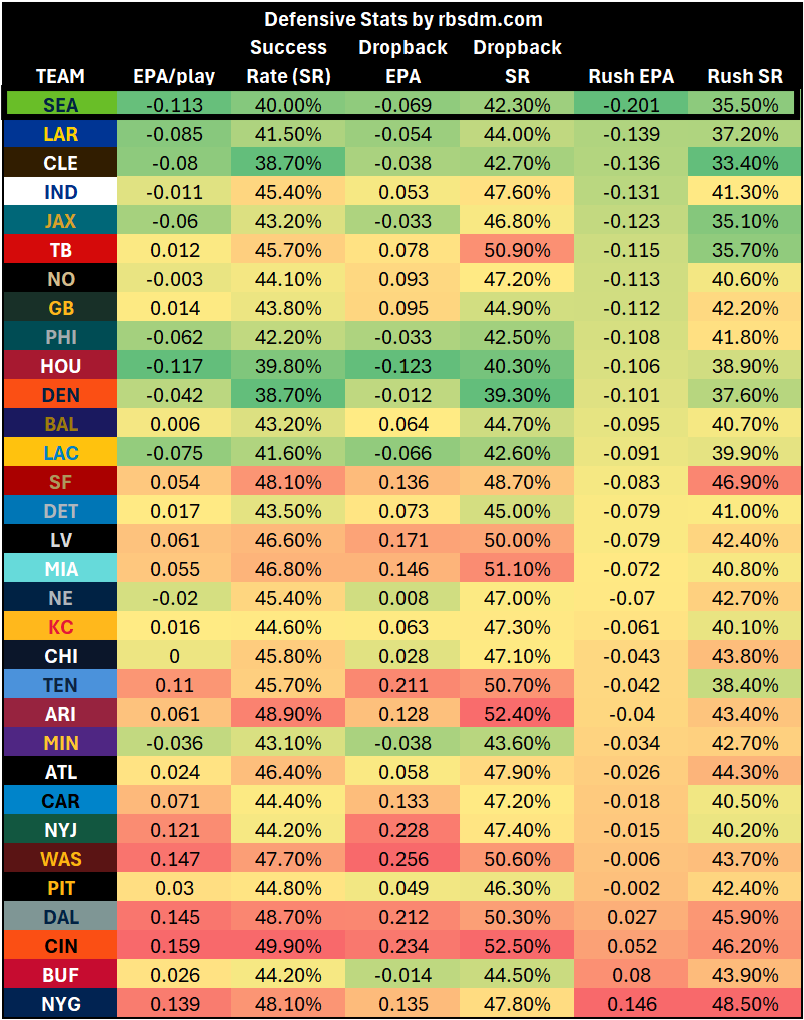
The Seahawks’ defense is well above average in dropback EPA and elite in rush EPA this season.
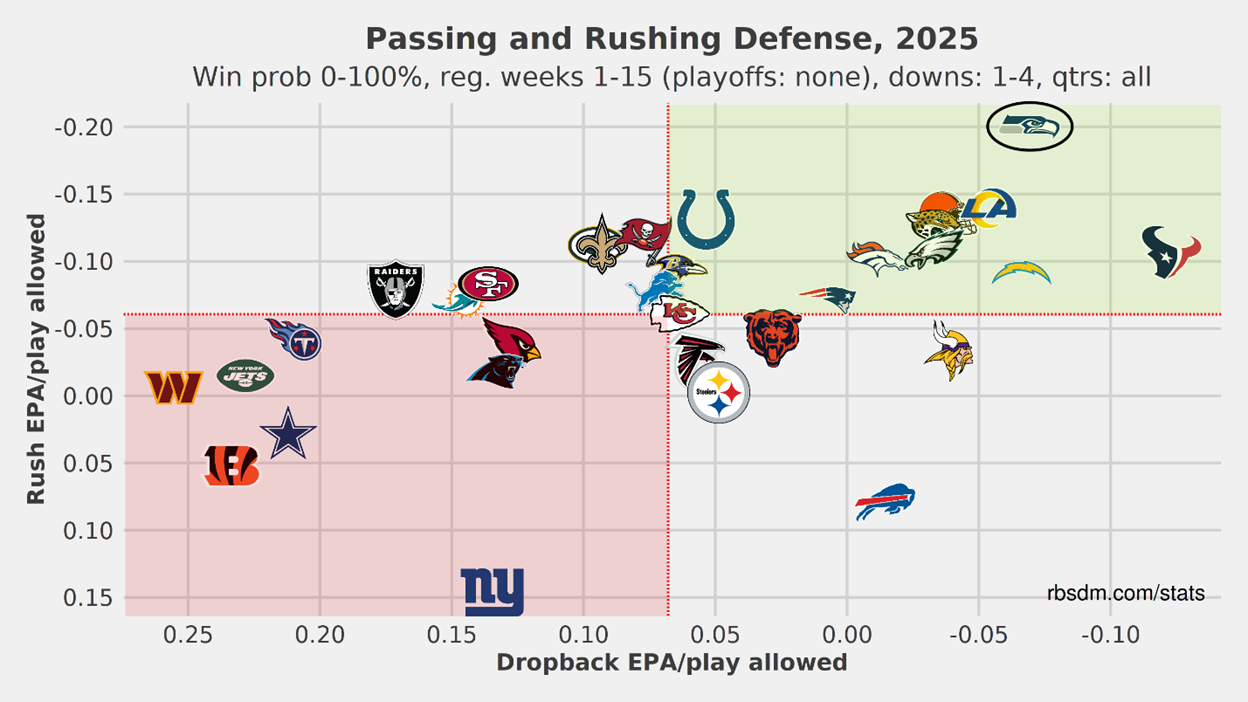
The Seahawks’ defense ranks second in EPA per play allowed and fourth in defensive success rate. They rank second in EPA per dropback allowed and third in defensive success rate on dropbacks.
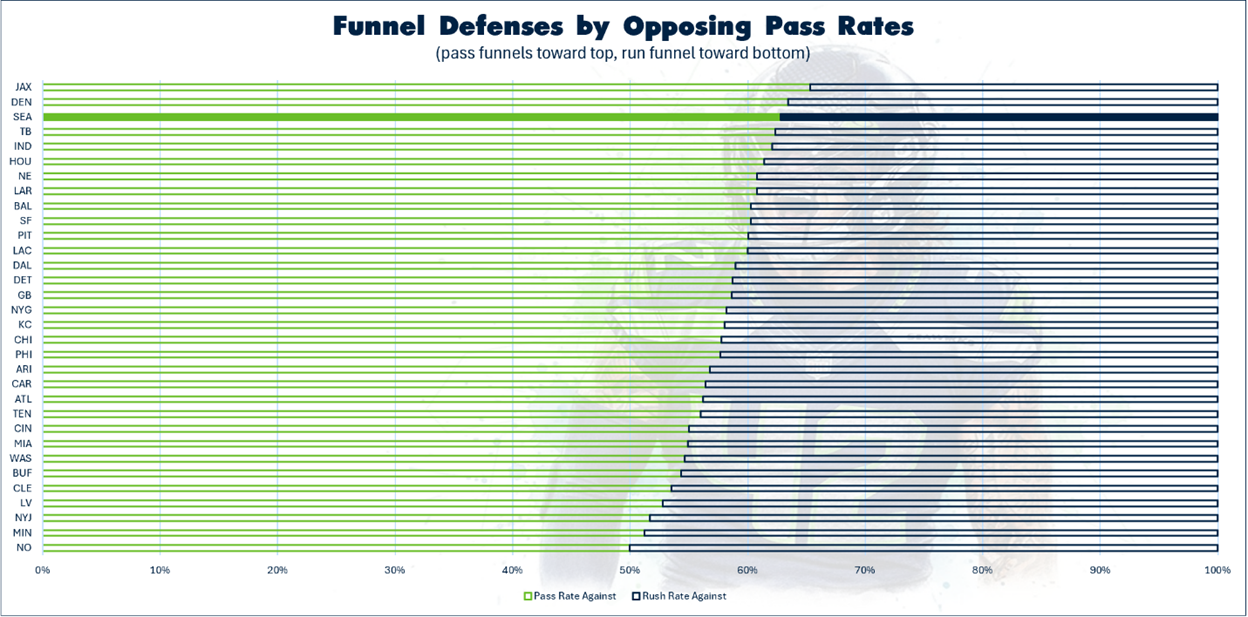
For all their perceived strength, based on the rates teams pass on them, the Seahawks read as a pass funnel. The Seahawks have faced a dropback rate against of 62.8% (3rd).
The Seahawks use zone at a rate of 77.4% (6th). They use two-high safeties at a rate of 55.0% (7th). They are highly multiple, using five defensive alignments more than 13%, but they only use one more than 20%: Cover 3 zone (31.1%). They blitz at a rate of 19.6%, among the league's lower rates.
Fantasy Points’ coverage matchup tool assigns a zero-based matchup grade to each pass-catcher based on their opponent’s use of specific types and rates of coverage and how that pass-catcher performs against them. Positive numbers indicate a favorable matchup and negative numbers indicate an unfavorable one.
Based on this model, not one single LA Rams’ pass-catcher’s matchup grades out as good; Nacua’s is -5.5%, Parkinson’s is -0.8%, and Mumfield’s is -30.5%.
PFF’s matchup tool is player-based, pitting the PFF ratings of individual players against each other for an expected number of plays based on historical tendencies and rating on a scale from great to poor.
Based on this model, Nacua’s and Parkinson’s matchups grade out as good, while Mumfield’s grades out as poor.
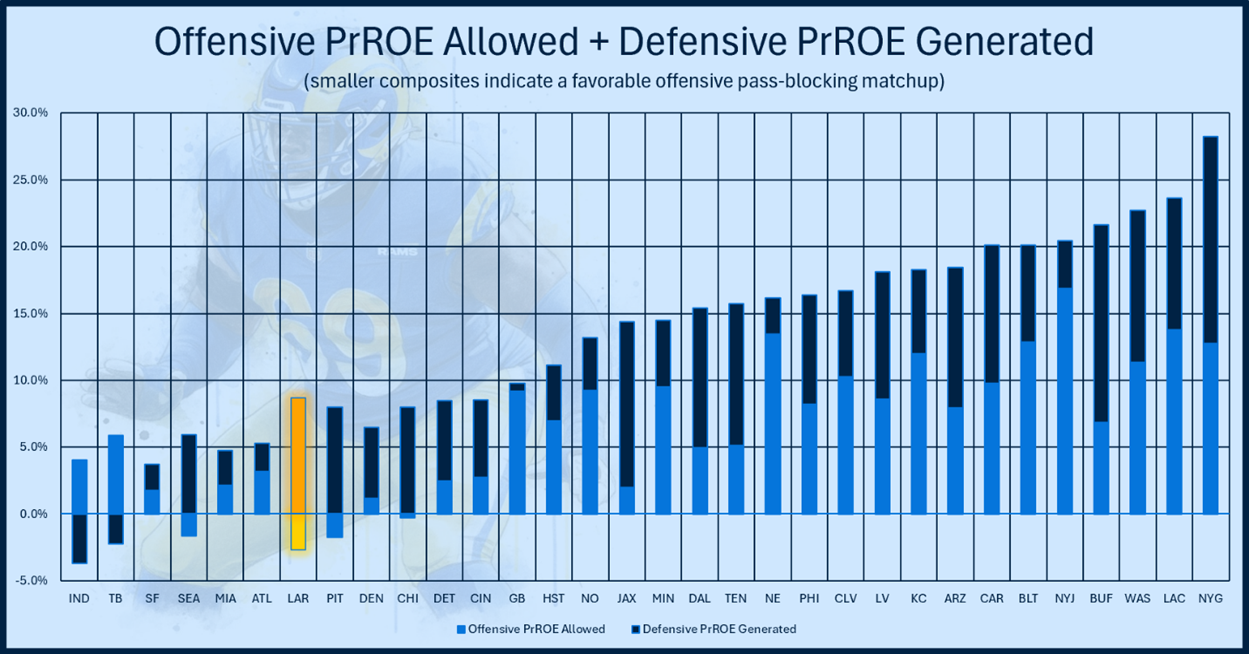
The Rams have the best pass rate over expected allowed (PrROE) among all offenses in football (-2.71%). The Seahawks generate a PrROE of 8.66% defensively (11th). The battle is strength-on-strength, but the composite favors the Rams, who are expected to enjoy an advantage in pass blocking on offense.
The Rams also generate 2.71 adjusted yards before contact per attempt (adj. YBC/Att, 3rd). The stout Seahawks’ front only allows 1.62 adj. YBC/Att defensively, though, so the matchup is somewhat neutral in run blocking while LA is on offense.
The Rams rank second in offensive EPA per rush and first in offensive success rate on rushes.
In the past five games, Kyren Williams has earned a 60% snap share, 5% target share, and 51% of the team’s rush attempts. Corum factors in, but the size of the split is akin to other backfields in the league.

Williams has been an RB1 seven times. Most weeks, he’s viable as a flex. He’s only had single-digits twice, and on one of those occasions, he was just outside of the top 24. Williams is a consistent RB2 with legitimate upside in his spike weeks.
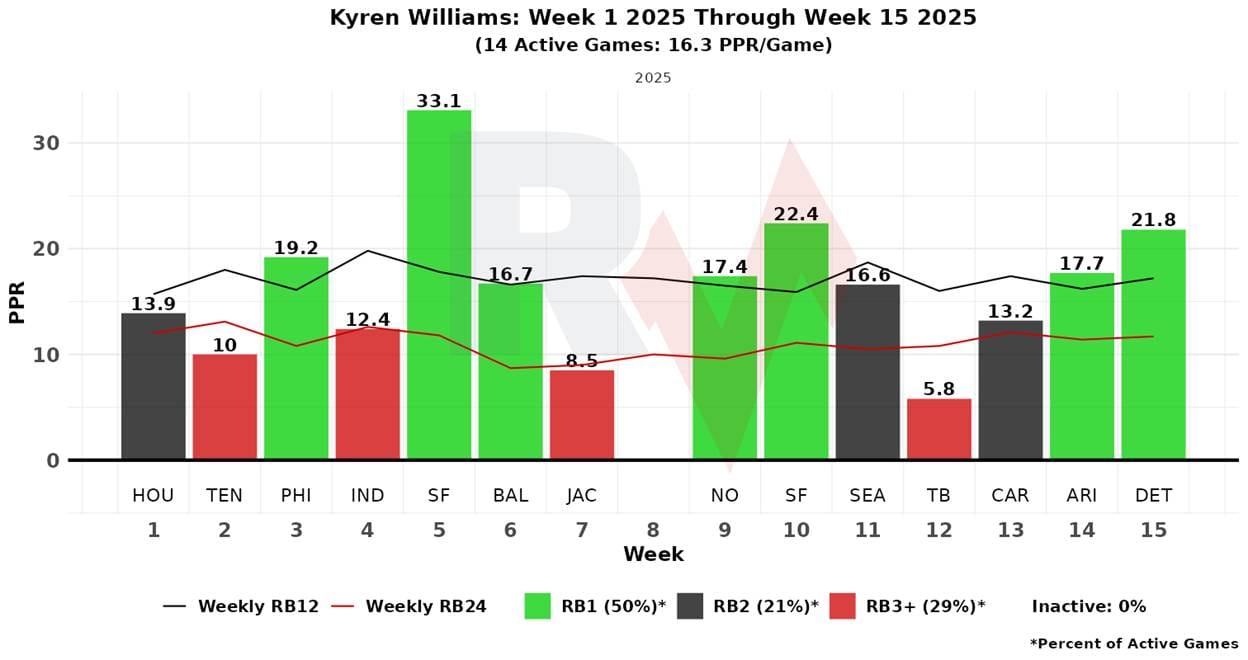
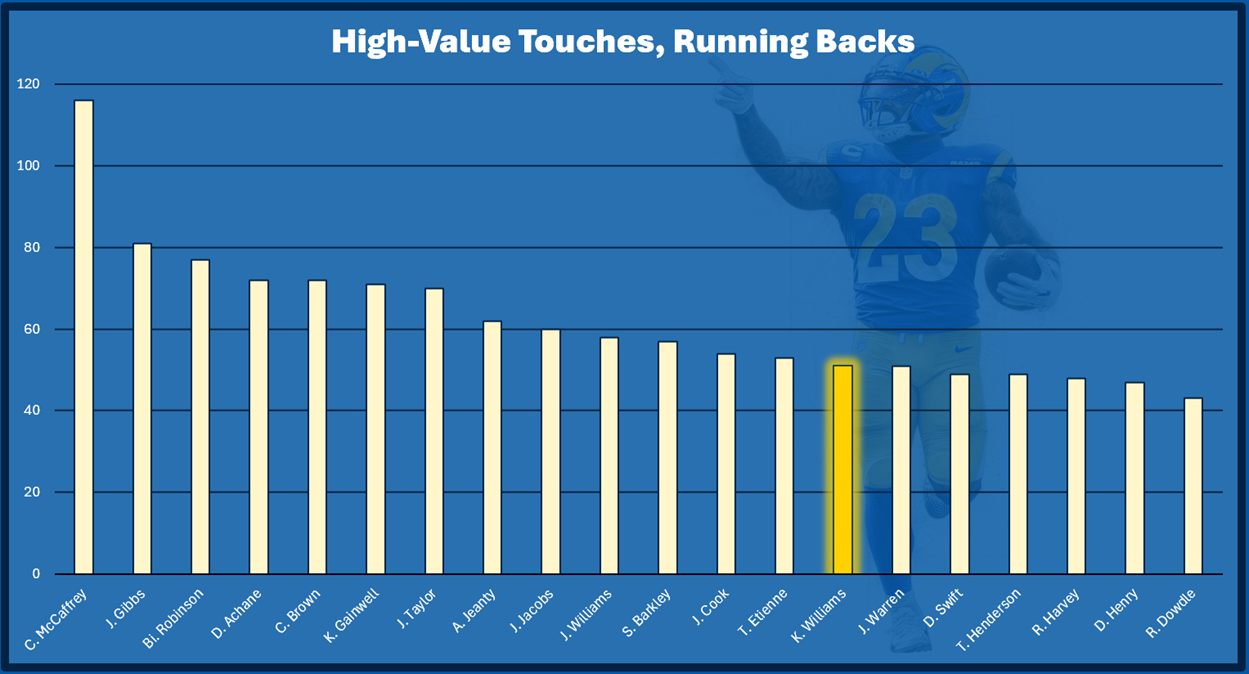
Williams’ fatal flaw (a bit dramatic for a very usable fantasy player) is not Corum’s cut; it’s his lack of involvement in the passing game—something that has been true for him throughout his tenure on the Rams. Even without that, Williams ranks 14th in high-value touches (HVTs), which is propped up entirely by his usage in the green zone. Simply put, Williams lacks the upside of an RB with no passing game role, but for an RB without a passing game role, Williams is about as good as it gets.
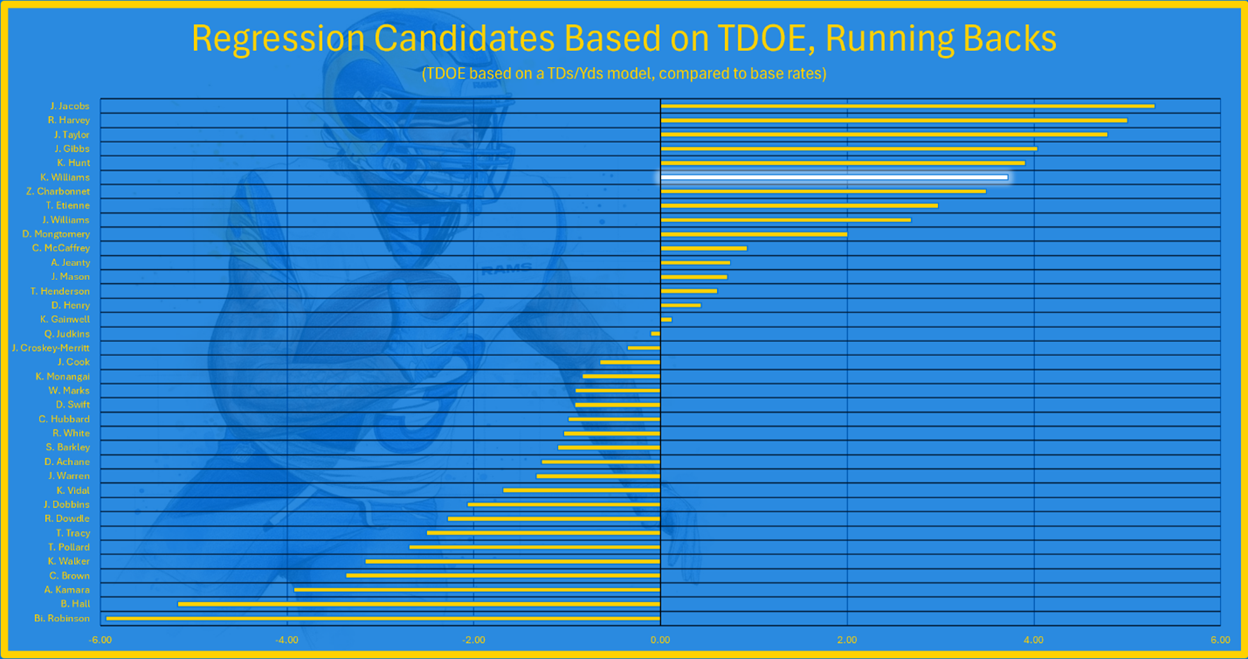
Williams also has a high TDOE and could be considered a TD regression candidate relative to league averages. Then again, his 4.7% TD rate is right in line with his career 4.6% TD rate, so the most likely scenario is that he simply continues to score TDs at this same rate.
Corum has been quite fantasy viable the last three weeks, even posting a pretty significant spike week against Arizona. We should be very clear what we’re talking about here, though.
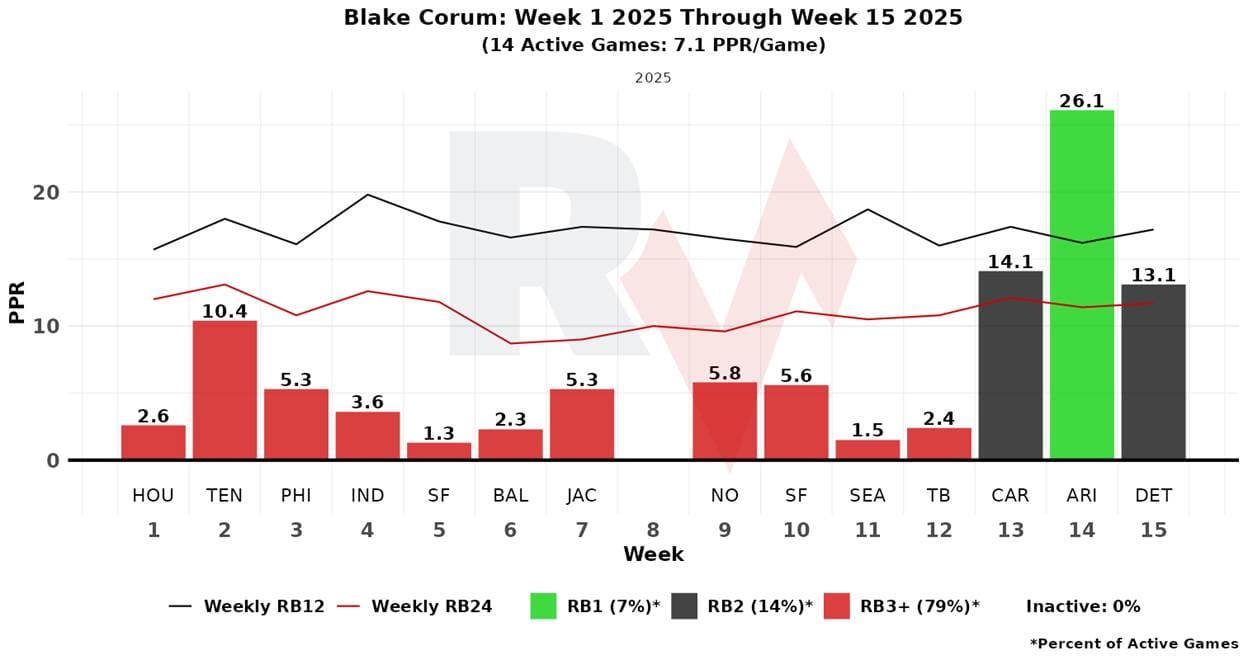
Corum has scored four TDs in three weeks—one in Week 13, two in Week 14, and one in Week 13. His YPC is well ahead of Williams’, but he’s had some big gains: 24-yard, 48-yard, and 34-yard carries. His opportunities in those three games have been seven, 13, and 11—in line with his opportunities throughout the season. He’s had two carries from within the five, as has Williams; Williams has had twice as many carries from inside the ten. Corum has only one target during that span; Williams has three.
Corum is not scoring because his role has suddenly changed; if he’s such a big-play machine, why didn’t he really do it before Week 13 while in the same role? My guess is that it’s a bit of luck, and he’ll cool down a little bit.
The Seahawks rank first in EPA per rush allowed and third in defensive success rate on rushes.
They are tough against RBs, surrendering the 25th-most fantasy points to RBs in their last five games.