
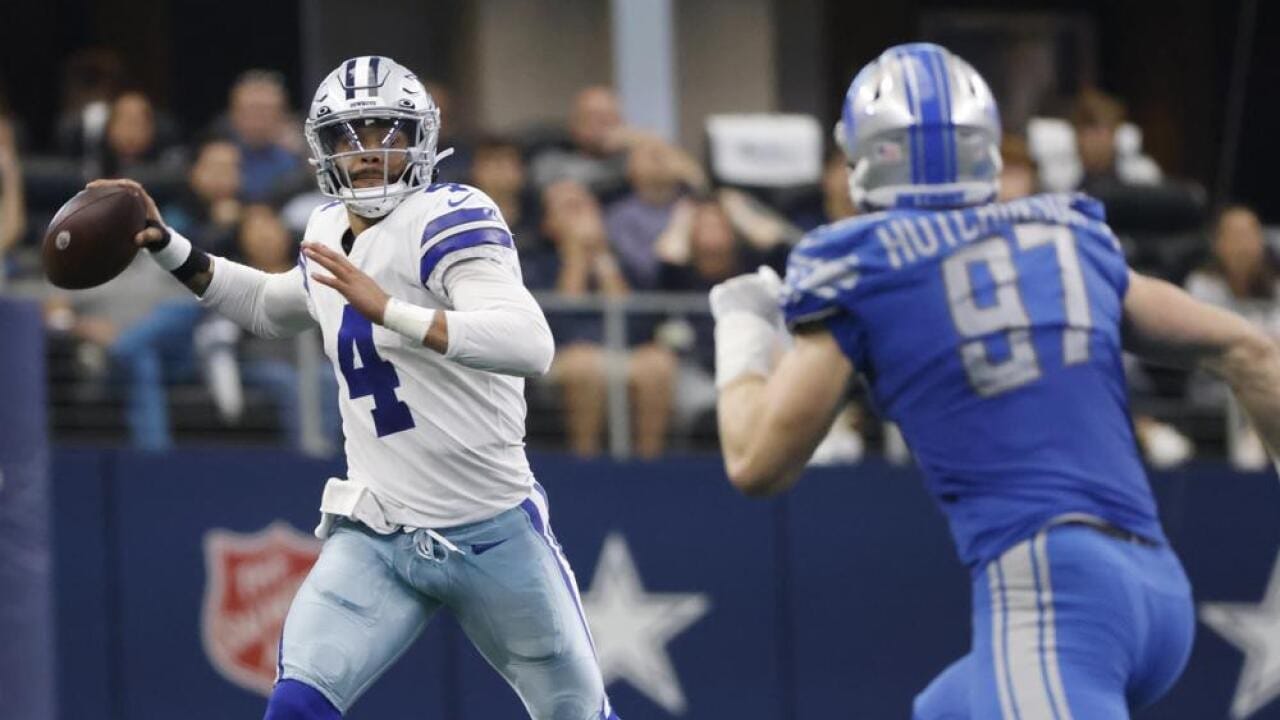
Quick Slant: TNF - Dare to Believe

Mat Irby’s Quick Slant
The Silverdome was alive. The stands were in constant motion, an anthill underfoot; the noise rose like a giant kettle at full boil, whistling and shaking the walls. Faces showed pure joy—dancing, singing, waving towels—convinced this was the day—January 5, 1992—when the curse would finally break.
The Lions hadn’t won a playoff game since 1957, when backup QB Tobin Rote led a Folesian run while subbing for Bobby Layne and won the championship. Thirty-four years later, the thrill of that win had long vanished, replaced by unceasing frustration. But a 12-4 season offered a cure.
The Lions were young, led by 23-year-old wunderkind Barry Sanders, who some consider the most talented RB ever to lace up cleats. The roster was stocked with youth: LB Chris Spielman, LT Lomas Brown, WRs Brett Perriman and Herman Moore, and S Bennie Blades. They were riding a wave of emotion, dedicating each game to RG Mike Utley, who had been paralyzed in Week 11. Something felt different, and Lions fans dared to believe they were on the edge of a dynasty.
The Cowboys’ drought had been shorter, but they, too, had drifted to the bottom. Their reward for late-80s futility was QB Troy Aikman, a first-overall pick destined for greatness. But HC Jimmy Johnson was a different kind of cat—a psychology major who bucked convention at every turn. He had broken RB Herschel Walker into 18 pieces, forming the nucleus of a whole-cloth team. He cut John Roper on the spot for sleeping in a meeting, Curvin Richards for fumbling in a game. His methods were sharp, unconventional, and unapologetic.
Looking back, it’s little surprise Johnson stuck with Steve Beuerlein, whose five-game streak had carried the Cowboys here, even with Aikman—injured in Week 13—cleared and eager to reclaim the job.
The Lions controlled the game from start to finish. Sanders’ 41-yard off-tackle score to seal it—a microcosm of his unreal balance, agility, and burst—was the dawn of a new era, only not Detroit’s. It served a different truth: some are unmade by success, while others grow through failure.
For Dallas, the loss was a crucible. By applying themselves to the fire, the Cowboys went in a blunt, shapeless ingot—got banged around a little—and came out a sword. Their run of three Super Bowls in four seasons would begin the following September.
For Detroit, it was a false positive. The victory was the crescendo of an emotional opera, powered by adrenaline, time, and tragedy. An unsustainable high propelled them, brimming with bravado and vainglory, directly into the jaws of the elite. A week later, Washington crushed them 41-10, pulling that elation under the tires. The press had run with the Cinderella narrative, forgetting the midnight clause. In the end, the Detroit Lions of the ’90s were never meant to be a dynasty. And on they went, into another 32-year abyss, devoid of new playoff victories.
Meanwhile, set to return to school after winter break in Glen Rose, Texas—deep in Cowboys country—15-year-old Dan Campbell was watching, agonizing. Campbell had grown up on Tony Dorsett, Ed Jones, Randy and Danny White, and Everson Walls. It stung, but it was his ethic to shake off disappointment.
And besides, he was a busy boy. His Glen Rose Tigers had taken a narrow 3A Bi-District playoff loss to Forney around Thanksgiving (where he was on varsity as a sophomore and already a star), and he’d moved on to basketball. Soon, track would start. He excelled in all three.
Campbell’s charisma and bigness made him a local hero; no one in Glen Rose knew what he would eventually be, but they were already smitten by the charm that would later come for us all.
Campbell was undeniably Texas. He eventually played for Texas A&M, part of the '98 team that displaced No. 1 Kansas State in a 1998 Big 12 Championship classic. He had a stint with the hometown Cowboys from 2003 to 2005. As soon as a mic was placed before him, he was famous for his accent and colloquialisms, his backwoods wisdom—talk of biting kneecaps and no-turds policies. He had a deep appreciation for hard work, born from his part-time job as a ranch hand with his father.
Hired in Detroit in 2021, Campbell stood out like a flare in the dark. It was impossible not to wonder if he was another Lions mis-hire—another big-talking, low-substance meathead like Matt Patricia, Rod Marinelli, or former GM Matt Millen. His opening presser was alarming; his attempts at humor missed, and he was mistaken for a barbarian with a clipboard.
But a surprising thing happened. Campbell revealed himself to be smart, forward-thinking, and a master of relationships. He didn’t reject Smashmouth; he married it to psychology and analytics. And in a few short years, he broke the 32-year curse that had existed since that fateful January day in 1992, taking the Lions from laughingstock to the NFL’s upper crust.
Cowboys
Implied Team Total: 25.75
Cowboys vs. Lions features the highest over/under of the week. The Lions are favored by three at home, so they are generally considered equals, but the Lions benefit from the home-field advantage.
The Lions are on pace for 10.5 wins based on Pythagorean expected wins, while the Cowboys are on pace for 8.7. Each team is chasing its division—the Cowboys are hunting down the Eagles, while the Lions are trying to catch the Bears and Packers.
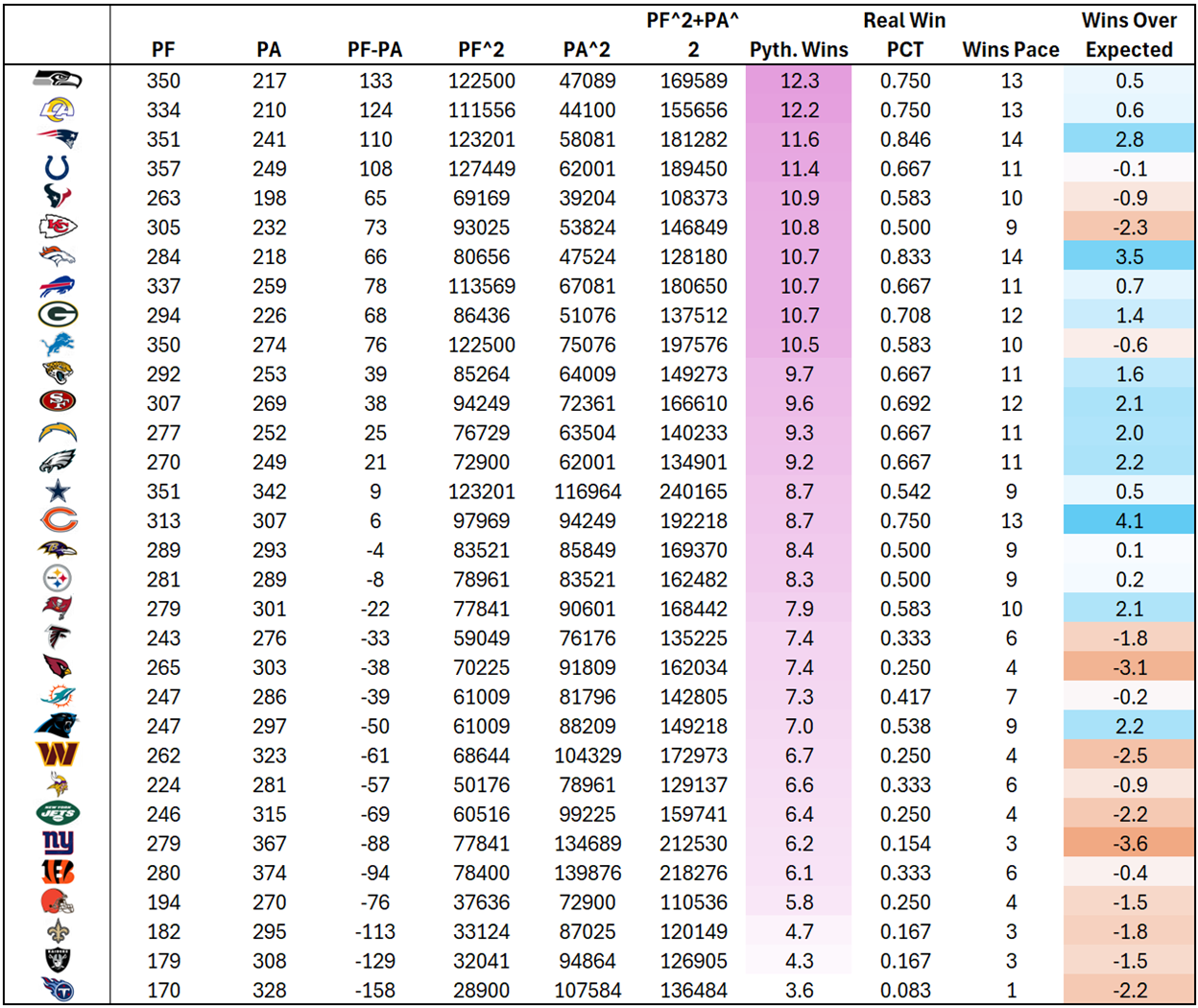
The Cowboys are a dream come true for fantasy football, featuring the holy combination of a potent offense and a feeble defense.
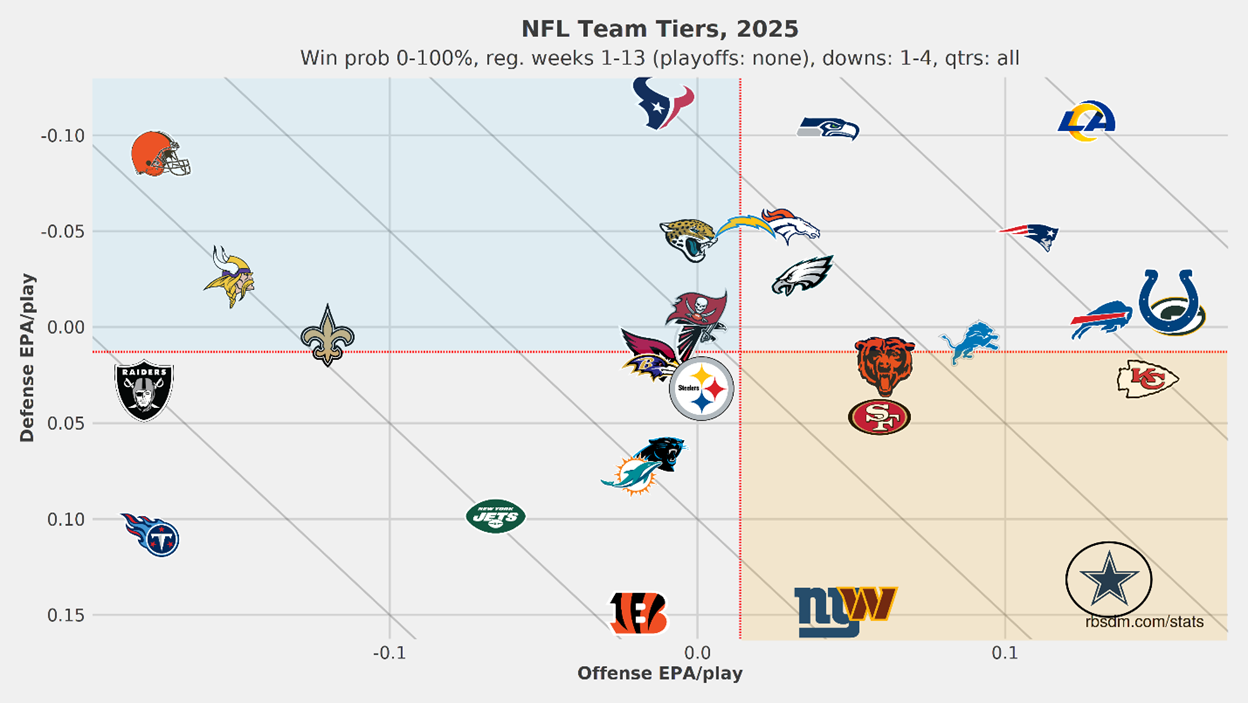
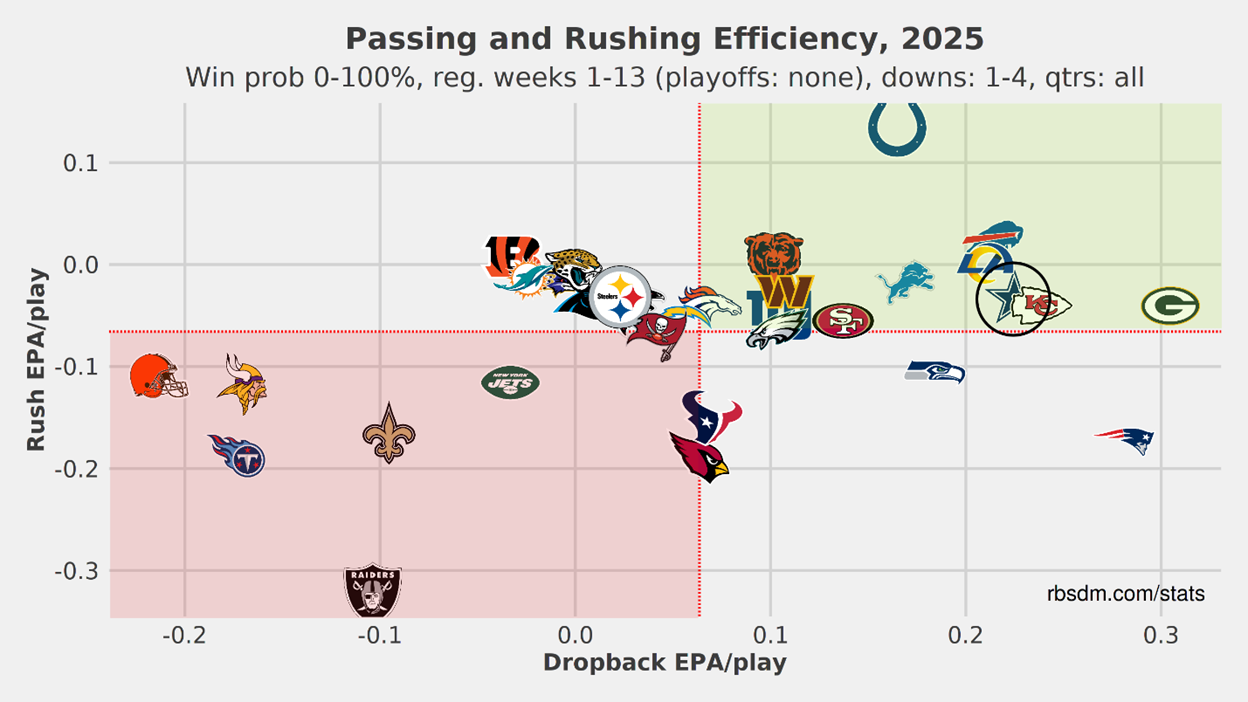
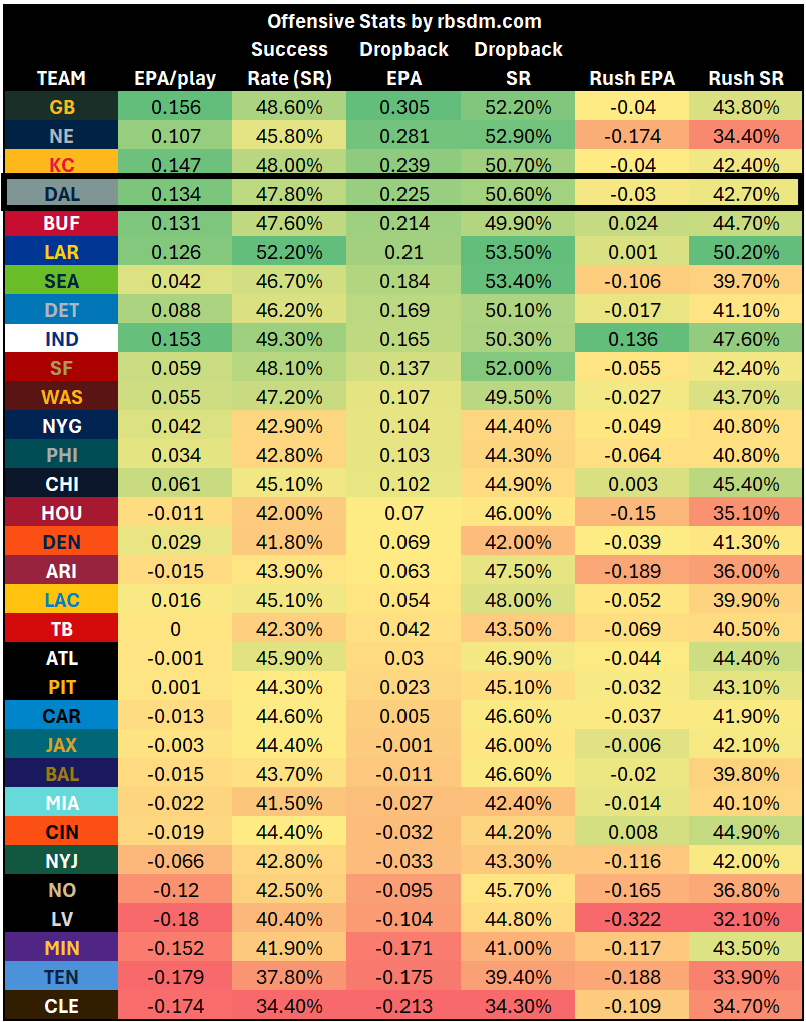
Offensively, they are well above average in dropback EPA and slightly above average in rush EPA.
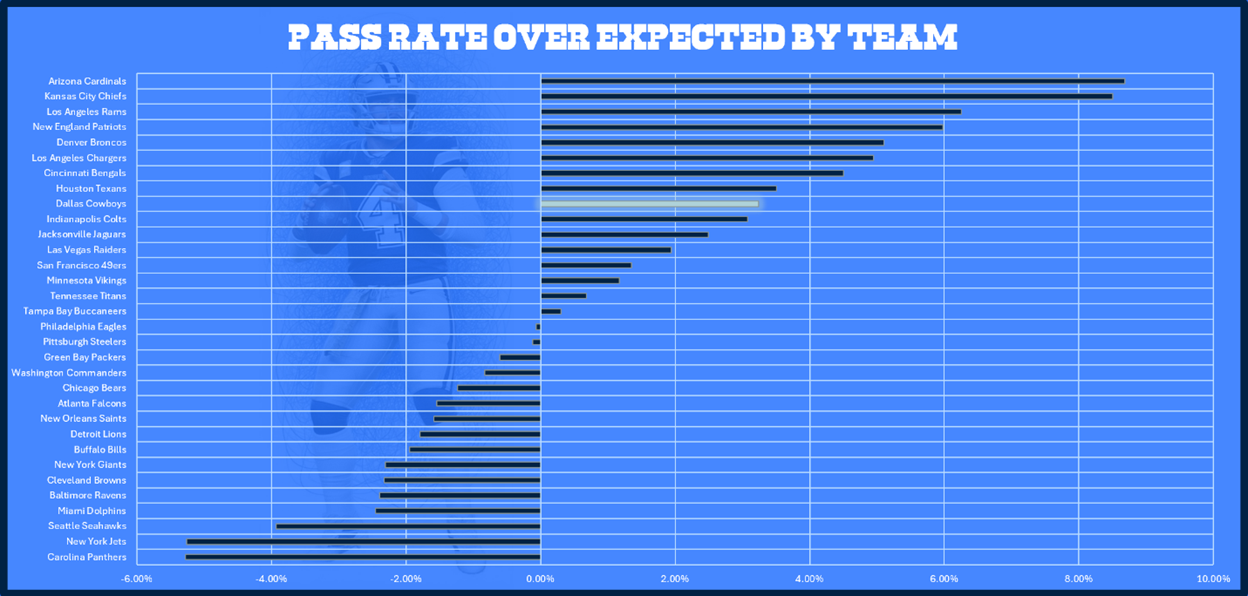
The Cowboys have a pass rate of 60% (T-7th). They are quick at the line (25.6 seconds to snap, 4th). Their pass rate over expected (PROE) is +3.24% (9th). They have run 67 plays per 60 minutes (T-5th). Again, this is a tremendous fantasy environment.
The Cowboys rank fourth in offensive EPA per play and sixth in offensive success rate. They rank fourth in offensive EPA per dropback and seventh in offensive success rate on dropbacks.
They are led by QB Dak Prescott, who is +1600 (3rd) in MVP odds, according to Vegas Insider. He has dropped back 476 times (T-3rd), resulting in 437 passing attempts (2nd). He ranks only 21st in rushing yards (124 yards), so he is no longer the threat he once was on the ground. This means he lacks the elevated platform that rushing provides, which raises a player’s floor and ceiling.
On the other hand, he is on an offense that has afforded him the second-most rushing attempts, and it scores a significant number of TDs, so this serves as a proxy for that type of rushing and essentially creates the same condition.
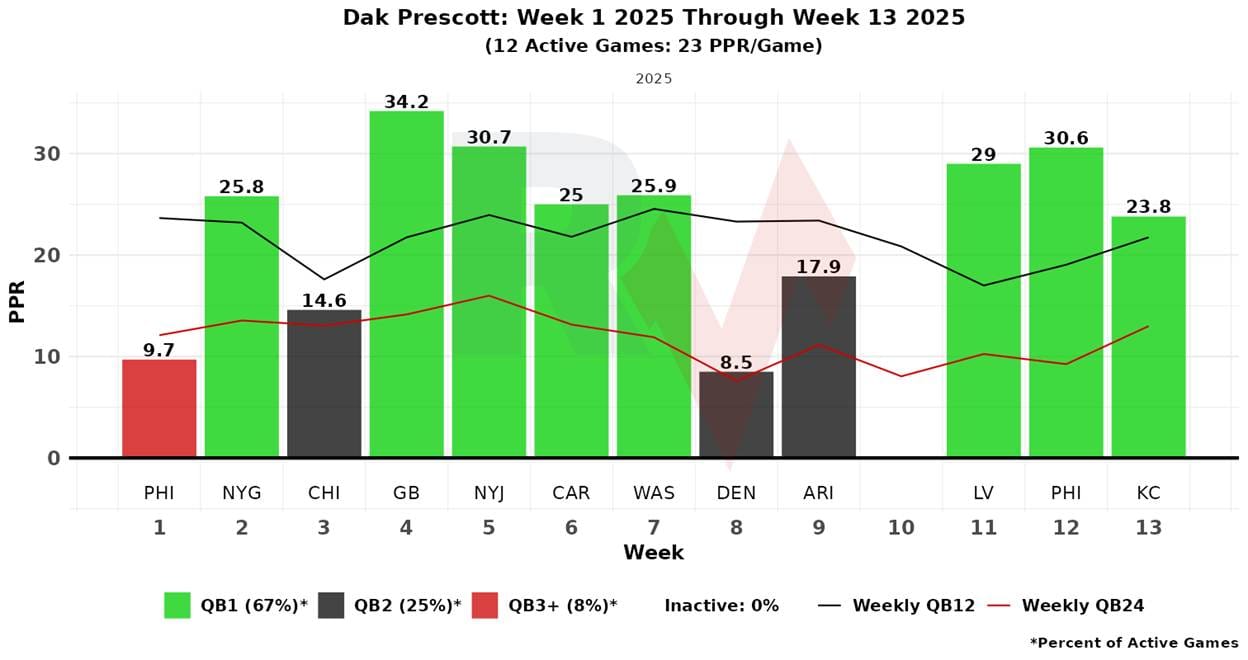
Prescott has been a QB1 eight times in 12 games, and has only been a fantasy disaster in single-QB leagues twice.
As a passer, he is elite, ranking fourth in EPA + CPOE composite, trailing only Drake Maye, Jordan Love, and Sam Darnold.

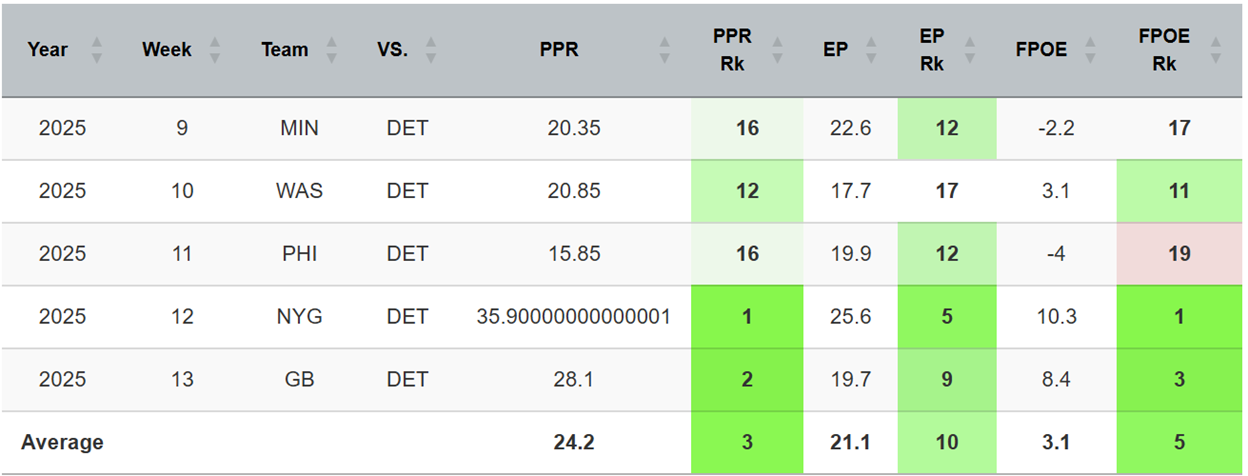
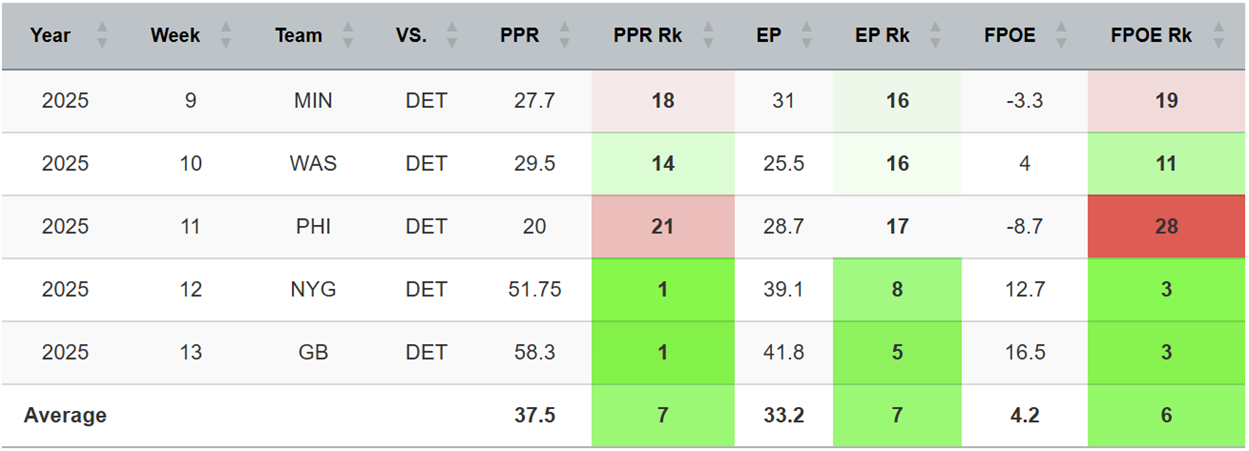
The Lions have recently struggled in pass defense, and in their last five games, they rank third-favorable for fantasy QBs.
The Cowboys have a narrow target distribution, as only two players have a target share per game better than 15% in their last five games: WRs George Pickens (26.4%) and CeeDee Lamb (26.4%), who account for 52.8% of the Cowboys’ target share during that span.

Pickens has been the better WR in 2025. He ranks in the top 10 in many of the most significant WR statistical categories in the NFL and second in PPR fantasy points among WRs.
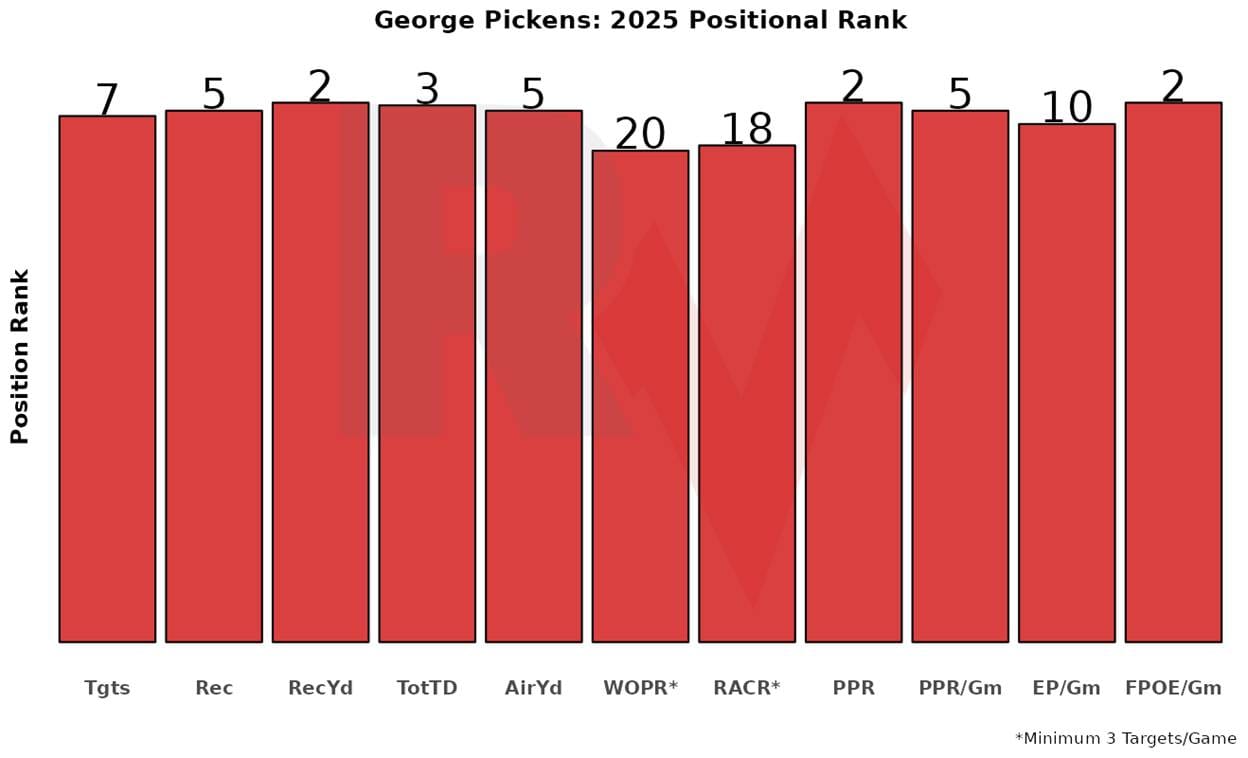
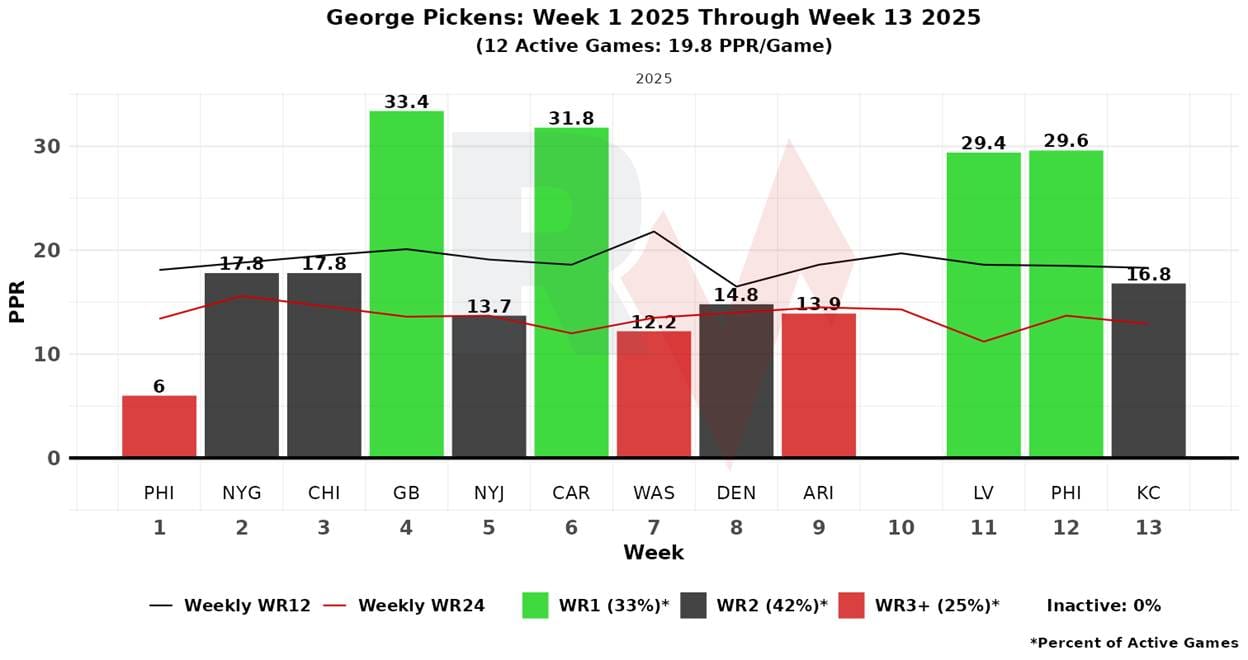
Pickens also has demonstrated immense upside—hitting totals at or above 30 PPR points four separate times. But he has done so without frequently disappearing entirely. He really has only one no-show for fantasy—the first game of the year against Philly.
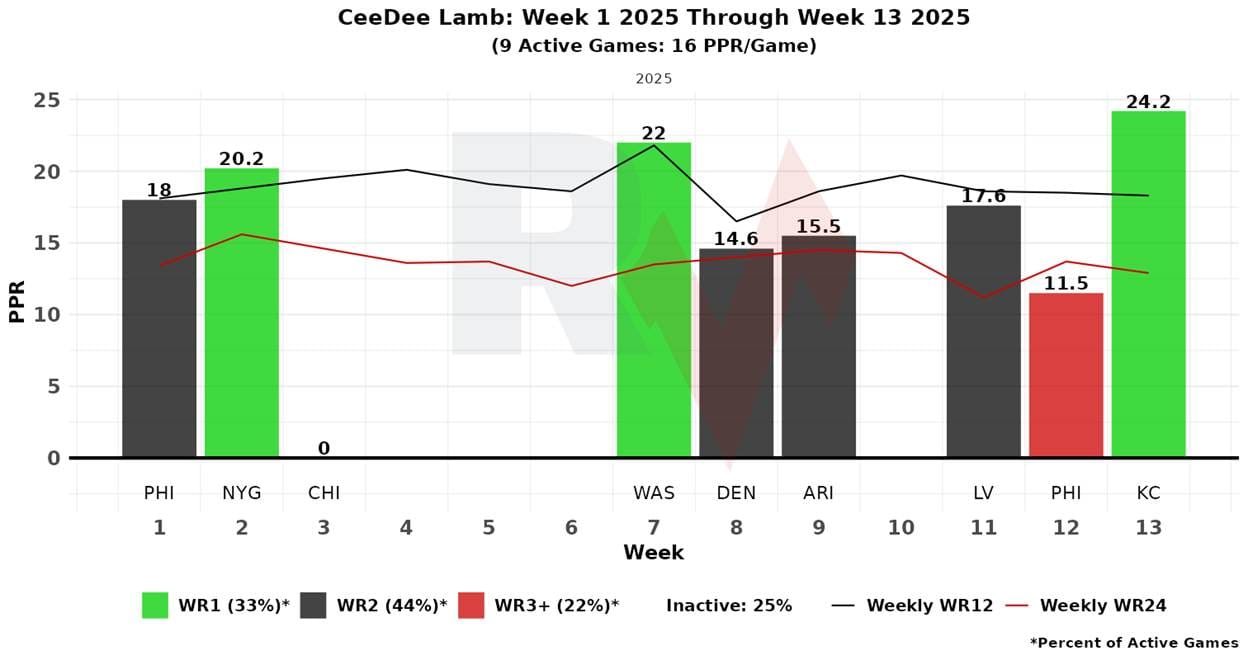
Lamb missed some time earlier this year with an ankle injury, but on a per-game basis, he is nearly as potent. He has three WR1 performances and, outside of the game against Chicago, where he got hurt, has scored enough PPR points not to tank fantasy lineups. Lamb has yet to show the high-high ceiling that Pickens has flashed several times, but we know he is capable of it, as he was fantasy’s WR1 overall in 2023.
Similar to how they’ve been against QBs, the Lions have been vulnerable against WRs, surrendering the seventh-most fantasy points to the position in their last five games.
Though he’s dipped below a 15% target share per game rate in recent weeks, TE Jake Ferguson ranks third among fantasy TEs in PPR leagues and second in total targets.
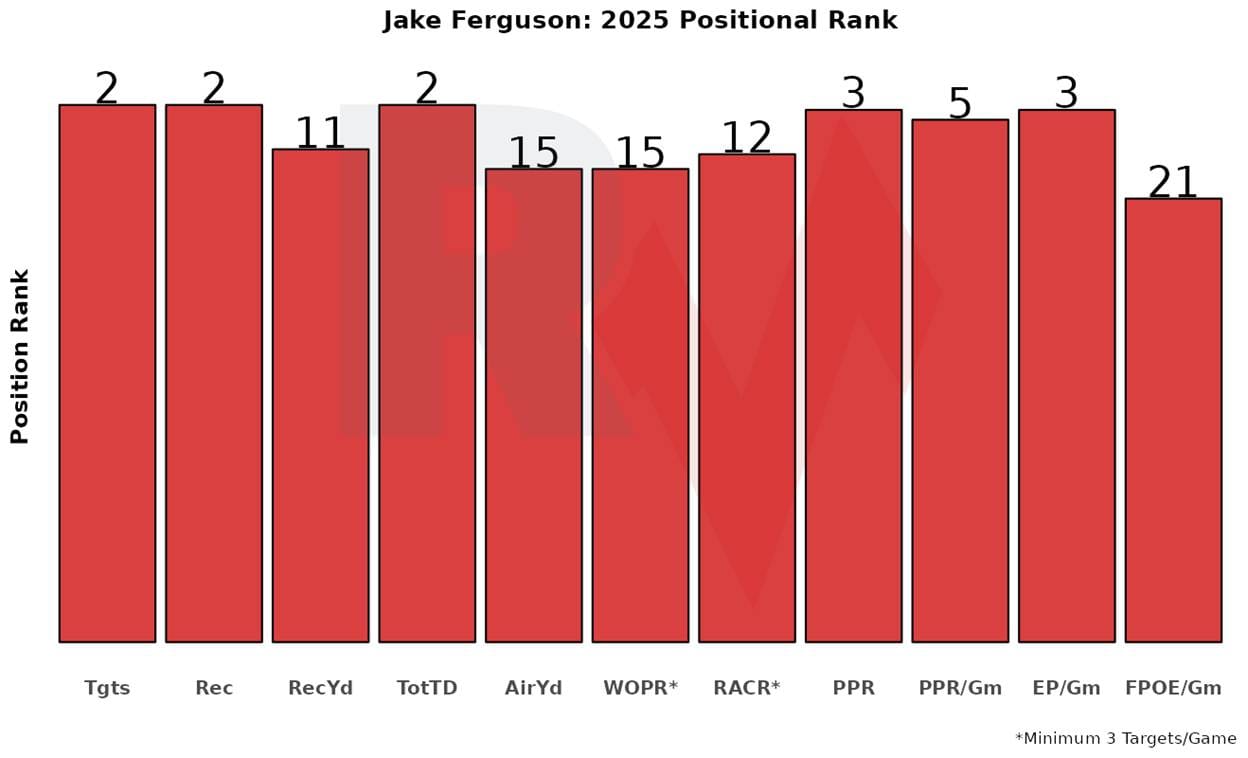
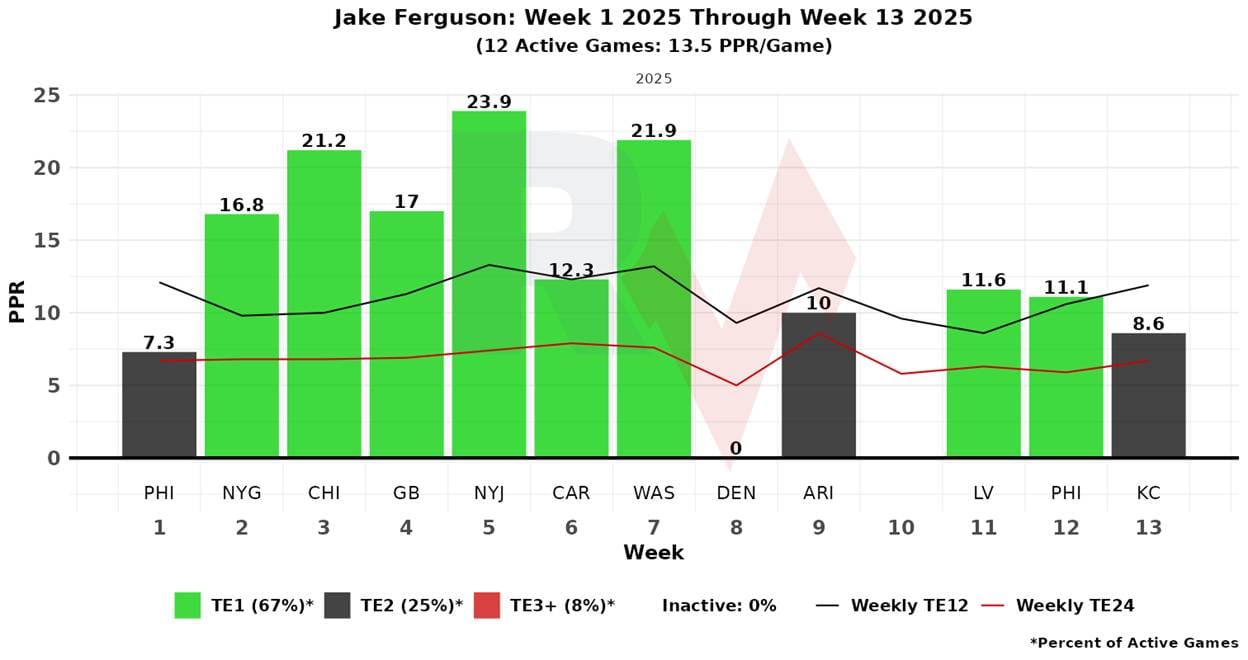
Ferguson had one goose egg against Denver in Week 8; otherwise, he’s been consistently functional. He has also demonstrated exceptionally high highs, hitting above 20 PPR points on three different occasions.
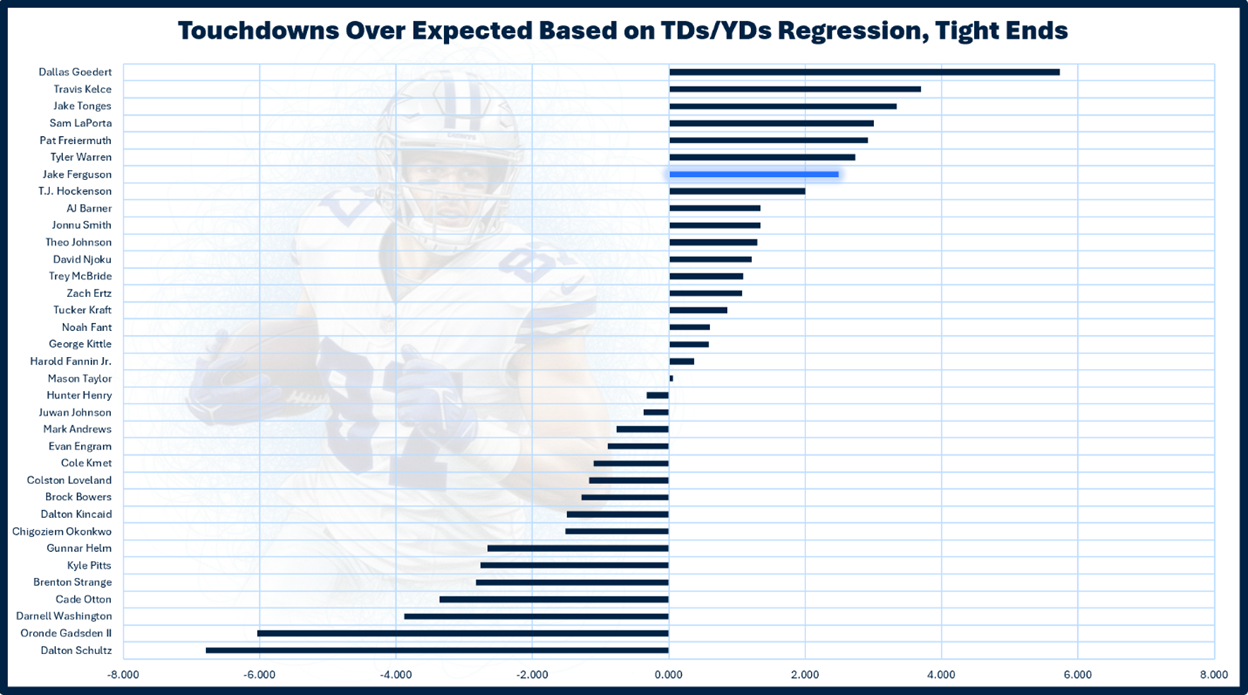
Ferguson is a TD regression candidate based on TDs/Yds regression, but not by a substantial margin. Regression of this sort is more predictive along the margins than it is toward the middle; Ferguson is somewhere in between.
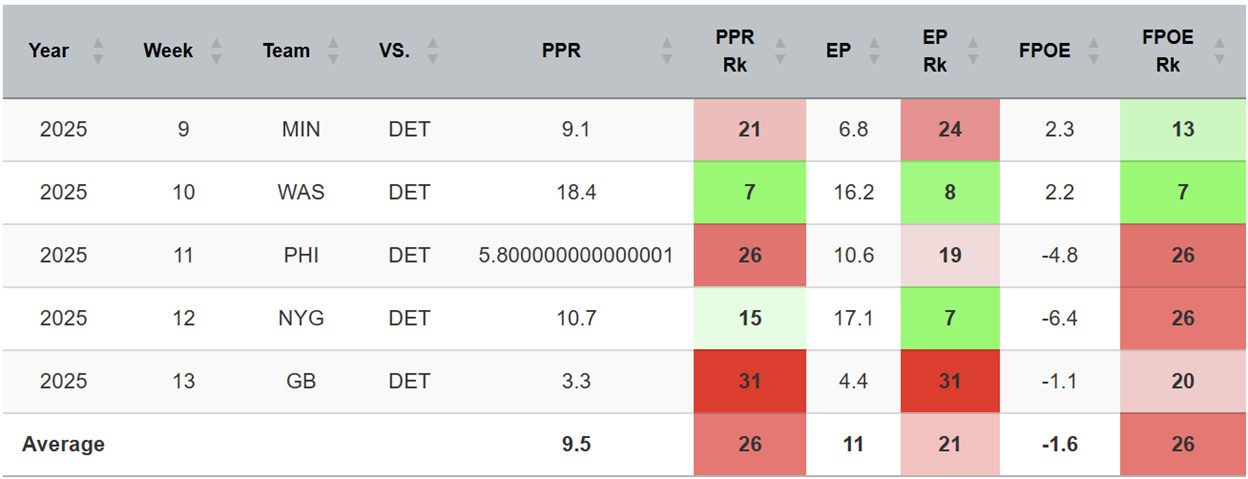
The Lions are better at defending fantasy TEs. They’ve held opponents to the 26th-most fantasy points per game in their last five games.
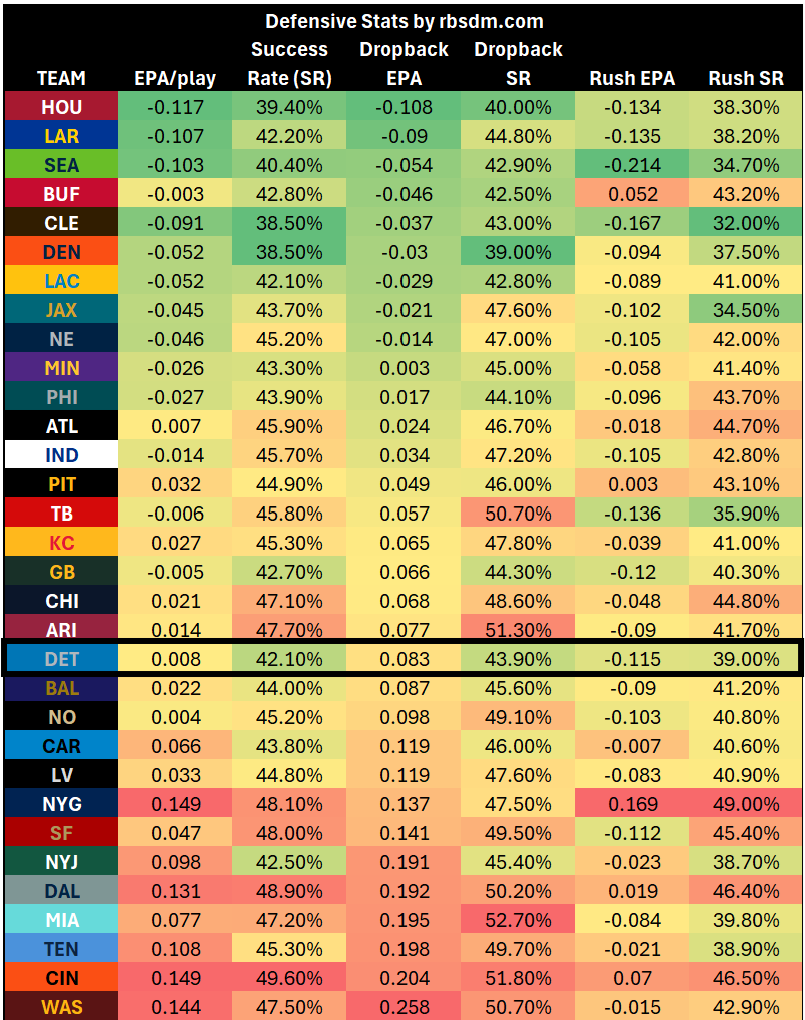
Based strictly on EPA allowed, the Lions profile as a pass funnel, as they are above average in rush EPA and below average in dropback EPA. This has not necessarily borne out, given how opposing offenses approach them, as they have faced the 18th-most dropbacks and the 20th-most rushing attempts.
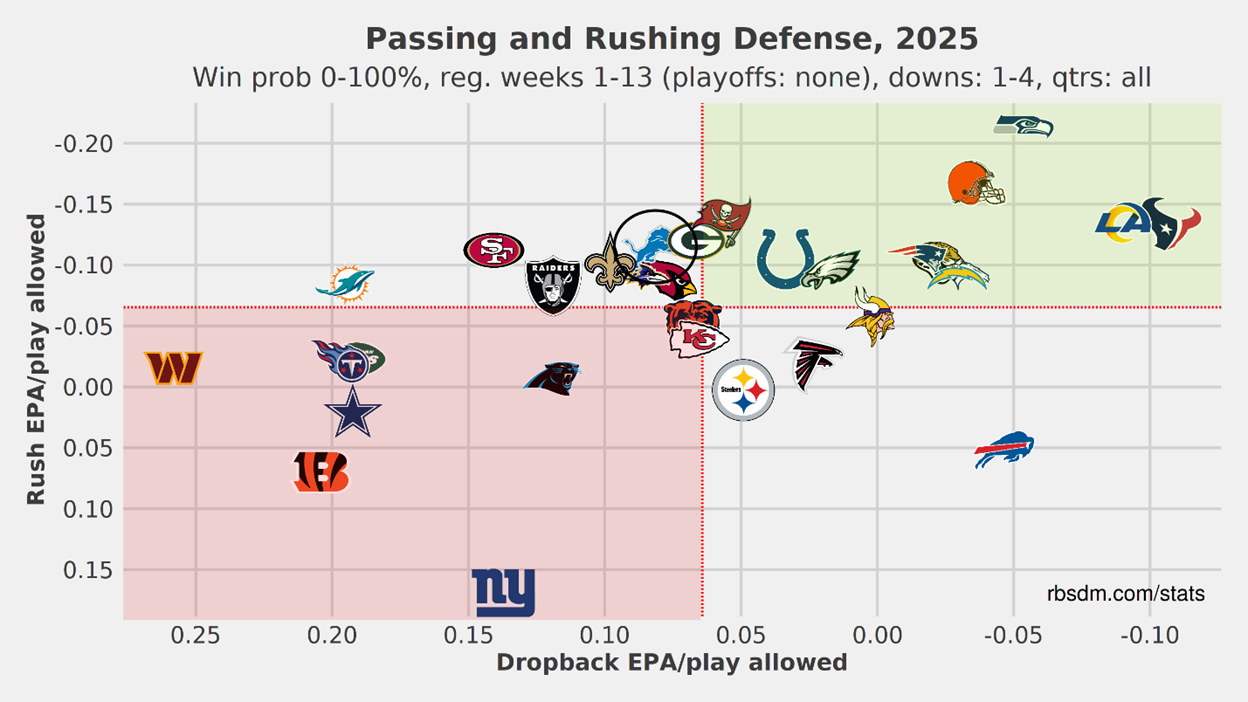
Detroit ranks 17th in EPA per play allowed and sixth in defensive success rate. It ranks 20th in EPA per dropback allowed and seventh in defensive success rate on dropbacks.
Detroit uses man defense on 42.8% of their defensive plays (1st). They use single-high safety on 61.4% of defensive plays (3rd). It should be no surprise at all, then, that they use Cover 1 (33.6%) more than any other alignment (2nd). They use Cover 3, which is the zone equivalent, 24.7%. They blitz at 24.4%, an average rate.

Fantasy Points’ coverage matchup tool assigns a zero-based matchup grade to each pass-catcher based on their opponent’s use of specific types and rates of coverage and how that pass-catcher performs against them. Positive numbers indicate a favorable matchup and negative numbers indicate an unfavorable one.
Based on this, Lamb has a slightly unfavorable matchup (-3.6%), Ferguson has a somewhat favorable one (+2.2%), and Pickens has a highly favorable one (+11.3%).
PFF’s matchup tool is player-based, pitting the PFF ratings of individual players against each other for an expected number of plays based on historical tendencies, then rating them on a scale from great to poor.
In this model, Ferguson’s matchup grades out as fair, Lamb’s grades out as good, and Pickens’ grades out as great. It’s all systems go for Pickens.
Dallas allows +3.87% pressure rate over expected (PrROE) offensively (11th). Defensively, the Lions generate +8.21 PrROE (13th). The composite makes for a relatively neutral pass blocking matchup when Dallas is on offense.
The Cowboys generate 1.94 adjusted yards before contact per attempt (adj. YBC/Att, 19th). The Lions allow 2.10 adj. YBC/Att defensively (16th). This is also a relatively neutral run blocking matchup when Dallas is on offense.
Dallas ranks 11th in offensive EPA per rush and offensive success rate on rushes. They use RB Javonte Williams as a bell-cow, giving him 78% of the snaps, 62% of the team rush attempts, and 6% of the target share in their last five games, all of which lead the backfield.

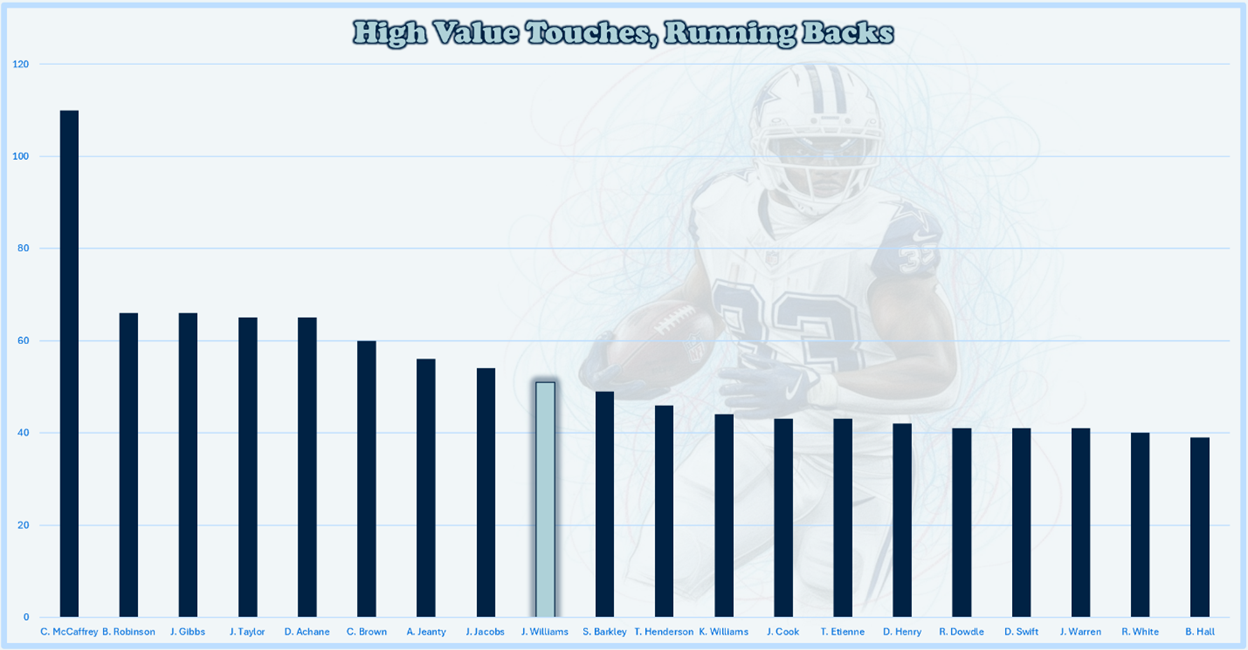
RB receiving works similarly to QB rushing in that it raises the player's platform. If a player adds rushing production, he will find ceiling. If he adds little or no meaningful rushing production, he will still find floor. Williams doesn’t have this in this offense, so he relies on ground production. The good news is that he gets a lot of work, and the offense is hyper-productive, running a lot of plays and scoring TDs. In fact, even with a moderate target share, he still ranks in the top ten among RBs in high-value touches.
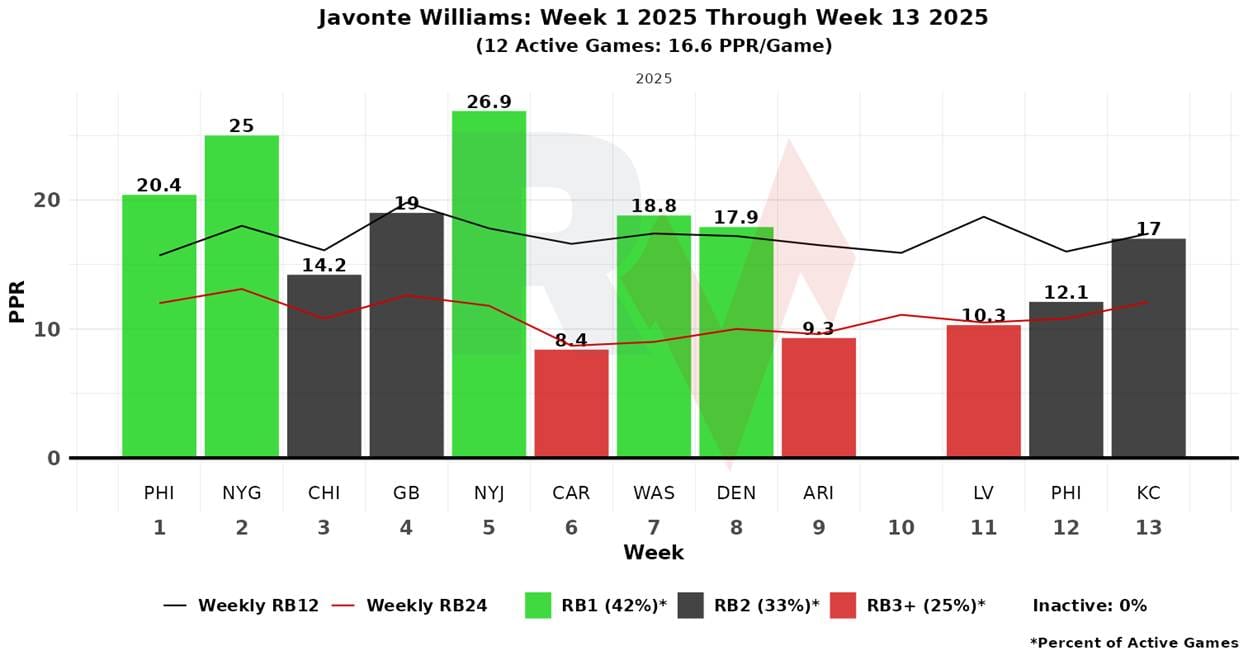
Williams has been an RB1 five times, at times showing legitimate ceiling. He has fallen to flex territory three times, but he has never had the bottom fall completely out.
Detroit ranks seventh in EPA per rush allowed and 10th in defensive success rate on rushes. Rush defense is their strength, and opposing RBs have ranked just 31st against them in the last five games.
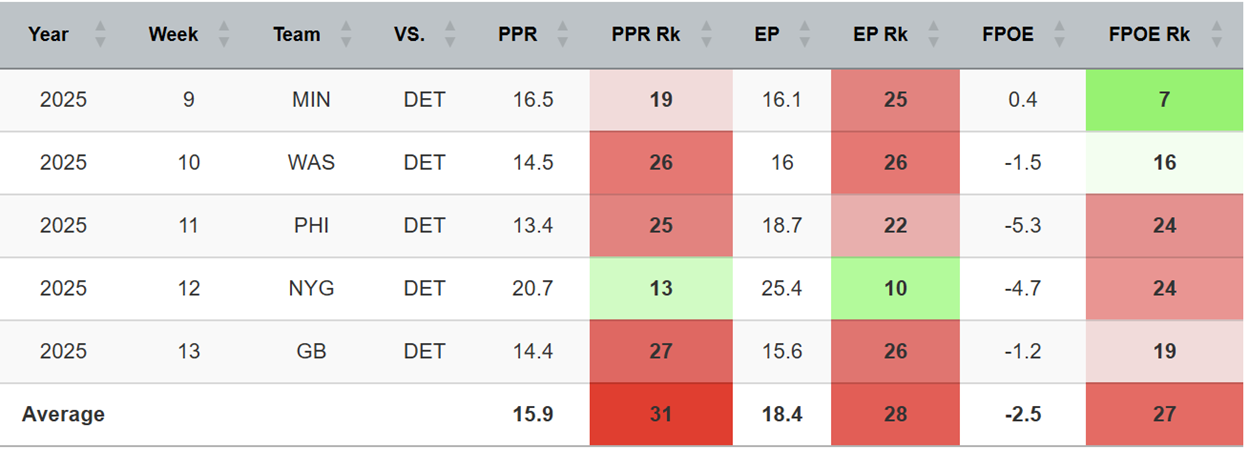
Certainly, with a player as involved as Williams in an offense this potent in a game with such a high total, it is hard to justify sitting him. But it is easy to envision this week as perhaps one of his weaker outputs.