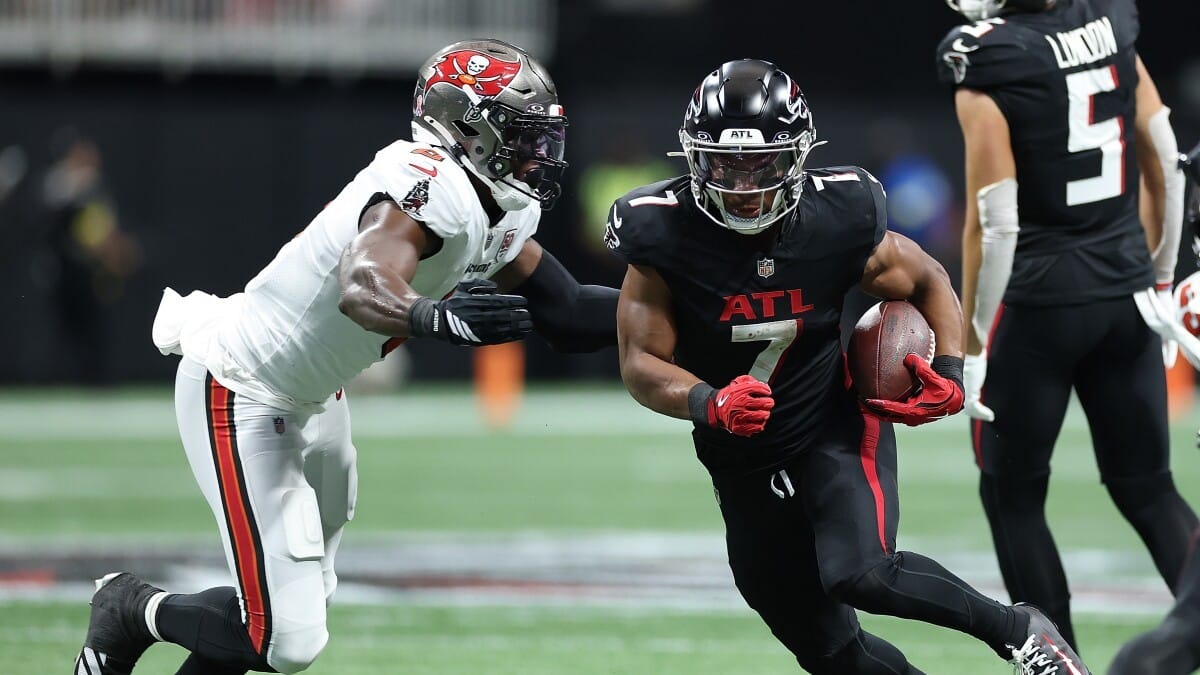
Quick Slant: TNF - The Anaconda

Mat Irby’s Quick Slant
By the time your synapses have caught up with what’s happening, it’s already got you. You tell yourself there is a way to escape, so you flail with all your might; blood rushes to your extremities, filling your chest, your shoulders, your thighs, your core. But your hands don’t shove forward. Your elbows don’t break free. All your kicking, flapping, screaming, and squirming are met with only more binding, as layers of meaty coils clench around you like you are held by the fist of God. By the time your face gets pulled underwater, panic gives way to acceptance. As it spins you around like a screw, your face emerges to a sky dulling by each lethargic blink, and your breath becomes increasingly impossible. Chirping crickets and groaning bullfrogs pierce the silence, so innocuous moments ago; now they highlight your solitude as you breathe your last. No one is coming to save you. You relent. You peer up at the canopy of the tall forest, which steadily closes in on your disappearing.
When the Falcons entered Week 14 with the slightest possibility of a playoff spot, they met the steamroller of Seattle headlong. They fought with all the courage of a besieged outpost walled against the edge of a cliff; when the sky lit with the crackle of the rush at dusk, they had bluster; by midnight, they were filled with hope; by first light, they had only their endless despairs left to count. It was apparent then: this was never a battle at all. The anaconda had had them all along. Slowly, it crushed them into surrender; by sunrise, they were devoured whole.
With the loss to the Seahawks, the Falcons may find strange liberation. There is no more weight pressing down on their chests, no tensions keeping them awake at night. In a way, there are no longer any doubts about next year; it is understood that many in black-and-red fleeces and hats today will be replaced by the NFL’s cruel conveyor belt tomorrow. For the Falcons, there is no trophy; all there is is Thursday, a child’s game, our team against yours.
Their opponent, Tampa Bay, is still very much in the struggle. Despite their 7-6 record, they are tied for the division lead in the NFC South’s annual race to the bottom. They lick their wounds from a demoralizing loss to New Orleans, who were long left for dead, but so far, the anaconda has not yet lunged for them.
For the Bucs, there are questions about a more imminent tomorrow. A +9 turnover margin, a skewed points-for and points-against ledger, and a 1-5 record at home against the spread all tell the tale of a team that, despite its disappointing record, may be overachieving. The Bucs grow healthier, but they still aren’t winning, so their excuses carry less weight by the week. Terrible Red Zone performance, a fourth-quarter reputation for wilting, and a suddenly reeling defense all speak for themselves; if the Bucs make it out of December alive, what fight do they realistically bring to January?
It’s a shoot down I-75; it’s Georgia and Florida; it’s a 32-32 all-time record between division rivals. For the Falcons, that will have to be all the motivation there is. If there can’t be a piece of the postseason bracket for Atlanta, if its coaches and front office staff are destined to fire off résumés come spring, perhaps it could be some consolation to crush the dreams of another, to pay forward the fear and desperation the anaconda had wrought and so recently released them of.
Falcons
Implied Team Total: 20
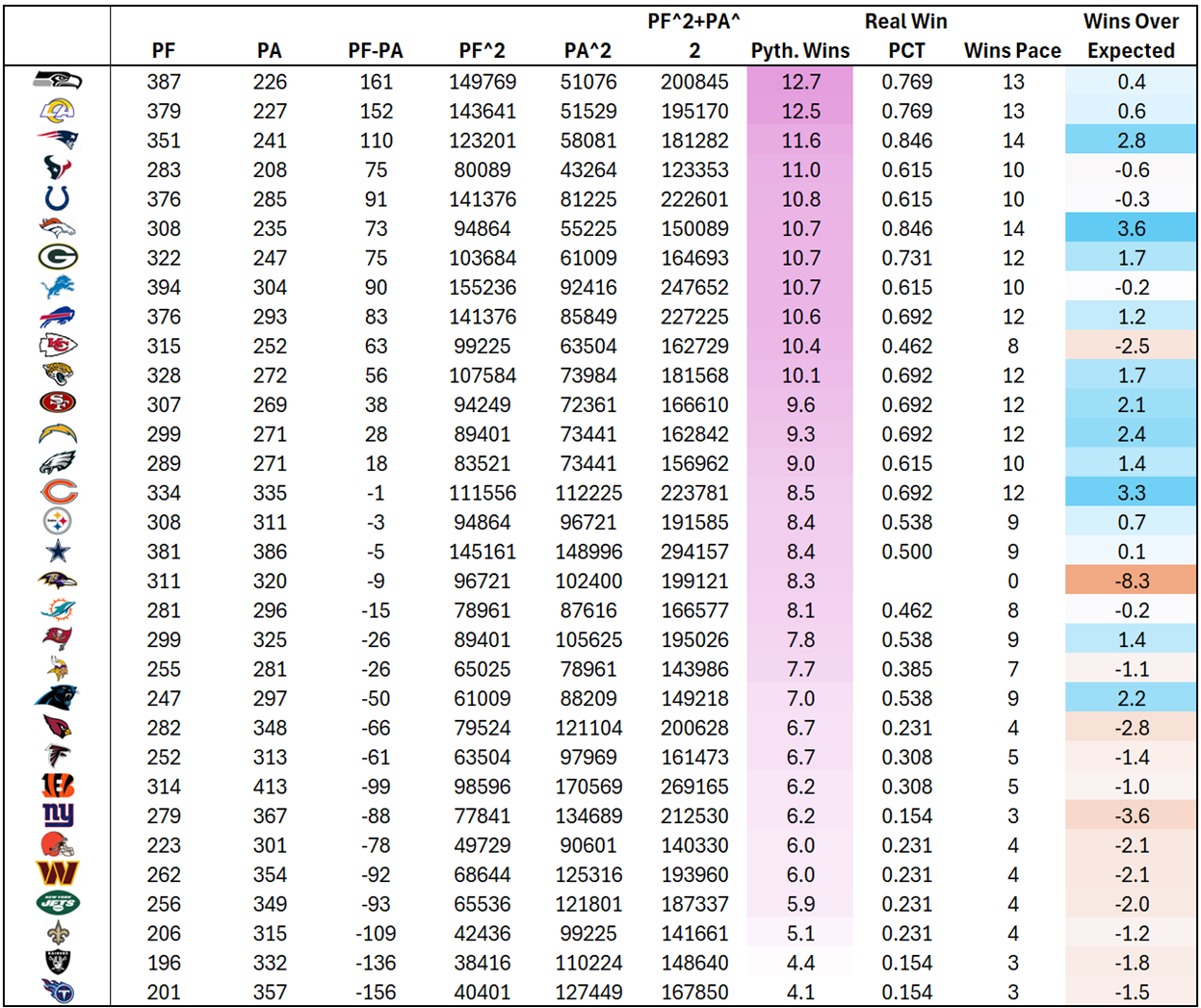
The Falcons and Bucs are three wins apart in the standings, but they are much closer in Pythagorean expected wins, which are based on points for and points against. In this model, they are each bottom-half NFL teams, with the Bucs pacing for 7.8 expected wins and the Falcons for 6.7.
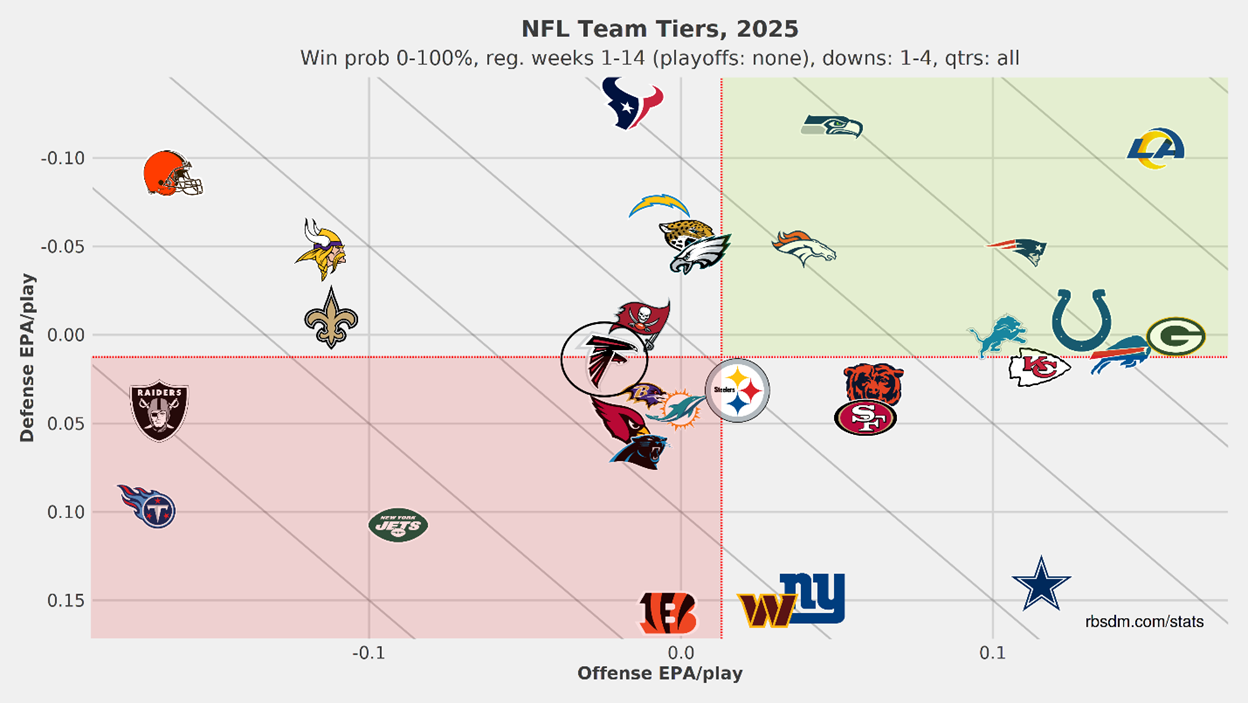
The Falcons are about average in defensive EPA and a little below average in offensive EPA.
The Falcons’ offense is about average in rush EPA and a little below average in dropback EPA. They will finish the season with their backup QB, Kirk Cousins, who is far less effective than he was in his prime. Their starter, Michael Penix, is out for the season with a torn ACL.
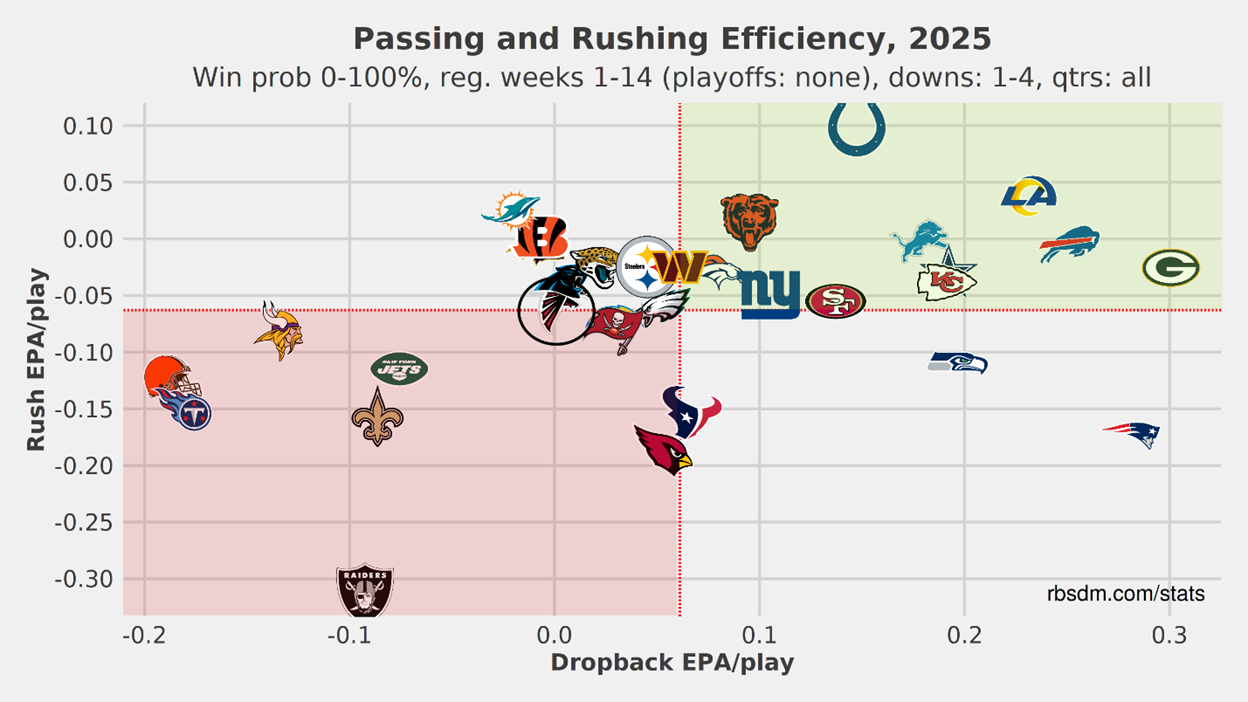
The Falcons rank 26th in offensive EPA per play and 13th in offensive success rate. In its basic form, this means they are more likely to sustain drives and less likely to make big plays.
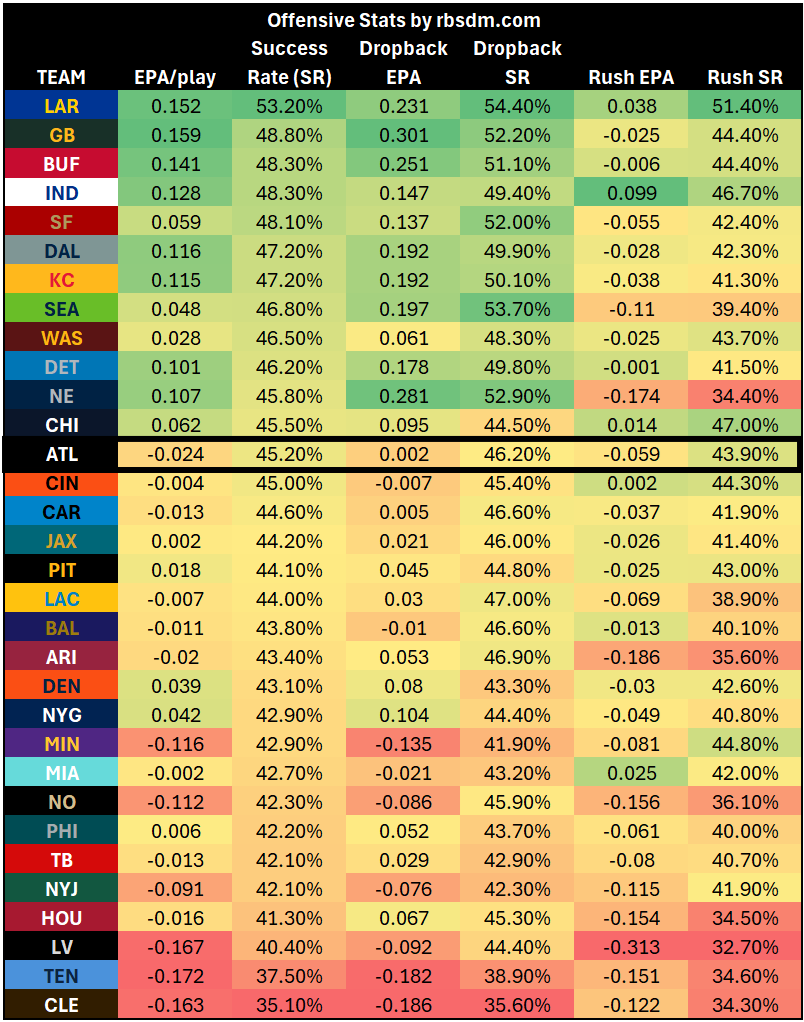
They rank 23rd in offensive EPA per dropback and 16th in offensive success rate on dropbacks.
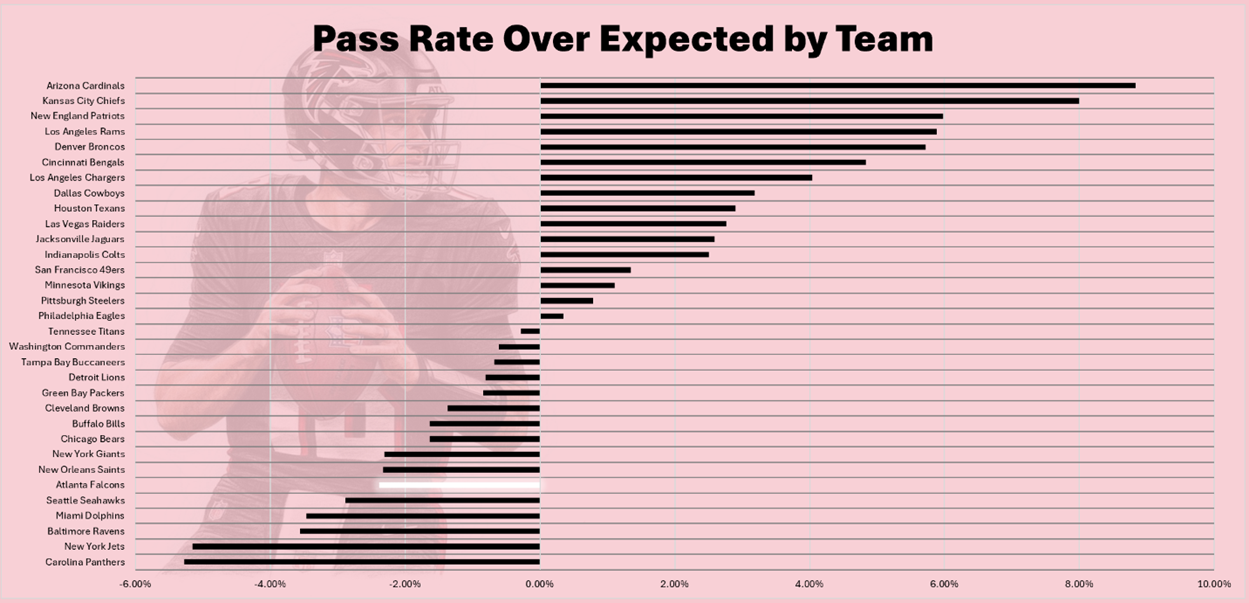
For a Shanahan-type scheme, the Falcons move fast at the line, getting plays off in 26.3 seconds per snap (T-6th). They have a 56% pass rate (T-18th). They have a -2.39% pass rate over expected (PROE, 27th), so their preference is to run.
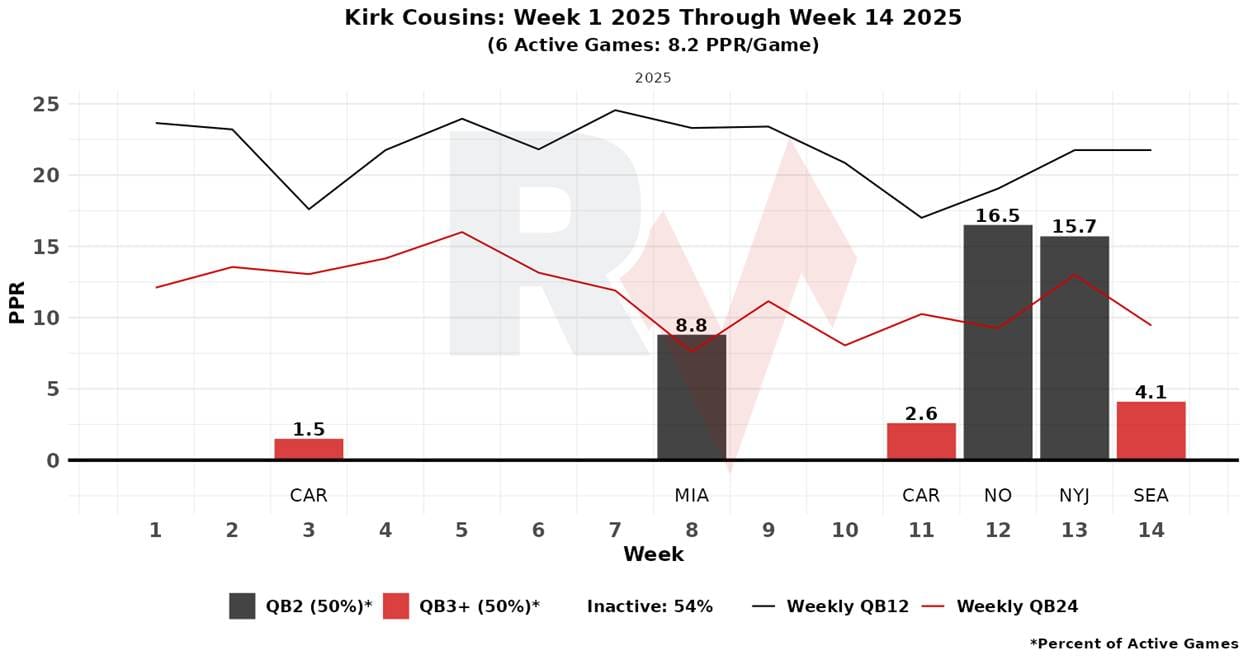
Cousins has started three games; he is completely immobile. He has twice been a middling QB2, and last week, he was completely unproductive against Seattle’s outstanding defense. His place in the fantasy world, at this point, is as a TD-dependent matchup-based streamer.
The Buccaneers’ defense has surrendered the most fantasy points to opposing QBs in their last five games. This sample includes Drake Maye, Josh Allen, and Matthew Stafford—three of the four biggest favorites for the MVP award—but also includes lesser-regarded Jacoby Brissett and Tyler Shough, who led top-10 efforts in Weeks 13 and 14.
The Falcons have three players who have at least a 15% target share per game rate in their last five games: WRs Drake London (29.3%) and Darnell Mooney (18.8%), and TE Kyle Pitts (20.8%). London has a strained PCL and will miss his fourth-straight game.
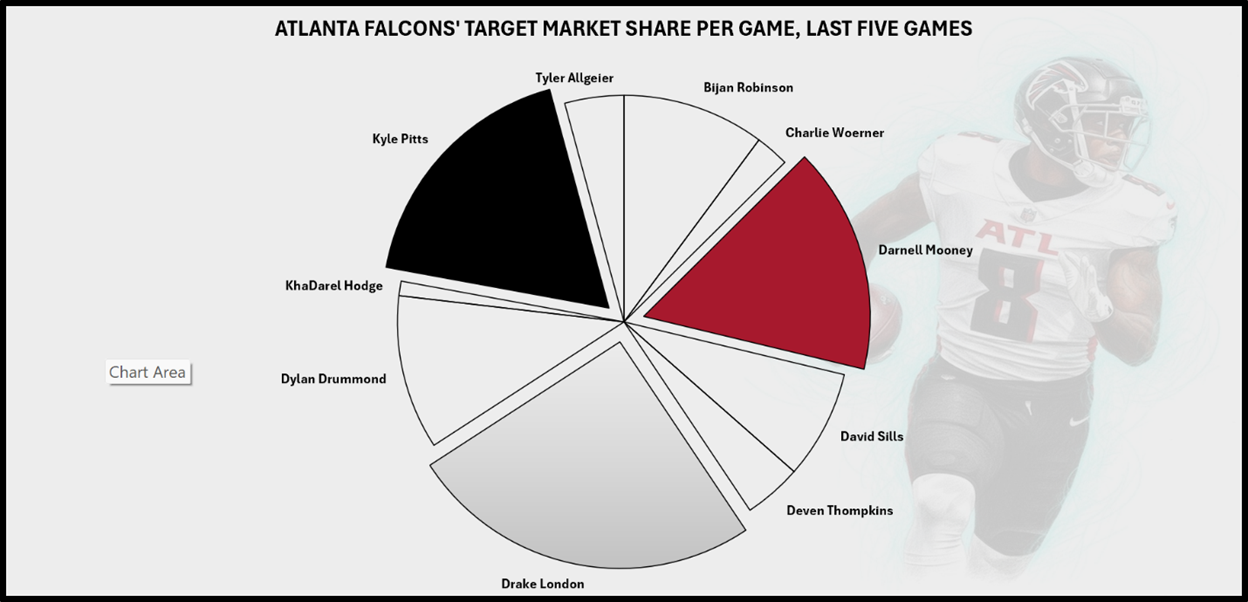
With London gone for the last three weeks, there hasn’t been a WR to step up and replace his workload; instead, Pitts has become hyper-utilized.
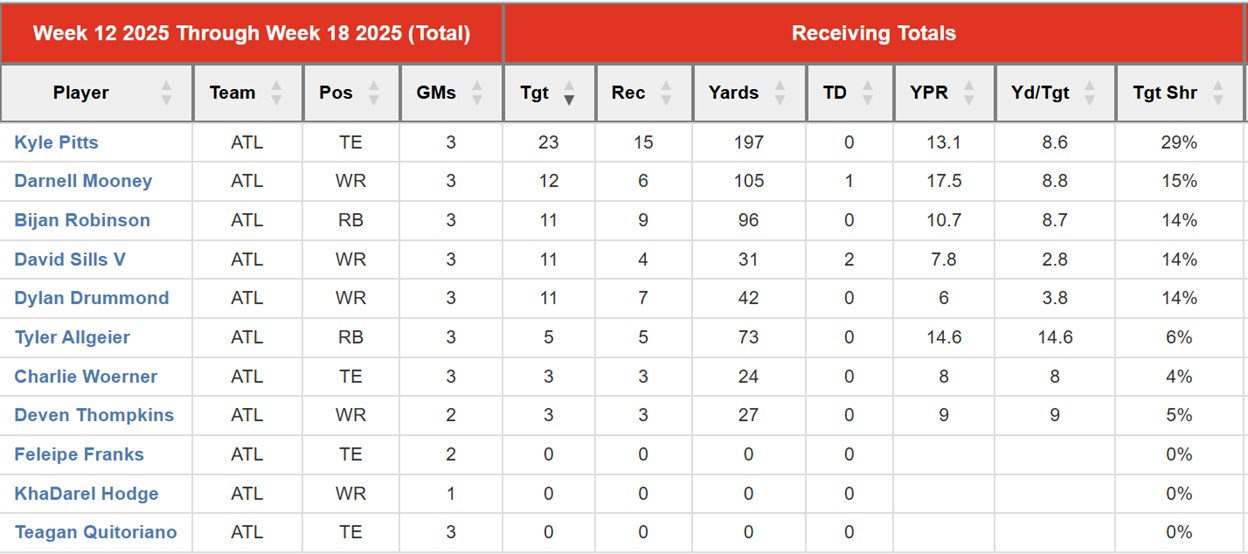
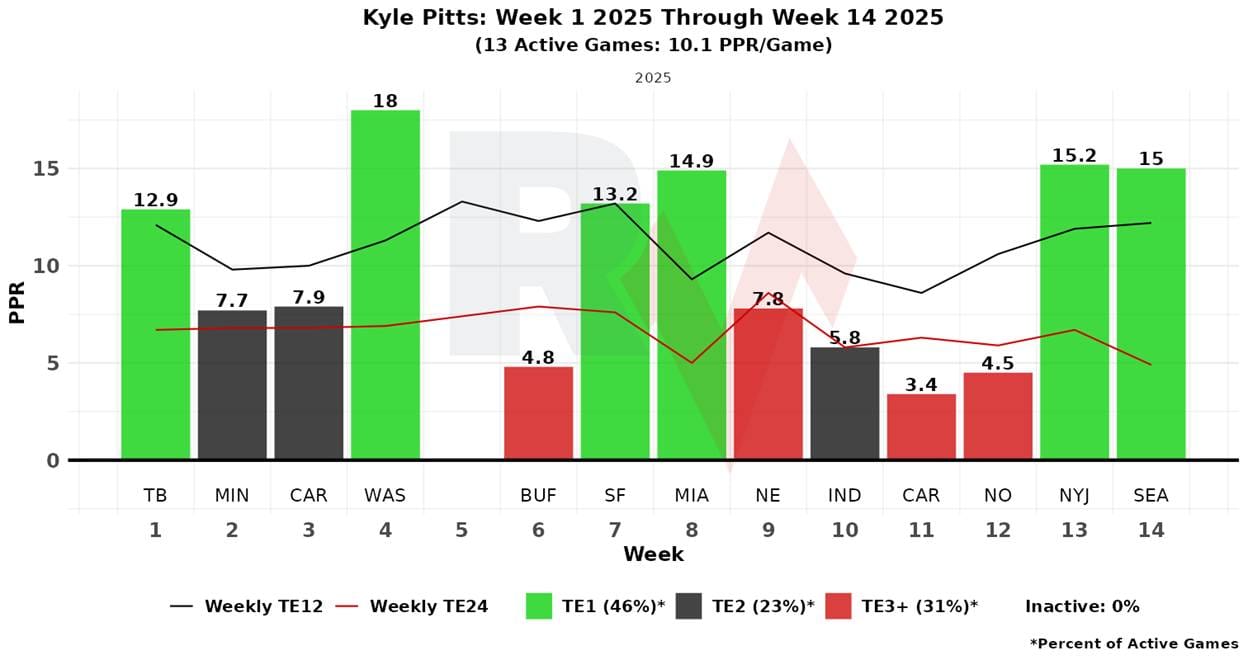
Pitts’ 22 targets, 15 receptions, and 197 receiving yards, according to Fantasy Points, since Week 12 trail only Trey McBride, and he also ranks in the top five among TEs in targets per route run (5th), yards per route run (3rd), YAC (2nd), first-read targets (2nd), and first downs (T-3rd). He has been a TE1 for fantasy in each of his last two games.
In addition to these fantastic underlying metrics, Pitts is also a strong positive regression candidate. Based on a TDs/Yds touchdowns-over-expected (TDOE) model, he is nearly four TDs off-pace, making him the most significant positive TD regression candidate among TEs this season.
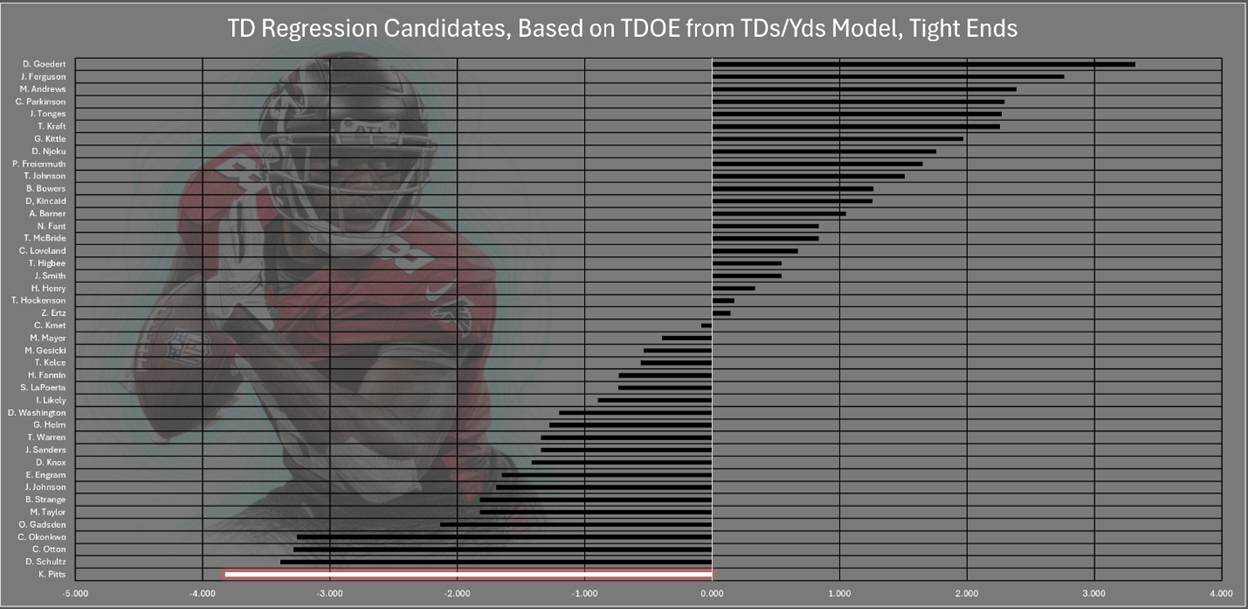
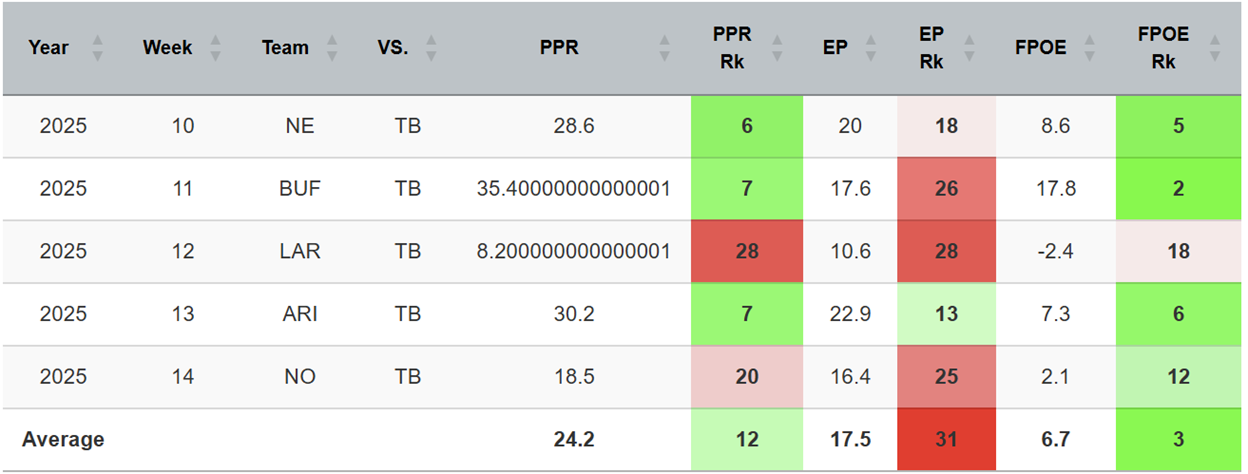
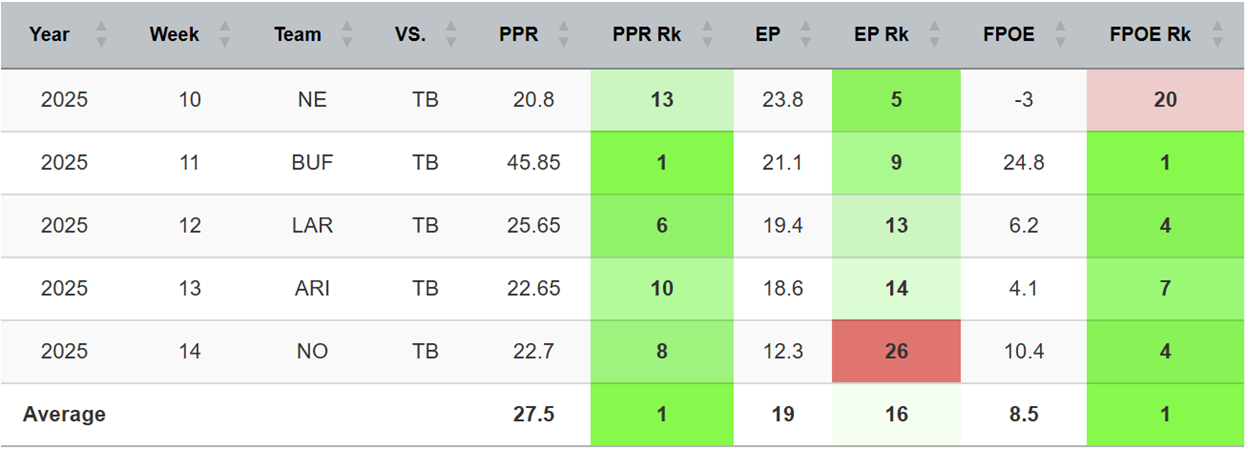
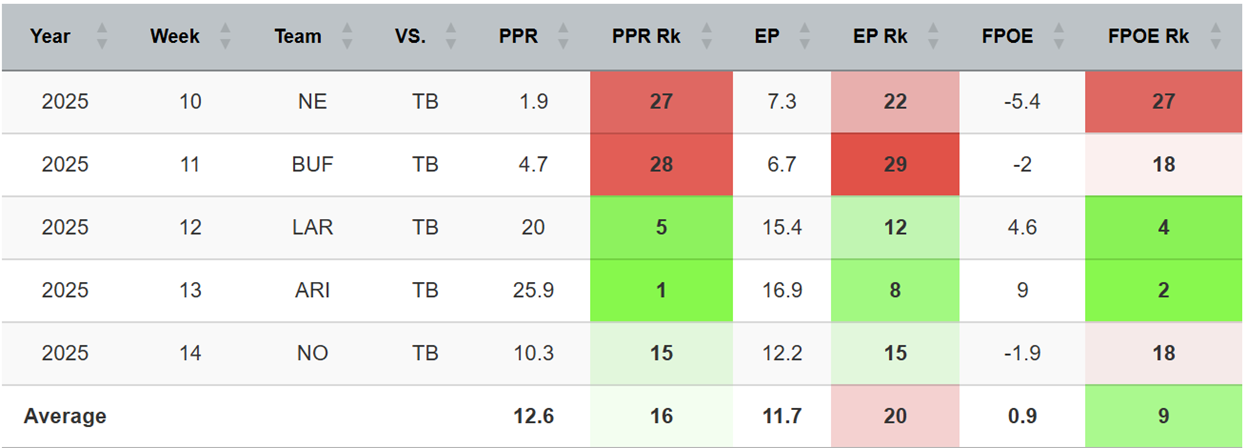
The Buccaneers lie in the middle of the pack in terms of defending fantasy TEs in their last five games. They rank poorly against league averages in fantasy points over expected (FPOE) than against expected points (EP), indicating they are not tested often but generally surrender production when they are.
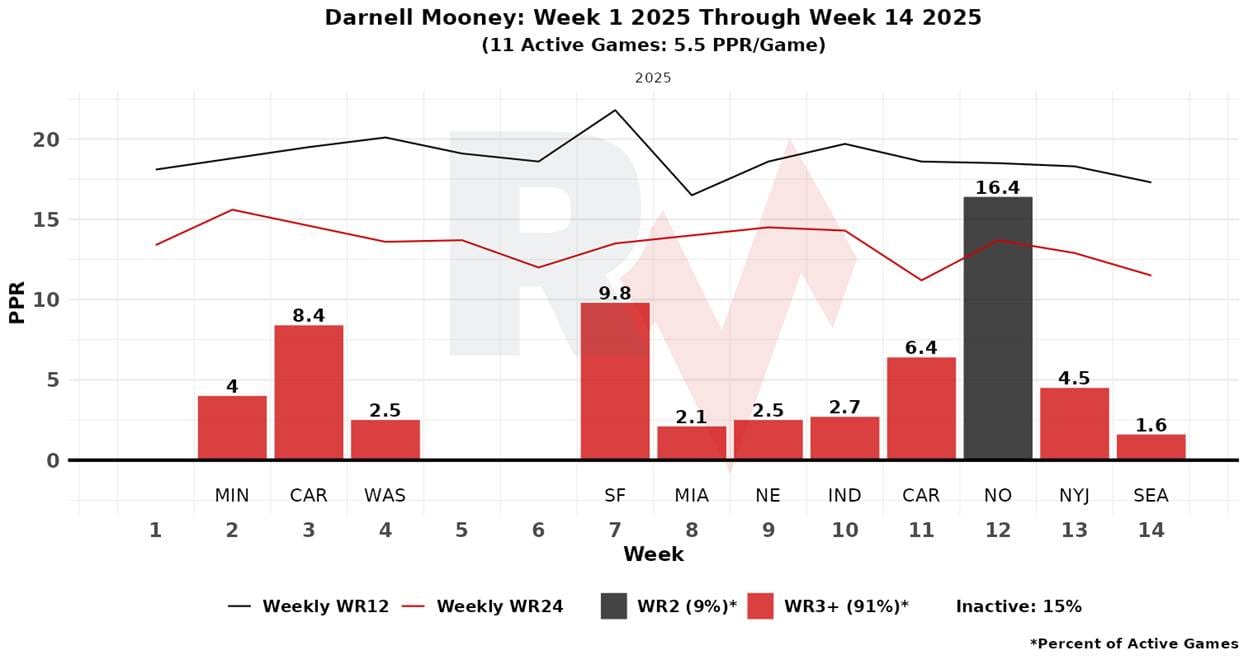
The top WR left on the Falcons’ roster is Mooney, who has not seen a significant upturn in production as the team’s de facto WR. In fact, Mooney has been a fantasy disappointment all season after popping in many predictive metrics and profiling as a sleeper. He has been a WR2 only once, in Week 12, but in most weeks, he has been unusable.
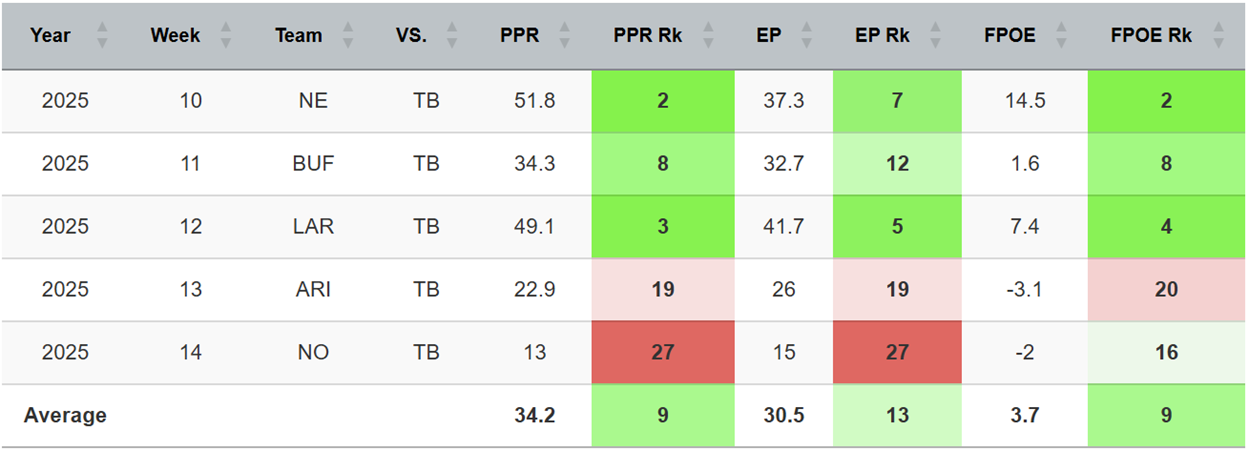
The Buccaneers have allowed the ninth-most fantasy points to opposing WRs in their last five games. That isn't enough to lure me into playing Mooney, though, frankly.
The Bucs’ defense has been above average in rush EPA allowed, but relatively neutral in dropback EPA allowed. They will be without LB SirVocea Dennis, a playmaker, who is out with a hip injury, and S Tykee Smith, one of their best secondary players, who has a shoulder issue.
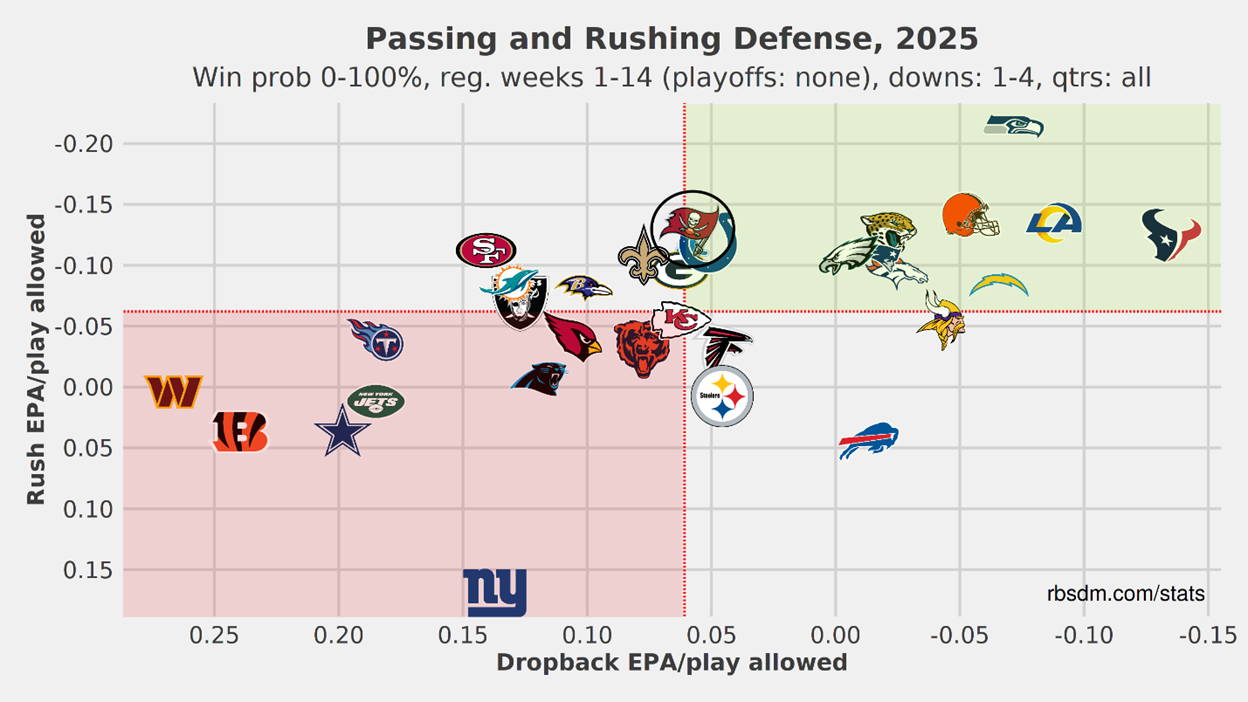
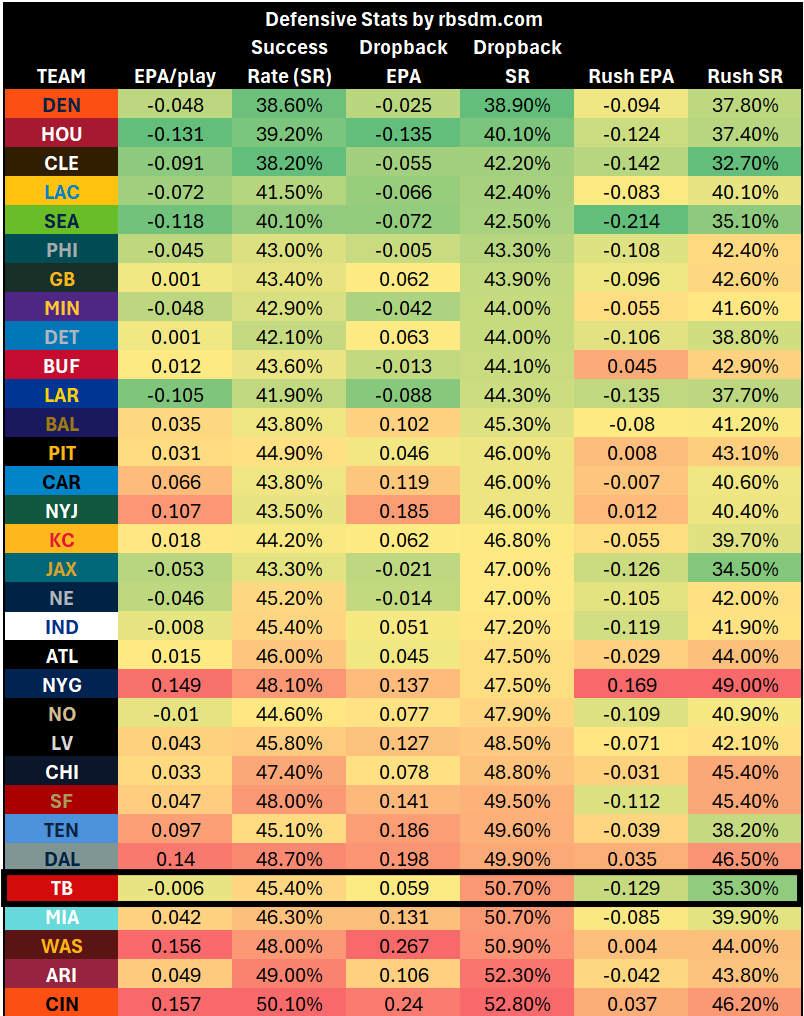
The Buccaneers rank 13th in EPA per play allowed and 22nd in defensive success rate. They rank 15th in EPA per dropback allowed and 28th in defensive success rate on dropbacks. Simply stated, this indicates they are more likely to give up big plays but less likely to get carved up on a constant play-by-play basis.
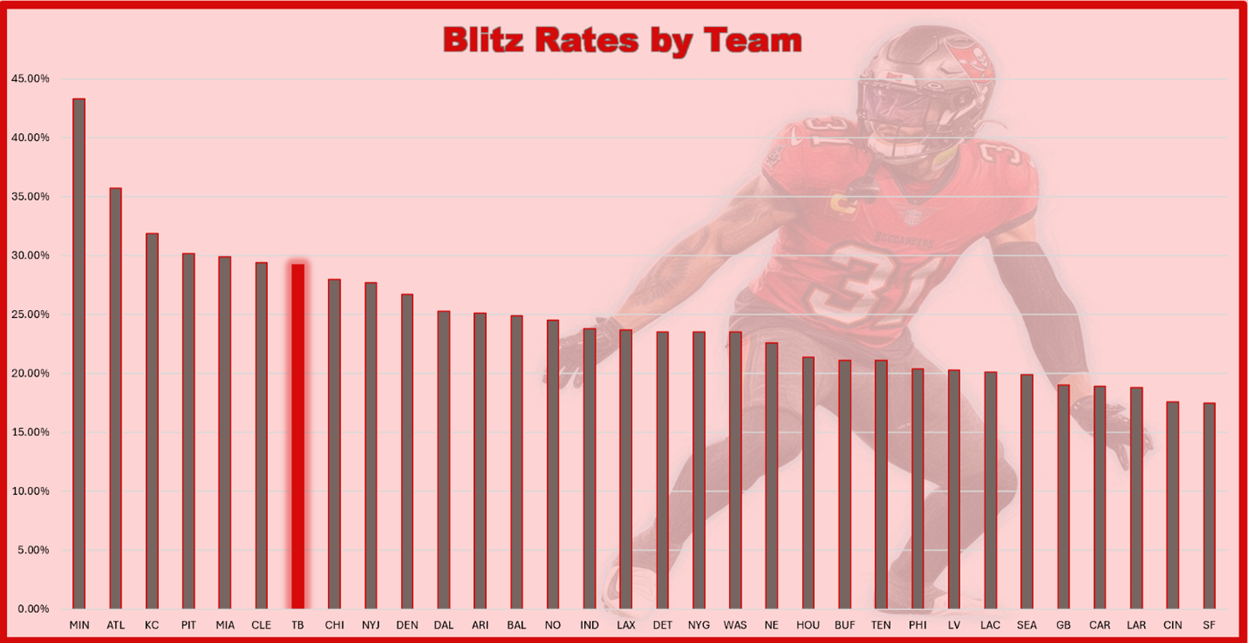
The Buccaneers use a zone defense 73.2% of the time, which is neutral, and they use an even mix of single-high and two-high safeties. The only alignment they use at a rate of 20% or higher is Cover 3 zone (35.5%). The Bucs are among the most multiple defenses in the NFL. They blitz at a rate of 29.2% (7th).
Fantasy Points’ coverage matchup tool assigns a zero-based matchup grade to each pass-catcher based on their opponent’s use of specific types and rates of coverage and how that pass-catcher performs against them. Positive numbers indicate a favorable matchup and negative numbers indicate an unfavorable one.
Based on this tool, Mooney’s matchup is favorable (+4.9%), while Pitts’ matchup is unfavorable (-5.8%). For what it’s worth, RB Bijan Robinson shows up with a favorable matchup (+5.2%), and WR David Sills, who should see the field a reasonable amount, has a very positive assignment (+12.0%).
PFF’s matchup tool is player-based, pitting the PFF ratings of individual players against each other for an expected number of plays based on historical tendencies and rating on a scale from great to poor.
Against this specific personnel, the Falcons should be at a substantial disadvantage. Pitts’ matchup grades out as fair, and both Mooney and Sills land in the poor range. However, Robinson’s receiving matchup grades out as great, as PFF ranks the Bucs’ LBs 31st in pass defense and their safeties 28th among all 32 teams.
The Falcons are a relatively decent pass-blocking unit, allowing just a 3.32% pressure rate over expected (PrROE, 11th), while the Buccaneers generate 11.05% (5th) PrROE defensively. Since both units are good, the matchup comes out as fairly neutral, with a slight edge towards the Bucs’ pass rush.
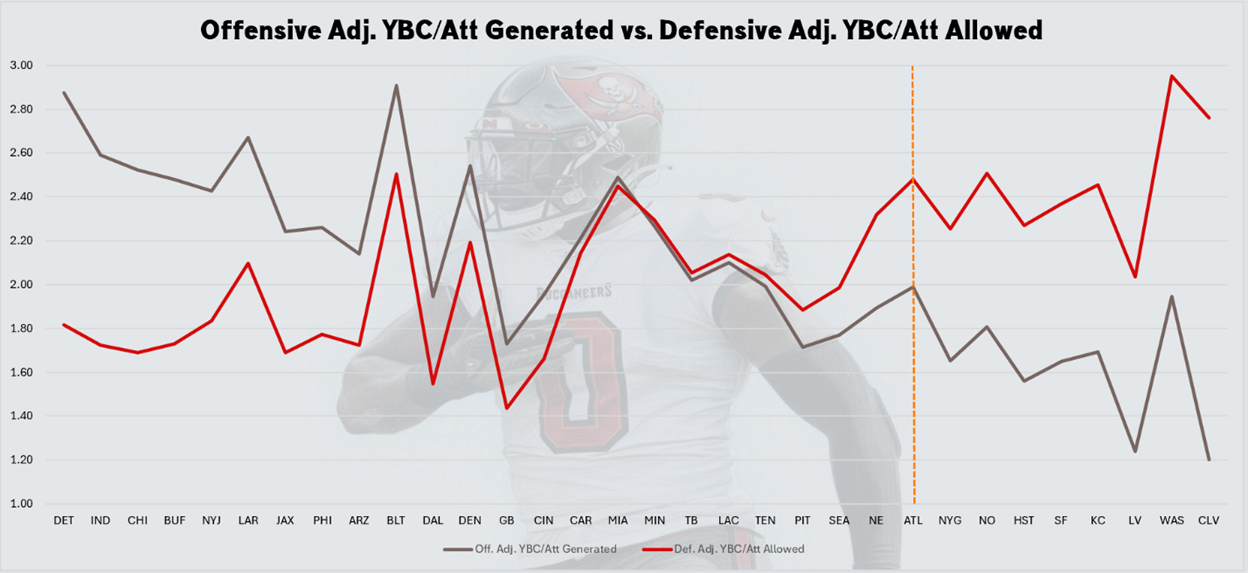
As a run blocking unit, the Falcons show up at a slightly more pronounced disadvantage. The Falcons generate 1.99 adjusted yards before contact per attempt (adj. YBC/Att) offensively (18th), while the Bucs allow 2.48.
The Falcons rank 19th in offensive EPA per rush and eighth in offensive success rate per rush.
Robinson’s usage is about as good as we could hope for this season, as he has a 71% snap share, an 18% target share, and 60% of the team’s rush attempts according to RotoViz data.

This has suited Robinson well, as the Falcons’ offense has produced enough RB opportunity in general for Robinson to find fantasy production, and have a little left over for Allgeier to be relevant.
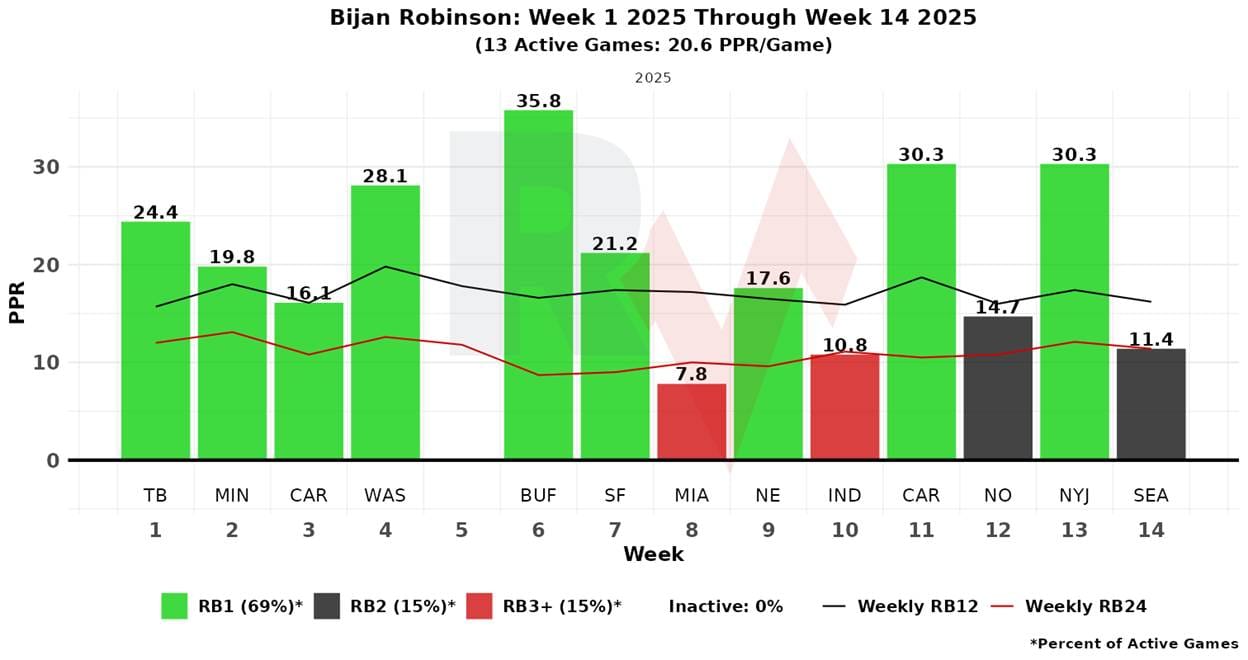
Robinson is an efficient runner, ranking 10th in rushing yards over expected (RYOE, 117). He has been able to return nine RB1 weeks, including four at or over 30 PPR points. He has only been outside of the top 24 twice.
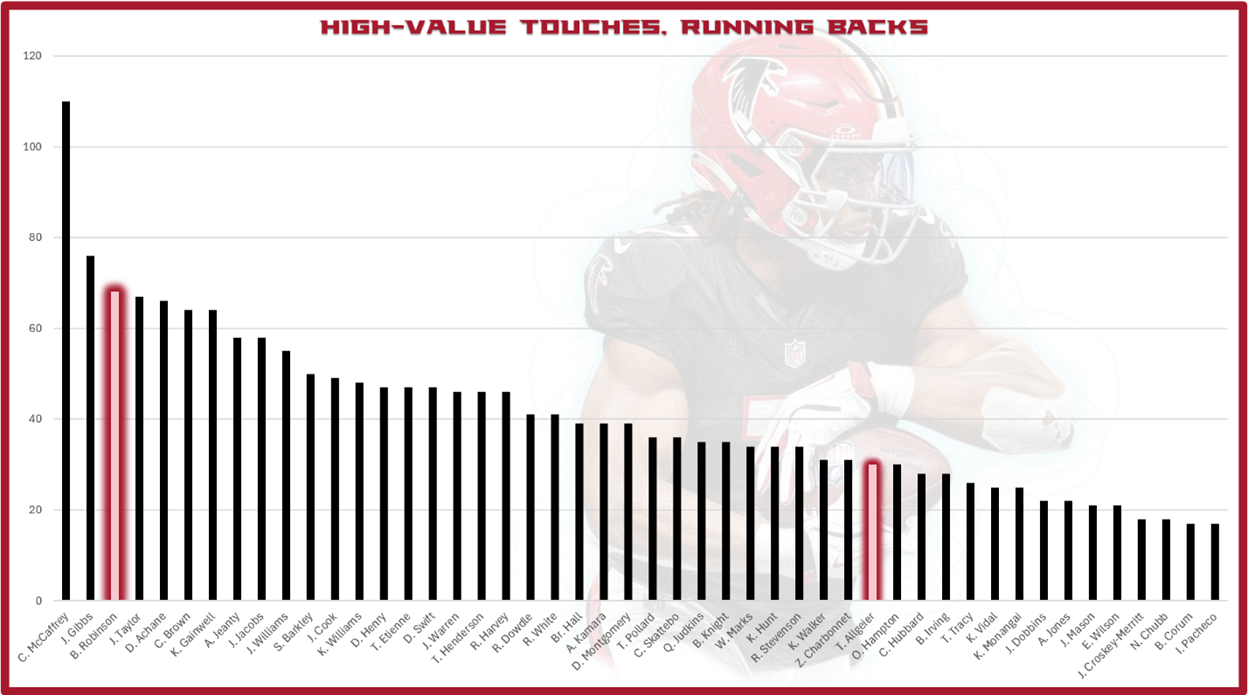
Robinson is such a prominent pass-catcher that he can’t help but be among the league leaders in high-value touches (HVTs); he ranks third with 68, trailing only Christian McCaffrey and Jahmyr Gibbs. RB Tyler Allgeier ranks only 35th in gross HVTs (18), but 24.8% of his total opportunities are HVTs, the 14th-highest rate.
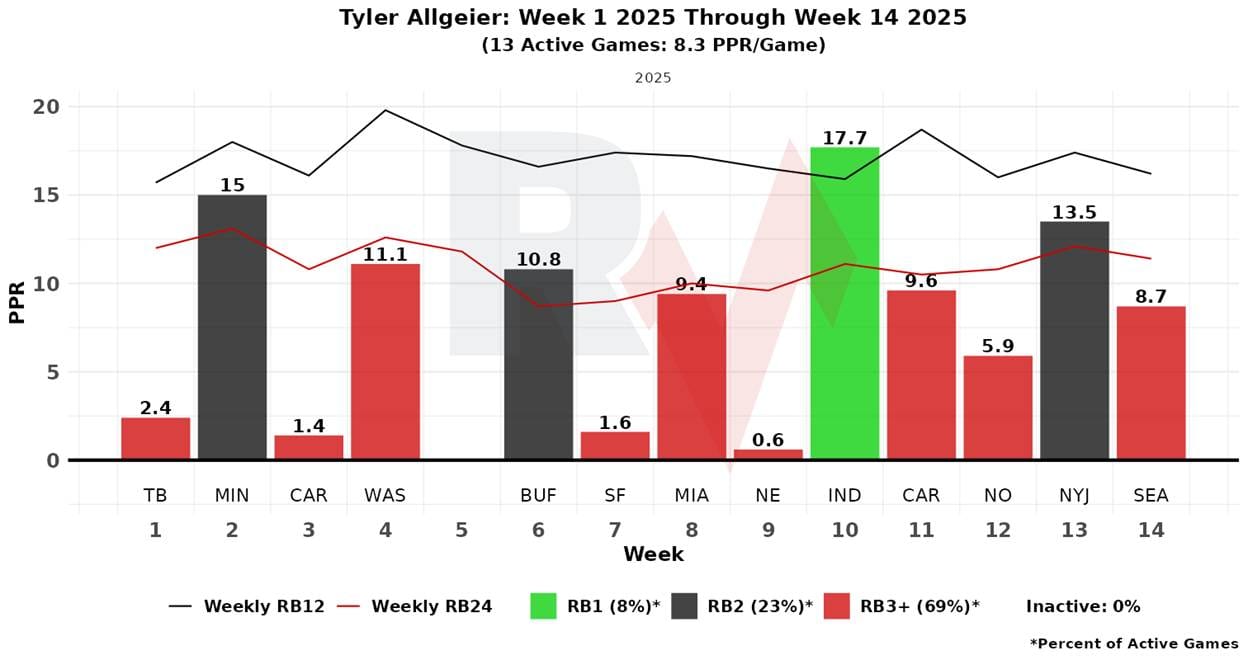
Allgeier is not much of an upside play, but since such a significant amount of his few touches are HVTs, he's constantly a threat to score on the RB2/RB3 fringe. His best fit would be as a low-tension flex or even a rotational RB2 for a zero-RB build in a deep PPR league that demands a lot of WRs.
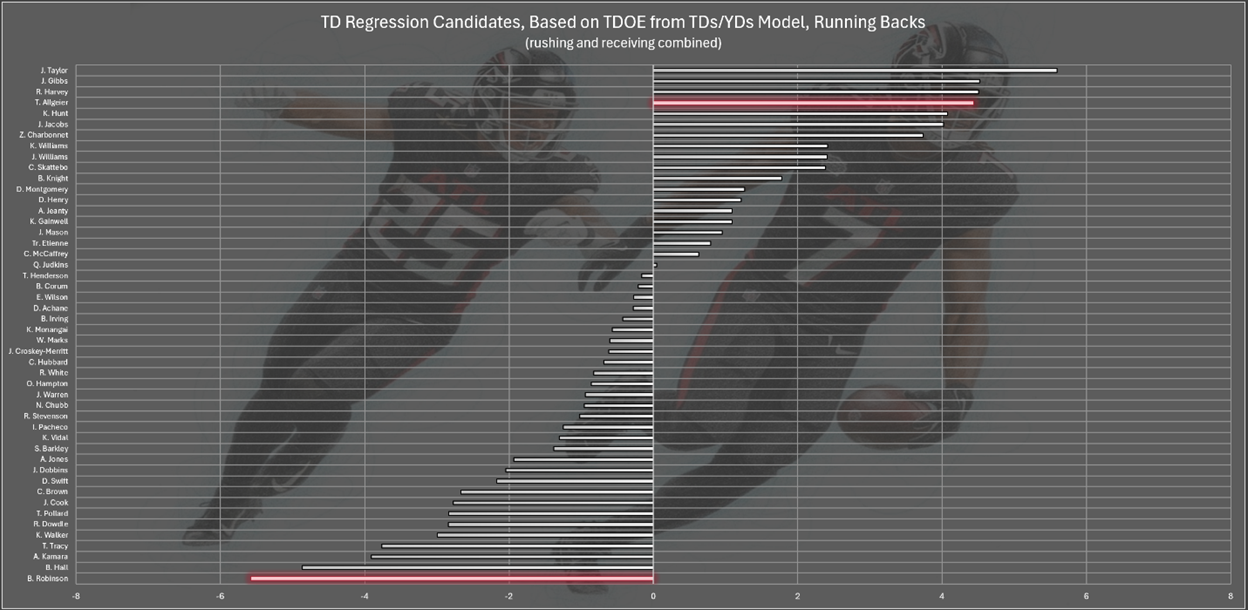
Based on TDs/Yds TDOE, Allgeier is among the most significant negative TD regression candidates, having scored roughly four TDOE. Robinson is the most significant positive TD regression candidate, having scored nearly five TDs under.
The Buccaneers rank fourth in EPA per rush allowed and defensive success rate on rushes. In their last five games, the Bucs have relinquished the 12th-most PPR points to opposing RBs. The immense imbalance between EP and FPOE we see here indicates that teams have not been using their RBs against Tampa Bay very often, but those who have have done well. Perhaps of particular interest to Robinson GMs is that the Bucs have allowed the fifth-most receiving yards to opposing RBs during that span.