Week 15 Walkthrough: To Chase a Dream

Welcome to the Week 15 Walkthrough.
In this article, I'll outline critical fantasy football context for the 15th glorious football Sunday of 2025.
(The stats below are from PFF, NFLfastR, rbsdm.com, RotoViz, FantasyLabs, Fantasy Life, Fantasy Points, ESPN, FTN, and NFL Next Gen).
PROE data is available for subscribers at the bottom of the post.
Quick Links
- Ravens at Bengals, 1 PM
- Bills at Patriots, 1 PM
- Chargers at Chiefs, 1 PM
- Commanders at Giants, 1 PM
- Raiders at Eagles, 1 PM
- Jets at Jaguars, 1 PM
- Cardinals at Texans, 1 PM
- Browns at Bears, 1 PM
- Packers at Broncos, 4:25 PM
- Lions at Rams, 4:25 PM
- Panthers at Saints, 4:25 PM
- Titans at 49ers, 4:25 PM
- Colts at Seahawks, 4:25 PM
Ravens at Bengals, 1 PM
Ravens
Implied Team Total: 27
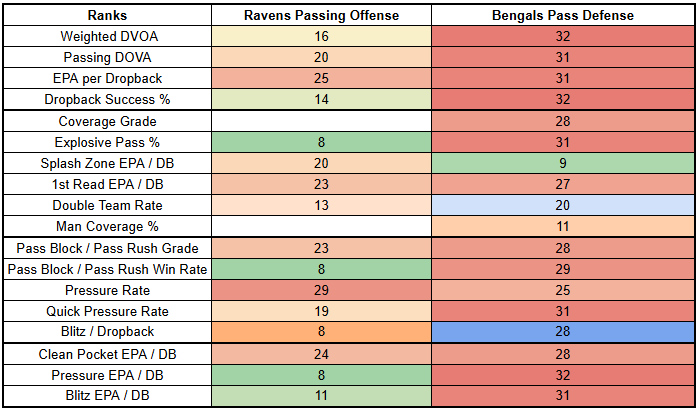
The Bengals' pass defense has been downright awful this year, and will now be without Trey Hendrickson for the rest of the season.
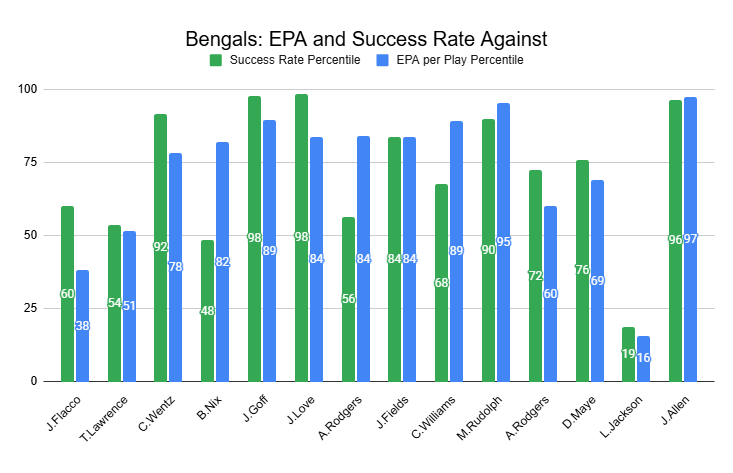
Since Week 3, everyone, and I mean everyone, has been efficient against the Bengals... unless you're Lamar Jackson.
Jackson spent the week between Bengals games turning in unimpressive efficiency against the Steelers.
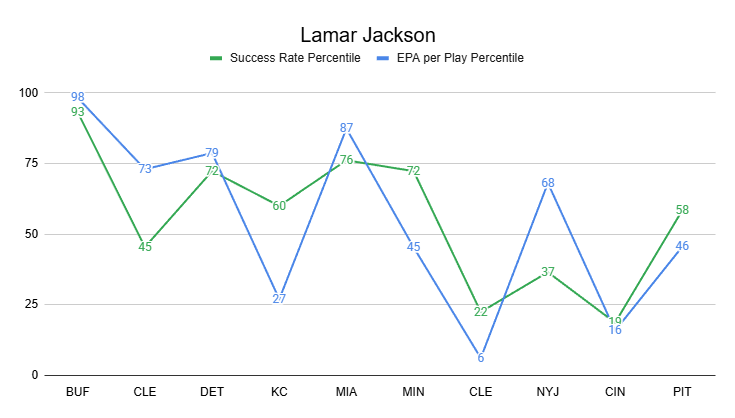
He's down to QB17 in EPA per game and QB20 in success rate.
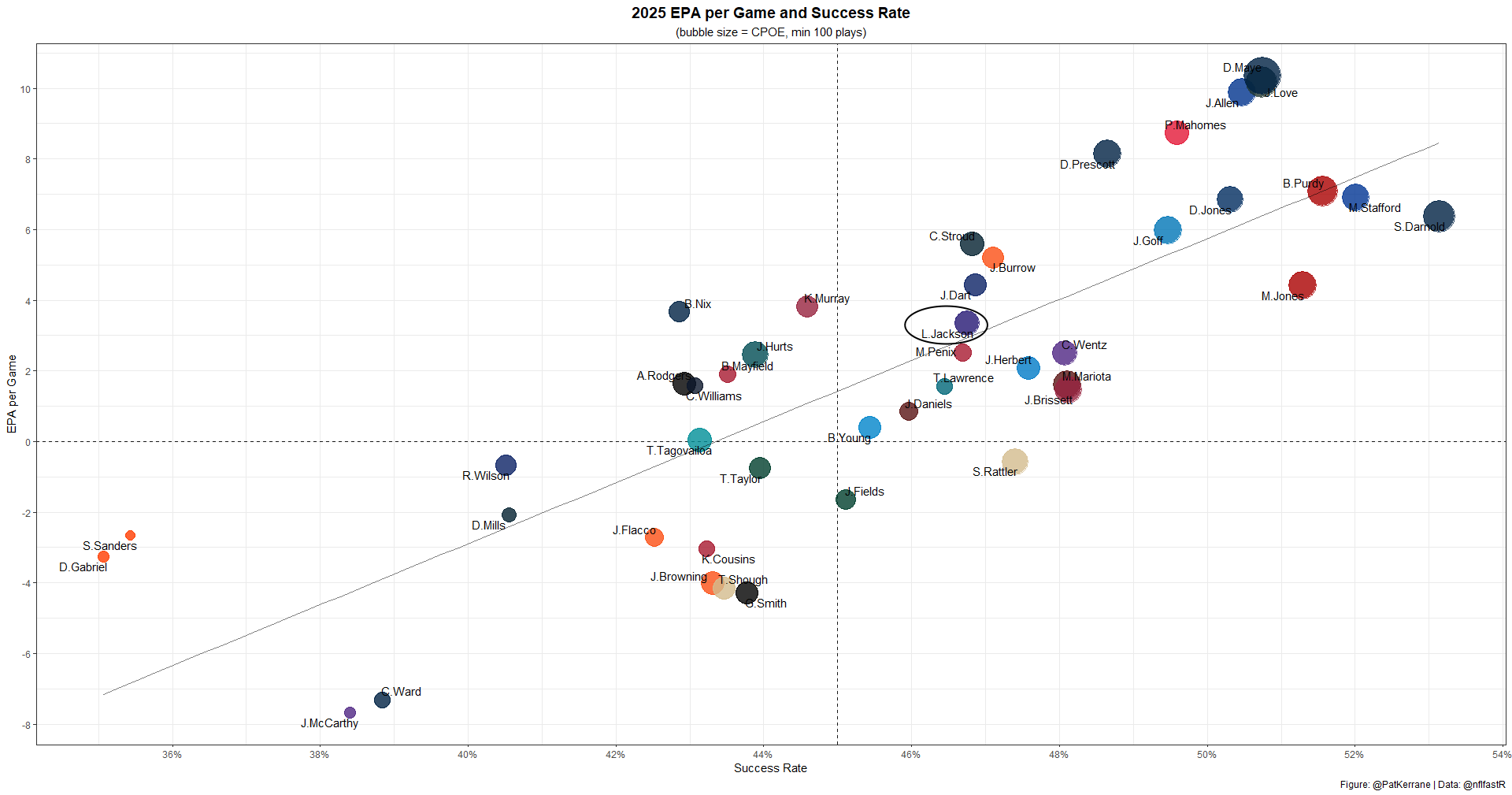
Jackson is locked into a disappointing season compared to the MVP-level performances he delivered in 2023 and 2024. However, it's still very possible he improves from here.
At the very least, he should be better against the Bengals in the rematch than he was in Week 13.
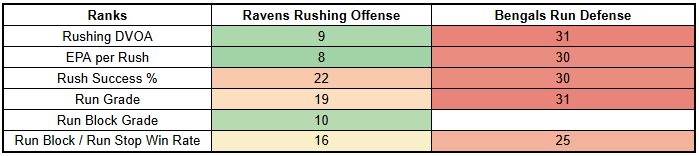
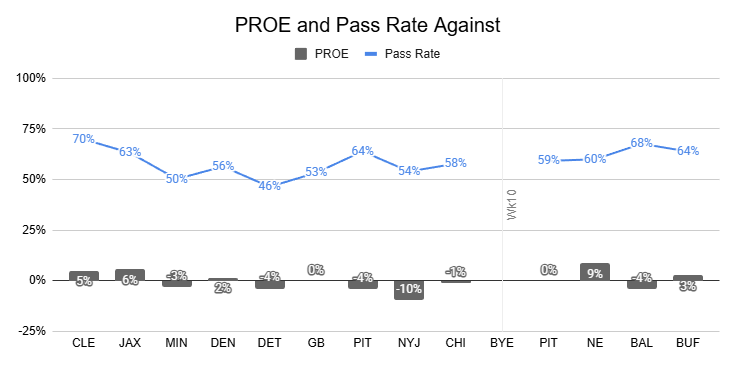
But even if Jackson dramatically improves this week, it's unclear how much pass volume he'll have to work with. The Bengals are nearly as bad against the run as they are against the pass.
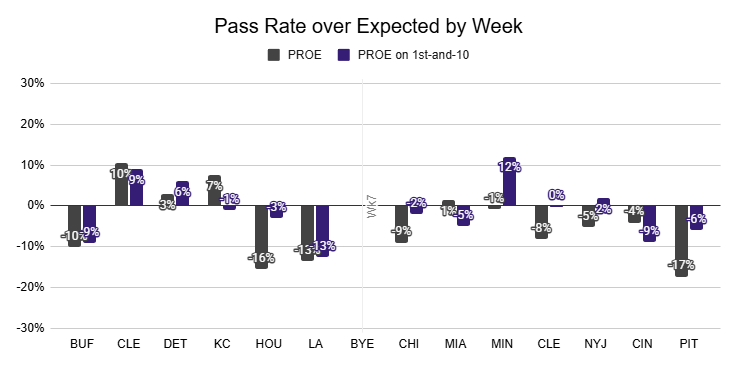
And in their 32-14 loss against the Bengals, the Ravens actively fought game script. Then, in their 27-22 loss to the Steelers, the Ravens were even more conservative.
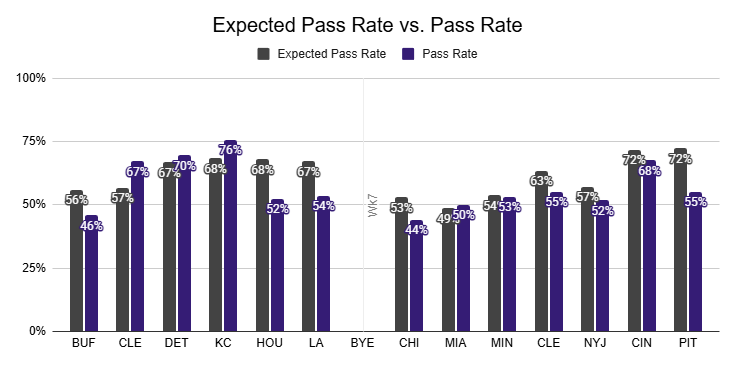
This led to a 55% pass rate in a game where the Ravens saw a 72% expected pass rate—tied with Week 13 for their highest mark of the year.
When looking at how other teams have played the Bengals, it's clear that you don't have to run on them. But given how the Ravens have operated recently, it's clear they will view this as an opportunity to get the run game going. That's especially true if, as 2.5-point favorites, they can play from ahead.
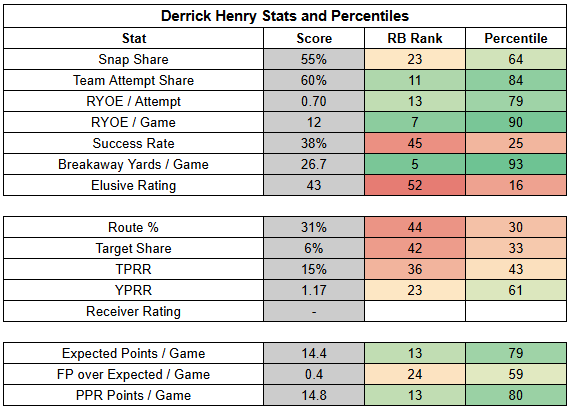
This sets up Derrick Henry for a strong workload. He has two outs here. Like last week, Henry can be fed targets in a game script where the Ravens would probably be better off passing—Henry saw 25 carries in the Steelers loss.
Henry's other out is that Jackson plays better this week, but with the Ravens still leaning on the run game against one of the worst run defenses in the league.
Henry's profile is TD dependent, but he's still in a strong enough setup to be an RB1.
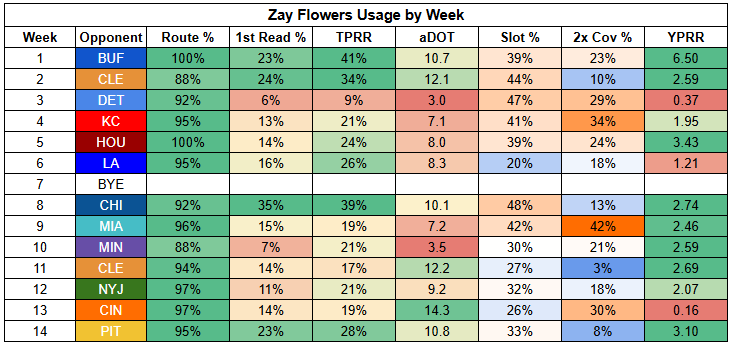
If Jackson returns to form this week, Zay Flowers should benefit in a big way. Even with Jackson disappointing, Flowers has been very consistent this year. Week 13 against the Bengals was one of his only inefficient games of the year.
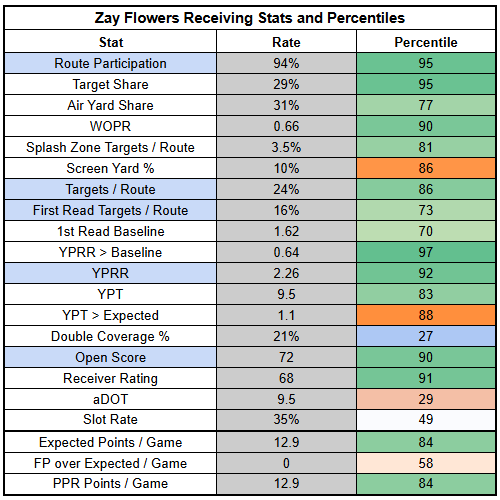
Flowers hasn't been a red zone weapon for the Ravens, which has lowered his ceiling. He's also attached to an underperforming QB in an offense that could be very run-heavy. So it's hard to get super excited about him. On the other hand, he's Lamar Jackson's clear-cut No. 1 WR in one of the softest matchups in recent memory. Flowers is a high-end WR2.
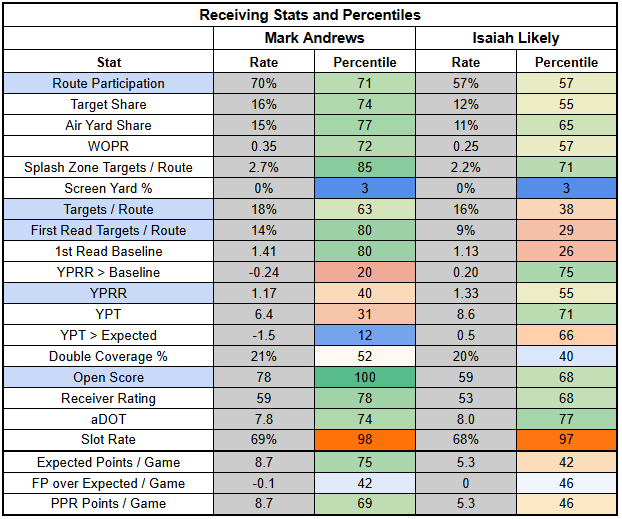
After inking a three-year extension with the Ravens, Mark Andrews posted a season-high 86% route participation. It makes sense; if they're going to pay him, he should at least be in a full-time role. Unfortunately, Andrews struggled to draw targets against the Steelers.
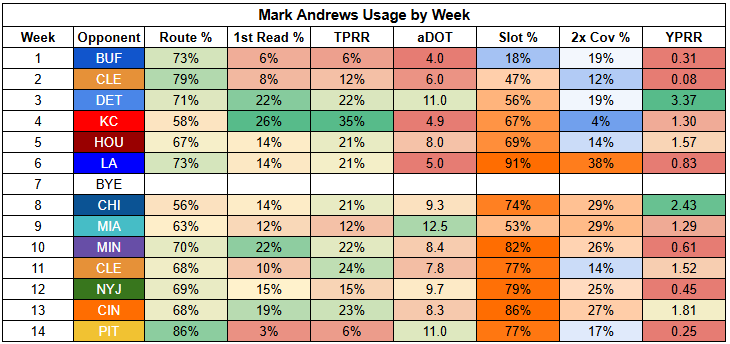
Isaiah Likely was more active on his routes and got in the end zone with a 4/25/1 receiving line on five targets.
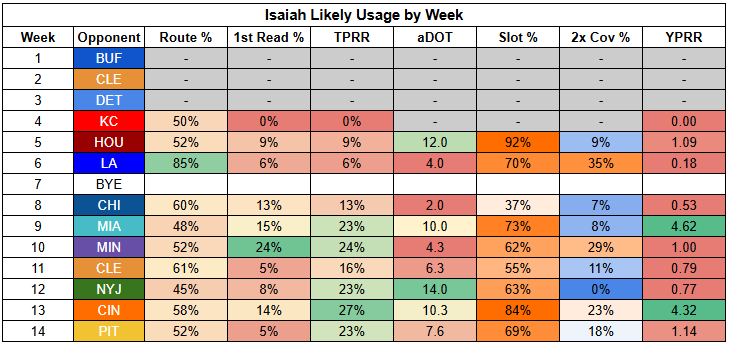
However, Andrews' per-route target profile has been stronger than Likely's this year, and he's a much stronger bet for routes. Andrews is a low-end TE1.
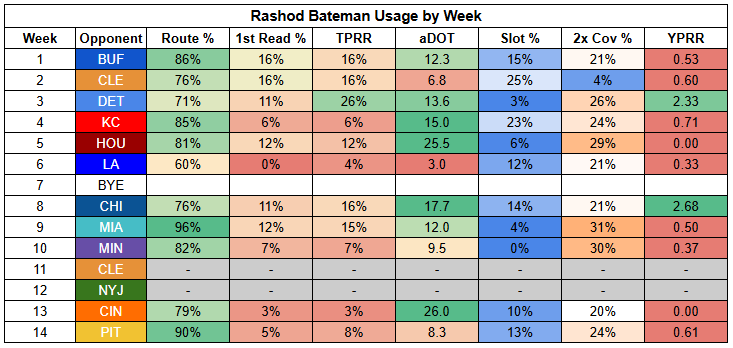
Rashod Bateman is where I get off the train.
Bengals
Implied Team Total: 24.5
Joe Burrow very nearly led the Bengals to victory against the Bills last week. Even with two interceptions that ultimately swung the game to Buffalo, he turned in his best marks in EPA per play and success rate of the year.
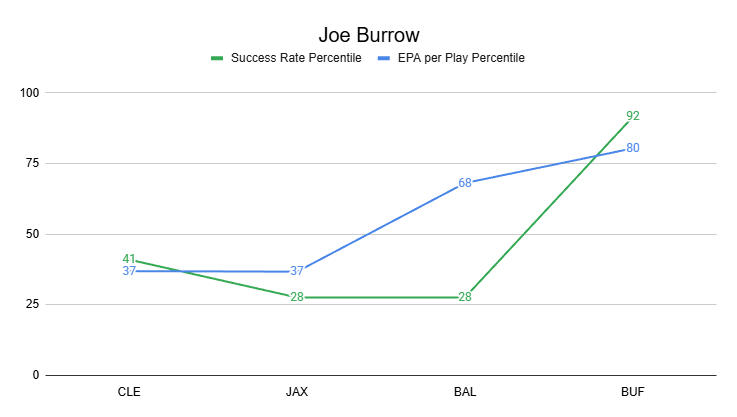
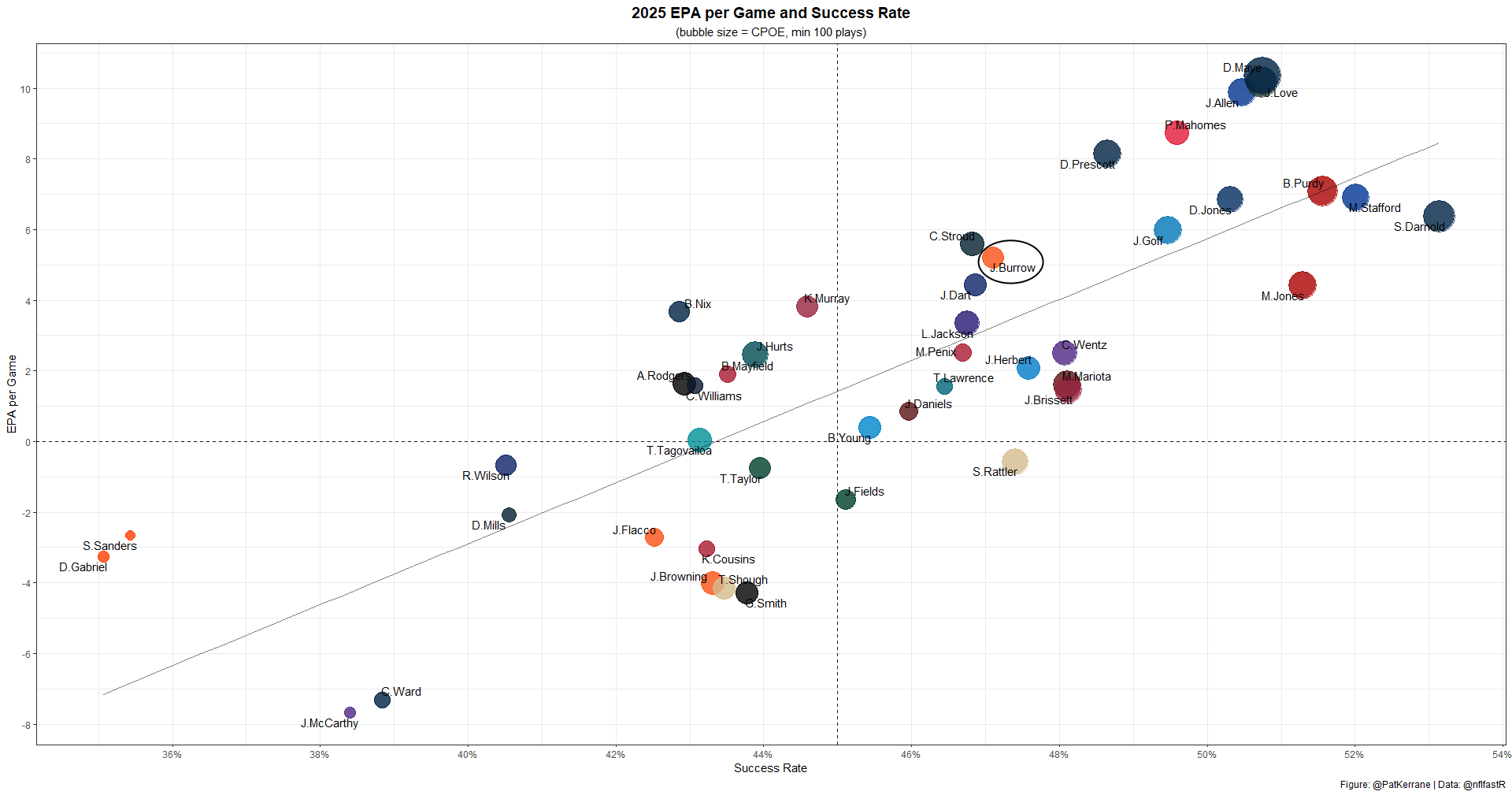
Burrow ranks QB12 in EPA per game and QB17 in success rate, which are disappointing marks by his standards. But last week was a sign that he may be returning to his 2024 form.
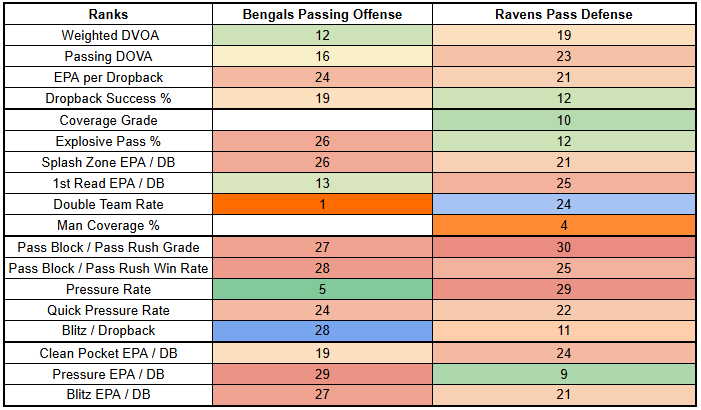
The Bengals' offensive line continues to be a significant issue. But last week, against a Bills defense that was without Joey Bosa and may have struggled for footing in the snow, Burrow faced just a 24% pressure rate, the second-lowest of the week. The Bills also ranked 20th in quick pressure rate on the week (18%).
The Ravens' pass rush will probably be a bit more impactful, but not by much. In Week 13, they had a 22% pressure rate with a 22% quick pressure rate, and Baltimore has lacked pass rushing juice all season.
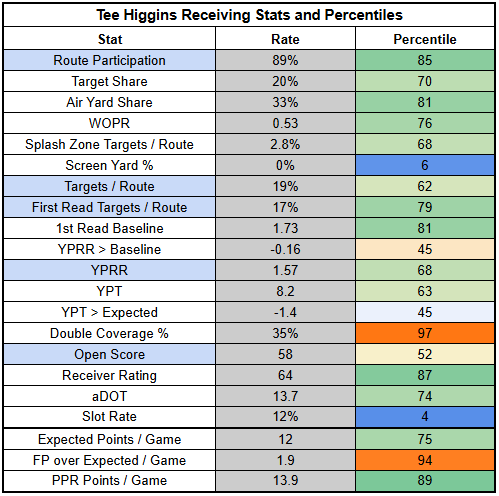
Burrow may have time to throw this week, but he will be down one of his best weapons. Tee Higgins is set to miss this game after entering the concussion protocol after Week 14. Higgins hasn't been as efficient as usual this year, but it's been a challenging season. He's still a significant loss.
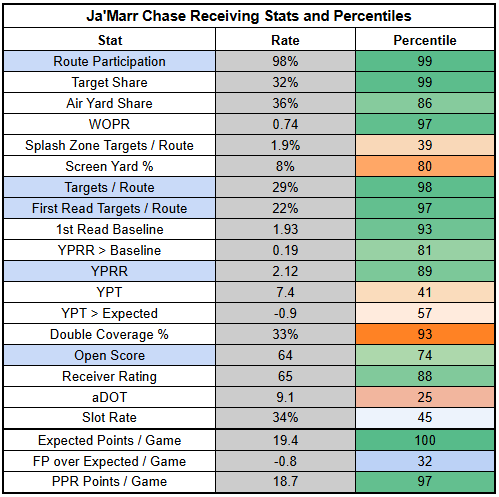
For Ja'Marr Chase, this is a double-edged sword. On one side, Higgins being out makes him the true focal point of the Bengals' passing attack. Burrow needs him to have a big game to get the win here. On the other side, though, Chase will need to operate further downfield than he has for much of the season, helping to stretch the defense with the Bengals' top deep threat out of the lineup.
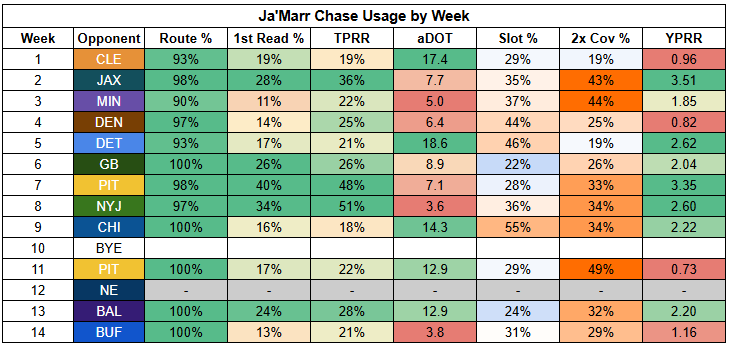
In Week 13, it's hard not to feel that Tee Higgins' absence hurt Ja'Marr Chase on some level. Sure, he saw 14 targets, going 7/110/0, but Chase wasn't as efficient as we know he can be.
But it's also hard not to feel like Burrow left some meat on the bone on Thanksgiving.
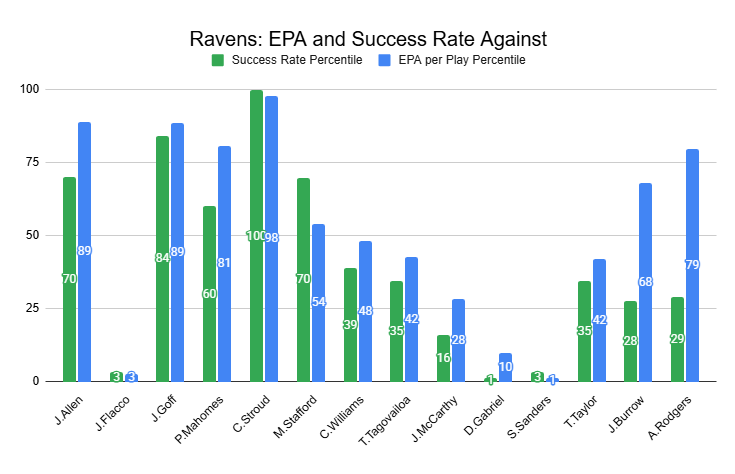
In his first game back from injury, he wasn't able to deliver high-end efficiency. But this defense has yielded EPA per play marks in the 75th+ percentile against five different QBs. Last week, they had Aaron Rodgers looking like he never left Green Bay.
Ultimately, Chase is an all-world WR whose offense will be built around him. And I do mean the offense, not just the passing game.
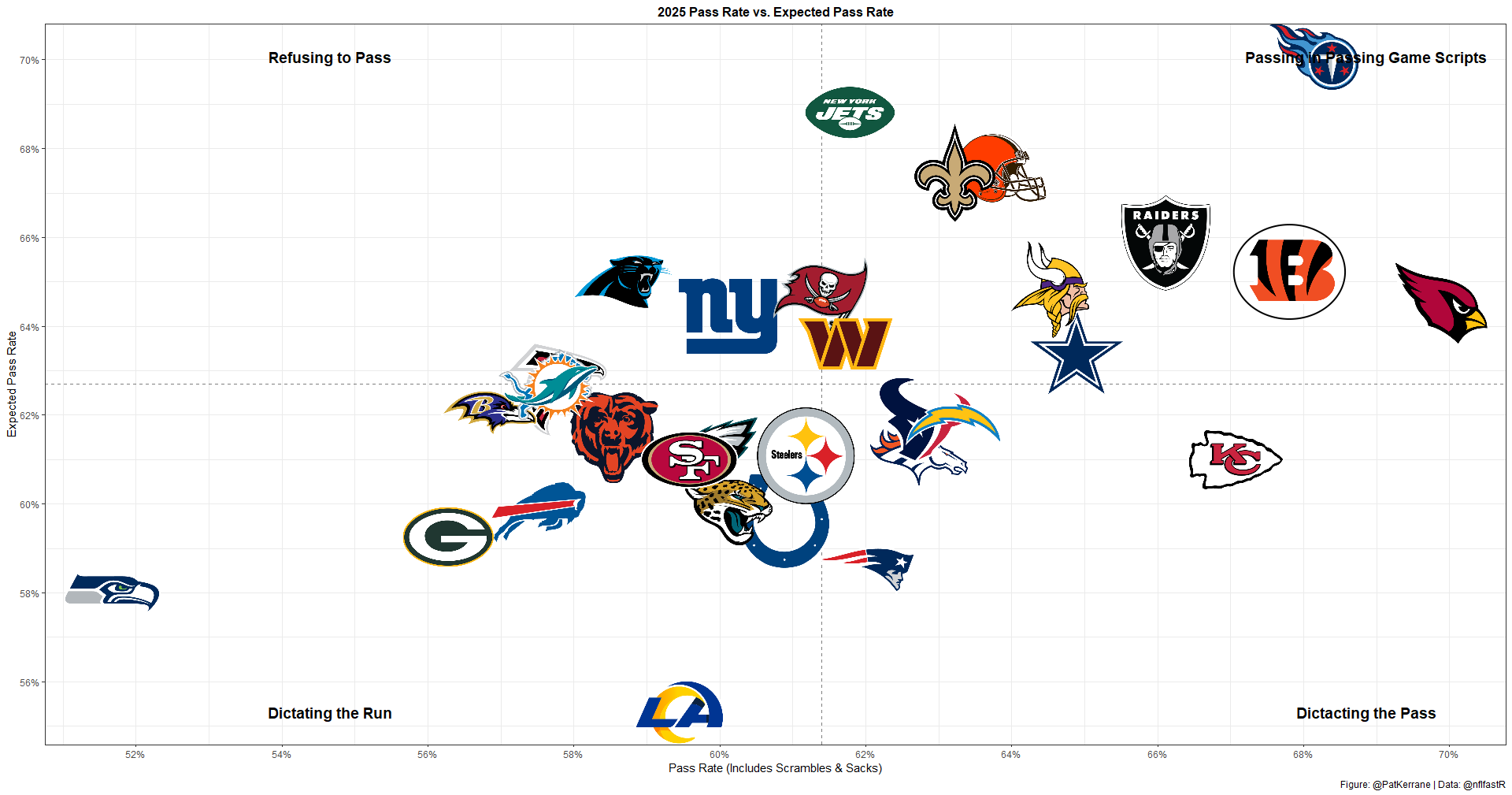
Zac Taylor has continued playing his pass-heavy brand of football, even with Burrow out for much of the year. Only the Cardinals (70%) and Titans (68%) have a higher pass rate than the Bengals this year (68%).
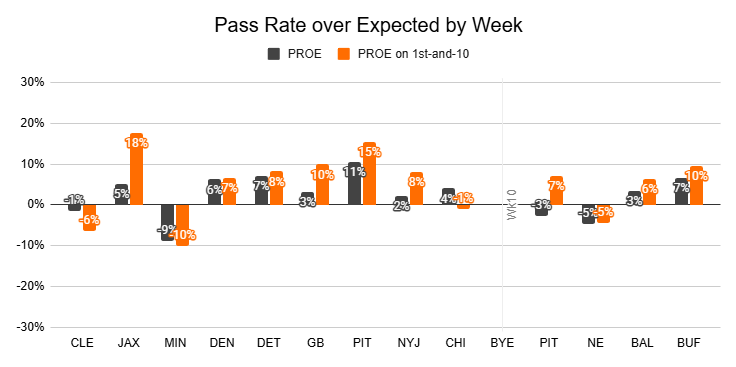
And over the last two games, the Bengals have been leaning into the pass both overall and on 1st-and-10.
With the Bengals built to get Chase the ball and in a matchup where Burrow should have time to throw, Ja'Marr Chase is an elite WR1.
With Tee Higgins out against the Ravens in Week 13, Andrei Iosivas was elevated into a full-time role, with Mitchell Tinsley operating as a part-time outside WR.
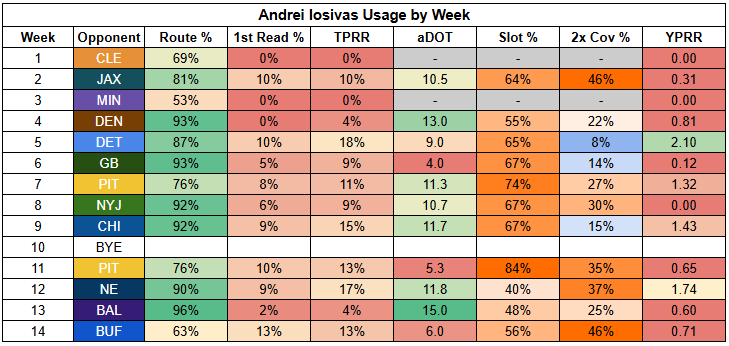
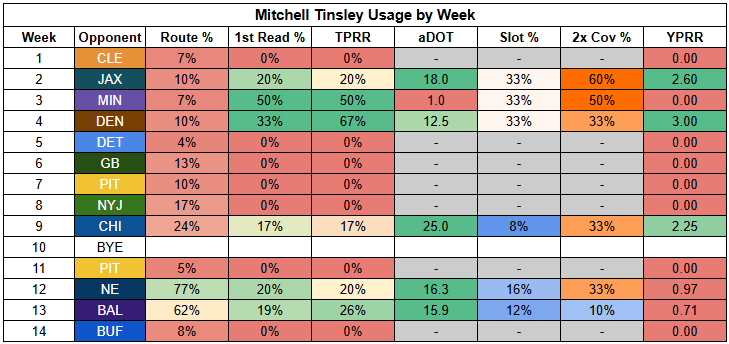
Unfortunately, neither player has been able to generate efficiency this year. Tinsley has at least drawn some targets and is a deep threat. That's enough to make him a dart throw, as is Iosivas' route participation, which should be at 90%+.
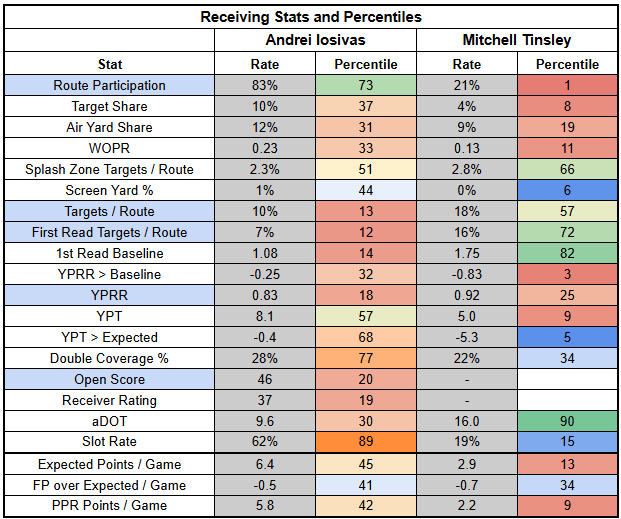
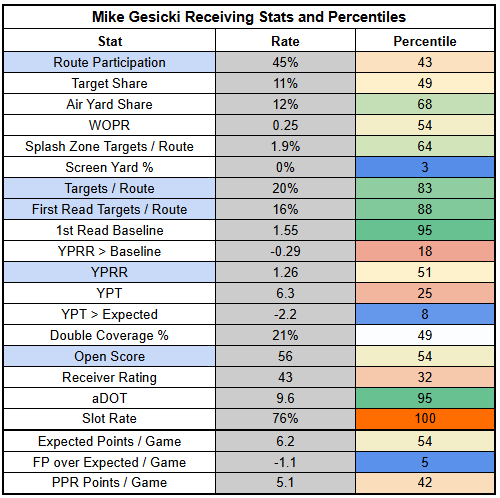
Mike Gesicki is a safer bet than both from a per-route perspective. Routes are an issue, however. Even against the Ravens, he was at just 40% route participation.
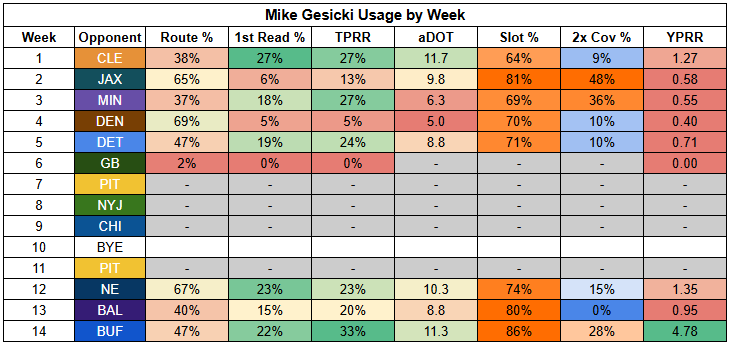
Geskicki is in a four-way tight end committee, with the Bengals also rotating in Noah Fant, Drew Sample, and Tanner Hudson.
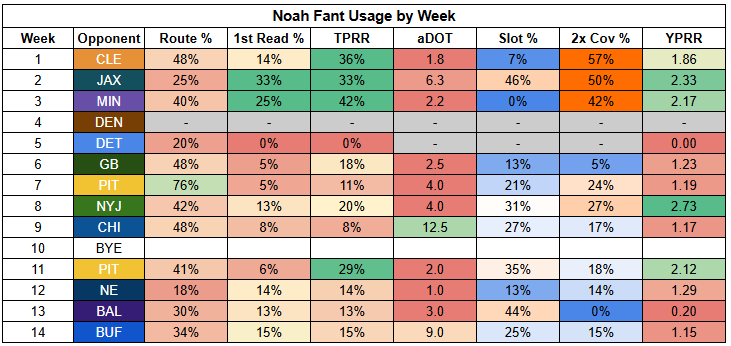
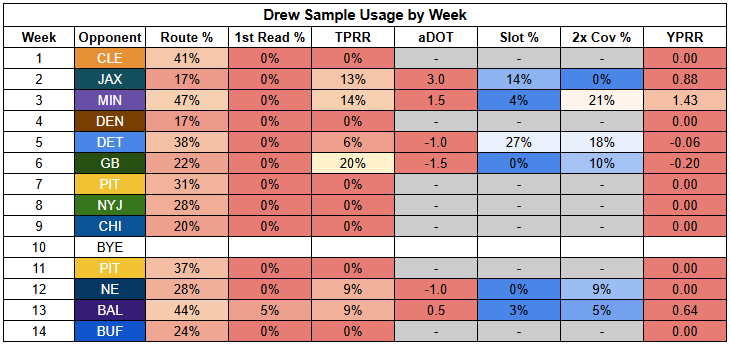
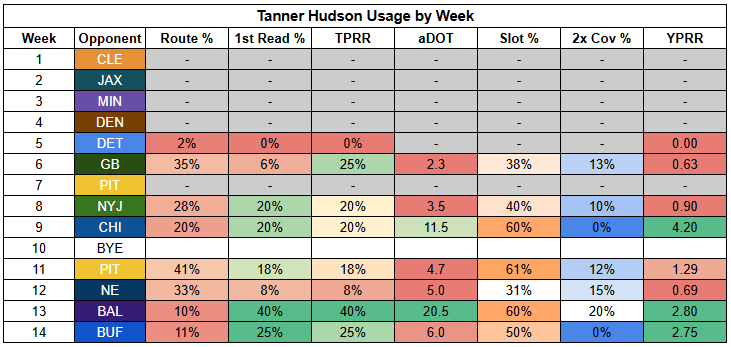
Gesicki should help pick up some slack with Higgins out, but there's only so much he can do if on the field for less than half of dropbacks. He's a high-end TE2.
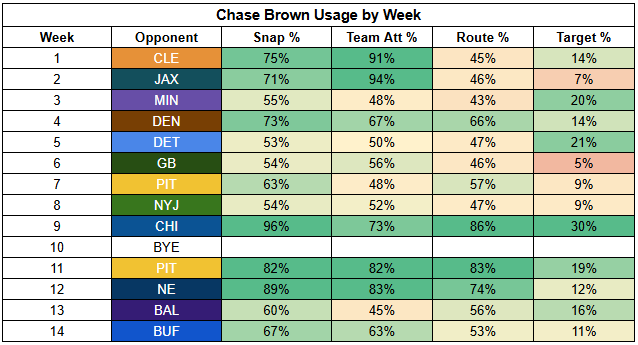
In the backfield, Chase Brown's role was a bit stronger than I was worried it might be against the Bills.
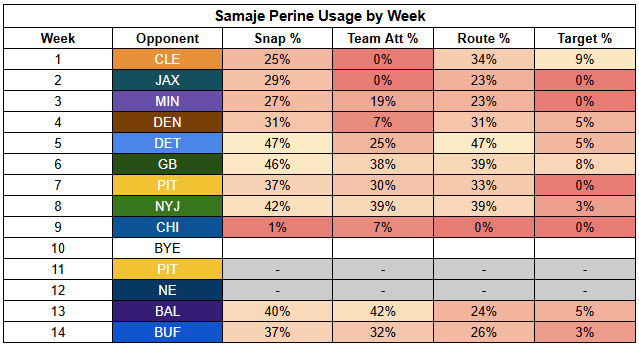
However, Samaje Perine continued to siphon away value.
Brown now gets a Ravens defense that has actually been pretty solid against the run.
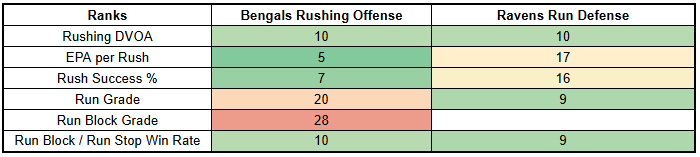
Brown won't have the full backfield here, which isn't great, given his weak efficiency this year.
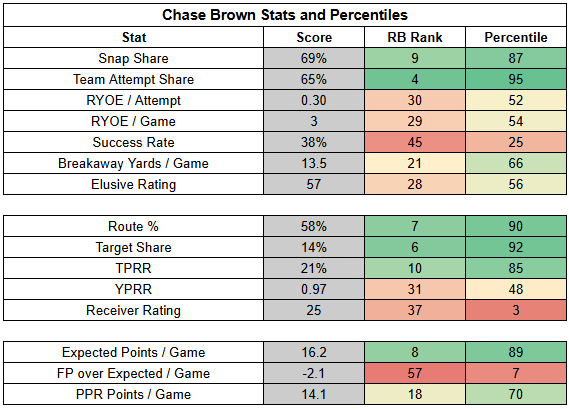
However, Brown is also a lead RB on a team with a 24.5-point implied team total. And, given that he has a solid receiving role, it's also helpful that this game has a 51.5-point total. Brown is more fragile than he used to be, but he's still an RB2 in this game environment.
Bills at Patriots, 1 PM
Bills
Implied Team Total: 26
It seems like the MVP conversation this year is really about who is having the coolest season relative to expectations. Matthew Stafford is having a great year, but with an elite defense, a generational offensive mind at head coach, and two of the best WRs in football, I'd argue he's putting the Rams over the top more than putting the team on his back. Even in New England, it's clear that Mike Vrabel and Josh McDaniels have had a transformative effect. Drake Maye is having an incredible year, but is now being aided by his situation rather than succeeding in spite of it. Can we say the same for Josh Allen?
It's hard to argue that any player is more valuable to his team than Allen. When he's asked to put the team on his back, he typically does... and then some.
One of the Bills' biggest issues this year is that they've actively deprioritized Allen's efficiency. Their -9% PROE on 1st-and-10 is the second-lowest in the NFL. Only the Panthers (-12%) are lower. There are reasons to run a Josh Allen offense like you have Bryce Young at QB... but none of them are good.
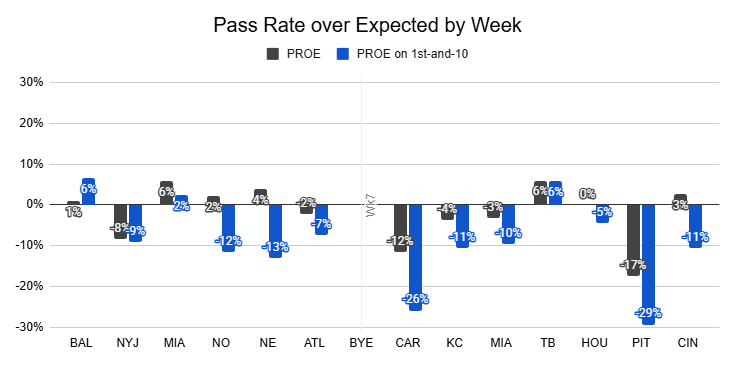
We've also seen the Bills frequently pass less than expected overall, most notably in losses to the Falcons and Dolphins.
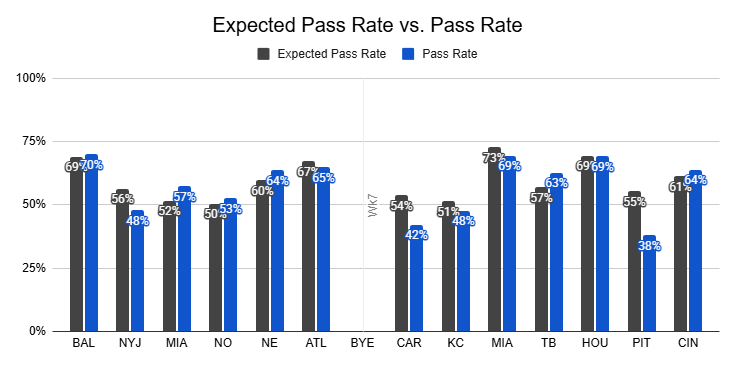
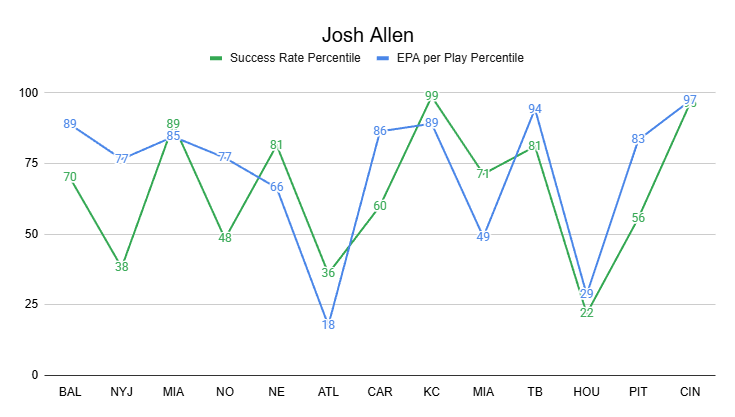
This creates a ceiling-limiting effect for Allen in most weeks. But last week was yet another reminder that we doubt his ceiling at our own peril. Even with limited dropback volume and severely lacking WR firepower, Allen ranks QB3 in EPA per game. He's also QB7 in success rate.
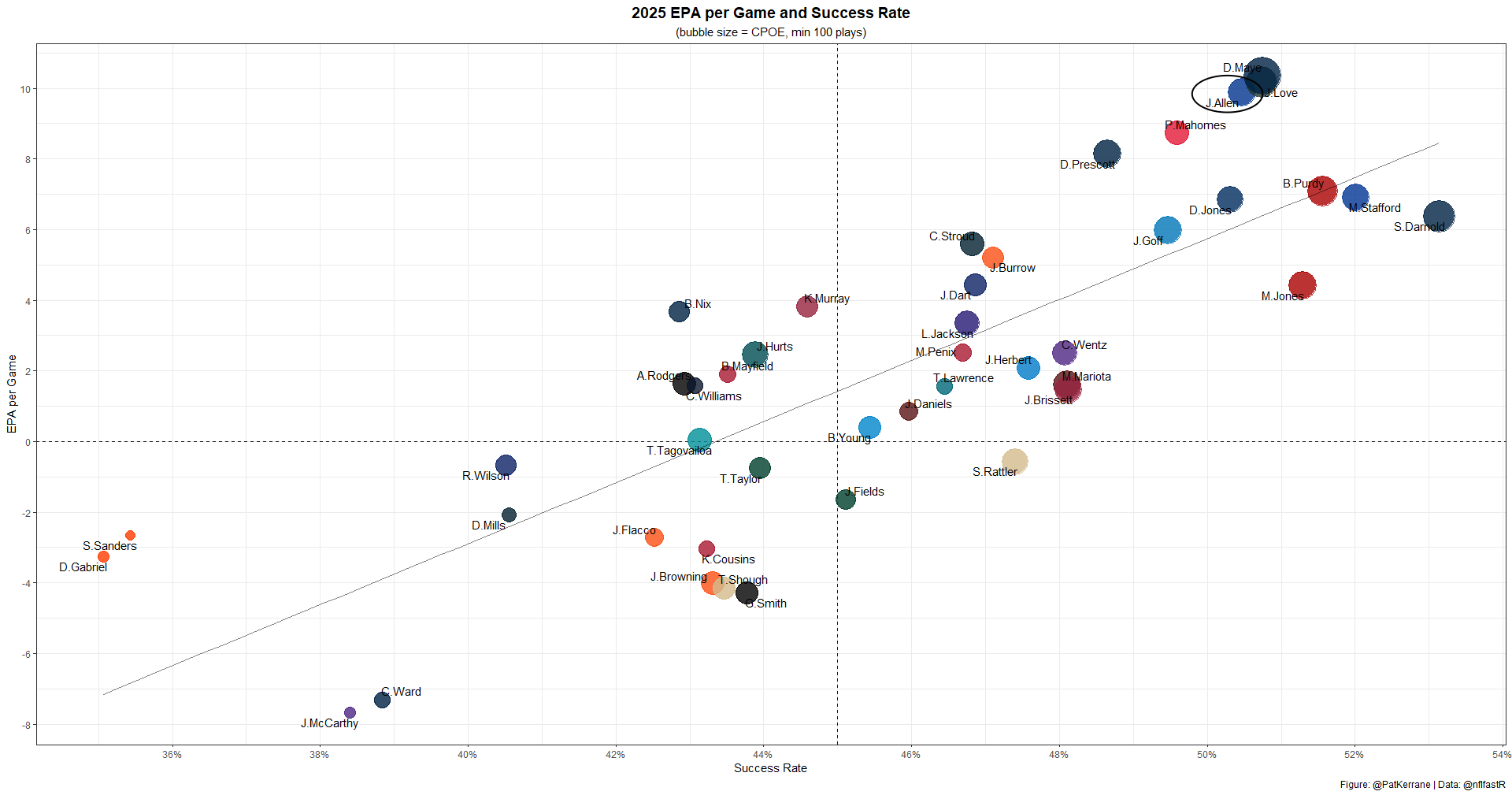
Allen is operating efficiently within the structure of the Bills' offense, ranking QB5 in EPA per play on first-read dropbacks. But he's been a true difference maker when reading the field and making plays; he leads the NFL in EPA per play on non-first-read dropbacks.
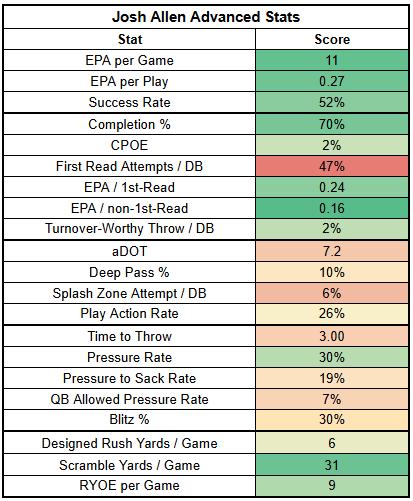
Allen now faces a Patriots defense that has been strong in coverage this year and, by EPA per play, looks like a challenging test.
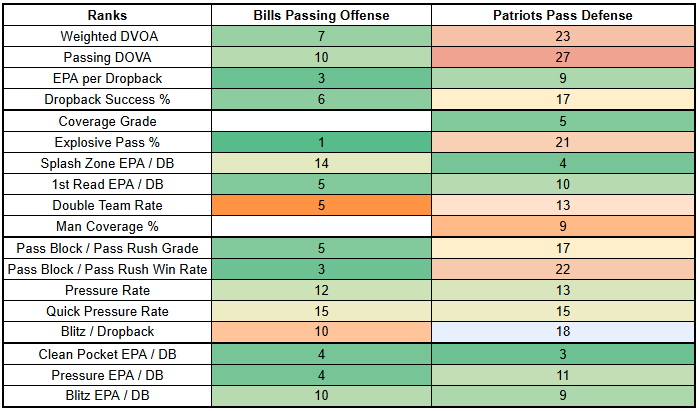
However, the Patriots' passing DVOA probably tells the more accurate story. Especially with star interior pass rusher Milton Williams on injured reserve, the Patriots' defense looks pretty unimposing.
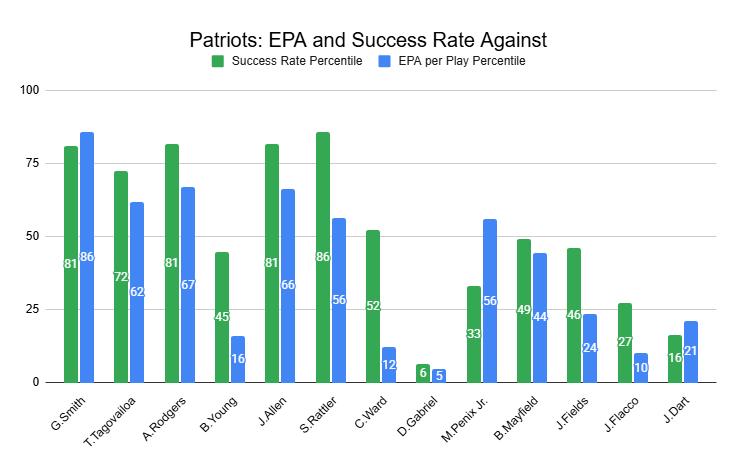
The Patriots offense has faced some challenging defenses this year—I largely reject the schedule narrative when it comes to Maye's performance—but the Patriots defense does look like a bit of a schedule merchant. And Allen was just fine against them in Week 5.
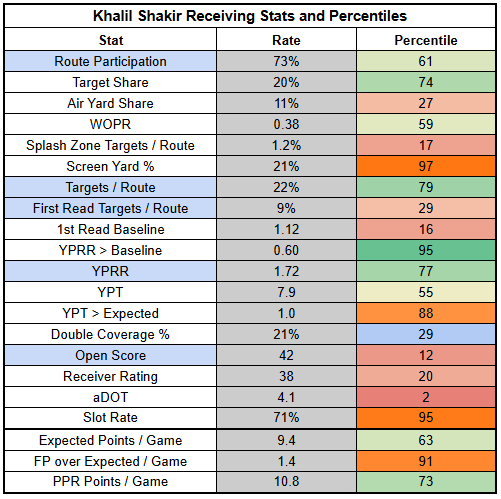
The hope for the Bills' passing game is that the Patriots' offense can push this into a back-and-forth game. Theoretically, a shootout environment should generate more 11-personnel, which is hugely important for Khalil Shakir, who plays primarily out of the slot. However, even last week wasn't enough of a shootout to push Shakir into a full-time role.
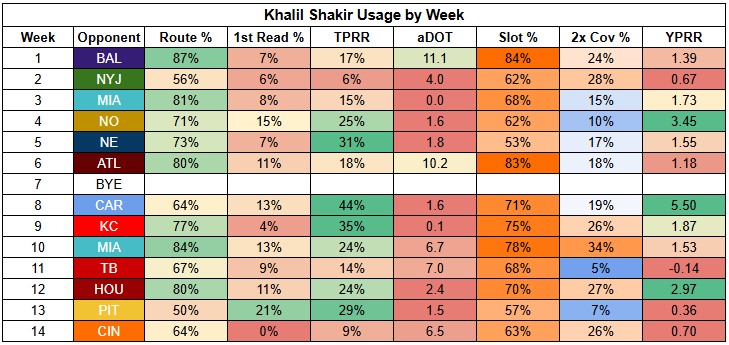
Shakir has been efficient when on the field, but he looks increasingly like a boom/bust bet in an offense where Gabe Davis, Tyrell Shavers, and Brandin Cooks are all getting significant run.
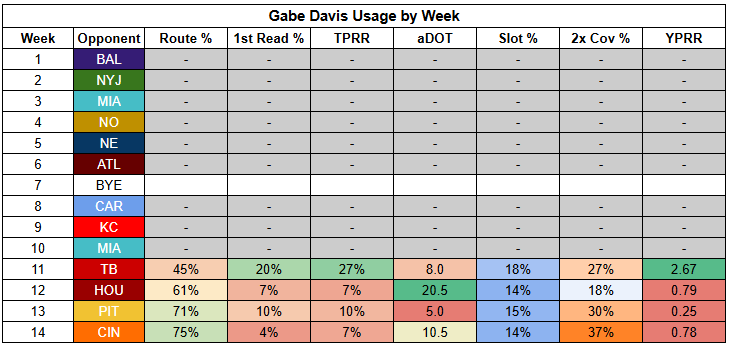
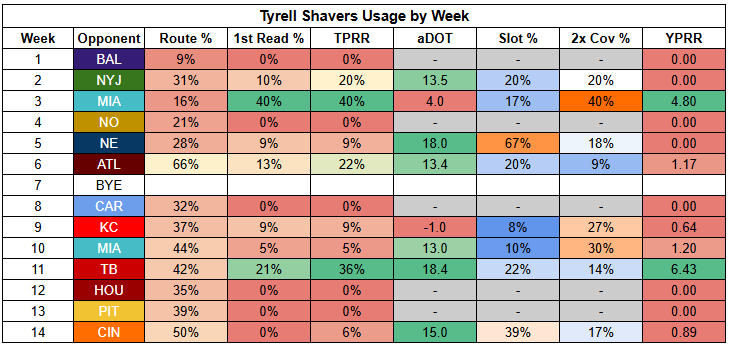
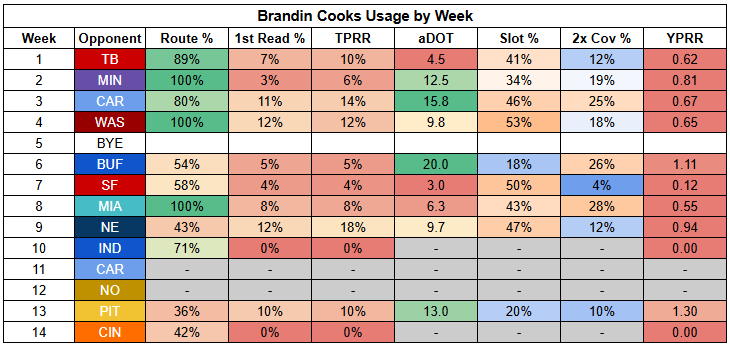
But, hey, at least he's playing more than Keon Coleman.
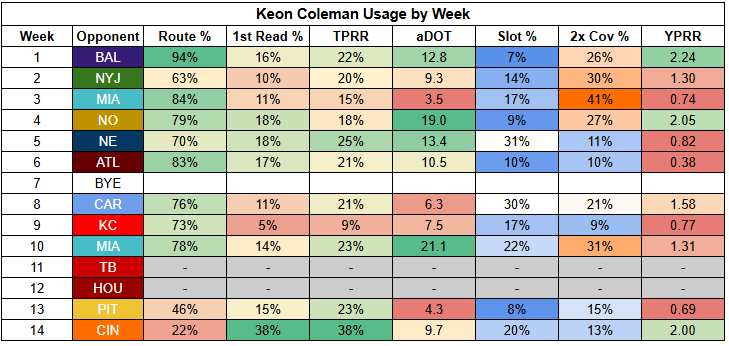
This game environment could create a bigger role for Shakir. But we could also be looking at a part-time receiver whose efficiency has been hit-or-miss. He's a WR4.
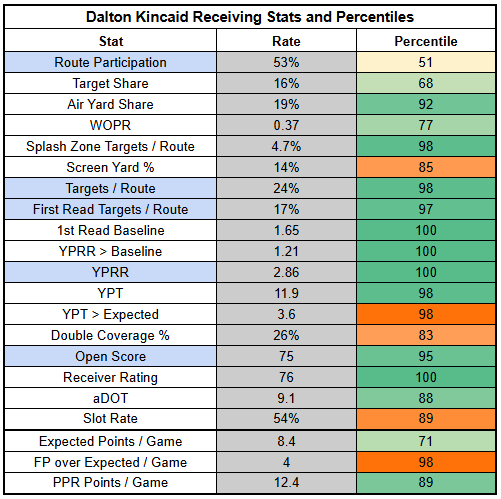
At tight end, Dalton Kincaid returned to the lineup last week and was in his usual role. Fortunately, that meant a strong target rate and impressive efficiency. Unfortunately, it also meant he was on the bench for roughly half of dropbacks.
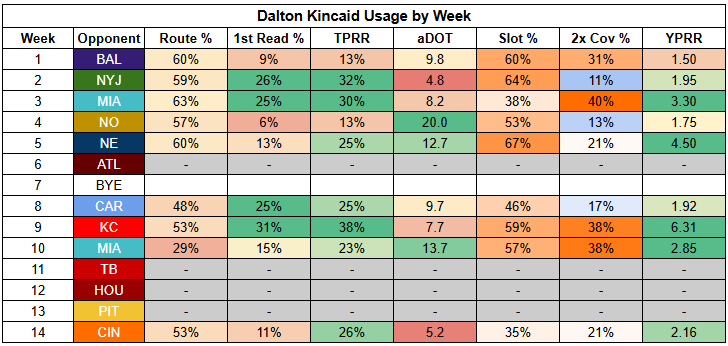
Kincaid has consistently been efficient on his limited snaps this year. This pretty clearly looks like a plan. Whether to keep Kincaid fresh or to get more blocking TE power on the field (probably both), the Bills have installed their best receiver in a part-time role. That's unlikely to change. But Kincaid has been efficient enough to still profile as a low-end TE1.
Even with Kincaid back last week, Dawson Knox led the Bills with six receptions and 93 receiving yards. However, his route participation took a big hit.
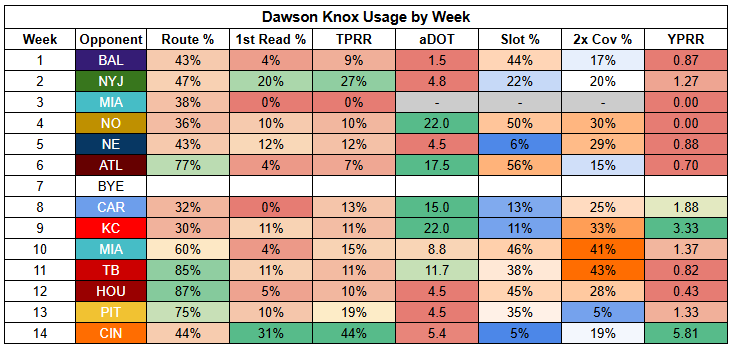
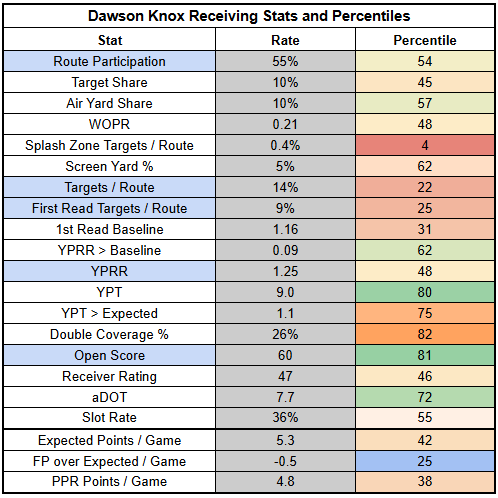
Knox has not been impressive this year, and his route participation is the stickiest element from last week's performance. He's just a TE3.
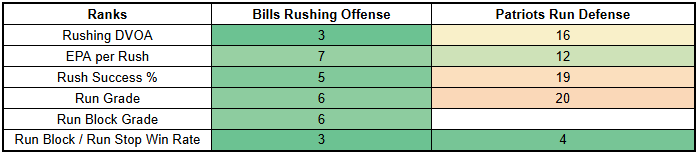
At one point this season, the Patriots' run defense looked to be a genuinely impactful unit. However, they've regressed to a more middling run defense at this point.
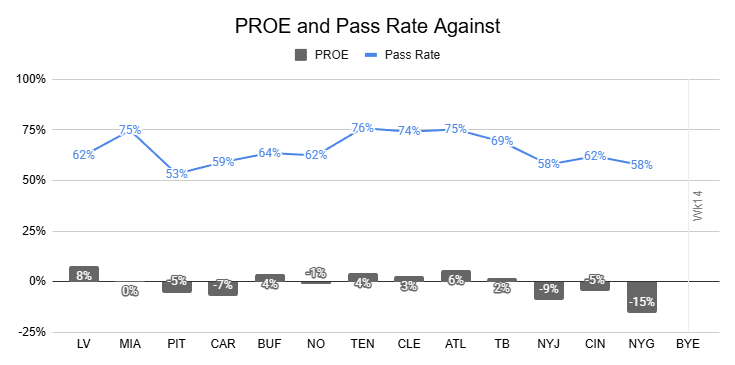
Likewise, the Patriots profiled like a bit of a pass funnel earlier in the year, but their last three opponents have not treated them like that at all.
With the Bills operating as a run-first, borderline run-heavy team, they are unlikely to be worried about the Patriots' middling run defense.
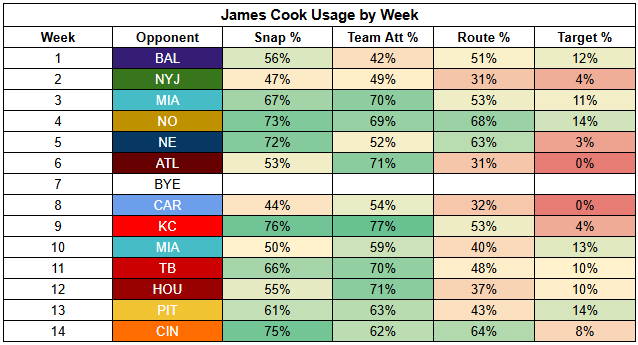
James Cook fumbled away an impressive fantasy day against the Bengals, but his underlying usage was strong.
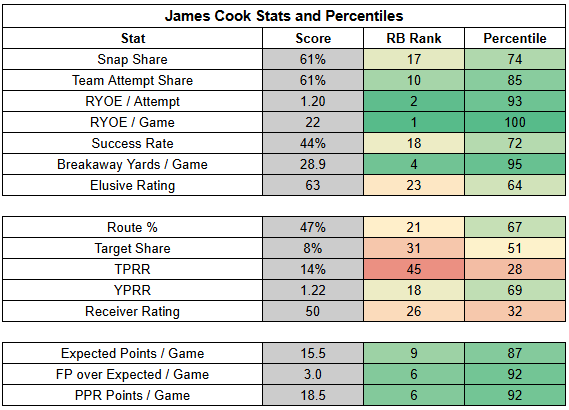
And even coming off a down week, Cook profiles as one of the best rushing bets in football. He's a locked-in RB1.
Patriots
Implied Team Total: 24.5
In the Patriots' Week 5 win over the Bills, Drake Maye turned in very solid efficiency.
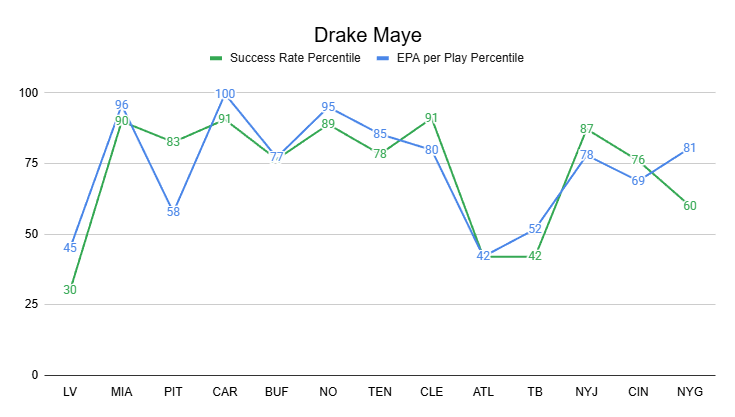
Maye has turned in stronger efficiency this year, but he managed several highlight throws against this defense, including this gem.
This throw by Drake Maye 🙏 pic.twitter.com/Wpdv5aArpm
— GhettoGronk (@GhettoGronk) October 6, 2025
In addition to "the schedule," the main anti-Maye talking point is that he doesn't have a 300-yard passing game this year. But that stat primarily highlights Maye's consistency. He's second in the NFL in passing yards this year behind Dak Prescott, despite not hitting 300 yards in a game—because he's hit 250 yards 10 times and has 200+ yards in every game this year.
Maye also leads the NFL in EPA per game and ranks QB5 in success rate. It's been a fun year.
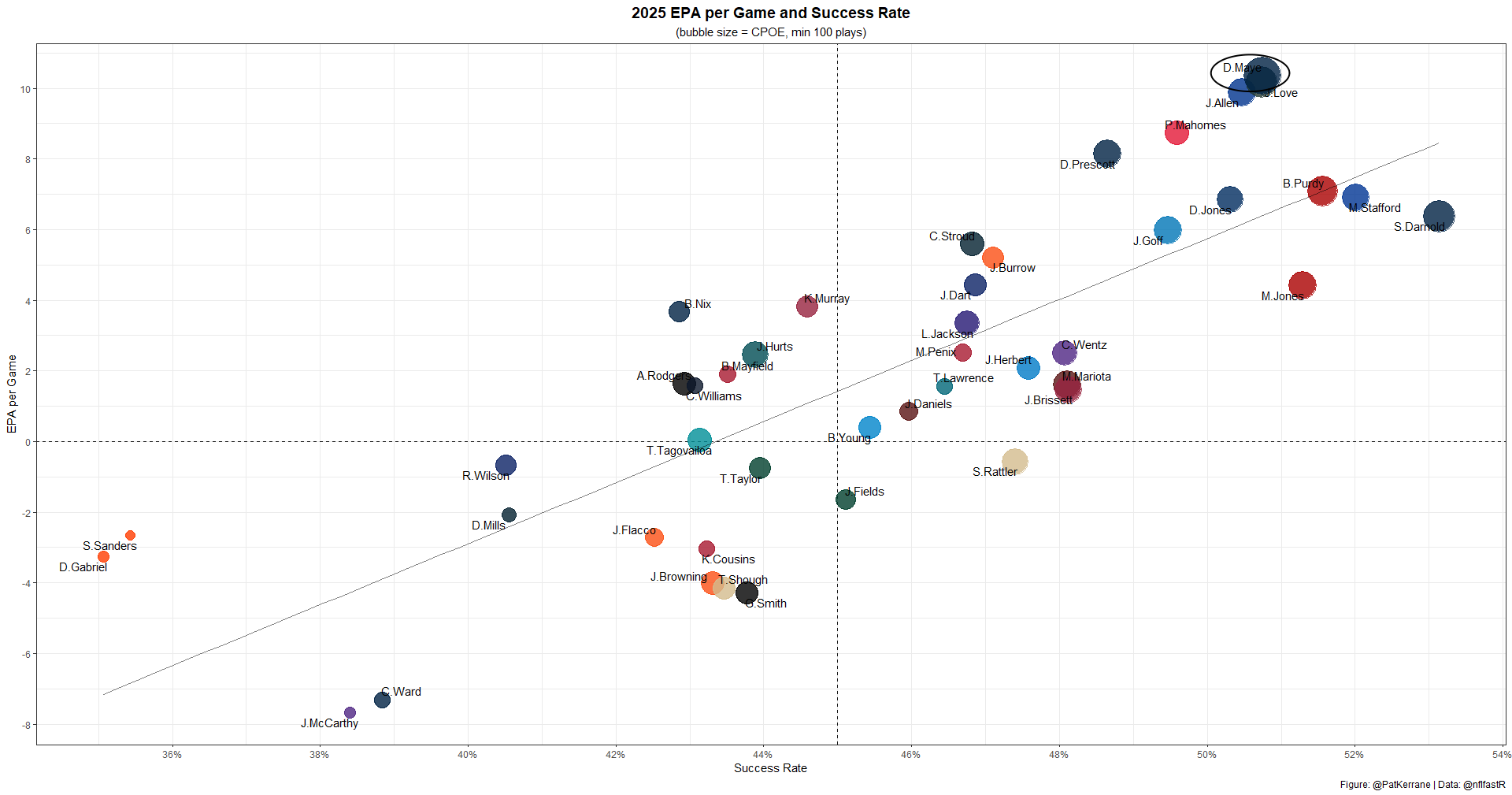
Maye's success is built partly on deep passing. But in that regard, it's more that he's incredibly accurate as a deep ball thrower rather than Maye being exceptionally aggressive. His 8.9 aDOT is fairly high, and his 10% deep pass rate isn't low, but we're not talking about a QB who's constantly big play hunting; he's able to make plays in structure. Only Jordan Love has a higher EPA per play on first-read dropbacks.
At the same time, when Maye works past his first read, he's been extremely efficient. Only Patrick Mahomes and Josh Allen have a higher EPA per play on non-first-read dropbacks.
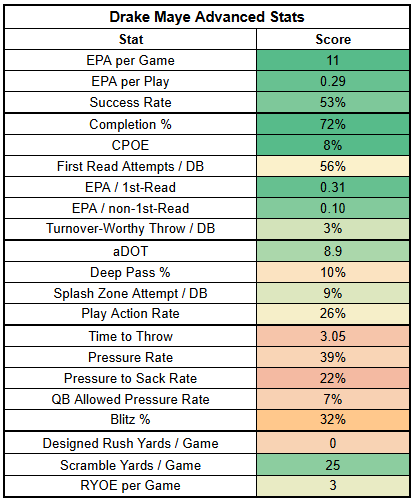
The red flag in Maye's profile is his ability to handle pressure. He holds the ball longer than most QBs, creating pressure for himself, and allows pressures to turn into sacks. This problem is exacerbated by the loss of LT Will Campbell (injured reserve, knee). Fortunately, LG Jared Wilson is set to return this week after practicing in full all week.
Fortunately, the Bills' pass rush isn't very impressive, especially without Joey Bosa, who missed last week's game against the Bengals. The Bills just had a very tough time pressuring Joe Burrow behind one of the worst offensive lines in the league, with just a 24% pressure rate, the second-lowest rate of the week. Bosa is back at practice, with limited sessions on Wednesday and Thursday. But even assuming Bosa returns, we're talking about a pass rush that can create some disruption but is unlikely to take over the game.
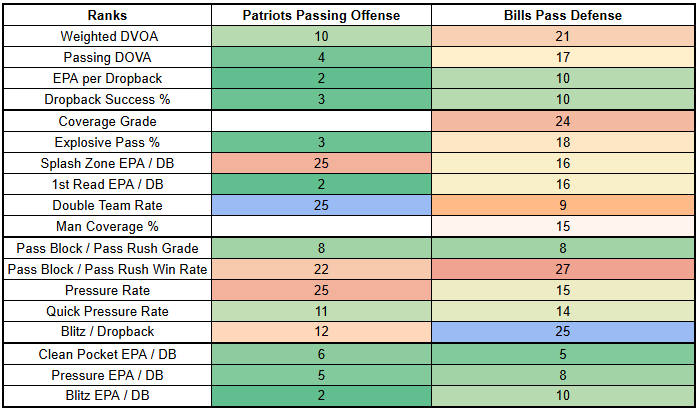
In fact, the Bills' pass defense has probably been hidden this year by a significantly worse run defense.
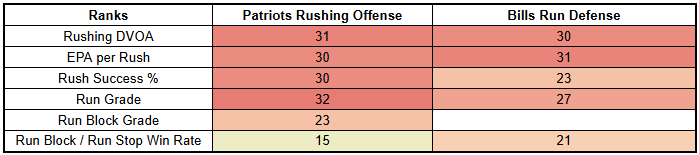
This has made the Bills a massive run funnel.

However, the Bengals just played a pretty typical Burrow-style game against this defense, turning in a 68% pass rate with a 7% PROE.
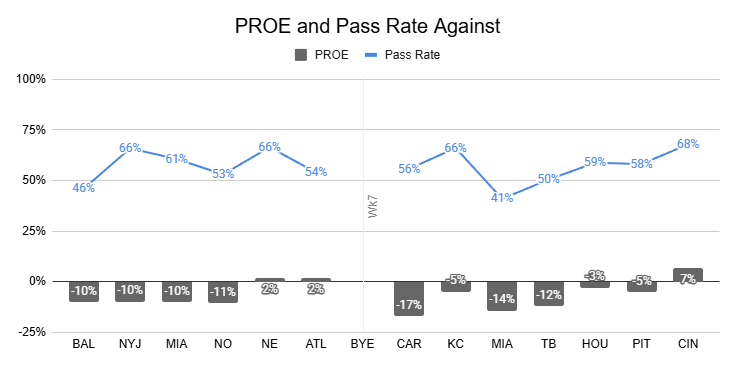
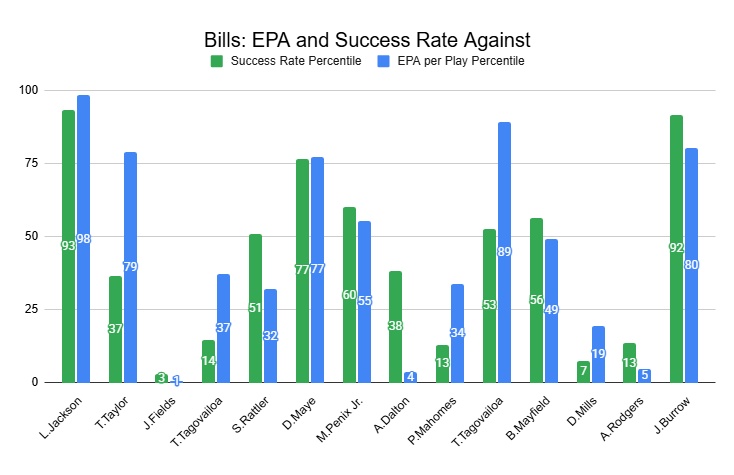
Despite two back-breaking interceptions to close the game, Joe Burrow was very efficient against this defense, turning in slightly better efficiency than Maye did in the first matchup. Clearly, you don't have to run on the Bills, even though it's an appealing option for run-first teams.
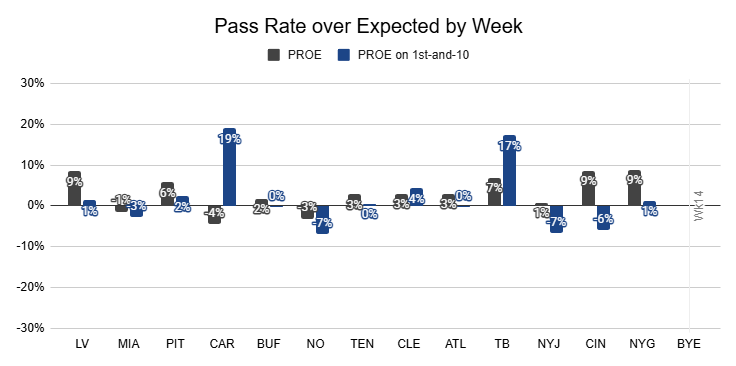
With a 3% PROE, the Patriots profile as a pass-first team this year and notably posted a 9% PROE against the Giants, who have a very weak run defense and a 2% PROE against the Bills in their first matchup.
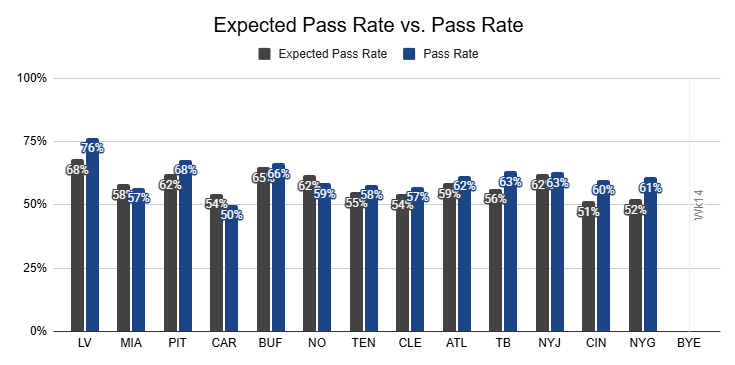
As an 11-2 team, the Patriots have had plenty of positive game script. But they have just a 62% pass rate, in line with the league average. They've rarely been truly pass-heavy, but they look capable of being pushed to the air—a distinct possibility as 1.5-point home dogs. The Patriots also look unlikely to back down from a Bills pass defense that is a challenge, but not particularly intimidating.
With dropback volume likely to be solid here, and with Maye likely to be solidly efficient, we'll have to see how much revenge Stefon Diggs has left in his heart. The last time he faced the Bills, he helped power the Patriots to victory with a 10/146/0 receiving line on 12 targets.
Over the last couple of games, Diggs' route participation has dropped; the Patriots may be trying to keep the 32-year-old fresh.
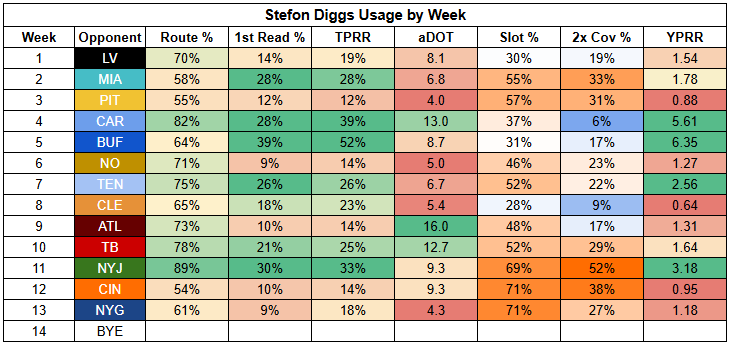
But Diggs has plenty in the tank this year when on the field, turning in an impressive 2.16 YPRR and profiling as an strong target earner and route runner. He's WR2.
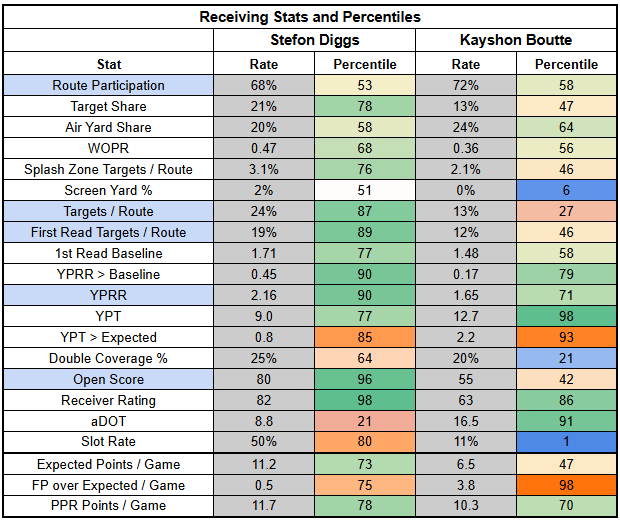
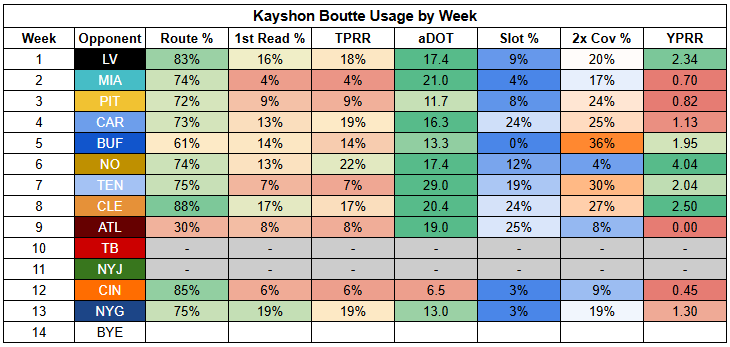
It's been a while since we've seen Kayshon Boutte turn in a strong YPRR, but he's back to running routes at a starter's level and is operating as the Patriots' primary deep threat. With Diggs potentially facing double coverage, Boutte is in play as a WR5.
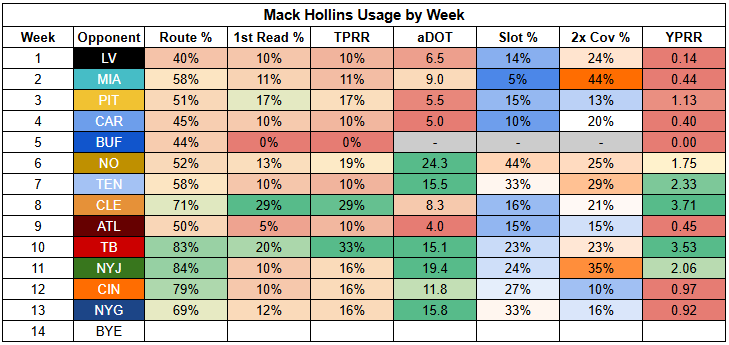
Mack Hollins will likely operate as the No. 3 WR, but Demario Douglas and Kyle Williams will be mixing in. Douglas, in particular, has been producing when on the field. He and Hollins are in the dart throw mix.
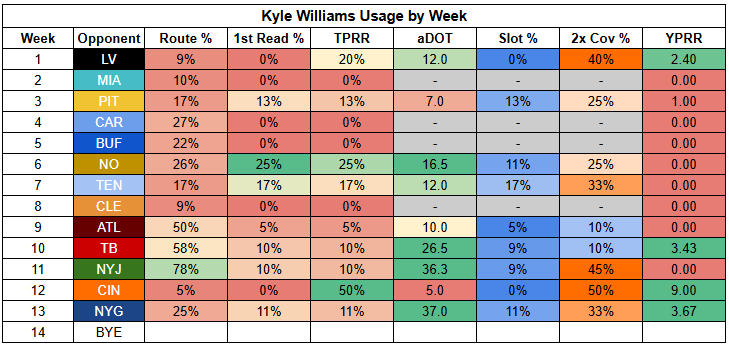
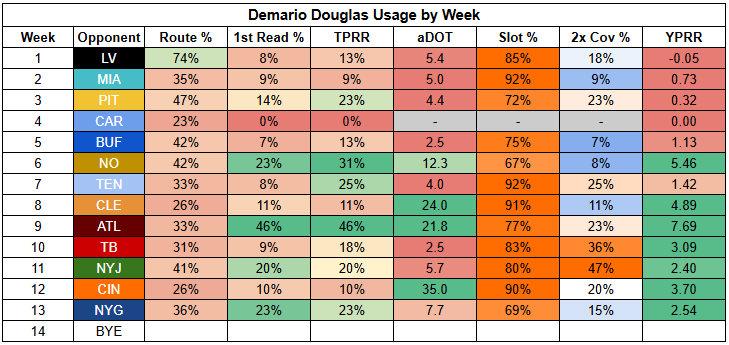
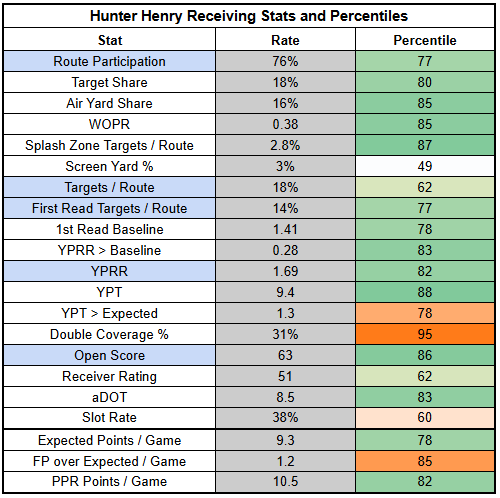
Outside of Diggs, Hunter Henry looks like the most reliable receiving option in New England, and he's coming off his two most efficient games of the year.
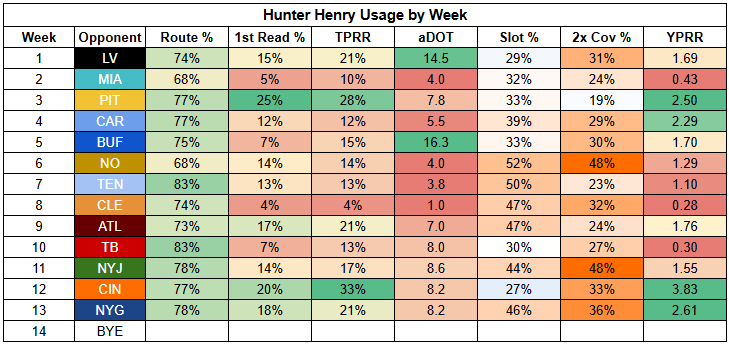
Henry's profile isn't elite, but he's very strong across the board, and in a game with a 49.5-point total, he's a TE1.
On the ground, I'm not expecting volume to spike the way it sometimes does against the Bills. However, it's definitely not a bad thing that the Bills have one of the worst run defenses in the NFL.
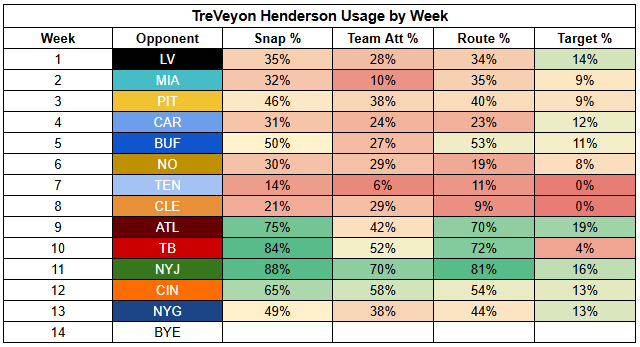
When the Patriots played the Bills in Week 5, Antonio Gibson was still a big part of the backfield. Rhamondre Stevenson was held to just seven carries, with Gibson and Henderson both at six.
Based on the Patriots' backfield usage against the Giants, this will likely be a split backfield, but with a two-way rather than a three-way split.
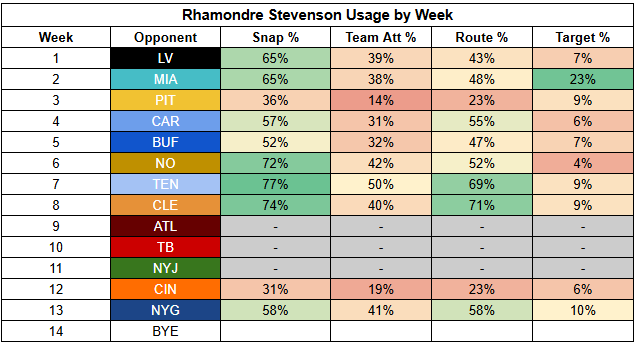
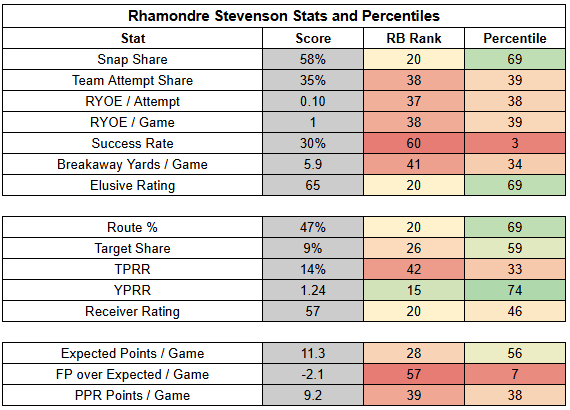
In theory, Stevenson is the thunder to TreVeyon Henderson's lightning. But we might need to start calling Stevenson "Silent Thunder" because he's been one of the least effective runners in the league this year, particularly in terms of success rate. He's an RB3 as a bet on a TD.
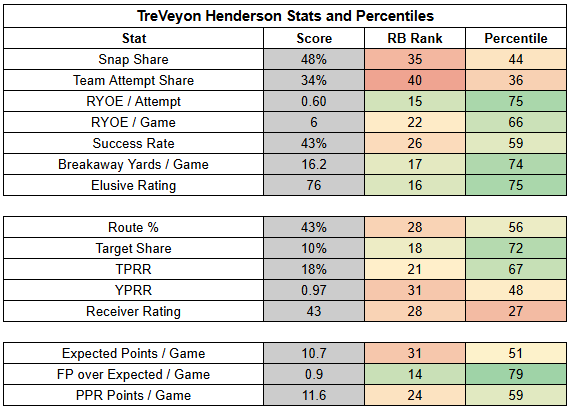
Henderson started the season as an extremely boom/bust runner but has become significantly more consistent over time and offers considerably more explosiveness. Unfortunately, while he's been a good receiver, Stevenson has been a good receiver as well, creating a split role there. Henderson is a low-end RB2 as a bet on his talent.
Chargers at Chiefs, 1 PM
Chargers
Implied Team Total: 18
Back in Week 1, Justin Herbert lit up the Chiefs' defense. At the time, it looked like a statement game. With the Chiefs now likely to miss the playoffs... I guess it was—just not the statement we thought at the time.
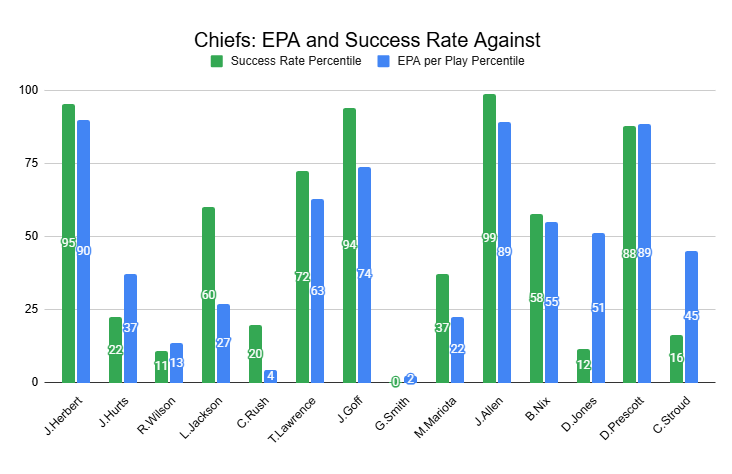
The Chiefs have had a very disappointing season, but their defense remains solid. In fact, with the Chargers' offensive line in shambles, the Chiefs' defense looks like a potential problem in this rematch. Since Week 1, the Chargers have lost RT Joe Alt, and they will also likely be without LT Trey Pipkins, who suffered an ankle injury against the Eagles and hasn't practiced yet this week. As CJ Stroud learned last week, this is a difficult matchup for a weak offensive line. The Chiefs turned in a 41% pressure rate against the Texans, the sixth-highest of the week.
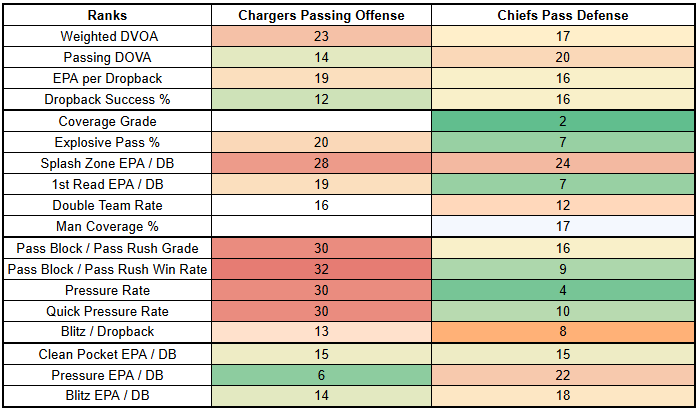
Justin Herbert has had his moments this year, but he's never been quite as impressive as he was in the season opener.
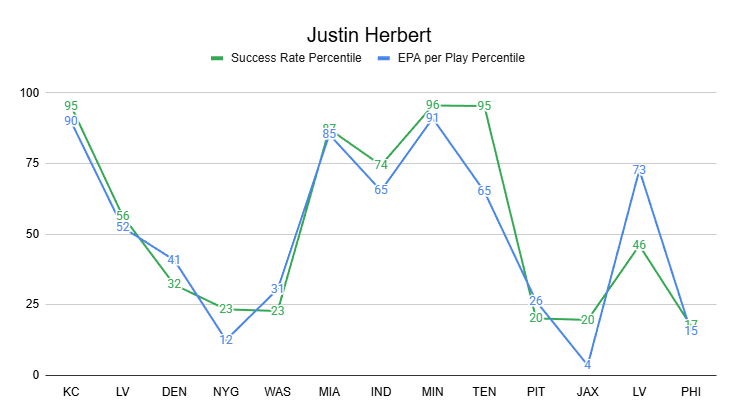
And, overall, Herbert's season has been disappointing. He ranks QB21 in EPA per game, between Jalen Hurts and Baker Mayfield, and QB15 in success rate, between Carson Wentz and Spencer Rattler.
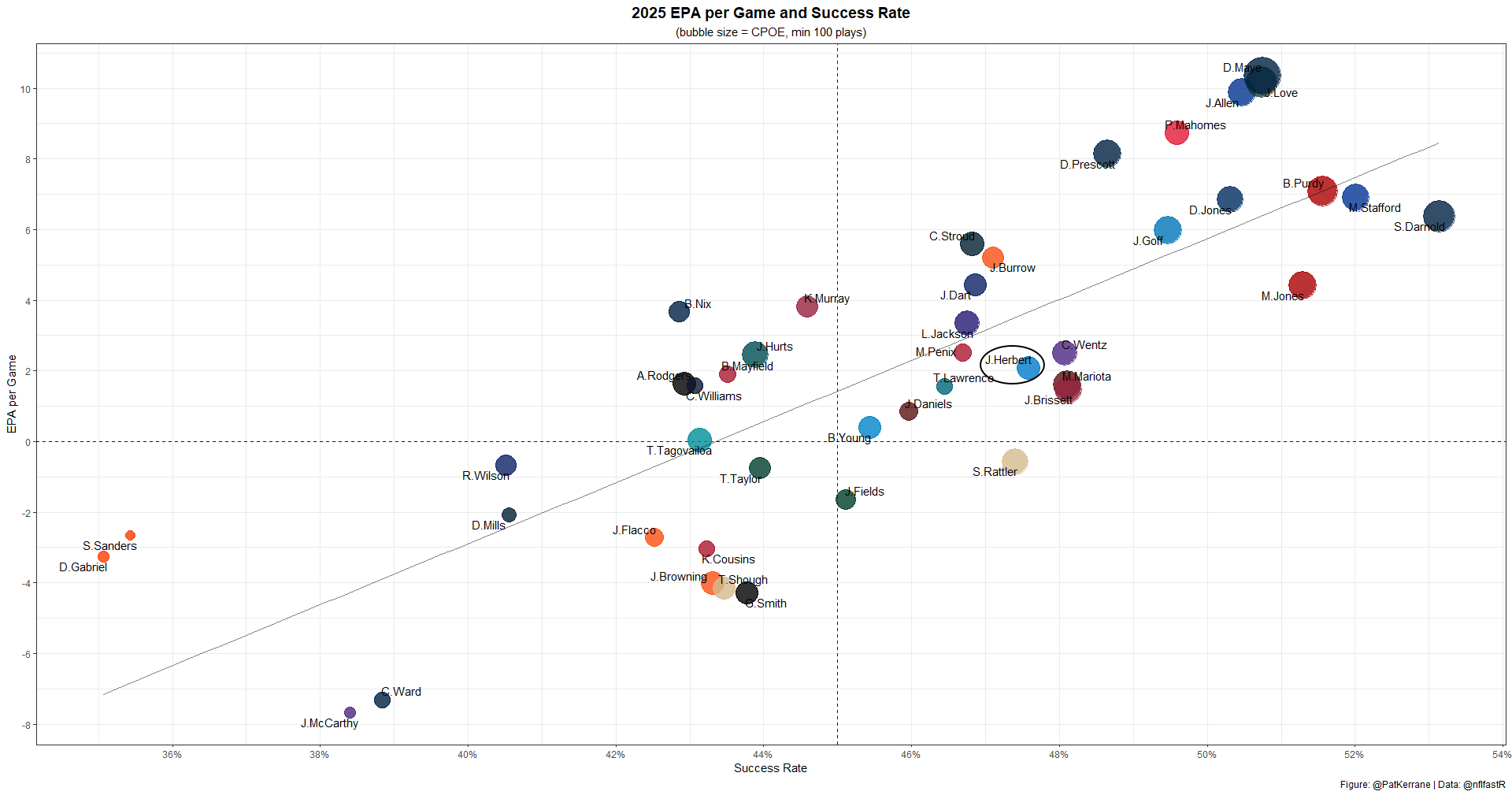
Herbert's lack of protection has been a major driver of his lackluster year. His hand is also literally broken.
But Herbert's hand remains injured, and he's likely to be under pressure again this week, making this a low-floor setup.
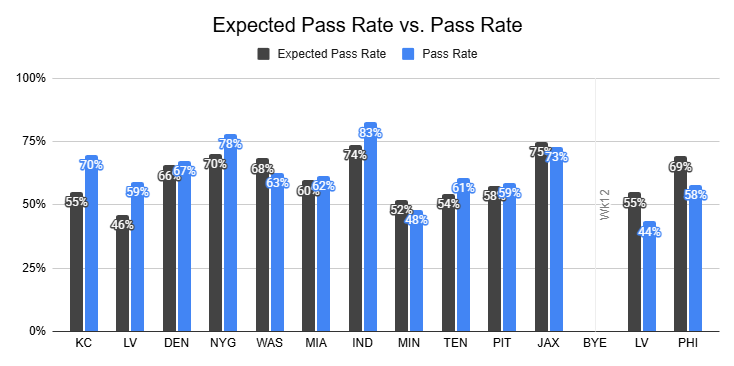
Part of the downside for the passing game comes from a potential lack of volume. After Week 1, we were looking at the Chargers as a candidate to lead the NFL in pass rate over expected. Week 2 only made us more excited. However, since their Week 12 bye, the Chargers have pivoted hard to the run.
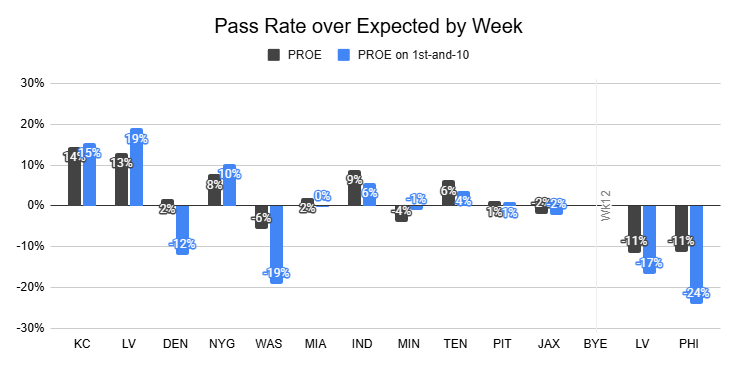
This adjustment makes sense. It's hard to justify aggressively passing the ball if you can't protect your QB. However, we're looking at a Chargers team that is far less likely to post an above-average pass rate than they were to start the year.
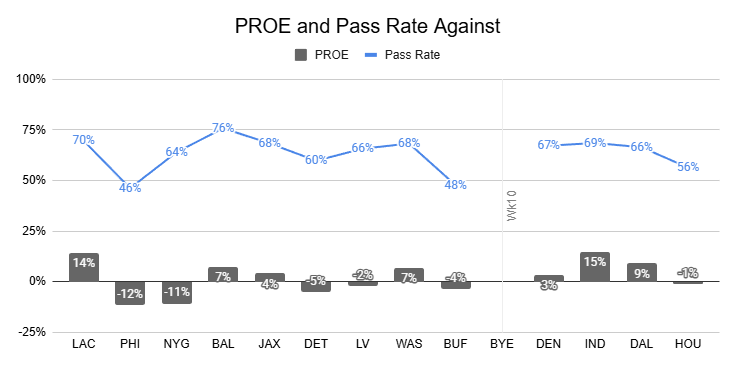
Meanwhile, the Chiefs look like a defense that you don't have to pass against. In previous years, it was generally difficult to go run-heavy on Kansas City—it was tough to score enough points to keep up with Patrick Mahomes. But with the Chiefs' offense losing some of its luster, we've seen other strategies open up. We've now seen the Eagles, Bills, and Texans beat the Chiefs with sub-60% pass rates.
The Chargers are 5.5-point road underdogs, so they aren't well-positioned for a run-heavy approach. But it's no longer crazy to run the ball against the Chiefs and trust your defense. There's a strong possibility that's what the Chargers do here.
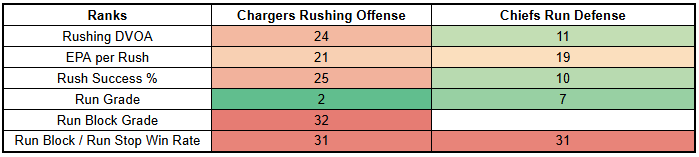
They'll be going against a Chiefs defense that has been good against the run, but isn't a shutdown defense.
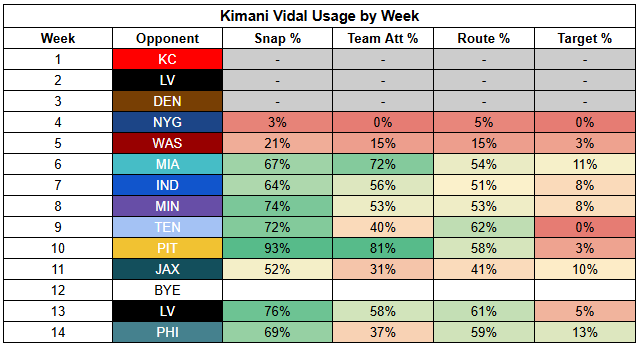
Last week, the Chargers played Kimani Vidal as their lead back.
However, Omarion Hampton nearly matched him in carries.
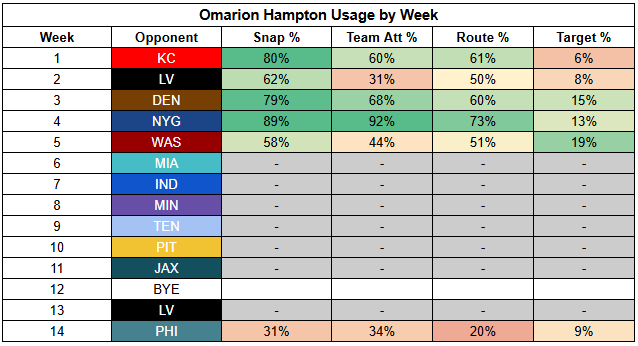
In his second game back, Hampton will probably see his workload grow, likely taking on more carries than Vidal.
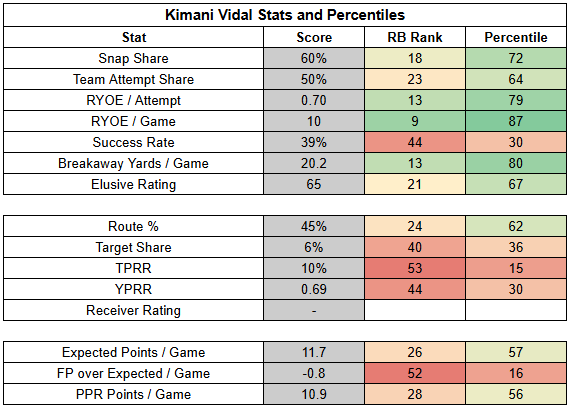
It was interesting to see Vidal's clear lead in the passing game last week, but Vidal doesn't really profile as a passing-down back.
Hampton's route participation has been solid this year, and last week's usage may have just been about getting the most out of Hampton's limited snaps.
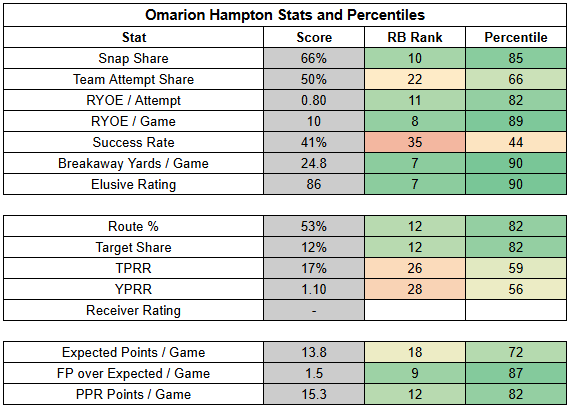
With the Chargers likely to lean on the run as much as they can get away with, Hampton and Vidal are both in play, but the uncertainty around the receiving role hurts both players' floors. I'm treating Hampton as an RB3 with Vidal as an RB4.
In the passing game, we're looking at another tough matchup with the potential for limited volume. But at least Ladd McConkey won't be going against Cooper DeJean.
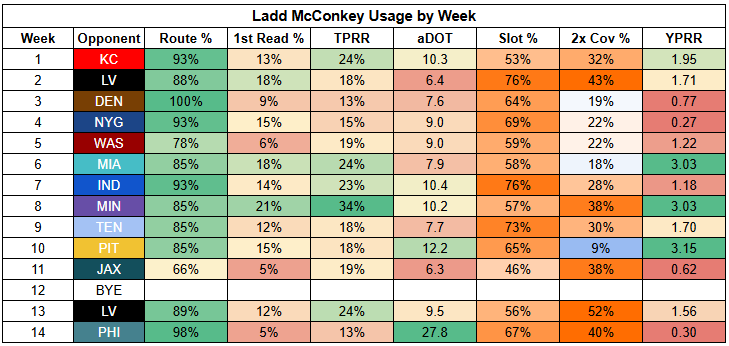
McConkey has been a major disappointment this year, and barely leads the Chargers in target share. Still, he's a strong route runner and stands to benefit the most if the Chiefs push the Chargers to the air. He's a WR3.
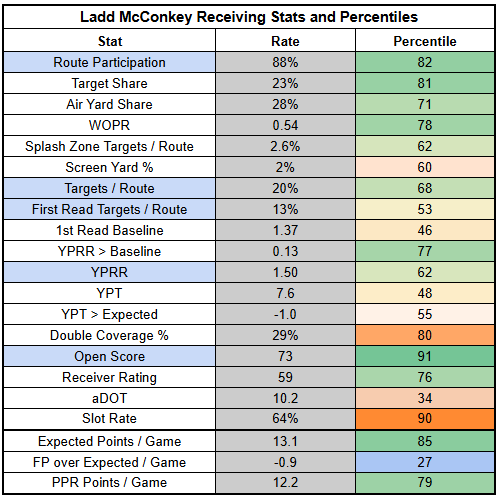
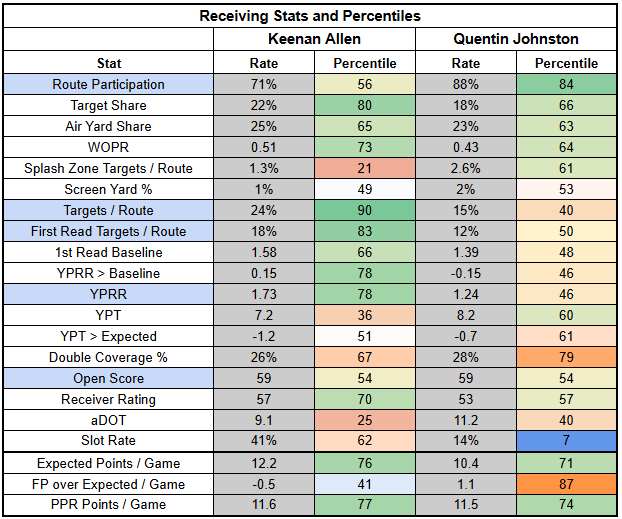
Keenan Allen's route participation has been up over the last three games, after looking like he was being phased out of the offense.
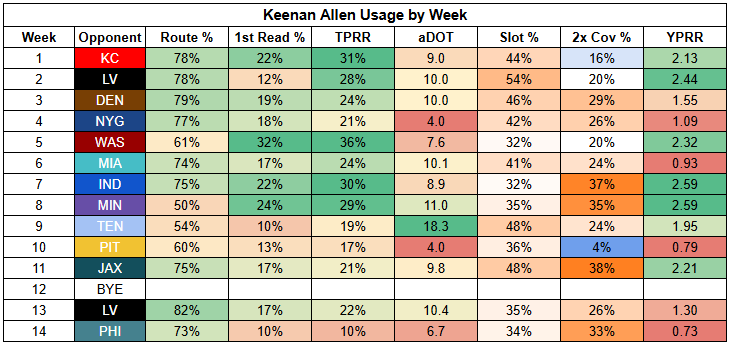
We're back to McConkey, Allen, and Quentin Johnston forming a clear top 3 at WR for the Chargers.
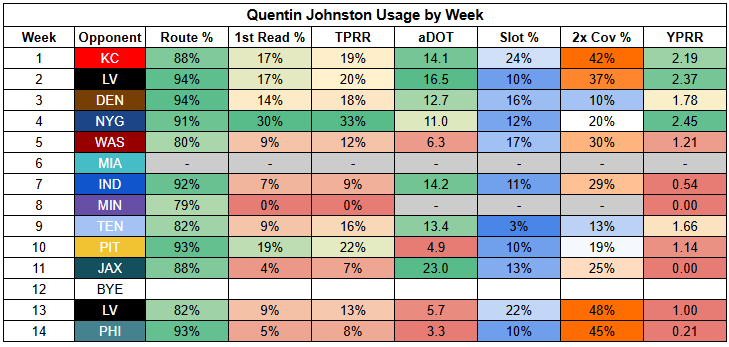
Unfortunately, Johnston's ability to draw targets has dropped off dramatically since the early season. He's just a dart throw. Given his improved route participation, Allen profiles as a WR5.
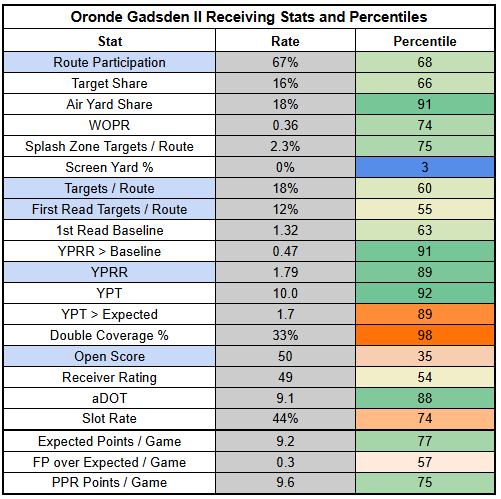
At tight end, Oronde Gadsden's role has regressed over the last few weeks. He's still the Chargers' starting tight end; his impact just looks smaller.
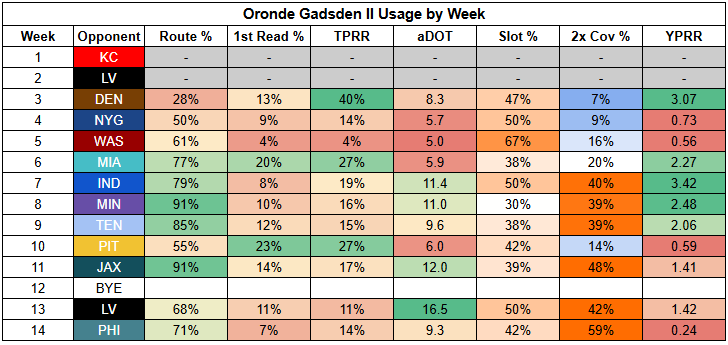
Allen's semi-reemergence makes the target tree more crowded here. And given the potential for a low-volume game plan as Herbert plays through injury, Gadsden's floor is pretty low. But he has enough upside to make him a high-end TE2.
Chiefs
Implied Team Total: 23.5
Last week, with the Chiefs' season on the line, Patrick Mahomes was like his average deep ball this year—nowhere near good enough.
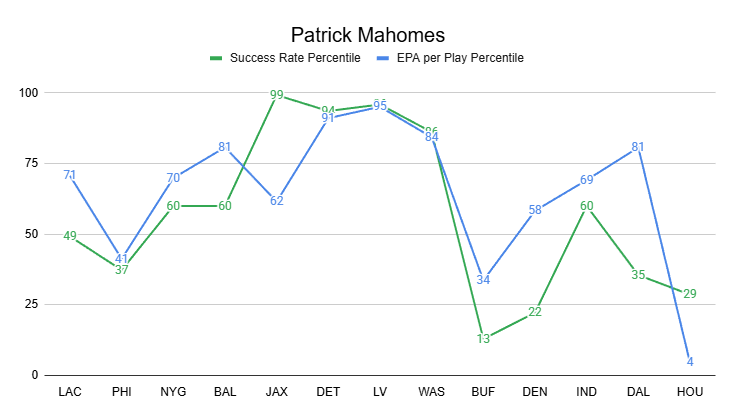
In fairness to Mahomes, he was going against the Texans, who profile as the best defense in the NFL.
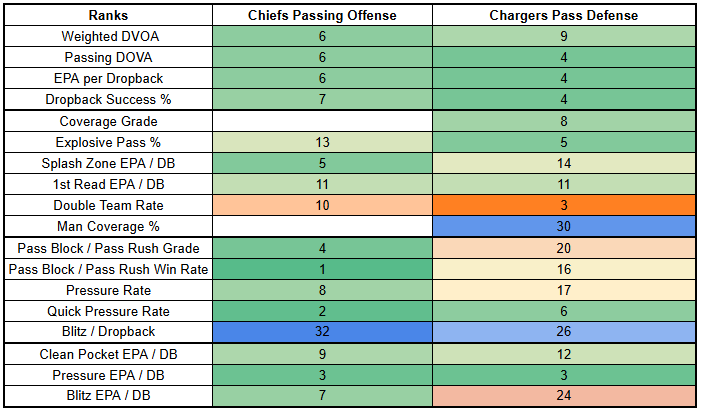
Unfortunately, Mahomes gets another difficult test this week. He faces a Chargers defense that has been hit-or-miss, but when playing at its best, it has been a legitimate shutdown defense.
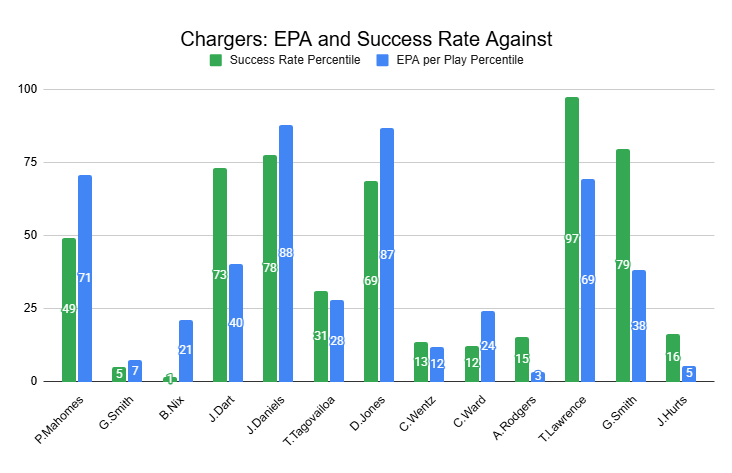
However, the Chargers have also allowed some efficiency to opposing QBs this year, including Mahomes, who posted an EPA per play in the 71st percentile against Los Angeles. In retrospect, that looks more impressive than it did at the time.
And with Rashee Rice back in the lineup, the Chiefs should be able to attack a Chargers defense that relies heavily on zone coverage.
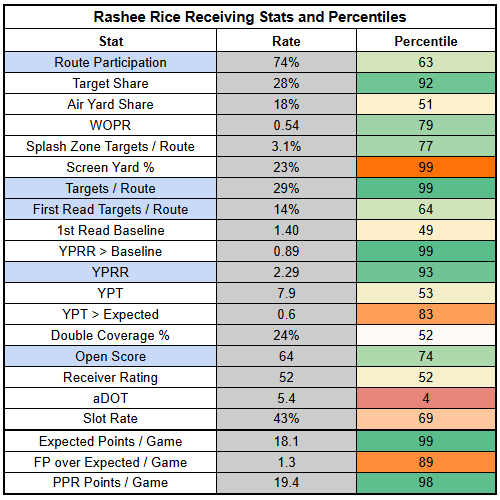
Against zone, Rice has a 32% TPRR and 3.24 YPRR. With just a 4.7 aDOT against zone, Rice is a chain mover in the passing game. He should be an impact addition in the rematch.
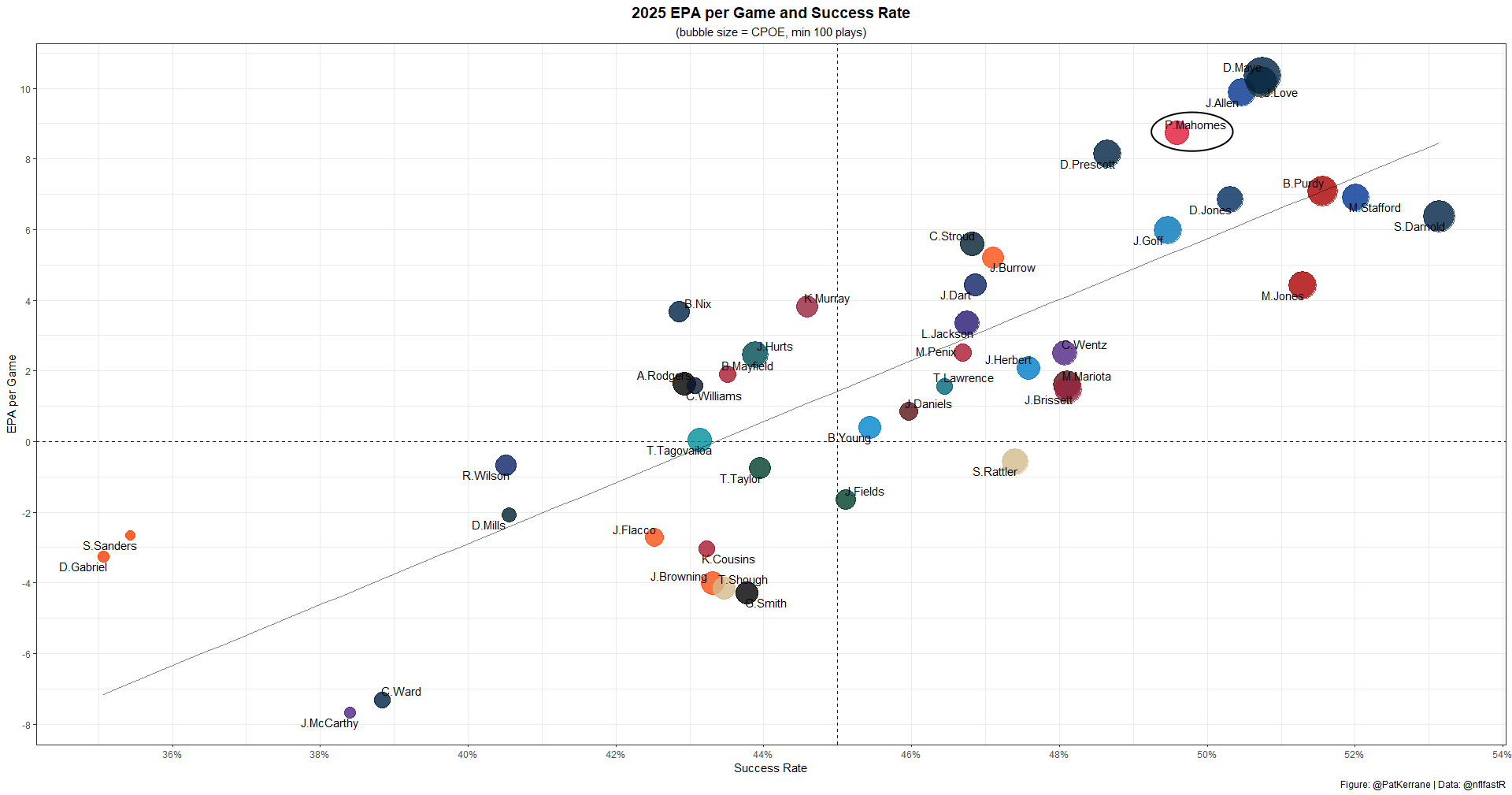
And we're still talking about Patrick Mahomes here. Even in the most disappointing season of his career, Mahomes ranks QB4 in EPA per game and QB9 in success rate. By any other standard than the one that Mahomes has set, we'd be calling this a strong season.
And fundamentally, we're also still talking about an Andy Reid offense. I recognize that Reid hasn't been at his most impressive from a game planning and play calling perspective, but at the very least, we can count on passing volume here. Reid is still committed to throwing it.
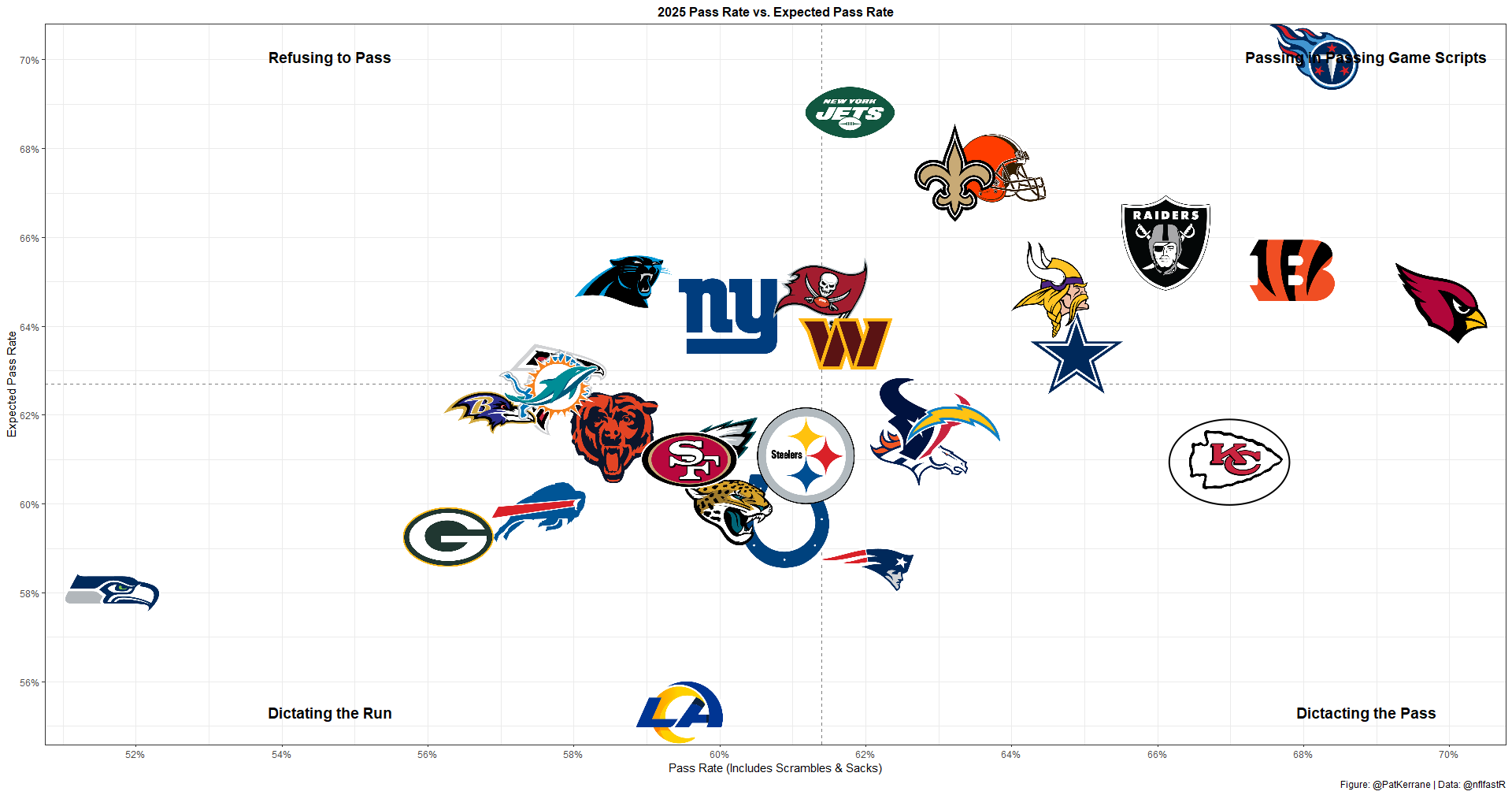
This was true even with Mahomes playing poorly last week.
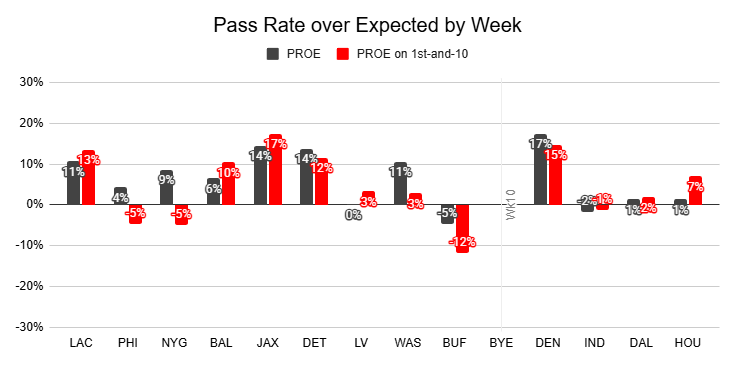
From both an efficiency and volume perspective, there's a ceiling in this matchup. However, it's important to note that the Chiefs will be without LT Josh Simmons and RT Jawaan Taylor, leaving them with Jaylon Moore and Esa Pole at tackle. Both players have been decent so far, but the tackle injuries significantly lower the floor for the offense, and help explain why Mahomes was so inefficient last week.
Assuming Mahomes can return closer to form this week, Rashee Rice is set up exceptionally well in a matchup that favors his skillset and in an offense that should remain built around the pass. However, with the offensive line risk in this matchup, I'm downgrading everyone slightly. Rice is a WR1.
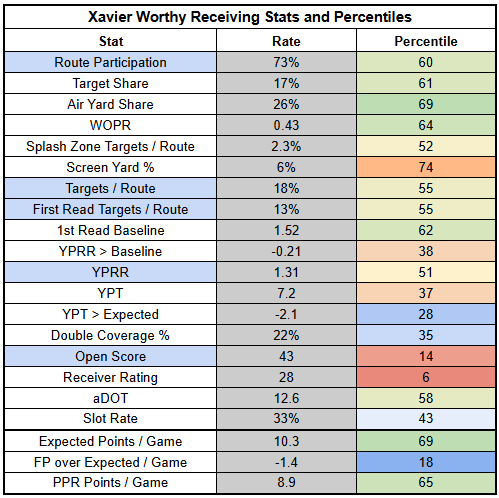
Xavier Worthy is far more speculative. He's yet to hit 100+ yards in a single game this year, with just one game at 2+ YPRR, and he's scored just one TD. Worthy's efficiency has been a little better recently, but his target rate looks worse, if anything.
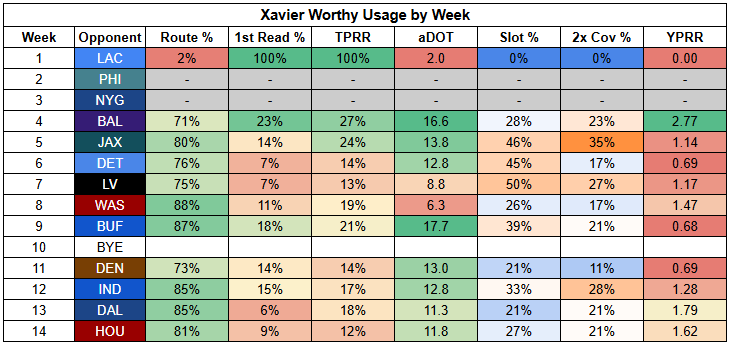
Worthy is a WR5.
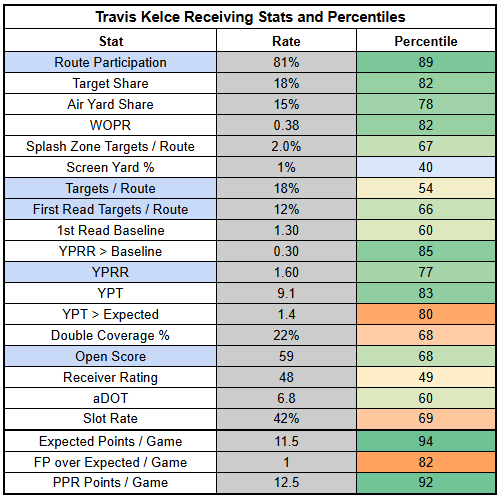
Travis Kelce has had a rough three-game stretch. Rashee Rice has dramatically eaten into his targets.
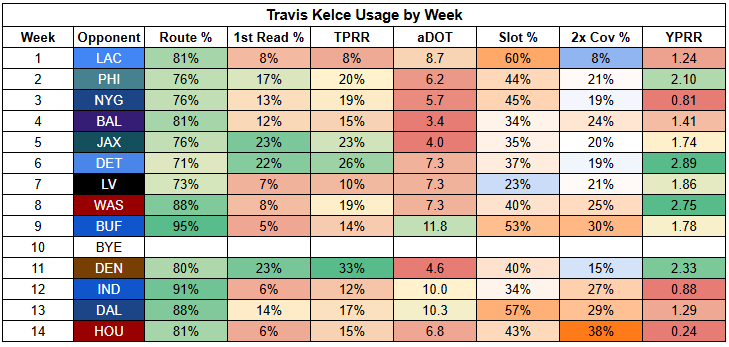
Kelce's season-long numbers still paint the picture of a clear TE1, but with the potential for the passing to flow through Rice, and with pass protection concerns, he's a low-end TE1.
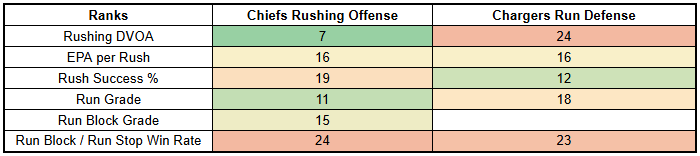
In the run game, the Chargers have not been impressive. Unfortunately, neither have the Chiefs.
Isiah Pacheco has been back for two games, but has been stuck in a backup-level role.
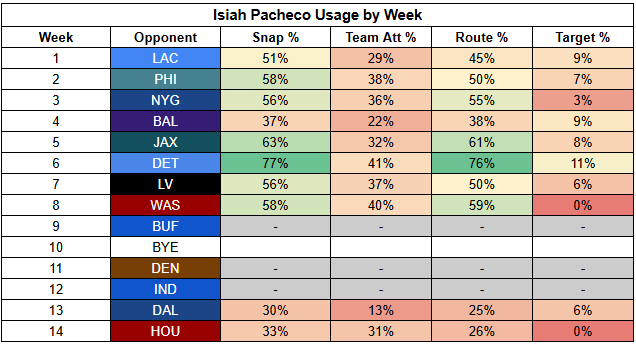
Kareem Hunt looks like the Chiefs' starting running back right now.
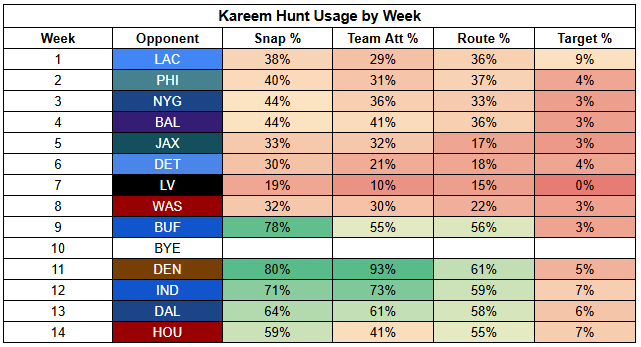
Hunt has been very unimpressive this year, outside of his elite 49% success rate. The Chiefs trust him to move the chains... and for good reason.
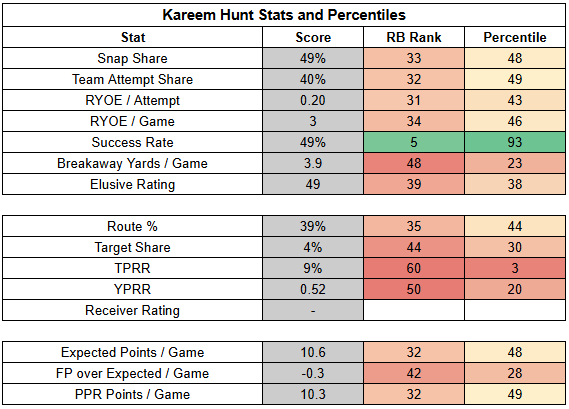
Still, at this stage of his career, Hunt is more of a glorified fullback than a weapon out of the backfield. He's a TD-dependent RB3.