Is there any Best Ball Value in the 2026 Rookie RB Class?

I recently wrote up the 2026 rookie WR class through a best ball lens. I'm now turning my attention to running back.
In this article, I'll be looking at the 2026 rookie RB class. And then in a follow-up article, I'll dive into the sophomore RBs, which are highly intriguing this season.
Rookie RB Best Ball Results
Like last time, I'm going to review how previous rookies have performed in the Best Ball Mania data from 2021-2025, courtesy of RotoViz's Underdog Advance Rate Explorer.
Looking only at RBs drafted 1,000+ times in Best Ball Mania, I broke out the rookies into five groups.
- Group 1 - Legends
- True league-winning picks you'd have been happy to have on every team.
- Group 2 - Hits
- Added value above cost.
- Group 3 - Small Misses
- Not hits, but provided at least some production.
- Group 4 - Whiffs
- Picks that hurt teams, even if there were some occasional bright spots.
- Group 5 - Landmines
- The type of pick that was a gut punch to an otherwise good team.
Group 1 - Legends
Round 1-2 NFL Draft Picks

Najee Harris profiled as a reach for the Pittsburgh Steelers in Round 1. Among 1st-round picks, only Clyde Edwards-Helaire, Sony Michel, and Jadarian Price rate worse in my dynasty-focused rookie RB model—with Najee falling in a tier worth a late-1st-round rookie pick.
But the Steelers were pretty clear about their intentions to lean on Harris. And the big back was up to the task, posting a big-time advance rate of 25% as a rookie.
In Week 15, Harris posted a 3.6-half-PPR-point dud. But he rebounded with 13.5 in Week 16 and then turned in his best score of the entire season in Week 17. If you were able to make the finals with Harris, he was a true league winner, despite costing a 2nd-round best ball pick.
Kenneth Walker (early-2nd tier) is another prospect I was skeptical of. He posted anemic receiving efficiency in college and profiled as a rushing-dependent rookie. Walker also joined a Seattle running back room that included Rashaad Penny, fresh off his impressive late-2021 surge. And Walker dealt with injuries in the preseason, ultimately undergoing surgery for a sports hernia in August.
But all of this kept Walker's price in check. With an ADP outside the top 100 picks, he was far cheaper than Harris.
Walker missed Week 1 and didn't see 10+ attempts until Week 6, when the injury luck flipped in Seattle, with Rashaad Penny suffering a season-ending ankle injury. Drafters who scooped the 41st overall pick at a discount ended up scoring an advance rate hammer.
Round 3-4 NFL Draft Picks

De'Von Achane (early-2nd tier) profiled as an underdrafted prospect. He was highly productive in college as a traditional back with pass-catching versatility and elite explosiveness. But at just 188 pounds, the NFL clearly had questions about his ability to translate, and he fell to the 3rd round. But he found himself in a backfield with a path to an immediate role and was a classic bet-on-talent play.
In Weeks 1-14, Achane only played in seven games. But he posted four 20+ point outings, including a nuclear 49.3 half-PPR performance in Week 3. At pick 120, that was more than enough to make him a massive advance rate hit. With 21.7 points in the finals, Achane was also a playoff contributor.
At 192 pounds, Bucky Irving (late-2nd tier) was another undersized rookie who proved capable of handling an NFL starter's workload. Irving lacks Achane's breakaway ability, but Irving's football athleticism proved far more impressive than his 2.15 RAS. He profiled as a bet on his college production and against inefficient incumbent rusher Rachaad White.
Irving put up usable production early in the year and following the Bucs' Week 11 bye, turned in three 20+ points outings, including a 21-point score in the finals. Irving peaked at 26 half-PPR points; so he never singlehandedly tilted matchups. But at a 15th-round cost, his production was still pretty epic.
Round 5+ NFL Draft Picks
None.
Group 2 - Hits
Round 1-2 NFL Draft Picks

Jahmyr Gibbs (early-1st tier) was a high-end prospect who profiled as a potentially elite playmaker despite weighing just 199 pounds. Paired with David Montgomery, workload concerns helped keep his price down relative to other high-ceiling Round 1 rookie RBs.
Gibbs' ceiling was evident early in his career. He went for 20+ five times as a rookie, including a 22-pointer in Week 16. Gibbs was ultimately quiet in Week 17, despite seeing 15 carries and three targets. Still, even after steaming into the 3rd round to close draft season, Gibbs was a clear-cut hit.
Javonte Williams (early-1st tier) was a committee back at UNC, but with a profile that hinted at potential workhorse ability at the next level. He was initially paired with Melvin Gordon, though, keeping his price in check.
Williams was solidly productive in the regular season, but was fairly quiet in the playoffs, turning in half-PPR scores of 10.1, 9.0, and 3.7. Still, at an early 6th-round price, he paid off nicely.
Quinshon Judkins (late-1st tier) profiled as an exciting rushing prospect, but with a lacking receiving profile. He then landed on a directionless Browns franchise.
Judkins' ADP dropped precipitously over the summer on concerns that he would be suspended, compounded by a contract dispute. And Judkins did ultimately miss Week 1 after being unavailable for much of training camp.
But drafters overcorrected, pushing a lead runner with a strong rushing pedigree outside the top 100 picks.
In Week 3, Judkins went for 16 points, his first of four total 15+ point games. He ultimately peaked with 26.4 points in Week 7. Judkins was quiet in the playoffs and missed Week 17 due to an ankle injury, but was still a hit at his average cost.
Round 3-4 NFL Draft Picks
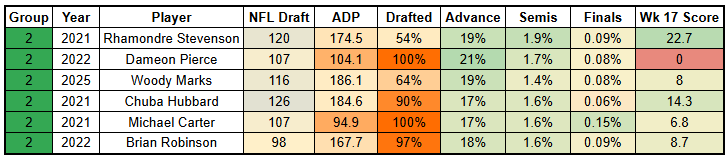
Dameon Pierce and Michael Carter emerged as Day 3 rookie starters on empty RB depth charts. Pierce profiled as a premium dart throw type in my model—a 4th round dynasty pick. Carter was a higher probability bet (late-2nd tier), given his receiving chops.
And despite unusually high prices for their NFL draft capital, both players hit. Notably, Pierce started out cheaply and then rose substantially. His 21% advance rate actually understates his impact on teams where he was basically a free add. Carter's ADP was less volatile, but with a 17% advance rate and a usable Week 16 score of 13.4, he was still a small hit at cost.
Woody Marks was somewhat similar to Carter in his receiving profile, but his rushing profile was weak enough that he looked like a Pierce-level dart throw bet from a dynasty lens. However, Marks landed in an advantageous situation, forming a committee with a diminished Nick Chubb. Despite missing Week 16 and peaking with just 10.3 points in the best ball playoffs, Marks was a clear hit in the late rounds.
Rhamondre Stevenson (late-2nd tier) and Brian Robinson (4th-round tier) were in committee situations. But both eventually did enough to post above-average advance rates. With a 22.7-point Week 17, Stevenson was the closest to being a true smash. But he missed six games as a rookie (including Week 16), curtailing his impact.
Chuba Hubbard (late-2nd tier) was a contingent play behind Christian McCaffrey, who only played seven games in 2021.
Round 5+ NFL Draft Picks
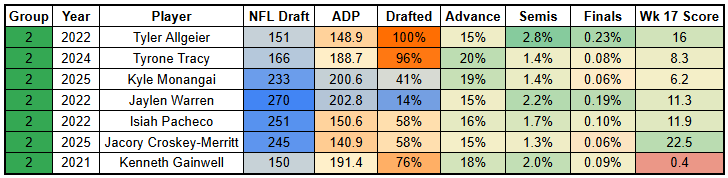
Tyler Allgeier (late-2nd tier) peaked with 22.1 points in Week 15, his only game with more than 16 points. But he hit 10+ points seven times in Weeks 1-17, and 13+ in all three playoff weeks.
Jaylen Warren (waiver wire tier) peaked at just 11.4 points, but that was in Week 15. And with an ADP outside the top 200 and a draft rate of just 14%, he was very low-owned. Ultimately, Warren didn't really move the needle, but as a non-zero 200+ ADP pick, he was at least a minor hit.
Kyle Monangai (waiver wire tier) was also less than 50% drafted, and contributed a 10.8-point Week 16. He also hit 10+ points a total of six times, making him an advanced-rate hit.
The hype train on Jacory Croskey-Merritt (waiver wire tier) eventually got him to a 58% drafted rate. He paid that off with two 20+ point games, including 22.5 in Week 17. JCM only posted an overall advance rate of 15%, but he was a clear-cut hit for drafters who got him before the Brian Robinson trade.
Isiah Pacheco (waiver wire tier) was ultimately more of a hit in his second season than his first. But as a rookie, he started out completely free, which made his six 10+ point games quite useful. Unfortunately, he peaked at just 15.2 as a rookie.
Kenny Gainwell (late-2nd tier) had an intriguing college production profile, but landed on a depth chart with Miles Sanders as the established starter and with Jordan Howard and Boston Scott also mixing in. Gainwell paid off by posting 33 receptions (despite just 68 carries), helping him hit 10+ points four times in Weeks 1-17.
Unfortunately, Tyrone Tracy (waiver wire tier) peaked at 23.9 points... in Week 18. Nevertheless, he was a clear hit in Round 16, with 23.2 points in Week 15 and a total of four 10+ point games in Weeks 1-17.
Group 3 - Small Misses
Round 1-2 NFL Draft Picks

Breece Hall (early-1st tier) was on his way to being a rookie-season smash before tearing his ACL in Week 7. He was a clear hit the following season, but ultimately, as a rookie, he was an injury-driven miss.
RJ Harvey (late-1st tier) and TreVeyon Henderson (mid-1st tier) both had nice moments in their rookie seasons, but dealt with enough committee usage to hurt advance rates as top 60 picks.
Round 3-4 NFL Draft Picks

Like with Hall, there are universes where Cam Skattebo (early-2nd tier) is seen as a rookie-season smash. But in this universe, he fractured his fibula in Week 8 and was a playoff zero.
Rachaad White (late-1st tier) was nearly as expensive as Skattebo, which hurt when he was unable to break out of a committee with Leonard Fournette. Still, he hit 10+ points five times, which limited the damage, and would have very likely qualified him as a hit if he'd been cheaper.
Guerendo (4th-round tier) peaked with 25.8 points in Week 14, which was useful. Had it come one week later, he could have been a legendary last-round click.
Tyjae Spears (early-2nd tier) had an ill-timed 20.1-point peak, occurring in Week 18. Still, with three 10+ point outings, he wasn't a zero.
Roschon Johnson (4th-round tier) also hit 10+ points three times, including 13.4 in Week 17. Unfortunately, he peaked with just 14.5 points in Week 1 and didn't really move the needle for his price.
Round 5+ Draft Picks
None.
Group 4 - Whiffs
Round 1-2 NFL Draft Picks

James Cook (early-2nd tier) eventually emerged as a clear hit for the Bills and drafters who stuck with him. But as a rookie, he hit 10+ points just three times. Fortunately, his 17.3-point peak was in Week 16, which helped surviving teams make the finals.
Round 3-4 NFL Draft Picks

Dylan Sampson (3rd-round tier) fell to Day 3 of the draft and looked to be firmly behind Round 2 pick Quinshon Judkins. That is, until Judkins looked to be facing a potential suspension.
Unfortunately, Sampson operated behind Judkins for most of the year and missed Weeks 15 and 16. He returned for Week 17, but even with Judkins out, managed just 4.2 points. Ultimately, I think Sampson was a worthwhile click, but he did not help teams, with just a 15% advance rate, and goes down as a rookie-year bust.
Round 5+ NFL Draft Picks

Kyren Williams (3rd-round tier) was a Year 2 league winner, and probably could have had a stronger rookie season. But he was injured on a Week 1 kickoff and didn't log his first offensive snap until Week 10.
Brashard Smith (4th-round tier), Devin Neal (3rd-round tier), and Audric Estime (late-2nd tier) saw rookie playing time, but even as free dart throws, weren't able to help best ball rosters.
Group 5 - Landmines
Round 1-2 NFL Draft Picks
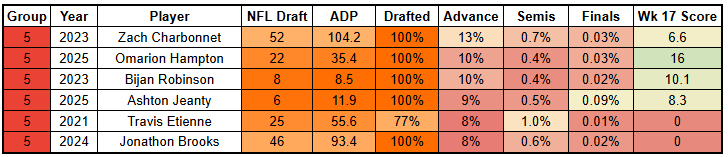
Bijan Robinson (superflex 1.01 tier) has developed into a true superstar. We're expecting the same for Ashton Jeanty (superflex 1.01 tier). And yet, both players were true landmines as rookies—even with Robinson hitting 15+ points six times and Jeanty spiking for 31.3 points in Week 16. The bottom line is that we were asking for a ton at these rookie-season prices, and both players weren't ready to deliver at that level, making both silent killers.
Omarion Hampton (mid-1st tier) peaked at 25 points in Week 4, and could have gone down as a hit, or at least a small miss, had he stayed healthy. But he missed seven games in the middle of the season, and peaked at just 16 points the rest of the way. At his price, he was a big miss.
Zach Charbonnet (early-2nd tier) only missed one game as a rookie, but hit 10+ points just once as well—a 16.4 Week 13 outing. As a 9th-round best ball pick, that hurt.
Recovering from a torn ACL at Texas, Jonathon Brooks (mid-1st tier) didn't log his first action until after the Panthers' Week 11 bye. He then re-tore his ACL in Week 14.
Travis Etienne (early-1st tier) missed his entire rookie season with a foot injury he suffered in the preseason. At least he didn't have to actually play for Urban Meyer.
Round 3-4 NFL Draft Picks
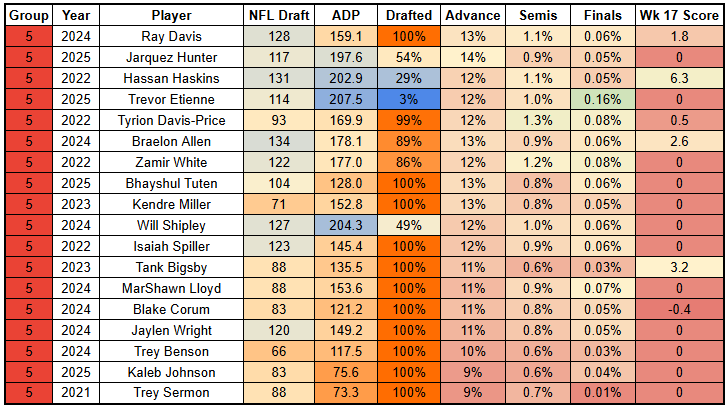
The sheer length of this list jumps out, and notably includes players who were drafted in the top seven rounds as well as total dart throws.
Notably, Bhayshul Tuten and Trey Benson profiled as early-2nd tier prospects in my model. And Kendre Miller, Trey Sermon, Blake Corum, Kaleb Johnson, Tank Bigsby, Ray Davis, Braelon Allen, and Isaiah Spiller all rate as late-2nds. I'd argue that Kaleb Johnson and Trey Sermon were overpriced in drafts relative to their profiles, but largely, this is not a group of terrible prospects.
To me, this is a reminder that rookie RBs can be both worthwhile 2nd-round gambles in dynasty and very low floor best ball picks, even in the double-digit rounds.
Round 5+ NFL Draft Picks
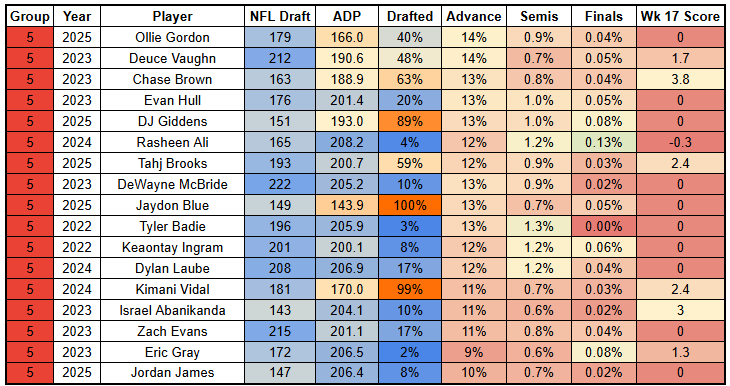
This list of landmines is nearly as long as the previous group, but with most of these Round 5+ rookies being drafted well below 50% of the time.
Jaydon Blue is the only Round 5+ rookie to be 100% drafted in BBM's history. Blue rewarded his believers with a total of 7.5 half-PPR points in Weeks 1-17, all occurring in Weeks 5-8.
Notably, the RBs with the three highest drafted rates—Blue, Kimani Vidal, and DJ Giddens—were all drafted in 2024-25. Additionally, last year Tahj Brooks was 59% drafted despite never really getting any buzz. It looks like drafters are getting more willing to take on rookie RB zero risk, not less.
Chase Brown obviously went on to be a major hit in Year 2. But, infamously, he really had only one highlight in his rookie season (a very fun 54-yard TD catch and run). That helped generate an 18-point Week 14 peak. But Brown otherwise topped out at just 6.6 points.
From a prospect quality standpoint, none of these players rate better than a 3rd-round rookie pick for me, and the vast majority are 4th-round fliers or worse. Given that all were Round 5+ picks... that's not surprising. But it's not like we had big drumbeats on these players, either. With that combination... how can we be surprised they hurt rosters?
As rookies, players like Chase Brown, Jaydon Blue, and Kimani Vidal were more theoretical bets on their depth charts than the result of player-generated training camp hype or high-confidence prospect profiles.
And while, technically, DJ Giddens was reportedly the RB2 in Indianapolis last year, he didn't generate sustained buzz. Admittedly, I ended up being too optimistic on Giddens, given how low the floor has been on this type of play.
What About 2020?
We don't have Best Ball Mania data for the 2020 season, but FFPC win rates can still provide insight into the 2020 rookie class.