
Quick Slant: MNF - Barely Conscious and Not What We Wanted

Mat Irby’s Quick Slant
Some of us are just going to get excited about any NFL news come May. It’s just the way it is. Every February, we quit cold turkey, and by March, we’ve got the shakes. Free agency and the draft provide a dopamine hit, but by late spring, we’re at rock bottom, stranded between Mr. Irrelevant and the Hall of Fame Game (unless you’re Pat, of course, and best-ball season is Christmas every hour).
So, I get it. Some of us get pumped about anything crossing the NFL ticker. And the NFL machine knows it, laying little forget-me-nots like breadcrumbs, then siccing its minions on every morsel to dissect the smallest rumor like the Warren Commission.
Forgive me, but I don’t get excited about the schedule release. When I’m mowing the lawn, I skip the pods about yearlong schedules or which WRs have the best CB matchups in December. I’d rather listen to the Ship Chasers draft again or see what music has dropped lately.
It’s not that I’m not excited about the NFL’s return. I think I’ve proven my fervor for this silly little game. It’s that, to me, the schedule release is almost a total nothingburger.
Breaking down the first four weeks? I could see it. There’s something pragmatic about gaining an early edge in redraft leagues. Looking ahead to the best-ball playoff schedule? Sure, especially for portfolio players treating it as another data point rather than letting everything ride on it.
But what we think we know in May is far from what we get when the pads start popping, or worse, when the ACLs and Achilles-es-es start doing the same.
Exhibit A: The Week 10 matchup between the Los Angeles Chargers and Baltimore Ravens.
Before the season, Baltimore ranked third in Super Bowl odds (+1100); Los Angeles was tied for sixth (+1700). Two-time MVP QB Lamar Jackson was glazing new HC Jesse Minter and loving the new offensive system under OC Declan Doyle. The Ravens were healthy, with seemingly nothing preventing another deep playoff run.
Meanwhile, the Chargers, steadily improving under HC John Harbaugh, decided to modernize by bringing in OC Mike McDaniel, architect of one of the most electric single-season offenses in modern history, the 2023 Dolphins. McDaniel had suffered through the indignity of committing himself to QB Tua Tagovailoa, who rewarded him with constant injury and underperformance, before watching his remaining hopes ride away on a cart with WR Tyreek Hill’s badly mangled ACL and MCL. But in Los Angeles? With OTs Rashawn Slater and Joe Alt returning? With QB Justin Herbert? It seemed like a no-brainer.
But the view from May is often a sparkling oasis in the distance; each step toward November reveals a mirage. And here we are, arriving at a game so many circled for its postseason implications, only to find nothing there.
The Ravens’ hopes for a liberated Jackson, freed from his old ball coach’s run-heavy system, were dashed by two significant injuries that cost him almost the entire year. Even his trusty backup succumbed to injury, leaving them with journeyman QB Jacoby Brissett, who was a Cardinal two weeks ago. All three divisional opponents are in the postseason hunt and leaving Baltimore behind.
And the Chargers? They’re the last team still on the season-long Schneid. Underperformance was conceivable, but nobody saw Los Angeles winning the race to the absolute bottom, the only winless team through nine weeks, even worse off than the Dolphins McDaniel abandoned. Maybe McDaniel’s style and Harbaugh’s wouldn’t mesh perfectly, but the most ineffective offense in football? Nobody saw that coming either.
So, here we are. The spyglass saw land; the eye has revealed a barren atoll. What seemed like a crucial stop on the race to Lombardi now looks like a critical juncture for coaches trying just to make it to 2027. Herbert isn’t trying to prove he belongs with the elite; he’s trying to prove he belongs at all. McDaniel hasn’t reestablished his genius and fielded head-coaching rumors; he’s hoping Kyle Shanahan has an opening on his staff next summer. And the Ravens are hoping to stay relevant enough to catch a wild-card berth and get Jackson back in uniform, just to earn the right to pray for a miracle.
There is still much at stake Monday night – barely conscious and not what we wanted.
GAME ENVIRONMENT
Los Angeles Chargers at Baltimore Ravens (-4.5)
Over/Under: 38.5
Baltimore ranks 26ᵗʰ in Pythagorean Wins (pacing for 6.6), while Los Angeles ranks last (pacing for 4.0). The Ravens are 4-5, pacing for eight actual wins, while the Chargers are 0-8, pacing for a winless season.
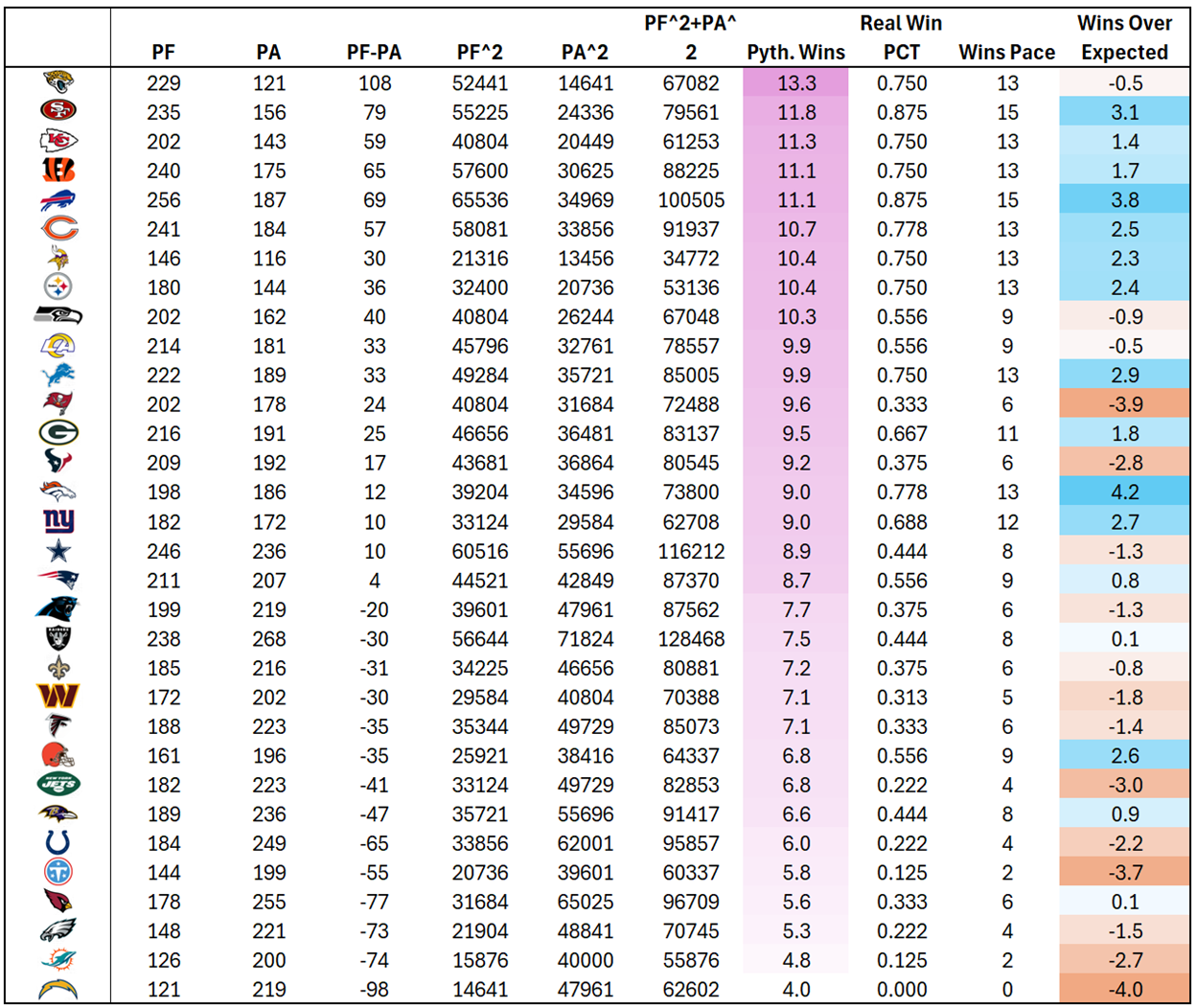
Both teams have struggled recently, with Baltimore losing four straight and Los Angeles losing all eight games this season. According to ESPN’s updated NFL draft order projections, Baltimore has a 44% chance for a top-10 pick (12th), while Los Angeles has a 16% chance at the first pick overall (3rd).
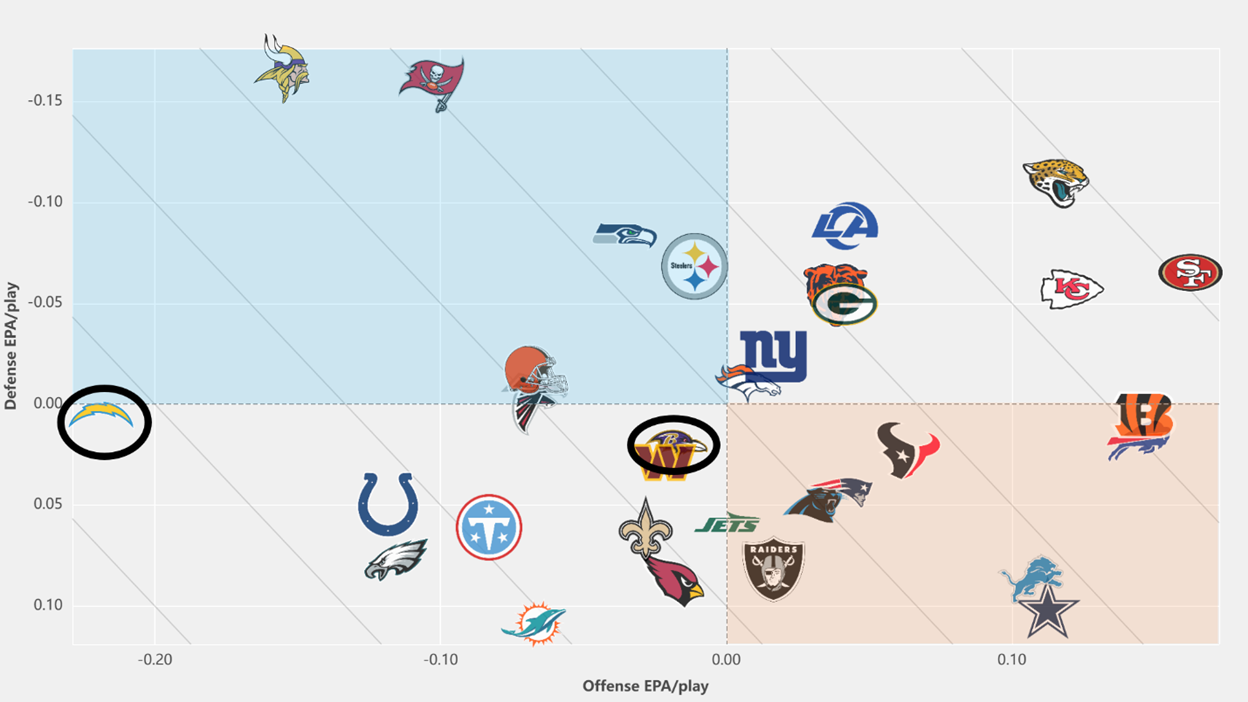
Based on EPA per play, Baltimore ranks 19ᵗʰ offensively (-0.018), although they are down to their fourth starting QB of the season, while Los Angeles ranks last (-0.219). Defensively, Los Angeles ranks 16ᵗʰ in EPA per play allowed (0.006), compared to Baltimore's 18ᵗʰ (0.020).
Neither team plays particularly fast from a neutral script. Los Angeles averages 29.7 seconds per snap (24ᵗʰ), while Baltimore averages 30.5 (30ᵗʰ). Across all game scripts, Los Angeles averages 62 plays per 60 minutes (T-14ᵗʰ), compared to Baltimore's 59 (T-25ᵗʰ).
The low over/under reflects a matchup between two struggling offenses, particularly Los Angeles. Neither defense has been especially efficient, but they are at least serviceable. The combination of poor offensive production and a relatively slow pace creates an unfavorable fantasy environment overall.
Baltimore is coming off an extended break after taking a 33-10 shellacking to Jacksonville on Thursday of Week 9 while starting emergency UDFA Joe Fagnano, who did not prove to be Brock Purdy. Los Angeles lost 44-22 to Houston on Sunday. The Chargers travel across three time zones for Monday night's game, with Baltimore enjoying an additional three days of rest.
Weather: Monday evening at M&T Bank Stadium should be clear and cool, with temperatures around 47° at kickoff. Winds should be light, around 4 MPH, with gusts up to 8 MPH and little chance of precipitation – perfect conditions for a football game.
Chargers Key Injuries: WR Ladd McConkey (back) did not practice Thursday or Friday. WR Tre' Harris (shoulder), CBs Cam Hart (ankle) and Deane Leonard (concussion), and LB Daiyan Henley (personal) practiced fully on Friday. RB Keaton Mitchell (hip) and starting G Kayode Awosika (fibula) were limited. TE David Njoku (fibula) and LB Denzel Perryman (pectoral) remain on IR but have resumed practicing.
Ravens Key Injuries: QB Lamar Jackson (thumb) remains on IR after surgery this week and is expected to miss six to 10 weeks. WR Rashod Bateman (calf), S Kyle Hamilton (hip), CB Nate Wiggins (illness), and starting G Vega Ioane (knee/shoulder) practiced fully on Friday. Starting S Jaylinn Hawkins (knee) was limited.
CHARGERS
Implied Team Total: 17
The Chargers have been the worst offense in the league, ranking last in offensive EPA per play (-0.219), including -0.187 EPA per dropback (31ˢᵗ) and -0.267 EPA per rush (32ⁿᵈ).
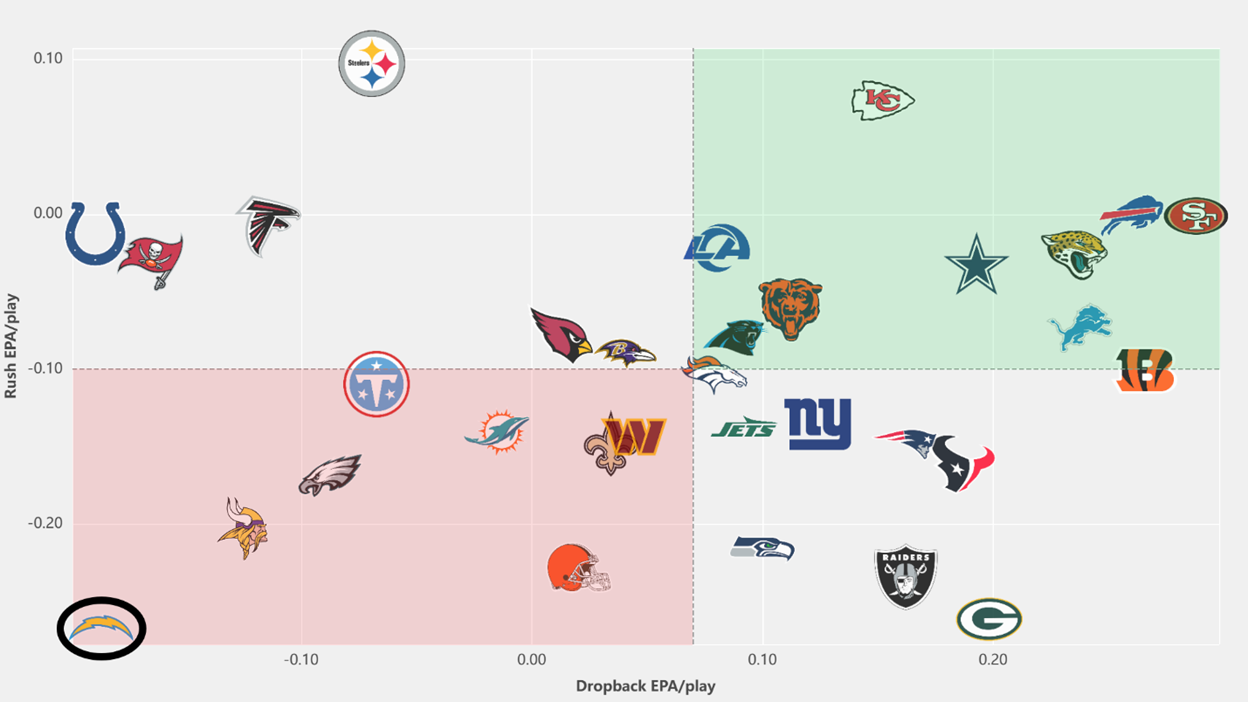
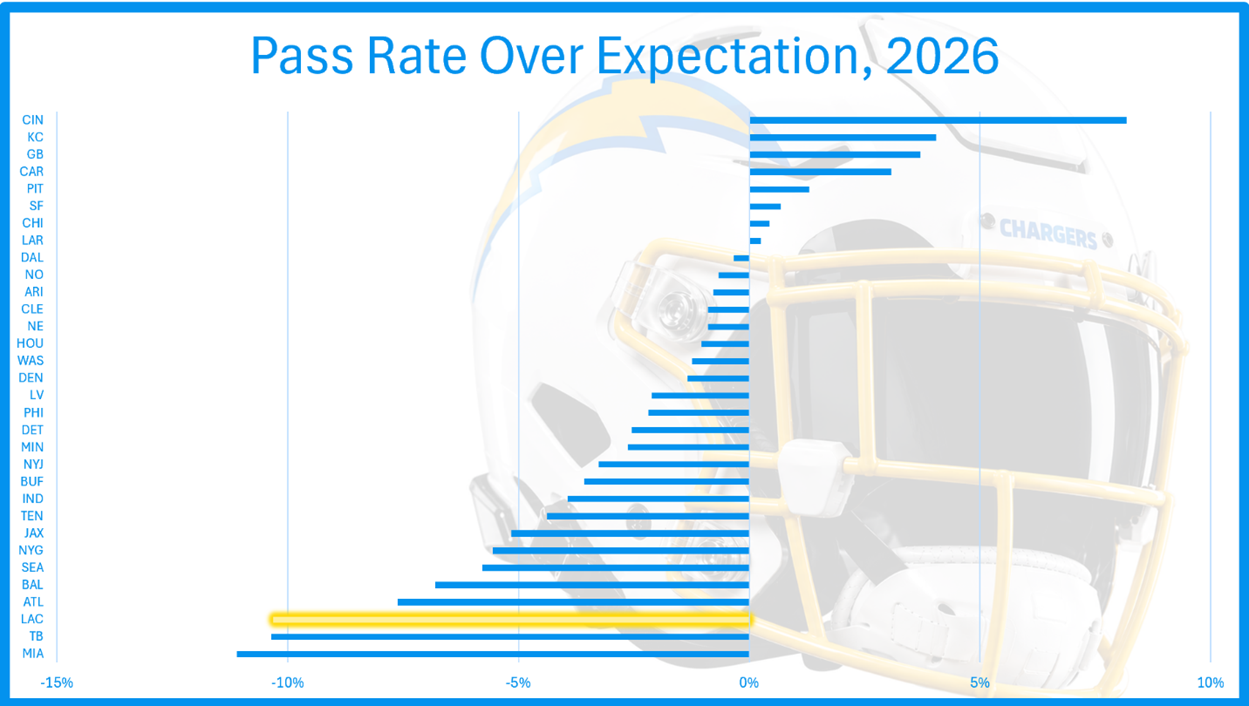
Los Angeles has been considerably more run-oriented than expected, ranking 30ᵗʰ in PROE (-10.31%).
QB Justin Herbert has 1,591 YDs, six TDs, and 11 INTs. He averages 36.1 dropbacks/G (T-17ᵗʰ), 29.4 passing attempts/G (26ᵗʰ), and 198.9 passing YDs/G (24ᵗʰ), with an 8.5-yard aDOT (T-12ᵗʰ).
Herbert has struggled with efficiency, averaging -0.23 passing EPA (32ⁿᵈ) with a 40.3% positive EPA rate (31ˢᵗ). His 1.375 INTs/G rank 33ʳᵈ. He has averaged 16.5 FP/G (22ⁿᵈ), underperforming expectation by 3.95 FPOE/G (31ˢᵗ).
Herbert has contributed 23.8 rushing YDs/G (9ᵗʰ) on 4.25 attempts/G (T-10ᵗʰ), including 23 scrambles (4ᵗʰ). His rushing production accounts for 20.3% of his fantasy points (11ᵗʰ).
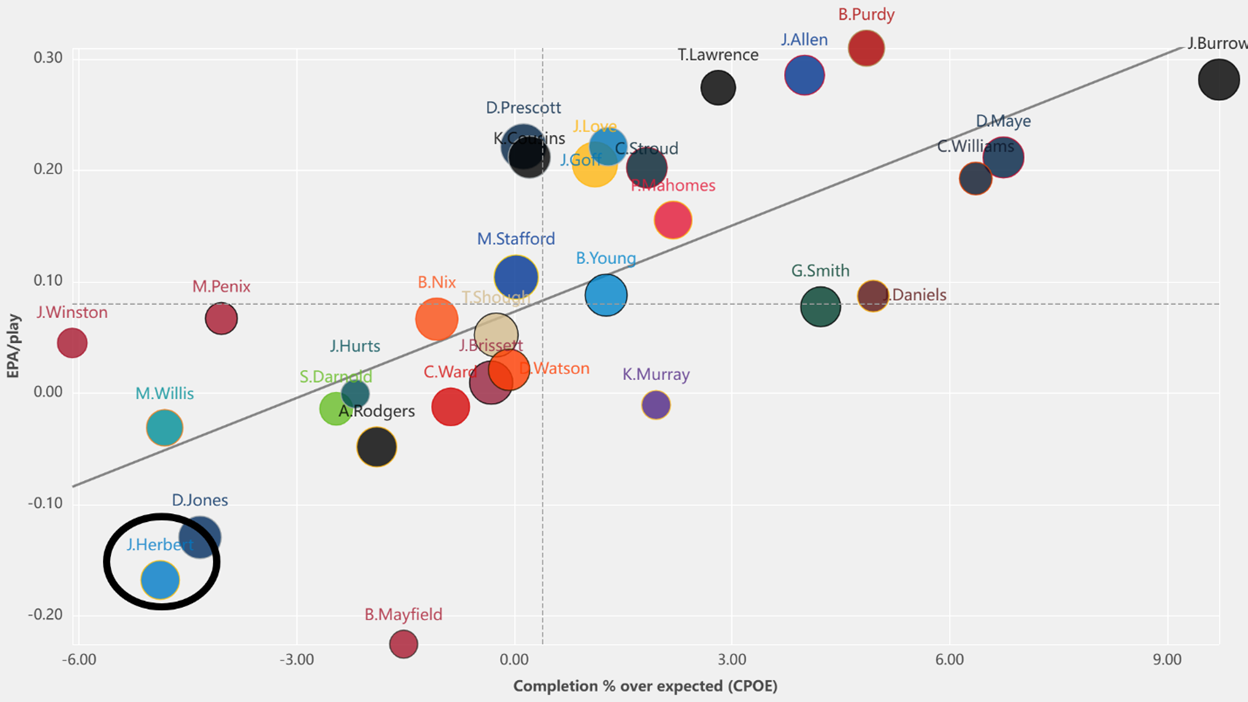
He ranks 47ᵗʰ among all QBs in EPA per play (-0.168), with a -4.88% CPOE and 38.4% positive EPA rate. His adjusted EPA per play is -0.133.
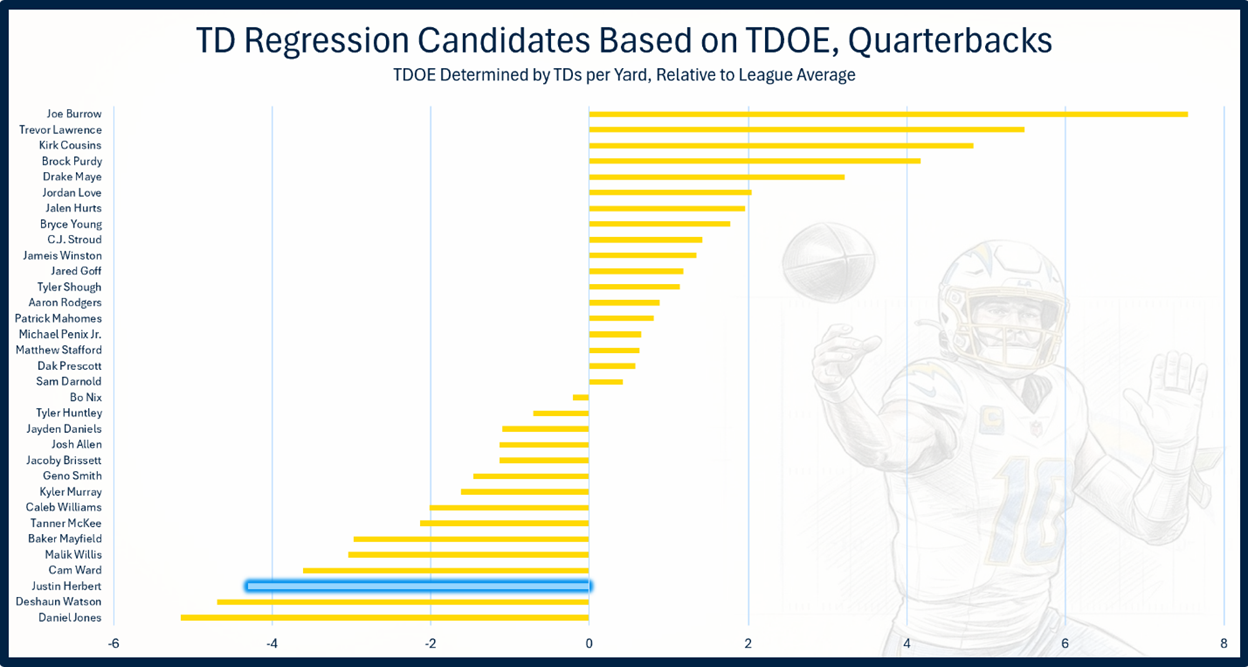
One statistical inequality stands out, defining Hebert’s inefficiency: his TD/INT ratio. While this is indisputably bad, it is out of character against his larger body of career work, and Herbert is a significant positive TD regression candidate at -4.31 TDOE based on TDs per yard, the third-lowest mark among qualified QBs.
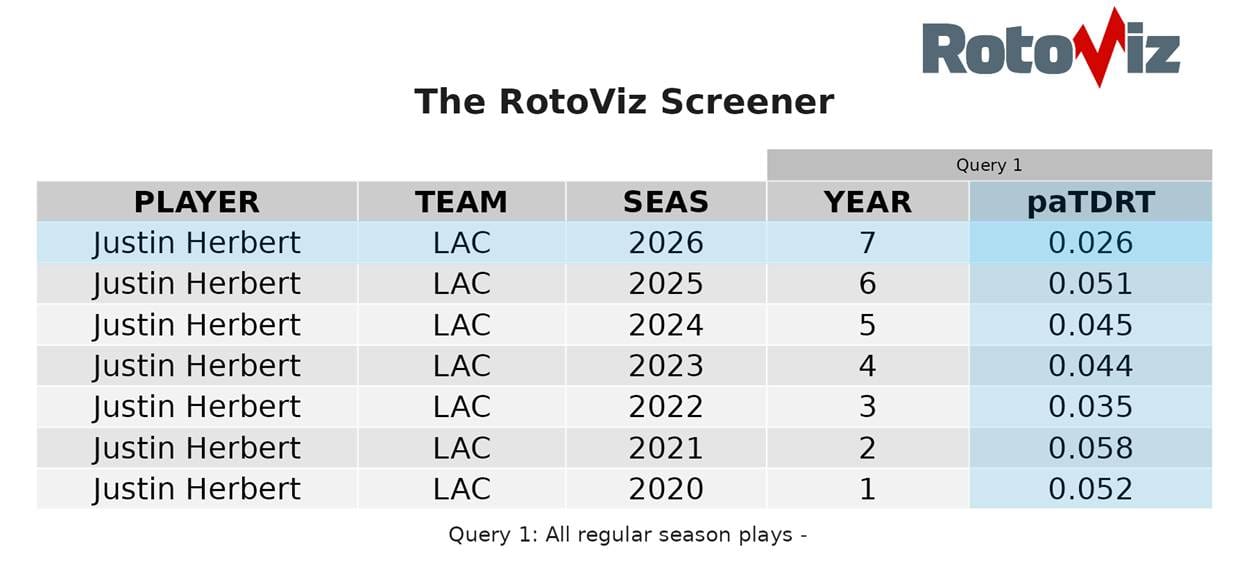
His 2.6% passing TD rate ranks 29ᵗʰ and is by far the worst rate of his career. While this season has been uncharacteristically poor for Herbert, it is tempting to draw a straight line to the association with McDaniel, whose unique system may simply not be compatible with Herbert. While this may offer some long-term comfort to beleaguered dynasty GMs grasping at straws, it offers little short-term consolation.
Baltimore ranks 18ᵗʰ in defensive EPA per play allowed (0.020), including 0.093 EPA per dropback (20ᵗʰ) and -0.090 EPA per rush (17ᵗʰ).
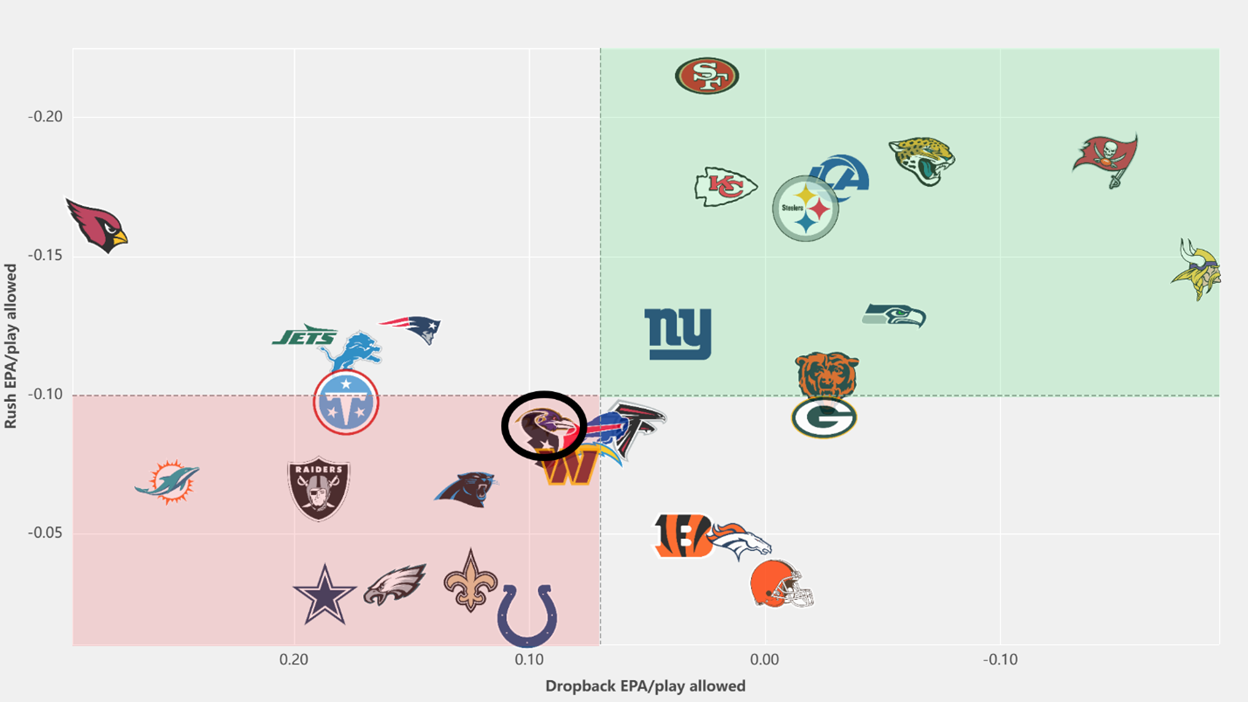
The Ravens primarily play zone coverage (79.8%, 9ᵗʰ), using two-high safeties 61.0% of the time (6ᵗʰ). Their most common coverages are Cover 3 (30.4%, 21ˢᵗ) and Cover 4 (22.1%, 6ᵗʰ). Baltimore blitzes at a rate of 30.8% (11ᵗʰ).
According to Fantasy Points' Coverage Matchup tool, Herbert is projected for a 7.4% upgrade in FP/DB against Baltimore's coverage based on the types and rates of coverage the Ravens employ. The PFF Matchup tool, based on PFF grades and the frequency of matchup assignments, considers his assignment fair.
Over their last five games, the Ravens have allowed 20.9 FP/G to QBs (8ᵗʰ), including 18.6 EP/G (17ᵗʰ) and 2.3 FPOE/G (10ᵗʰ).
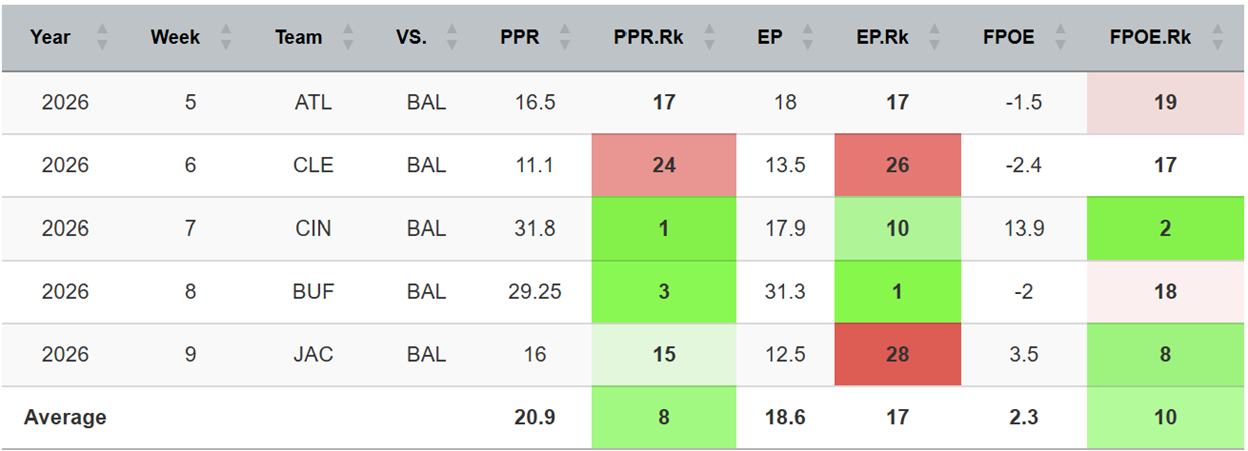
If we subscribe to the theory that Herbert is uncharacteristically underperforming and due for positive regression, the Ravens present an opportunity for correction in a favorable QB matchup.
The Chargers' receiving distribution has been relatively spread out over their last five games. TE Oronde Gadsden leads the team with 20 targets, followed by WR Tre Harris (19), RB Keaton Mitchell (17), and TE Charlie Kolar (16). Starting WRs Quentin Johnston (13) and Ladd McConkey (8) haven’t even earned 15 targets during that time.
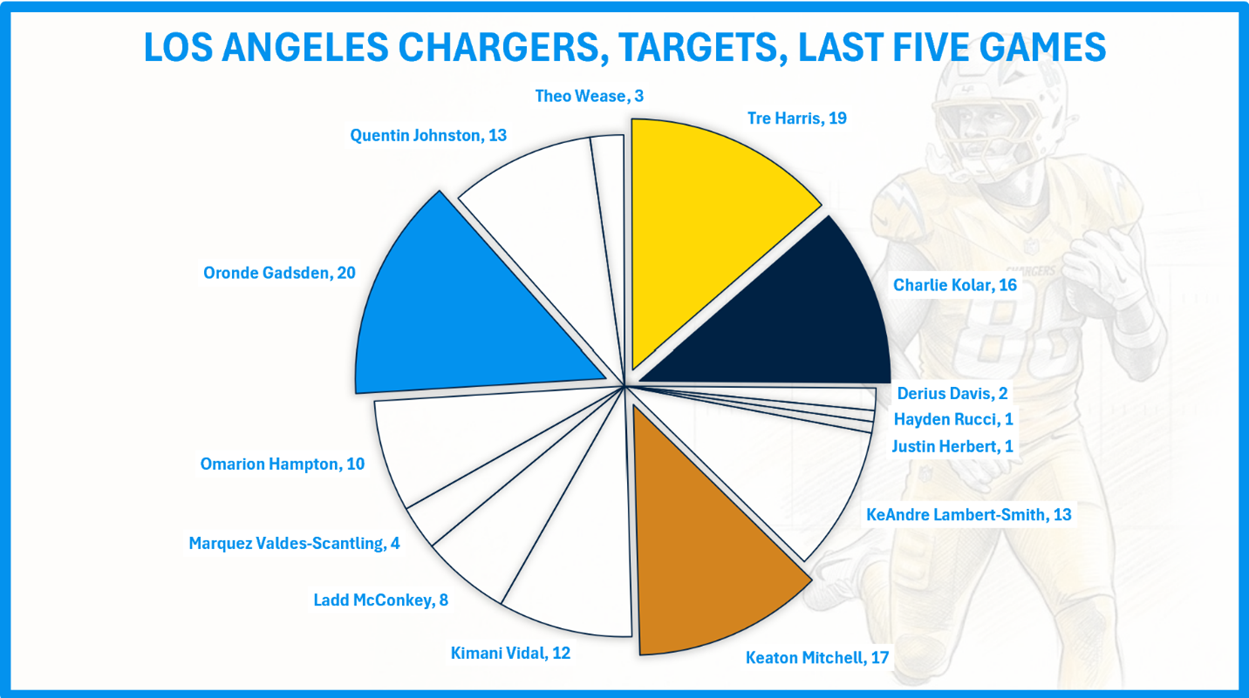
McConkey’s low volume is entirely justifiable; he is perceptibly the team’s alpha WR, but injuries have limited him to just 87 snaps over the past five games, missing two and leaving two early. His 19% TPRR would rank 44th if it reached the minimum threshold to qualify. McConkey’s target-earning hasn’t been the best, but his efficiency has been better; he has averaged 2.23 YPRR, which would rank 16ᵗʰ, and a 10.7% first-down rate per route, which would rank 18ᵗʰ.
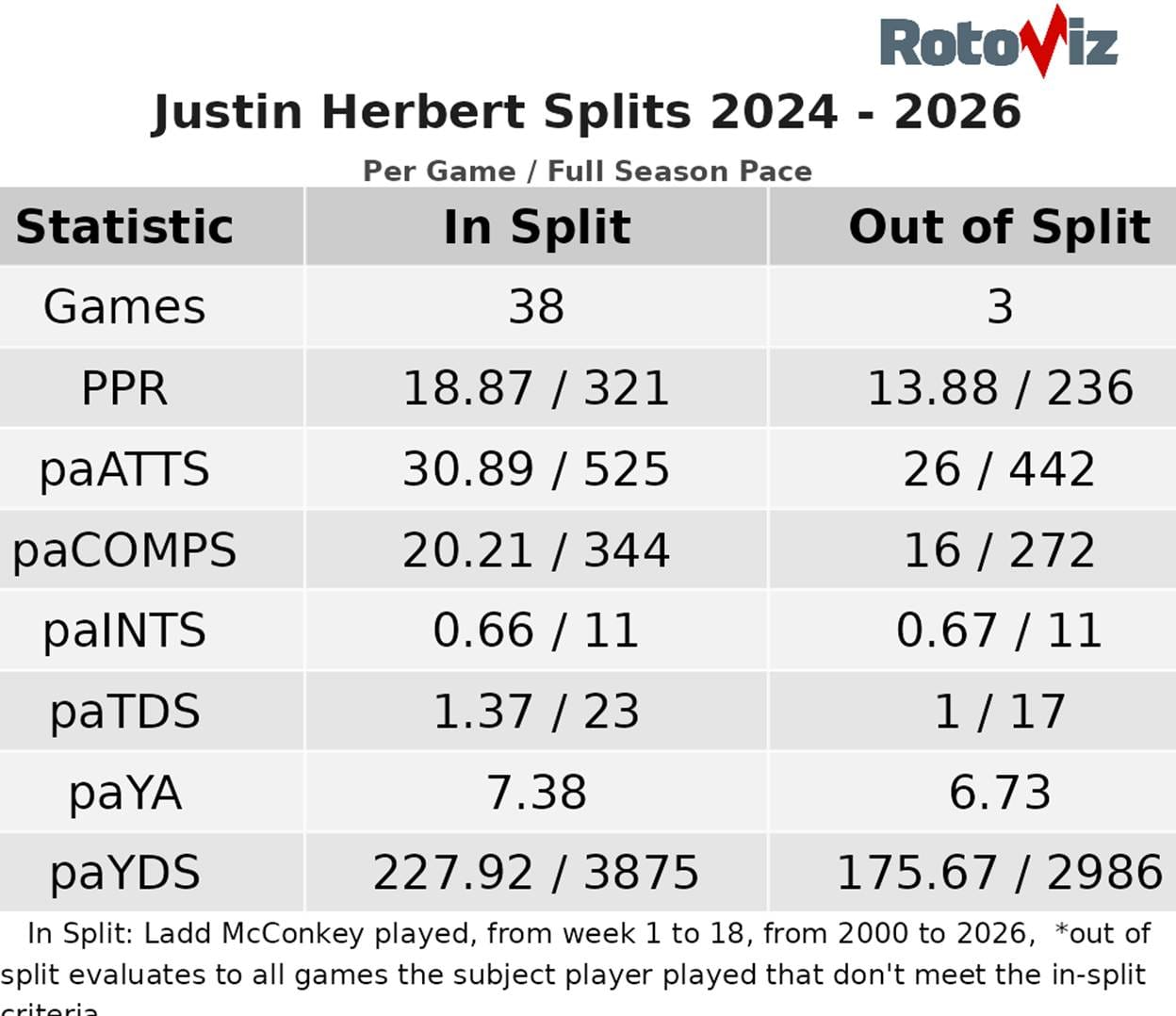
McConkey is essentially the Chargers’ only quality pass-catcher, but his availability is genuinely in question for Monday night. If he can't go, it would hamper Herbert’s prospects as a QB sleeper pick this week. Since McConkey arrived in 2024, they’ve played three games apart, with Herbert scoring five more FP/G with McConkey in lineups than without.
Johnston’s target deficiency has been far more troubling precisely because he’s played. He has been relegated to a field-stretcher, playing a decent 53.6 snaps/G (20ᵗʰ), with an 81% snap share (T-20ᵗʰ) and 73.2% route participation (43ʳᵈ), but earning only a 12.67% target share (55ᵗʰ) at a reasonably long 15.5-yard aDOT (7th). In the aggregate, Johnston has been ineffective, averaging 1.18 YPRR (56ᵗʰ), 14% TPRR (T-67ᵗʰ), and underperforming expectation by 1.06 FPOE/G (58ᵗʰ).
Harris is the only starting WR with at least 15 targets in the last five games. He has played 46 snaps/G (T-45ᵗʰ), with a 70% snap share (T-44ᵗʰ) and 63.2% route participation (58ᵗʰ). He has drawn a 15.84% target share (42ⁿᵈ) and 21.2% first-read target share (44ᵗʰ), averaging 4.86 targets/G (54ᵗʰ). His 1.46 YPRR ranks 47ᵗʰ, while his 22% TPRR ranks T-32ⁿᵈ. These outperform Johnston, but they are still uninspiring numbers.
According to Fantasy Points' Coverage Matchup tool, Harris receives a 23.3% projected upgrade against Baltimore's coverage, followed by Lambert-Smith (+21.4%), McConkey (+8.7%), and Johnston (+1.2%). The more personnel-based PFF Matchup tool, however, grades all three of Harris, McConkey, and Johnston's assignments as poor.
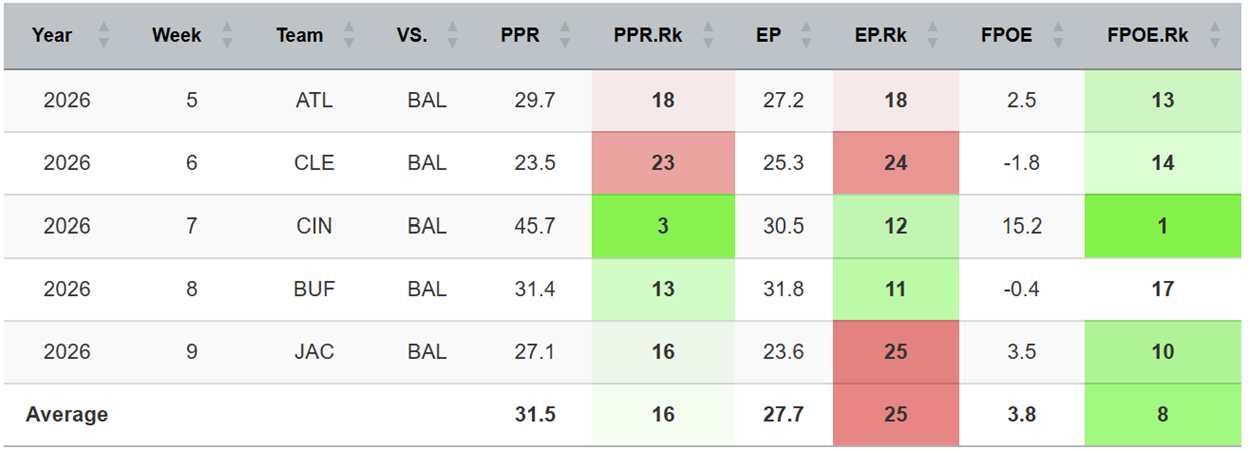
Over their last five games, the Ravens have allowed 31.5 PPR/G to WRs (16ᵗʰ), including 27.7 EP/G (25ᵗʰ) and 3.8 FPOE/G (8ᵗʰ).
Another reason WRs have been untenable for fantasy purposes is that the Chargers rank second in plays from 21 personnel and 30th in plays from 11. Between the lower total play volume and slow pace, Herbert’s drive-killing inefficiency, the run-heaviness, the injuries, and the number of two-WR sets, the volume has been too low for fantasy viability without strong efficiency, and no one but McConkey has that.
As for those TEs, they haven’t been all that viable themselves. Gadsden has averaged only 21.2 routes/G (T-30ᵗʰ), with 46.5% route participation (33ʳᵈ) and an 11.76% target share (22ⁿᵈ) after he was put third on the depth chart to start the season and was only permitted to play when the coaching staff was brought there kicking and screaming. His 8.2-yard aDOT ranks 10ᵗʰ among TEs, although his 1.01 YPRR ranks only T-36ᵗʰ.
Kolar has played 37.2 snaps/G (33ʳᵈ), with a 57% snap share (T-32ⁿᵈ), but has run an even fewer 17.5 routes/G (35ᵗʰ) with 42.2% route participation (36ᵗʰ). He has drawn an 8.6% target share (33ʳᵈ), averaging 3.17 targets/G (34ᵗʰ).
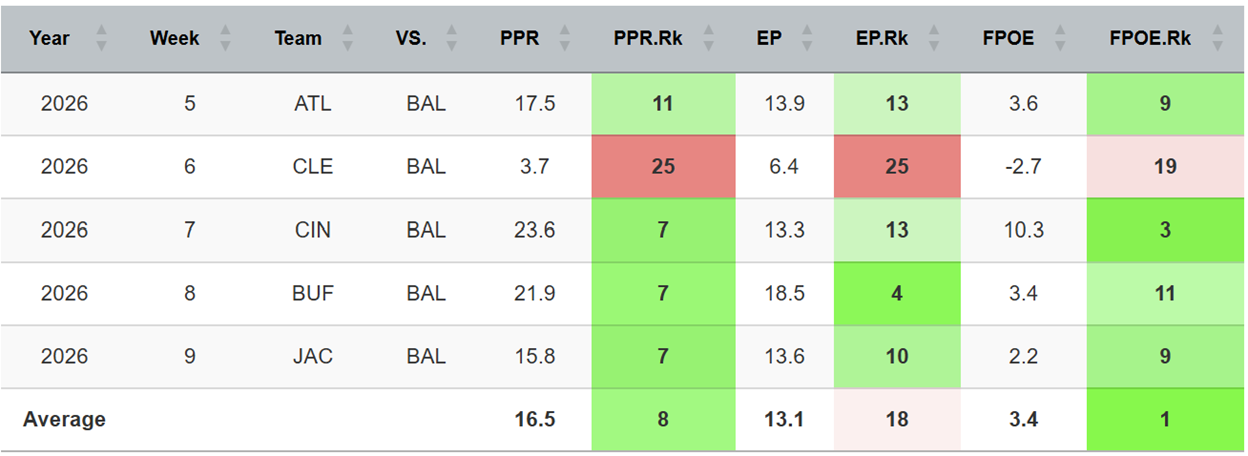
Fantasy Points' Coverage Matchup tool projects Gadsden for a 1.8% upgrade and Kolar for a 1.0% upgrade. The PFF Matchup tool grades both assignments as fair. Over their last five games, Baltimore has allowed 16.5 PPR/G to TEs (8ᵗʰ), including 13.1 EP/G (18ᵗʰ) and 3.4 FPOE/G (1ˢᵗ).
Both Chargers’ TEs seem like a no-go for most managed leagues, but if they were ever going to perform, this is the spot to do it, especially if McConkey can’t go. Perhaps they are more viable in DFS.
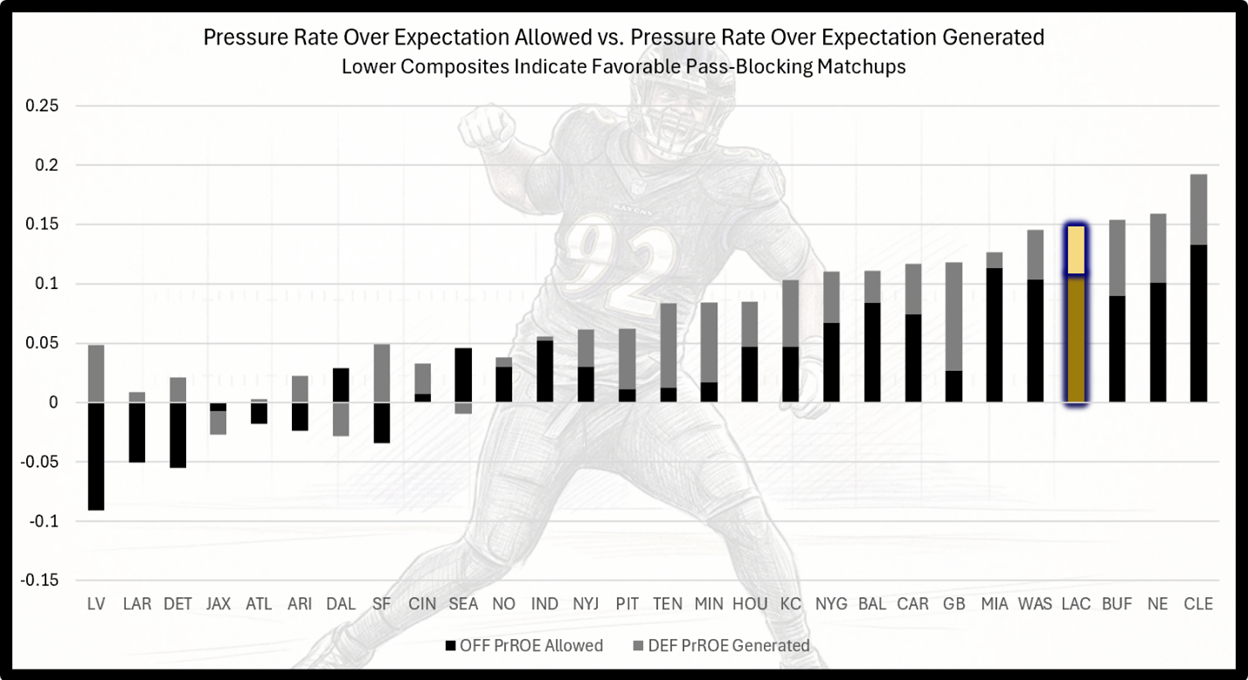
In the trenches, the Chargers face one of the NFL's least favorable pass-blocking matchups, based on pressure rate over expectation (PrROE) allowed versus Baltimore's PrROE generated.
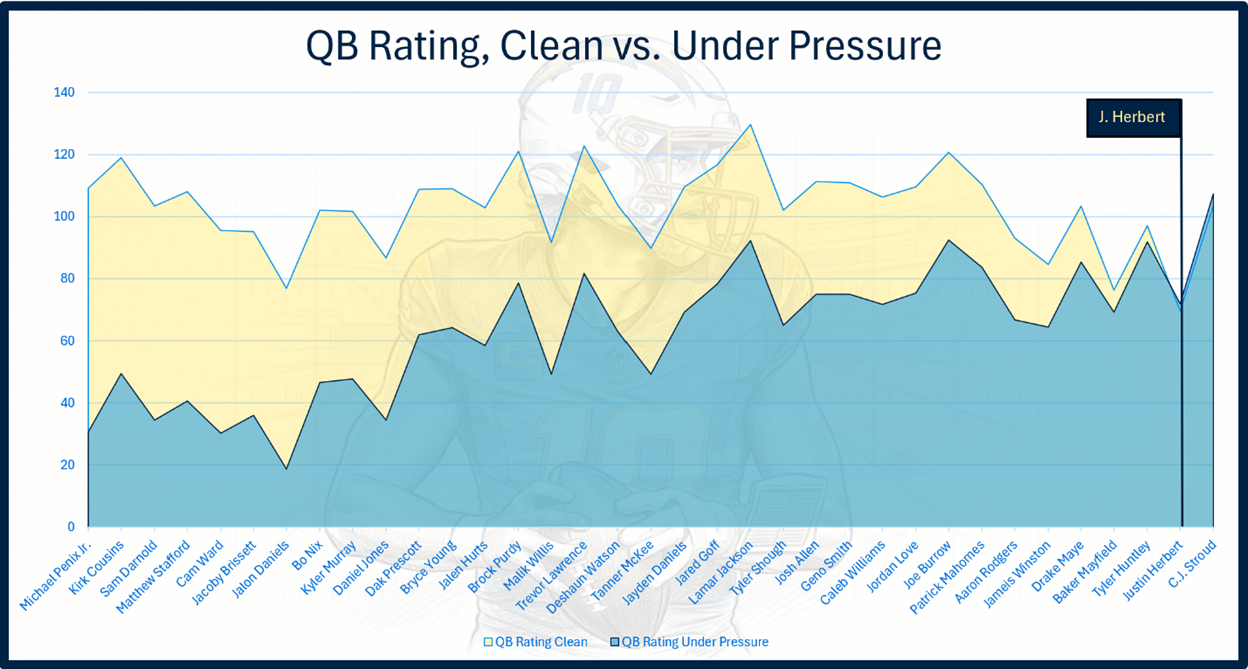
Herbert's 69.6 QB rating when kept clean is actually slightly lower than his 71.9 rating under pressure, a -2.3-point differential. That is unusual, although neither rating has been particularly encouraging. It’s more accurate to say Herbert has been poor from a clean pocket, and equally poor under pressure.
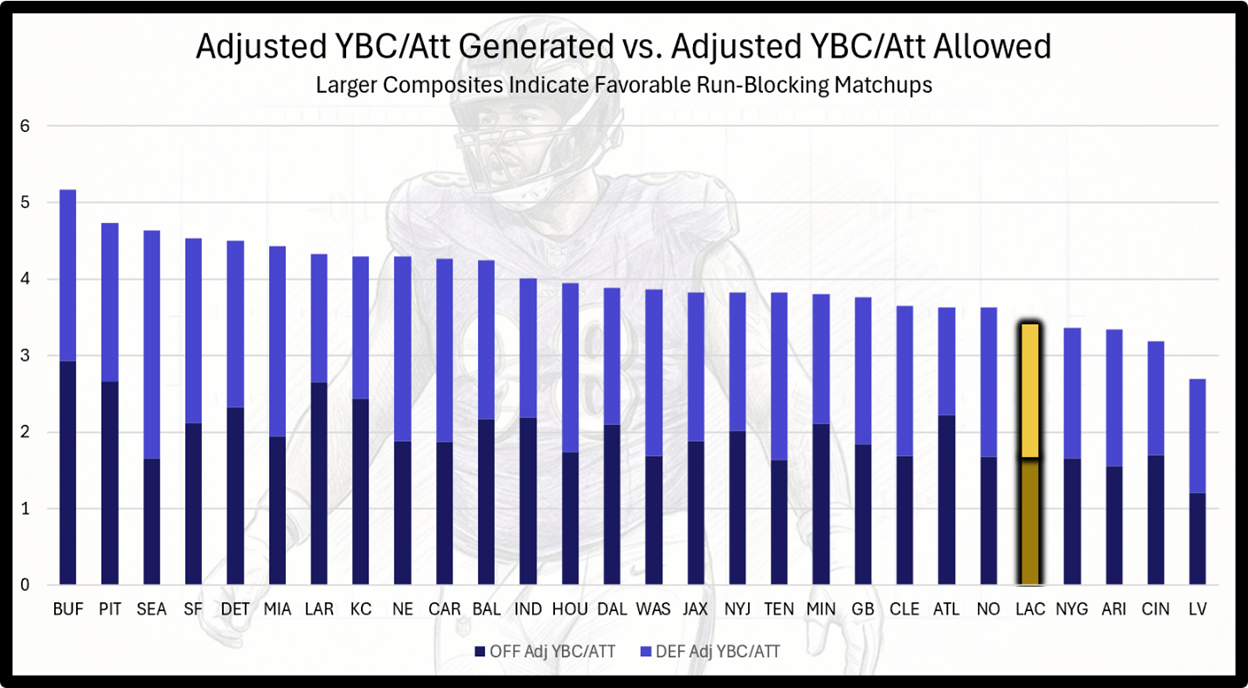
The run-blocking matchup is somewhat more favorable, although still below average. Los Angeles’ run-blocking matchup ranks 24ᵗʰ among the 28 teams playing in Week 10, based on adjusted YBC/Att generated and Baltimore's adjusted YBC/Att allowed.
The Chargers’ backfield has become a dreaded “three-headed monster,” which is typically a bad development for all parties involved, but especially for low-volume, low-scoring, bad teams.
Hampton’s 12.8 carries/G (T-25ᵗʰ), 43% snap share (33ʳᵈ), and 42nd percentile route share reflect the limitations of his role, but his efficiency is no better. He has averaged just 3.62 YPC (40ᵗʰ), with 1.62 missed tackles forced/G (33ʳᵈ). He has underperformed expectation by 0.787 FPOE/G (40ᵗʰ). So, he has low volume and low efficiency, making him a very bad bet.
Mitchell has been particularly disruptive to Hampton's receiving opportunities. Despite averaging just 5.75 carries/G (T-49ᵗʰ), Mitchell’s 30% route participation and 24% TPRR suggest intentional involvement in the passing game. Thus far, he has caught 18 of 22 targets for 103 yards and a TD, accounting for 65.83% of his fantasy production through the receiving game.
More recently, Vidal has also been involved, accounting for double-digit opportunities in every game since Week 5.
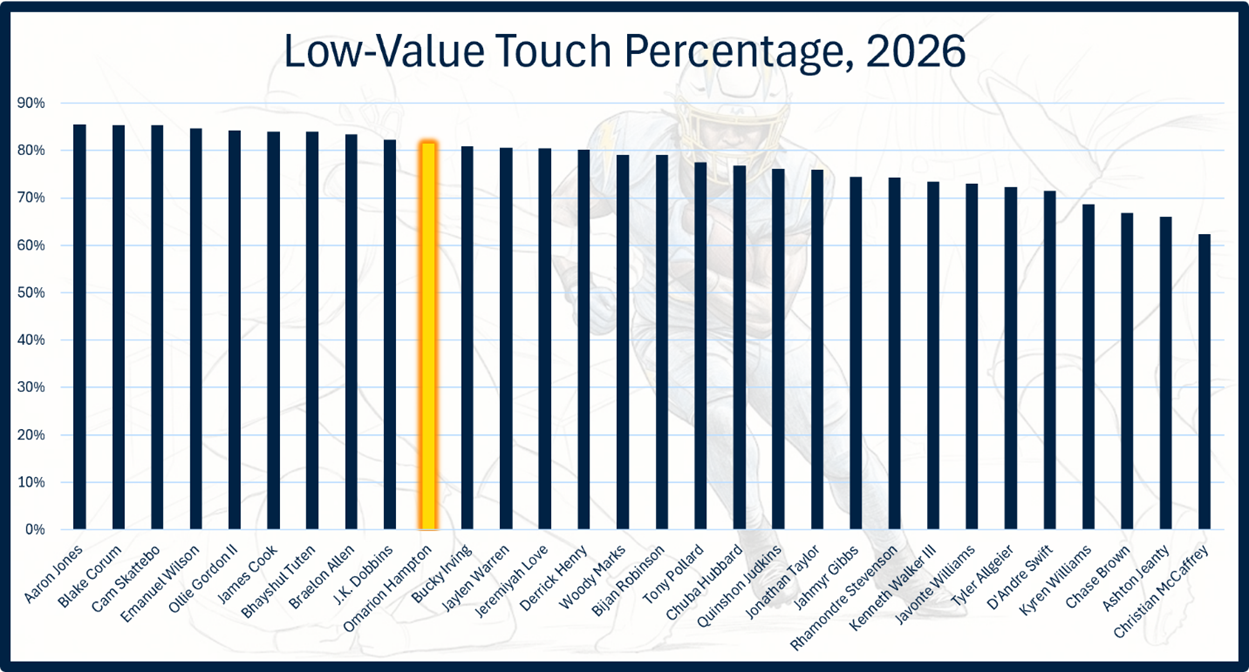
The distribution of valuable touches offers Hampton little relief. He has handled 21 HVTs, compared to 19 for Mitchell and 10 for Vidal. However, 81.42% of Hampton's opportunities have been LVTs, and his 25% team opportunity share (T-26ᵗʰ) leaves him dependent on efficiency and touchdowns that have been hard to come by. Hampton has scored three rushing TDs on 369 rushing yards, a 2.9% rushing TD rate (29ᵗʰ).
The matchup offers little encouragement. PFF ranks the rushing matchup for both Hampton (61ˢᵗ of 78 RBs) and Vidal (59ᵗʰ) as poor. According to the tool, Mitchell has a favorable receiving matchup (25ᵗʰ of 93 RBs).
Over the past five games, Baltimore has allowed 20.5 PPR/G to opposing RBs (23ʳᵈ), against 23.3 EP/G (12ᵗʰ). Opposing backs have underperformed expectation by 2.8 FPOE/G (27ᵗʰ), suggesting that Baltimore has been considerably better at limiting production than opportunities.
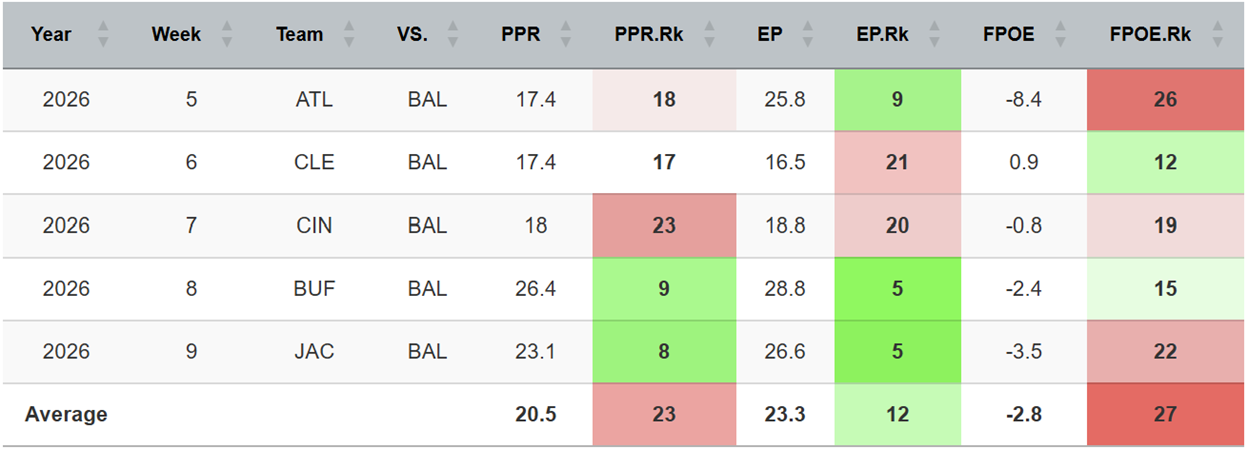
The Ravens have allowed at least 23.1 PPR points to opposing backfields in each of their last two games, but those totals have required substantial collective volume. For a Chargers backfield splitting rushing attempts, routes, and valuable touches three ways, that isn't especially reassuring. Mitchell has the most interesting receiving role, Hampton remains the nominal lead runner, and Vidal has become involved enough to limit both without establishing a dependable fantasy role of his own.