
Quick Slant: SNF - The Convergence of Sports Hopium and Unfeeling Pragmatism

Mat Irby's Quick Slant
“You are what your record says you are.”
Legendary HC Bill Parcells would toss out this line from time to time, and it would land like a fire blanket.
One of the most familiar pastimes of sports fans worldwide is seeking an alternate reality that better explains their team than the numbers on their ledger. For most, it is a way to pry open the window just enough to let some hope waft in—a defense mechanism to help us mitigate our devastations just enough to permit another roll of the dice to play out in our open chest cavities the following week.
Generally, we build the best-case scenario in our minds and endlessly justify it until we can no longer, and this plays out in an endless loop. And if the dam finally breaks in a given season, we pull the plug and begin reconstruction for a long-form version of the same exercise, which will have us back in shape by opening kickoff in Week 1 the following fall.
When an optimistic reporter working the local beat would try to pull Parcells into this game of rationalizing and hand-waving, he would splash them with this lovely little bucket of cold water. It sounds harsh; that’s a Northeast thing. It’s not rude; it’s direct, and it comes from having to walk a quarter mile in the rain from Penn Station to Herald Square to catch the B-train after NJ Transit from Watsessing had already been delayed, making you 150% more likely to be late for work. Over time, living in the Northeast strips away unnecessary words, leaving people with only what’s needed to fit into the small pockets of time they can afford.
The important thing about the convergence of sports hopium and unfeeling pragmatism is that you get to choose what suits you best. No one is saying you can’t live with your head in the clouds; if that’s where you need to be to emotionally process the game’s ups and downs, by all means, have at it. It’s sports, not your bank ledger; it’s frankly not that critical to get it all that right to enjoy a game on a Sunday afternoon.
Parcells, and people like him (I’d like to think we at Legendary Upside are in this camp), would simply extend the invitation to join them in reality. If you want to know how to go about fighting the battle, you first need to know what battle you’re in. To understand the battle you’re in, it begins with an honest self-appraisal.
Whatever pretext we had about Washington—a final-four team in 2024 led by an incumbent OROY QB and a HC who has been one of the great defensive minds in the NFL for years, leading a young squad, ever improving—should really be quashed by the season’s midway point. The Commanders are a 3-5 team.
And whatever our preconceptions about Seattle—overachievers with a shaky offense to begin with, set to be led by the retread of all retreads, who had been propped up by a system he now departs, in a move that could even result in a QB downgrade—that’s all equally insufficient. The Seahawks are a 5-2 team.
Does honest self-appraisal leave no room for improvement or growth (or their inverse)? Hardly; in fact, it is necessary for either, and teams surge or collapse in the back half every year. On the other hand, dysmorphia about your team identity is the first step toward dooming yourself to repeating mistakes and amplifying flaws.
As fans, we should prepare ourselves: the Seahawks have been the far better team thus far, so Occam’s Razor says they probably just are. And the Commanders, who look up at them, are looking for a signature win that can flip their fortunes on end on six days of prep compared to Seattle’s 13. A win here would be no small feat, and its significance could be destiny-defining.
Seahawks
Implied Team Total: 25.25
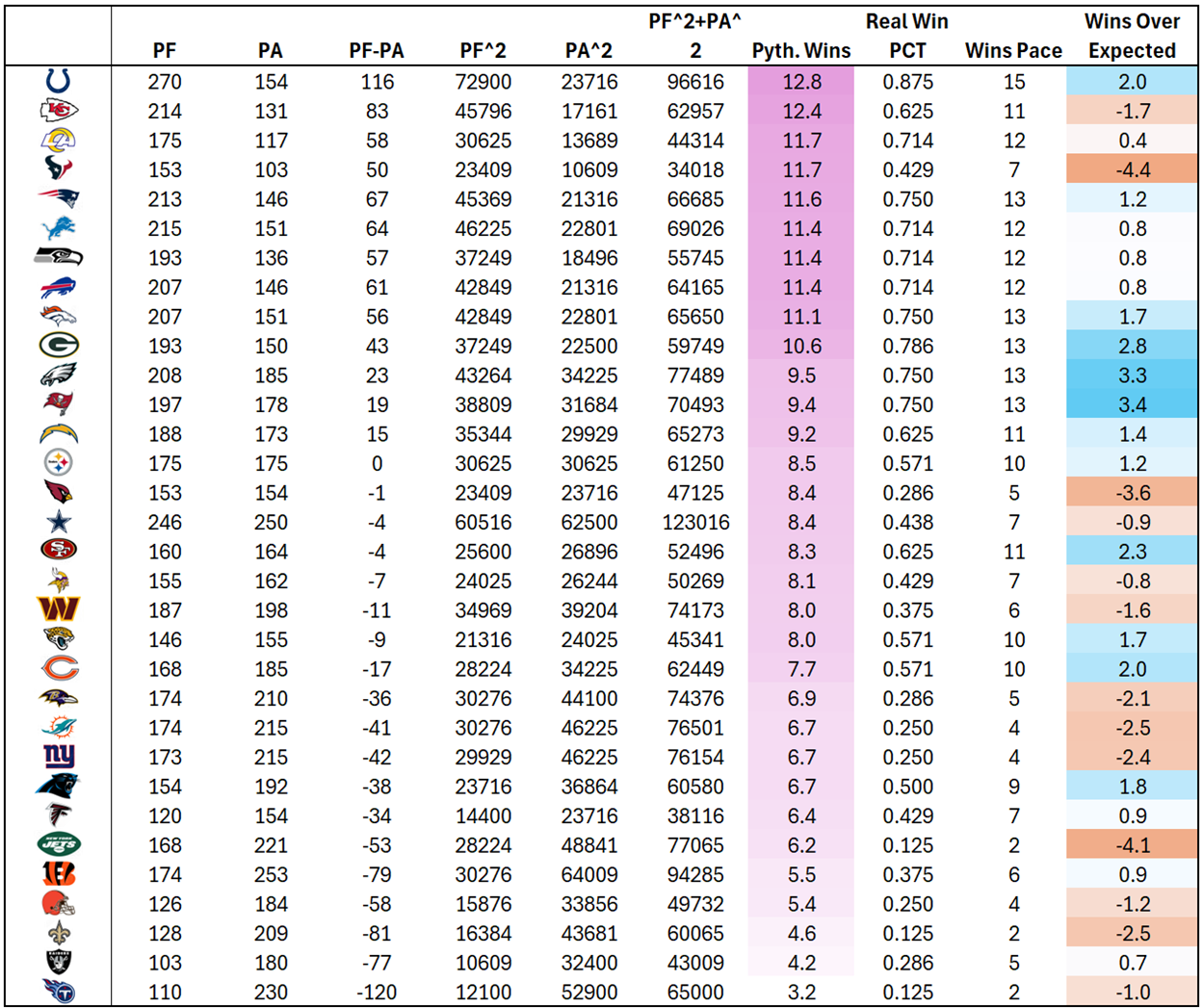
The Seahawks are not only 5-2, but they are also seventh in Pythagorean expected wins, which is based on points scored and points allowed. They are projected for 11.4 wins.
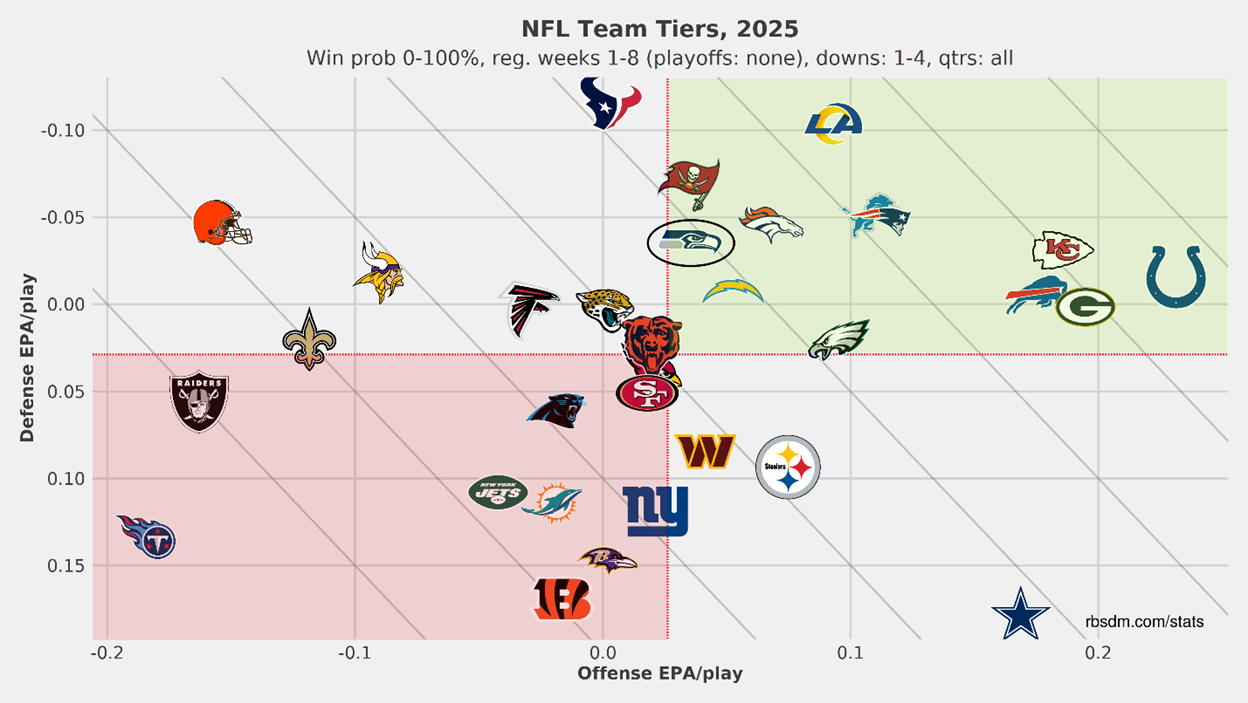
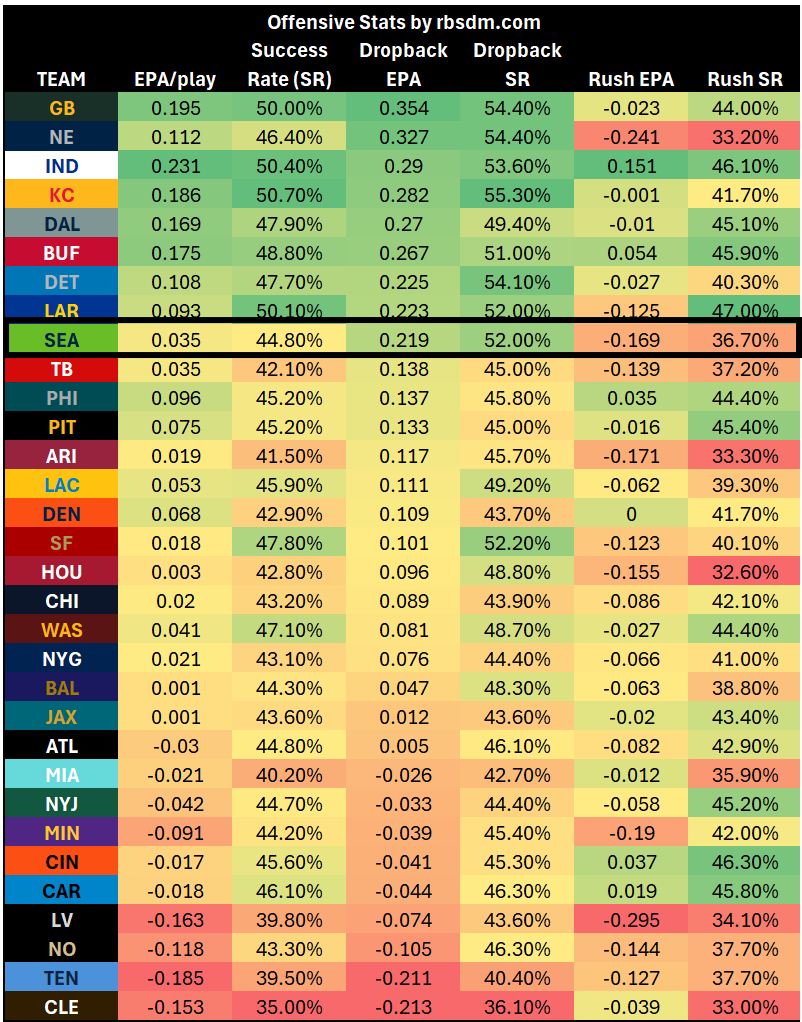
The Seahawks’ offense is about average, ranking 15th in offensive EPA per play and 16th in offensive success rate. Their defense is above average, ranking eighth in defensive EPA per play and seventh in defensive success rate.
Seattle is average in the speed at which it runs plays at the line, at 26.8 seconds per snap. They run the football on 49% of their plays (2nd). They are on the low side in terms of play volume, averaging 61 offensive snaps per 60 minutes (T-25th). They also run a lot against circumstance; their pass rate over expected (PROE) rate is -5.8% (29th).
As such, QB Sam Darnold has only 29.7 dropbacks/G (34th) and 27.4 attempts/G (29th). As a passer, he has been quite good when called upon. He ranks third in EPA + CPOE Composite, according to rbsdm.com.
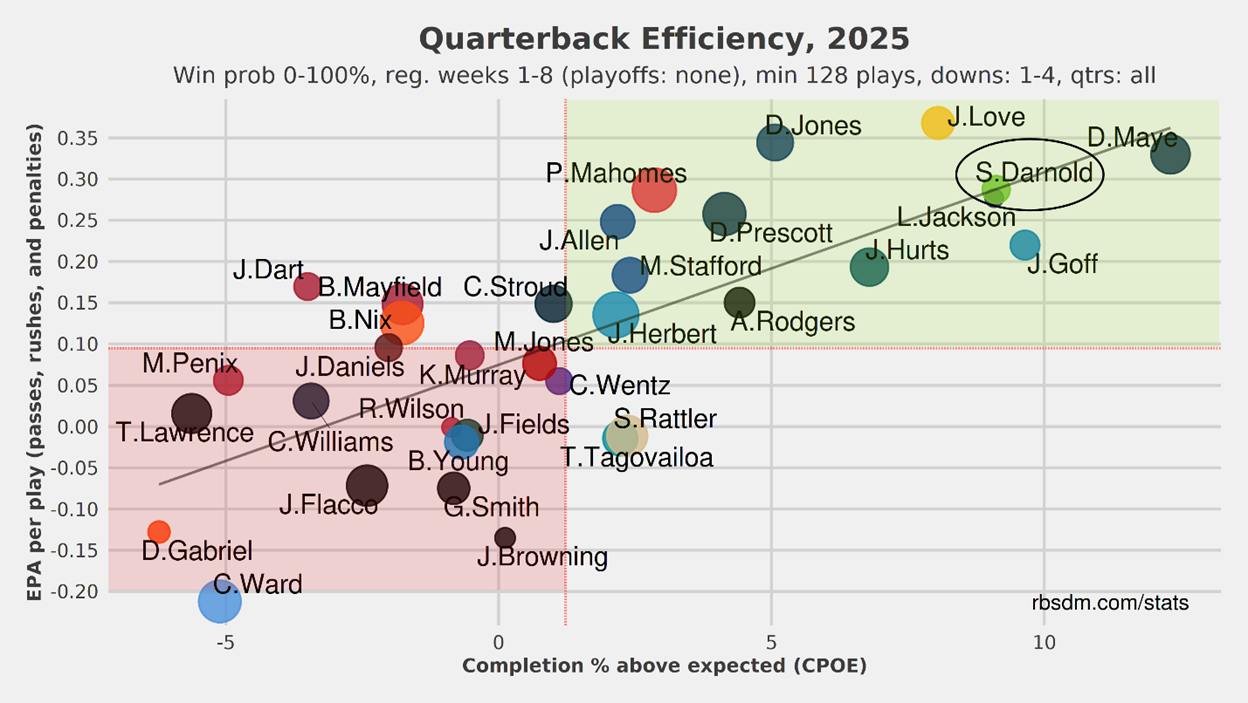
Seattle’s strength is its passing; it simply chooses to pass less often than it runs. This makes sense, as OC Klint Kubiak is the son of Gary Kubiak, one of the developers of the Shanahan wide zone scheme, and then later worked closely with Kyle Shanahan in San Francisco. It is common for Shanahan systems to run at a slower pace, with a greater emphasis on the running game, while also maintaining an efficient and effective passing game.
Darnold provides no rushing component, so he is strictly dependent upon passing to get him over in fantasy. This makes him more volatile, and he needs TDs to put up fantasy points. In seven games, he’s been a top 12 option three times.
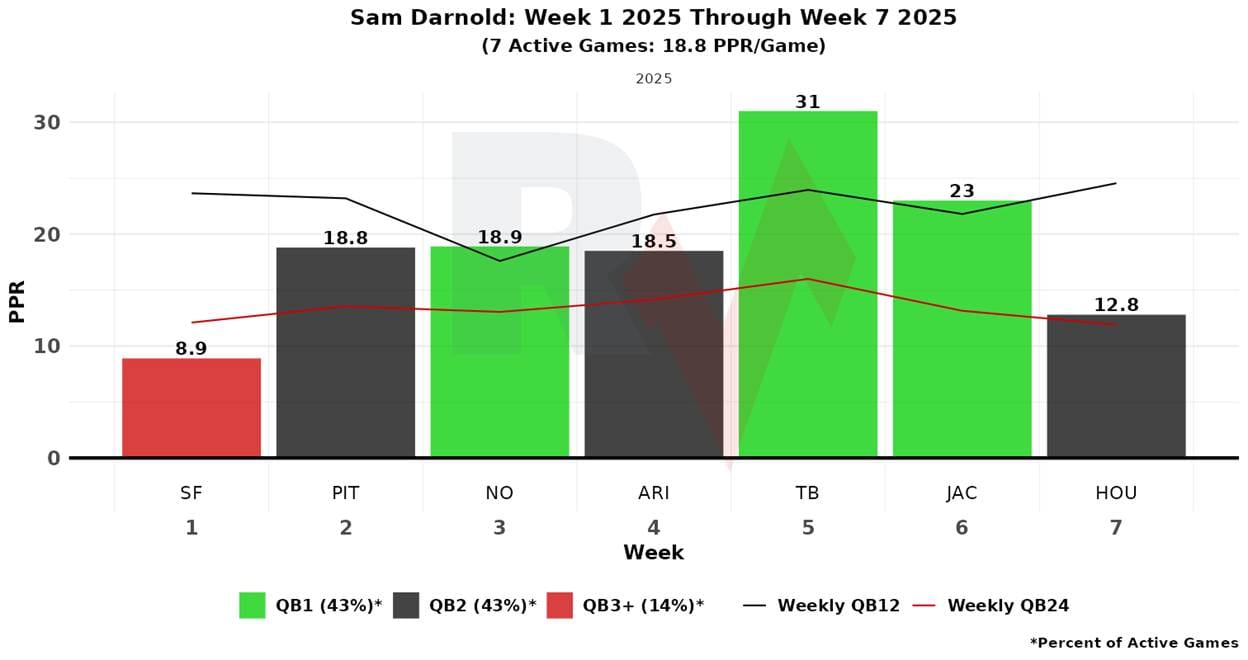
Thus far, however, Darnold has rarely been a total dud. Really, only Week 1 against San Francisco was an abject failure, fantasy-wise. Last week wasn’t great, but it probably didn’t make most managed-league GMs lose their games all by itself.
The Seahawks have only one player with a target share greater than 15% in his past five games, and that’s Jaxon Smith-Njigba, who leads the NFL during that span (32.1%, according to Fantasy Points data, 34.7% on the season). WR Cooper Kupp comes in second with a 14.3% share in the past five games.
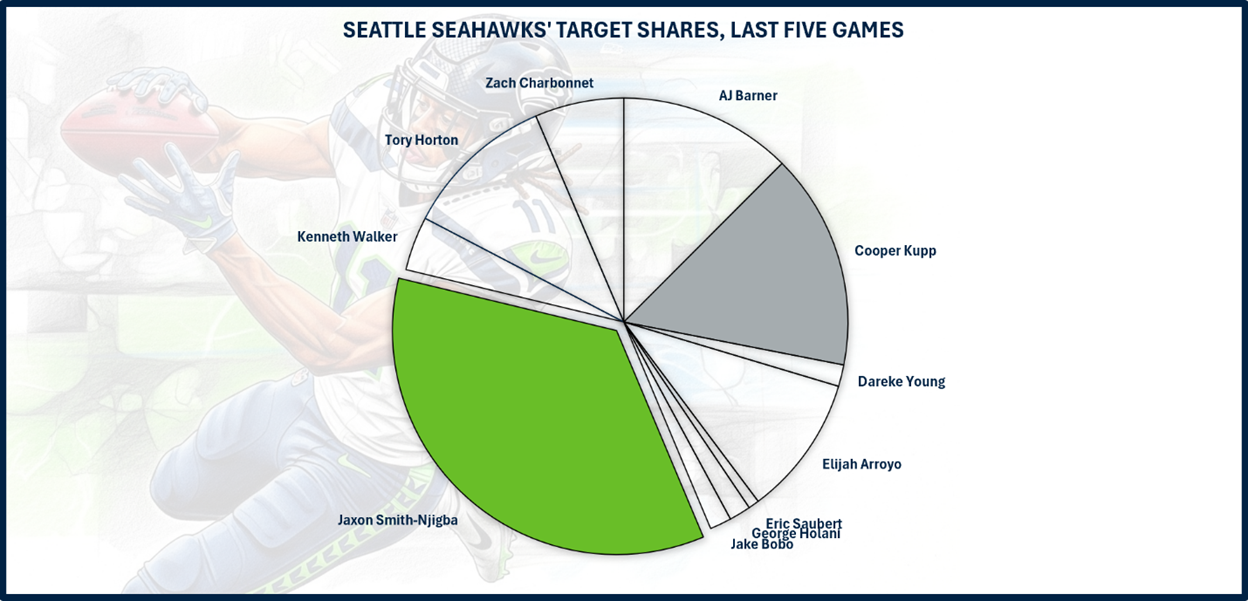
Smith-Njigba is arguably the best WR in the NFL, ranking in the top five in PPR points (2nd), targets (3rd), receptions (4th), receiving yards (1st), targets per route run (TPRR, 2nd), yards per route run (YPRR, 1st), first-read targets (3rd), first downs (2nd), air yards (1st), weighted opportunity (WOPR, 1st), expected points (EP, 7th), and fantasy points over expected (FPOE, 1st). He’s clearly a must-start no matter what.
Kupp is hard to trust. He completely lacks upside, but he really doesn’t have the floor to be played in most leagues either. His name is bigger than his game at this point.
Everyone outside of Smith-Njigba is TD-dependent, which is difficult to pin down. As such, it is problematic to squeeze TEs A.J. Barner or Elijah Arroyo, or WR Tory Horton into lineups, either.
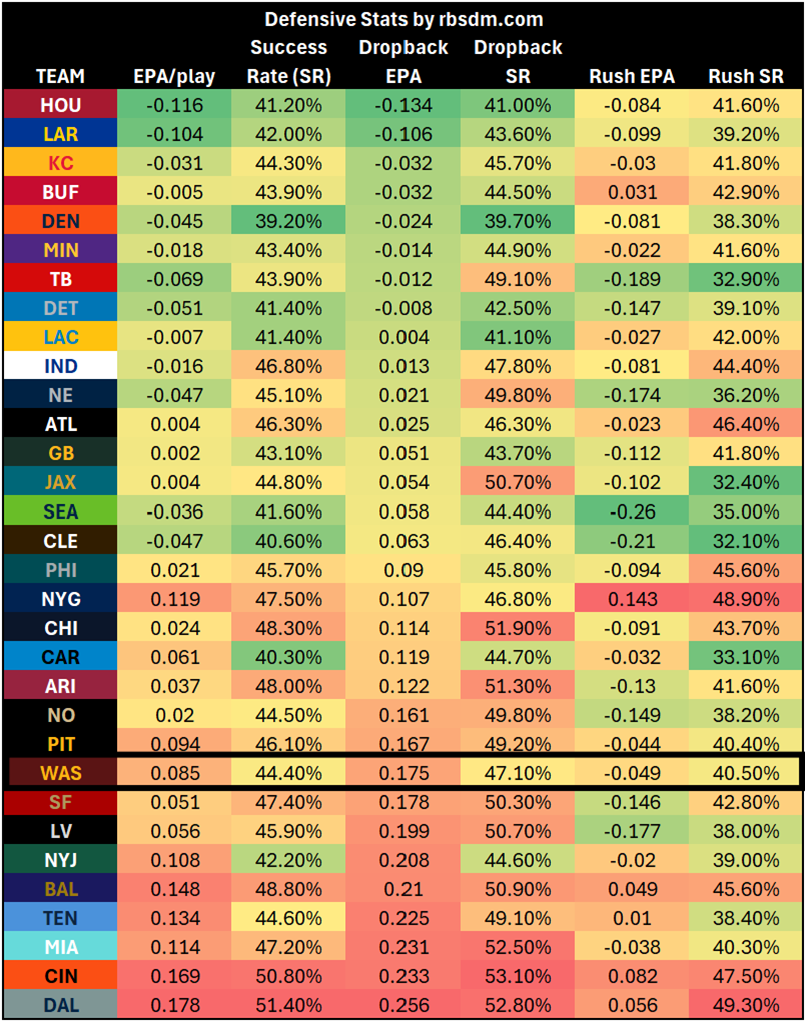
Washington uses a man defense on 30.0% of its defensive plays (8th) and plays single-high safety on 55.4% (10th). Their primary defensive alignments are Cover 3 (27.9%) and Cover 1 (25.1%). They blitz at 25.1%, which is pretty average.
Fantasy Points’ coverage matchup tool compares the types and rates of coverage a defense uses to how the pass-catchers from the opposing team perform against them to compile a zero-based coverage grade. This can help us see how well each player performs against the types and rates of coverage their opponents utilize. Kupp and Barner each grade out positively this week, but Smith-Njigba does not. However, even with a -7.7% coverage score, Fantasy Points predicts 0.81 expected fantasy points per route for Smith-Njigba, which ranks first this week among all WRs and TEs.
PFF’s matchup tool is player-based rather than scheme-based. It projects Darnold, Smith-Njigba, and Kupp to have great matchups, and Barner to have a good matchup. The Commanders’ CBs have been an utter disaster; Smith-Njigba and Kupp are poised to take advantage of a significant matchup advantage.
In the trenches, the matchup is neutral for Seattle’s offense, which should neither overmatch nor be overmatched by the Commanders’ pass rush. One of the biggest criticisms of the Commanders entering the season was that they would struggle in pass protection, but the unit has a 0.32% pressure rate over expected (PrROE) rate (4th).
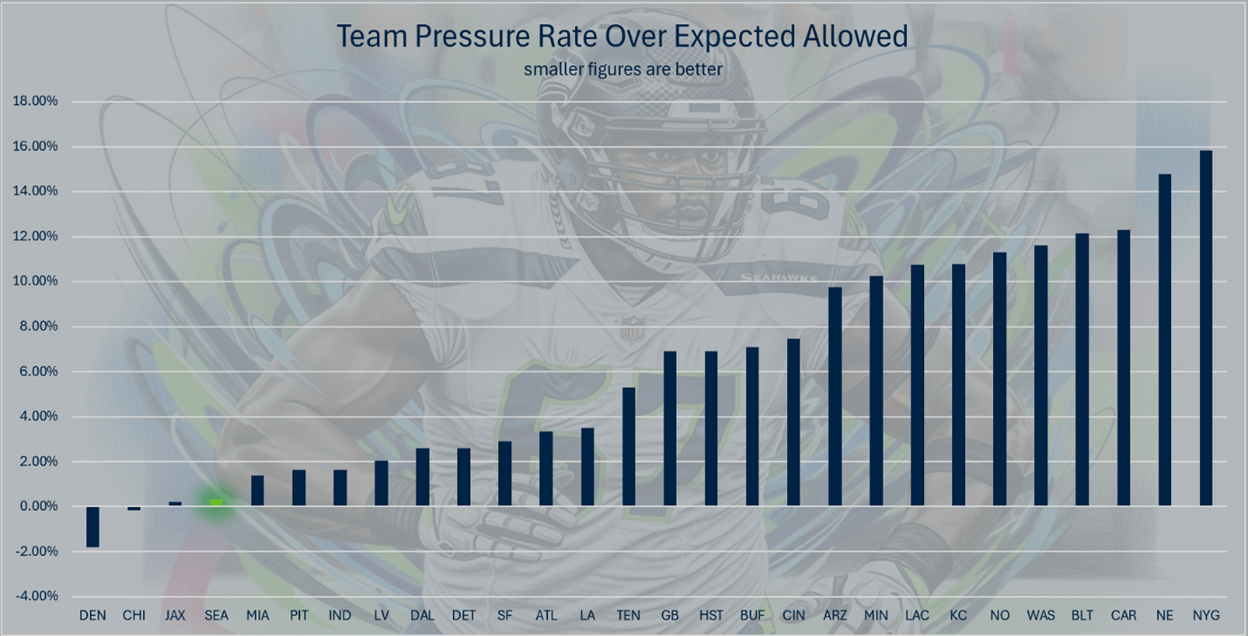
The Commanders will not be overmatched in this area, however, because their defense also ranks fourth in PrROE generated, so it’s a push.
The thing is that Washington can also be beaten on the ground. They have surrendered the fifth-most fantasy points to RBs in their last five games.
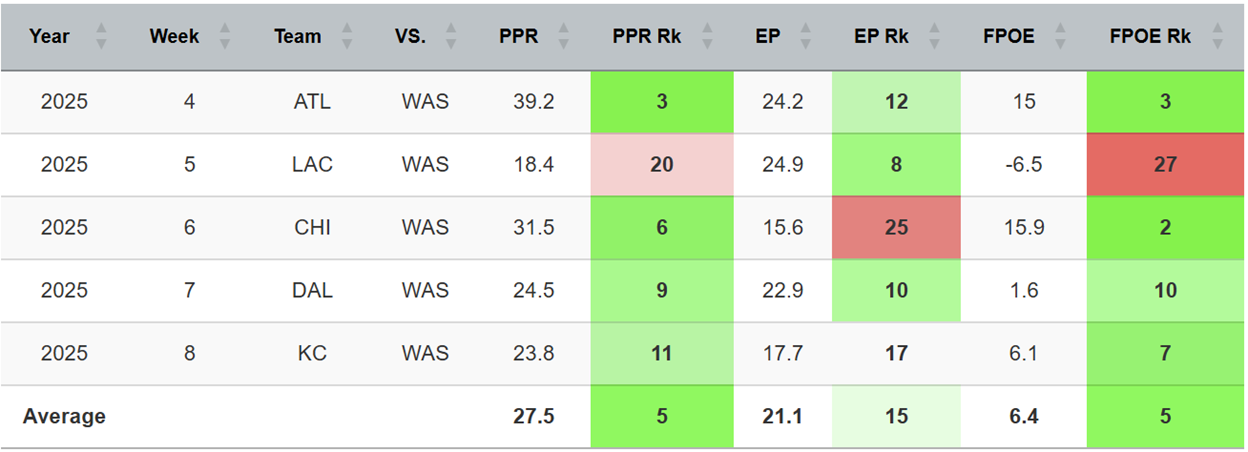
Included in this, they are inefficient against RBs out of the backfield, surrendering the 23rd-most receptions, but the fifth-most receiving yards. The Seahawks are unlikely to be the team to capitalize on this particular weakness, as their RBs don't get much run in the passing game.
The Seahawks’ pair of RBs, Kenneth Walker and Zach Charbonnet, are frustrating to use in lineups. Charbonnet leads in snap share, but he gets fewer touches. Walker has had slightly more of a role in the passing game (4.6% target share to 4.0%), while Charbonnet is far more heavily used around the goal line (75% of runs inside the five-yard line). The bottom line is, neither gets enough volume to be highly viable, and they split the high-value touches.
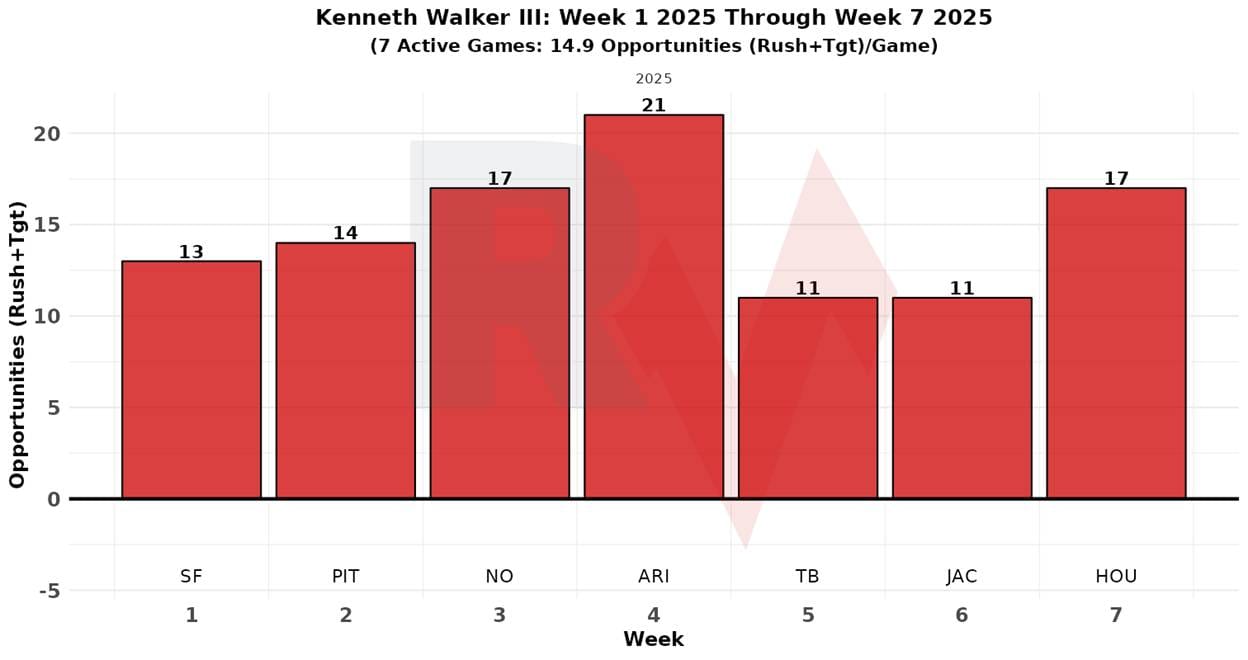
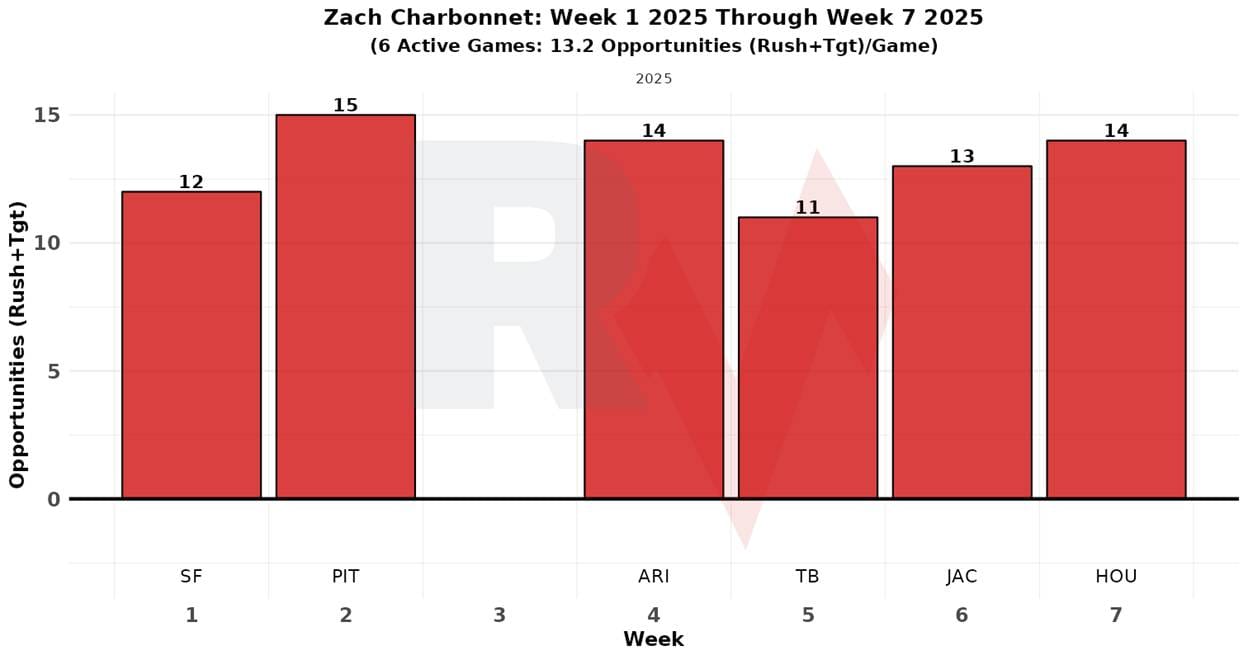
Without much of a role at all in the passing game (neither RB really has one) and no goal-line usage, Walker is only getting low-value touches. He relies on explosives to carry his fantasy production, which have been scarce of late. Of the two, Charbonnet is probably the better play, because he has a more realistic shot at a TD every week; it is still a hold-your-nose flex, for sure.