
Quick Slant: SNF - The Third-Place Game

Mat Irby’s Quick Slant
To become an astronaut in 1963, you needed American citizenship, a degree in engineering or a physical science, and 1,000 hours of jet flying, all before your 35th birthday. From the tiny pool of people meeting those parameters (an estimated 0.00003%–0.00006% of humanity), you still had to stand out.
You had to be brilliant, fit, composed, an excellent problem solver, and know machines inside out. You came from places like Caltech or MIT; trained like a prizefighter; endured stress tests, blood tests, psych evals, and probing for every conceivable ailment. They asked mysterious questions that felt like a job interview crossed with a Rorschach test. You proved you could run a six-minute mile while solving a Rubik’s Cube and Einstein’s field equations at the same time, all as someone pelted you with quarters.
I know what you're thinking: sounds like Dolph Lundgren. Unfortunately, you also had to be under six feet tall, so even Dolph would've been Woody standing in the street, watching Andy's station wagon driving away.
From a planet of 3.2 billion people in 1963, NASA chose fourteen.
Mike Collins was one of them.
Flash forward six years. Collins is aboard Columbia, orbiting sixty nautical miles above the Moon. Below, Eagle touches down. Neil Armstrong and Buzz Aldrin bumble down its janky ladder, take one small step for man, bound around, and plant their flag. They get the imagery, the press, and lines more referenced than Pulp Fiction's.
But Collins keeps their ride home circling overhead. Eagle can get them off the Moon. Only Columbia can get them back to Earth. Without Collins, no imagery, no quotes, or press. No back-to-back ticker-tape parades in New York and Chicago, with so much confetti that every photograph looks badly scratched. No ride on Air Force One. No Medal of Freedom. No household names. No guest appearance on 30 Rock.
Ask someone today to name Apollo 11’s three astronauts. Armstrong comes easily. Aldrin, slightly less so. But Collins, equally essential, has nearly vanished from collective memory.
I often think about Collins and wonder how he felt about his assignment. He didn’t merely touch the hem of Armstrong and Aldrin’s garments. He lived with them in outer space. They ate, slept, and went to the restroom together. And they owed him their lives. While the show ponies made history below, Collins remained quiet, manning a control board that looked like 100 black wristwatches glued to a tin barrel, doing the math so Armstrong and Aldrin didn’t drift toward Alpha Centauri. In an image, Collins was Ringo Starr: constantly pictured beside McCartney and Lennon, but never given equal footing.
And that's the cruelty of third. You can do something almost nobody on Earth can do, reach a place almost nobody has ever been, and still have a footnote’s legacy in a larger story written about Sam Darnold.
Which brings us to Sunday night’s game between the Los Angeles Rams and Denver Broncos.
Last January, both reached their respective conference championship games. They survived eighteen weeks of football and two rounds of the playoffs. They were among the last four teams standing in a league of thirty-two, each one victory from immortality. One in 10,000 American newborn males will play professional American football. One in 24,000 will start a game. One in 35,000 will start in a playoff game. One in 500,000 will start at QB in a conference championship game. That’s incredibly rare.
But at the end of the 2025–2026 season, Seattle and New England descended the ladder. Los Angeles and Denver stayed with the wristwatches. And eventually, almost no one will remember them.
This Sunday night, the Rams and Broncos meet on Sunday Night Football for the third-place game nobody wanted. Two extraordinary teams. One nationally televised reminder that they were almost somewhere else.
GAME ENVIRONMENT
Los Angeles Rams (-2.5) at Denver Broncos
Over/Under: 45.5
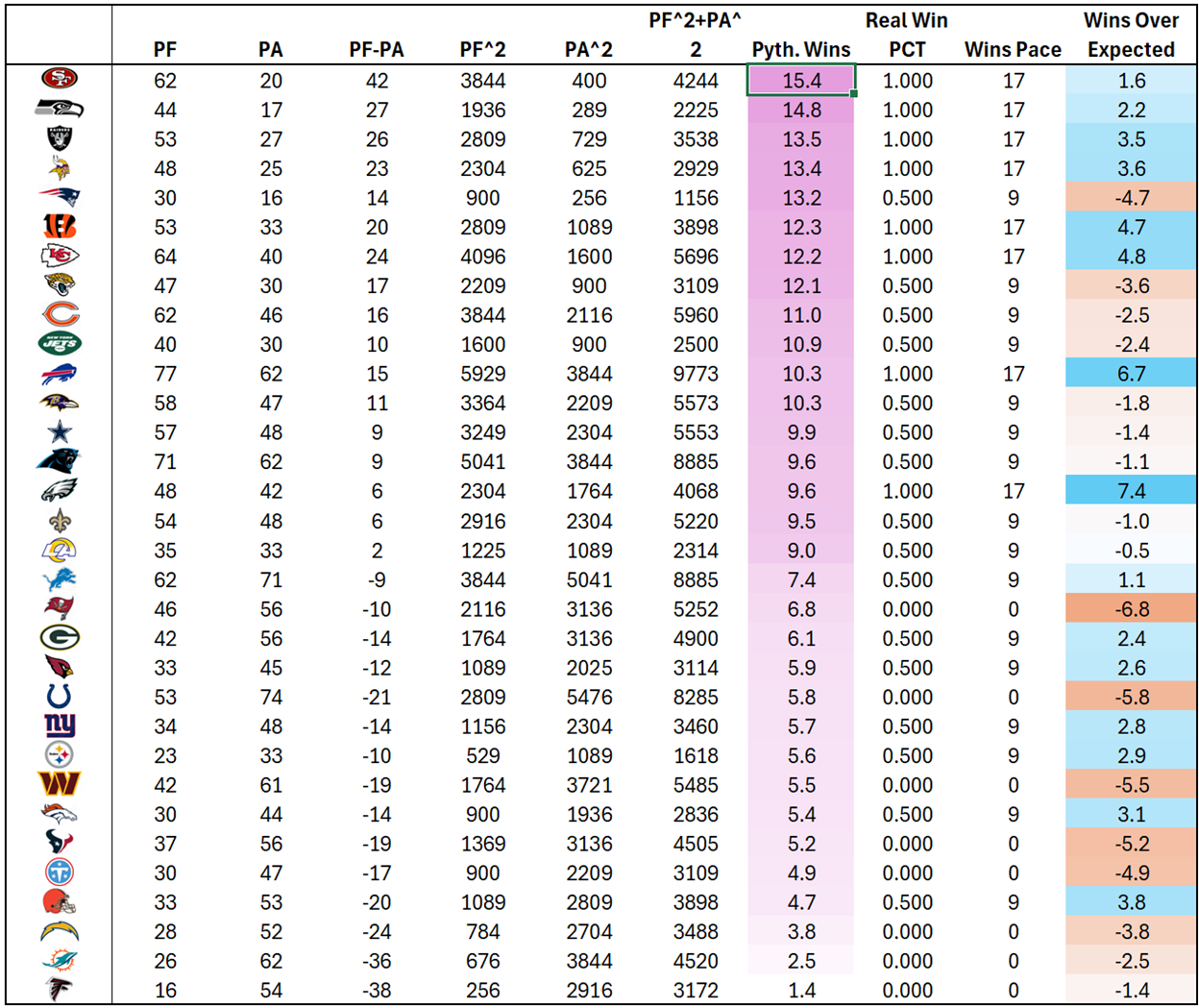
By record, the Rams and Broncos are both 1-1 through two weeks, but using Pythagorean Wins, Los Angeles has performed like a nine-win team, while Denver is pacing for 5.4.
The markets still favor Los Angeles to win the Super Bowl at +650, while Denver is at 20-1. The Rams are slight road favorites, with a spread around 2.5 points.
Denver has played at 30.1 seconds per snap from a neutral script this year (20th), while Los Angeles has ranked 15th at 29 seconds per snap. Denver has managed 54 plays per 60 minutes (T-28th); the Rams have gotten off 57 (18th). Neither offense has produced high play volume or fast pacing in the first two weeks.
In the first two weeks, the Rams have been slightly above average in defensive EPA per play and close to average in offensive EPA per play. Denver has been slightly below average on both sides of the ball.
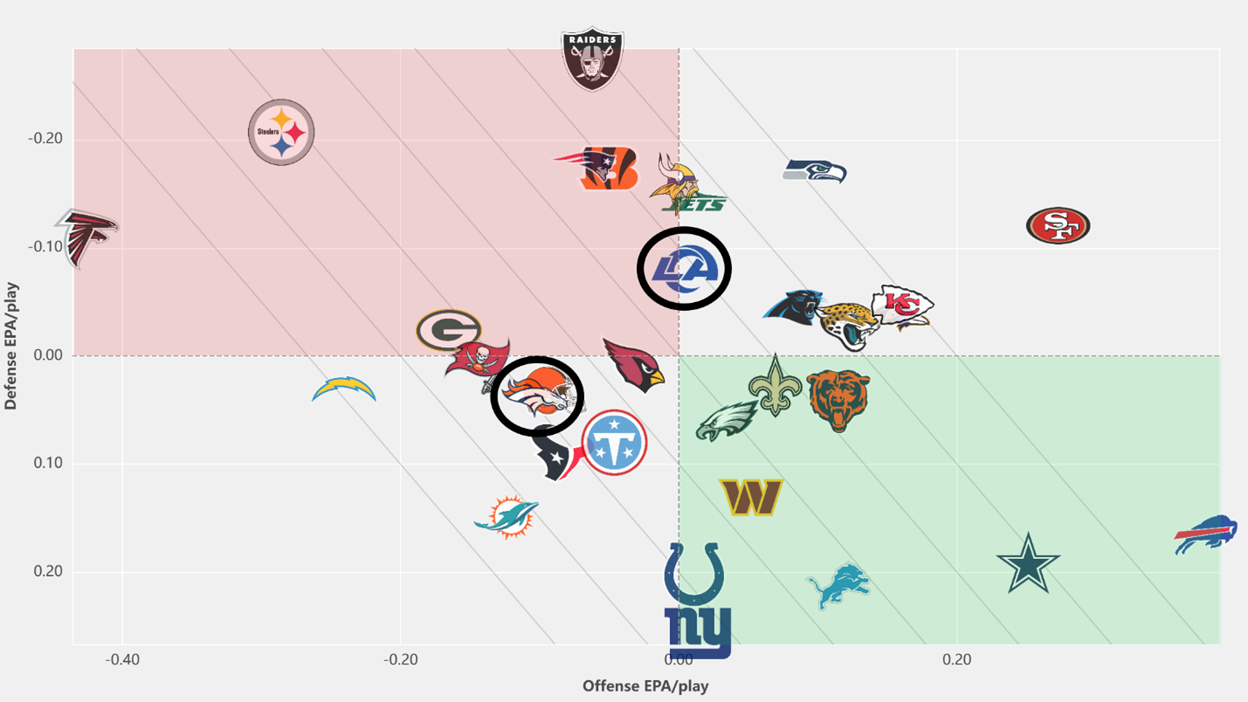
Altogether, this doesn’t make for a great fantasy environment, but not abysmal either. The Rams have the stronger underlying profile, but neither team’s early pace suggests a particularly high-volume game.
The game will be played on a warm Denver evening. Temperatures are expected to be in the mid-to-upper 70s at kickoff, falling into the upper 60s as the game progresses. There is little concern about rain. The main issue here could be wind.
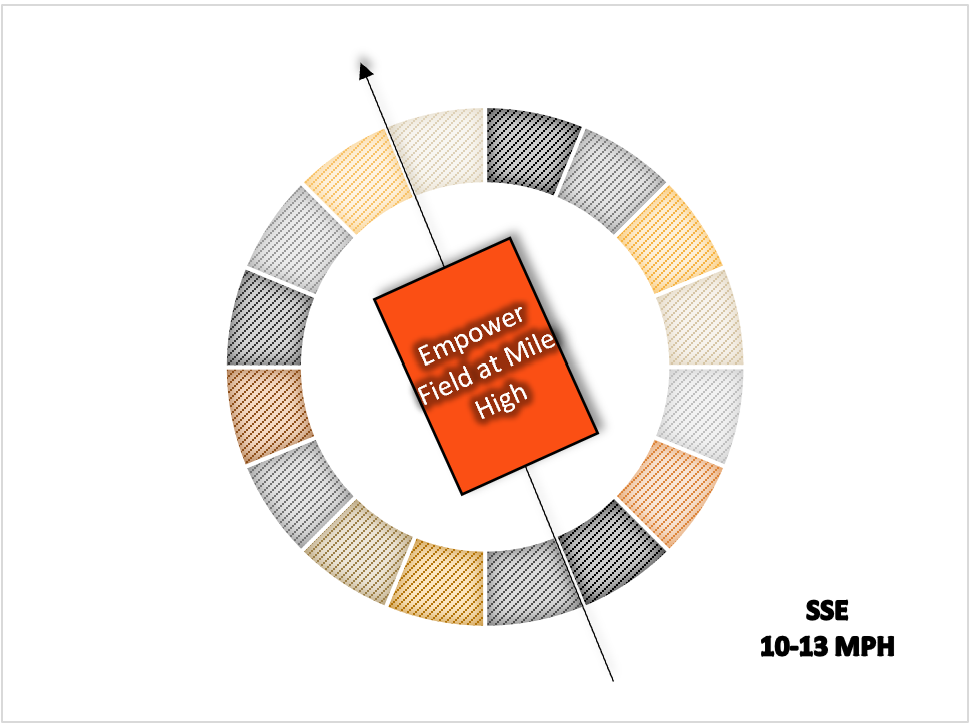
Wind speeds could be a concern, as they are expected to be around 10–13 MPH with gusts as high as 24 MPH around kickoff, though they should grow milder as the game goes on. Wind at that speed can adversely affect passing, especially at depth, a pass-catcher’s ball tracking, and long kicks. These effects are less prominent when wind runs parallel to the playing surface, and Sunday night's wind should be SSE, matching Empower Field at Mile High's azimuth.
Rams Key Injuries: WR Puka Nacua (hip) remains the primary concern after missing Monday’s game against the Giants. He is listed as doubtful and not expected to play. TE Colby Parkinson (knee) is questionable. WR Jordan Whittington (quadriceps), LT Alaric Jackson (knee), and TE Terrance Ferguson (ankle) are expected to miss time. ED and reigning DPOY Myles Garrett (knee) is on the short-term IR.
Broncos Key Injuries: RBs J.K. Dobbins (hip) and RJ Harvey (hamstring) have been removed from the injury report, while Jonah Coleman (ankle) is out – almost the inverse of what was expected to start the week. WR Marvin Mims Jr. (foot), who also missed Week 2, is listed as questionable.
RAMS
Implied Team Total: 24
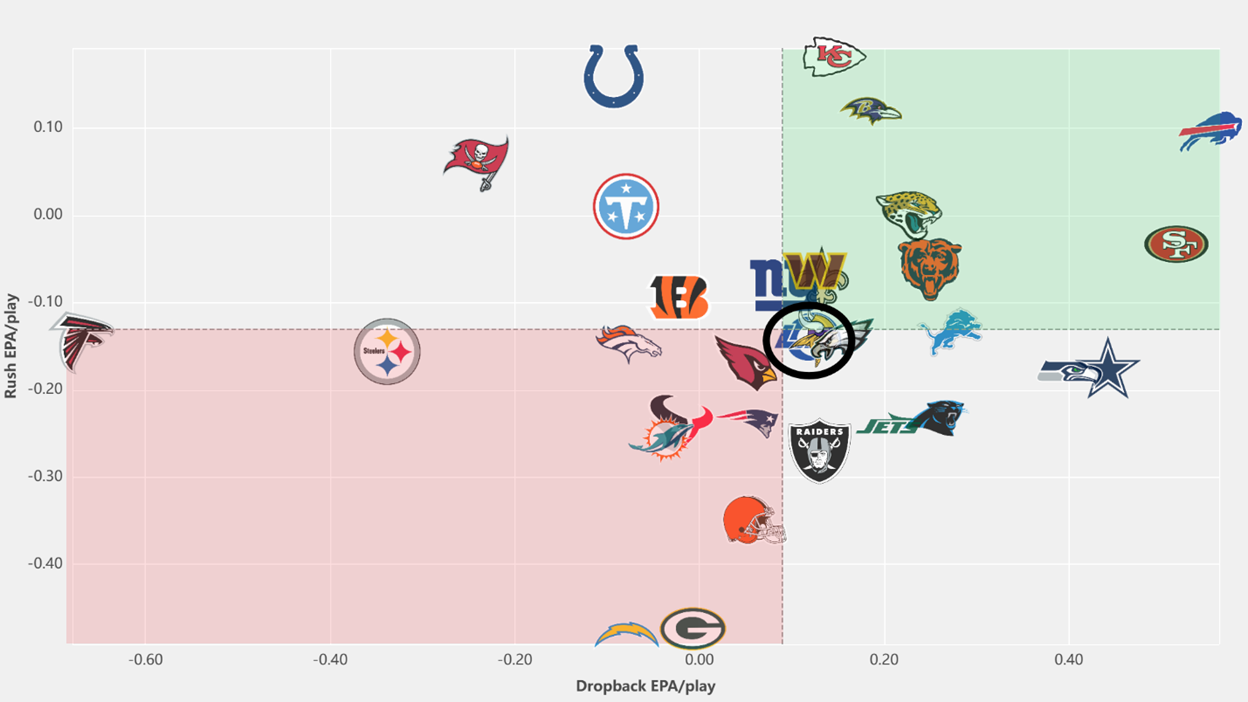
The Rams enter Sunday night with two very different offensive games under their belt: a 290-yard, seven-point dud against San Francisco in Australia, and a 481-yard, 28-point explosion against New York last Monday. As a result, they sit fairly close to the middle in offensive EPA per rush and offensive EPA per dropback.
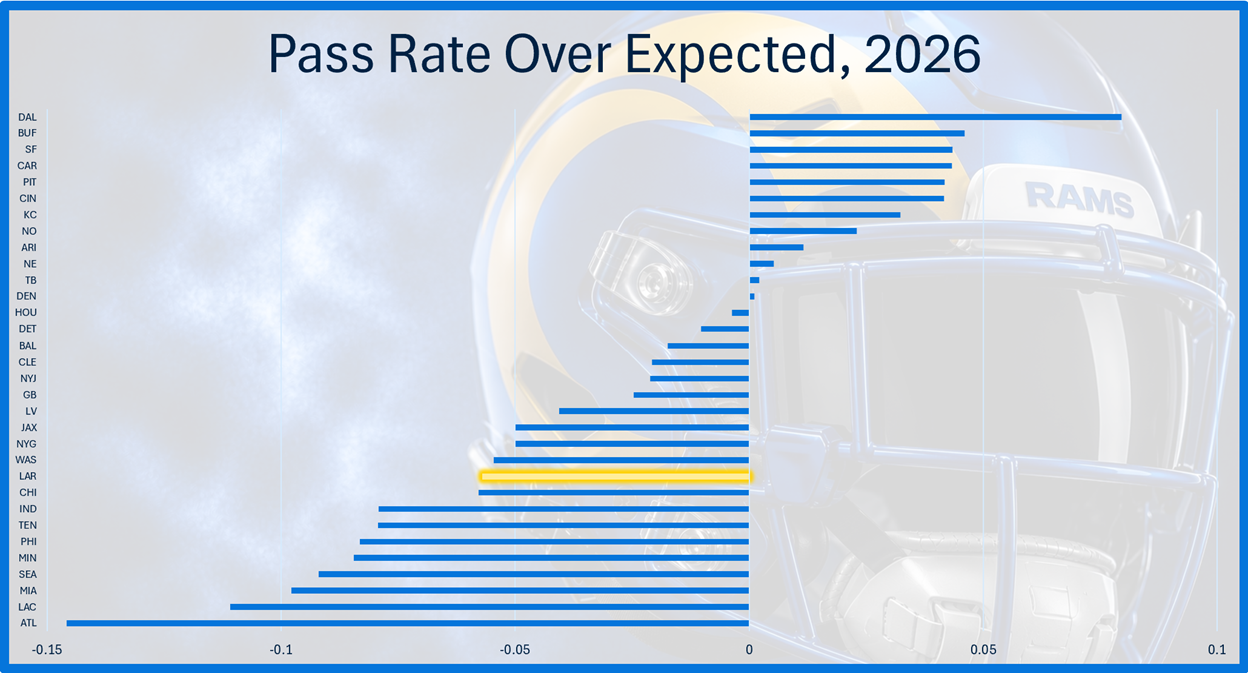
The Rams have been run-heavy so far, ranking 23rd in PROE (-5.6%).
I think it’s a reasonable conclusion that the Rams, who were the NFL’s best offense a year ago and have undergone few changes, came out flat in Week 1 but started to get their sea legs in Week 2, whether that was due to the travel schedule (the Rams traveled to Australia within 48 hours of their game halfway around the world, while San Francisco spent a week there) or because they refuse to play anyone of consequence in the preseason.
Even without all-everything WR Puka Nacua, who will likely miss his second game in a row with hip and groin injuries, the Week 2 version was probably much closer to what we’ll see going forward.
In the first two weeks, Stafford only has 58 dropbacks (27th), converting them into 56 pass attempts (20th). Stafford has a quick release and takes few sacks, so his attempt-to-dropback rate is usually good, especially since he’s played for HC and OPC Sean McVay. Among qualified QBs, Stafford’s pressure-to-sack rate (6.3%) trails only Brock Purdy and Jayden Daniels, who have not been sacked yet.
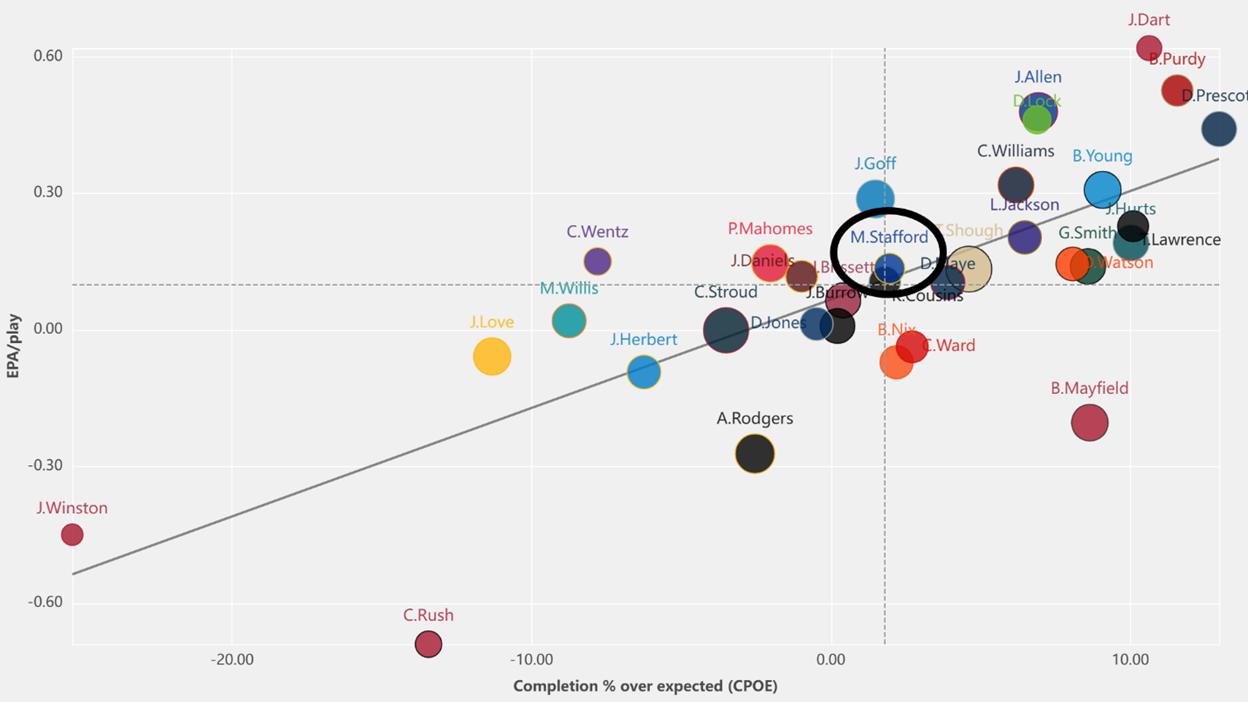
With one dud and one banger, Stafford is near the middle in both EPA and CPOE. Based on his 2025 MVP season, if we stick with the presumption that he got off to a slow start in Week 1, we’d expect this to rise.
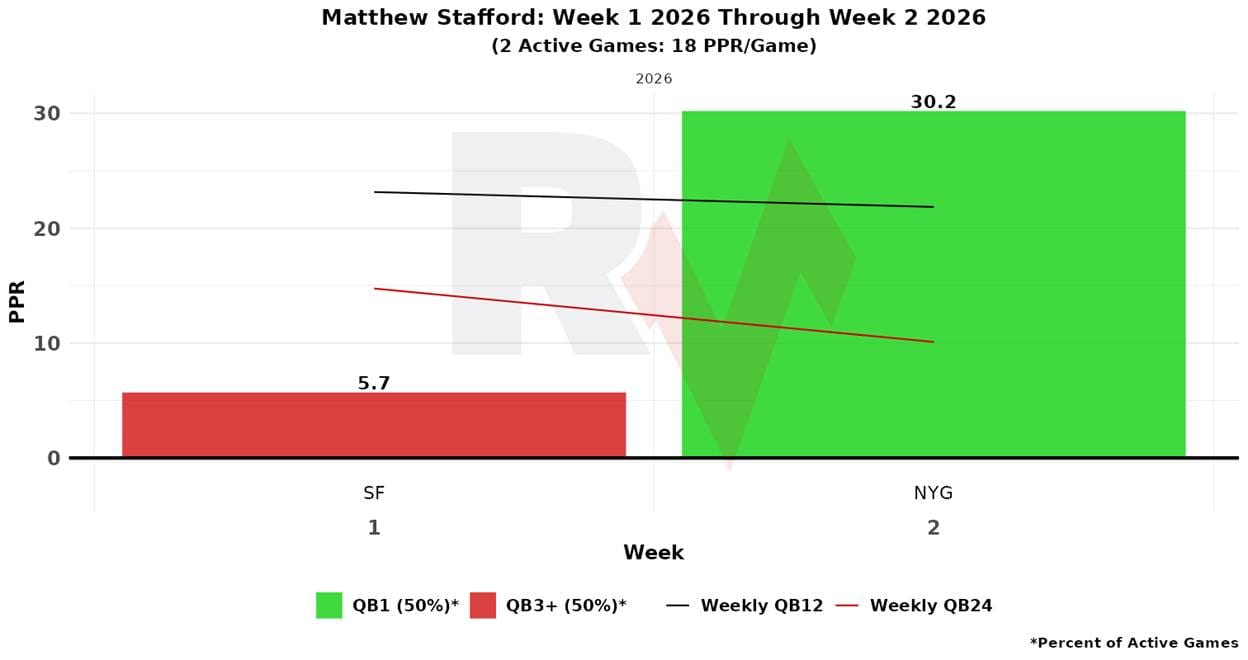
For fantasy, Stafford came into the year as a negative TD-regression candidate, but after a four-TD game last week, his 7.1% TD rate in 2026 essentially matches his elevated 7.5% rate from 2025, not the 4.6% rate from the fifteen years that preceded it. Stafford is likely the most immobile starting QB in the league, but he is also incredibly efficient and TD-prone, so his range of outcomes is wide, as shown by his nearly 25-FP swing from Week 1 to Week 2.
The Broncos have a sterling reputation for incredible defense under DC Vance Joseph. Still, they lagged somewhat as the season went on in 2025, and this year they are dead last in EPA per rush allowed (0.175), largely because RB Kenneth Walker torched them in Week 1.
However, they are still an above-average unit in dropback EPA allowed.
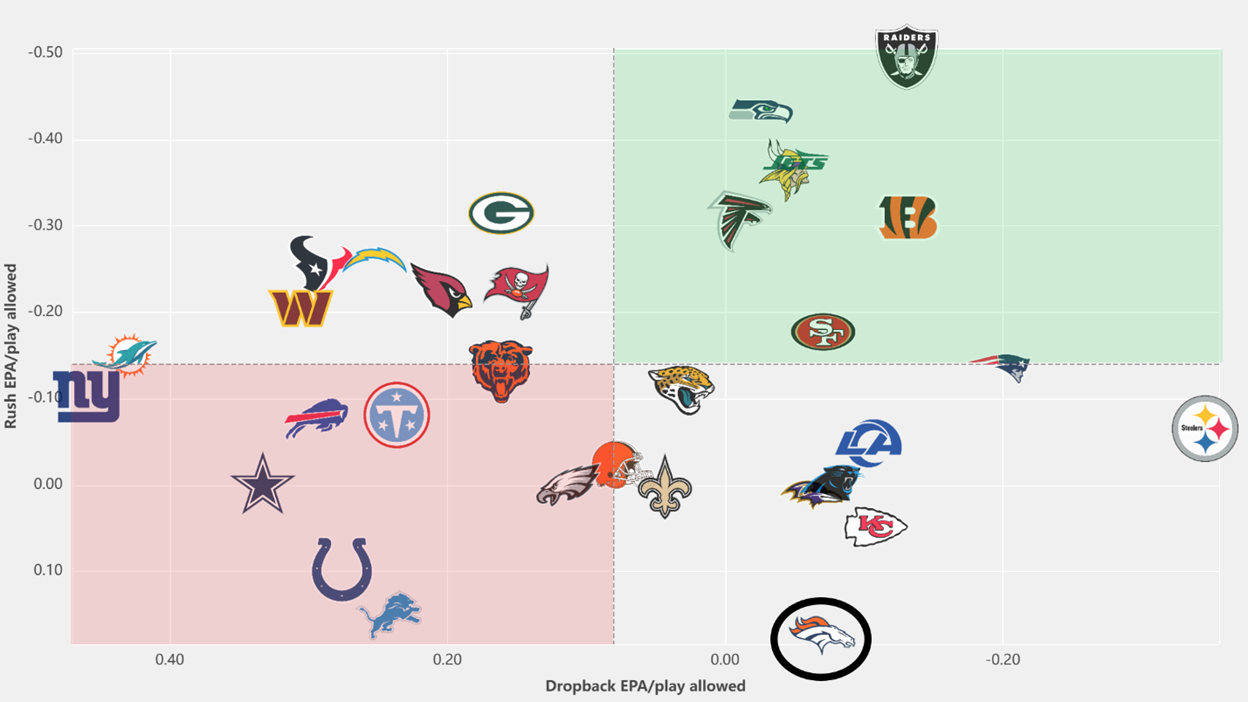
Like any team, the Broncos use zone more than man, but their rate of man defense has been pronounced at 37.5% (6th). Most teams use Cover 3 more than any other coverage, but some use Cover 1 more often; Denver is one of them (31.3%), and it uses Cover 6 at the same rate (20.3%) as Cover 3. Denver’s 30.1% blitz rate is above average.
Based on Fantasy Points’ Coverage Matchup tool, which still uses 2025 data, Stafford should gain a slight increase (+4.2%) on his standard FP/DB rate against the types and rates of coverage Denver uses. After applying the adjustment, Stafford is expected to have a rate of 0.58 FP/DB, second among QBs in Week 2.
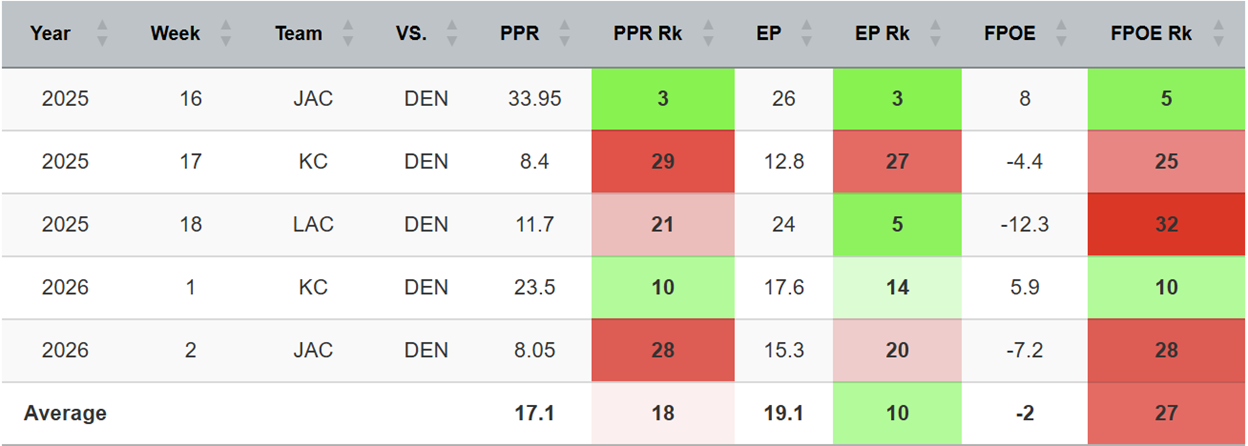
However, PFF’s more personnel-based Matchup tool grades Stafford’s matchup as fair. Based on Denver’s last five games, dating back to last season, they’ve allowed 17.1 FP/G (18th).
The Rams have increasingly turned to 13-personnel, and it’s been pretty crazy to start 2026. Using 11 personnel 53% of the time and 13 personnel a league-leading 45%, there is almost no in-between. TEs Colby Parkinson, Davis Allen, Tyler Higbee, and Terrance Ferguson rotate, with Parkinson serving as the de facto TE1, earning more snaps/G (23.5).
Parkinson has spent 80% of his snaps inline. If there is a move TE, it’s Ferguson, who has spent 42.5% of his snaps in the slot and 17.5% out wide. While Nacua is away, Ferguson is one of the primary beneficiaries. Ferguson went 6-54-1 in Week 2 after firing a blank in Week 1 while Nacua was playing.
Part of it is that, while they have arguably the best one-two punch at WR, the Rams are remarkably thin at that position, and Ferguson is basically a big WR; more than Xavier Smith, Jordan Whittington, Konata Mumpfield, or Tutu Atwell, Ferguson seems to be the Rams’ best Nacua understudy.
When in 11 last week, the Rams used a combination of Smith and Ferguson in the slot, and a combination of Mumpfield and Smith out wide.
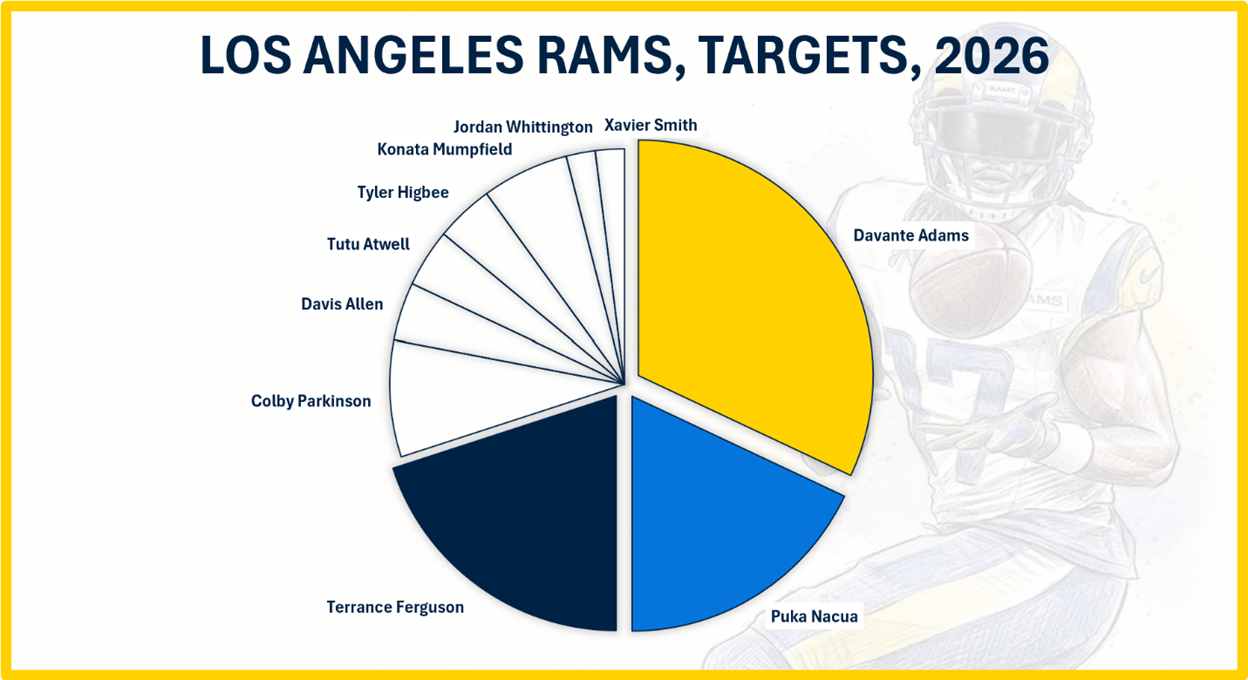
Of course, the biggest statistical beneficiary of Nacua’s absence was WR Davante Adams, who went bananas on MNF, putting up 8-195-2. Much was made about Adams’ age this off-season, especially when juxtaposed against his high TD rate, signaling that negative TD regression was incoming. However, I highlighted Adams as a value at a fifth-round ADP based on his 7.85 Apex Score (15th) entering the season, and he appears to be holding up thus far, despite being 33.
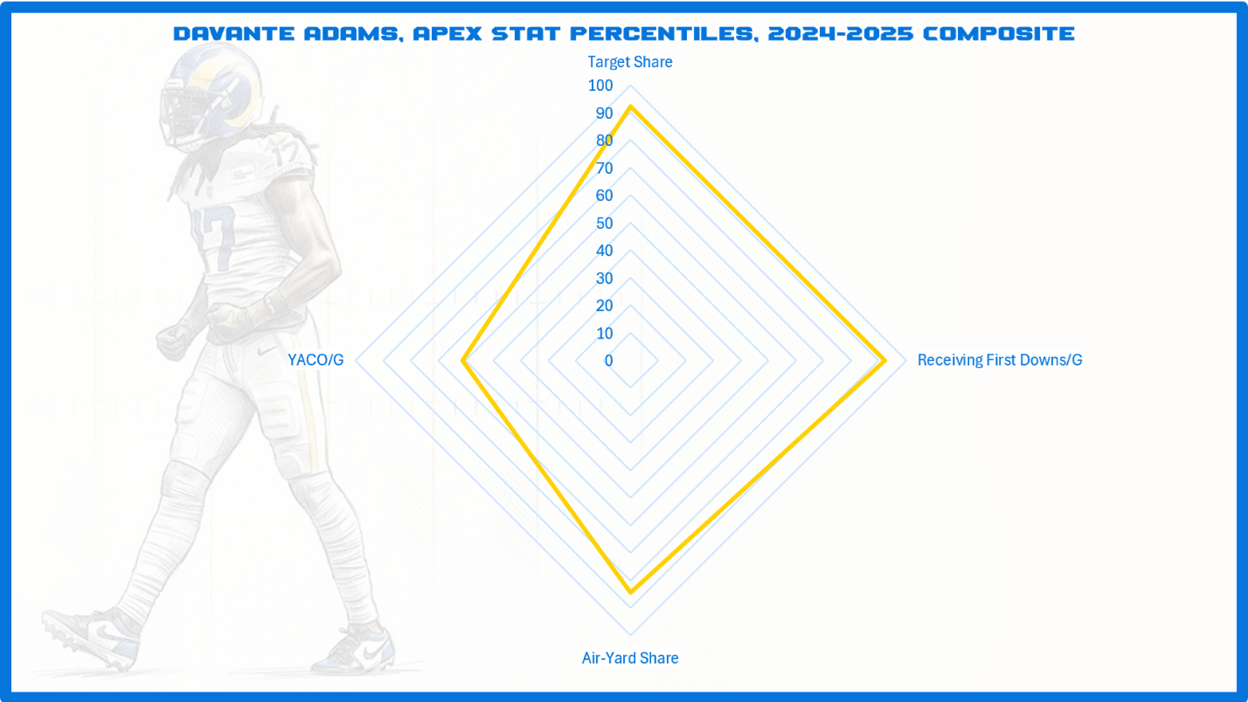
After his vintage offensive explosion last week, Adams ranks in the top five in target share (32.3%), AY share (58.4%), YPRR (4.6), TPRR (39%), first-read target percentage (40%), and PFF receiving grade (91.7).
It’s hard to trust any other WR here, but Ferguson and, to a lesser degree, Parkinson are in play (if he plays). It would take a lot to get there on Parkinson – a deep, TE premium situation – but he’s on the field so far with a 74% snap share. He’s run 28 routes, which isn’t great, but it’s comfortably second on the team among TEs, behind Ferguson. We know he’s been emphasized in the past for end zone looks, and Denver has given up the ninth-most FP/G to inline TEs so far (16.8), so he’s a thought for a Hail Mary.
Ferguson is far more appealing. He has only 34 total routes this season (28th), but 22 came last week (17th) without Nacua. And in Week 2, his target share was 29%, second in the NFL only to Trey McBride. Ferguson has crept into the top-ten in multiple per-route and rate stat categories, including TPRR (29%), YACo/rec (3.33), and Fantasy Points’ XFP/RR (0.51).
According to Fantasy Points’ coverage tool, using 2025 data, Parkinson has a huge matchup upgrade at +20.3% of his normal FP/RR, reflecting Denver’s strength against players out wide.
Based on pure fantasy performance, dating back to last year, the Broncos are a very tough matchup for WRs, allowing 22.2 FP/G in their last five games.
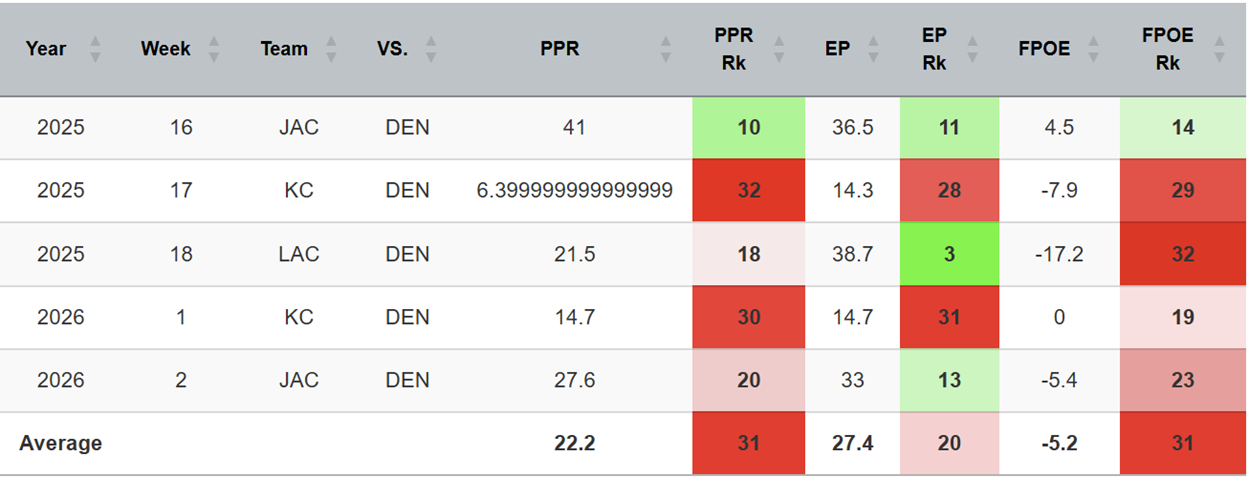
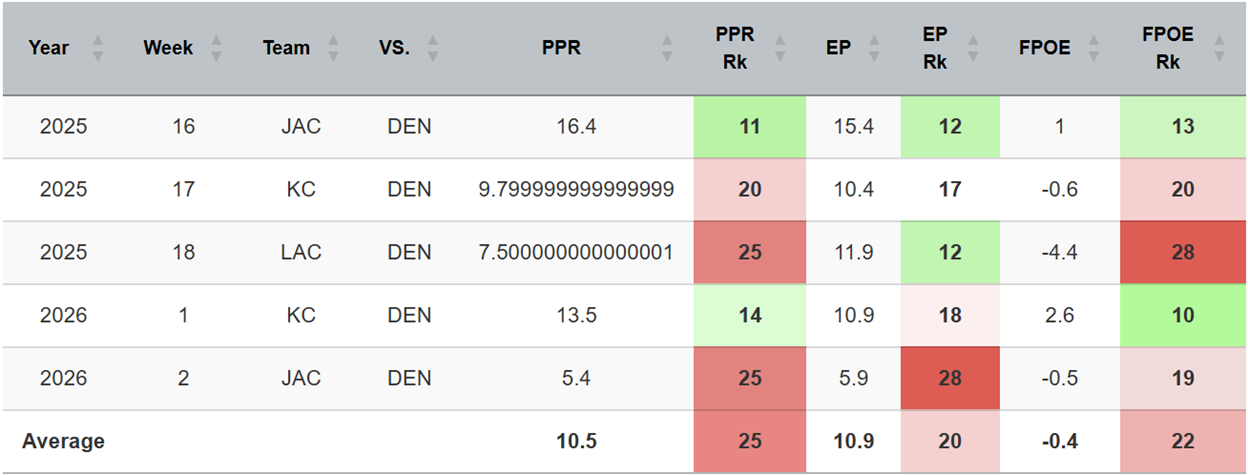
Against TEs, it’s not much better, as they’ve allowed 10.5 FP/G in their last five games (25th).
The PFF matchup tool assumes the normal split for Adams and Surtain, who can each alternate sides of the field outside, and treats Adams playing half his snaps against CB Riley Moss as a big win. And Mike Clay’s matchup report, published Thursday, doesn’t show shadow coverage. However, it assumes that Nacua will play, while I assume, as of Saturday, that he will not.
One of the most interesting things about Sunday night’s game is the chess match between OPC Sean McVay and DPC Vance Joseph. With the Rams likely down to one viable outside WR, I don’t see any real reason the Broncos wouldn’t shadow Adams with CB Patrick Surtain in 11 personnel, but the Rams used 13 more against the Giants than they used 11, which gives them a chance to dictate the terms rather than settle. I would expect a lot of this again on Sunday.
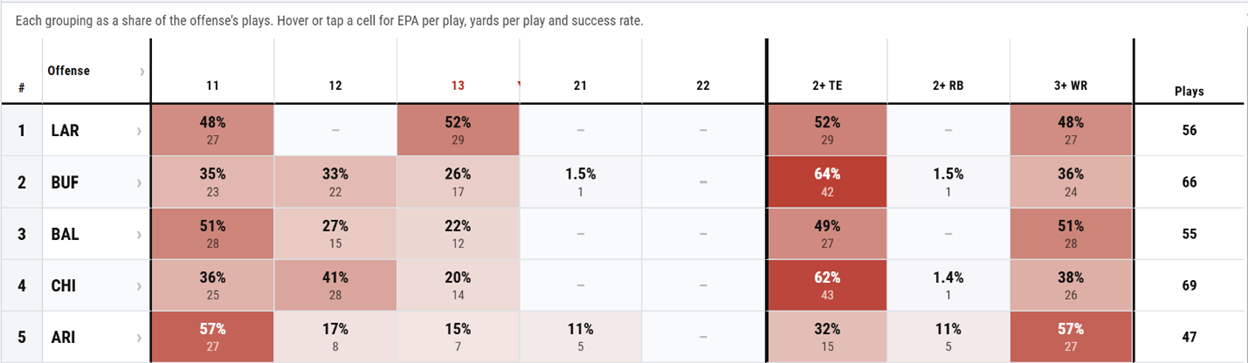
If McVay goes heavy, Joseph could counter with heavier personnel, but that risks creating passing-game opportunities for Ferguson and Parkinson against LBs and safeties.
Additionally, Surtain likely wouldn’t follow Adams into the slot, so McVay could put Adams there and sacrifice the outside matchups. This would force Joseph to respond with zone, bracket Adams, or even sort of let that go and make sure nothing else works.
The long story short? With tacticians like McVay and Joseph facing off, we can’t distill the matchups down to things like Player A goes left X amount and right Y amount, so he’ll face so-and-so Z amount of the time. How this could play out is more unpredictable than usual.
The next rub is if Parkinson doesn’t play, which the Rams are well-prepared for with five TEs on their roster, but how the Rams’ offensive personnel would be deployed then becomes extra mysterious, since he’s been anchored to the line more than the others.
In the trenches, it’s kind of a clash of titans when the Rams are on offense. The Rams have a great offensive line; the Broncos are strong up front. They generally neutralize each other, and I wouldn’t expect this to be a huge factor.
The Rams are famously locked into a backfield committee with RBs Kyren Williams and Blake Corum.
Quickly, this has become a red-alert scenario for Williams’ GMs, who have seen his share of team opportunities sink to 25%, while Corum’s has climbed to 20%. The difference, of course, is perspective, as Corum was taken with a much later ADP and saw his % of team opps only rise in Week 2, so his arrow is up while Williams’ is down; objectively, neither is exciting for fantasy so far in 2026.
The difference in Williams’ and Corum’s efficiency was often a talking point this offseason, though I warned against putting too much stock in such small samples. While Corum has a better percentage of 10+ yard runs so far (22.7% to 13%), Williams has a better percentage at 20+ (4.6% to 0%). And while Corum’s YPC is better (6.05 to 5.48), Williams’ FPOE per attempt is better (0.17 to 0.13). Both have been pretty efficient, but neither is getting a good fantasy workload.
For now, Williams appears to be the slightly better fantasy option, based on HVTs: he has all four green-zone carries between them and five receptions to Corum’s one. Even so, Williams is kind of the cleaner shirt in the laundry hamper between the two.
According to PFF’s matchup tool, Williams’ matchup is good while Corum’s is fair. Since last year, the Broncos have allowed only 20.1 PPR/G to RBs, which ranks 14th, but the split between how they finished 2025 and how they’ve started 2026 is stark.
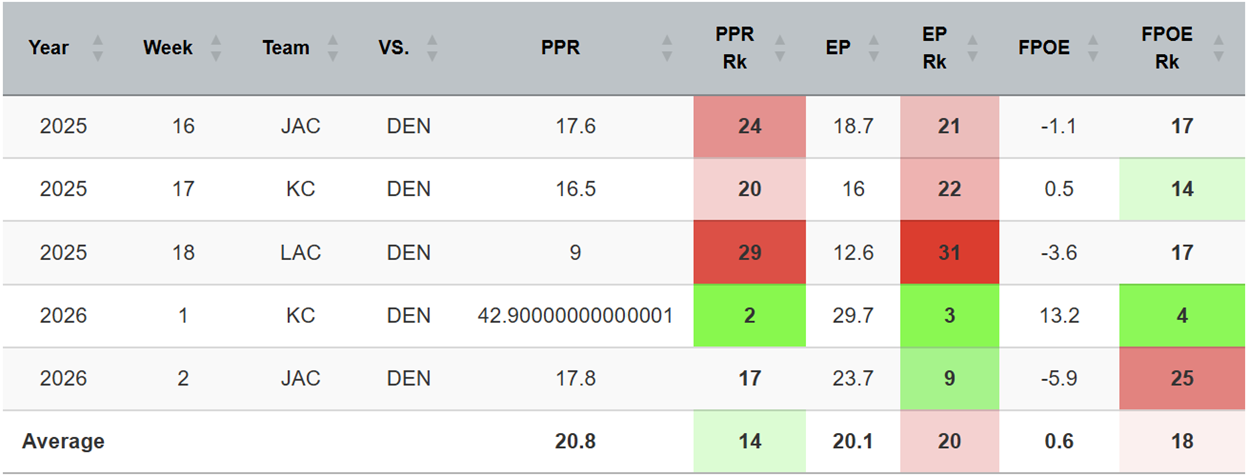
After Kenneth Walker and, to a lesser degree, the Jags' RB hybrid, torched them in Weeks 1 and 2, the Broncos have allowed 30.4 FP/G to RBs in 2026 (28th).
This comes with a warning: while it seems clear that the Rams may feel incentivized to run more without Nacua, that is not a given (see last week). While the Broncos have been porous at stopping the run, this is small-sample stuff and no doubt one of Joseph’s greater concerns and emphases. In other words, what we’ve seen thus far may motivate the opposite for Denver, while the Rams may find the passing game more appealing than the running game in the 13 personnel chess match.
It looks like a good spot for Williams and Corum, but it may not be as good as it looks; either way, they are a jumbled mess with little upside until further notice.