
Quick Slant: TNF - An Excuse to Leave the Room Might Be Nice

Mat Irby’s Quick Slant
Historically, Olympic badminton used a straightforward knockout format, but for London 2012, they introduced a World Cup-style round-robin group stage, with the top two doubles teams advancing. Seemed like a swell idea – more matches, more chances, maybe a little more drama.
Or maybe a lot more drama, as it turned out.
China entered the women’s doubles tournament with the top two seeded pairs, including reigning world champions Wang Xiaoli and Yu Yang. But when second-seeded Tian Qing and Zhao Yunlei unexpectedly lost to Denmark, they were lined up to face the winner of Group A in the quarterfinals. That group’s final match featured Wang and Yu against South Korea’s Jung Kyung-eun and Kim Ha-na. If the Chinese favorites lost, both pairs could avoid each other until the gold-medal match.
So, why wouldn’t Wang and Yu, who had already qualified, just sort of forget how to play badminton for forty-five minutes or so?
The match descended into absurdity. The best players in the world were suddenly unforced-error machines, launching birdies into nets and out of bounds. The South Koreans realized what was happening, and since they didn’t particularly want to win either, they started making conspicuous mistakes themselves. The longest rally was just four shots; the crowd booed. The match, normally closer to an hour, lasted just 23 minutes.
To make matters worse, another South Korean pair tried to throw the next match. Indonesia caught on, and spectators watched two more world-class teams do their best to hand victory to their opponents. The referee disqualified both teams on the spot; then, presumably realizing he lacked the authority, let play continue.
On August 1, the Badminton World Federation disqualified all eight players, and lower-seeded teams advanced. Particularly devastating for Wang and Yu, who entered as favorites but got too cute by half, tried to make their pathway easier, and outmaneuvered themselves out of the hardware altogether.
It’s an odd phenomenon, but sometimes sports teams are incentivized to lose. There’s plenty of debate about how often this happens in the NFL. Skeptics point out that professional football is populated by players with only a few years, sometimes a few opportunities, to prove themselves and make a living. Good luck convincing a locker room to risk its livelihood so the franchise can replace them with younger, more preferred alternatives.
But tanking has certainly been long suspected. In 2019, Dolphins owner Stephen Ross allegedly offered then-HC Brian Flores $100,000 per loss. Investigators found that Ross repeatedly prioritized draft position over winning, but concluded the alleged offer wasn't serious and that Miami hadn't deliberately lost games.
Famously, Super Bowl-winning HC Doug Pederson’s Philadelphia tenure ended after he suspiciously benched QB Jalen Hurts for Nate Sudfeld in the fourth quarter of a competitive game in 2021, with the Eagles already eliminated from playoff contention.
And then there’s soft tanking, done in plain sight. One could argue Miami hasn’t committed credible resources to its roster all year. Indianapolis, meanwhile, traded veterans Quenton Nelson, DeForest Buckner, Keenan Allen, and Josh Downs before the 2026 deadline, collecting draft capital while making its immediate path to victory harder.
Highlighting these teams on TNF used to be an annual tradition. Since Amazon acquired Thursday games, less so, but this affair feels all too familiar: two AFC South cellar-dwellers with six wins combined in November, trying to hit their birdies into the net without anyone suspecting it’s deliberate. The winner is the loser, and the loser grows closer to its inevitable goal: a high draft pick.
It wasn’t supposed to be this way. The Colts opened 2025 like gangbusters and were competitive until the bitter end, while the Texans, even now, seem far better than their record suggests. But here we are. The Jags have stolen the division, and their bunkmates are looking forward to a revered draft class. The consumers are left holding the bag, and this time, it stinks to high heaven. Enjoy your throwback TNF. Too bad there are no Thanksgiving leftovers in the fridge just yet; an excuse to leave the room might be nice.
GAME ENVIRONMENT
Indianapolis Colts at Houston Texans (-11.5)
Over/Under: 44.5
Indianapolis ranks 26ᵗʰ in Pythagorean Wins (pacing for 6.3), while Houston ranks 14ᵗʰ (pacing for 9.0). The Colts are pacing for roughly six real-life wins over a full season, compared to nine for the Texans. Indianapolis enters Thursday at 3–7, while Houston is 3–6. Both teams have underperformed their expected records, with the Colts pacing 1.2 wins below expectation and the Texans 3.4 wins below expectation.
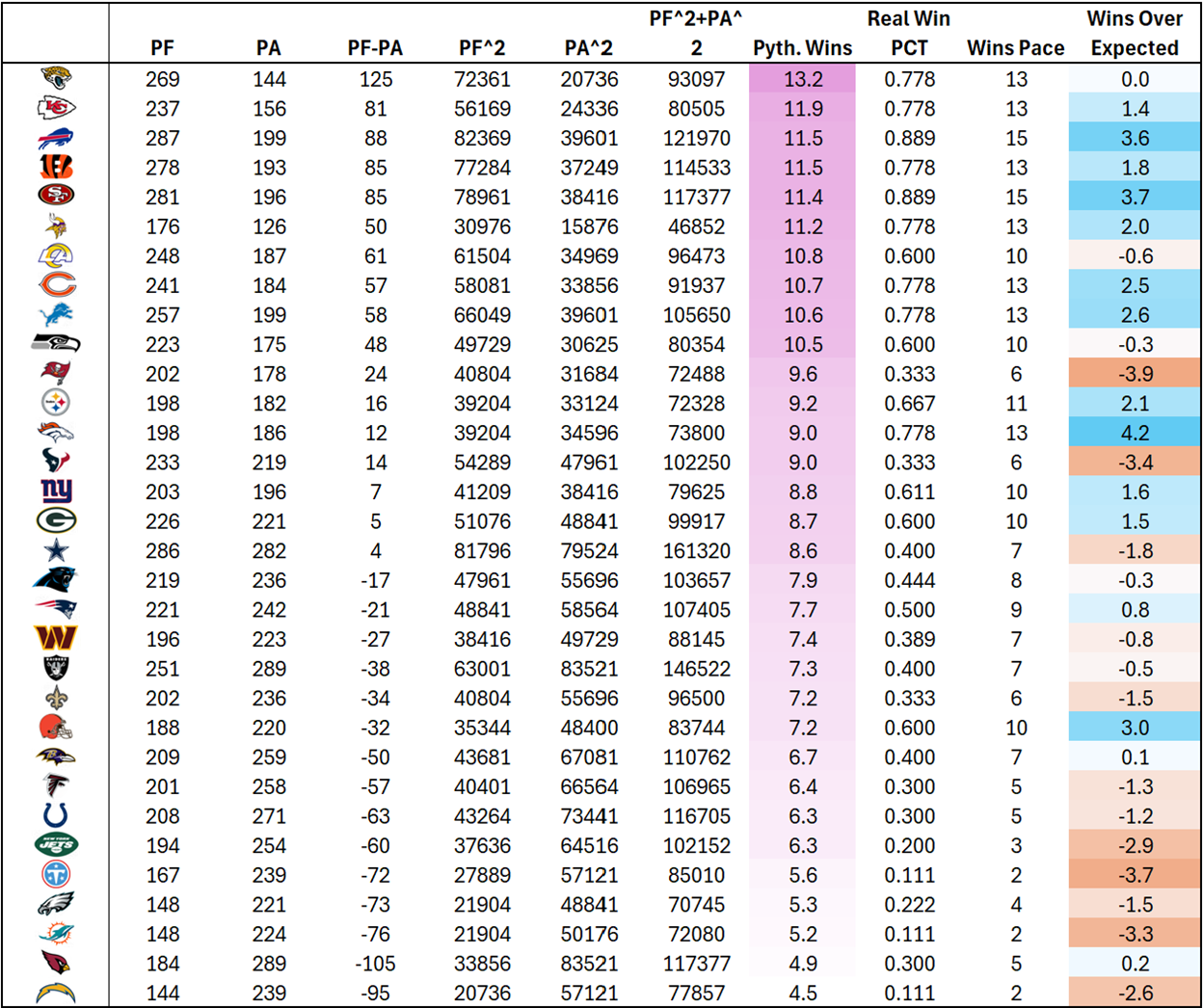
Houston is favored by 11.5 points at home, with an over/under of 44.5. The Texans opened as 10-point favorites, but the line has moved further in their direction, and some books have it at -12.5
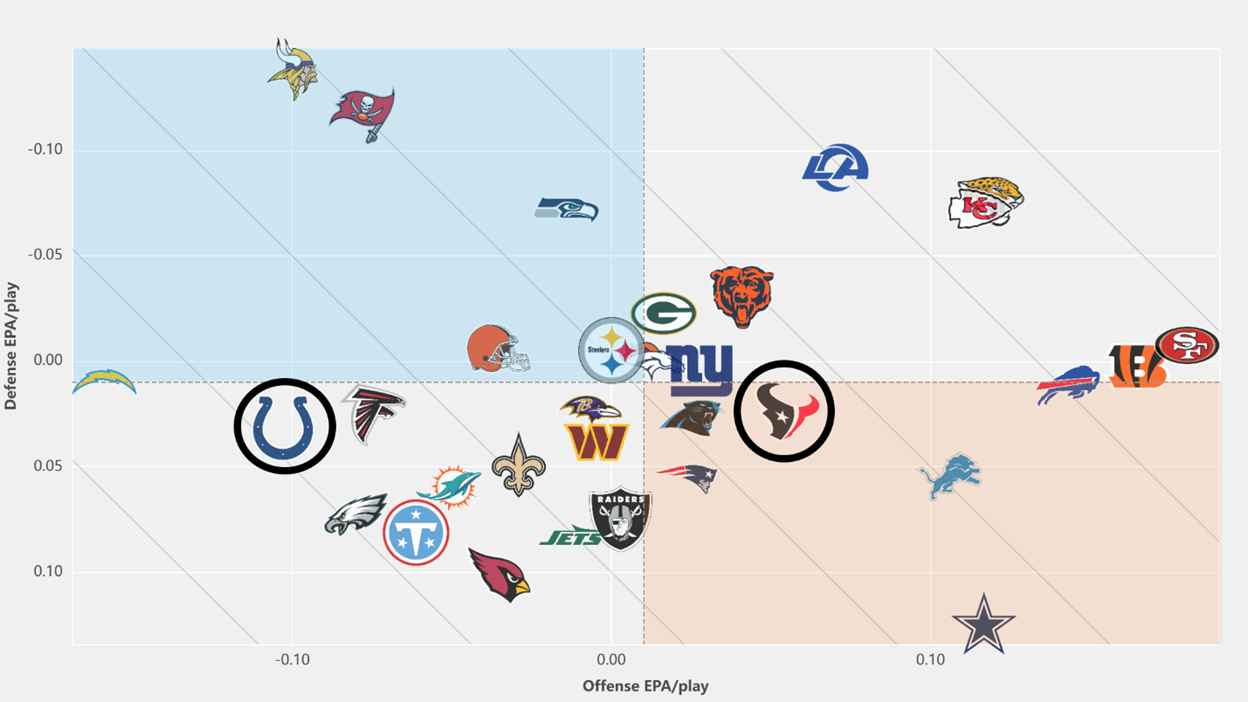
Houston ranks ninth in offensive EPA per play (0.055), compared to Indianapolis at 31ˢᵗ (-0.103). Defensively, the teams are considerably closer. The Texans allow 0.024 EPA per play (18ᵗʰ), while the Colts allow 0.032 (21ˢᵗ).
Houston averages 27.9 seconds per snap in neutral script (10ᵗʰ), compared to 29.2 for Indianapolis (22ⁿᵈ). Across all game scripts, Houston averages 26.2 seconds per snap (7ᵗʰ), while Indianapolis averages 27.7 (23ʳᵈ). Both teams average 62 plays per 60 minutes.
Weather: Thursday's game will be played at NRG Stadium, which has a retractable roof, so weather shouldn't be an issue.
Colts Key Injuries: Starting LT Bernhard Raimann (concussion), RT Jalen Travis (knee), CB Charvarius Ward (knee), DT Jerry Tillery (calf), and TE Will Mallory (hamstring) are out. CB Sauce Gardner (calf), WR Anthony Gould (toe), and OT Charlie Heck (personal) are questionable. LB Jaylon Carlies (neck) was placed on IR this week.
Texans Key Injuries: LB Azeez Al-Shaair (groin) has been placed on IR. RB Woody Marks (concussion), WR Marvin Harrison Jr. (hamstring), DE Danielle Hunter (hamstring), TE Brevin Jordan (foot), and CB Kamari Lassiter (wrist) have been dealing with injuries. Marks is listed as doubtful in the latest available ESPN-derived report, while the others remain uncertain. RB David Montgomery (groin) has returned to full practice participation and should play.
COLTS
Implied Team Total: 16.5
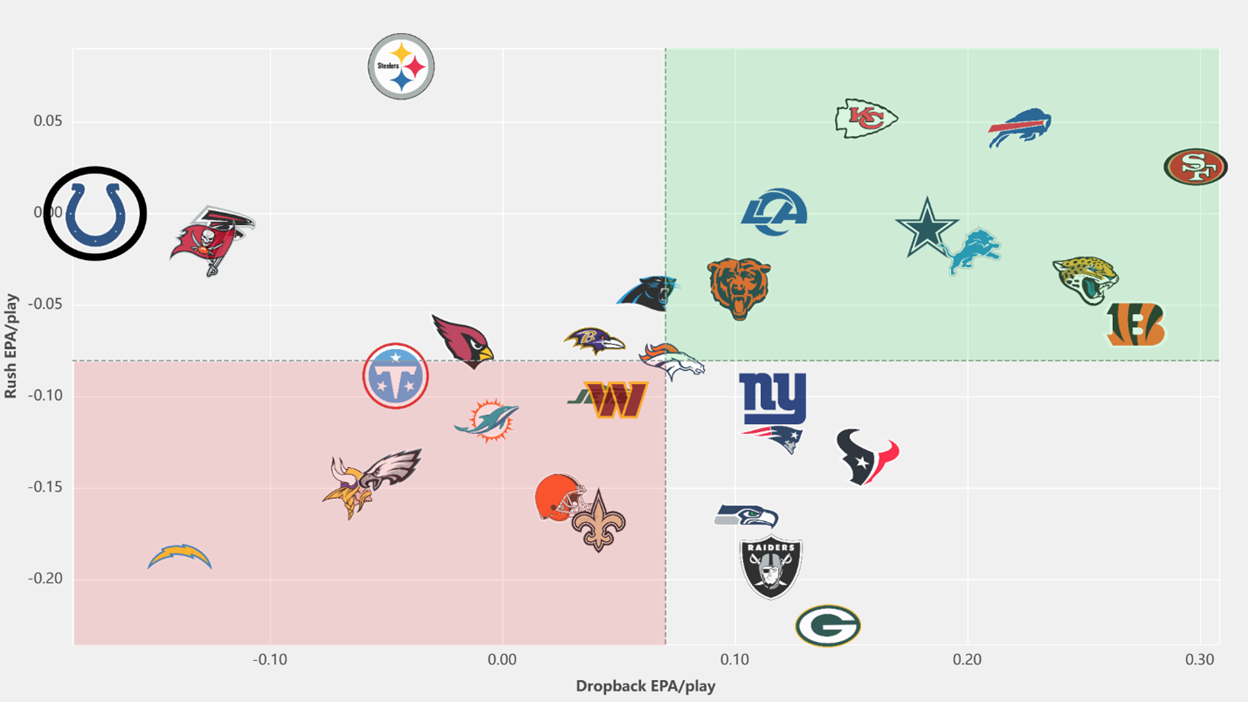
Indianapolis ranks 31ˢᵗ in offensive EPA per play (-0.103). The Colts have been considerably more effective running the football (-0.001 EPA per rush) than passing (-0.175 EPA per dropback).
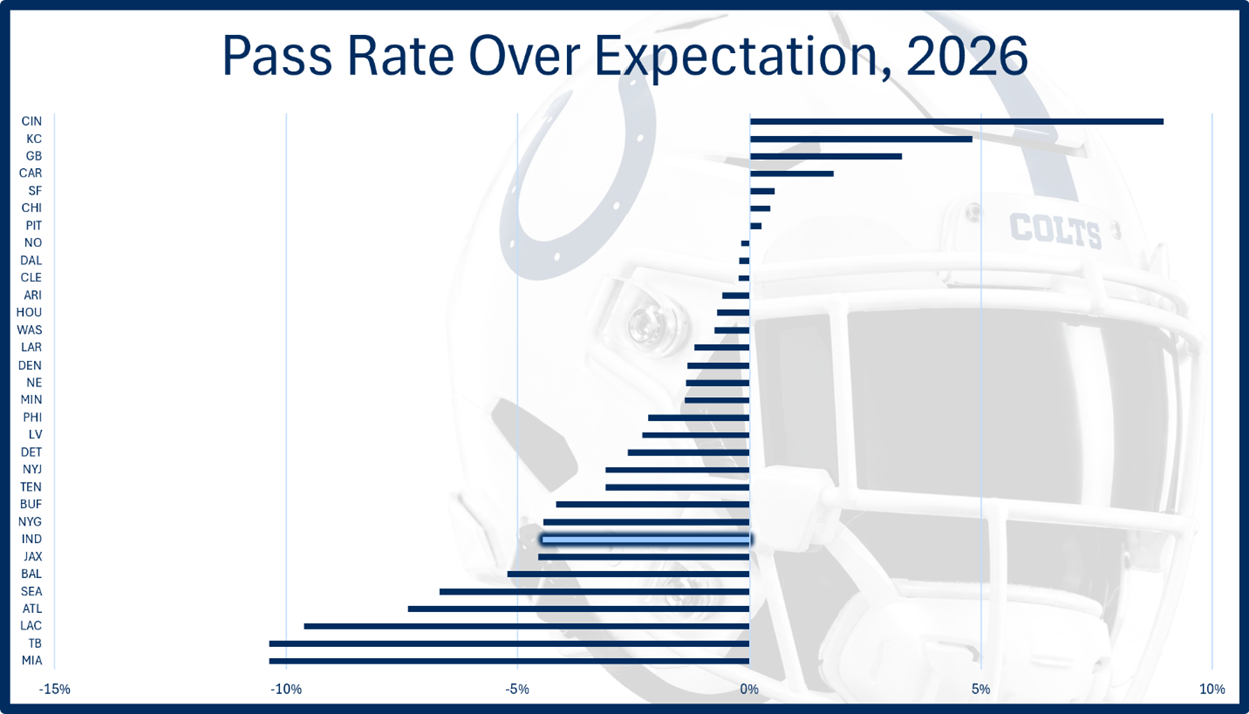
Indianapolis has been more run-oriented than expected, ranking 26ᵗʰ in PROE (-4.46%). The Colts have passed on 58.3% of their plays, compared to an expected pass rate of 62.7%.
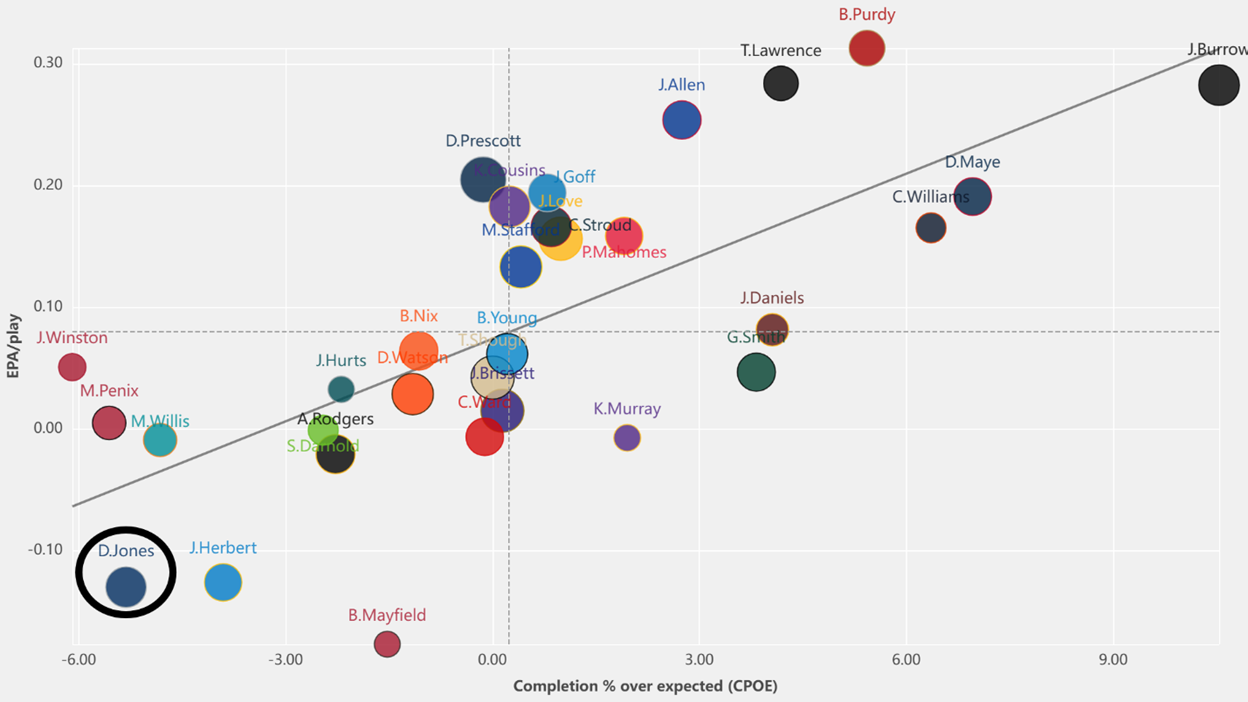
QB Daniel Jones has averaged 36.4 dropbacks/G (15ᵗʰ) and 32.4 passing attempts/G (14ᵗʰ). Jones has averaged -0.130 EPA per dropback with a -5.3% CPOE.
Jones has offered relatively little as a runner, averaging 3.3 rushing attempts/G, 9.5 rushing YDs/G, and 1.55 rushing FP/G (20ᵗʰ).
Jones has completely lost the image rehabilitation he earned through the first half of last season. His passing efficiency has been particularly poor, including a 40.9% positive EPA rate (29ᵗʰ), a 41.1 PFF passing grade (31ˢᵗ), and a 2.2% passing TD rate (30ᵗʰ).
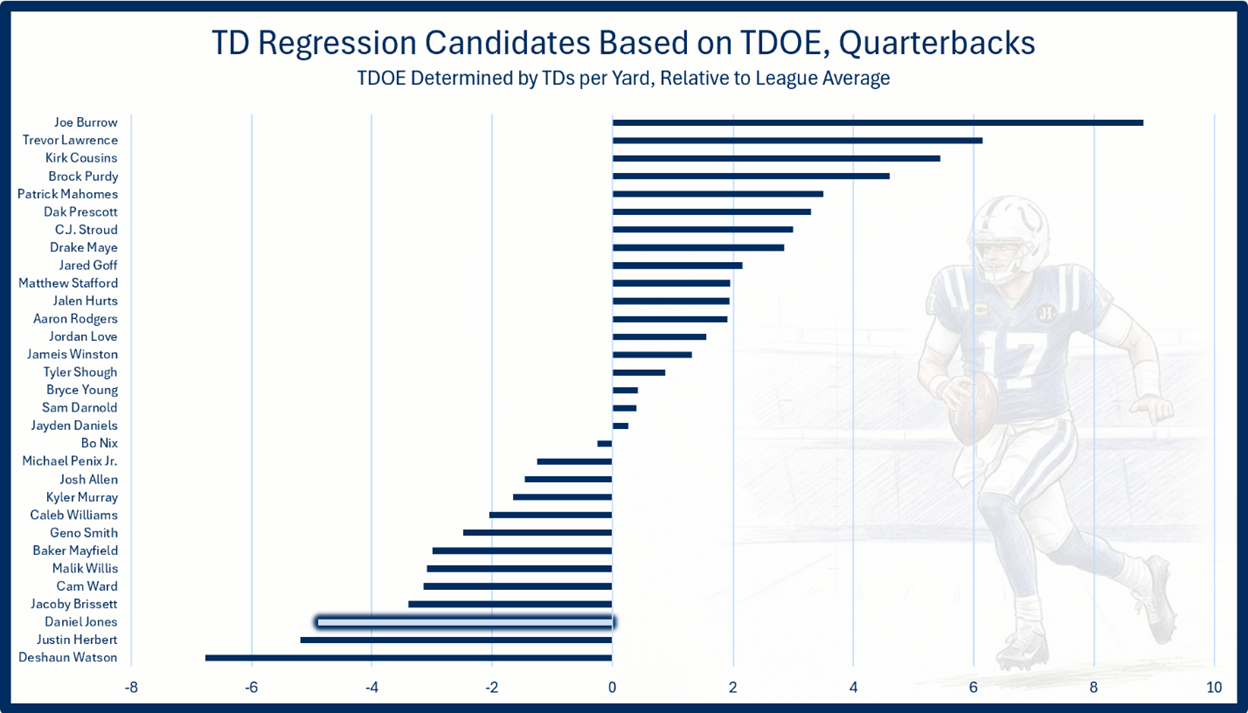
Jones has thrown seven TDs against 12 INTs through ten games. His -4.9 TDOE suggests he has scored roughly five fewer passing TDs than expected based on his passing yardage, technically making him a potential positive TD-regression candidate.
One potentially significant issue for Jones is that he’s a veteran QB playing for a team with a poor record, without the credibility to be considered its long-term answer. While QBs Anthony Richardson and Riley Leonard haven’t necessarily earned that standing either, both offer something that could make them intriguing Door Number 2 options: Richardson’s lofty 2023 draft capital and unique athleticism, and Leonard’s youth and relative inexperience, having yet to see meaningful NFL game action.
For now, speculation seems to be coming from local media and fan sites, not the team; the belief is that the Colts’ staff doesn’t see enough in Richardson or Leonard even to give them an audition. However, it is undeniable that the road must be narrowing for Jones, who underwhelms week after week. As such, I’d consider him a risk to be benched at any time, regardless of what the team does or doesn't say.
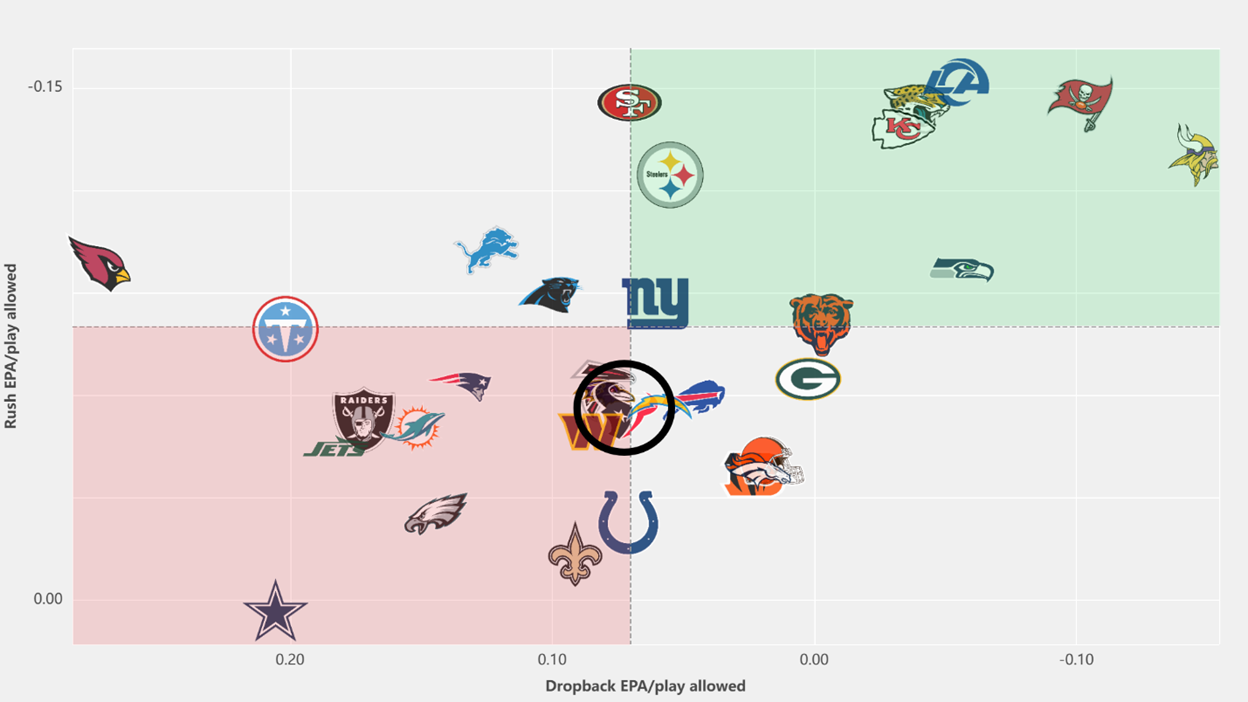
Houston ranks 18ᵗʰ in defensive EPA per play allowed (0.024), including 0.072 EPA per dropback and -0.055 EPA per rush.
The Texans primarily play zone coverage (80.8%), using single-high safeties 57.1% of the time. Their most common coverage is Cover 3 (41.2%), followed by Cover 4 (17.0%).
According to Fantasy Points' Coverage Matchup tool, Jones is projected for a 0.5% upgrade against Houston's defensive coverage. The PFF Matchup tool grades his assignment as poor, with Jones ranking 36ᵗʰ among 36 QBs this week and Houston ranking sixth among 32 defenses in its matchup model.
Over their last five games, Houston has allowed 19.7 FP/G to QBs (13ᵗʰ), including 19.3 EP/G (8ᵗʰ) and 0.4 FPOE/G (17ᵗʰ).
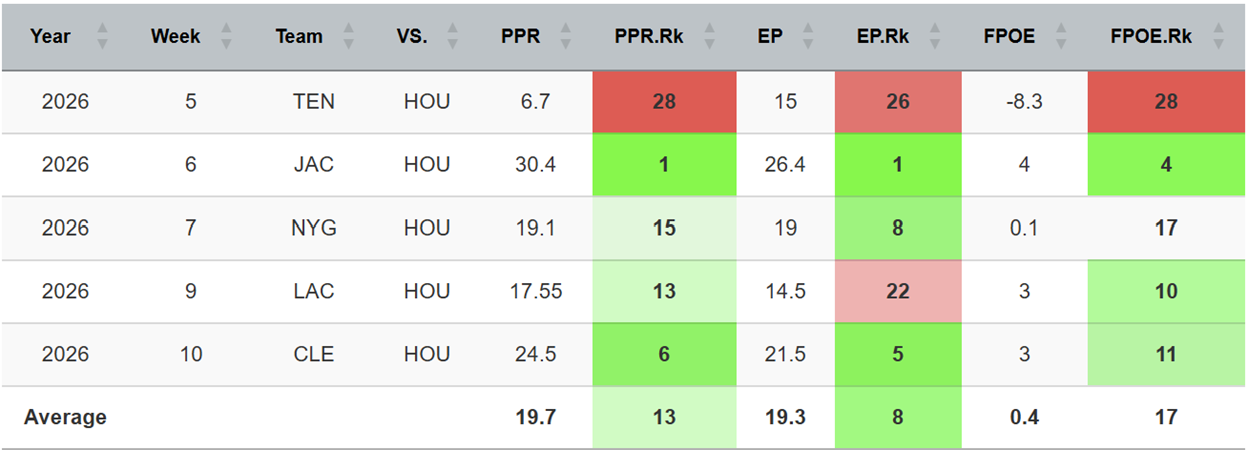
The Texans have allowed opposing QBs to exceed 24 FP in two of their last five games, including 30.4 FP to Jacksonville in Week 6 and 24.5 FP to Cleveland in Week 10. However, they also held Tennessee to 6.7 FP in Week 5, with the Titans underperforming expectation by 8.3 FP.
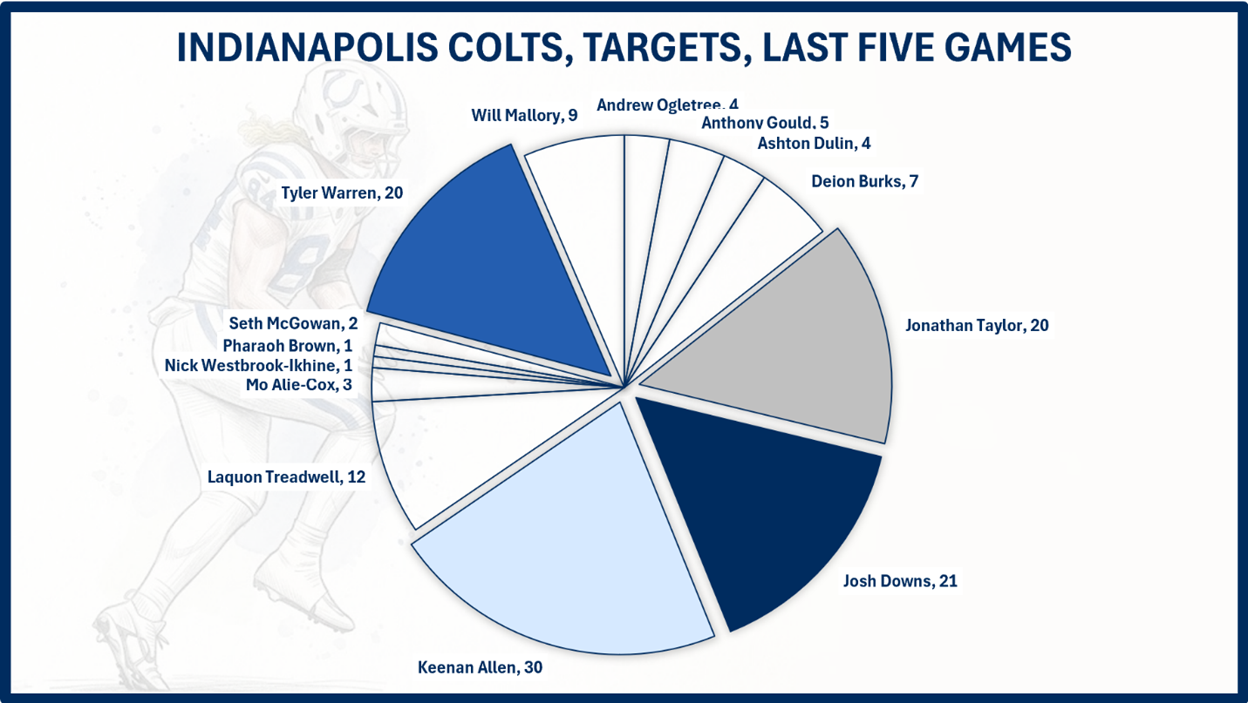
The Colts' passing game looks considerably different following the recent trades of WRs Keenan Allen and Josh Downs. The two accounted for 51 of Indianapolis' 138 targets over its last five games, with Allen leading the team (30) and Downs ranking second (21). RB Jonathan Taylor and TE Tyler Warren follow with 20 apiece.
Last week's receiving usage likely offers a better indication of how Indianapolis might look going forward. Treadwell led the remaining WRs with a 76% route participation rate in Week 10, followed by Gould (60%), Burks (52%), and Ashton Dulin (28%). Gould led the group with four targets, followed by Treadwell (3), Dulin (2), and Burks (2). Gould caught two passes for 28 yards, Treadwell caught all three of his targets for 24 yards, and Burks went without a reception. Long story short, there is little reason to get excited about any of these WRs.
I suppose it is worth monitoring Gould since he was highly efficient in limited action, producing 2.75 YPRR and a 31% TPRR, but those figures come on just eight routes and five season-long targets, leaving him well short of qualification. This is unlikely to hold up, so he's strictly a provisional hold for anyone with a lot of room on their bench.
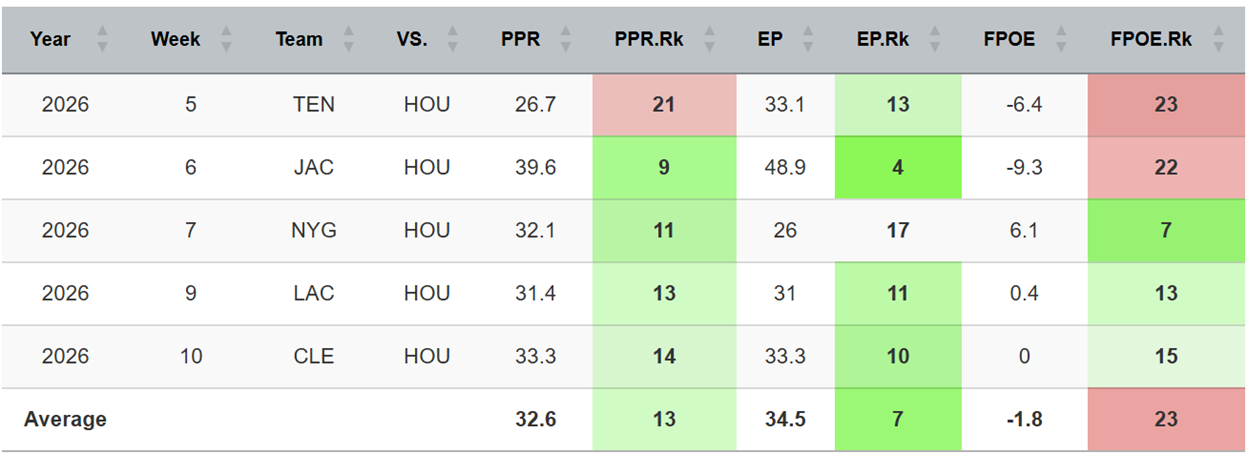
Houston has allowed 32.6 PPR FP/G to opposing WRs over its last five games (13ᵗʰ), compared to 34.5 EP/G (7ᵗʰ), with opponents underperforming expectation by 1.8 FP/G (23ʳᵈ).
The matchup is not particularly attractive. Fantasy Points' Coverage Matchup tool assigns Treadwell a -0.7% coverage grade, while Burks receives a +10.3% grade. However, PFF ranks Houston 21ˢᵗ among 32 defenses in its WR matchup model, and grades the assignments for all three Colts WRs as poor.
TE Tyler Warren is the most interesting option among Indy pass-catchers. He has run a route on 80.7% of Indianapolis' dropbacks (3ʳᵈ among TEs), averaging 6.88 targets/G (4ᵗʰ) with an 18.5% target share (7ᵗʰ). His 24% TPRR (T-6ᵗʰ) and 20.4% first-read target share (6ᵗʰ) reinforce his importance to the offense, although his 1.18 YPRR (35ᵗʰ) has been disappointing. Warren’s 12.0 expected FP/G (5ᵗʰ) is particularly encouraging, although he has underperformed expectation by 1.11 FP/G (39ᵗʰ). With Allen and Downs gone, Warren can absorb additional first-read targets but will also draw more defensive attention.
Warren's usage is heavily concentrated near the line of scrimmage, with a 4.6-yard aDOT (40ᵗʰ). He also averages 2.38 short-center targets/G (6ᵗʰ), giving him a potentially useful PPR role despite his modest yardage efficiency.
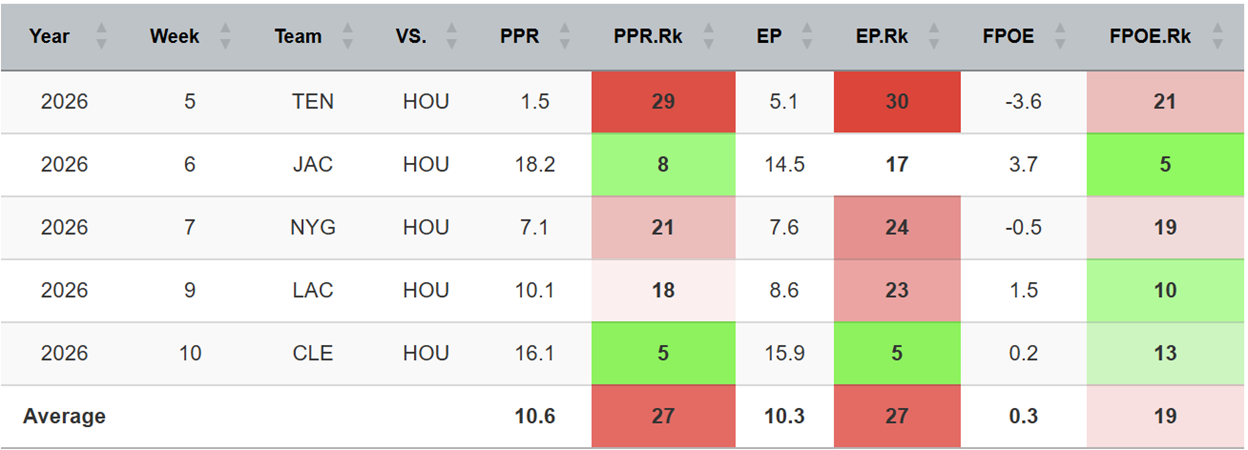
Fantasy Points' Coverage Matchup tool gives him a neutral +0.5% grade, while PFF ranks his matchup as fair. Houston has allowed just 10.6 PPR FP/G to TEs over its last five games (27ᵗʰ), including 10.3 EP/G (27ᵗʰ) and 0.3 FPOE/G (19ᵗʰ). Warren's workload makes him the clear priority among Indianapolis' pass-catchers, although the matchup is unfavorable.
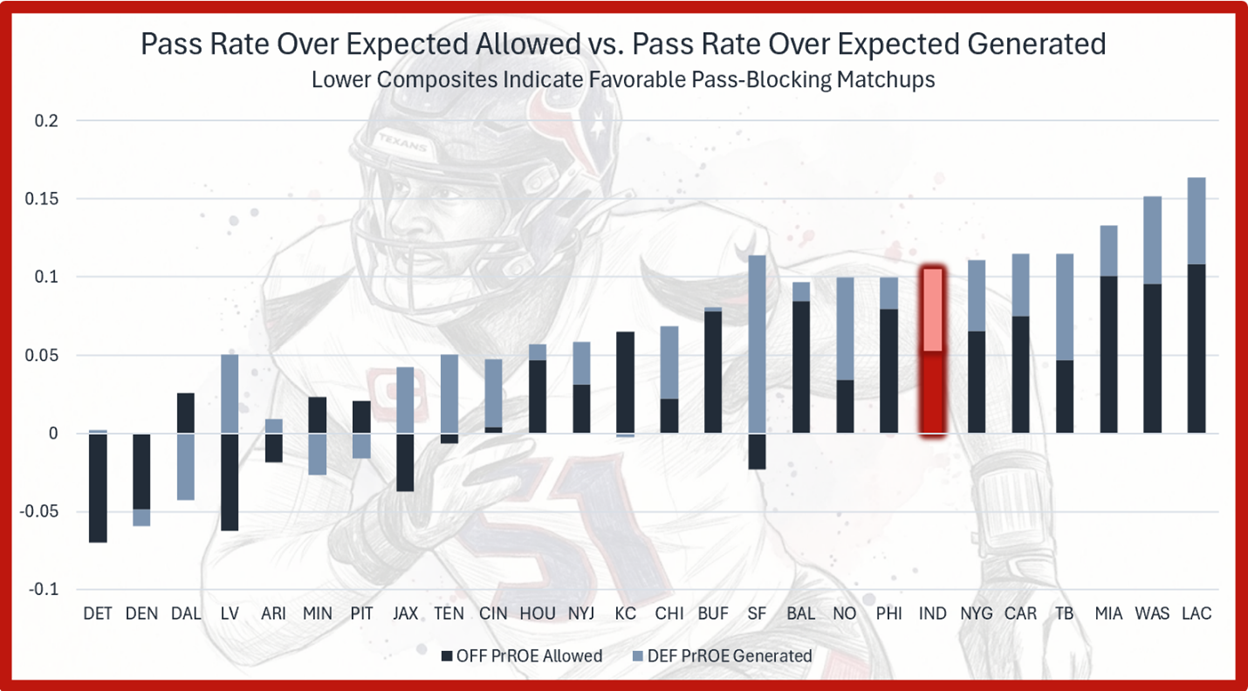
The Colts face an unfavorable pass-blocking matchup against Houston. Indianapolis allows a 5.32% pressure rate over expected, while Houston generates pressure at 5.18% above expected. Their combined PrROE of 10.50% is the seventh-highest among the 26 matchups in Week 11.
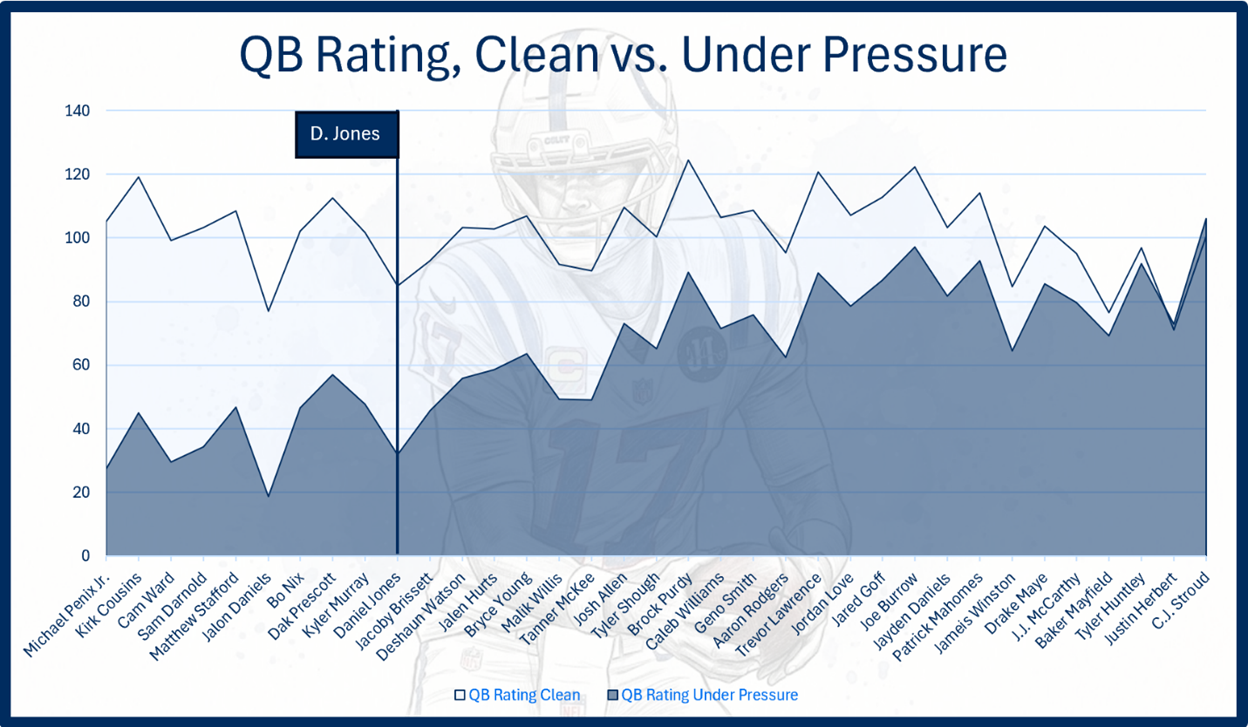
That is somewhat concerning for Jones, whose passer rating falls from approximately 85 when kept clean to 32 under pressure, a decline of roughly 53 points.
The rushing matchup is more encouraging. Indianapolis averages 2.22 adjusted yards before contact per attempt, while Houston allows 1.97. Their combined 4.19 yards ranks seventh-highest among the 26 matchups, suggesting a relatively favorable environment for the Colts' running game.
RB Jonathan Taylor remains in Indianapolis despite trade speculation, although RB Seth McGowan has been cutting into his workload regardless. Taylor still averages 17.7 carries (8ᵗʰ) and 3.7 targets (11ᵗʰ) per game, with a 76% snap share (T-2ⁿᵈ) and 37% team opportunity share (T-5ᵗʰ). McGowan, meanwhile, has averaged 5.5 carries (52ⁿᵈ) and played 23% of the snaps (67ᵗʰ). This remains Taylor's backfield, even if McGowan has developed a role. This only becomes an issue of McGowan gets more going forward, and Taylor gets less.
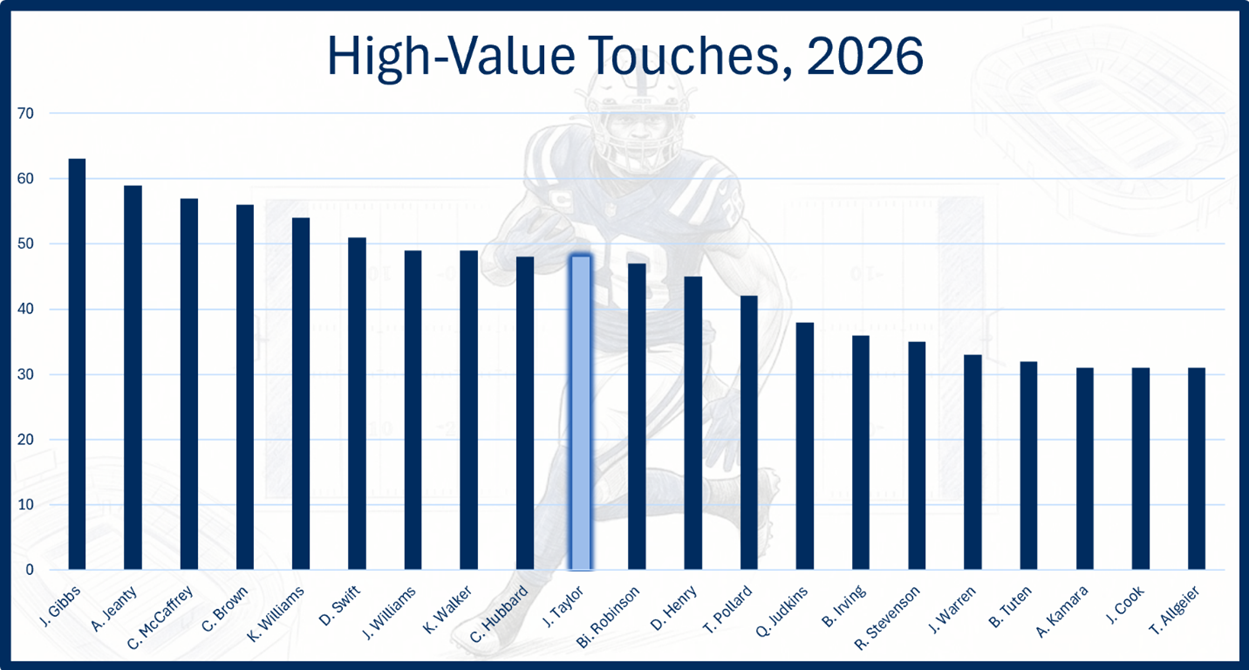
Taylor has earned 17.4 expected fantasy points per game (7ᵗʰ), supported by 11.7 rushing EP/G (7ᵗʰ) and 5.66 receiving EP/G (11ᵗʰ). He has also generated 4.1 rushing first downs per game (8ᵗʰ), although his 0.03 rushing FPOEPA (T-20ᵗʰ) and 62.8 PFF rushing grade (43ʳᵈ) have been less impressive than we are used to. Taylor averages 4.8 high-value touches (10ᵗʰ) per game.
McGowan has been more efficient on his limited rushing opportunities, averaging 0.16 rushing FPOEPA (T-7ᵗʰ) with a 77.6 PFF rushing grade (14ᵗʰ). However, his 4.2 EP/G (53ʳᵈ), 10% team opportunity share (55ᵗʰ), and minimal receiving involvement make him hard to trust without Taylor missing time.
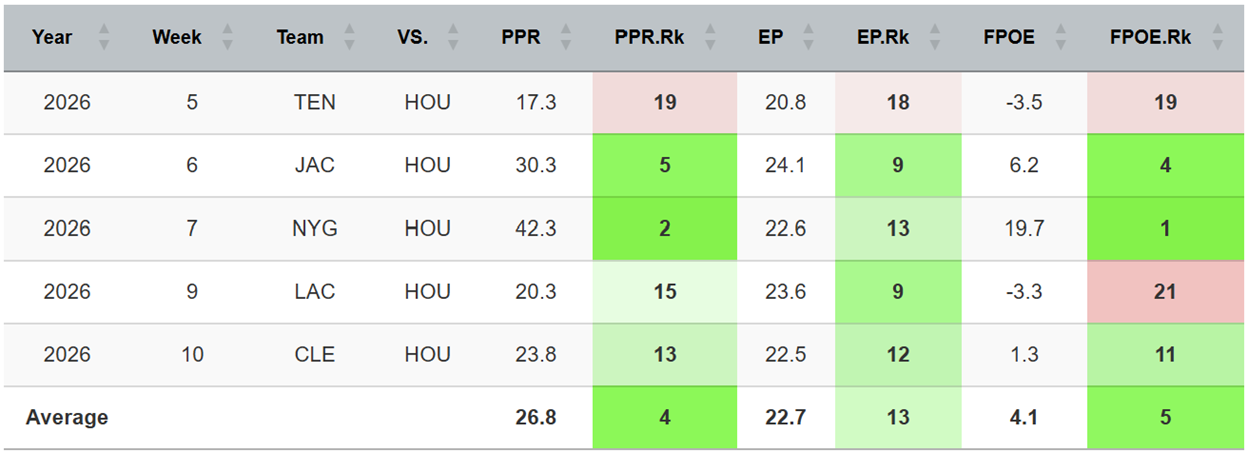
Houston has been a difficult matchup for opposing running backs, allowing 26.8 PPR points per game (4ᵗʰ-fewest) over its last five games. However, opposing RBs have averaged 22.7 expected points (13ᵗʰ-fewest), outperforming expectation by 4.1 points per game. That discrepancy is heavily influenced by the Giants' 42.3-point performance in Week 7, which exceeded expectation by 19.7 points.
Taylor's somewhat modest receiving involvement provides another path to production. He averages 2.8 receptions (12ᵗʰ) and 24 receiving yards (13ᵗʰ) per game, accounting for a 12.58% target share (8ᵗʰ) and 29.6 receiving yards after the catch per game (9ᵗʰ). McGowan has drawn just six targets through Week 10.
If the game script is as lopsided as implied totals suggest, receiving work may be Taylor’s best path to getting over. In the last five games, the Texans have surrendered 5.8 receptions per game to RBs (3rd) for 38.6 rec Yds/G (11th), so they are somewhat vulnerable.