
Quick Slant: TNF - Fixer Uppers Looking to Flip Their Seasons

Mat Irby’s Quick Slant
“It was like playing on a frozen pond. It was slicker than snot on a doorknob.”
Cowboys RB Walt Garrison spoke from beneath his cream-colored 10-gallon hat. His demeanor was as straightforward as a man pleading his case when pulled over for speeding; his eyes were battle-worn, faintly haunted by the distant memory of the Ice Bowl.
Fifteen future Hall of Famers. Two legendary coaches who had served as coordinators on the same staff years earlier. Vince Lombardi's Packers, chasing a third consecutive NFL championship, against Tom Landry's Cowboys, desperate to avenge the previous year's title-game loss. Sixty minutes to decide it all and reserve a date with Oakland in Super Bowl II.
It was New Year’s Eve, 1967, and in Green Bay, it was −13° at kickoff, dropping to −18° by game’s end, with wind chills between −48° and −70°. Calling it the coldest game in NFL history is almost unjust; it was the kind of cold that climbed into your marrow and stayed there – that made the sun feel counterfeit despite clear blue skies – that stripped away all color, leaving white lines against blue-green blades, frozen upright like a bed of nails on glacial concrete.
“The ball felt like a piece of ice,” said Packers QB Bart Starr. Cowboys WR Lance Rentzel described spectators' breath never dissipating, but collecting into a fog like that over San Francisco.
“I think I’ll have a bite of coffee,” chimed in commentator Frank Gifford.
The Packers asserted their dominance, chopping up Dallas’ secondary and scoring the first 14 points on two Starr TD passes to WR Boyd Dowler. Another second-quarter drive might have closed the book, but free-running defenders swarmed Starr, his cleats performing like ice skates. Cowboys DE Willie Townes wrapped him up and swatted the ball loose. It slid like a hockey puck until DE George Andrie clumsily collected it from the glass-like surface and jogged seven yards into the end zone.
Dallas continued its unanswered scoring with a Danny Villanueva field goal. Then, on the first play of the fourth quarter, Dan Reeves – that Dan Reeves – swept left but slowed inexplicably. He gingerly caught his footing, swiveled, and launched a long pass. Alone, Rentzel waited beneath it like a right fielder, then turned and accelerated past DB Tom Brown, who had overcommitted.
Backed against the ropes, Green Bay must have felt its torture had been in vain. Even Lombardi sounded nervous.
“What the hell is going on around here?” he wondered aloud, spinning toward his players, then back to the field, desperate concern malforming his countenance.
Packers RG Jerry Kramer framed their hopelessness as they entered the final drive. They had become frozen themselves, stifled by a Doomsday Defense that had seemingly figured them out.
“Four and a half minutes when we hadn’t even gained a yard in 31 plays,” he recalled. “In fact, we’d gained minus-nine yards.”
Their response was surgical. Starr hit Dowler, who made a tough catch in traffic, likely suffering a concussion. He dinked it wide to RB Donny Anderson, who cut inside. He lobbed it left to RB Chuck Mercein, who caught Cowboys LB Dave Edwards at a bad angle and couldn't adjust on the poor footing.
Mercein dove through the A-gap, slammed to the ice, and skidded inside the five for a first down. Anderson followed but met a wall, unable to gain leverage with each panicked, slipping step. On second down, he dove beneath that wall, searching through a forest of legs, but was stonewalled again.
During their final timeout, Starr suggested a sneak because the RBs couldn't reach the line quickly enough.
“Well, then run it,” Lombardi barked, “and let’s get the hell out of here.”
Kramer, just to Starr’s right, took outside leverage on Cowboys DT Jethro Pugh, unfolding him like a letter with his left shoulder. Starr found the hole just as Cowboys LB Chuck Howley reached through the clutter. It wasn’t enough. Starr collapsed to the permafrost, ball in hand, a half-yard beyond the goal line. An epic war of attrition between two NFL titans came down to literal inches.
Non-divisional rivalries are difficult to cultivate, but Green Bay and Dallas have managed it. The Packers, the team of the ’60s, and Cowboys, the team of the ’90s, have taken turns breaking each other’s hearts. Nine playoff meetings. And several of the most iconic moments in NFL postseason history: the Ice Bowl sneak, Aaron Rodgers’ impossible sideline throw to TE Jared Cook, and, of course, the most controversial no-catch of all time.
Most recently, they tied 40–40 last season, weeks after Dallas surprisingly traded superstar DE Micah Parsons to Green Bay. Each team enters disappointed with their start; the next chapter in this rivalry could mark the reclamation of a season on the brink.
GAME ENVIRONMENT
Dallas Cowboys at Green Bay Packers (-1.5)
Over/Under: 52.5
Dallas and Green Bay entered the season with decent expectations, but they’ve fallen from grace with some key losses and underwhelming play. Based on Pythagorean Wins, both teams are at or below average, with the Cowboys slightly better.
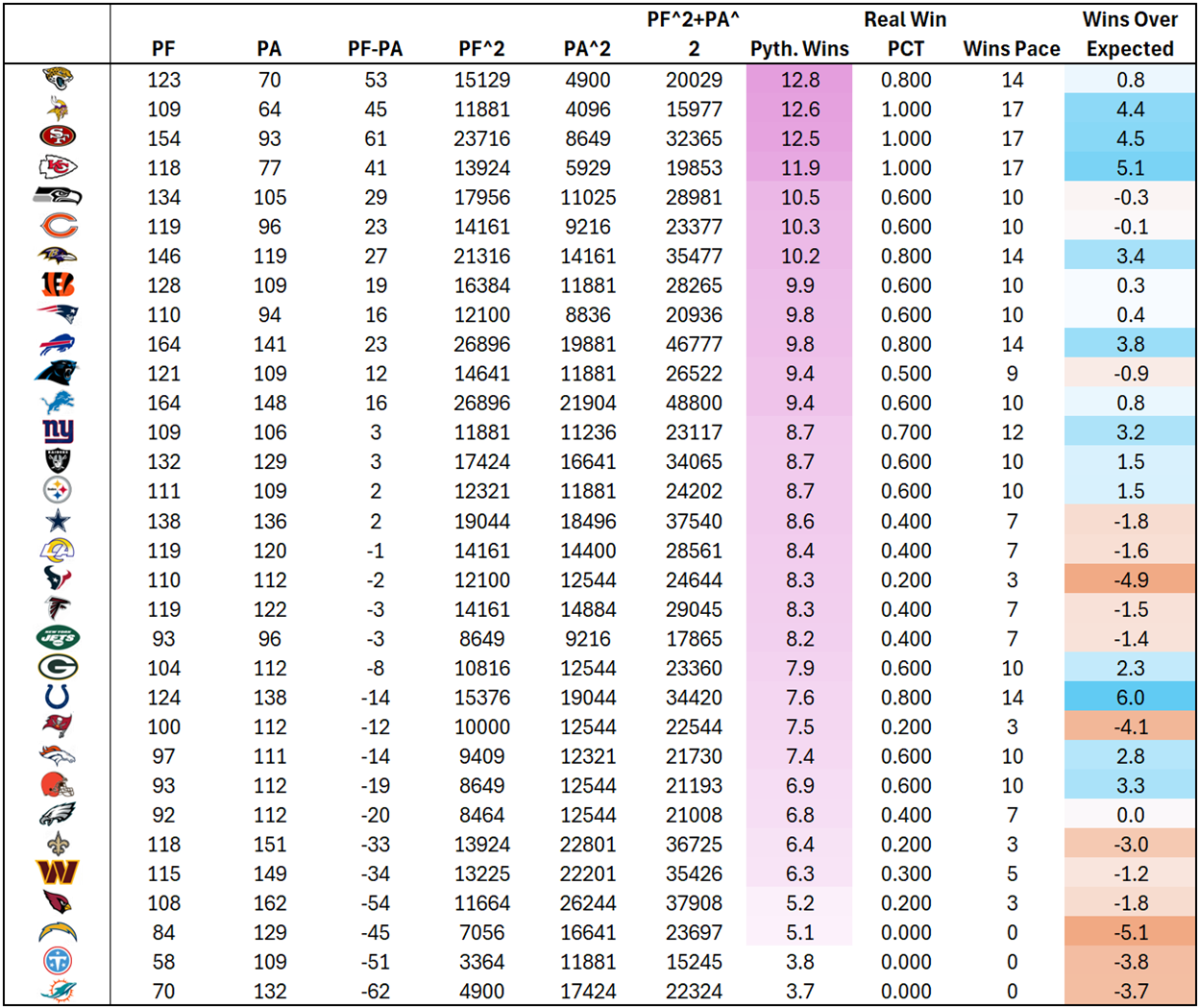
The Cowboys were in the top ten leading into last week, but after a surprising upset at the hands of Tampa Bay and UDFA backup QB Jalon Daniels in an island game, they’ve slipped to +2700. The Packers are currently +4500. The spread is very close at Green Bay -1.5, meaning if the game were in Dallas, the Cowboys would be slightly favored.
In a neutral script, the Cowboys run at a pace of 26.8 seconds to snap (5th), while Green Bay, traditionally a slower team, is nearer to the middle of the pack this season at 28.2 neutral seconds to snap (T-13th).
Green Bay averages 58 plays per 60 minutes (T-25th), and Dallas averages 62 (T-13th). For Dallas, this dropped significantly after Tampa Bay outpossessed them almost exactly 2:1 last week. Still, the Cowboys have scored 27.6 PPG (7th).
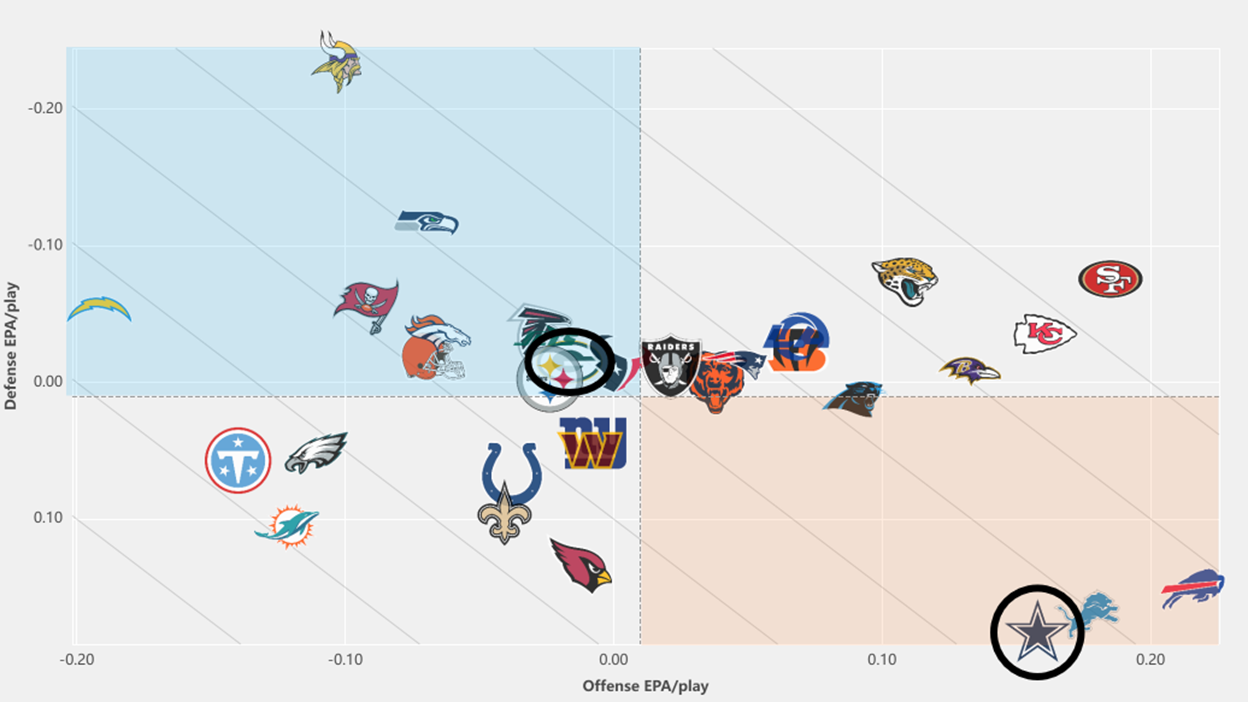
Part of Dallas's magic formula for scoring is that, despite their efforts to improve this season with a litany of hires, free-agent signings, trade acquisitions, and draft picks almost entirely centered on defense, they still have one of the league's worst units. This means their strong, well-above-average offense has to score to keep up with opponents. The combination of drastically bad defensive EPA and drastically good offensive EPA has long created fantasy-scoring machines, and the 2026 Cowboys are one, as they were in 2025.
Green Bay, by contrast, is slightly above average defensively and slightly below average offensively, though they are much closer to league average both ways. We might expect their offense to improve, as HC and OPC Matt LaFleur has traditionally had efficient offenses.
Weather: Sunday's game will be played at Lambeau Field in Green Bay. Temperatures should be around 52–55°F at kickoff, falling to approximately 49–50°F by the end of the game. Winds are forecast around 10 mph, with gusts potentially reaching 23 mph. Skies should remain clear, with virtually no precipitation expected. Occasional gusts could affect deep passes and longer field goals, but weather shouldn't be a major fantasy concern, especially with the wind blowing parallel to the field.
Cowboys Key Injuries: Starting CB Cobie Durant (hamstring) has been ruled out, while CB Joey Porter Jr. (ankle) is questionable after finishing the week limited. Starting LB DeMarvion Overshown (hamstring) has also been ruled out after initially being listed as questionable. CB Shavon Revel Jr. (knee) practiced fully and carries no designation. WR CeeDee Lamb (thigh), starting LT Tyler Guyton (back), and G Tyler Smith (thumb) practiced fully and are cleared to play. S Jalen Thompson remains on IR. Dallas has no significant injury designations among its active fantasy-relevant skill-position players.
Packers Key Injuries: Starting ED Micah Parsons (knee) remains on PUP and will miss the opportunity to face his former team. Starting LB Edgerrin Cooper (Achilles) and DT Javon Hargrave (Achilles) are on IR, with Hargrave joined Saturday by DT Jonathan Ford (calf) and WR Skyy Moore (ankle). Starting CB Benjamin St-Juste (hamstring) is out. Starting G Aaron Banks (knee/toe) and reserve G Jacob Monk (quadriceps) are also questionable. WR Jayden Reed remains on IR, while TE Luke Musgrave remains on PUP. RB Chris Brooks is on IR, and RB Josh Jacobs remains on the Commissioner's Exempt List for this game, although he is scheduled to become eligible in Week 7. WR Savion Williams (ankle) was activated from IR on Saturday. Green Bay's depleted defensive front and secondary are meaningful concerns against Dallas' passing offense.
COWBOYS
Implied Team Total: 25.5
The Cowboys have one of the most productive environments for fantasy production, with high play volume and scoring. They are above average in EPA per dropback and EPA per rush.
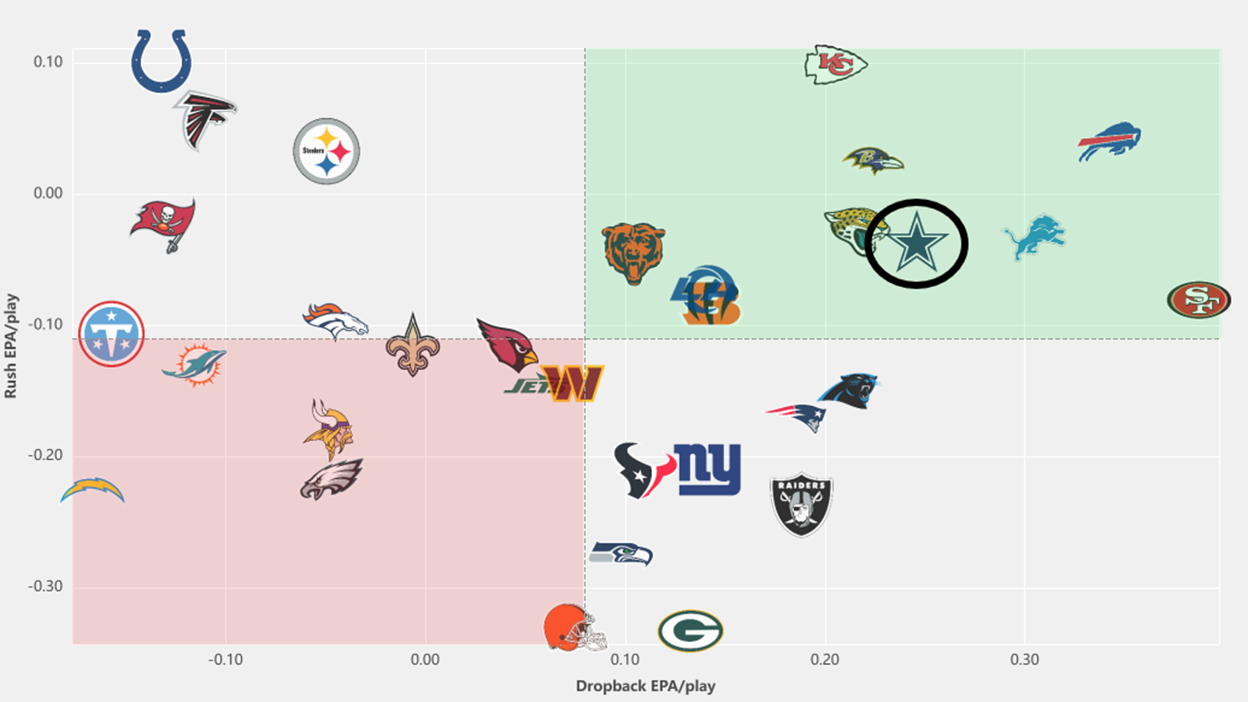
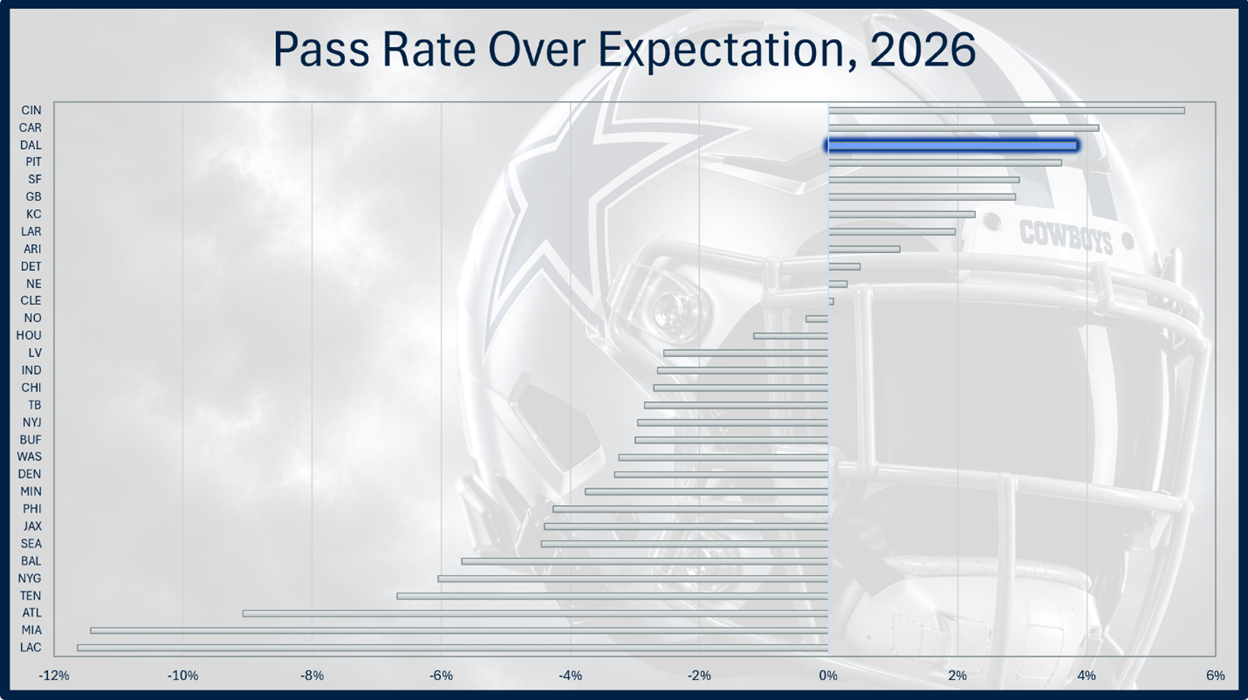
They have the third-highest PROE in the NFL (3.8%), trailing only Cincinnati and Carolina.
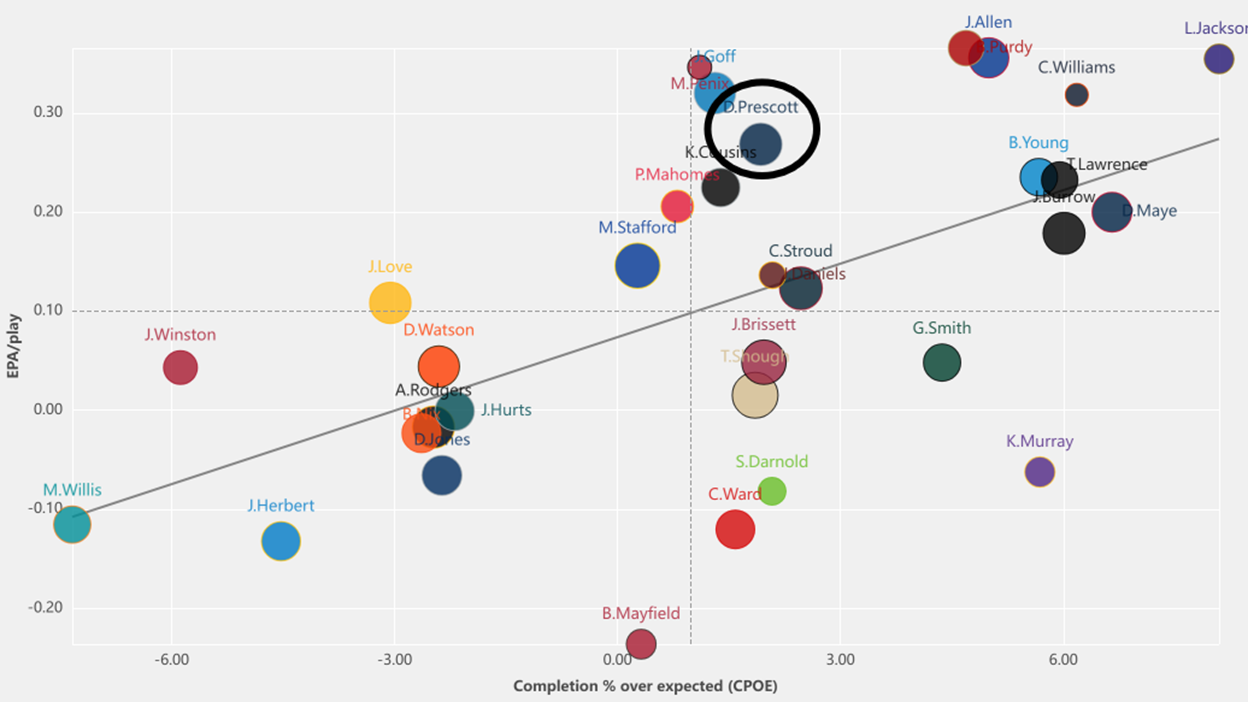
QB Dak Prescott has dropped back 209 times, converting that to 38.4 pass attempts/G (5th). Prescott’s passing yards/G ranks sixth (276.2). He ranks above average in EPA per play and CPOE and has an 85.3 PFF pass grade (3rd).
Prescott has scrambled 11 times, putting him in the 80th percentile, but he has not provided much fantasy production from it, earning just 1.32 rushing FP/G (22nd).
The Packers run zone on 82% of their plays (11th). They use two-high on 62.6% of their plays (5th). Their most common alignments are Cover 3 (23.1%), Cover 4 (23.5%), and Cover 2 (21.4%). Their blitz rate is 25.1%, which is below average.
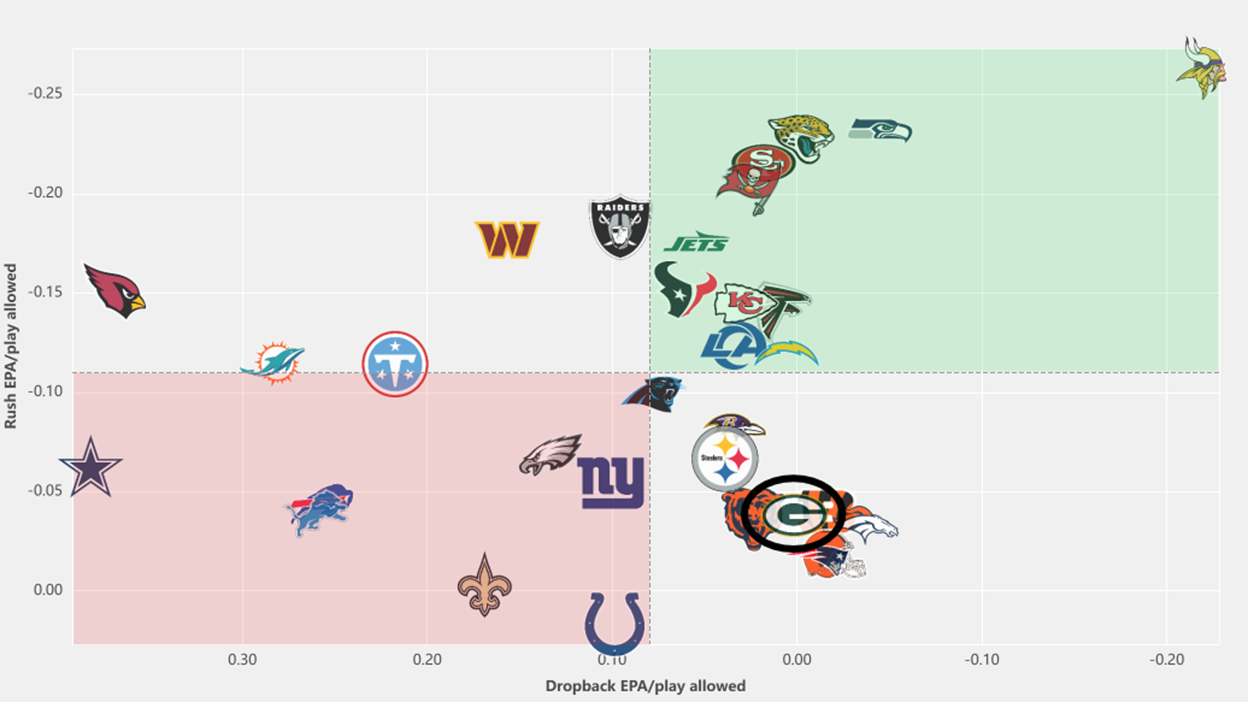
The Packers are above average in EPA per dropback allowed but above average in EPA per rush. This hasn't translated into a significant run funnel, although their run rate against is in the top third; it may indicate they could become one if more teams try to exploit this weakness.
The Packers continue to have injuries on defense; they’ve recently lost LB Edgerrin Cooper and DT Javon Hargrave to IR.
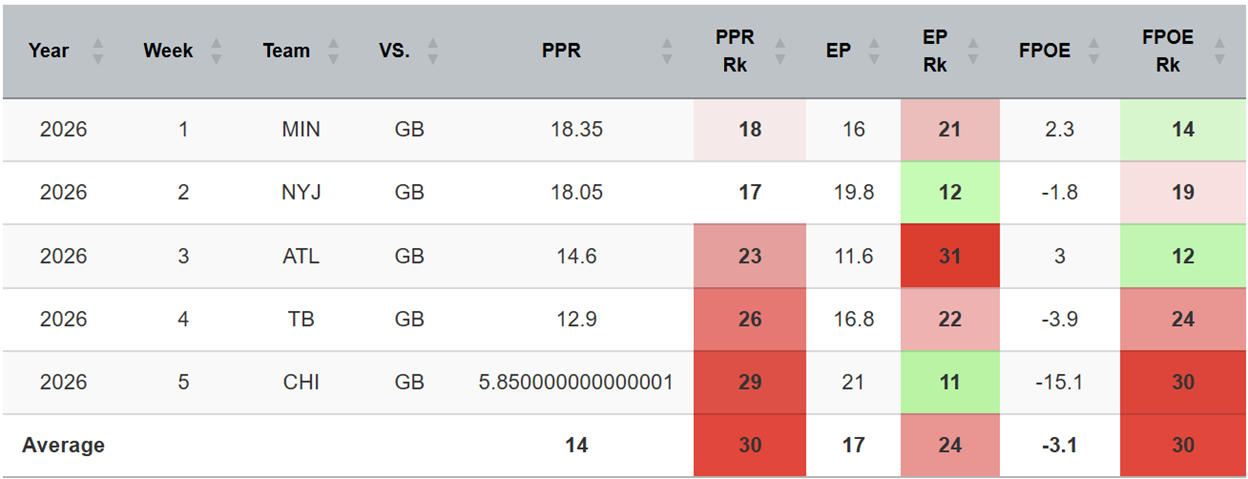
The Fantasy Points coverage matchup tool suggests a 4% downgrade in FP/DB for Prescott based on the types and rates of coverage the Packers utilize. The PFF coverage tool, which is more personnel-based, grades Prescott’s matchup as fair. Raw fantasy points corroborate the warnings, as the Packers have surrendered just 14 FP/G so far this season (30th). Notably, they’ve played against a backup QB for Minnesota, Chicago, and Tampa Bay during that stretch.
The Cowboys have four players with more than 20 targets in their first five games: WRs CeeDee Lamb (51), George Pickens (40), Ryan Flournoy (25), and TE Jake Ferguson (21). RB Javonte Williams is just behind with 18 targets.
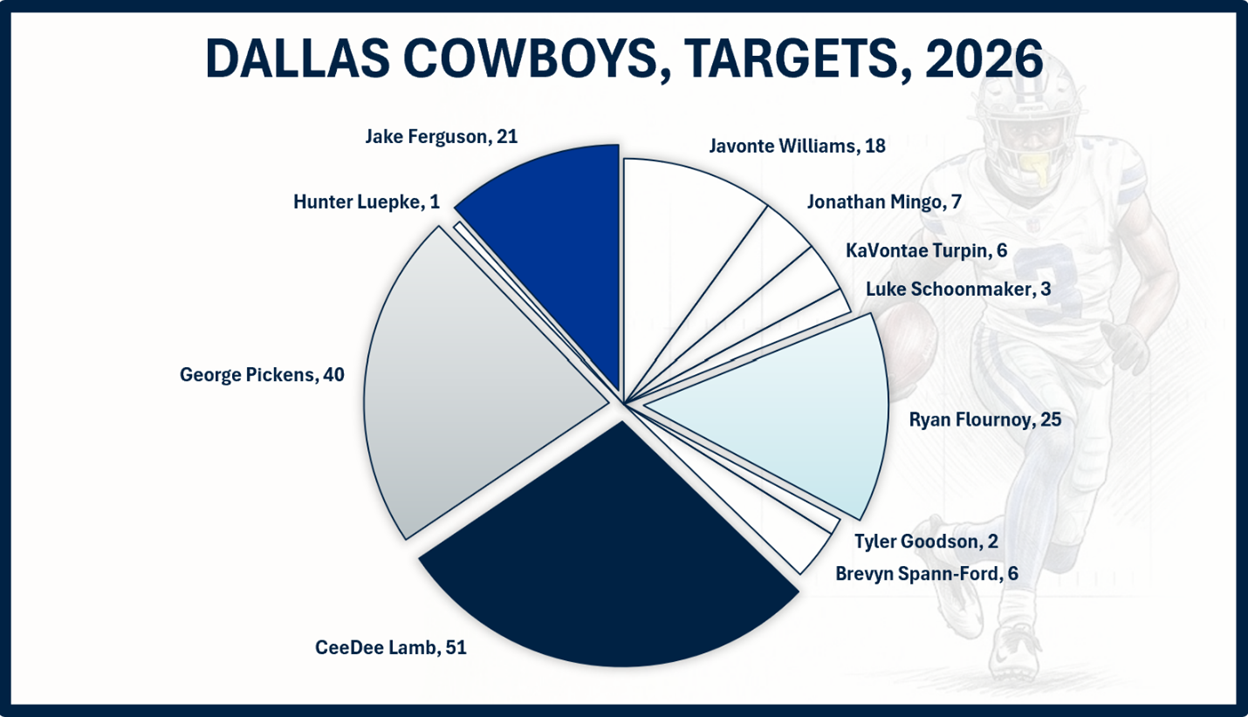
Lamb and Pickens are one of the best one-two punches at WR in the NFL. Lamb, in particular, is having another good season thus far, earning a 26.6% target share (10th). He ranks in the 90th percentile or better in several categories: targets/G (10, 4th), recs/G (7.8, T-2nd), rec 1Ds/G (5.6, T-3rd), first-read targets/G (9.4, 3rd), PFF rec grade (91.1, 3rd), TPRR (31%, 5th), and YPRR (3.02, 5th).
Pickens has started slowly, and it still looks like increased opportunities propped up his 2025 WR1 season while Lamb was injured; his target share is just 20.8% (28th). He is lagging compared to his production a year ago, earning just 0.4 FP/RR (T-34th).
WR Ryan Flournoy leads the team in slot routes (80), and the Cowboys are third in the league in plays from 11 personnel (219). In combination, this is enough in this fast-paced offense to make Flournoy a top-30 WR in routes/G (31.2). Flournoy ranks seventh in YACO/G (13.4).
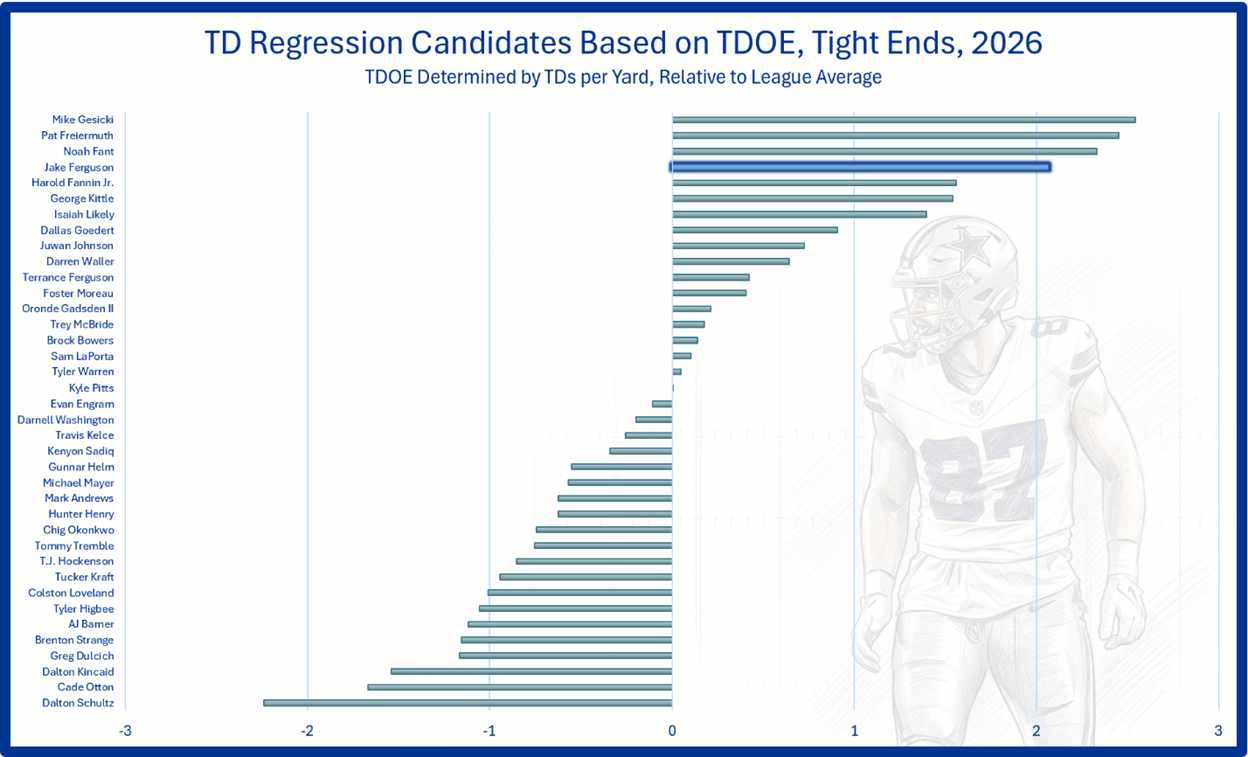
TE Jake Ferguson remains woefully inefficient. With a 15th percentile TPRR (15%) and a fifth percentile YPRR (0.73), Ferguson is practically unstartable, even having scored one TD/G. Ferguson ranks as one of the league's most significant negative TD regression candidates, and he’s wholly unreliable in most fantasy formats.
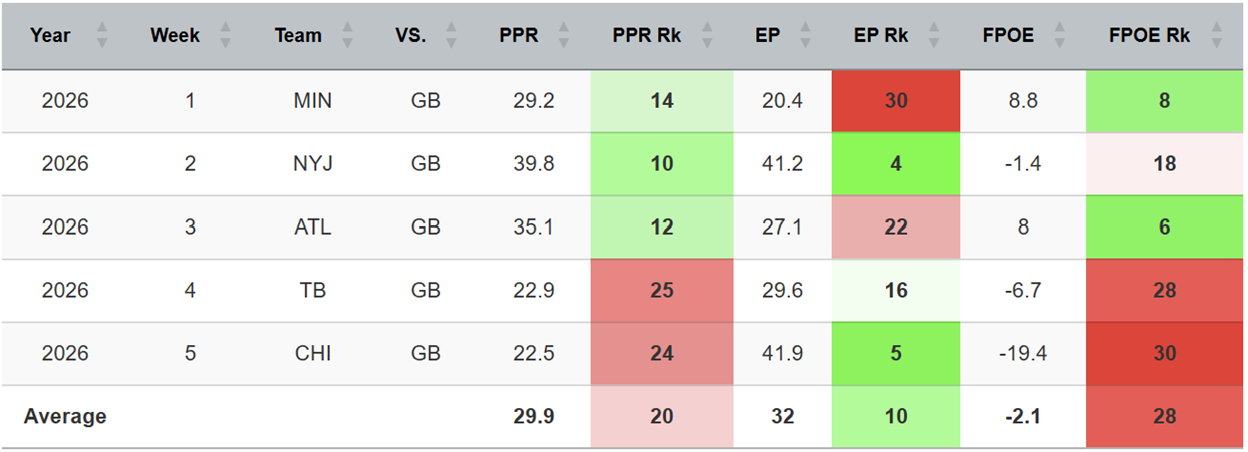
Fantasy Points' Coverage Matchup tool gives mixed assessments for Dallas' WRs against Green Bay. CeeDee Lamb (-5.2%) draws a slightly unfavorable coverage grade, while George Pickens (3.0%) and Ryan Flournoy (19.4%) have more favorable projections. The PFF Matchup tool is more optimistic about Lamb, grading his matchup as good. Pickens draws a fair matchup, while Flournoy's is graded as poor.
In their first five games, the Packers have surrendered 29.9 PPR/G to WRs (20ᵗʰ), despite allowing 32.0 EP/G (10ᵗʰ). Opposing WRs have averaged -2.1 FPOE/G (28ᵗʰ), suggesting Green Bay has allowed plenty of opportunity without surrendering especially efficient production.
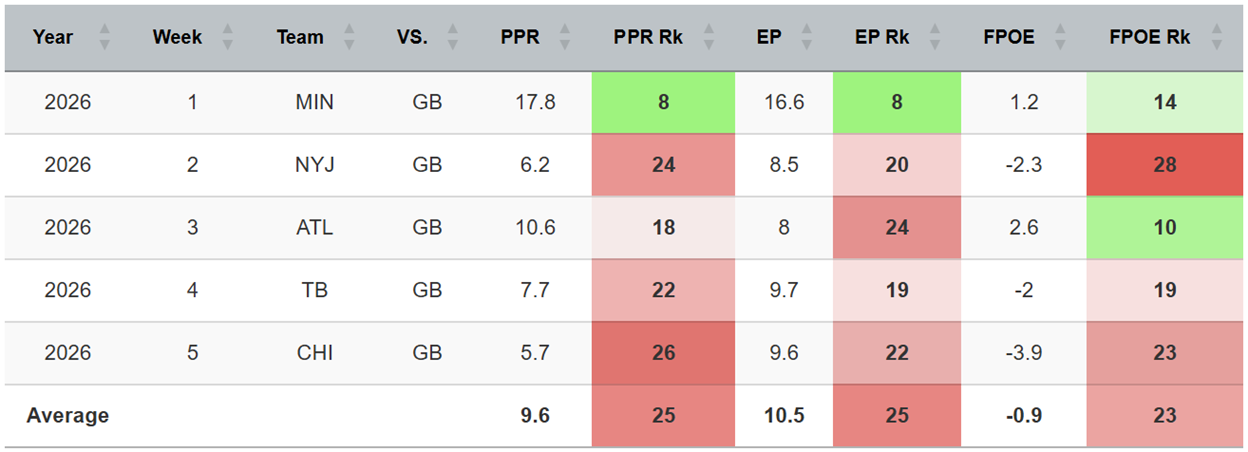
They have been more restrictive against TEs, allowing 9.6 PPR/G (25ᵗʰ) on 10.5 EP/G (25ᵗʰ). According to PFF’s matchup tool, the Cowboys’ TEs have poor matchups.
Additionally, the Packers have the best record against slot receivers in 2026, allowing 6.0 FP/G to the slot (32nd). Flournoy is in the slot the most often by raw snaps, but Lamb spends 37.6% of his time there, too.
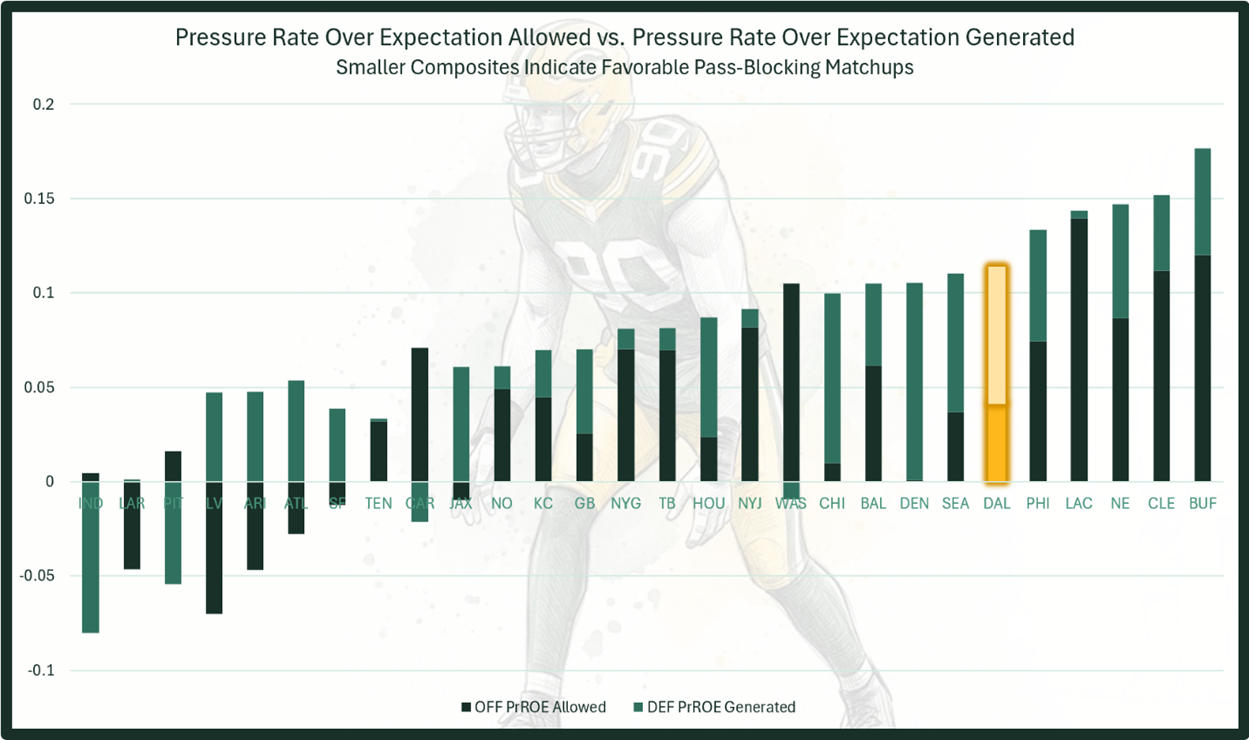
When on offense, the Cowboys may be outmatched in pass protection based on PrROE allowed vs. the PrROE the Packers generate. It is worth noting that the Fantasy Points data used to determine this is purely statistical. OG Tyler Smith missed Weeks 1-4 and was getting up to speed in Week 5. Some consider him the best OG in the league, so it is conceivable the OL looks better going forward than it did in the recent past.
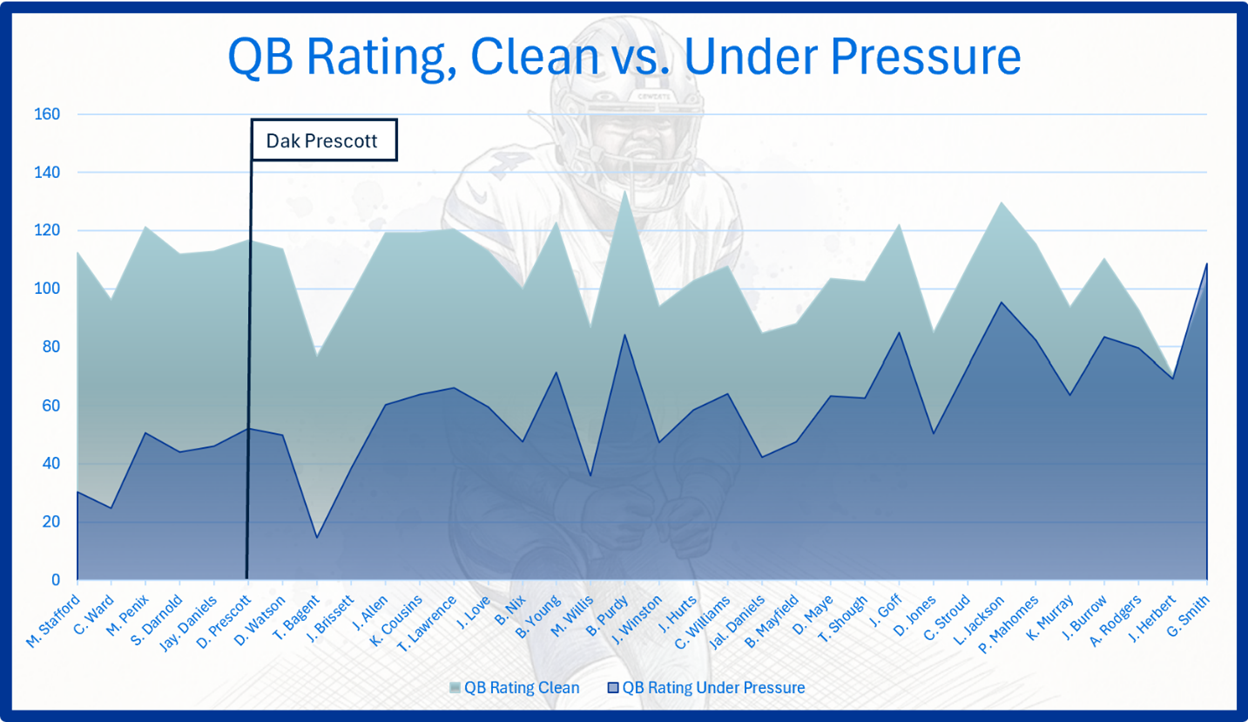
Prescott has struggled more than usual to handle pressure in 2026, posting the sixth-largest drop in QB rating under pressure vs. from a clean pocket. This is unusual for Prescott, who traditionally handles pressure well. Prescott is climbing out of the cellar, too. He recently had the largest gap between his QB rating under pressure and in a clean pocket, and he's trending in the right direction.
In the running game, the combination of the Packers’ defensive adj. YBC/Att allowed and the Cowboys’ offensive adj. YBC/Att generated is closer to neutral, but also shades in Green Bay’s favor.
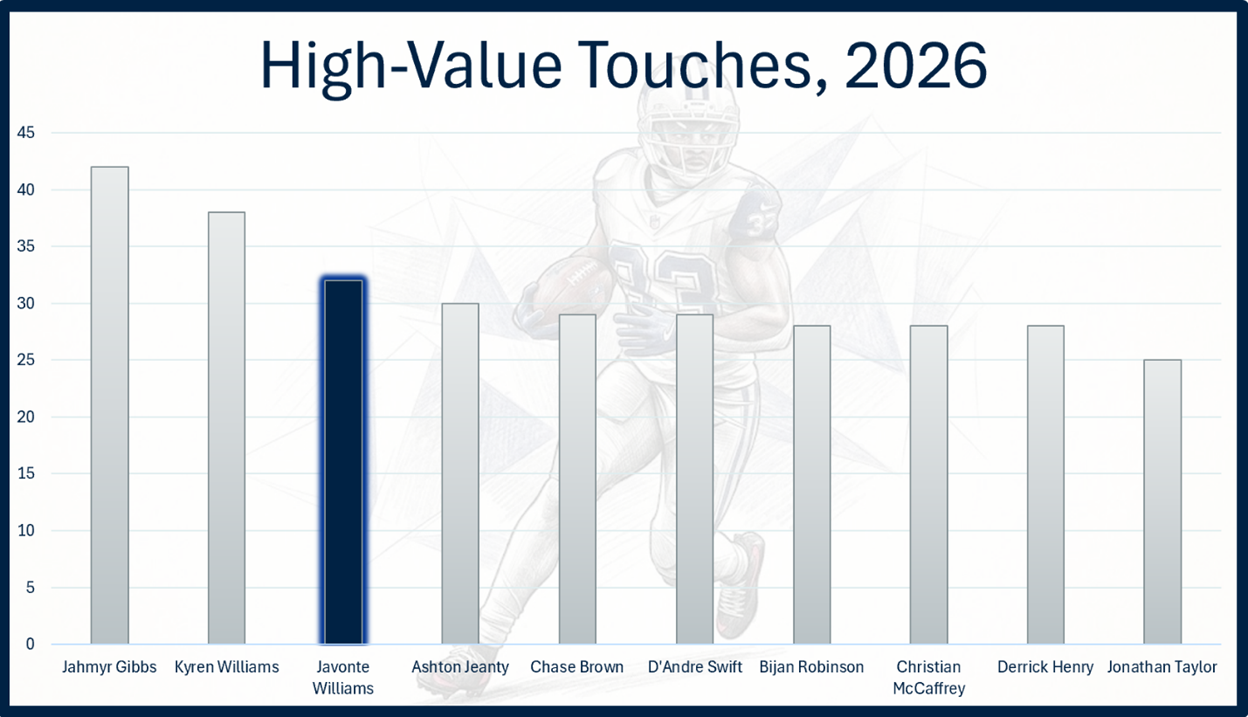
RB Javonte Williams has been one of the better fantasy stories of 2026. Through five weeks, Williams has 32 HVTs, third among RBs, trailing only Jahmyr Gibbs (42) and Kyren Williams (38). His receiving usage and goal-line opportunities give him a much stronger fantasy foundation than his rushing efficiency alone would suggest.
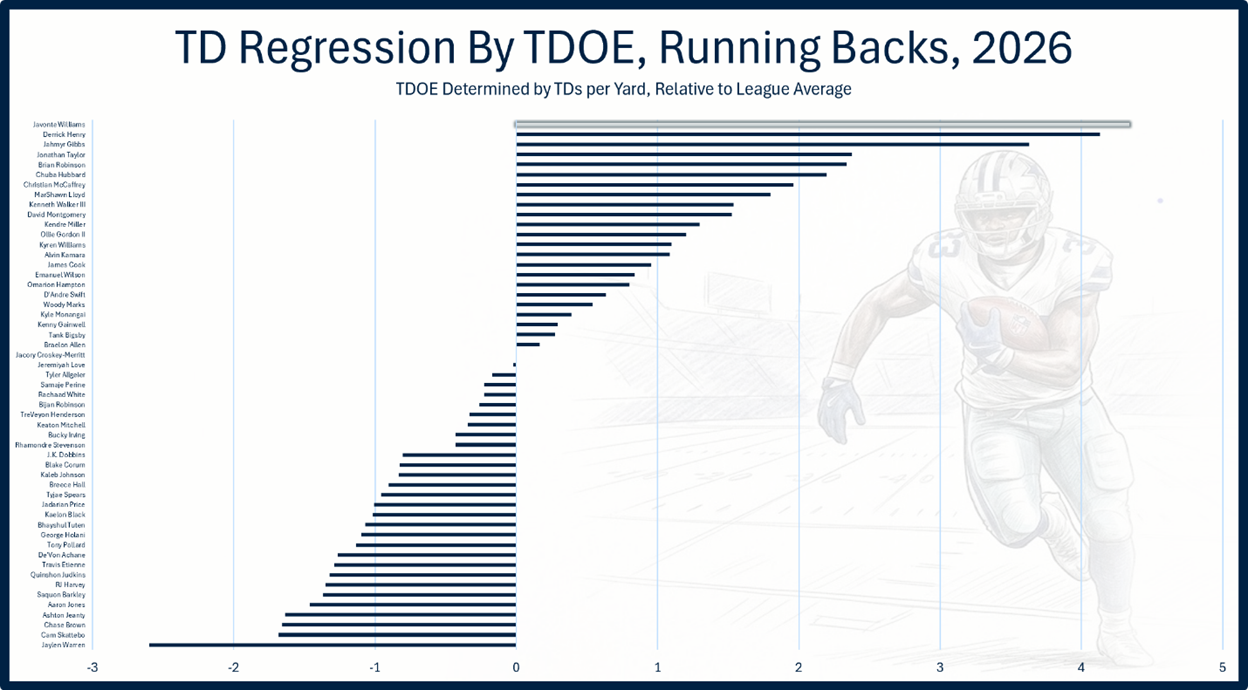
That said, Williams has also been one of the league's biggest beneficiaries of TD production above expectation. His TDOE leads all RBs by a considerable margin. That doesn't mean Williams' TD production is destined to collapse, especially with the opportunities he's getting, but it does suggest his current scoring pace may be hard to maintain.
According to the PFF Matchup tool, Williams' rushing matchup against Green Bay is fair, while his receiving matchup is poor.
However, the Packers have allowed 28.4 PPR/G to RBs through five weeks, second-most in the league. They've surrendered 23.8 EP/G (seventh) and 4.6 FPOE/G (third), meaning opposing RBs have benefited from both substantial opportunities and unusually efficient production.
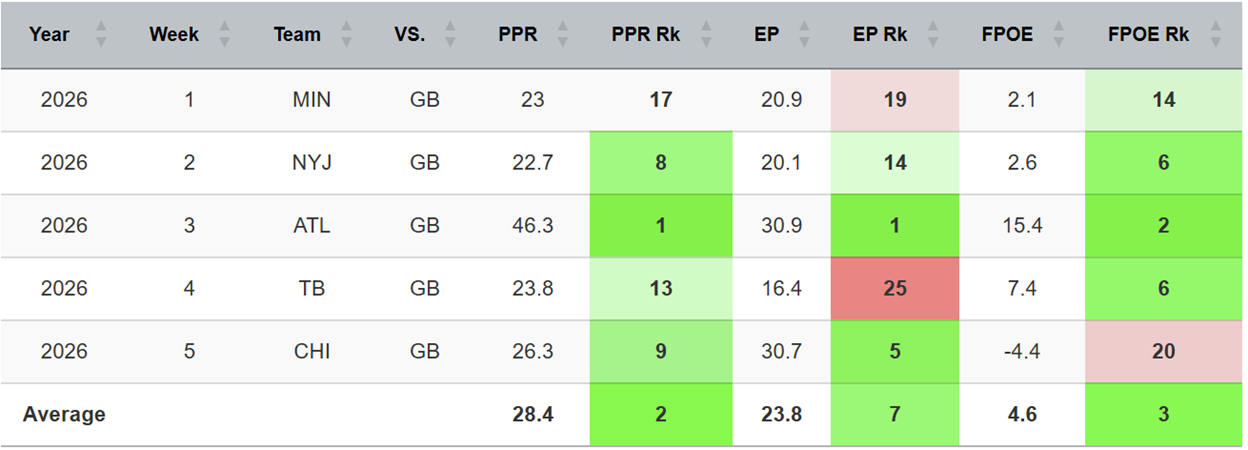
The whole story while the Cowboys are on offense is how their star-studded attack can fare against a slightly tougher defense, headed up by new DC Jonathan Gannon, and how well the Packers’ defense will fare against the most complete offense they’ve faced, especially with mounting injuries. If the Cowboys score, they'll have to get points from somewhere. The Cowboys' tendencies may point to a preference for moving the ball through the air, but the path of least resistance may be on the ground.