
Quick Slant: TNF - Still Theseus' Boat

Mat Irby’s Quick Slant
According to legend, Theseus, Athens’ great founding hero, sailed to Crete with fourteen young Athenians marked for death, killed a Minotaur waiting in the Labyrinth, and brought the survivors home. Credited with unifying Attica under Athens, Theseus was basically the Athenians’ George Washington, if Washington’s best-known victory was killing a bull-man in a basement. Generally speaking, they sure thought a lot of him.
So, legend has it, they preserved his ship for centuries, even keeping it in service. Made of wood, floating in saltwater, with Thompson’s WaterSeal nearly two millennia from invention, its planks inevitably rotted. The solution was the same as with my backyard deck: remove a rotten plank and replace it with a new plank of the same dimensions.
After centuries of maintenance, none of the original planks remained. This raised a famous philosophical question: if every plank had been replaced, one at a time, exactly where the old one was, was it still Theseus’ boat?
The Steelers and Browns no doubt hate each other. Yet Tomlin is gone. Stefanski is gone. Jim Schwartz and Arthur Smith are gone. Roethlisberger, Ward, Bell, Polamalu – all gone. Garrett, Thomas, Mayfield, and Chubb. And don’t even think about Lambert, Harris, Bradshaw, and Swann; Brown, Graham, Newsome, and Kosar. In Pittsburgh, it’s HC Mike McCarthy and QB Aaron Rodgers – Packers East – and in Cleveland, it’s HC Todd Monken and QB Deshaun Watson. It sounds deliberately wrong, like someone’s yanking our chain.
All the planks, replaced over time.
And the hate remains.
That part isn’t especially mysterious. It’s proximity; it’s strong industry rivalry, state pride, and a turf war. Pittsburgh and Cleveland are so close – about 133 miles apart, along the southern edge of Lake Erie – that McCarthy planned to have the Steelers sleep in their own beds Wednesday night and hop on a bus for Cleveland like it was a high school playoff game. McCarthy ultimately had to acquiesce to an obscure NFL rule that prohibited it.
So maybe that’s the answer to the Theseus problem. The people who made Steelers-Browns what we remember are almost entirely gone – true – but Pittsburgh is still there, and Cleveland is still there.
Rivalry games have volatile results; people love to say anything can happen in them. But even by that standard, Thursday nights with these two teams get hella weird.
As bad as the Browns have been, they’ve won nine straight Thursday night games at home and are 10-2 all-time. Think that’s unexpected? Well, as good as the Steelers have been, they’re 0-9 in road divisional games played on Thursday night since the merger. And I’ll say this, because I know you’re wondering: no, they weren’t all PIT at CLE; that would be cute. However, four were, and the Browns are 4-0 in those.
Somehow, when Thursday arrives in Cleveland, the rivalry survives just fine; it’s just that Pittsburgh kind of becomes Cleveland. And Cleveland kind of becomes Pittsburgh.
And please don’t tell anyone from either place that I said that.
GAME ENVIRONMENT
Pittsburgh Steelers (-2.5) at Cleveland Browns
Over/Under: 38.5
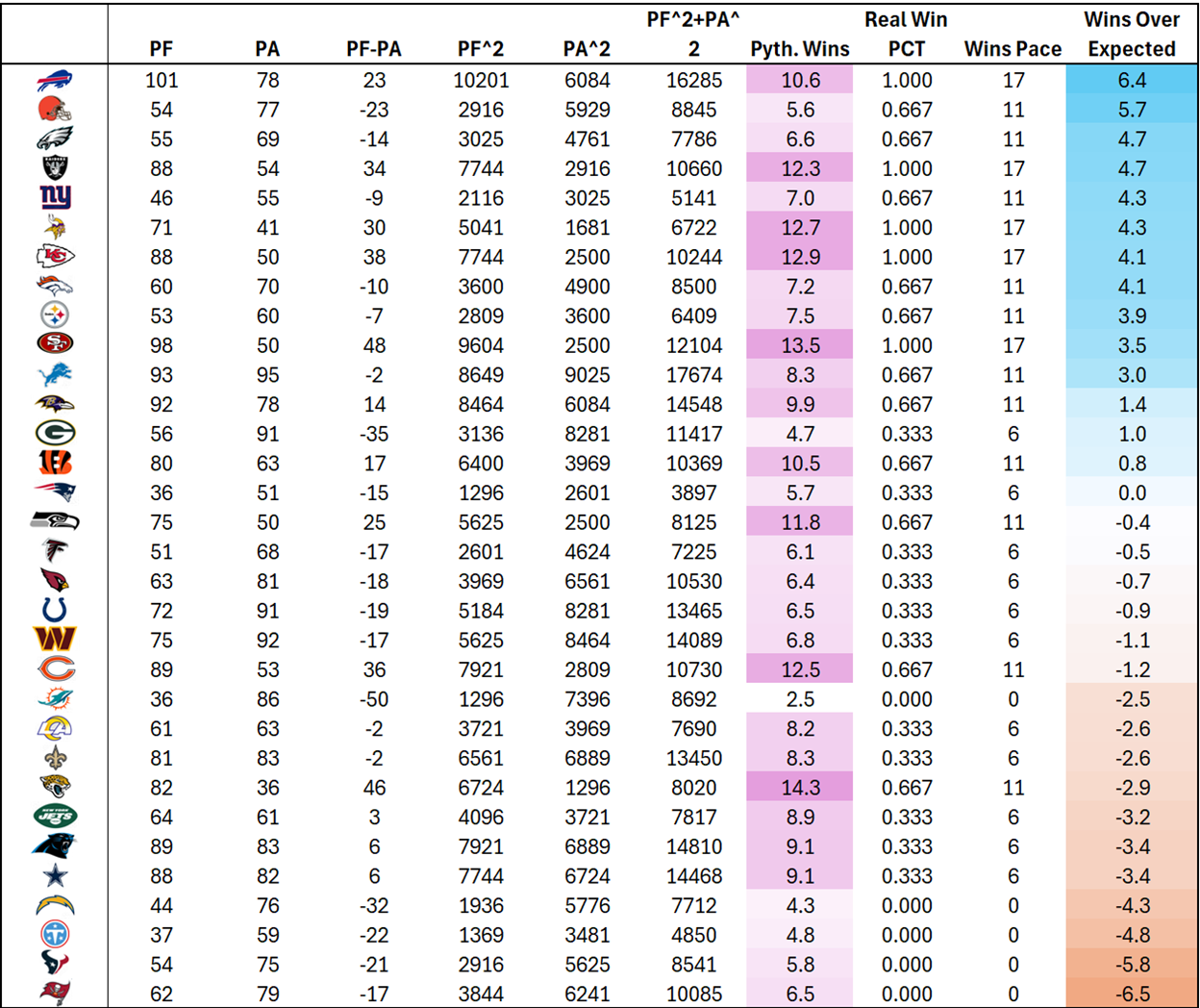
Both teams come in with 2-1 records. However, based on Pythagorean wins, they also rate as overachievers, with the Steelers 3.9 wins over expectation and the Browns, one of the more significant team regression candidates so far this season, at 5.7.
The public isn't buying into their records either: the Steelers are +10,000, and the Browns are +50,000 to win the Super Bowl, according to FanDuel Sportsbook, both ranking in the bottom seven.
Pacing has not been an issue, as the Steelers average 29 seconds per snap from a neutral script (T-15th), and the Browns average 26.7 (T-4th). However, the Browns struggle to maintain drives and average only 55 plays per 60 minutes (T-29th), while the Steelers average 63 (T-10th).
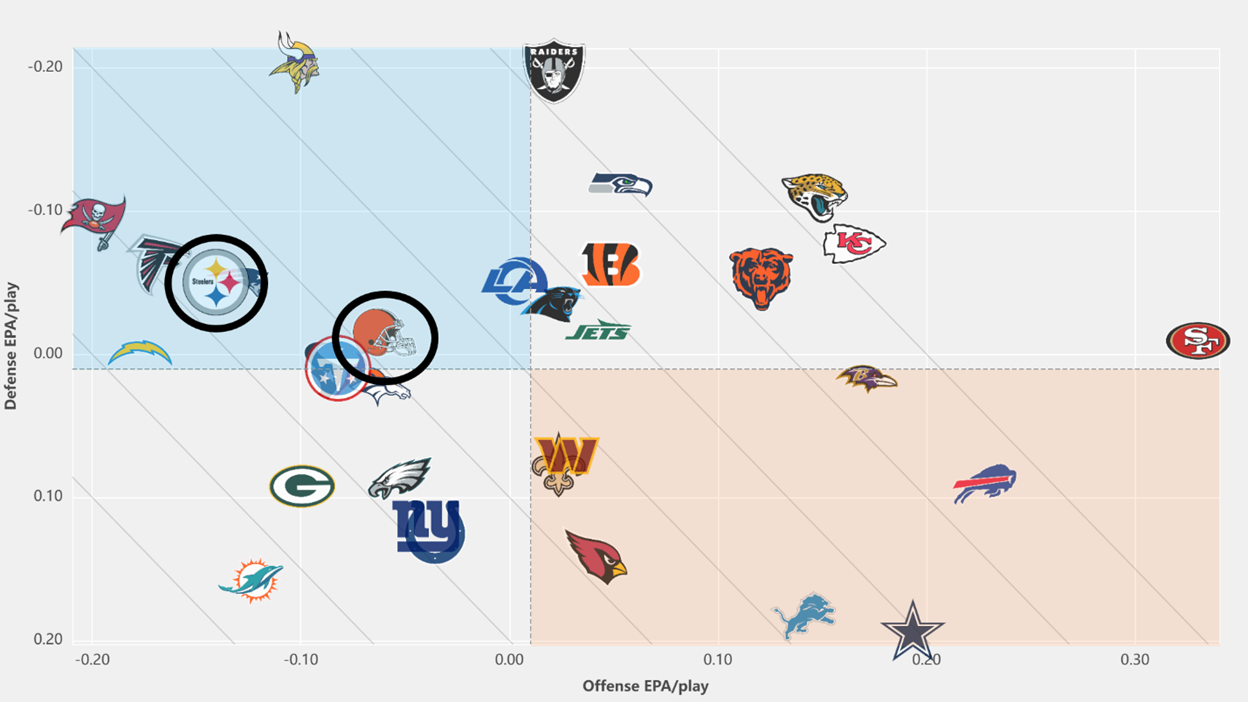
Both teams are below average in EPA per play, but slightly above average in EPA per play allowed.
Huntington Bank Field in Cleveland sits right off Lake Erie and famously has some of the worst weather conditions in football, though temperatures should be moderate this time of year and no rain is expected Thursday night. That said, the wind could be a moderate factor.
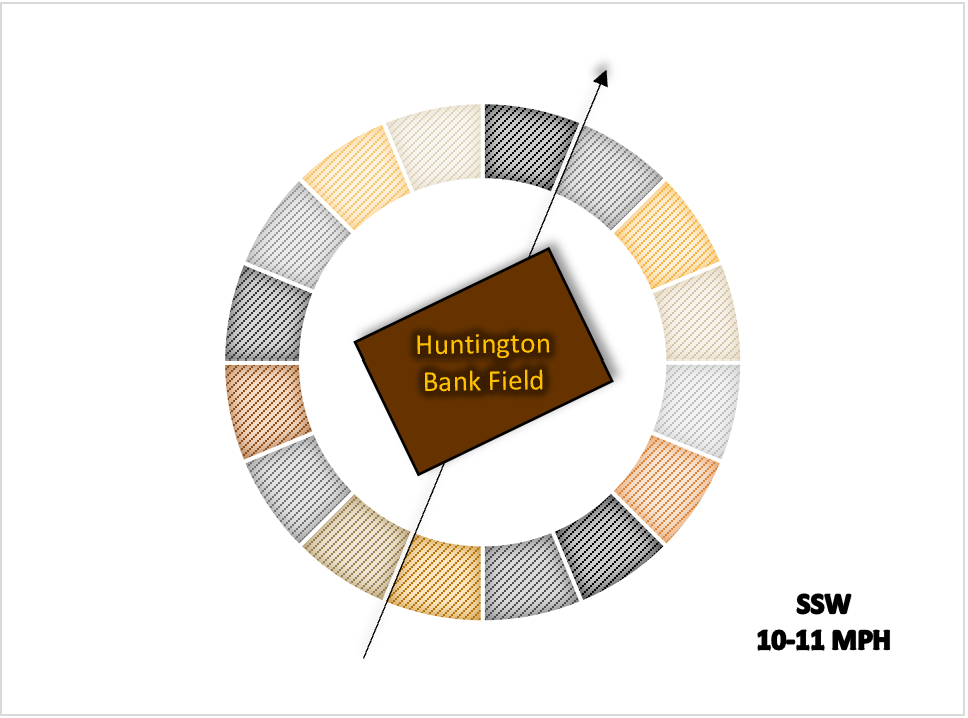
Wind speeds are expected to be between 10-11 MPH, with gusts between 18-21 MPH all game long. Wind effects can be more dramatic the more it crosses perpendicular to the field; Thursday night's wind is expected to be a quartering wind from the SSW. Generally, this could hurt ball tracking, passing, and kicking, especially at longer distances, but I’m not expecting the type of difference where we should significantly alter our plans.
Steelers Key Injuries: Backup OLs Jack Driscoll and Gennings Dunker are on IR. RB Rico Dowdle (toe) is out for the second straight game, leaving Jaylen Warren in position for another substantial workload. CB Joey Porter Jr. (back/conditioning) is out and will miss his fourth straight game. CB Jalen Ramsey (wrist) is questionable after playing through a broken wrist last week. He was limited all week and has indicated that he intends to try to play. I’d consider him slightly more likely to play than sit.
Browns Key Injuries: RB Dylan Sampson (knee) is on IR. LB Jeremiah Owusu-Koramoah (neck) started the year on PUP. QB Dillon Gabriel (back) is also on IR, though he likely would not factor in anyway. Cleveland will be without two starting offensive linemen: C Elgton Jenkins (concussion) is out, with Luke Wypler expected to start in his place, and G Teven Jenkins (back) is out for a fourth consecutive game.
STEELERS
Implied Team Total: 20.5
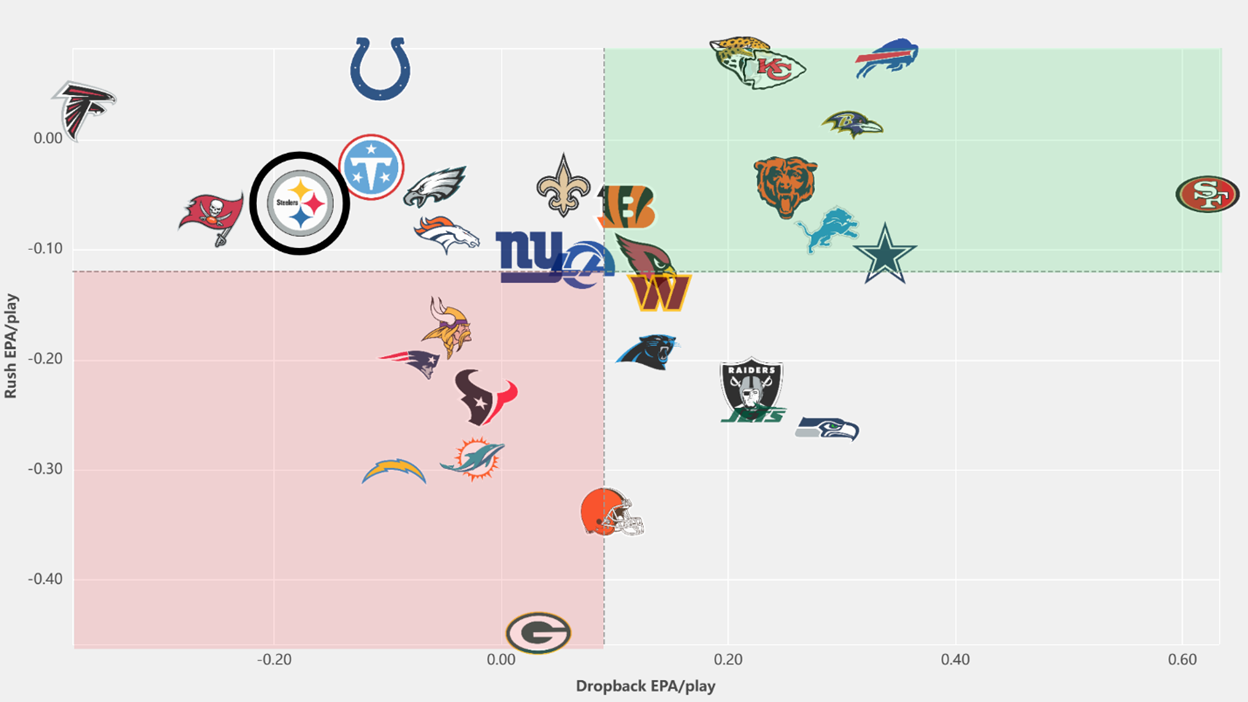
The Steelers enter the game as the favorite. Their rush EPA has been above average, while their dropback EPA has been well below.
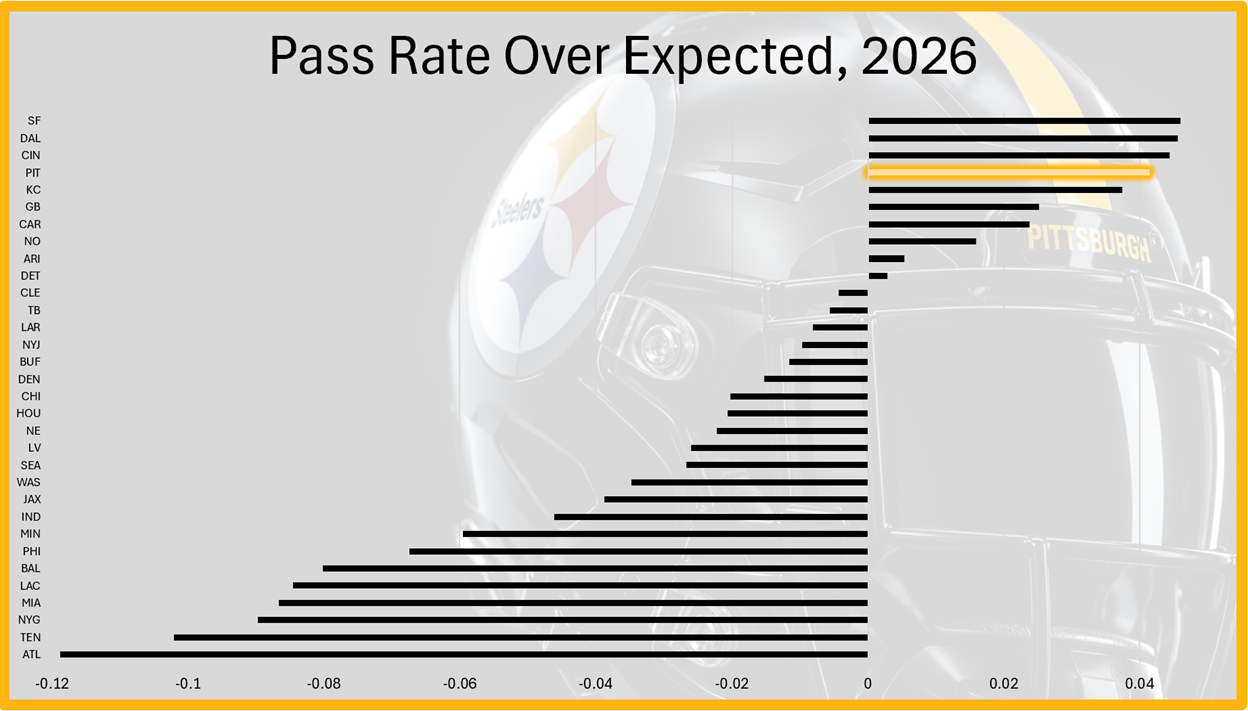
The Steelers have been prone to the pass, as McCarthy was in Dallas. Despite his age and his use of old-school Bill Walsh West Coast concepts, McCarthy does not retreat into the running game as many assume. The Steelers have the fourth-highest PROE this season (+4.15%).
Not only has Pittsburgh had a higher PROE than most, but they’ve trailed by seven or more for 61 plays this year (11th). From that deficit, Pittsburgh has a 64% pass rate, up from 58% in a neutral script.
As a result, Rodgers has dropped back 41 times per game (6th), converting those into 113 pass attempts (6th).
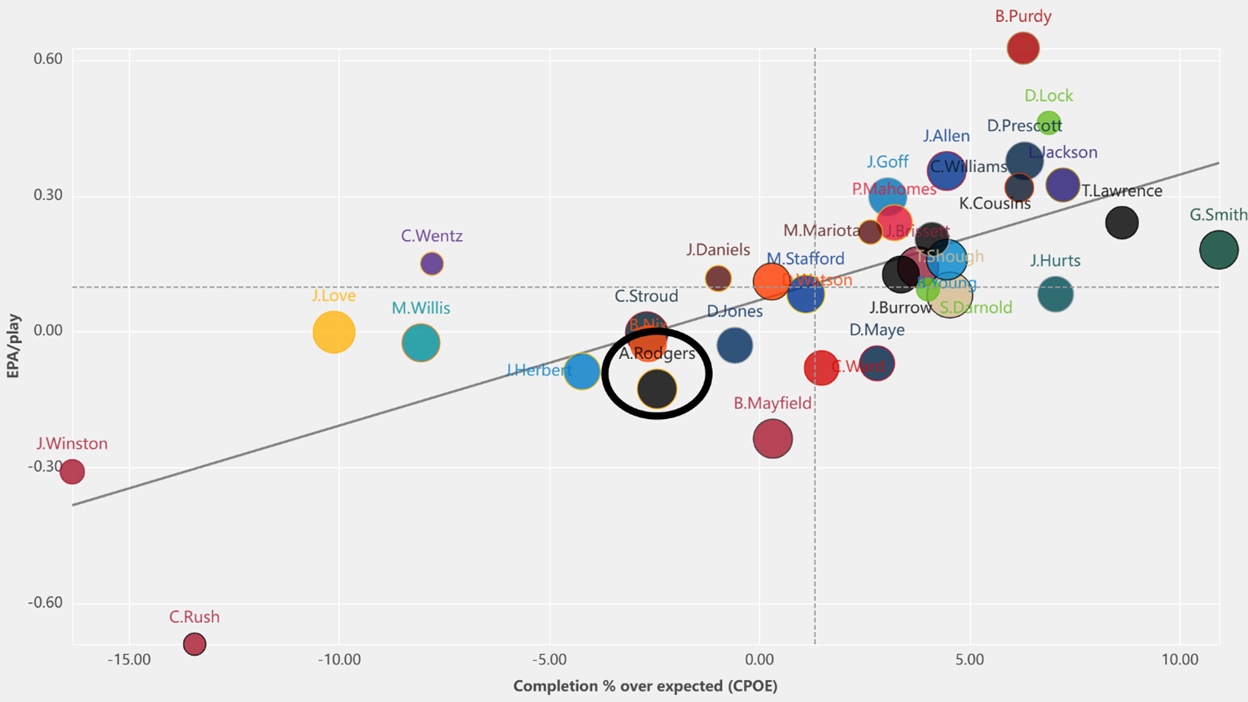
But that’s volume. Efficiency has been a different story. Rodgers has been below average in dropback EPA per play and CPOE.
Rodgers used to have a greater rushing component in his youth, but he is 15th percentile in rushing FP/G (0.4, 29th) in his mid-forties.
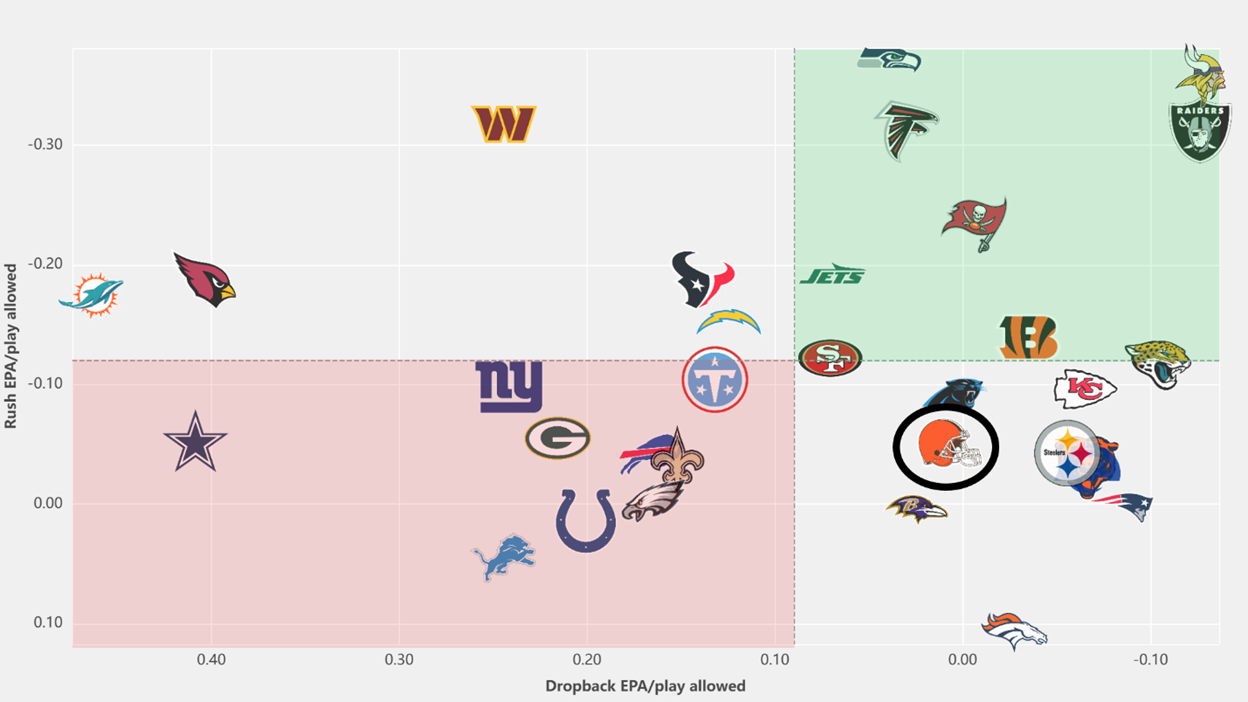
Not long ago, Cleveland had a killer defense under DC Jim Schwartz, but it has fallen to at least average, especially with reigning DPOY Myles Garrett in Los Angeles. The Browns are still above the Mendoza line in EPA per dropback allowed, but they fall below average in rush EPA allowed.
The Browns use man defense at the league's highest rate (43.5%). They also use single-high safety at the highest rate (75.7%). Their Cover 1 rate also leads the league by a wide margin (41.7%). They blitz at a below-average rate (19.1%).
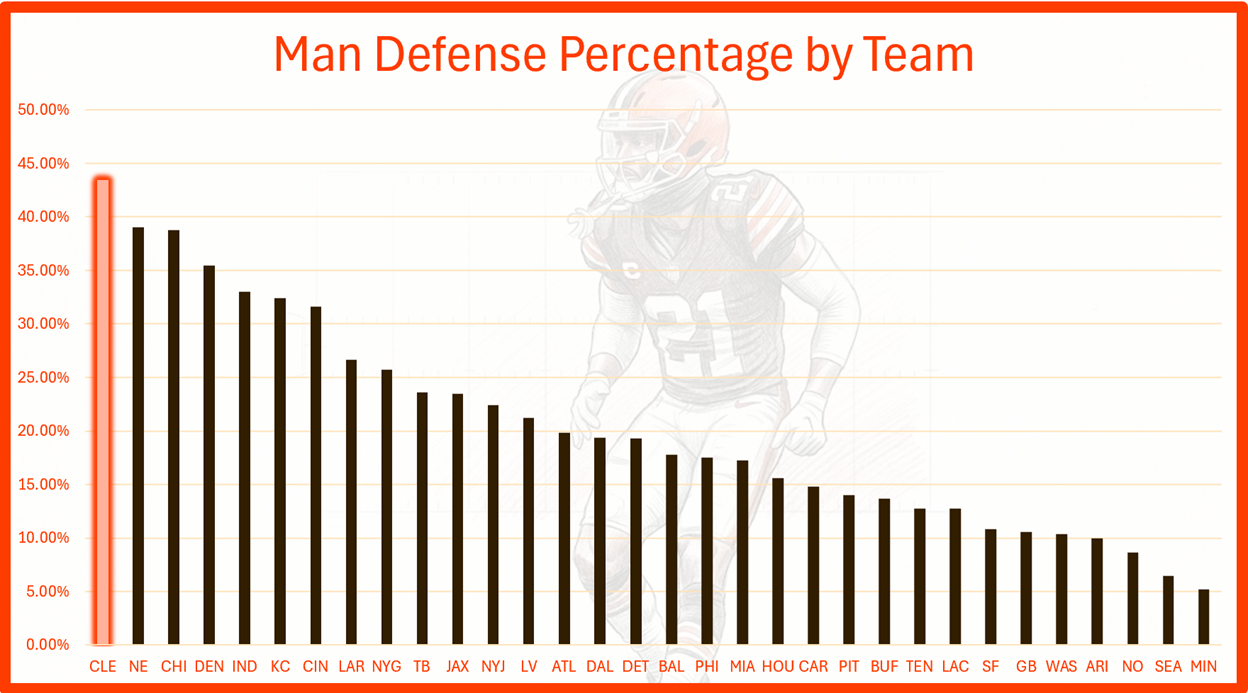
Based on Fantasy Points’ Coverage Matchup tool, Rodgers should see a slight decrease (-2.1%) from his standard FP/DB rate against the types and rates of coverage Cleveland uses.
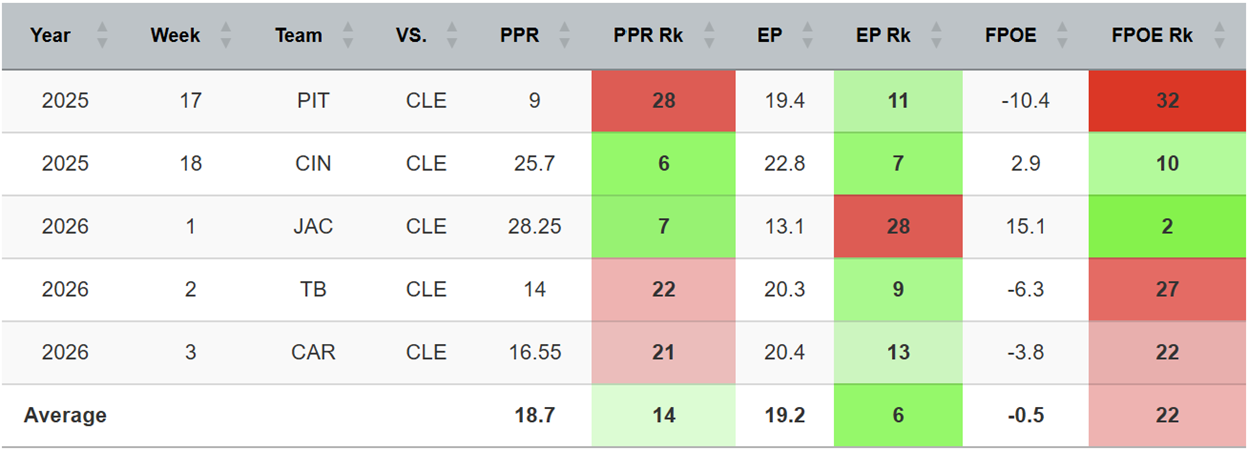
PFF’s more personnel-based Matchup tool is even less optimistic, grading Rodgers’ matchup as poor. Over Cleveland’s last five games, dating back to last season, they’ve allowed 18.7 FP/G to QBs (14ᵗʰ) but just 19.2 EP/G (6ᵗʰ), and opposing QBs have averaged -0.5 FPOE/G.
Pittsburgh’s target distribution has been relatively concentrated through three weeks. WR DK Metcalf leads with 24 targets, followed by WR Roman Wilson (19), TE Pat Freiermuth (14), and RB Jaylen Warren (13).
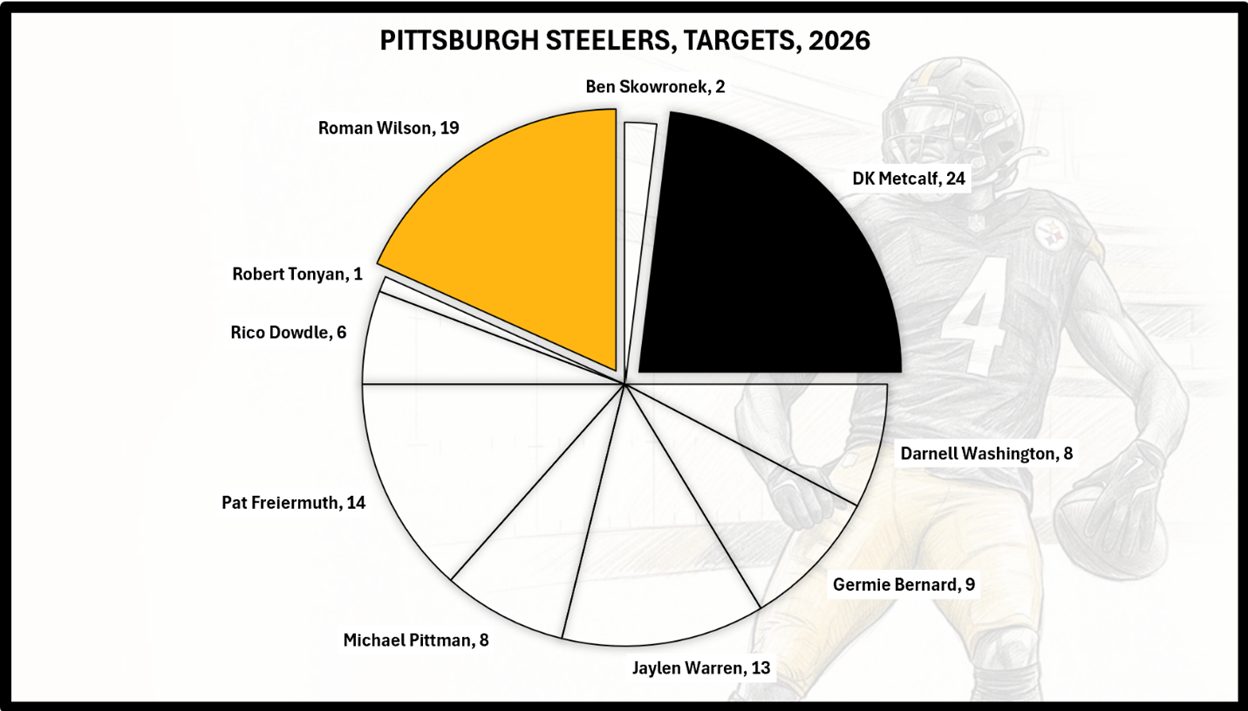
Metcalf has not capitalized on his decent opportunity. Despite a 23.1% target share and 35.6% AY share in a pass-first offense, he has only 11 receptions for 98 yards and one TD. His underlying efficiency has been ugly, with 0.78 YPRR (75ᵗʰ), a 54.4 PFF receiving grade (76ᵗʰ), and -3.67 receiving FPOE/G. Still, the usage has been encouraging. Metcalf ranks 15ᵗʰ in targets/G (7.67), 14th in first-read target percentage (31.4%), and third in routes/G (41.7), with a 95.2% route participation rate (T-2nd).
Roman Wilson has quietly drawn 19 targets, second on the team, and Fantasy Points’ Coverage Matchup tool actually rates him as one of Pittsburgh’s top pass-catchers this week. Using 2025 coverage data, Wilson is expected to lose only 2.5% from his normal FP/RR against the types and rates of coverage Cleveland uses, compared to -4.1% for Metcalf and -3.4% for Freiermuth. Michael Pittman gets the only meaningful upgrade (+12.4%), though he has played only two games and been pretty invisible.
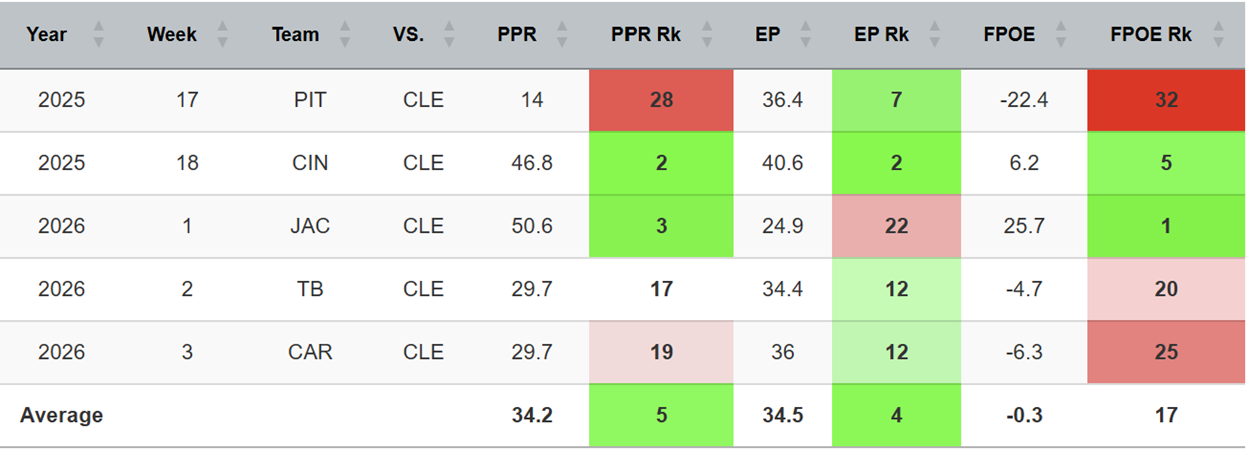
The matchup isn’t particularly inviting. PFF grades the matchup as poor for all three of Pittsburgh’s primary WRs, with Metcalf ranking just 91st of 104 WRs in its matchup model. Cleveland has allowed 34.2 FP/G to WRs over its last five games (5th).
Freiermuth has also been heavily involved in terms of playing time, but the targets haven’t followed to the same degree. He has 14 through three games, while Pittsburgh has also worked Darnell Washington (8) into the passing game.
PFF grades Freiermuth’s matchup as fair. Cleveland has allowed just 15.4 FP/G to TEs over its last five (9th).
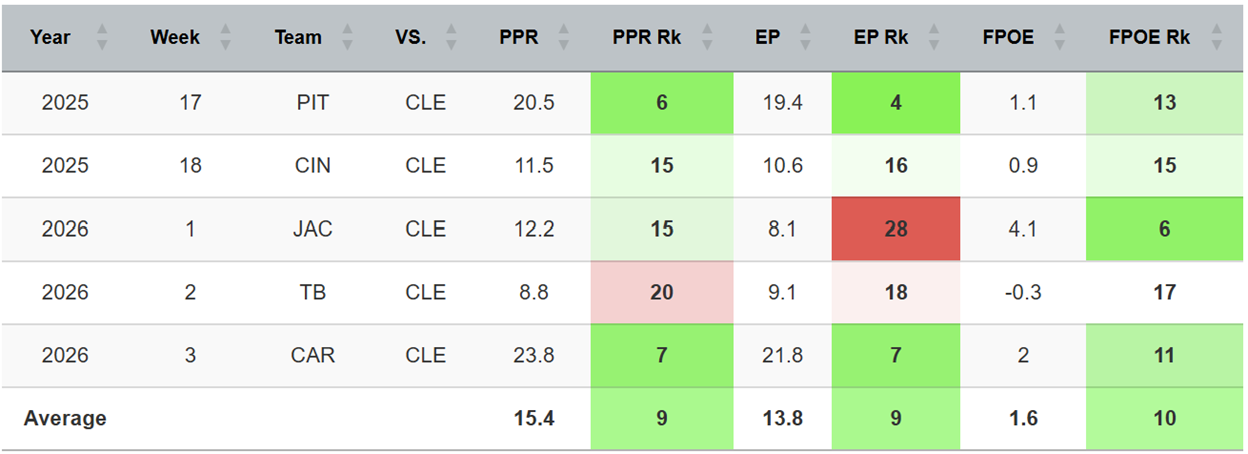
The bottom line is that Cleveland has a decent secondary, and Pittsburgh’s passing game hasn’t been efficient. Hence, the natural assumption is that the Steelers’ pass-catchers aren't in the best situation.
In the trenches, Pittsburgh has one of the week's better run-blocking matchups. The Steelers’ OL has generated about 2.2 adjusted YBC/Att, while Cleveland’s defense has allowed roughly 2.4, giving Pittsburgh the fifth-largest combined advantage on the slate.
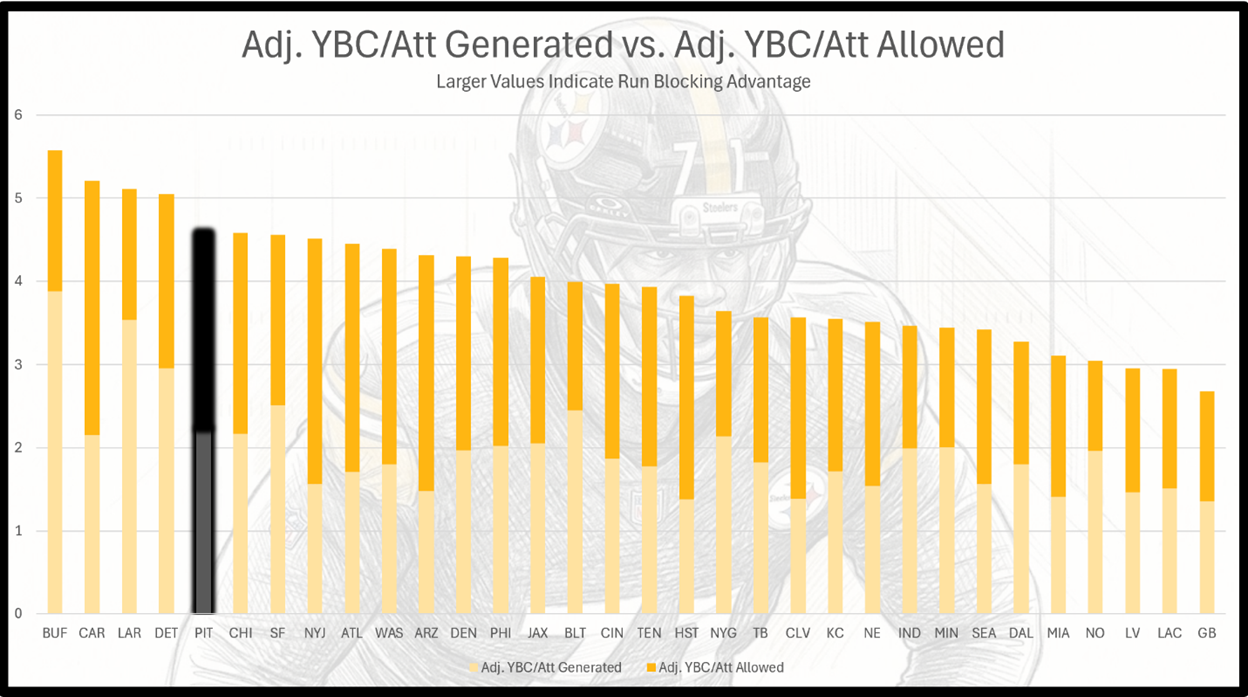
In the passing game, it should be far more neutral when Pittsburgh has the ball.
With RB Rico Dowdle set to miss another game, this all sets up as a potentially good environment for RB Jaylen Warren. PFF grades Warren’s rushing matchup as great.
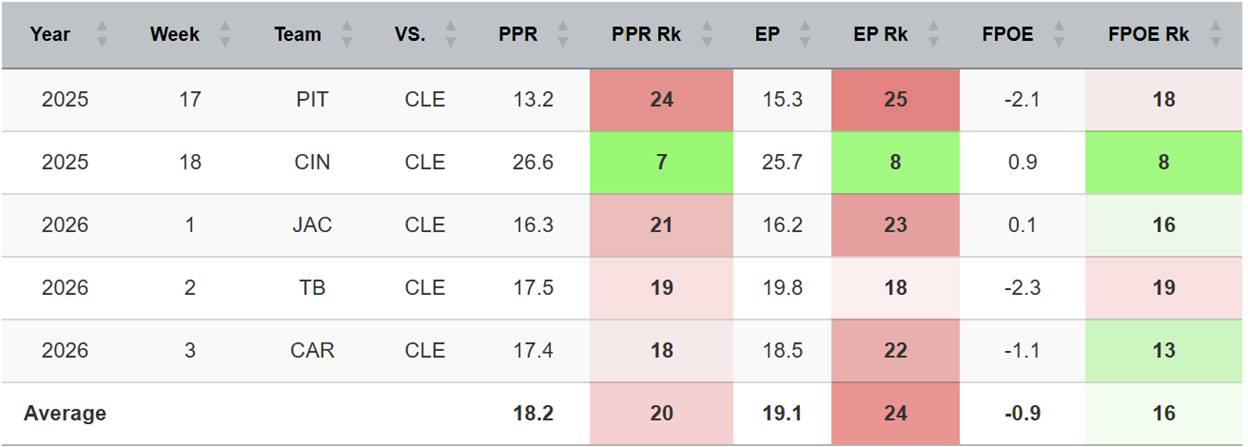
Over Cleveland’s last five games, opposing RBs have averaged only 18.2 PPR/G (20th), but the underlying opportunity has been considerably better: 19.1 EP/G, which ranks 24th. In other words, Cleveland has allowed fewer fantasy points than its workload suggests, with opposing backfields averaging -0.9 FPOE.
Warren has some regression working in his favor, too. Based on TDs per yard, he is the strongest positive TD-regression candidate among RBs in my TDOE model, sitting nearly two TDs below expectation.
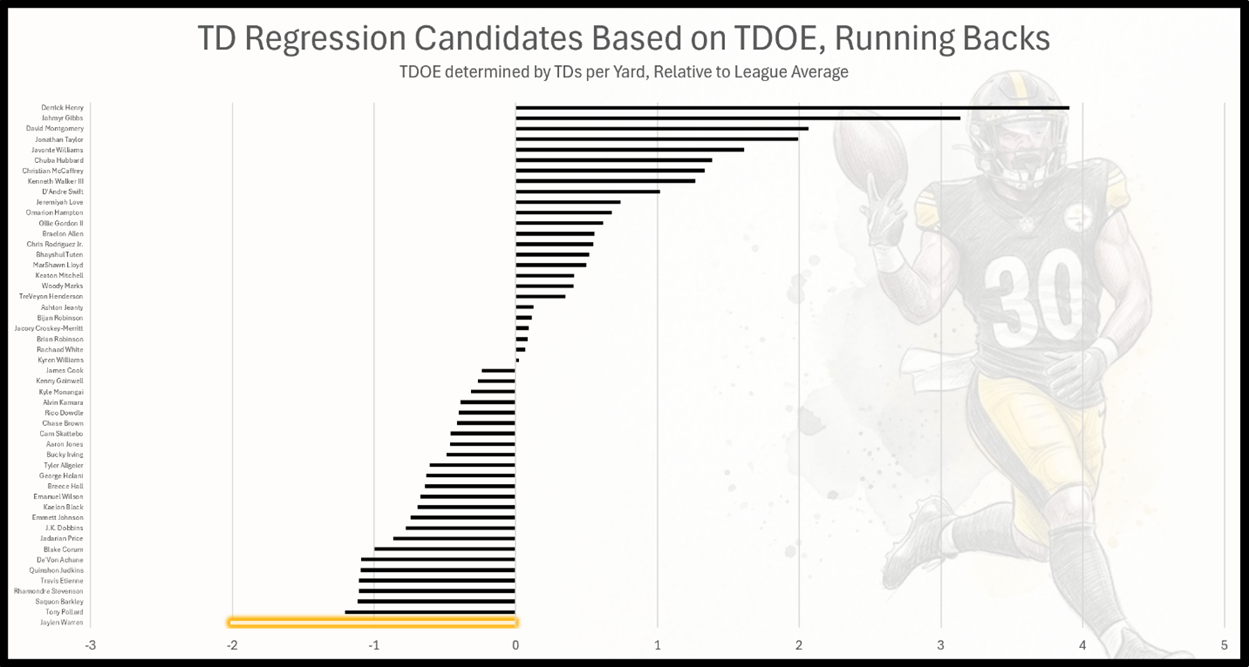
Put it together, and Warren has a pretty compelling setup: a favorable OL/DL matchup against a defense allowing more RB opportunity than its raw fantasy points suggest, and nearly two TDs worth of positive regression waiting in the wings.
And that’s coming off of a game where he was finally turned loose, gaining 176 total yards. Slappies rejoice!