
Quick Slant: TNF - The Past is Prologue

Mat Irby’s Quick Slant
On October 25, 1993, the Carolina Panthers didn’t exist. Twenty-four hours later, they did.
It had been an expensive couple of days. Jerry Richardson's group had watched the NFL's anticipated expansion fee balloon fivefold, from $50 million to $250 million. They responded by introducing Personal Seat Licenses, letting fans buy the rights to stadium seats. In one day, they raised $41 million in requests, each accompanied by a $1,000 deposit. It was a creative solution, and it worked. Just like that, the Carolinas had a football team.
Next, they needed to fill it.
Team president Mike McCormack hired Bill Polian, the mastermind behind Buffalo's great teams of the early '90s, as GM. Polian recognized something peculiar about the NFL's new salary cap system: Carolina's greatest encumbrance, its newness, could actually become its chief advantage.
While established franchises were up to their necks in financial quicksand, the Panthers had blank books. No bloated contracts. No aging superstars collecting checks for what they'd done five years earlier. Polian avoided pricey veterans, kept his powder dry, and waited.
In January 1995, Dom Capers arrived with Pittsburgh's vaunted 3–4 defense. Carolina drafted Penn State QB Kerry Collins, promptly lost its first five games, but finally tasted victory in Game 6 (against the Jets, of course).
Then, something strange happened. They kept winning. Seven victories in their inaugural season, an expansion record. Apparently, nobody told the Panthers they were supposed to be terrible.
The next season, Carolina moved into Ericsson Stadium and added Pro Bowl CB Eric Davis, TE Wesley Walls, and Hall of Fame LB Kevin Greene (reuniting him with Capers). The defense became one of the NFL's best. The Panthers went 12–4 and won the NFC West. On January 5, 1997, the defending champion Cowboys came to Charlotte and took a 26–17 clobbering, effectively ending their dynasty.
For Carolina, the early returns were impossible: Two seasons, one NFC Championship appearance.[1]
The Panthers were new. The Green Bay Packers, at that time, were already very, very old.
Green Bay joined the NFL in 1921 and won six championships before Vince Lombardi arrived in 1959. Under Lombardi, the Packers became the standard by which other franchises were measured, winning five NFL championships in seven years, including the first two Super Bowls. Then, Lombardi moved on, and the empire crumbled.
In the 24 seasons between his departure and 1992, Green Bay made the playoffs twice. Twenty-four years of coaching changes, losing seasons, and QBs who came and went failed to restore the glory days. Lombardi's trophies collected dust while the league passed Green Bay by like exhibits in some cut-rate museum.
Then GM Ron Wolf took a huge swing, trading a first-round pick to Atlanta for a kid named Brett Favre, a second-year QB out of Southern Miss with four NFL passes and a drinking problem. Wolf hired Mike Holmgren as HC, and Reggie White arrived in free agency in 1993. The pieces began falling into place.
Green Bay made the playoffs in 1993 and 1994, then reached the 1995 NFC Championship, losing to Dallas.
In 1996, Favre won his second consecutive MVP. Green Bay finished 13–3, leading the NFL in points scored and fewest allowed. The Packers dispatched San Francisco, another crumbling tentpole, 35–14 in the divisional round.
For Green Bay, the Super Bowl had been out of reach for 29 years. For Carolina, approximately 29 months. And for the NFL, the 1996/97 NFC Championship Game provided a chance to see someone other than Dallas or San Francisco represent the NFC for the first time in five seasons. On January 12, 1997, at Lambeau Field, one franchise was trying to recover a rich history. The other was trying to establish one.
Carolina intercepted Favre (you live and die by the sword that way), and a play later, Collins tossed to Howard Griffith for an early Panthers lead.
But it was all Green Bay thereafter. RBs Dorsey Levens and Edgar Bennett combined for 309 total YDs and two TDs, including one of the most WR-esque high-point catches you'll ever see from an RB by Levens. The Packers' defense held Carolina to 251 YDs, and the establishment claimed a comfortable 30–13 victory.
But Carolina was off on the right foot. Since then, they've swung in and out of high-level competitiveness, including two Super Bowl appearances. Green Bay? The NFL's second-winningest franchise since 1996, trailing only New England. And this year, both are competitive in their division races, looking for another shot at postseason glory. This Thursday, nearly thirty years after their first meeting, the stakes have changed; the ambitions remain the same.
GAME ENVIRONMENT
Carolina Panthers at Green Bay Packers (-3.5)
Over/Under: 47.5
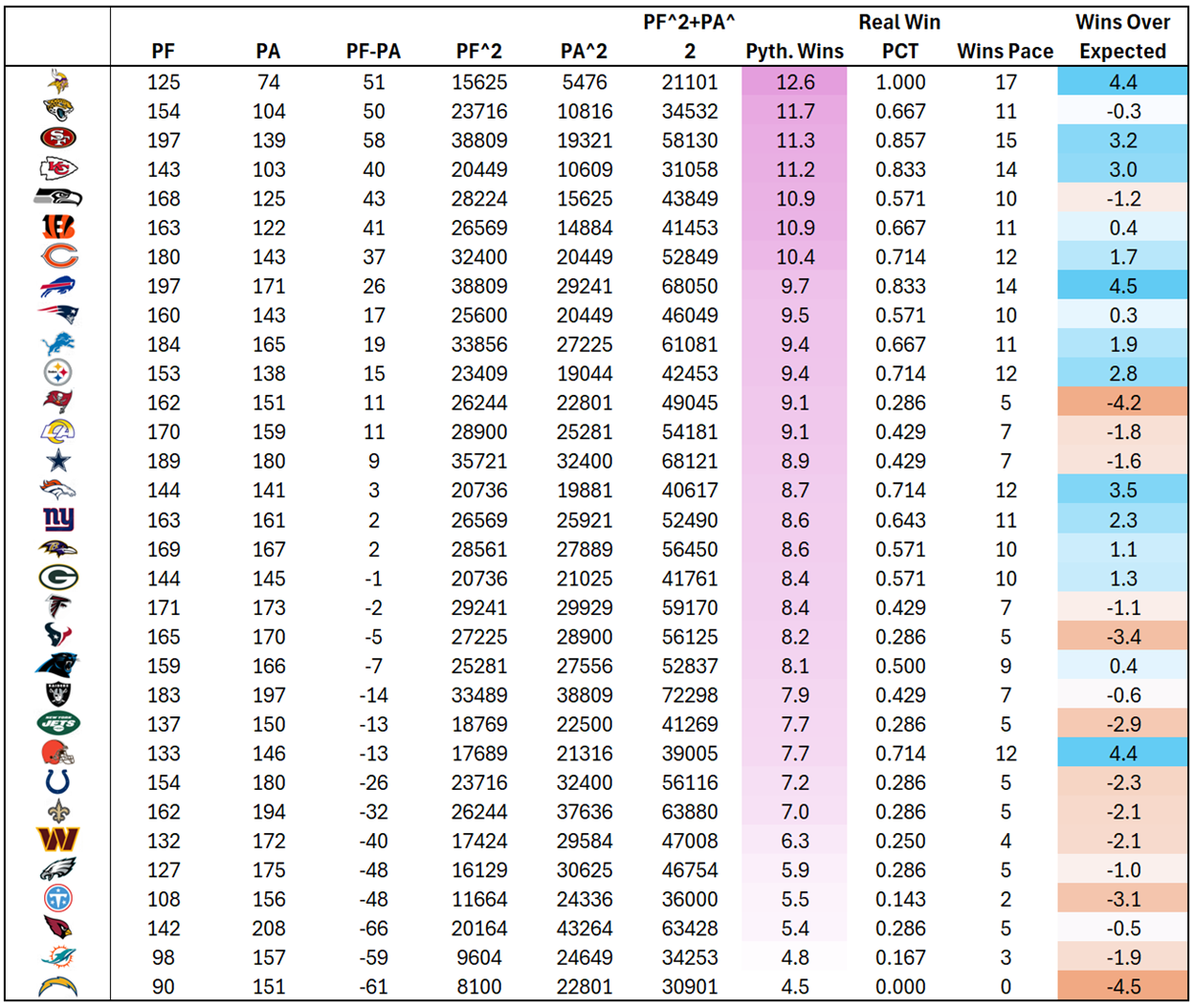
The Panthers and Packers are each in the mix for playoff spots, but they are middle of the pack by Super Bowl odds and Pythagorean Wins, with both pacing for around eight expected wins.
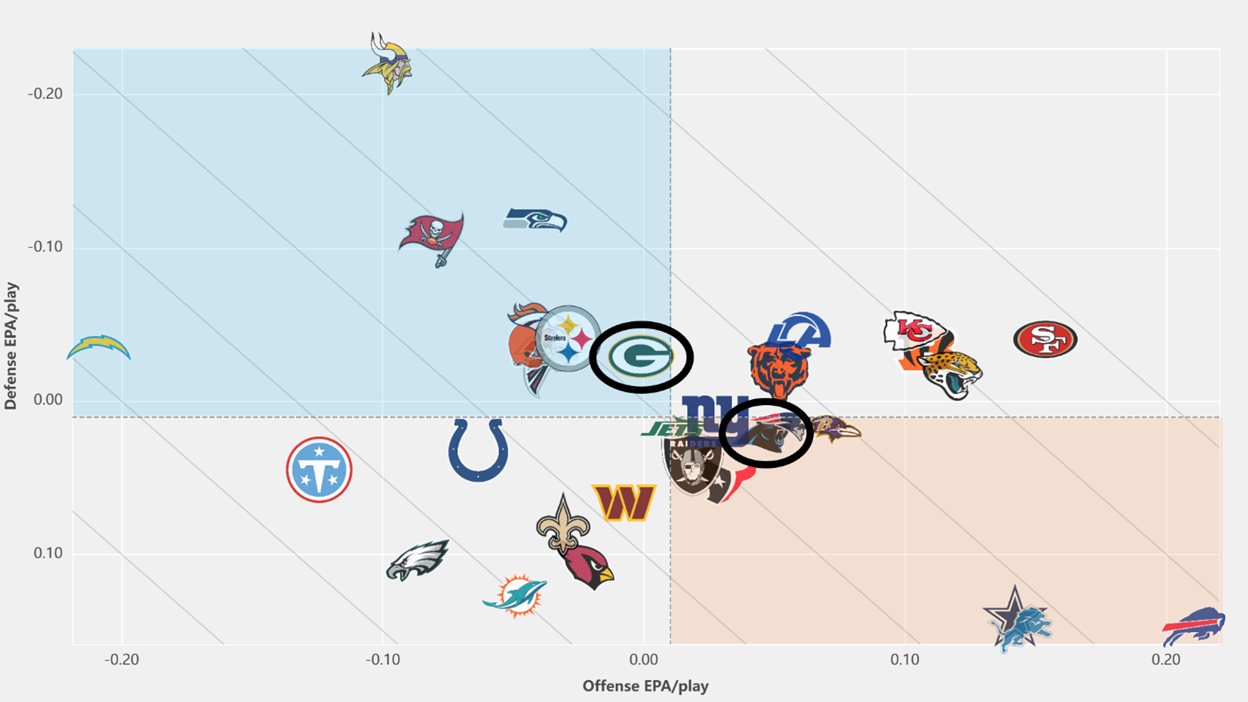
Based on EPA per play, the Packers have been slightly above average on both sides of the ball, with a stronger defense than offense. The Panthers, meanwhile, have been slightly above average in offensive EPA and slightly below average in defensive EPA.
Carolina plays at the NFL's fastest pace from a neutral script, averaging 25.2 seconds per snap (1ˢᵗ). Green Bay is closer to league average, averaging 28.2 seconds (12ᵗʰ). Across all game scripts, Carolina averages 67 plays per 60 minutes (T-5ᵗʰ), while Green Bay averages 61 (T-22ⁿᵈ).
Weather: Thursday evening at Lambeau Field should be clear and cool, with little chance of precipitation. Temperatures should be around 53–55° at kickoff, dropping into the upper 40s by the fourth quarter. Winds should be light, around 5–8 MPH from the west-northwest. These conditions should have little impact on the game.
Packers Key Injuries: Starting C Sean Rhyan (ankle), starting G/T Travis Glover (knee), and starting LB Zaire Franklin (shin) have been ruled out after missing practice all week. WR Matthew Golden (shoulder/foot) is questionable but returned to limited participation Wednesday, with HC Matt LaFleur expressing optimism about his availability. Starting DT Devonte Wyatt (ankle), DT Anthony Campbell (ankle), and ED Brenton Cox Jr. (quadriceps) are also questionable after limited participation. Starting G Aaron Banks (knee/toe) was limited but carries no designation. ED Micah Parsons (ACL) remains on PUP.
Panthers Key Injuries: Starting LG Damien Lewis (knee), starting CB Akayleb Evans (triceps/knee), and starting ED Jaelan Phillips (hamstring) have been ruled out. Starting RT Taylor Moton (fibula) was placed on IR Monday, joining starting LT Ikem Ekwonu on the reserve list. Rookie Monroe Freeling is expected to replace Moton. Starting DT Bobby Brown III (hand) is questionable despite returning to full participation Tuesday. QB Bryce Young (knee) and WR Jalen Coker (shoulder) practiced fully and carry no designations.
PANTHERS
Implied Team Total: 22
The Panthers have been slightly above average offensively, ranking 12ᵗʰ in EPA per play (0.046). They rank 17ᵗʰ in dropback EPA (0.113), but have been more effective on the ground, ranking 11ᵗʰ in EPA per rush (-0.078).
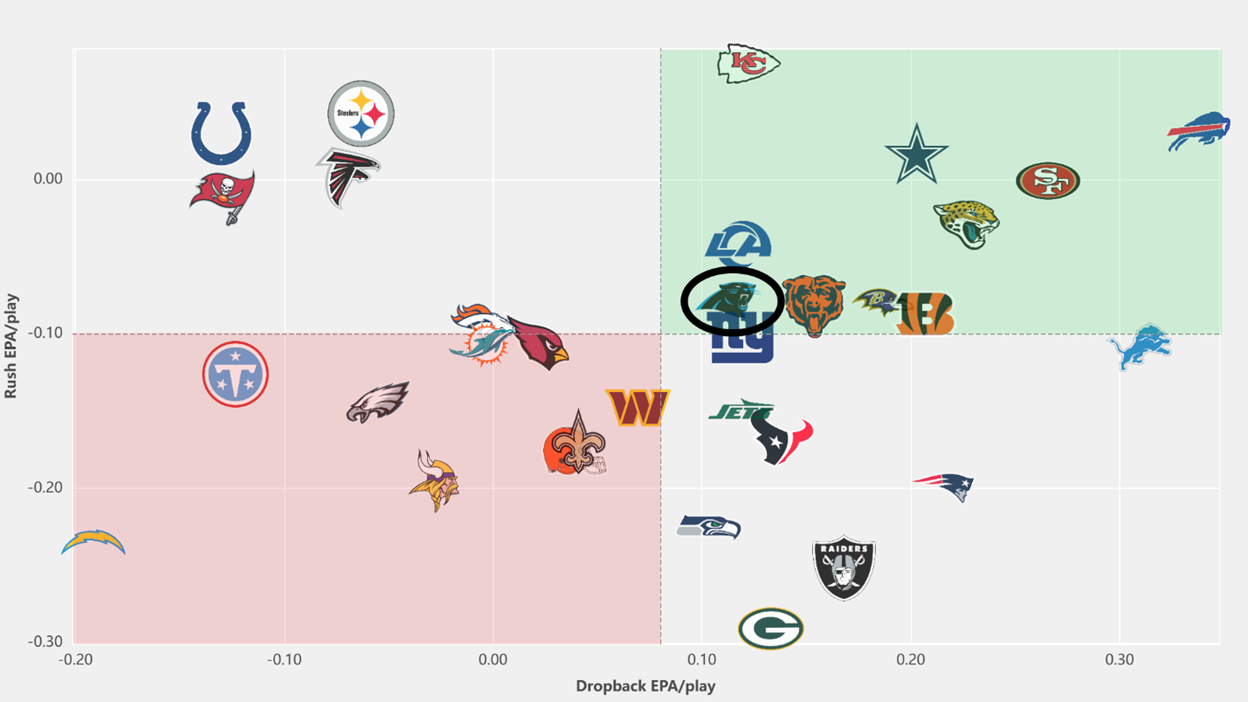
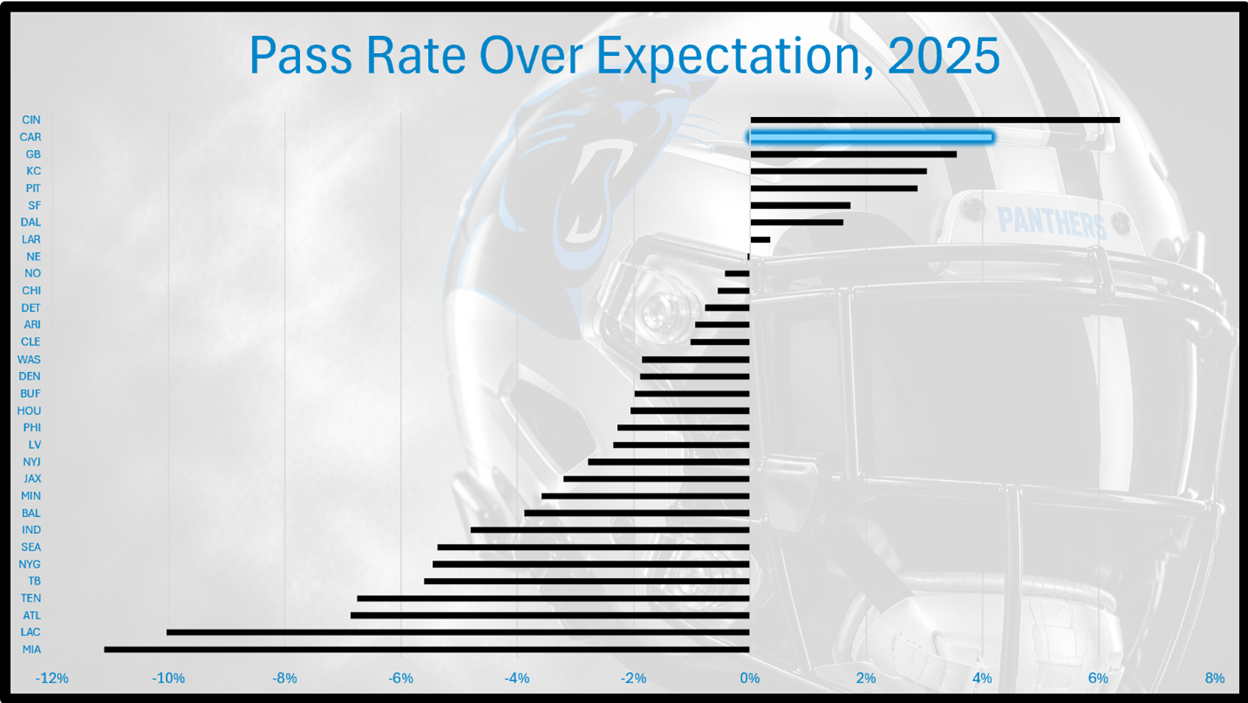
Despite their relative success running the ball, Carolina has been one of the NFL's most pass-oriented teams, ranking second in PROE (approximately 4.2%). Only Cincinnati has passed more frequently than expected.
QB Bryce Young has been reasonably efficient, perhaps more than expected. He ranks 16ᵗʰ in EPA per play (0.112), with a slightly positive CPOE (+0.72%). His efficiency has been respectable, but he hasn't produced the passing volume or rushing production needed to be a steady fantasy option.
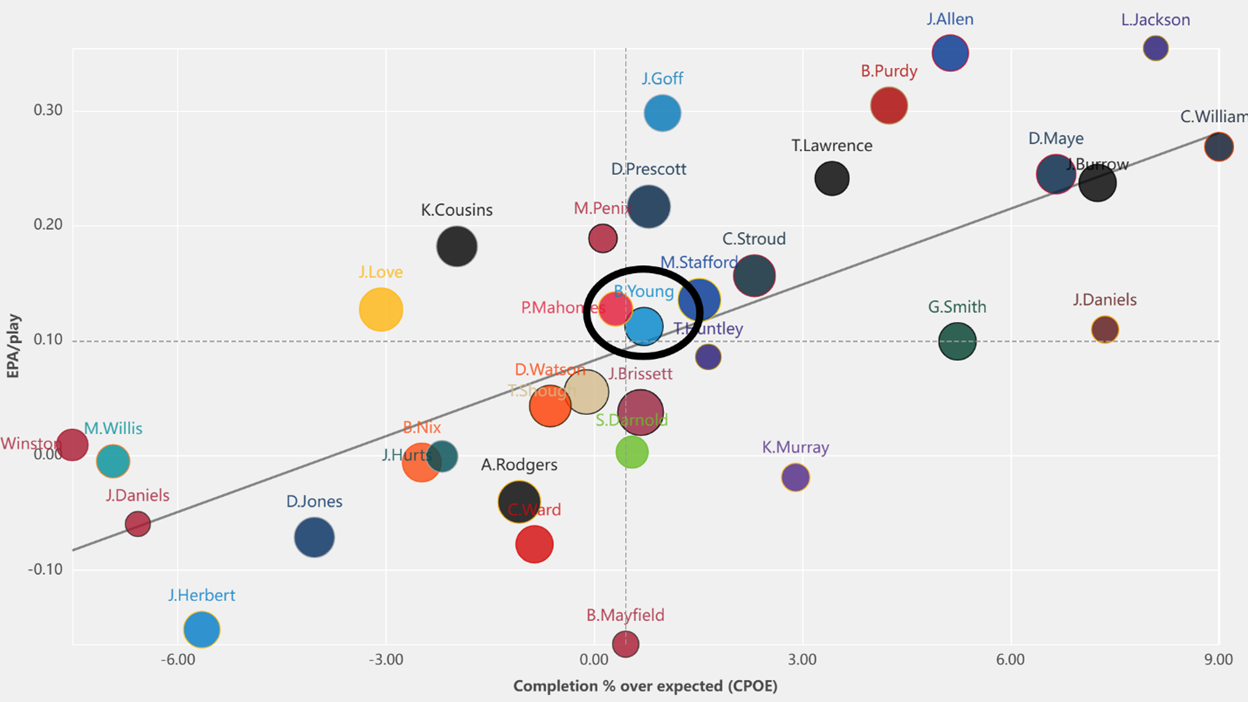
Young's efficiency is close to QB Patrick Mahomes (0.128 EPA per play) and Matthew Stafford (0.136), though the comparison probably says more about EPA's limitations than their relative abilities. Young has been competent, but there's little evidence here of an especially high fantasy ceiling. And with Carolina's offensive line dealing with significant injuries, there's reason to be concerned about how well that efficiency will hold up against Green Bay.
Young can rush, but he’s not a big positive in that area. His 2.18 FP/G from rushing is tied for 18th.
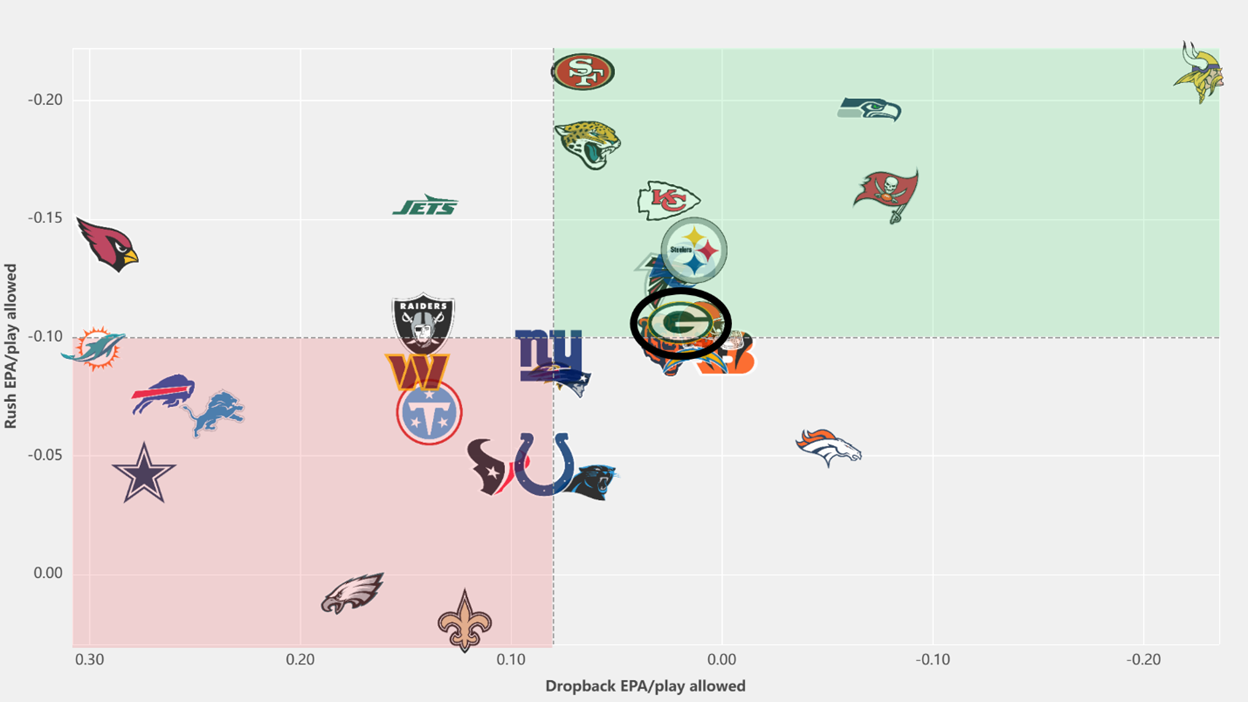
The Packers have been more effective against the run than the pass. They are allowing 0.020 EPA per dropback and -0.106 EPA per rush, ranking 12ᵗʰ overall in defensive EPA per play (-0.029).
Green Bay plays zone on 79.3% of defensive plays, with a particularly heavy emphasis on two-high safeties (66.3%). Their most common alignments are Cover 4 (24.3%), Cover 3 (23.2%), and Cover 2 (21.7%). They blitz at 26.8%, which is average.
According to Fantasy Points' Coverage Matchup tool, which evaluates how a QB has historically performed against the types and rates of coverage his opponent uses, Bryce Young is projected for a 5.3% downgrade in FP/DB. The PFF Matchup tool, which considers player grades and projected personnel matchups, considers Young's assignment poor.
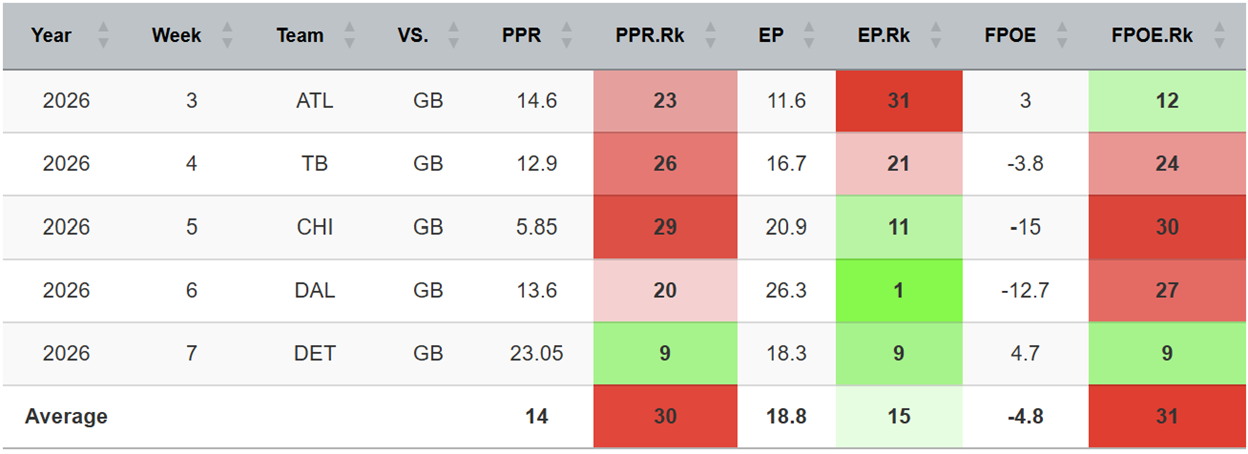
Over their last five games, the Packers have allowed just 14 PPR/G to QBs (30ᵗʰ), despite surrendering 18.8 EP/G (15ᵗʰ). Opposing QBs have produced -4.8 FPOE/G (31ˢᵗ), suggesting that Green Bay has been considerably more effective at preventing QBs from capitalizing on their opportunities than at limiting those opportunities in the first place.
This warrants at least some caution. The sample includes Dak Prescott, who was bottled up, and Jared Goff, who was not; otherwise, they faced two backup QBs and a guy making his first start off a third ACL tear.
The Panthers' passing game has largely run through WR Tetairoa McMillan, who has a 26% target share (12ᵗʰ), 8.5 targets/G (T-10ᵗʰ), and 6 receptions/G (9ᵗʰ). McMillan has been particularly effective after the catch, ranking fourth in YAC/G (14.5), while his 2.22 YPRR (16ᵗʰ) and 3.83 rec 1Ds/G (11ᵗʰ) suggest solid efficiency behind his production. McMillan ranks 11th of 71 qualified WRs in Apex Score (8.36) so far through 2026.
WR Jalen Coker returns from injury and probably assumes a role as a secondary option. He’s been a steal at ADP, with an 18.4% target share, 7.2 targets/G (24ᵗʰ), and 2.1 YPRR (20ᵗʰ). His 25% TPRR (T-19ᵗʰ) is actually better than McMillan's 23% (T-28ᵗʰ), although McMillan's greater route participation (86.8% to 68.5%) has translated to more opportunities.
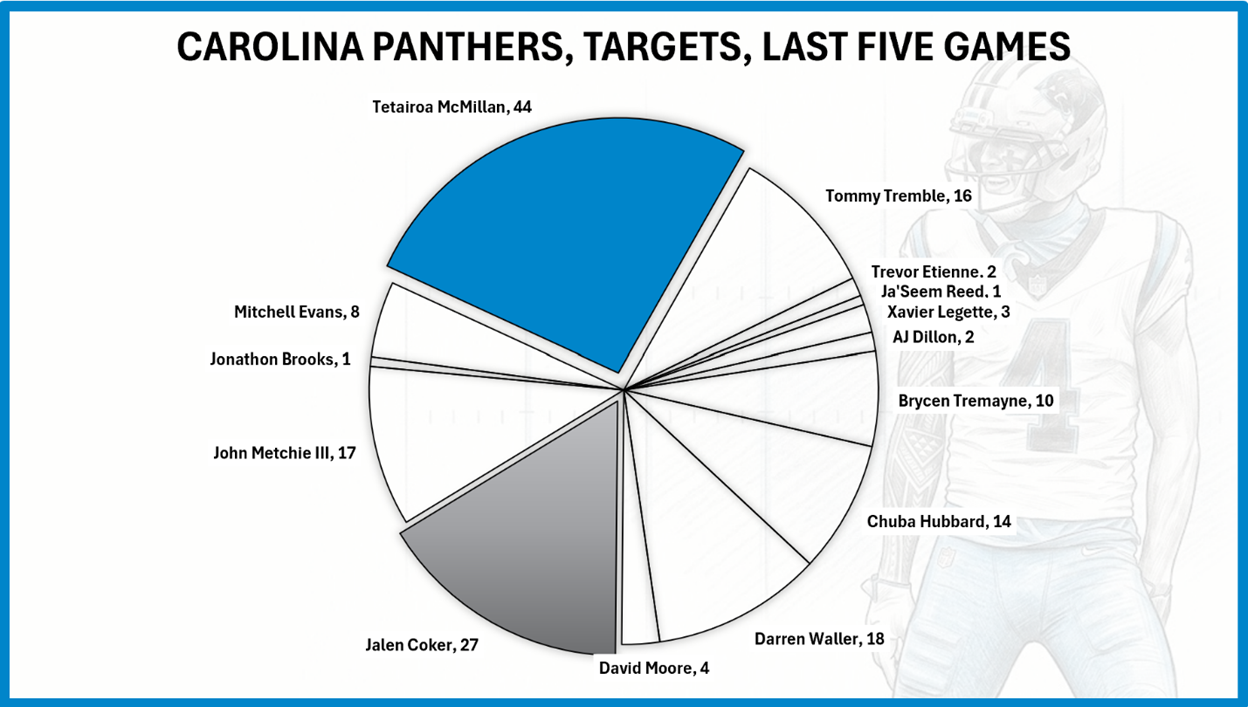
Over the Panthers’ last five games, McMillan has drawn 44 targets. Coker remains second on the team with 27 targets, despite missing time. TE Darren Waller has drawn 18 targets over that stretch, although his overall workload remains limited.
Over their last five games, Green Bay has allowed 35.8 PPR/G (11ᵗʰ), despite surrendering 40.1 EP/G (3ʳᵈ) and -4.2 FPOE/G (27ᵗʰ).
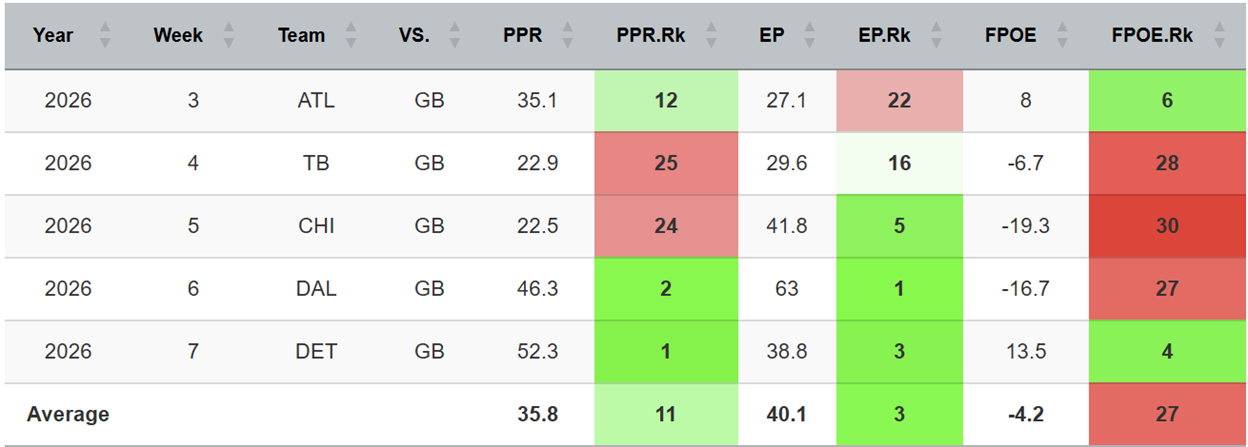
According to Fantasy Points' Coverage Matchup tool, McMillan is projected for a modest 1.4% downgrade against Green Bay's defensive coverages. Coker receives a more substantial 10.9% downgrade. The PFF Matchup tool rates McMillan's assignment as good and Coker's as fair. This makes McMillan the more appealing option, particularly given his larger and more stable workload.
Waller has 23 targets, 14 receptions, 198 YDs, and three TDs through Week 7, despite running just 22.8 routes/G (24ᵗʰ) and participating on 51.2% of dropbacks (31ˢᵗ). His 14% TPRR (T-41ˢᵗ) and 9.7% target share (T-29ᵗʰ) suggest he isn't earning enough opportunities to be relied upon for consistent fantasy production.
Waller has compensated with efficiency, producing 2 FPOE/G (8ᵗʰ), while his 0.5 rec TDs/G ranks T-8ᵗʰ. His 10.8 aDOT ranks third among TEs, suggesting that he is being used farther downfield than most players at the position. Still, with only 3.17 targets/G (T-31ˢᵗ), his fantasy production is vulnerable without a TD.
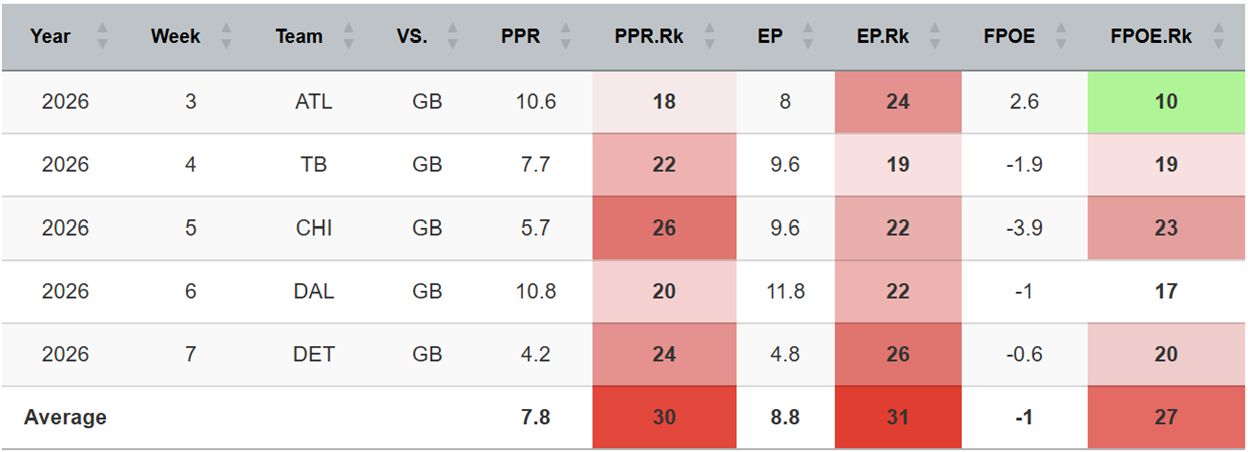
Green Bay has been effective against TEs. Over their last five games, the Packers have allowed just 7.8 PPR/G (30ᵗʰ), including 8.8 EP/G (31ˢᵗ) and -1 FPOE/G (27ᵗʰ). Waller is more of a streaming option, and this isn’t a great spot to stream him.
All considered, the trench matchup is pretty even when Carolina has the ball, though they may be at a slight disadvantage in run blocking. The Panthers have numerous injuries on their offensive line, but the Packers also have injuries on their defense. It might be a wash.
Against Green Bay, the Panthers' RBs face a defense that has been reasonably generous to the position. Over their last five games, the Packers have allowed 26.2 PPR/G to RBs (5ᵗʰ), including 24 EP/G (7ᵗʰ) and 2.3 FPOE/G (7ᵗʰ). Opposing RBs have received plenty of quality opportunities and have been reasonably efficient.
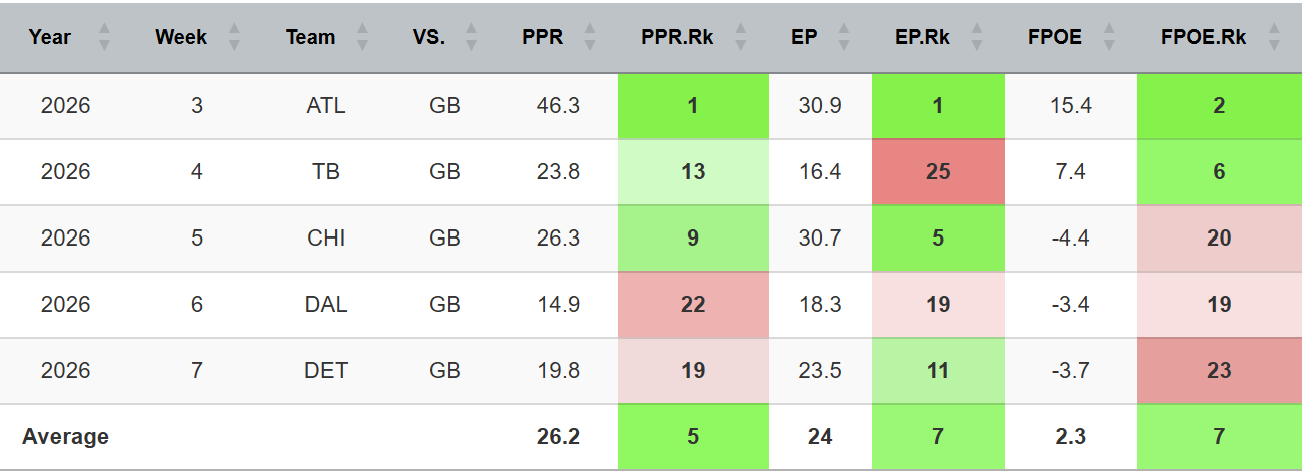
The PFF Matchup tool grades Chuba Hubbard’s rushing matchup as fair, but his receiving matchup as poor, but to me, it looks like we should start him where we can.