Quick Slant: TNF - Their Eyes Fixed on Lombardi

Mat Irby’s Quick Slant
I’m dating myself, but I was born in 1978. That childhood the kids today romanticize? The one with the house key and the bike ride to and from school? That was me (along with my high school dress code: baggy jeans, big tees, and Gazelles, BTW).
Perhaps every generation feels this way, but growing up in the eighties, extraordinary, almost mythological creatures roamed Sports Earth, existing somewhere between flesh and folklore, endowed with gifts we’d never seen. They possessed dangerous, improbable powers, and retirement translated them into legend.
They owned entire categories of human ability – Henderson was speed, Tyson was violence, Griffey was grace, Jordan was flight, LT was terror, Maddux was precision, Gretzky was foresight, Barry was balance, Ryan was power, and Bo was raw athleticism that could translate into any task. With each, nature had produced something it seemed unlikely ever to replicate.
And then, one day, they were gone.
I suppose everyone is possessive of their generation’s heroes, but mine were the best. Not to sound unfair, but if you were there, you know. If you weren't, you don't.
And in January 1986, between the first Martin Luther King Jr. Day and the Challenger disaster, there was another – more forgotten, every bit as fearsome.
To a seven-year-old boy who wore a full football uniform on weekends – sometimes with pads, sometimes sans – kept an army of Starting Lineup figures on a stereo stand, knew the scores and MVPs of every Super Bowl ever played, collected boxes of football cards, and slept with book fair books about football history beneath his pillow – a boy who also kept blank tapes ready to record Tone Loc, the Beastie Boys, and Run-DMC off the radio – the ’85 Bears were about as awesome as it got.
They wore a blue as dark as midnight, plunged a 300-lb. defensive lineman nicknamed “The Refrigerator” through goal-line formations, and had swagger – oh, they had swagger. Just as Michael Irvin and Jerome Brown partied with Uncle Luke in Coral Gables, showed up to games in military fatigues, and embraced the NCAA’s villain role, the Bears were theatrical, highly visible, and cocky as hell – a more Hulk Hogan’s Rock ’n’ Wrestling version, that is.
How cocky? The Super Bowl Shuffle was released in December, announcing their intentions more than a month early, before the regular season was even over, a fact that drove the old guard of American sports absolutely bananas.
But apparently, it sent even more people to Sam Goody. The Chicago Bears – the football team – charted on the Billboard Hot 100, even inspiring imitators (including the lesser-known but comically unmissable Let’s Ram It, which you really should see). They broke an unwritten rule of sports – you don't publicly celebrate a championship you haven't won – and some waited for the fall.
But it never came. In this version, Icarus walked straight to the sun, backed it into a corner, stared into its soul, flexed his chest muscles, and called two for flinching.
I’m positive the Bears’ 46–10 beatdown of the New England Patriots in the Superdome wasn't the first Super Bowl I watched, but it may have been when my love for football tipped into lifelong obsession. And the Bears – Sweetness, Singletary, Dent, Gault, and McMahon – even rapping badly under soft party-gelled lights in slick white football pants and sunglasses while fake-playing keytars and saxophones – were the coolest.
The world assumed it was the beginning of something great; turns out it was the end.
Funny thing about legends. Sometimes they last forever. Sometimes they last one season. And sometimes the team you thought you buried just Michael Myers-es forever. The Bears won the game by 36 points. New England won the next forty years.
2026 might be the year we’ve come full circle. A Super Bowl XX rematch would surprise no one come February, and each team is hitting the NOS button on 2026 as we speak. Slow starts and injuries are giving way to inevitability, and each team has its eyes as fixed on Lombardi as Ditka’s crew did in early December 1985. Their proclamation doesn’t come with a drum kit and a beta mixer; theirs comes with this week’s edition of Thursday Night Football.
GAME ENVIRONMENT
New England Patriots at Chicago Bears (-3)
Over/Under: 50.5
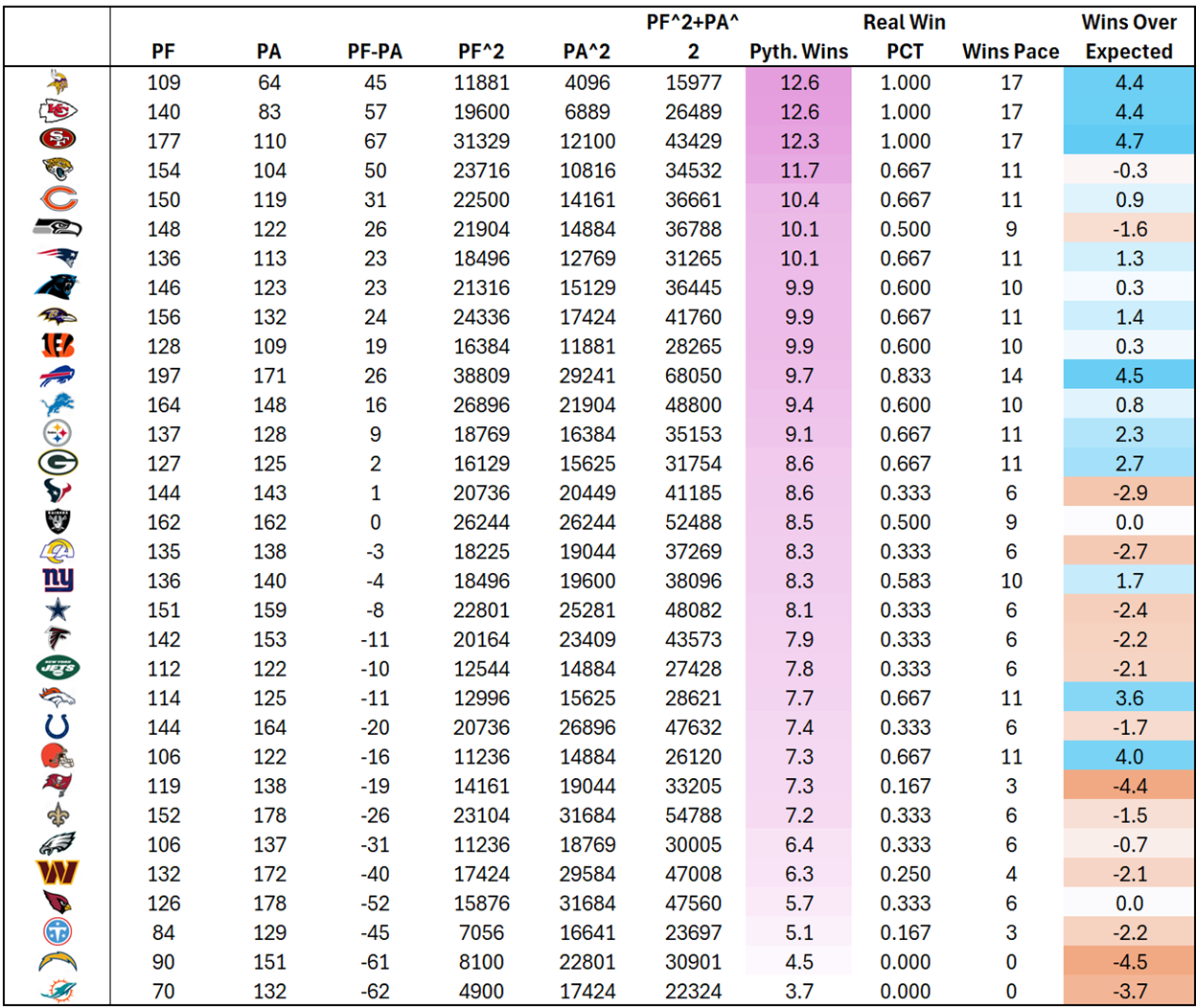
By record alone, the Bears and Patriots are each 4-2. By Pythagorean Wins, the Patriots rank 7th, pacing for 10.1 wins, and the Bears rank fifth, pacing for 10.4 wins.
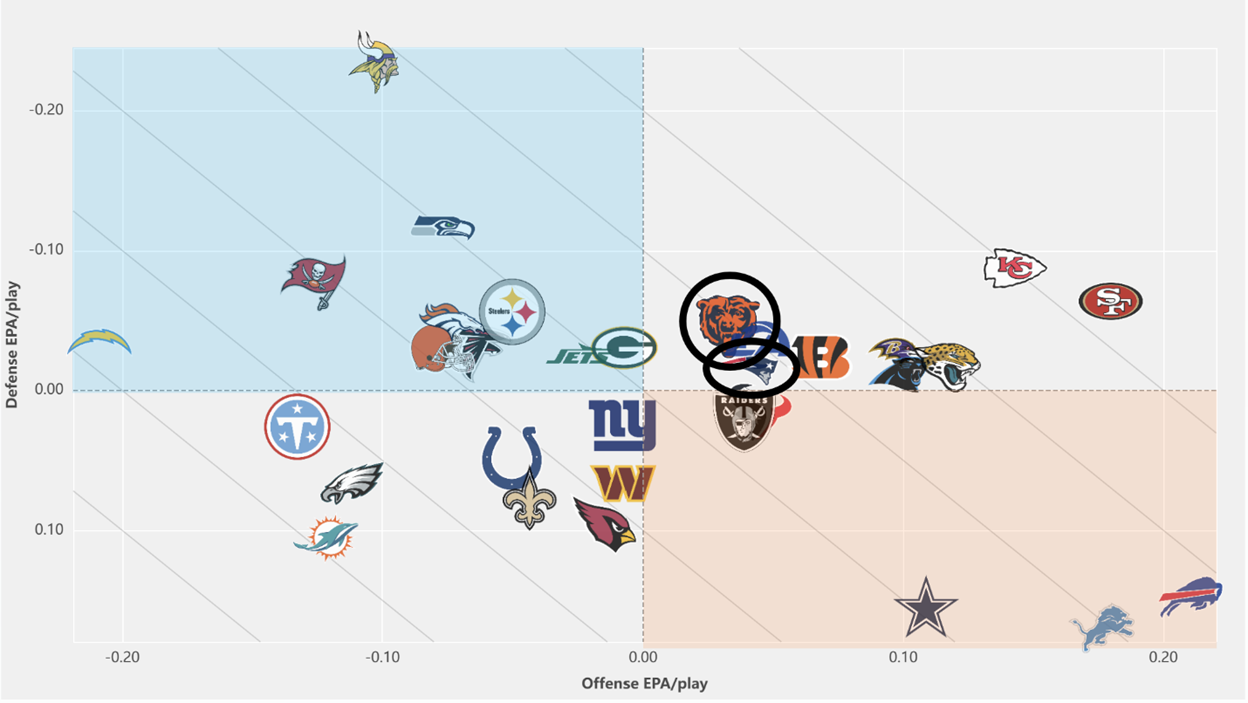
The Bears rank eighth in Super Bowl odds at +1500, and the Patriots are tied for 11th at +2000, according to FanDuel Sportsbook. Each is slightly better than average in offensive EPA per play and defensive EPA per play allowed.
Based on their seconds-to-snap from a neutral script, neither team is especially fast or slow; both land in the middle third, between 28.1 and 28.8 seconds to snap. Despite this, New England is tied for sixth in plays per 60 minutes (65), while Chicago leads the league with 74.
Weather: The weather should cooperate. The forecast calls for temps ranging from 59 at game time to possibly as low as 55 with almost no chance for significant precipitation and very mild wind. These should be the perfect conditions for a football game.
Bears Key Injuries: RB Kyle Monangai (thumb/toe) has been ruled out for the third consecutive game, leaving RB D’Andre Swift in line for another substantial workload with RB Roschon Johnson backing up. Starting LB T.J. Edwards (hamstring) is doubtful after returning to limited participation Wednesday, while starting CB Tyrique Stevenson Sr. (hip) is questionable despite practicing fully throughout the week. Starting OG Jonah Jackson (hip/quadriceps) practiced fully Wednesday and carries no designation. Starting ED Montez Sweat remains on the Commissioner’s Suspended List, while ED Dayo Odeyingbo (quadriceps) and OT Braxton Jones (knee) are on IR. Chicago’s depleted pass rush is a significant concern against New England.
Patriots Key Injuries: Starting LG Alijah Vera-Tucker (hamstring), RG Ben Brown (knee), and CB Carlton Davis III (neck) have been ruled out. Starting RT Morgan Moses (foot) is questionable after remaining limited throughout the week. Starting S Kevin Byard III (chest), S Craig Woodson (shoulder), and LB Christian Elliss (chest) are also questionable, although all three practiced fully Wednesday. QB Drake Maye (right shoulder), WR A.J. Brown (ankle), and RB TreVeyon Henderson (ankle) practiced fully and carry no designations. WR Romeo Doubs (shoulder) and WR Mack Hollins (calf) are on IR, along with starting G Mike Onwenu (ankle). New England’s depleted offensive line and receiving corps are the primary fantasy concerns.
PATRIOTS
Implied Team Total: 23.75
The Patriots are below average in EPA per rush (-0.181, 25th) but above average in EPA per dropback (0.191, 8th).
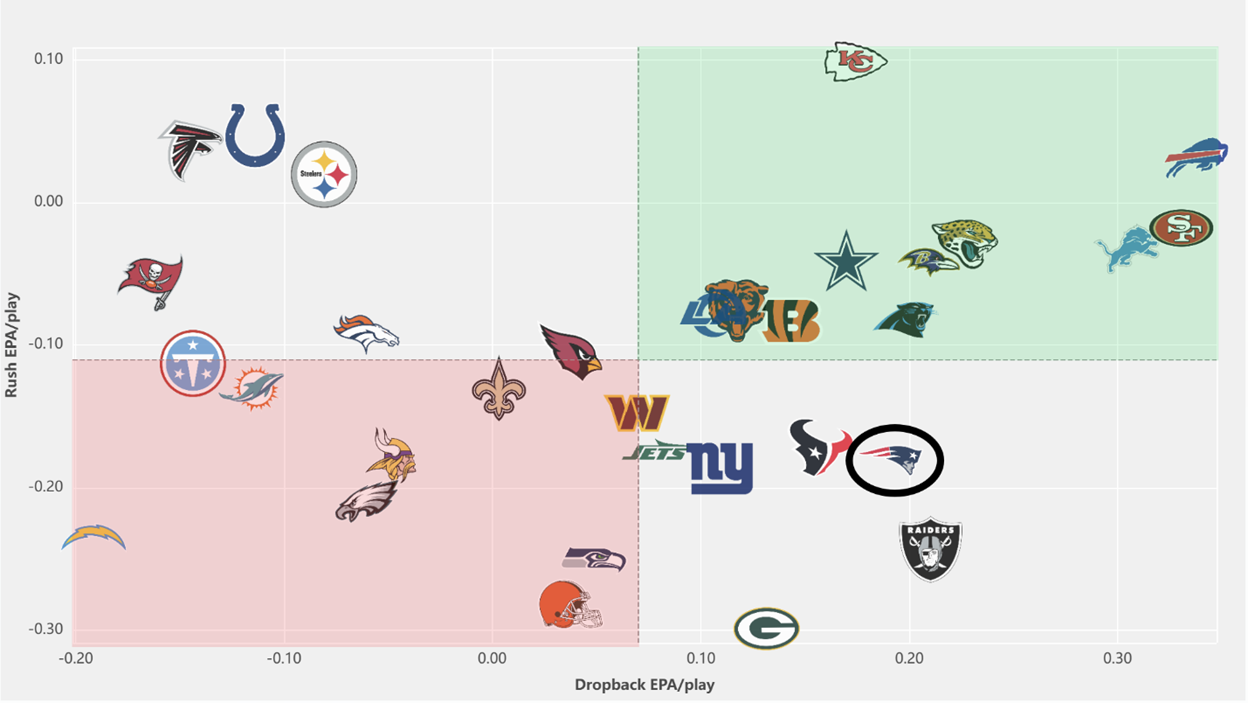
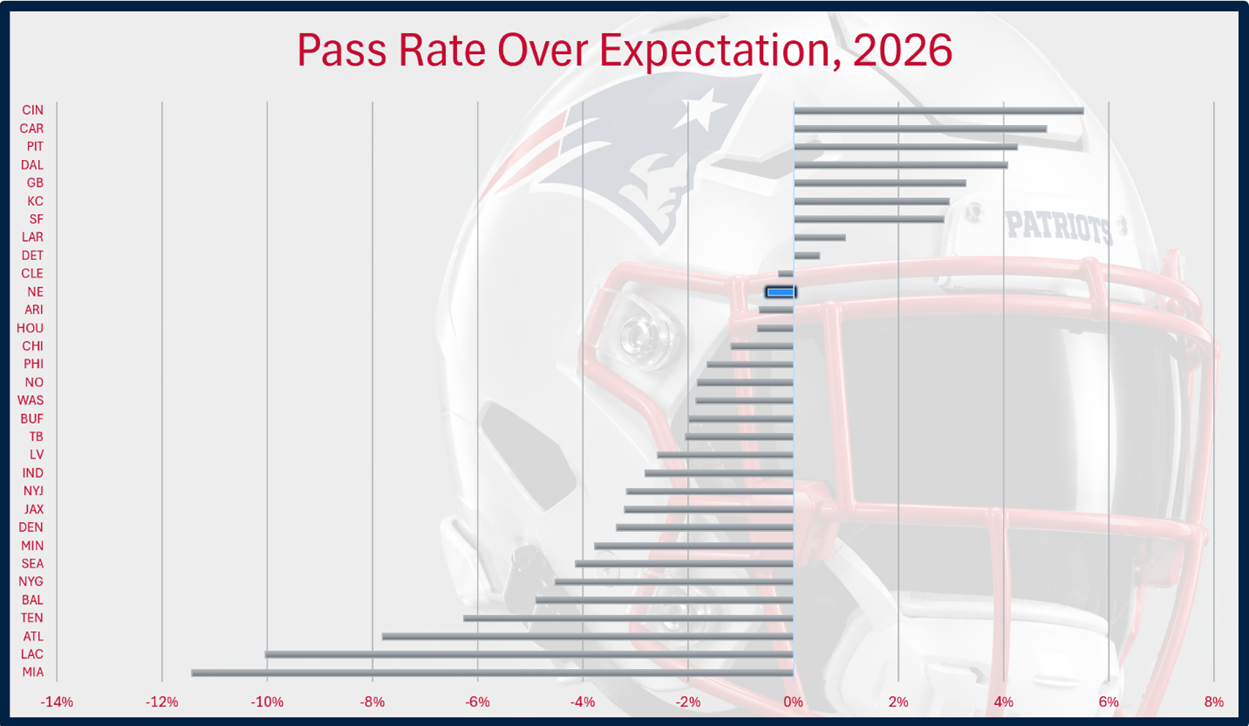
Their PROE is barely negative (-0.49%), but compared to league base rates, they are slightly above the mean.
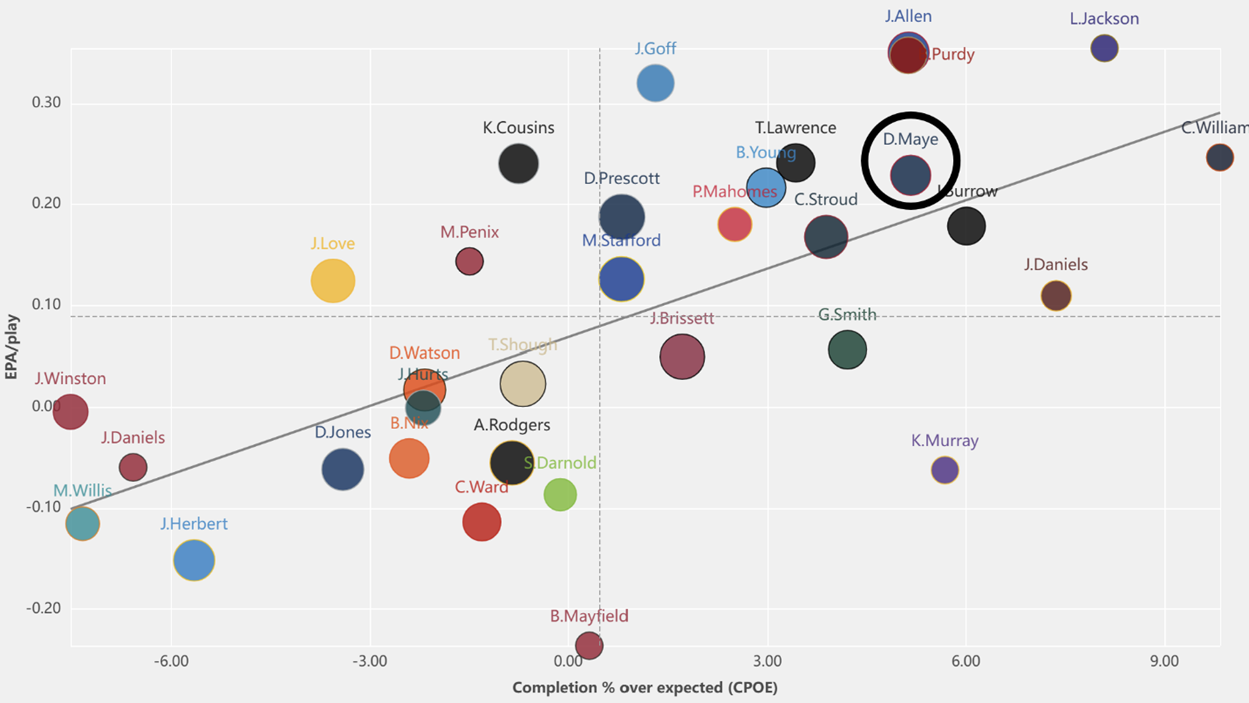
QB Drake Maye was the MVP runner-up in 2025 and, of course, a first-time Super Bowl participant. Despite big expectations, he started this season off slowly. However, he’s come on in his last few outings and now ranks closer to the high end in both EPA and CPOE; he finished first in EPA/CPOE composite by a wide margin in 2025.
Maye has earned 66 snaps/G (T-11th), converting them to 30.5 pass attempts/G (19th). Maye has an established pattern of converting dropbacks into attempts at a lower rate; this year is no different (85.52% Atts/DB, 23rd). Last year, the reasons were twofold: he commonly scrambled and was commonly sacked. This year, Maye’s sacks are down (11, T-17th), but he is tied for second in scrambles (19). Thus far, Maye ranks fifth in rushing attempts/G (5.67) and eighth in rushing FP/G (4.08).
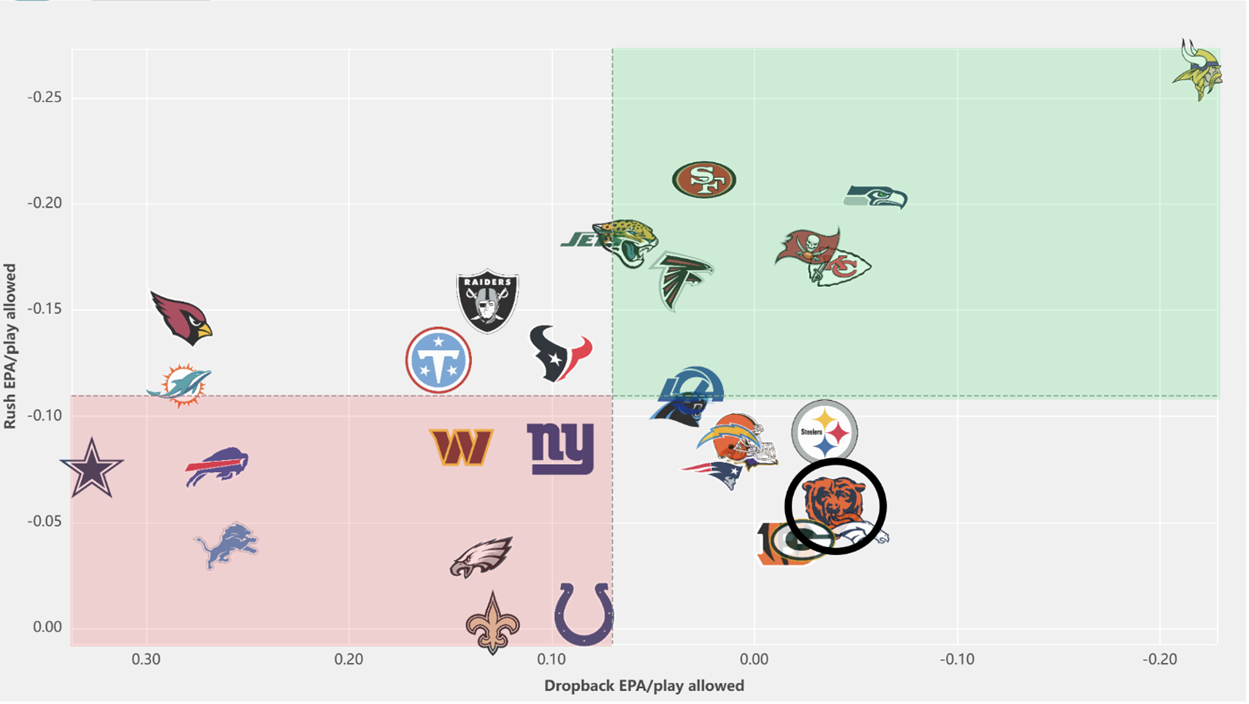
The Bears’ defense was supposed to be awful, and they haven’t been, despite a litany of injuries and suspensions to key players. They rank below average in EPA per rush allowed (-0.057, 25th), but above average in EPA per dropback allowed (-0.039, 5th).
Though they do run zone more frequently, as all teams do, the Bears run man defense 32.8% of the time (4th). They use single-high 56.1% (9th). Their most common alignments are Cover 3 (30.2%, 19th), Cover 1 (25.4%, 2nd), and quarters (15.3%, 19th). The blitz on 34.4% of defensive plays (7th).
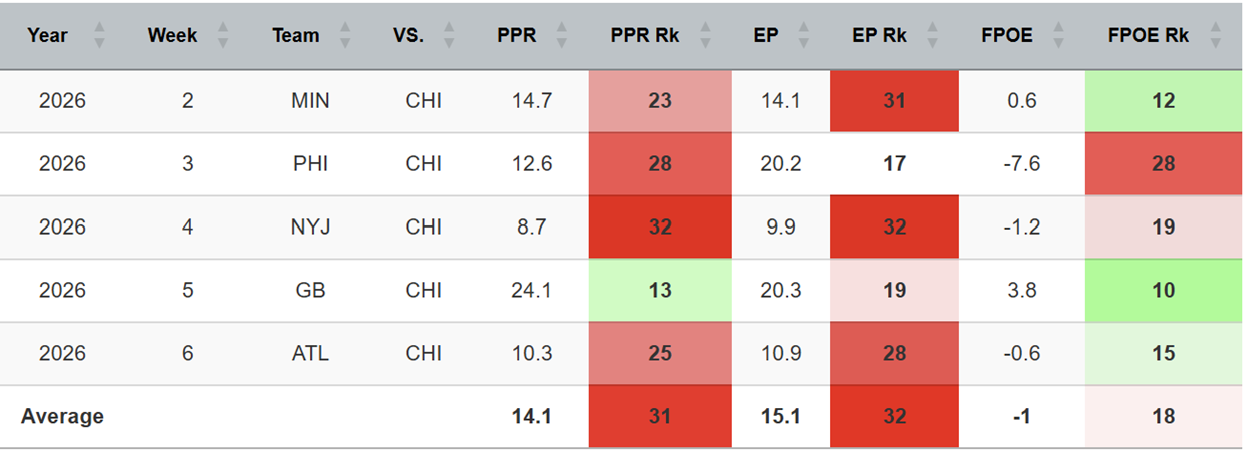
According to the Fantasy Points Coverage Matchup tool, Maye is expected to have a 10% increase in FP/DB, the third-best boost of the week based on the types and rates of coverage an opponent employs. PFF’s Matchup tool is more player-based, utilizing PFF grades and the number of expected combinations to assess; it grades Maye’s assignment as great. The Bears have allowed 16 FP/G in their last five games (25th), allowing only 13.9 EP/G (32nd).
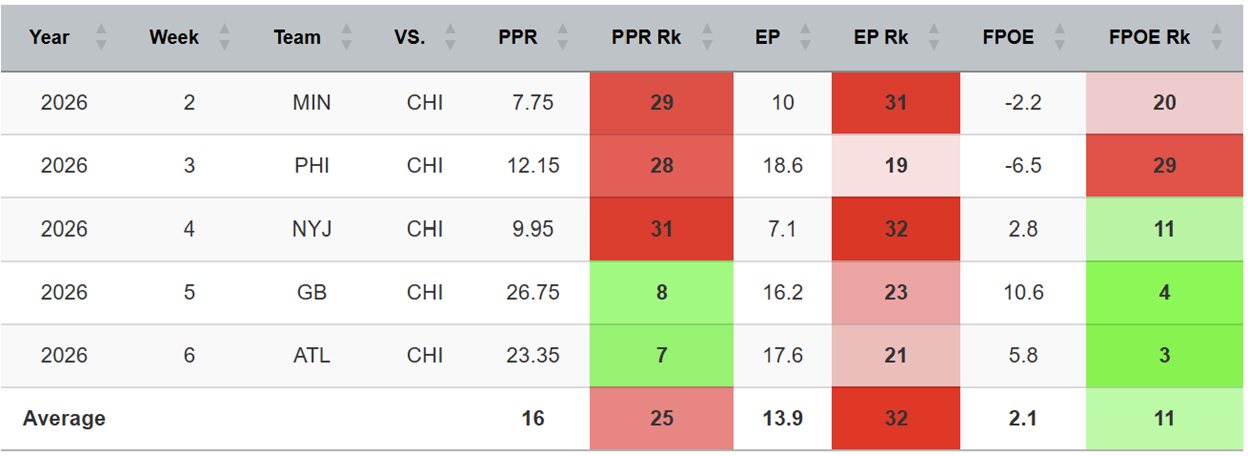
This hasn't made the Bears a total run funnel. It suggests they can be passed on, though teams haven't generated as many quality opportunities against the Bears’ pass defense as they should, or would be expected to. This makes sense: the Bears have defended only 242 plays in the last five weeks, the third-fewest, and only 29 pass plays per 60 minutes, tied for the fewest. This is how you get this imbalance without being a run-funnel.
In their last five games, the Bears have only allowed 7.2 rushing yards/G to QBs (27th), though except for Jalen Hurts, who earned 25 rushing yards against them, the QBs they’ve faced haven’t necessarily been track stars.
The Patriots have had a barrage of injuries to their skill core through the first six games. In their last five, only three players have at least 20 targets, and none have more than 22.
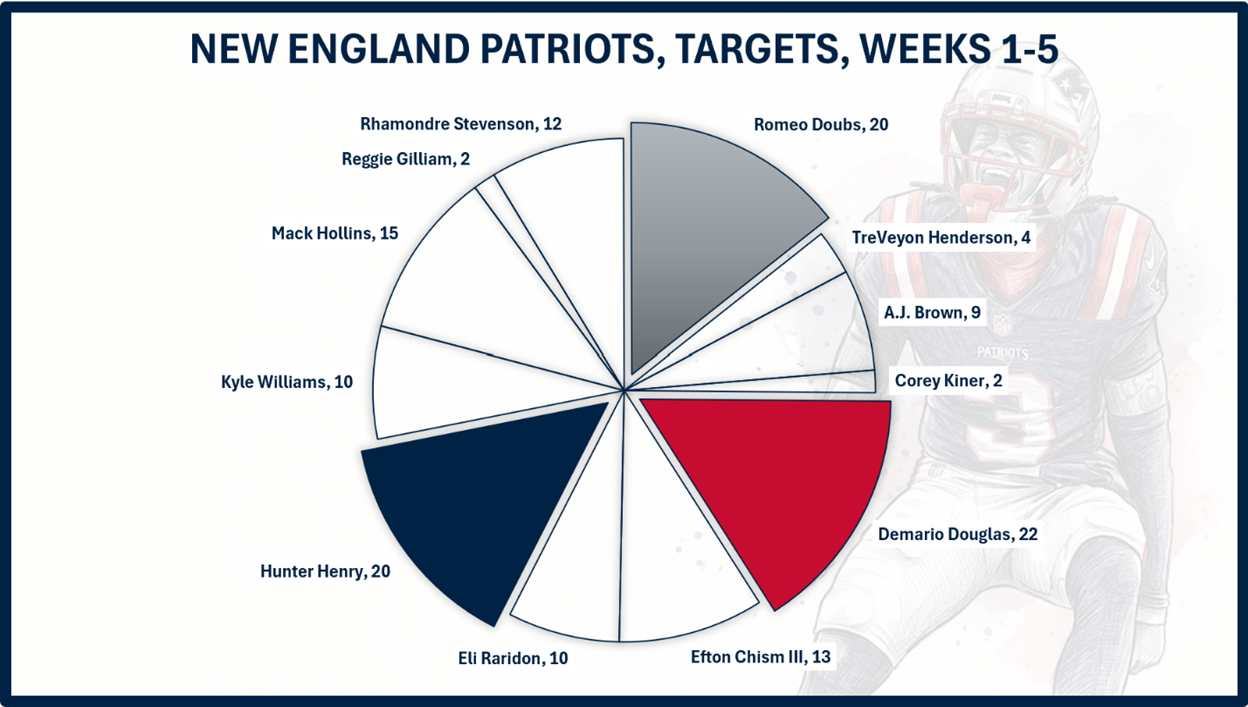
WR Demario Douglas leads the way. Even with the team-leading targets in the last five games, Douglas still has only a 16.67% target share and ranks in the bottom 50th percentile in almost every significant receiving category. The main problem for Douglas is that the Patriots use 11-personnel at a 59% rate (T-19th), and he’s almost entirely used in the slot (82.7%), which will always limit his overall route participation.
Douglas’ fantasy outputs have been occasionally usable in deeper leagues or for the desperate, as he ranks 38th in PPR/G. Still, his TD production has been overly positive, and he is a bit of a negative TD regression candidate based on TDs per yard, especially given his archetype as a smaller, more slot-based player. This factor doesn’t even show up in this model (this type of player traditionally has lower TD rates).
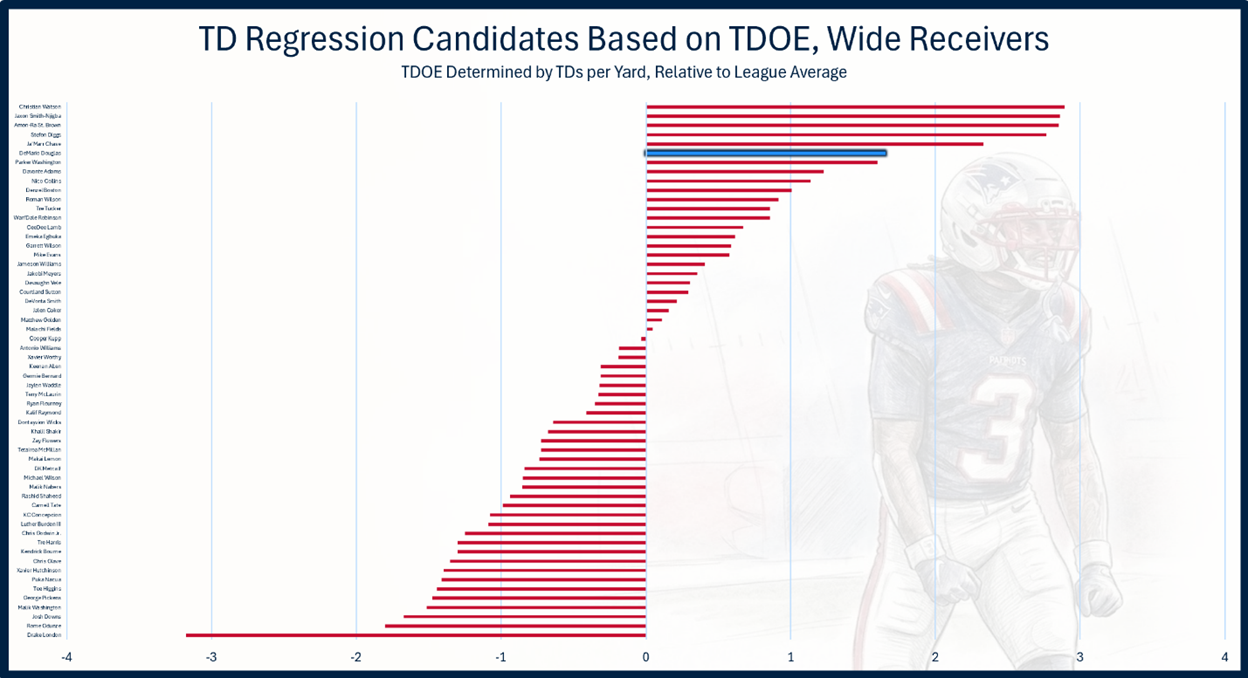
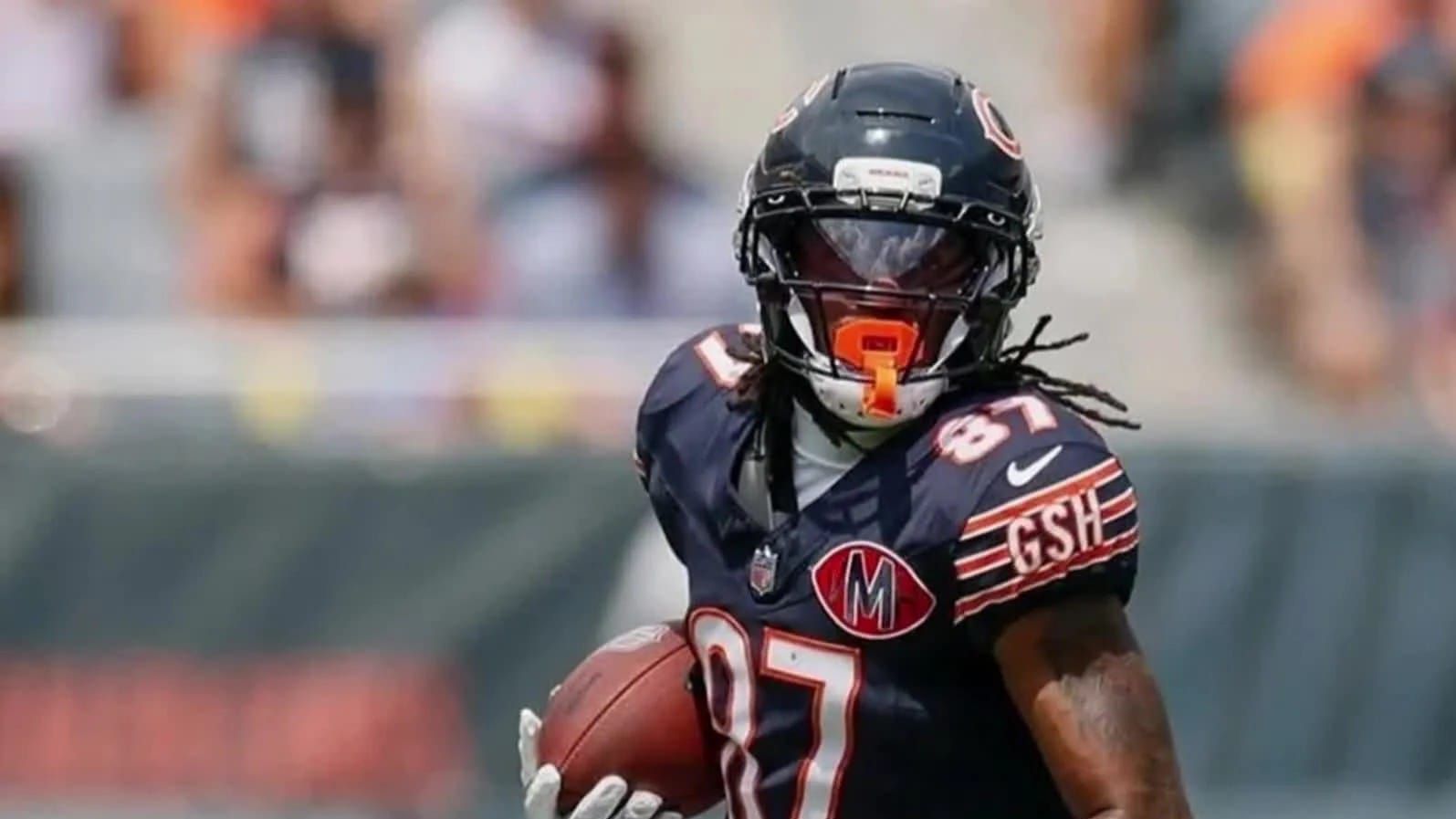
Doubs, highlighted here, won’t be available because he’s on IR, as is veteran WR Mack Hollins. Conversely, WR A.J. Brown returned from IR last week and led the team with nine targets; he didn’t capitalize, looked rusty, and was credited with two or three drops, depending on the source (although NBC Boston claimed five passes hit his hands and went uncaught). Drops aren't overly sticky, and with that kind of target share, I would be inclined to cut him some slack and trust the target-earning to be more substantial.
TE Hunter Henry has been disappointing, especially given the health and availability of the pass-catchers, creating a wide-open lane for Henry to be a top-two team target earner, something that we look for in sleeper TE selections. He ranks outside the top 15 in almost everything, though his 8.3% TD rate and 23.5 YAC/G (T-10th) have papered over a 17% TPRR (T-31st) and kept him viable for deeper or TE-premium formats.
Efton Chism is getting steadily more interesting, but he’s more of a stash than a play right now for anyone who can spare it.
Based on the types and rates of coverage the Bears like to employ, Douglas has the most favorable matchup of any Patriots pass-catcher, with an expected 17.3% increase from his usual FP/G. Henry, by contrast, is expected to be substantially downgraded at -22.7%. Brown doesn’t have enough routes to qualify for the tool.
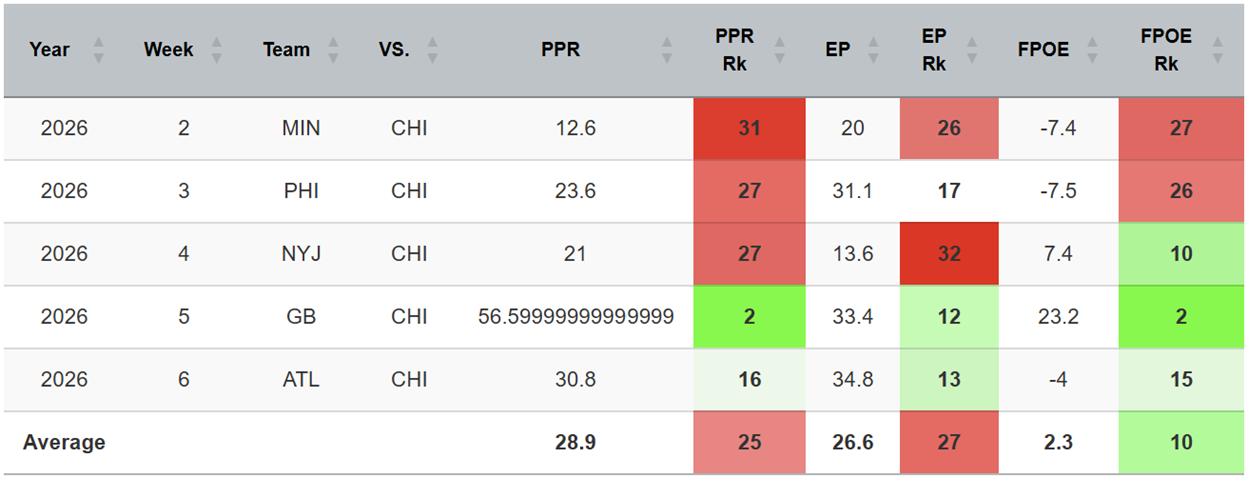
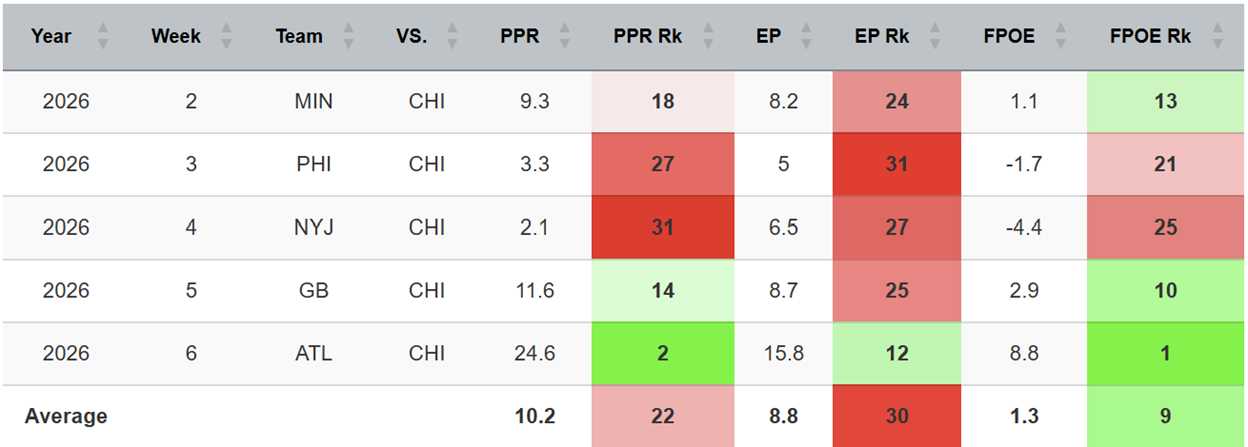
Based on PFF’s player-based matchup tool, Brown’s matchup is poor, Douglas’ is fair, and Chism’s grades out as great. The Bears have allowed only 28.9 PPR/G (25th) to WRs in their last five games, though they were torched by Green Bay’s WRs two weeks ago and are coming off a shaky outing against Atlanta. At QB, we see an imbalance in EP/G allowed (26.6, 27th) and FPOE/G allowed (2.3, 10th), suggesting they are easier to pass on than the raw numbers suggest, but teams are not racking up quality attempts through the air.
At TE, both Henry and rookie Eli Raridon have matchups that PFF grades as good. In their last five games, the Bears have held TEs to just 10.2 PPR/G (22nd), and we see the same trickle-down effect from the Bears not seeing many quality passes on defense.
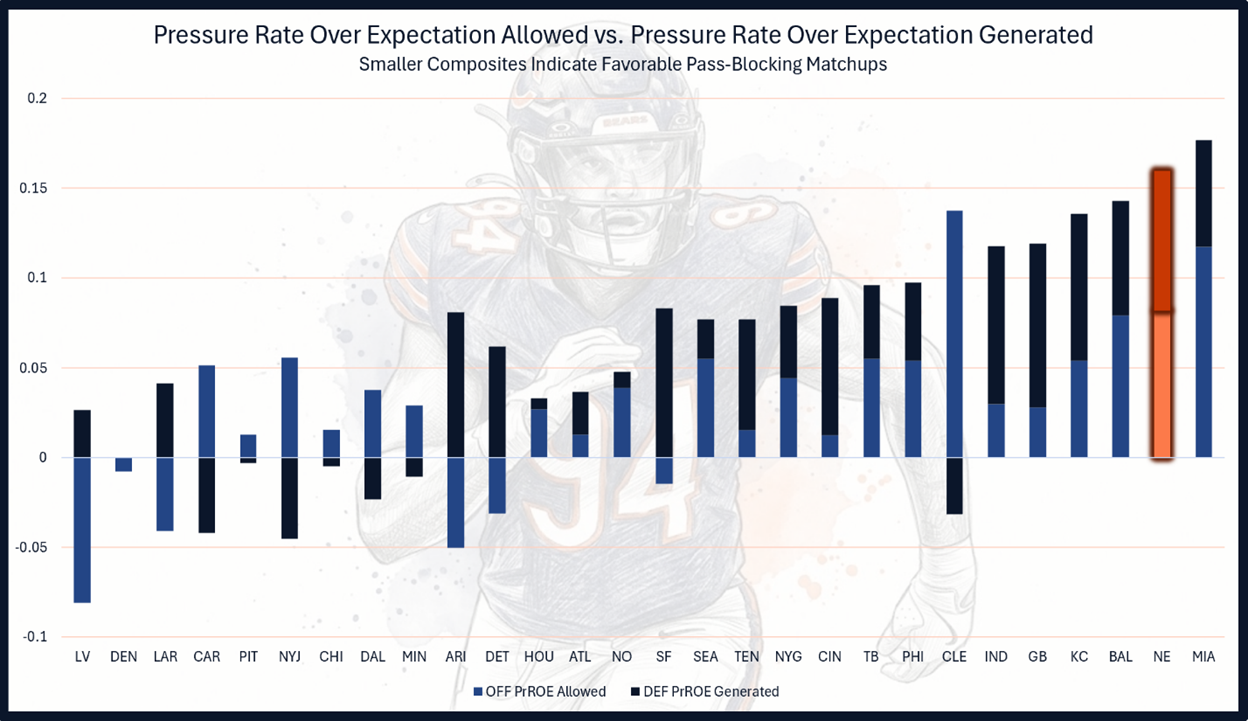
The Patriots should have another issue on the offensive line in the passing game. Based on their pressure rate over expectation allowed and the Bears’ pressure rate over expected generated, the Bears have one of the league's biggest pass-rush advantages this week.
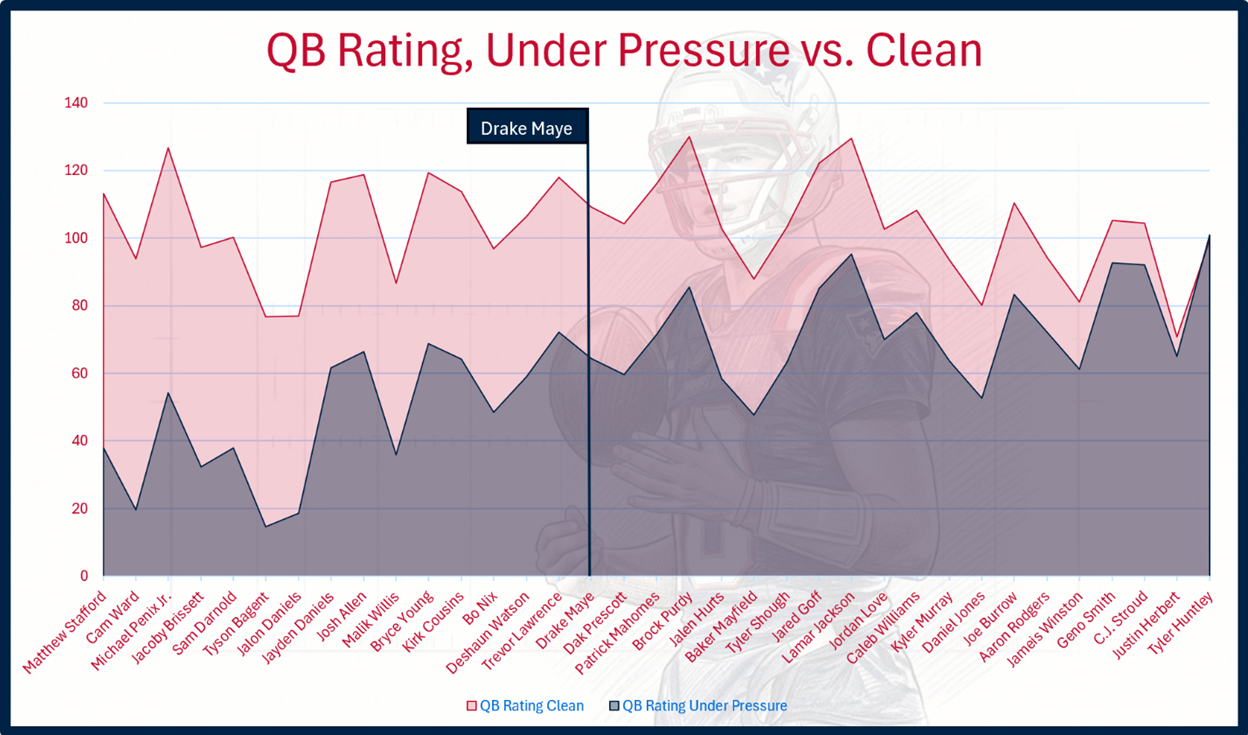
This is nothing new for New England, and as discussed, Maye scrambles out of these situations a lot. He is also about league average when it comes to passing out of pressure.
As such, Maye’s instincts and abilities should paper over the pass-blocking deficiencies if they rear their ugly head. Maye has no such effect, obviously, on designed rushes for RBs. The good news is that the offensive line should have a positive matchup based on adj. YBC/Att generated vs. the Bears’ adj. YBC/Att allowed.
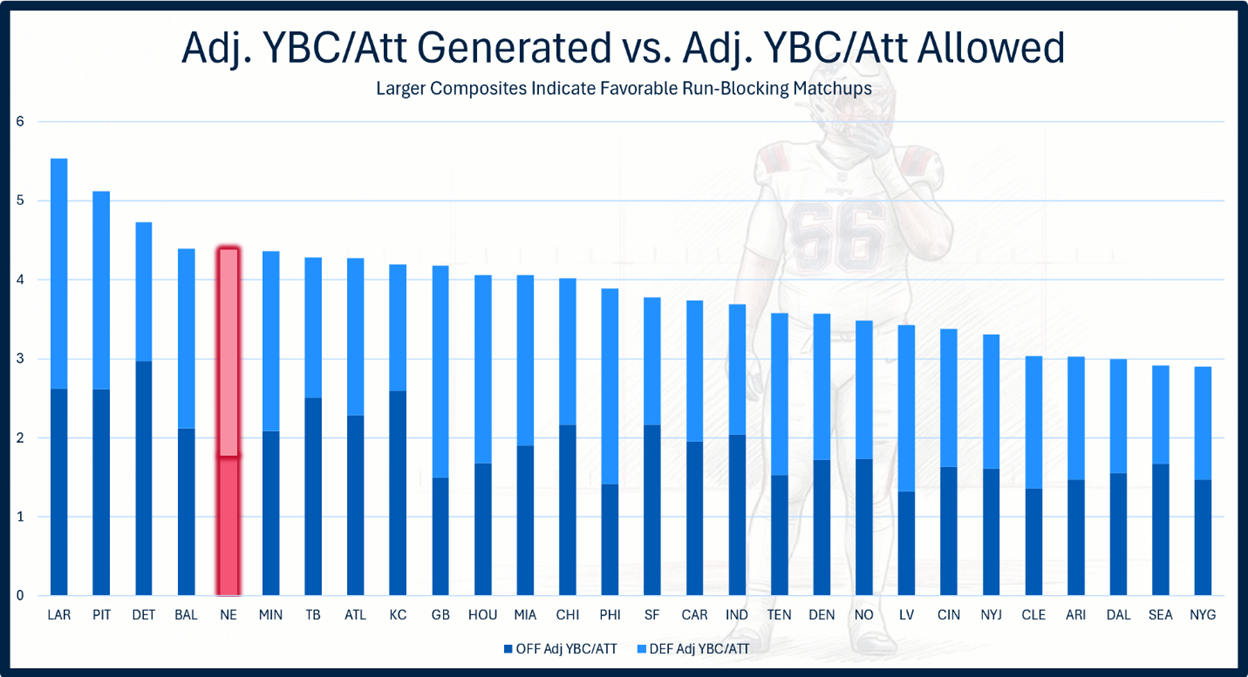
In fact, the inverse is likely true. The line is expected to pull their weight, but the same can’t be said about New England’s RBs, who have been disappointing.
Stevenson averages 0 FPOEPA, so he’s literally getting what’s blocked. He ranks outside of the top 75th percentile in almost any significant statistic except for snaps/G (42.8 (16th), snap share (63%, 15th), and route participation (49.8%, 9th). He does little with the opportunity.
The natural assumption is that when Stevenson’s efficiency falters, it creates an opportunity for second-year RB TreVeyon Henderson, but Henderson has not performed any better, even discounting a minor Week 5 injury that cost him the back half of the game. Henderson ranks outside the top 55th percentile in most significant stats, and he has become a low-value touch maven, owning the second-highest LVT rate in the NFL – not what fans expected when they took him as a Jahmyr Gibbs analog in 2025 rookie drafts.
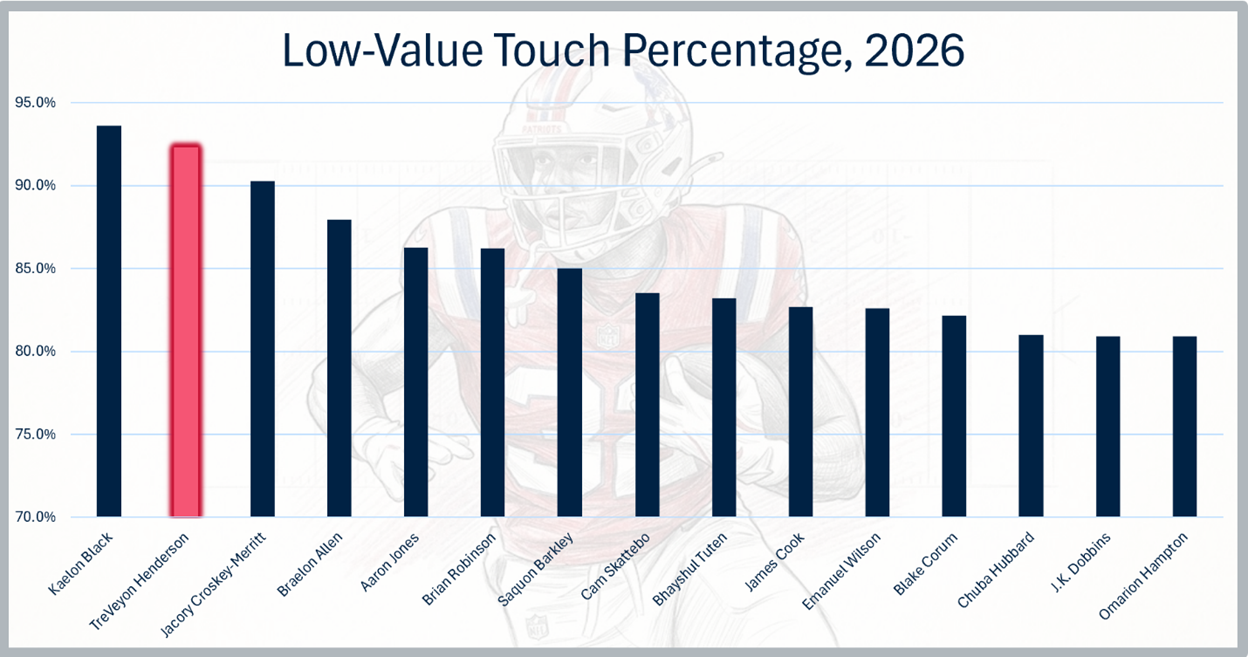
In fact, last week, Henderson struggled badly, and Stevenson fumbled, so RB Corey Kiner was brought in to bring the game home, collecting 11 carries for 5.2 YPC from the late third quarter to the final gun. This was in a competitive game environment. I picked Kiner up in some dynasty spots as a curiosity stash, but honestly, I expect him to frustrate the upside of Stevenson and Henderson more than take off as a solo fantasy entity.
PFF’s fantasy matchup tool doesn’t consider Kiner, but it gives Stevenson a good matchup and Henderson a fair matchup.
The Bears have seen low play volume overall, as mentioned earlier, so they have a similar imbalance in EP and FPOE against RBs in their last five, allowing just 14.1 FP/G (31st).