Week 3 Walkthrough: K9 in Vice City

Welcome to the Week 3 Walkthrough.
In this article, I'll outline critical fantasy football context for the third glorious football Sunday of 2026.
(The stats below are from PFF, NFLfastR, rbsdm.com, RotoViz, FantasyLabs, Fantasy Life, Fantasy Points, ESPN, FTN, and NFL Next Gen).
PROE data is available for subscribers at the bottom of the post.
Quick Links
- Chiefs at Dolphins, 1 PM
- Chargers at Bills, 1 PM
- Patriots at Jaguars, 1 PM
- Panthers at Browns, 1 PM
- Jets at Lions, 1 PM
- Texans at Colts, 1 PM
- Titans at Giants, 1 PM
- Bengals at Steelers, 1 PM
- Seahawks at Commanders, 1 PM
- Cardinals at 49ers, 4:05 PM
- Vikings at Buccaneers, 4:05 PM
- Raiders at Saints, 4:25 PM
- Ravens vs. Cowboys (Brazil), 4:25 PM
Chiefs at Dolphins, 1 PM
Chiefs
Implied Team Total: 28.25
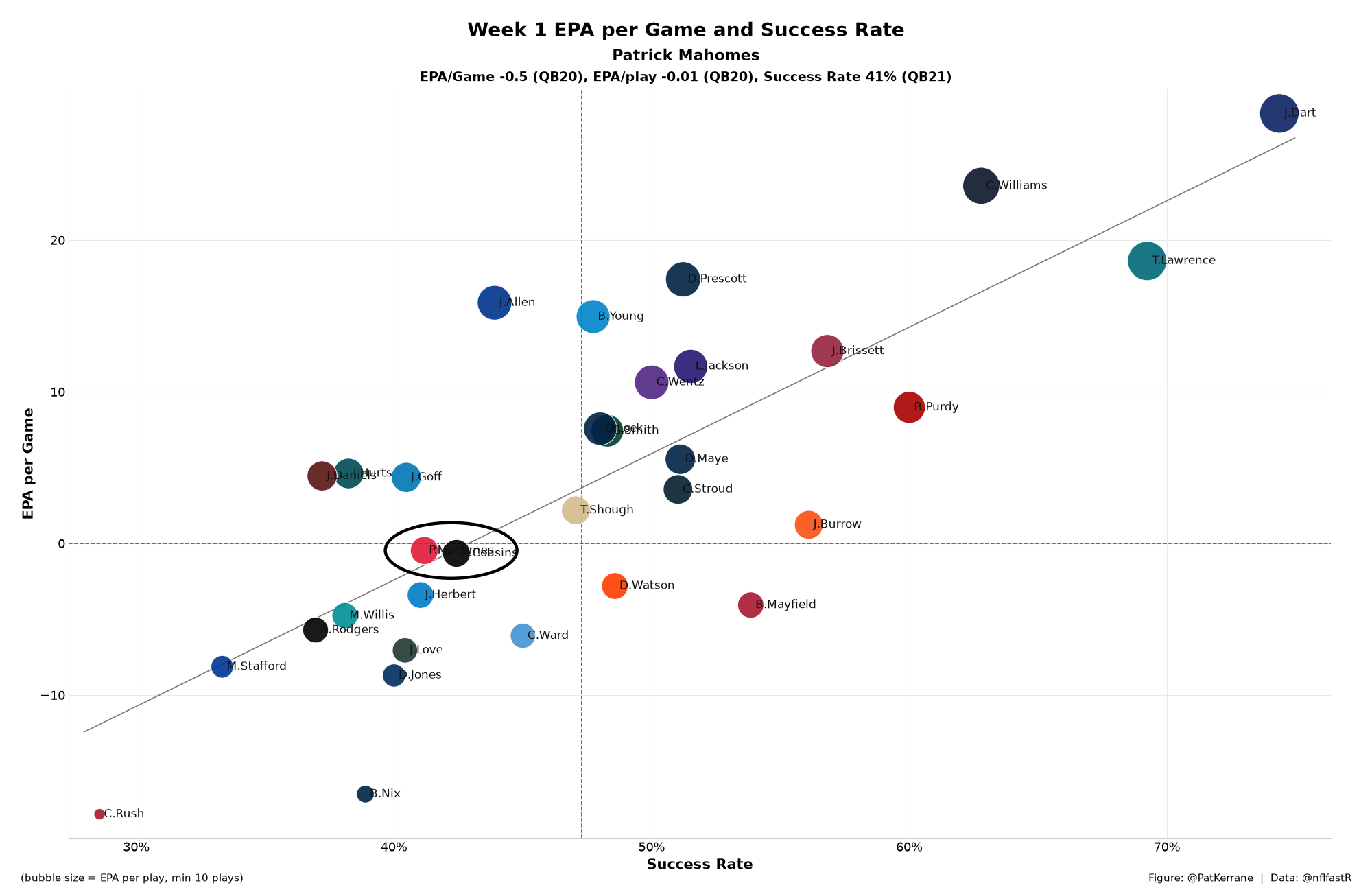
Patrick Mahomes opened the season against Denver with unimpressive efficiency. He posted negative EPA, just above Kirk Cousins but with a worse success rate. And like the Cousins-led Raiders, the Chiefs were really an offense built around their RB.
Just look at their 51% pass rate—clearly, not the Chiefs of old.
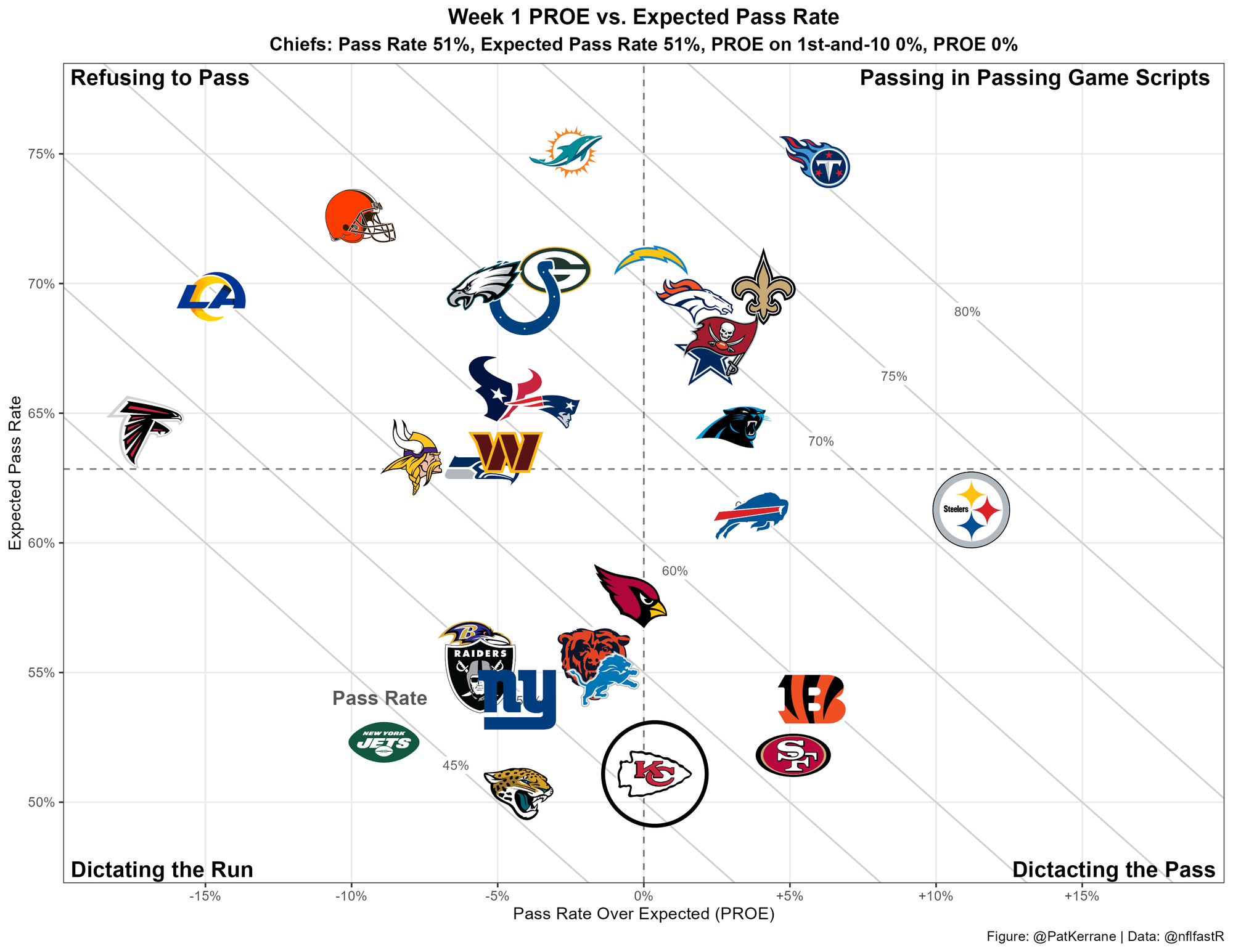
But over the course of an NFL season, things change. And, sometimes, they change quite quickly.
Against the Colts, the Chiefs were back to dictating the pass, with a 5% PROE in a script where they could have justified a run-heavy approach.
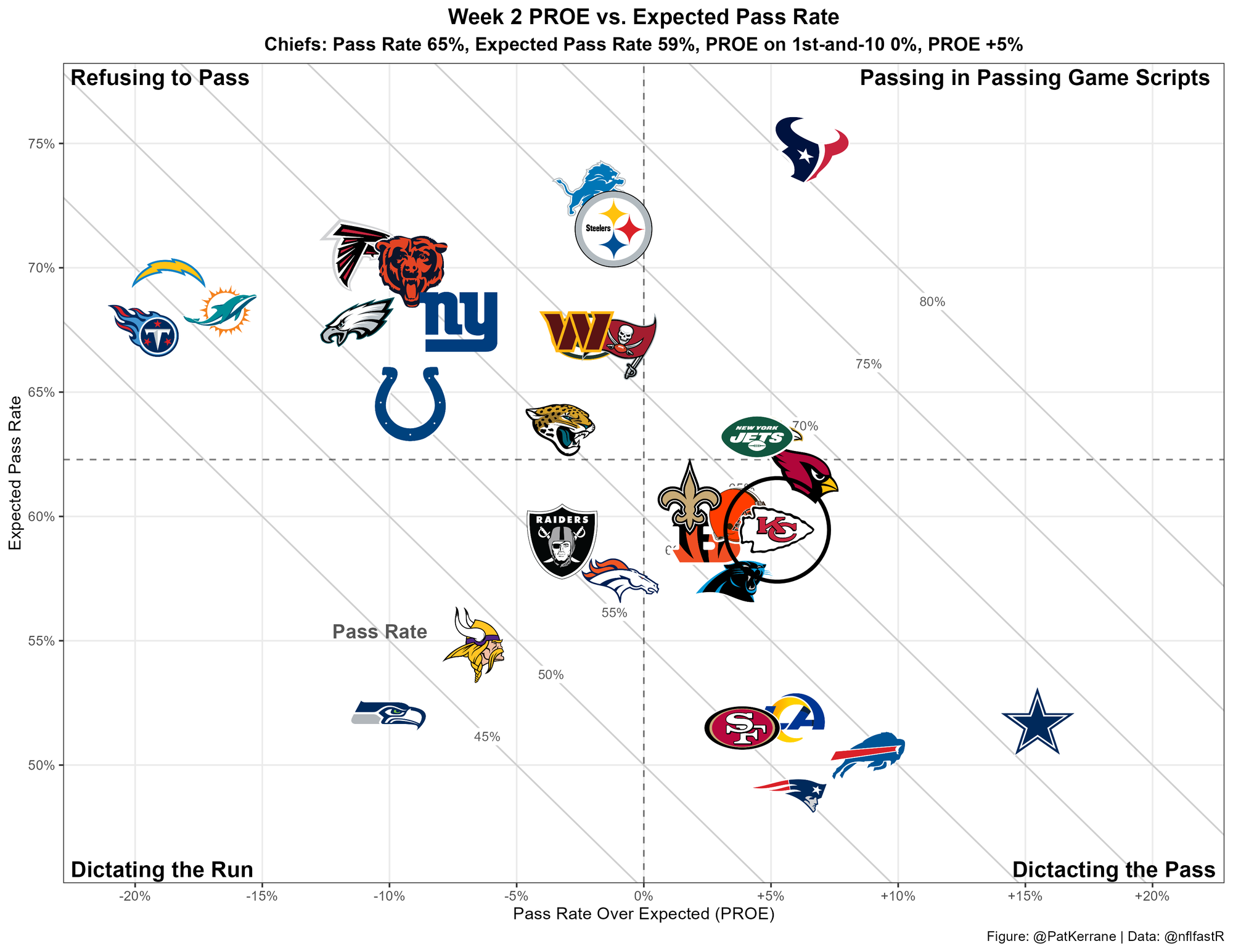
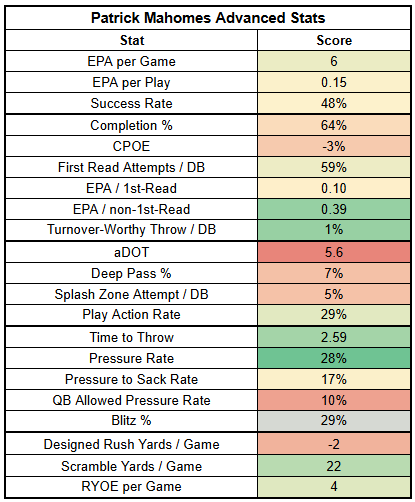
The Chiefs' pass-heavy playcalling was accompanied by much stronger efficiency from Patrick Mahomes. Even against the Colts, he wasn't near his peak form, but he was still very efficient with 13.1 EPA and a 52% success rate.
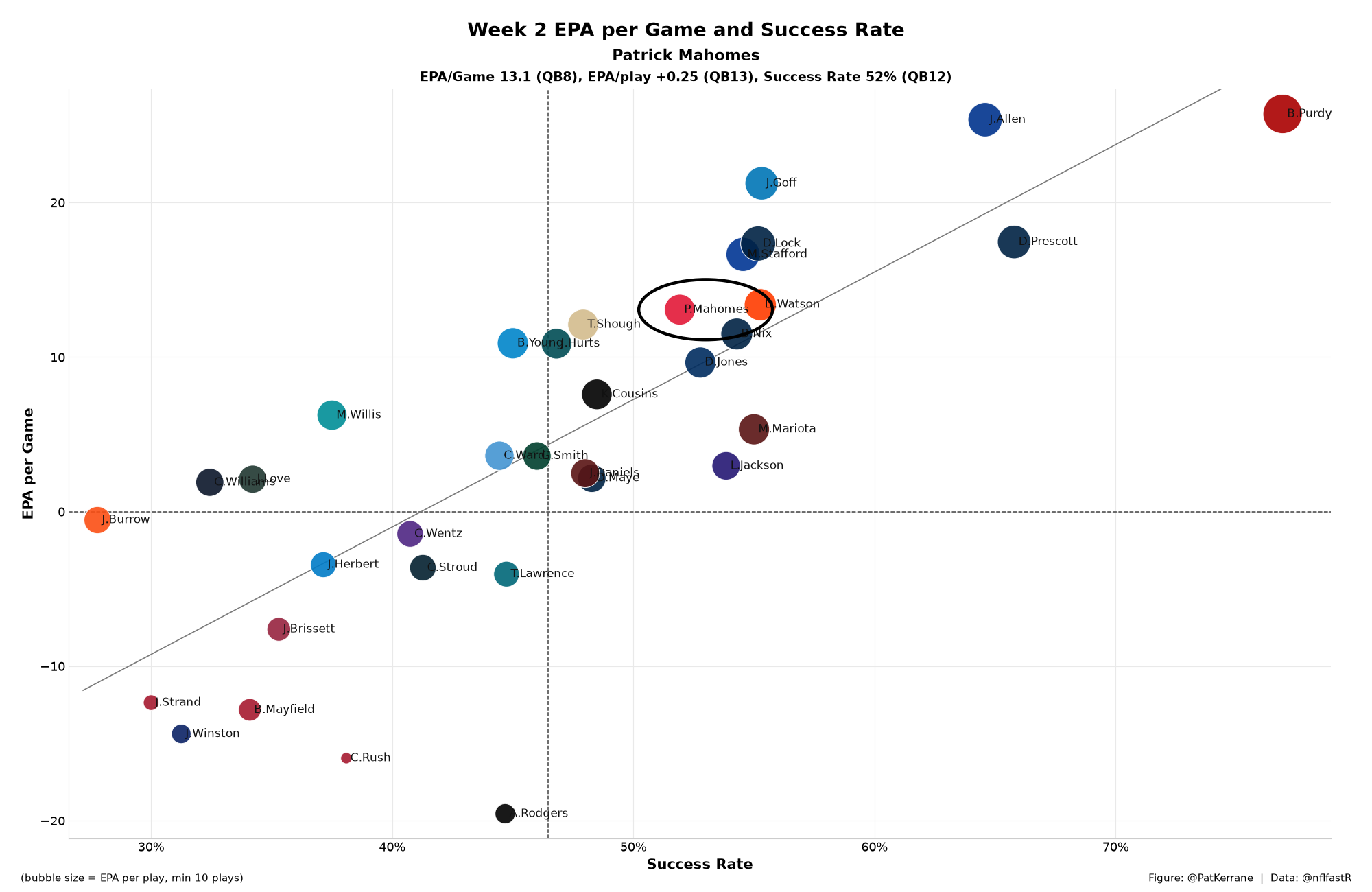
For the season, Mahomes looks good, rather than great. He still has a ways to go to be among the most efficient QBs in the NFL.
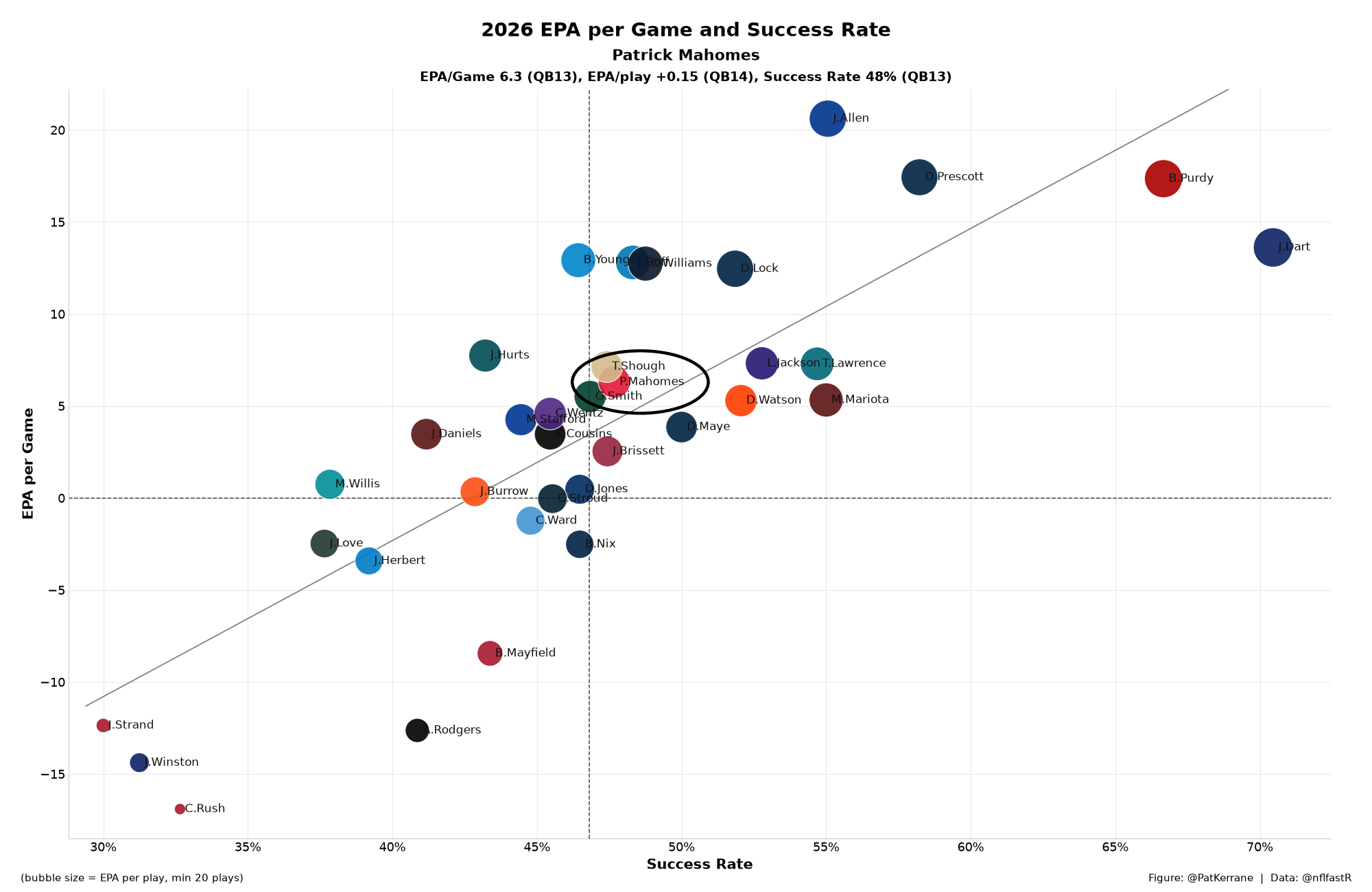
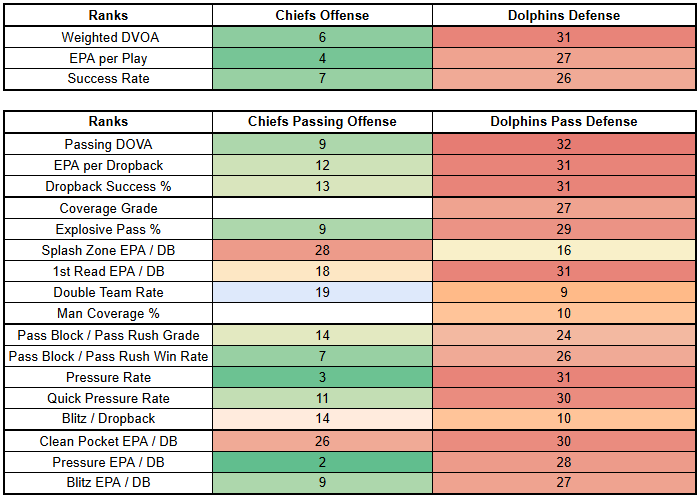
However, after this week, he'll have likely made up a bit of ground. Mahomes is facing a Dolphins defense that has been putrid against the pass.
Brock Purdy was damn near perfect against them.
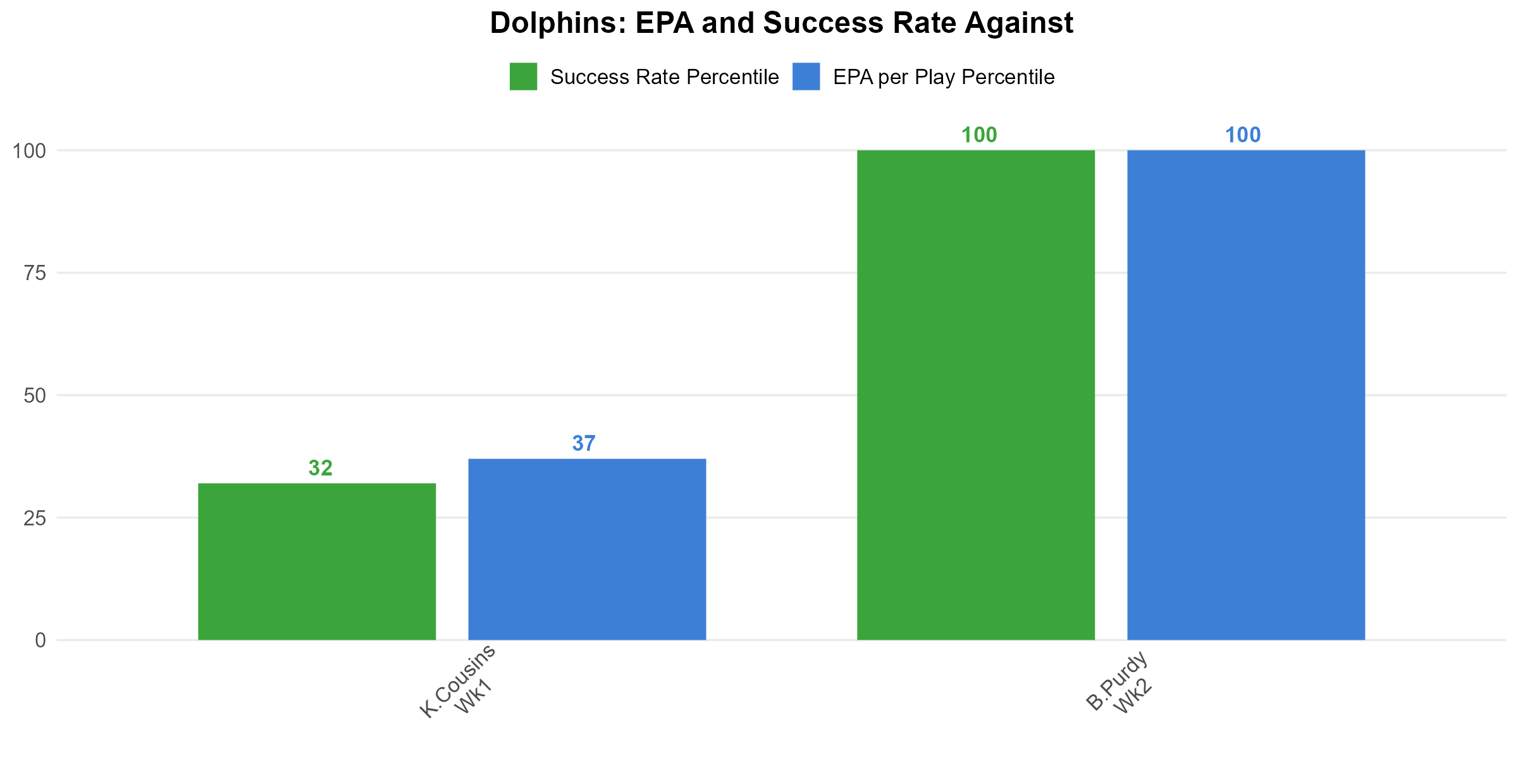
The Dolphins have been both inefficient and highly inconsistent against the pass. This is a great formula for most QBs, but especially for this version of Mahomes, who is getting the ball out quickly and shallowly. He's happy to dink and dunk defenses to death. Mahomes is also scrambling and mixing in deep throws, though. This isn't the Tyreek Hill-era Chiefs... but they are at least attempting some explosives. Primarily, though, Mahomes will be looking to consistently hit chunk plays against a defense that is allowing them at a very high rate.
Tyquan Thornton has been handling the clear-out deep threat role. And against the Colts, he did so effectively.

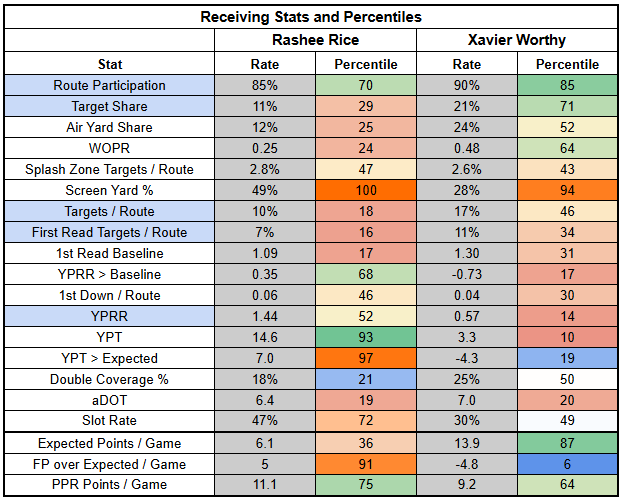
Xavier Worthy has been in more of an intermediate role. That role hasn't translated into much production yet, but Worthy has drawn targets at a decent rate in both games and saved his Week 2 with a TD.

Rashee Rice showed some improvement against the Broncos and did so while working a bit further downfield than usual. Given that he's coming back from a knee injury, it was a positive development.

Through the first two weeks, Worthy and Rice look to be in somewhat similar roles. Or, at least, more similar than expected. As Rice gets healthier, he'll probably start to separate as the better target earner. But, for this week, I'm treating Rice as a high-end WR3.
Worthy has been a key part of the offense so far. But he hasn't been able to deliver on that against the Broncos and Colts... both of whom have quality cornerbacks. The Dolphins do not.
Worthy isn't that good. But he's also not 3.3 YPT bad. It's a good week to bet on per-target positive regression. Worthy is also a high-end WR3.
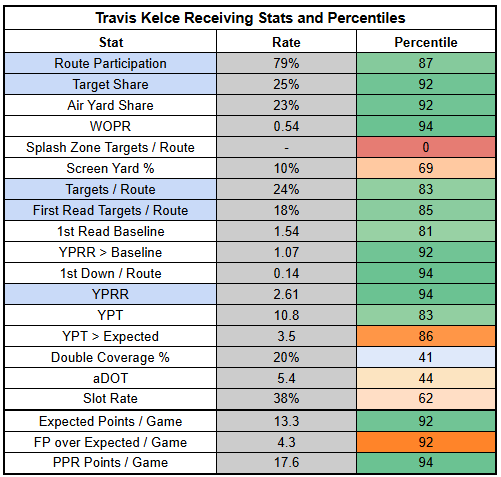
Ultimately, though, Travis Kelce profiles as the No. 1 receiver in Kansas City. He's been very efficient in both games so far and has been a key part of both game plans.

Kelce looks to be turning back the clock this season, running routes at a high-end rate, drawing targets, and delivering efficiently on them. Perhaps he'll slow down at some point, but I'm betting against it being this week. Kelce is a high-end TE1.
Even with the Dolphins being terrible against the pass, I don't expect the Chiefs to get carried away with pass-happy playcalling. In part, that's because I think they'll want to threaten the run enough to attack with play action. The Dolphins are seeing the highest rate of play action dropbacks against them and are also the worst defense in the NFL against play action—bad combo.
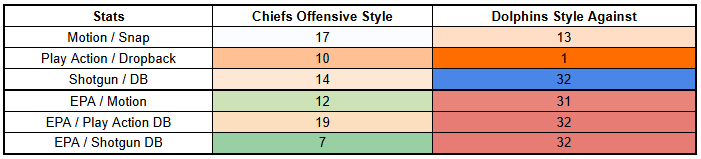
With a 40% TPRR on play action, Travis Kelce looks like the biggest beneficiary of this tactic. Worthy has also been heavily involved, with a 26% TPRR on play action. But I think the more important takeaway is that the Chiefs are going to want to stay balanced enough to benefit from faking the run. And as 10.5-point favorites... that shouldn't be a problem.
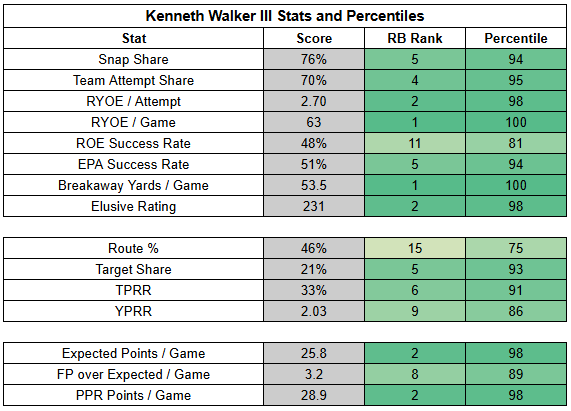
They've also been happy to lean on Kenneth Walker to this point. Walker already has 47 carries this season, the most in the NFL. And Walker has been truly excellent on that workload. He's profiling as a truly special talent now that he's developed into a receiving weapon and landed in a system looking to deploy him as an all-around workhorse.
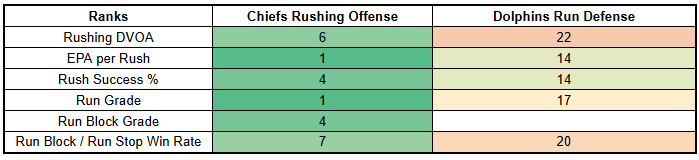
Through two games, the Dolphins' run defense has been middling rather than bad.
But Walker's 21% target share insulates him even if his rushing efficiency dips. His all-around usage also creates a huge ceiling. With 25.8 expected points per game, only Jahmyr Gibbs (26.9) has a more valuable workload so far. Walker is an elite RB1.
Dolphins
Implied Team Total: 17.75
After a rough Week 1, Malik Willis was much more efficient against the 49ers, turning in 6.2 EPA. However, he posted a weak 38% success rate.
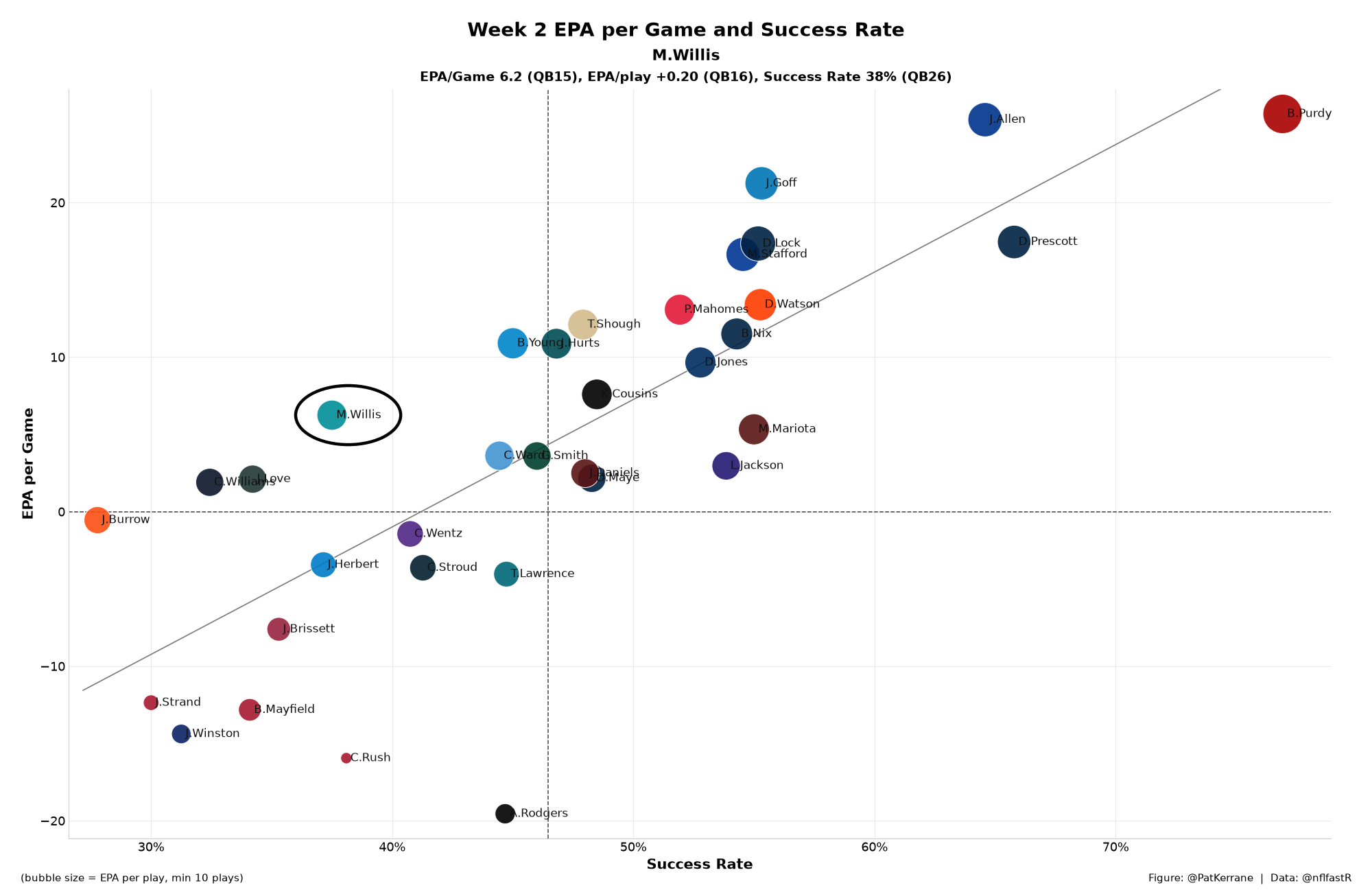
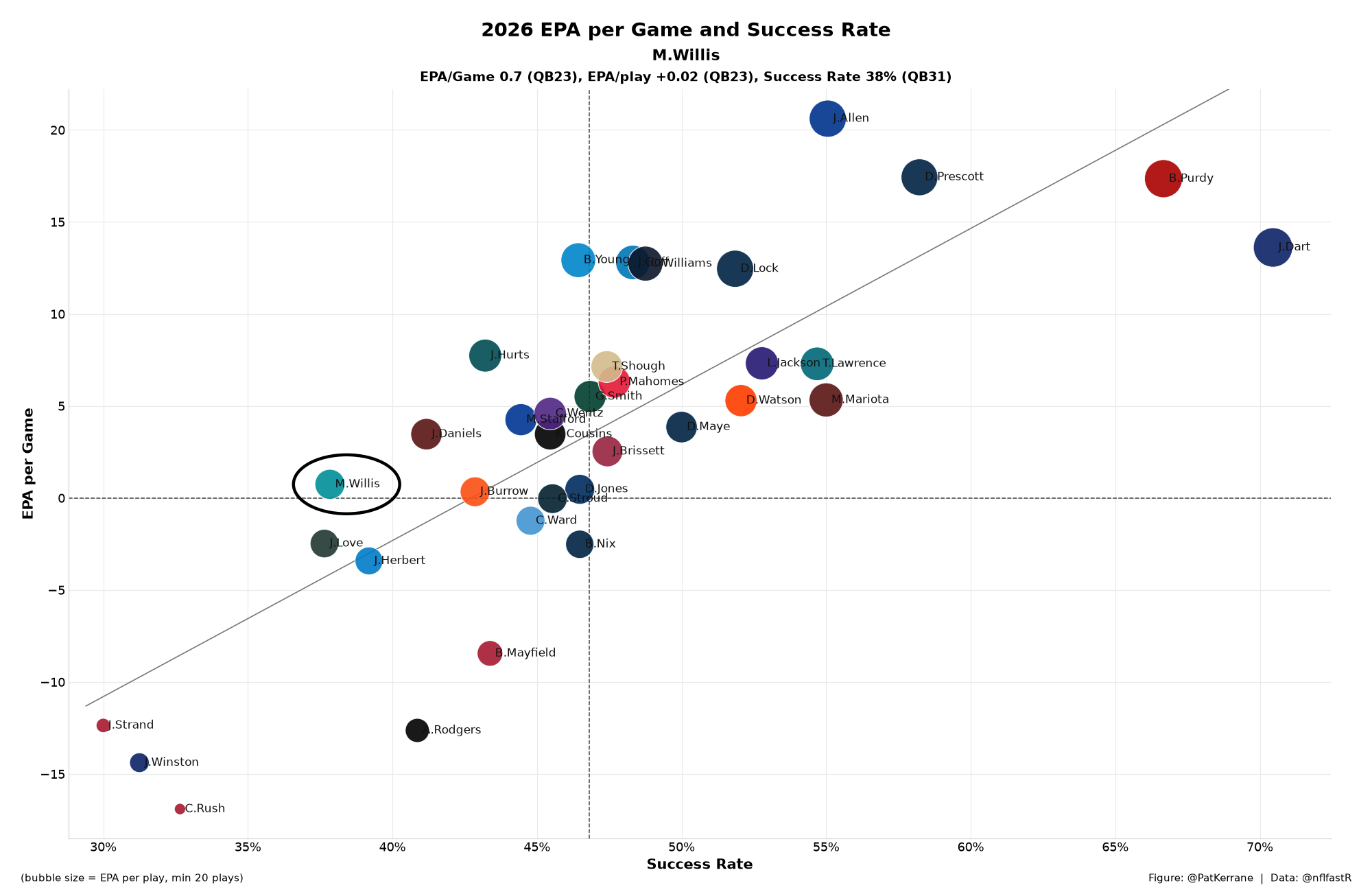
Consistency has been a problem for Willis in both games, and he now has just a 38% success rate this year, ahead of only Jordan Love, Cooper Rush, Jameis Winston, and Jack Strand.
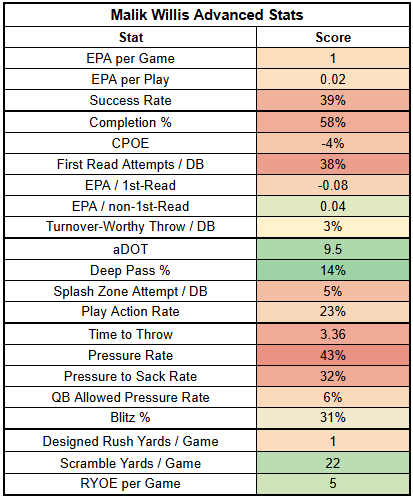
Willis has been a very aggressive downfield passer this year. And to find those throws, he's holding the ball a long time and moving off his first read at a high rate. This leads to pressure, which Willis is turning into sacks at a concerning rate. Willis has also been inaccurate, even in the context of his high aDOT.
Willis now gets a Chiefs defense that has been quite good this season in the overall numbers. However, it's noteworthy that Bo Nix really struggled against them and then Daniel Jones was impressively efficient. It's not clear that the Chiefs are really a needle-moving pass defense.
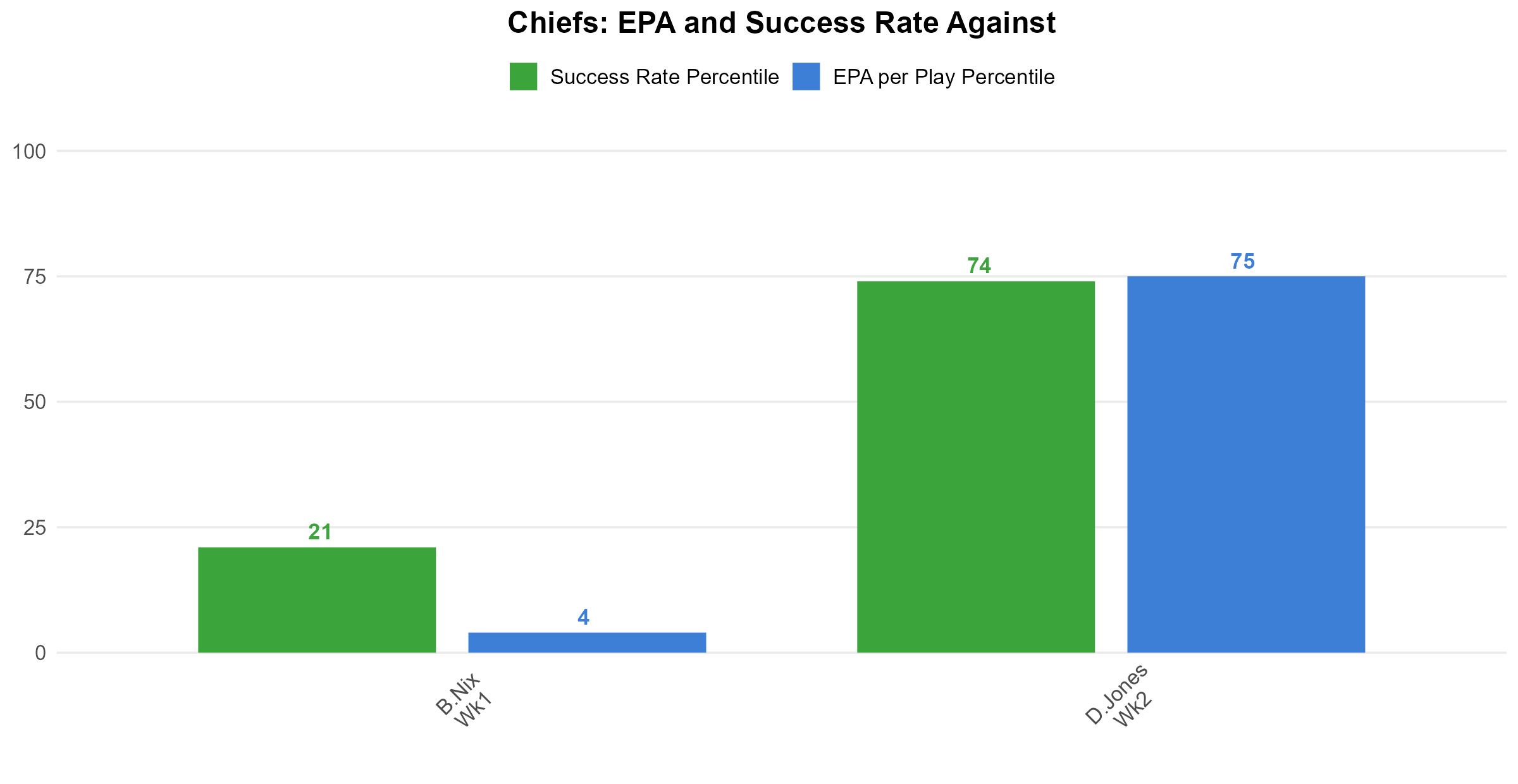
Still, Jones succeeded in a way that Willis is unlikely to replicate. He posted a 2.82-second time to throw with a 5.4 aDOT. Jones' success was driven by consistently taking what the defense was giving him, rather than hunting for big plays—the opposite of how Willis is likely to operate.
If Willis tries to hang back and hunt for deep throws, that is unlikely to go well. The Dolphins are allowing quick pressure at the highest rate in the league; the Chiefs are third-best at generating quick pressure.
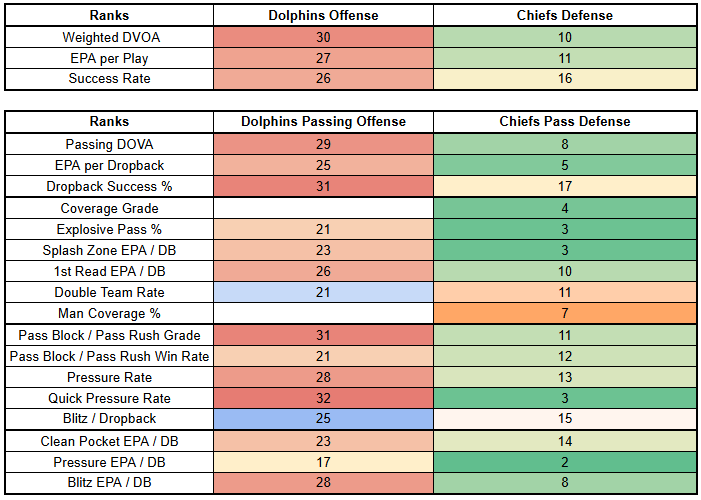
The Dolphins are also not a great bet for passing volume. They have fought game script in both games.
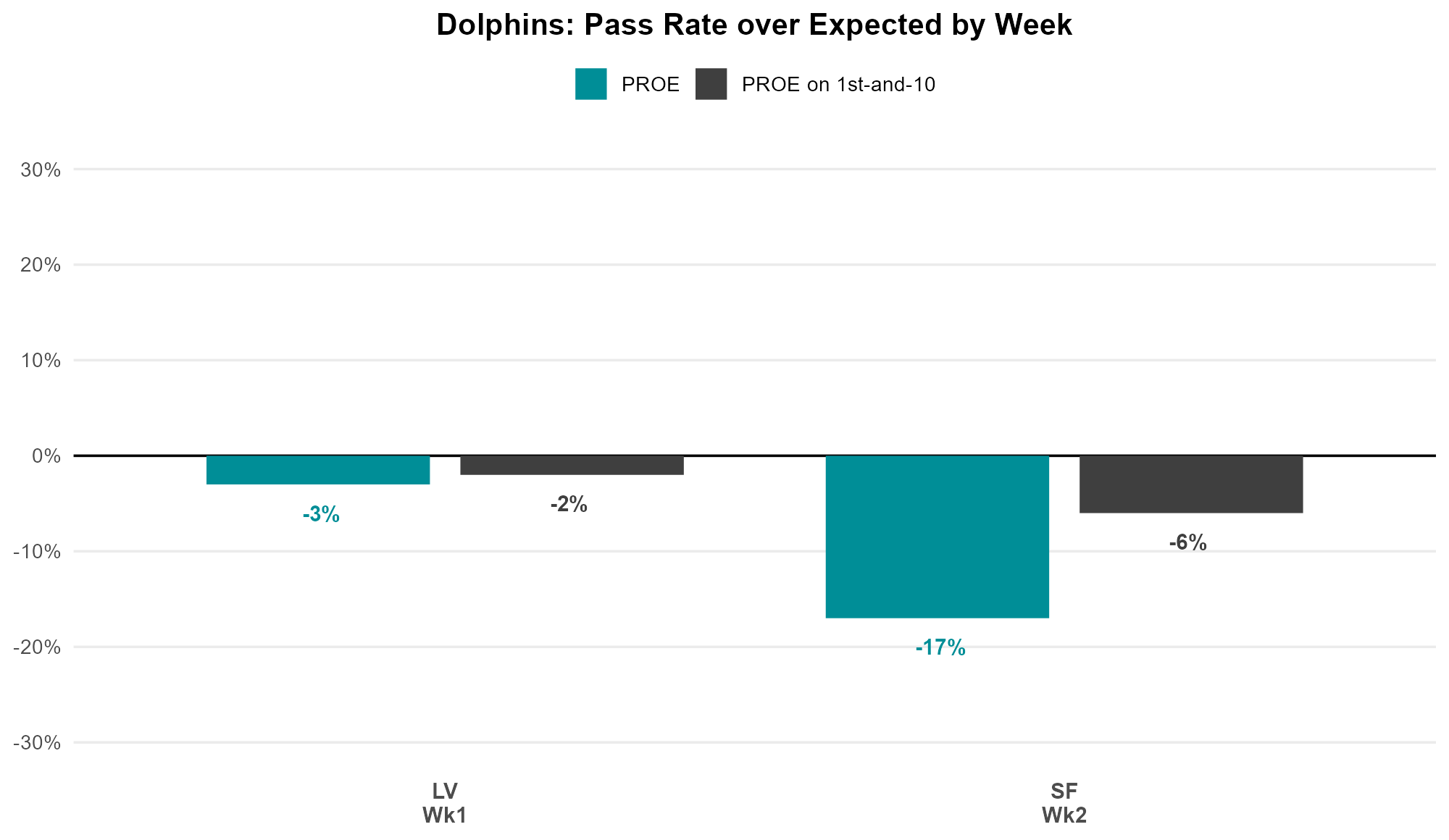
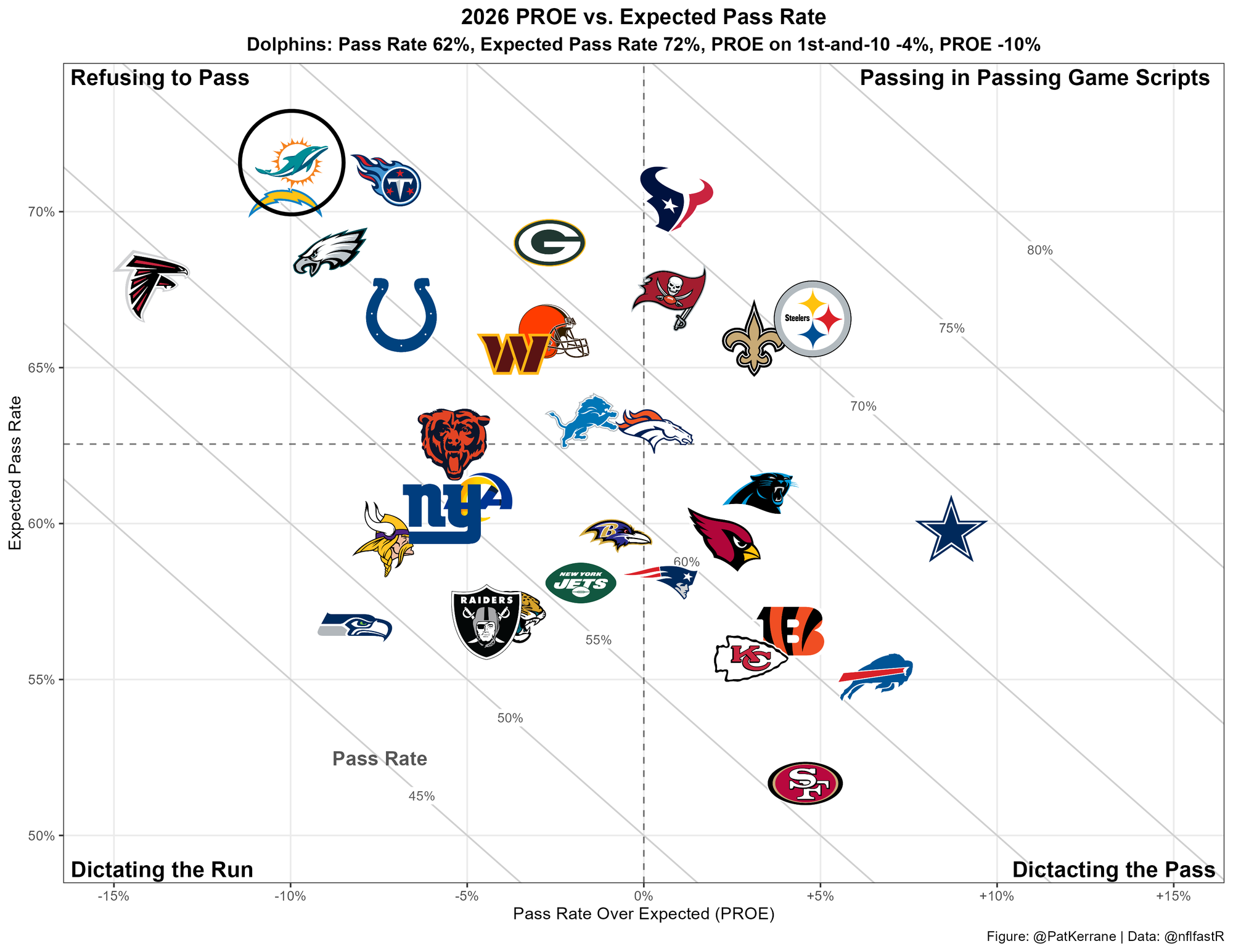
The Dolphins have been bad enough that they still have a 62% pass rate on the season. But they were at just 52% last week on a 68% expected pass rate. They're profiling as a team that will be stubborn about running the ball, even in negative game script.
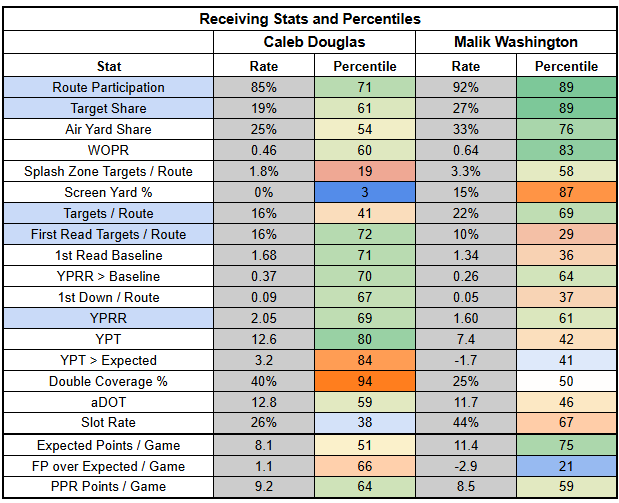
Caleb Douglas had a strong Week 1 but fell back to earth last week. He's now dealing with an ankle injury that has kept him out of practice. He's likely to miss this game.

Malik Washington picked up the slack, kind of, against the 49ers.

And with Chris Bell's playing time dropping last week, Washington looks like the best bet to operate as the primary receiver with Douglas banged up.

Still, it's not like Washington has been impressive so far this year. If Douglas suits up, I still prefer the rookie. But assuming Douglas is out, Washington is a WR4.
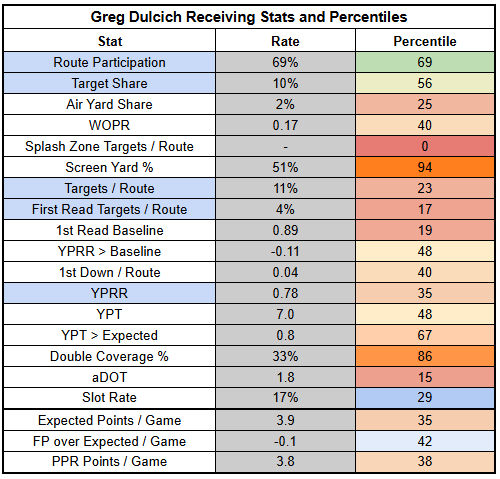
Greg Dulcich slipped to 61% route participation last week and looks like an increasingly shaky bet for production. He's a high-end TE3.
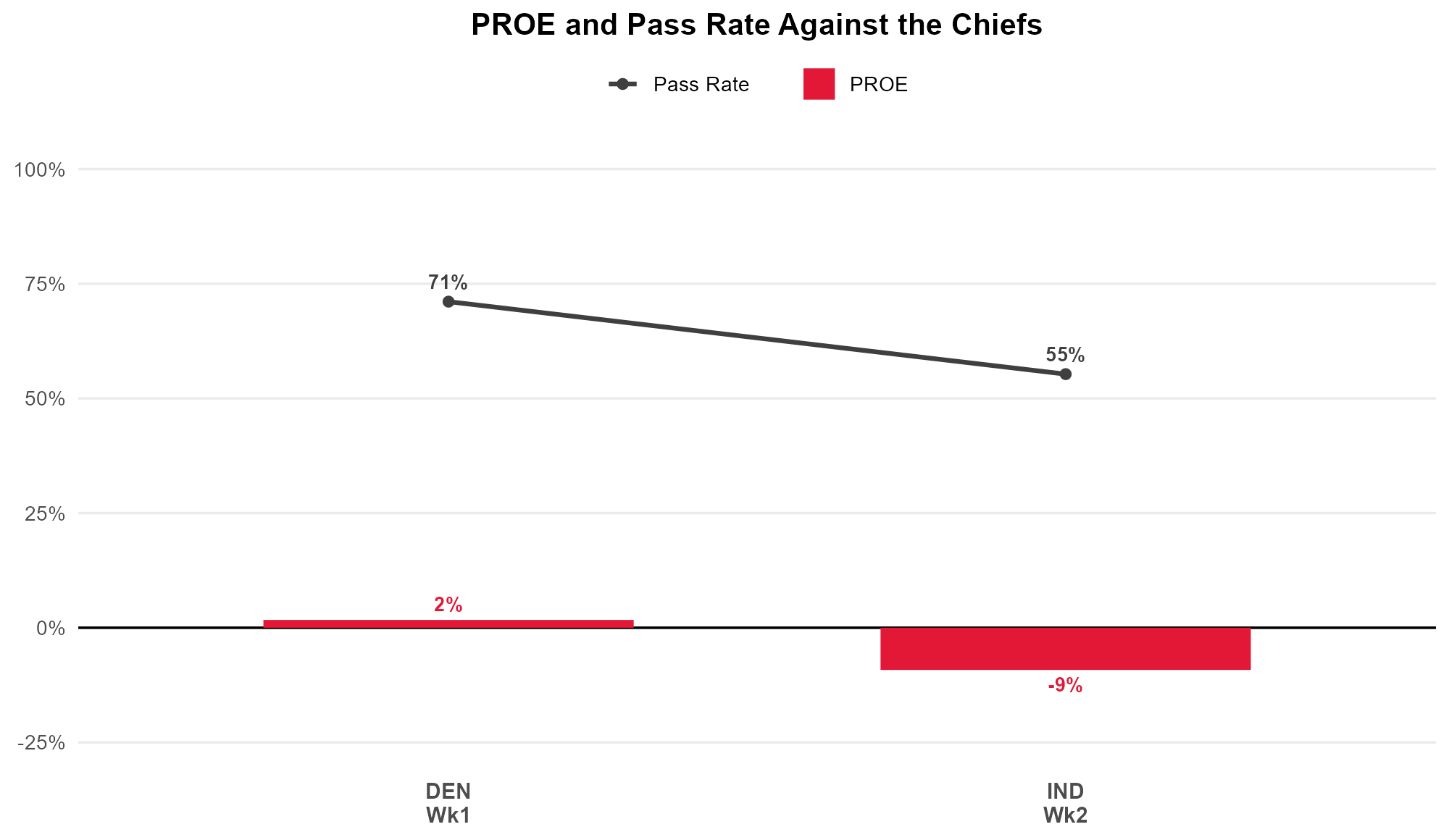
Last week, the Colts posted a -9% PROE against the Chiefs, and then efficiently passed the ball as part of a balanced game plan. And while I'm skeptical Miami is able to copy the passing efficiency portion of that game plan, I do think they'll attempt to run the ball.
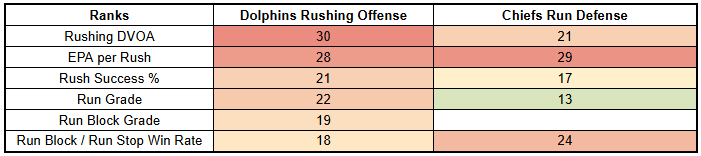
The Chiefs do not look very good at defending the run.
De'Von Achane's role has been truly excellent this year. He is dominating touches in Miami as both a runner and receiver. It just hasn't led to many fantasy points.
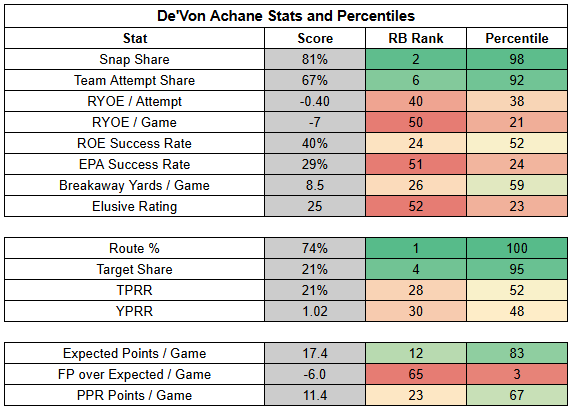
But last week's utilization was particularly bullish. He saw an elite expected points workload on the back of an elite target share. If that keeps up, he's going to have much better weeks. Achane is a low-end RB1.

Chargers at Bills, 1 PM
Chargers
Implied Team Total: 21.75
Mike McDaniel has kicked off his Chargers tenure with back-to-back losses to the Cardinals and Raiders. It's been brutal.
McDaniel is doing the McDaniel things. The Chargers are using motion at the second-highest rate and frequently utilizing play action. It just isn't working very well.
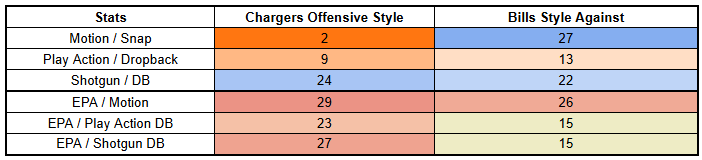
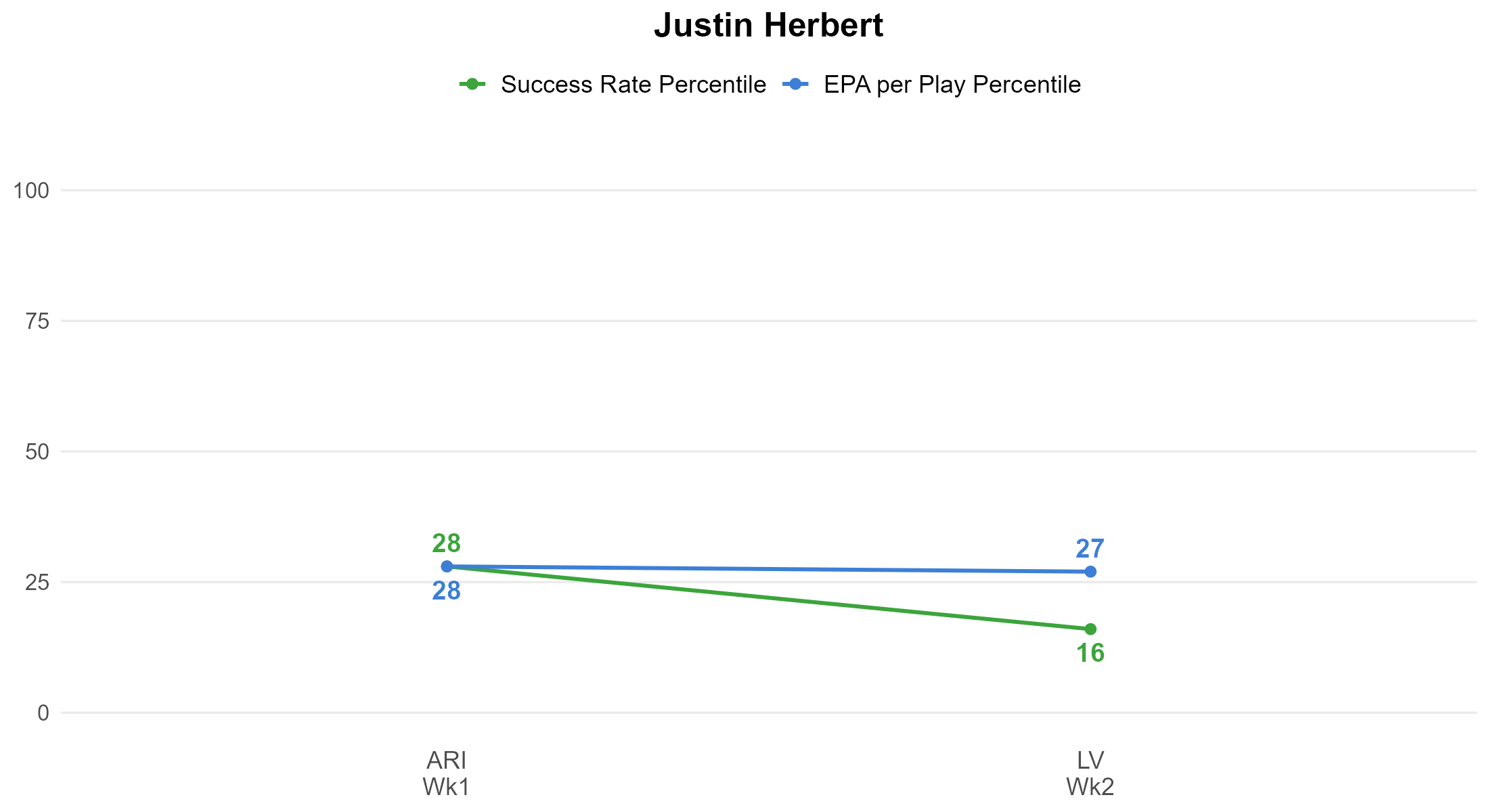
Justin Herbert has put up two straight stinkers, rating poorly in both EPA and success rate in both games.
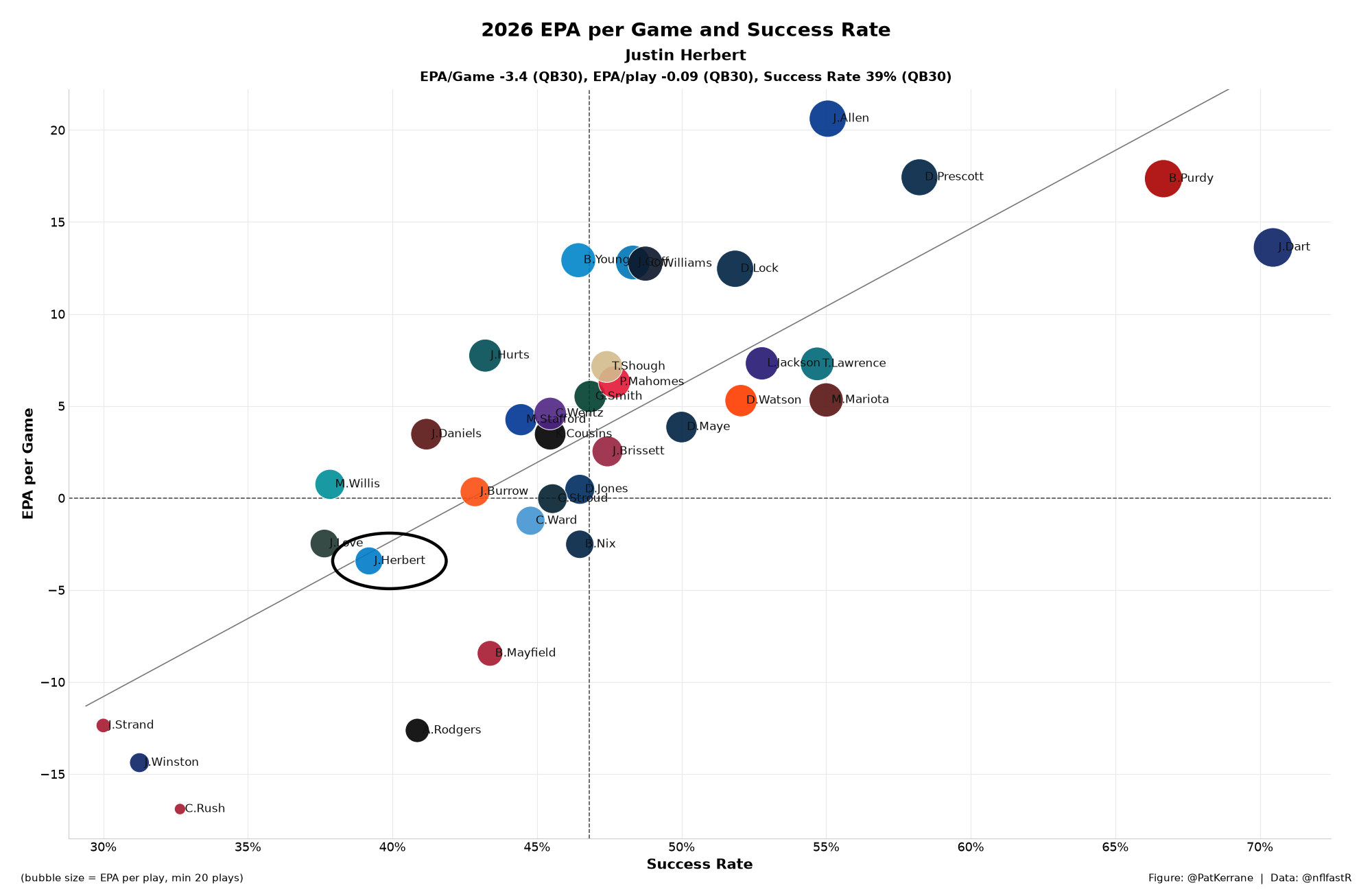
Through two weeks, Herbert has been one of the worst starters in the NFL. Among non-backups, only Jordan Love and Malik Willis have a worse success rate than Herbert's 39%, and only Baker Mayfield and Aaron Rodgers have turned in worse EPA per game than Herbert's -3.4.
Fortunately, the Bills' pass defense looks quite weak.
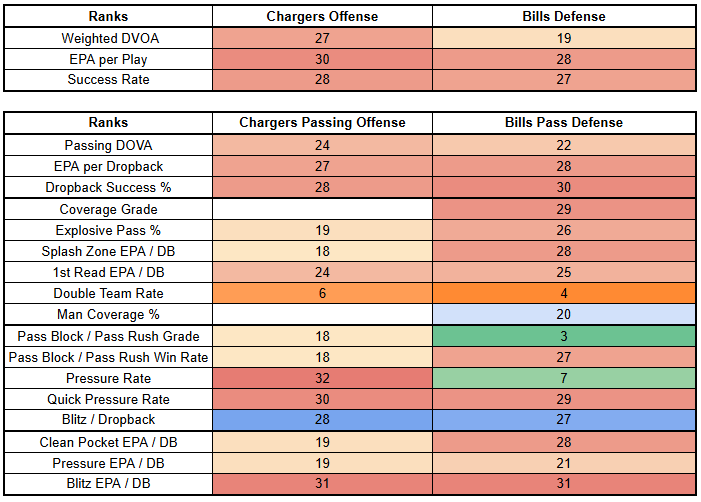
Both CJ Stroud and Jared Goff were effective against them.
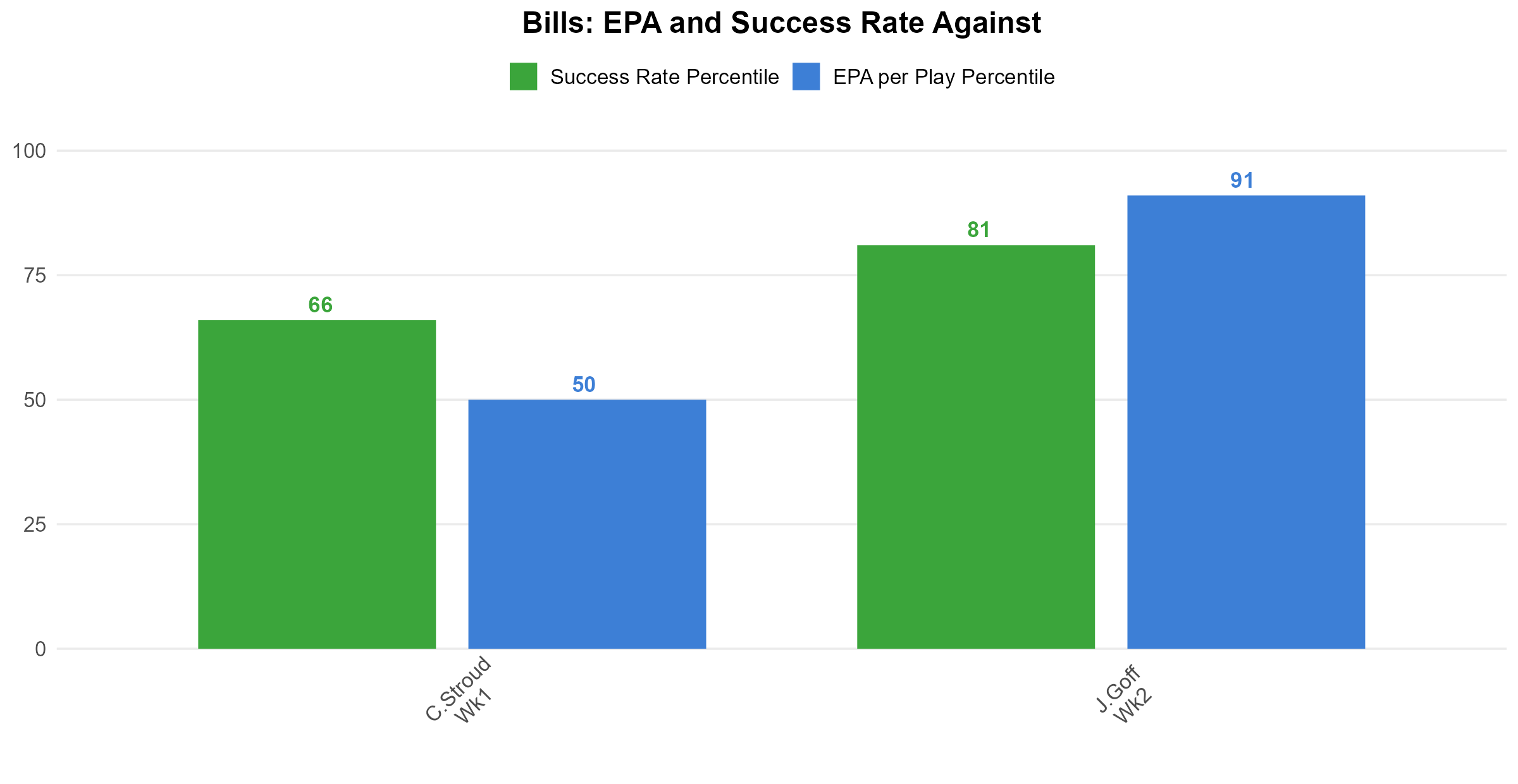
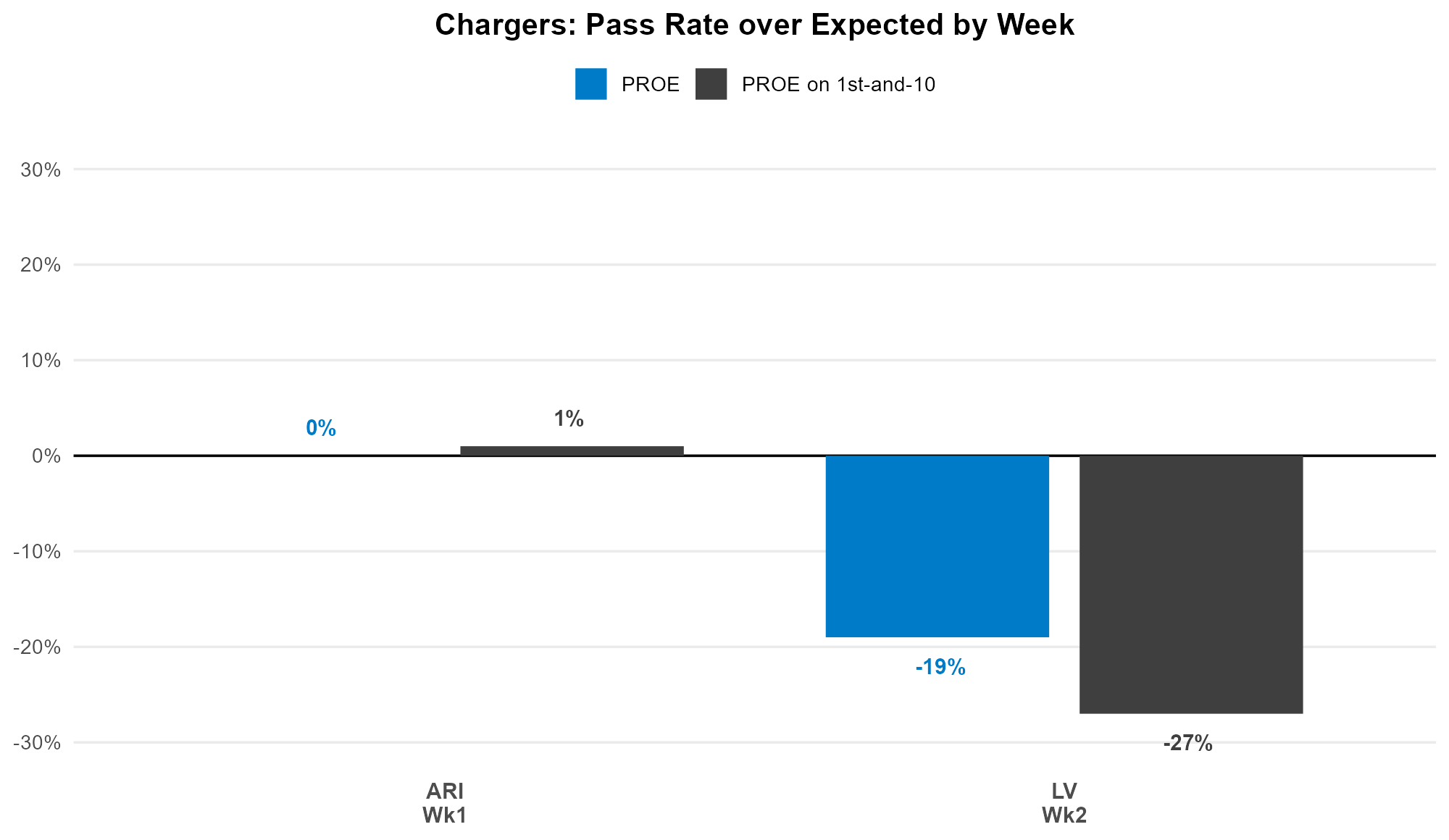
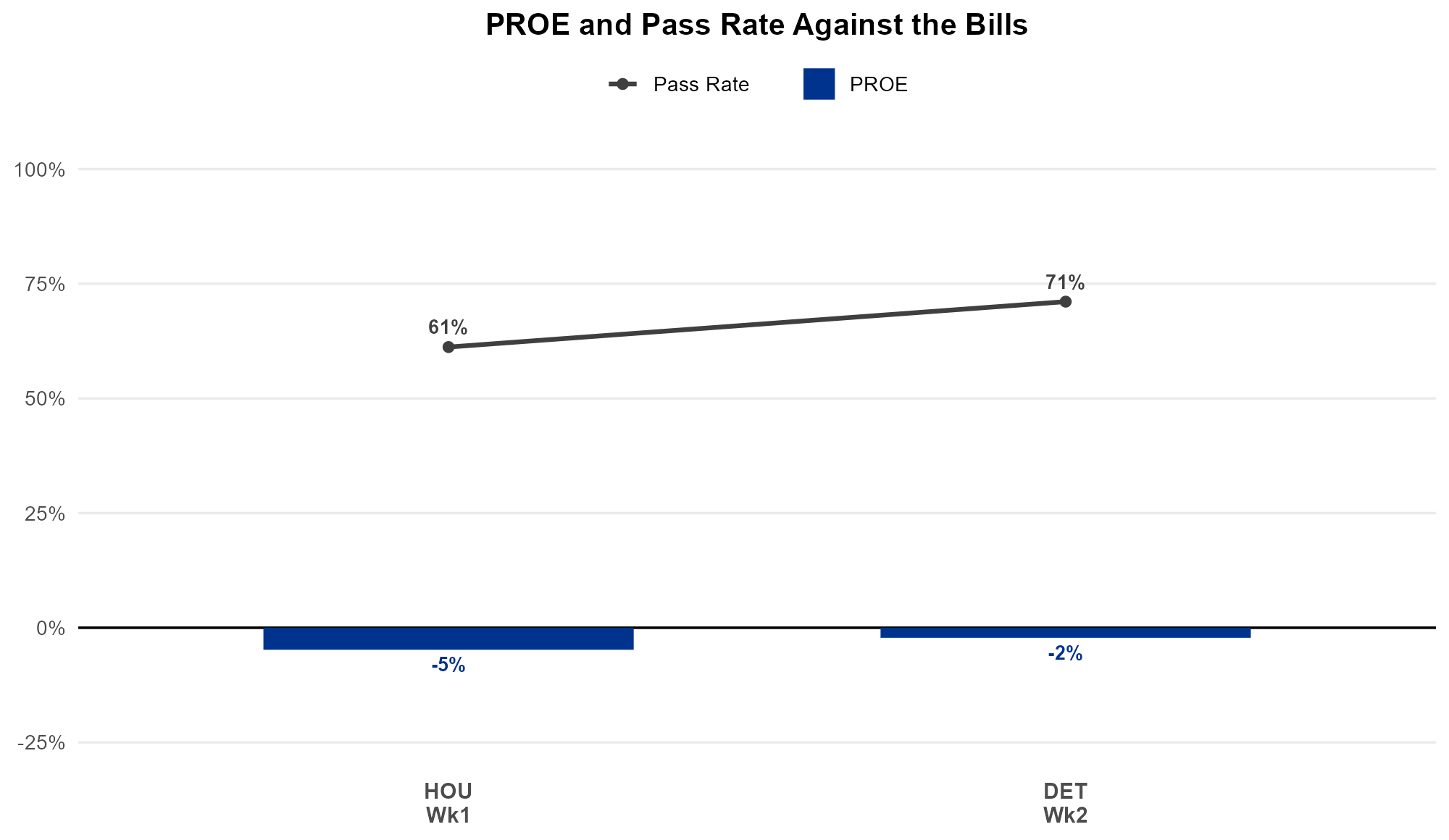
In addition to passing efficiency, however, we now have questions about McDaniel's commitment to the pass. The Chargers played very conservatively in Week 2, both overall and on 1st down.
The Chargers had very similar expected pass rates in both of their games. But they passed 71% of the time in Week 1; in Week 2, just 51%.
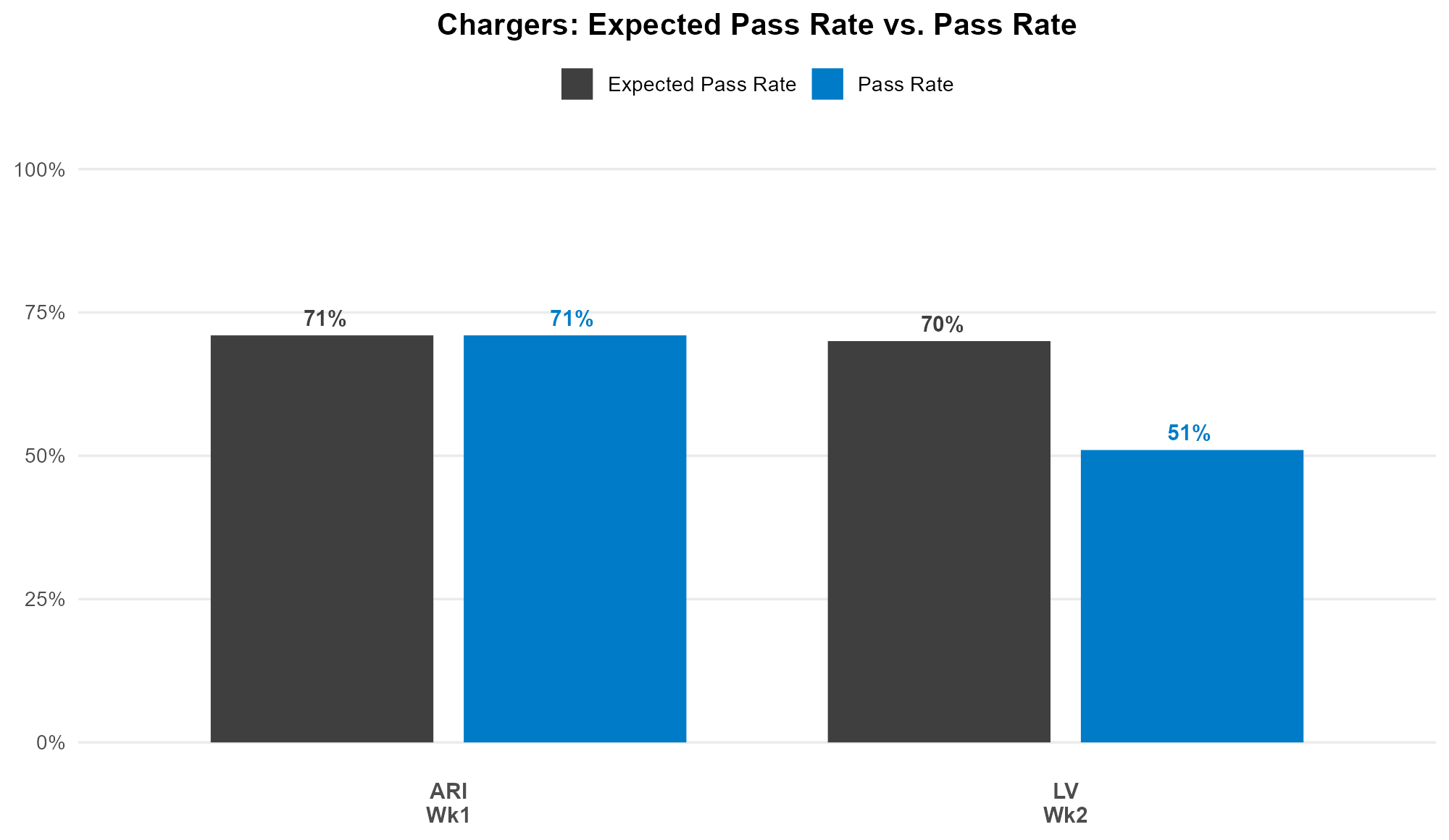
They were straight up refusing to pass against the Raiders—embarrassing stuff.
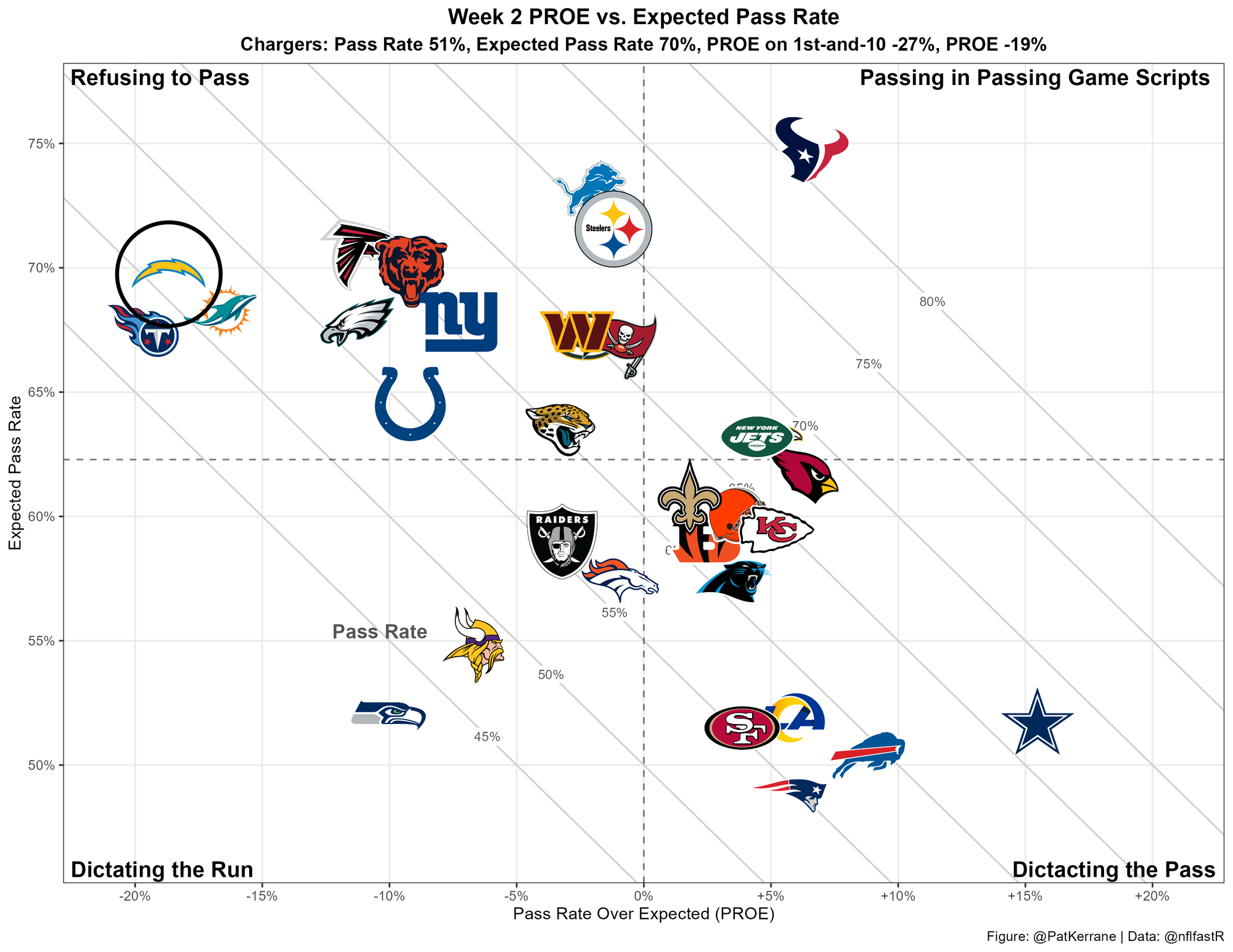
Although a matchup with the Bills is not good news for the Chargers' chances of winning, it could boost their passing production. As 7.5-point dogs, the Chargers will have a hard time keeping up if they play like last week. And, for the first time this year, they'll be facing a confident offense, one that will look to score points in bunches, rather than grind a time-of-possession-driven victory.
The other piece of good news is that Ladd McConkey was able to suit up in Week 2. McConkey wasn't able to deliver like he was against Arizona. But he was dealing with an extreme rate of double coverage while playing at less than 100%. Hopefully, in his second week back, he'll look more like he did against the Cardinals than the Raiders.

Even with a down game last week, McConkey's profile is quite strong. With the Chargers very likely to beat the 33 dropbacks per game they've averaged through two games, McConkey is a high-end WR2.
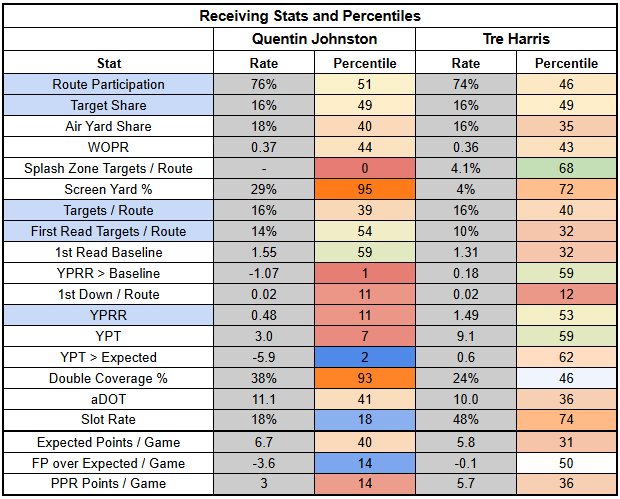
It's harder to be optimistic about Quentin Johnston and Tre Harris, who have done very little to this point. Johnston looks like a WR5, with Harris as a dart throw.
Last week, David Njoku was limited to 26% route participation before suffering a knee injury. Charlie Kolar posted 39% route participation before injuring his forearm.
Those injuries open up significant opportunity for Oronde Gadsden, who, with 2.63 YPRR, has been productive when on the field this season.

Gadsden is a very specific type of player. He's a big slot WR. But the Chargers have open snaps at tight end and could use more playmaking in the passing game. He has a real opportunity in front of him and profiles as a TE2.
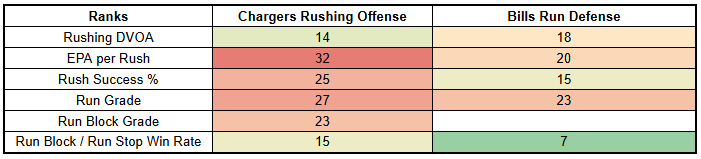
On the ground, the Bills have not been impressive. Granted, they had to face Jahmyr Gibbs without Ed Oliver in the lineup last week, and Oliver is expected back this week. Still, this defense is vulnerable on the ground as well as through the air.
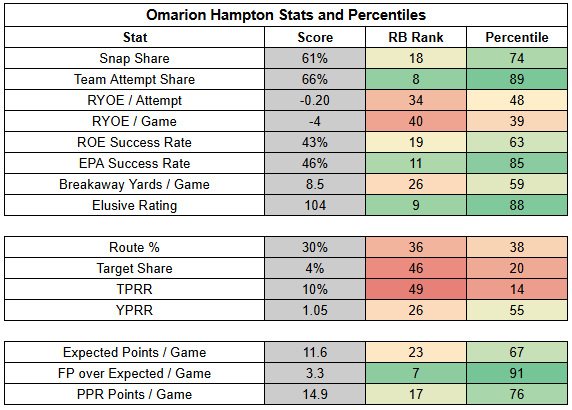
Omarion Hampton had an unimpressive workload in Week 1. Most notably, he was not targeted. He improved to a 9% target share last week, which is better, but still lower than ideal.
Hampton posted 19.5 PPR points last week, which was nice to see. But it's worth noting that the Chargers' run-heavy game plan was the driving force there.

If the Bills force the Chargers to chase points, Hampton's role in the offense could be disappointing once again. As a rushing hammer more than an all-around weapon, Hampton profiles as a low-end RB2. kjk;kjl;ljk
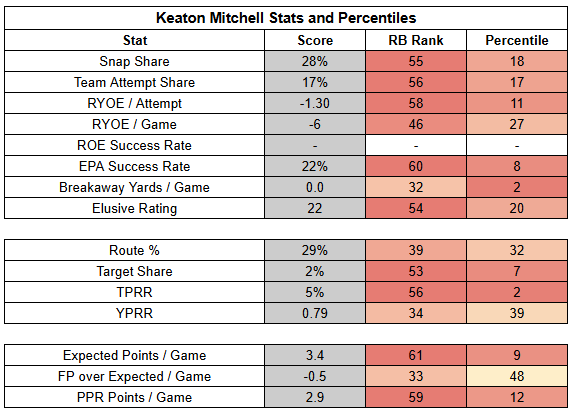
Before the season, this might have stood out as a high-end matchup for Keaton Mitchell. But Mitchell's role has been highly disappointing. He looks like more of a change-of-pace runner than a receiving back.

It's possible the 2026 numbers are wrong here. Justin Herbert didn't attempt a single pass to a running back in Week 1, and then the Chargers were extremely run-heavy in Week 2. There's some upside for Mitchell to prove he has a pass-catching role in this 50.5-point total game. But it's a leap of faith that, personally, I'm not excited to make. Mitchell is an RB5.
Bills
Implied Team Total: 28.75
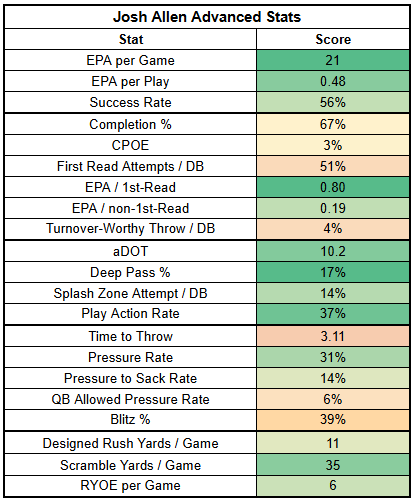
Josh Allen is rolling right now. He followed up his excellent Week 1 with an even better performance against the Lions.
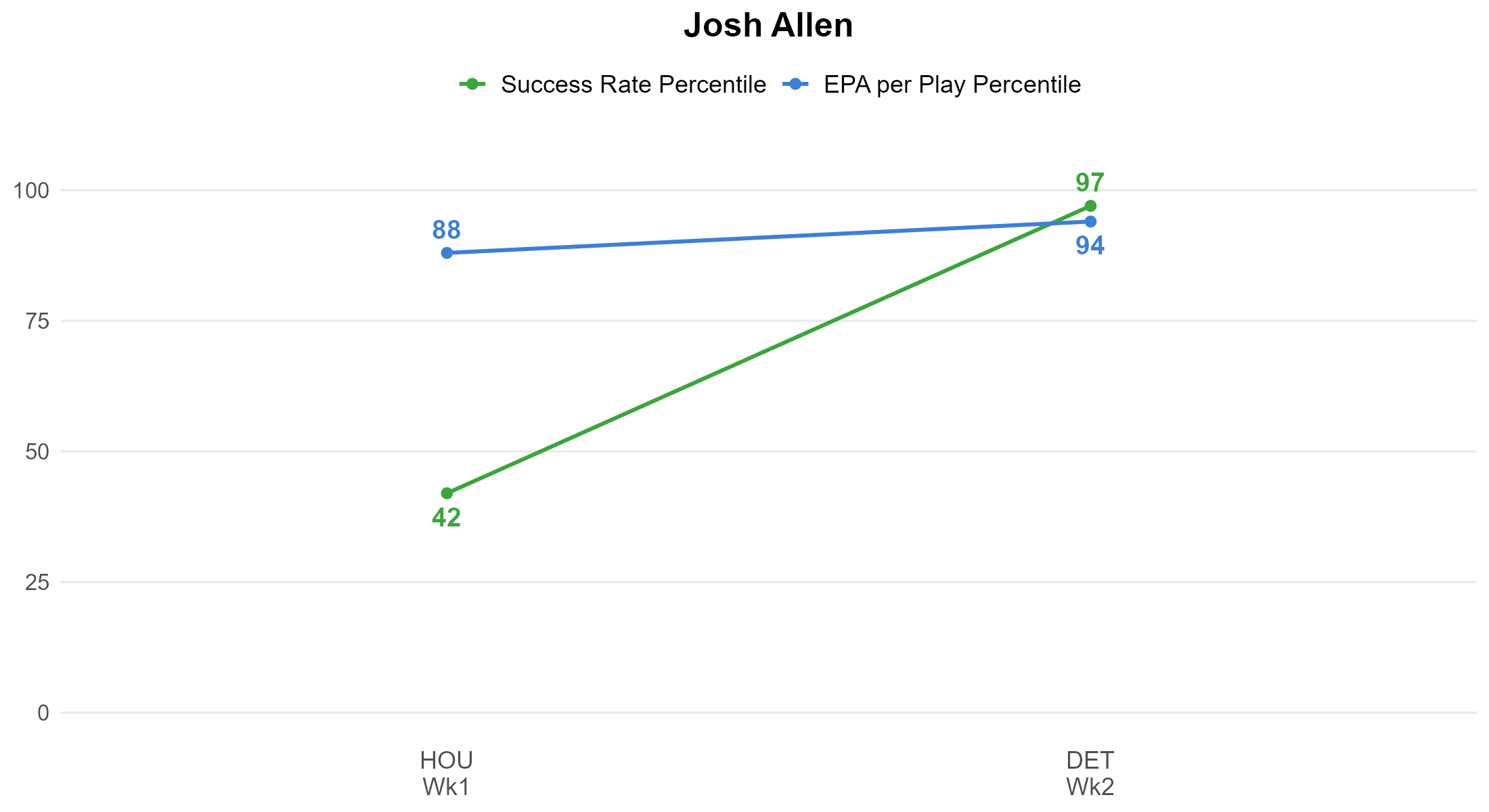
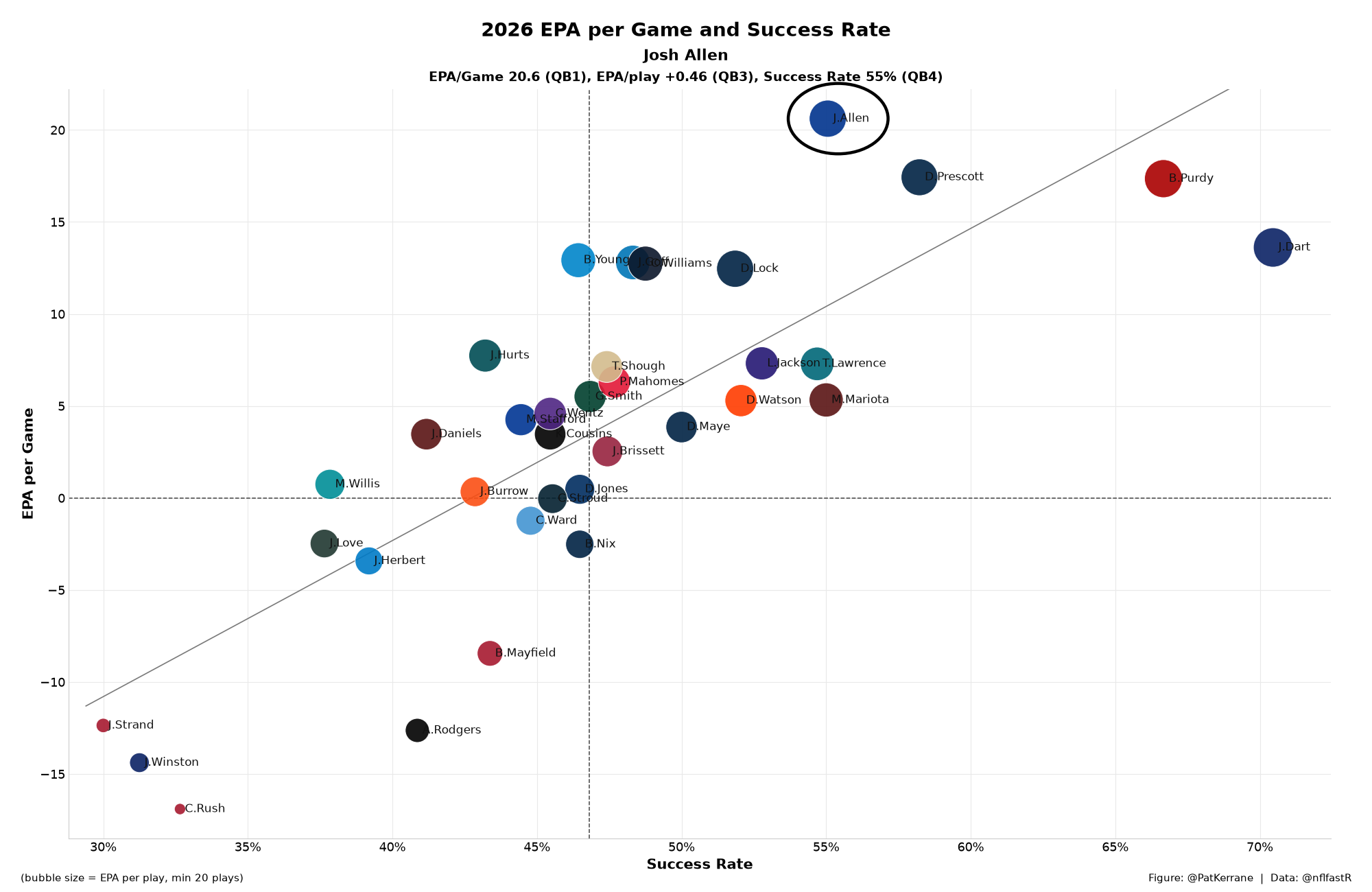
Allen currently leads the NFL with 20.6 EPA per game and a very strong 55% success rate. He's the early MVP frontrunner.
Allen now gets a Chargers defense that has been very weak against the pass. They've failed to generate pressure, especially quick pressure, and it's led to opponents consistently and efficiently moving the ball against them.
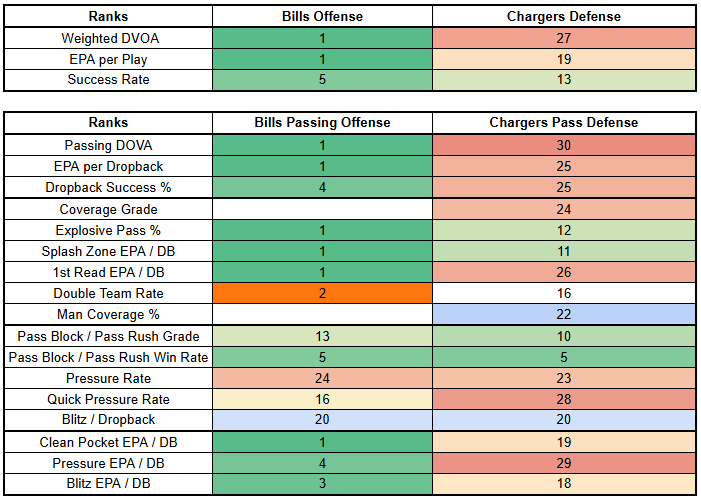
The Chargers have been much more effective against the run. Even with the Bills proving to be an elite rushing team this year, this run defense will be a test.
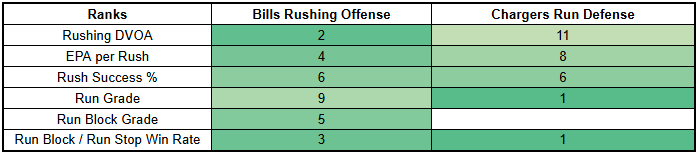
Last year, in this type of matchup, I would have worried about the Bills getting overly conservative. However, this year, they've been playing much more aggressively.
Buffalo has turned in positive PROEs in both of their first two games. And they just posted an 11% PROE on 1st-and-10 against the Lions.
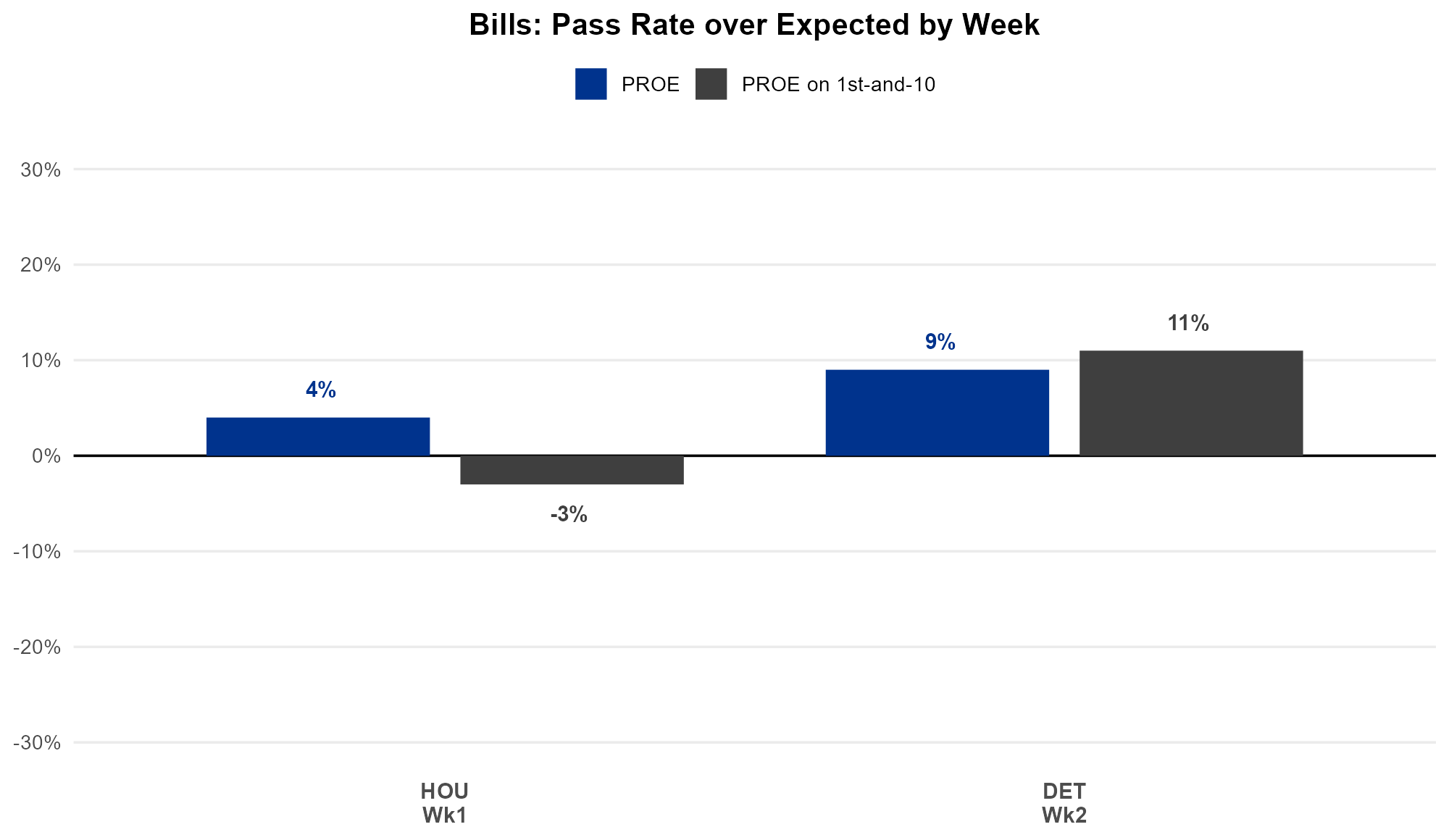
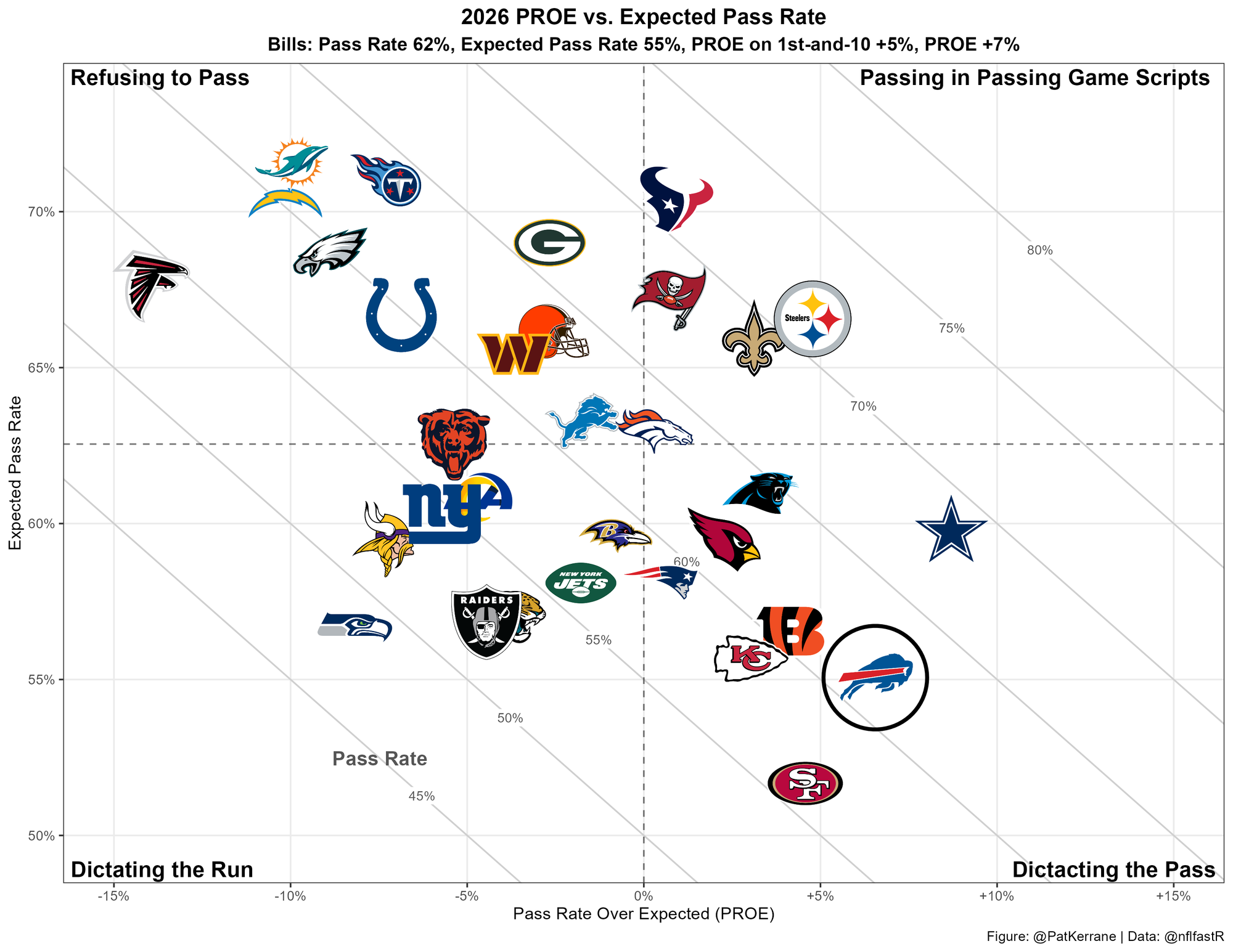
The Bills now have a 7% PROE, second only to the Cowboys (9%). This is very exciting, signaling an identity shift under Joe Brady... toward actually featuring the best QB in the NFL.
And it's not like this approach will necessarily make the Bills one-dimensional. By scoring points, the Bills are putting themselves in situations where the defense expects them to run. This was especially true last week, when they had just a 50% expected pass rate, the second-lowest mark of the week.
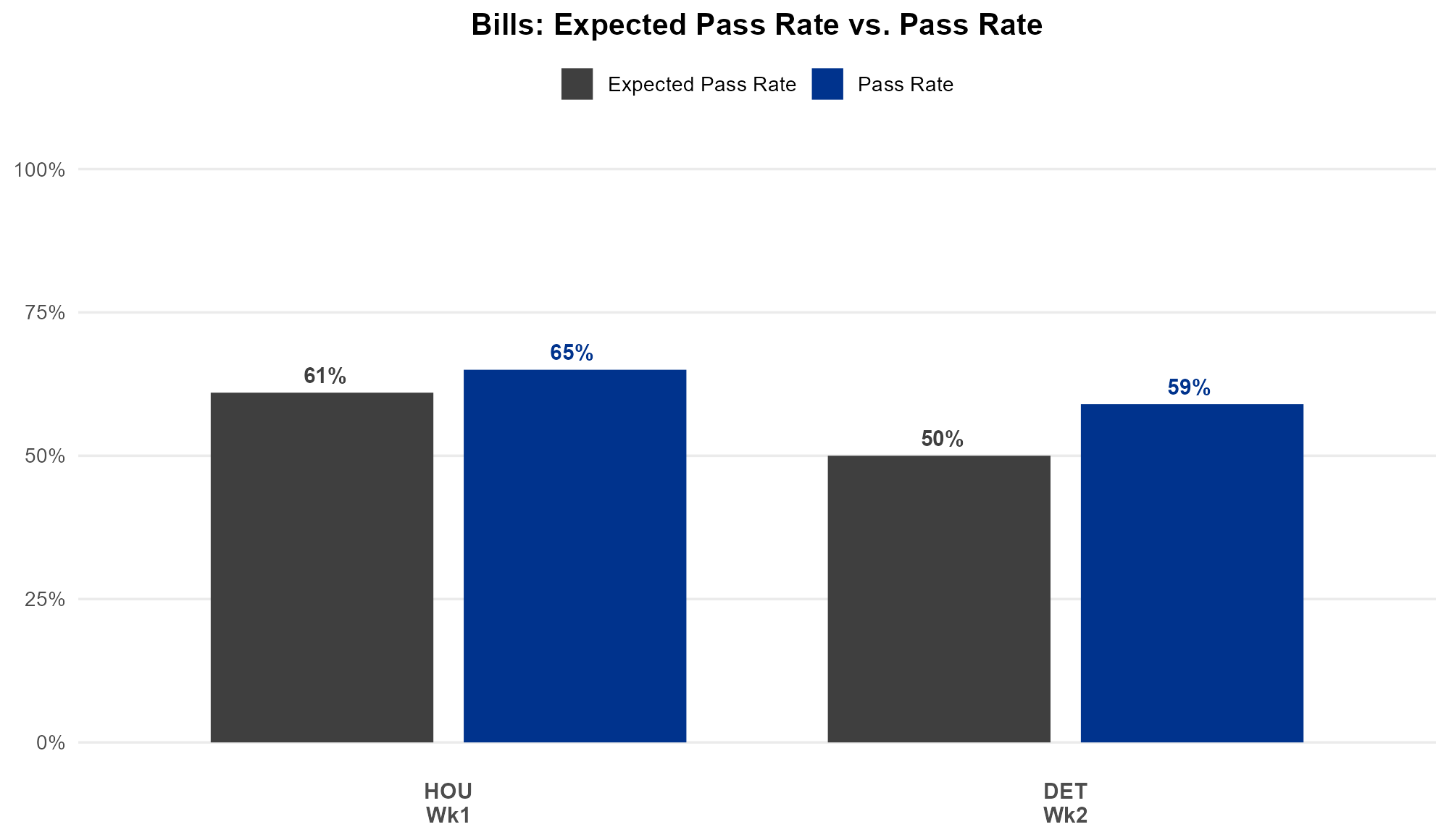
In other words, while the Bills are passing more than expected, they're still generating plenty of rushing volume by being a good team. Even with a 9% PROE, their 62% pass rate is barely above average.
As 7.5-point home favorites, the Bills look well positioned for positive game script. And if operating from ahead, they'll be set up to deploy play action from under center—punishing the Chargers for overplaying the run in scripts that call for it.
This is exactly how the Bills have operated so far. They have the lowest shotgun rate in the NFL and lead the NFL in play action rate. Meanwhile, the Chargers have been quite poor at defending play action.
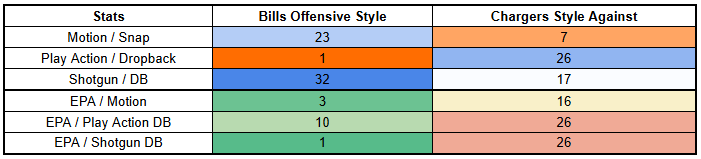
Allen has been pretty aggressive on play action, with a 10.5 aDOT on those attempts. But in all honesty, this is just one of the ways that the Bills look to have an advantage here. Allen is averaging 10.4 yards per attempt without play action and 8.8 yards per attempt with it.
If the Bills decide to operate a shotgun-driven passing attack, that would probably be even better for Buffalo. They have the highest EPA from the shotgun in the NFL.
But, of course, if this game becomes a shootout, that will be good for Allen and his receivers. The key point here is that even if it doesn't, that's probably cool too. This year's Bills look much better suited to putting up passing production in favorable game scripts. They're better at keeping Allen involved and the defense off balance.
Moreover, it's kind of hard to overstate how bad this Chargers defense might be. They've played Jacoby Brissett and Kirk Cousins so far. Both have been very efficient.
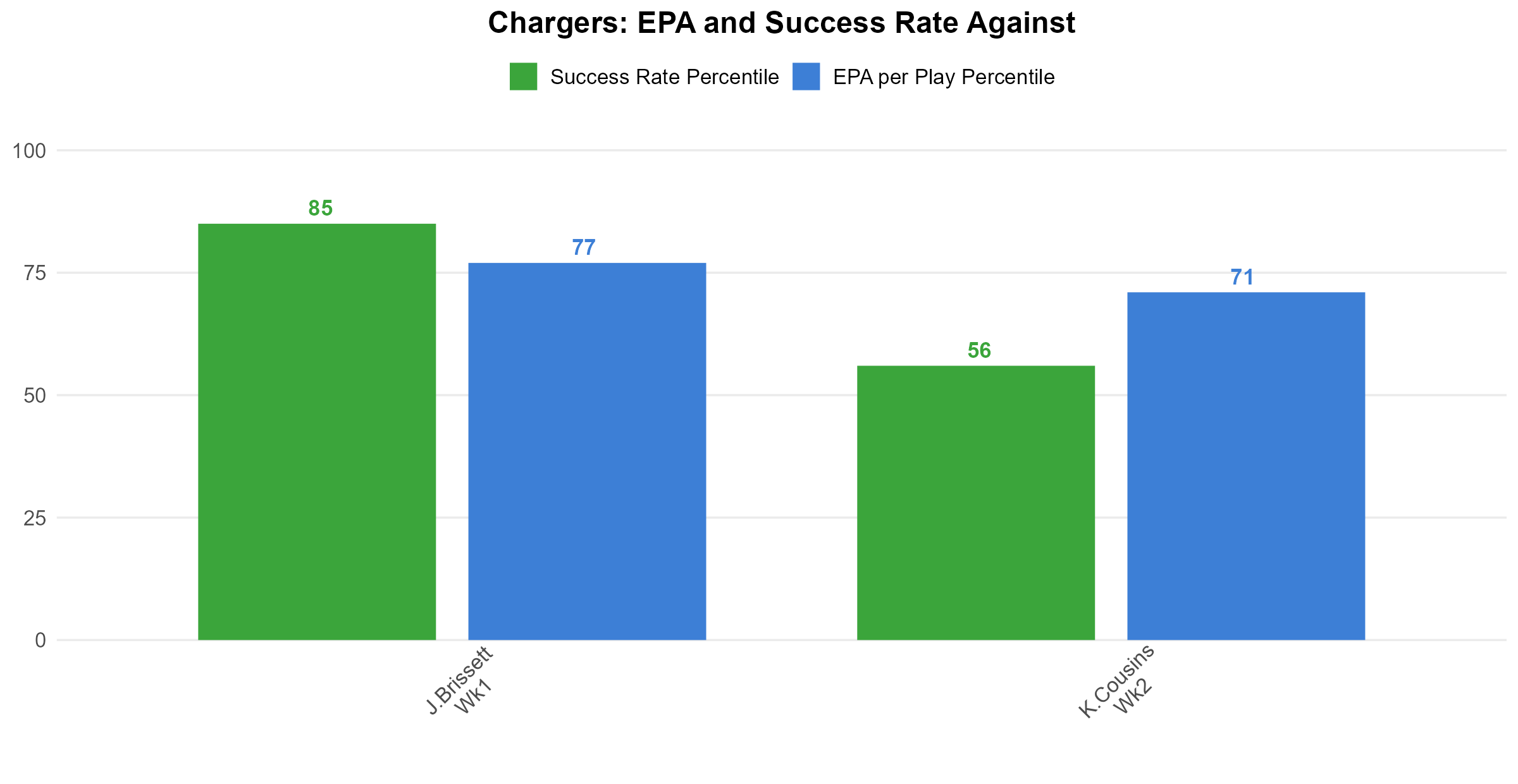
They now get Josh Allen.
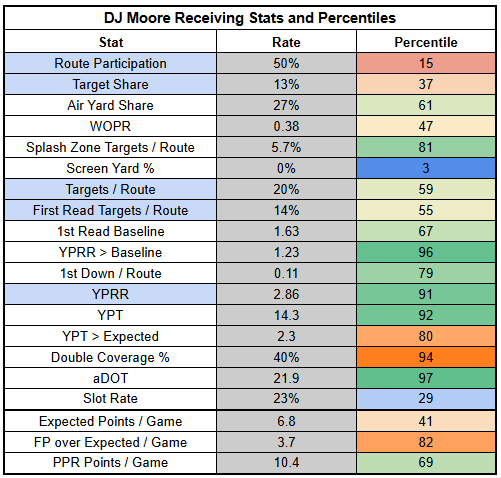
Allen's weapons are less of a slam dunk. Even if DJ Moore suits up this week, he'll be playing through a shoulder injury.
Moore's role in the offense hasn't been ideal. He's been very efficient, which is nice to see in the new offense. But his per-route target numbers are more solid than strong. At less than 100%, he shapes up as a high-end WR3.
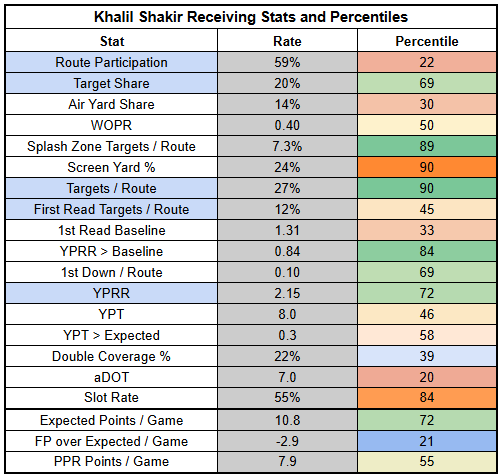
Even with Moore limited to just 24% route participation last week, Khalil Shakir saw just 55% route participation. It's a concerning sign for his future playing time.

Shakir is drawing targets at a high rate. But even that is more about his connection with Allen than his presence in the game plan. Shakir's 12% first-read target rate is unimpressive.
The good news is that Shakir is playing his role very well, and Allen may look for Shakir more often if Moore is limited. The bad news is that he's likely limited to a part-time role in the offense, with the passing game unlikely to truly flow through him even when he's on the field. Shakir is a WR4.
Keon Coleman stepped up as the primary outside WR with Moore out. He looks like a dart throw here.

Josh Palmer also rotated in, as he did in Week 1. But he's not really in play this week unless Moore is out.

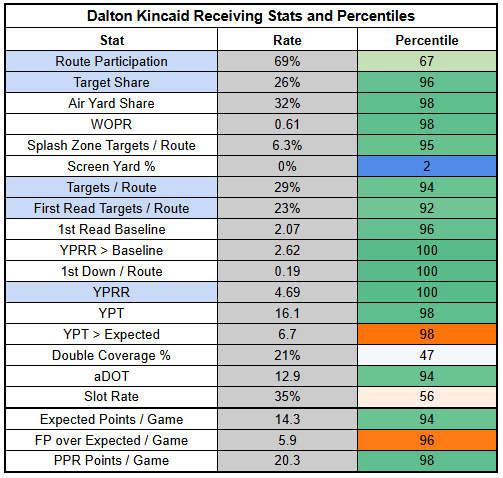
Dalton Kincaid looks like the most interesting Bills receiver. He's posted very similar route participation in Weeks 1-2, well above last year's 51% mark.

And with a bigger role, Kincaid has maintained elite efficiency. Kincaid is unlikely to ever post elite route participation for the position, but he's profiling as a true weapon at tight end. Kincaid is a high-end TE1.
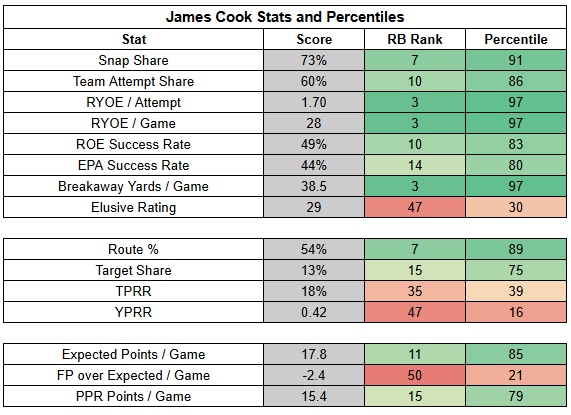
In the backfield, James Cook saw a much stronger workload against the Lions than against the Texans.

That makes sense. The Texans have a good run defense and pushed the Bills into a back-and-forth game. The Bills jumped on the Lions and played from ahead against their poor run defense.
This week, the Bills are likely to play from ahead, but again, get a good run defense... on paper at least. It's very much worth noting that the Chargers have faced the Cardinals' and Raiders' run games. Neither team ran the ball well last year. This probably isn't an ideal setup, but Cook is still a 7.5-point home favorite and is one of the most efficient runners in football. He's an RB1.