Week 5 Walkthrough: Stock Up on Brock

Welcome to the Week 5 Walkthrough.
In this article, I'll outline critical fantasy football context for the fifth glorious football Sunday of 2026.
(The stats below are from PFF, NFLfastR, rbsdm.com, RotoViz, FantasyLabs, Fantasy Life, Fantasy Points, ESPN, FTN, and NFL Next Gen).
PROE data is available for subscribers at the bottom of the post.
Quick Links
- Raiders at Patriots, 1 PM
- Bears at Packers, 1 PM
- Texans at Titans, 1 PM
- Bengals at Dolphins, 1 PM
- Vikings at Saints, 1 PM
- Browns at Jets, 1 PM
- Colts at Steelers, 1 PM
- Giants at Commanders, 1 PM
- Broncos at Chargers, 4:05 PM
- Lions at Cardinals, 4:25 PM
- 49ers at Seahawks, 4:25 PM
Raiders at Patriots, 1 PM
Raiders
Implied Team Total: 21
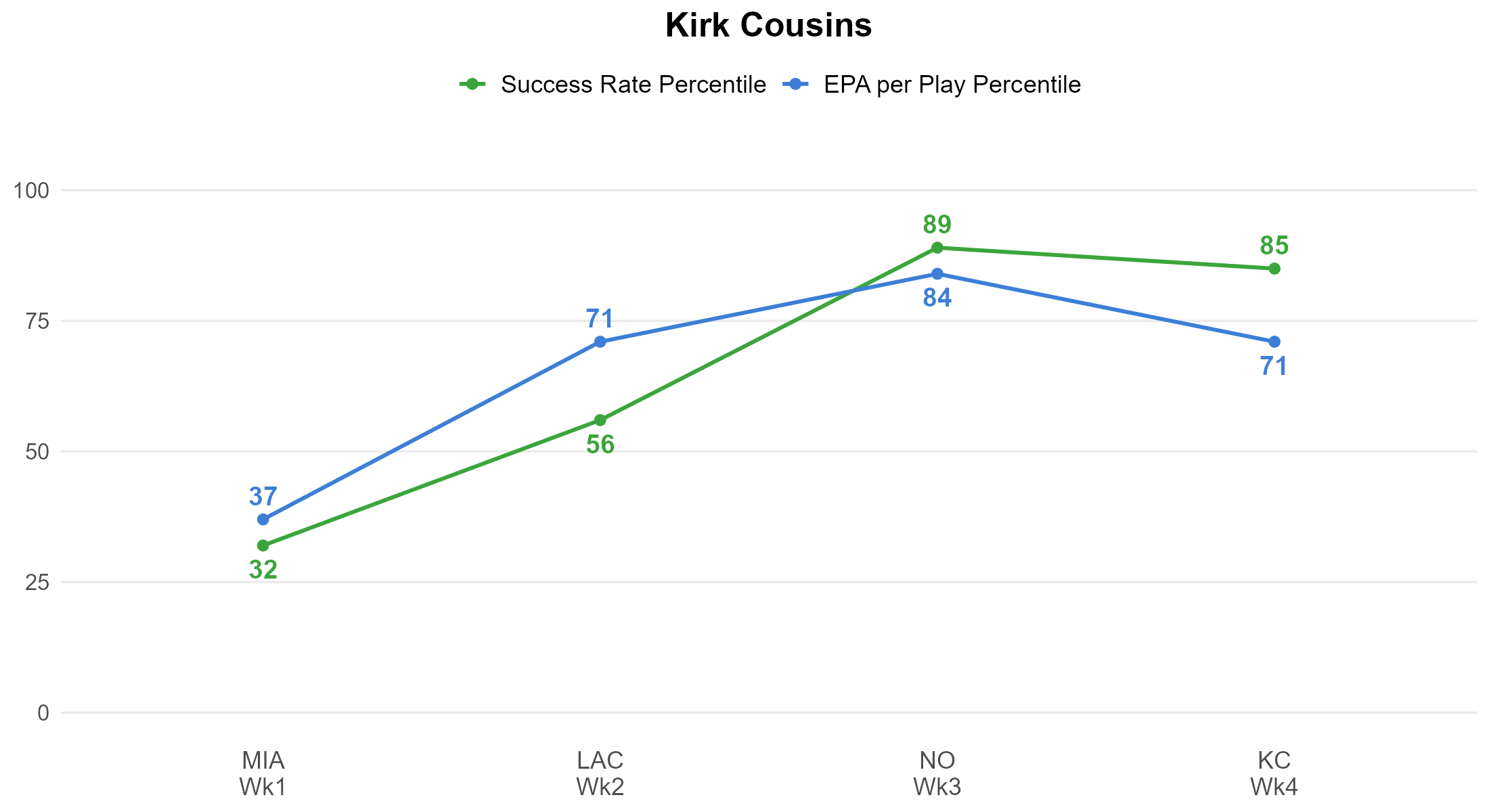
Kirk Cousins is having a remarkably strong start to the season. He currently ranks QB12 in EPA per game and QB8 in success rate.
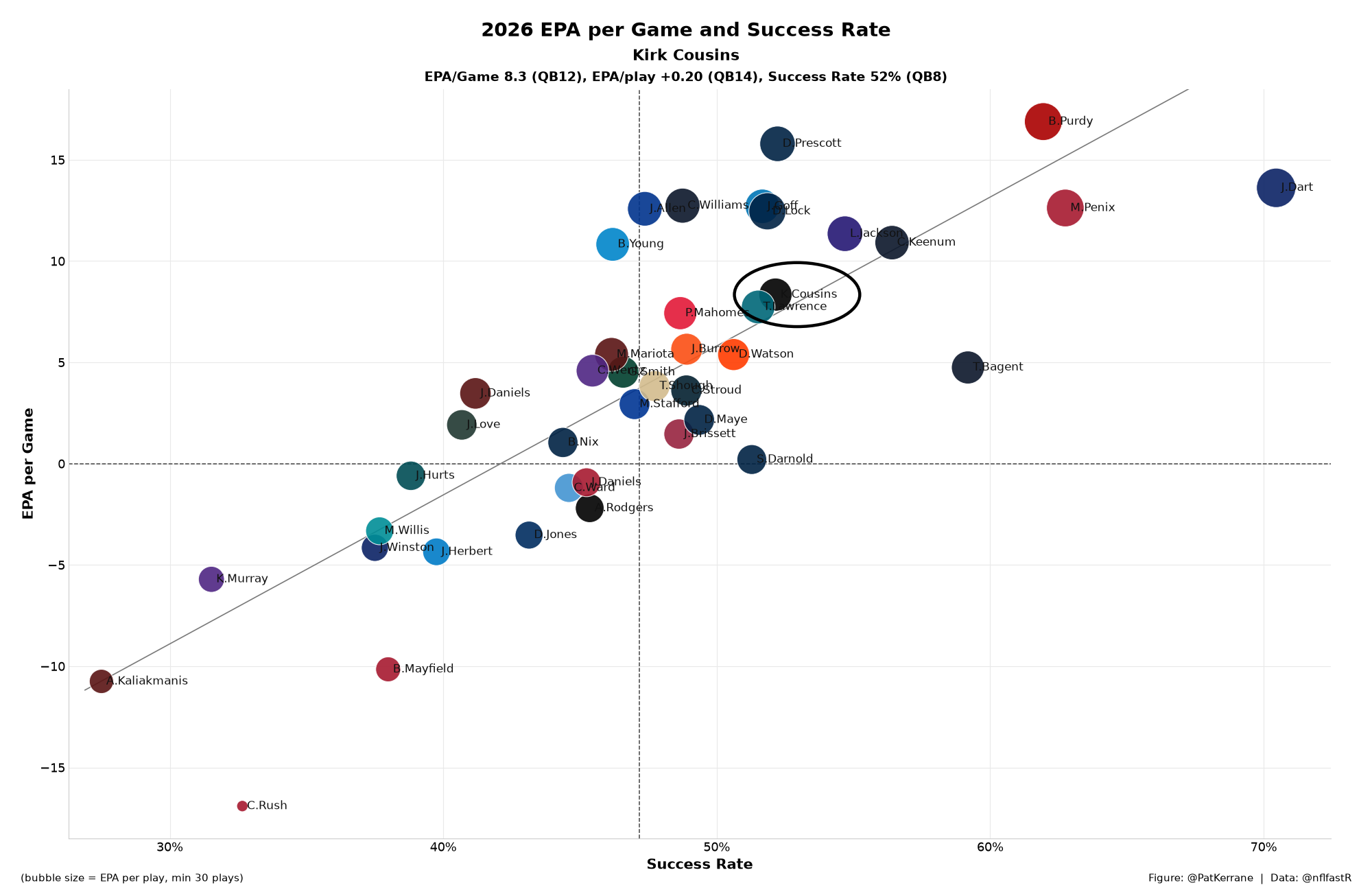
Cousins' season essentially boils down to a disappointingly inefficient Week 1 against the Dolphins and then three impressive outings since. The Raiders finally lost a game in Week 4, but Cousins played well.
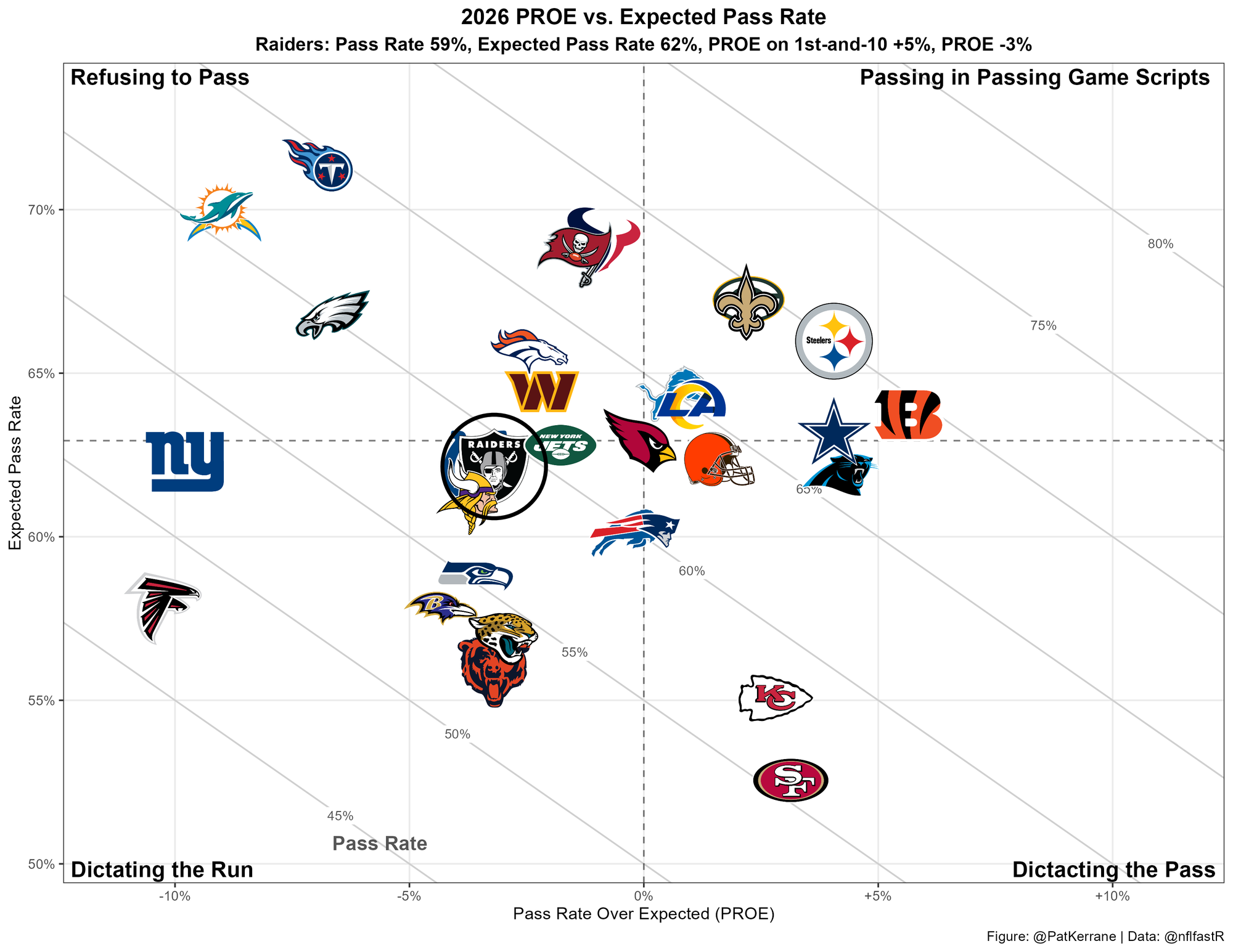
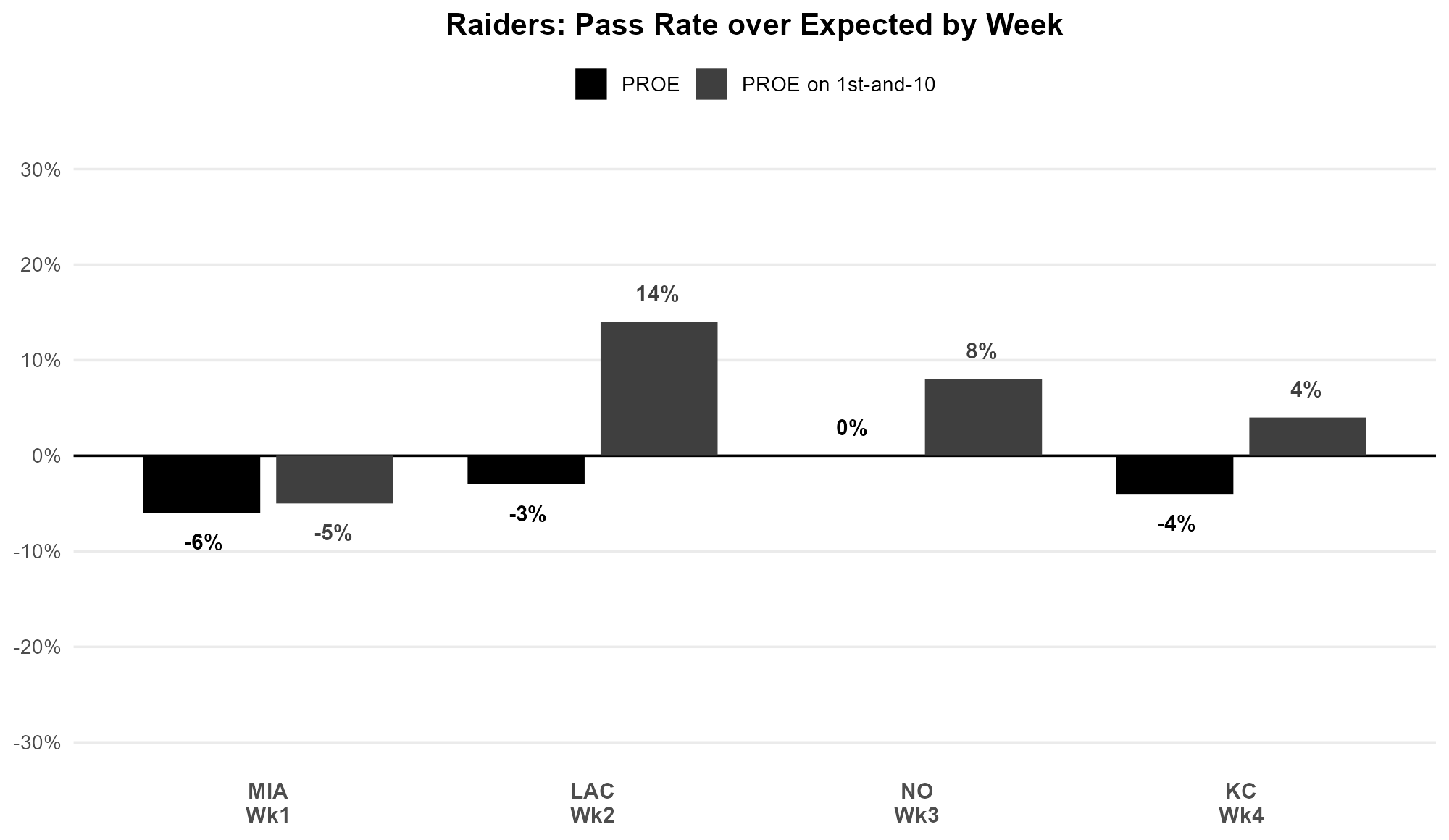
Cousins is operating efficiently in an offense that is built around the run. But the Raiders aren't extreme in their tilt to the run. They have a -3% PROE but a 5% PROE on 1st-and-10. There is still some pass volume in this offense.
The Raiders are also playing with pace, which is helping to generate raw production, despite a run-first philosophy.

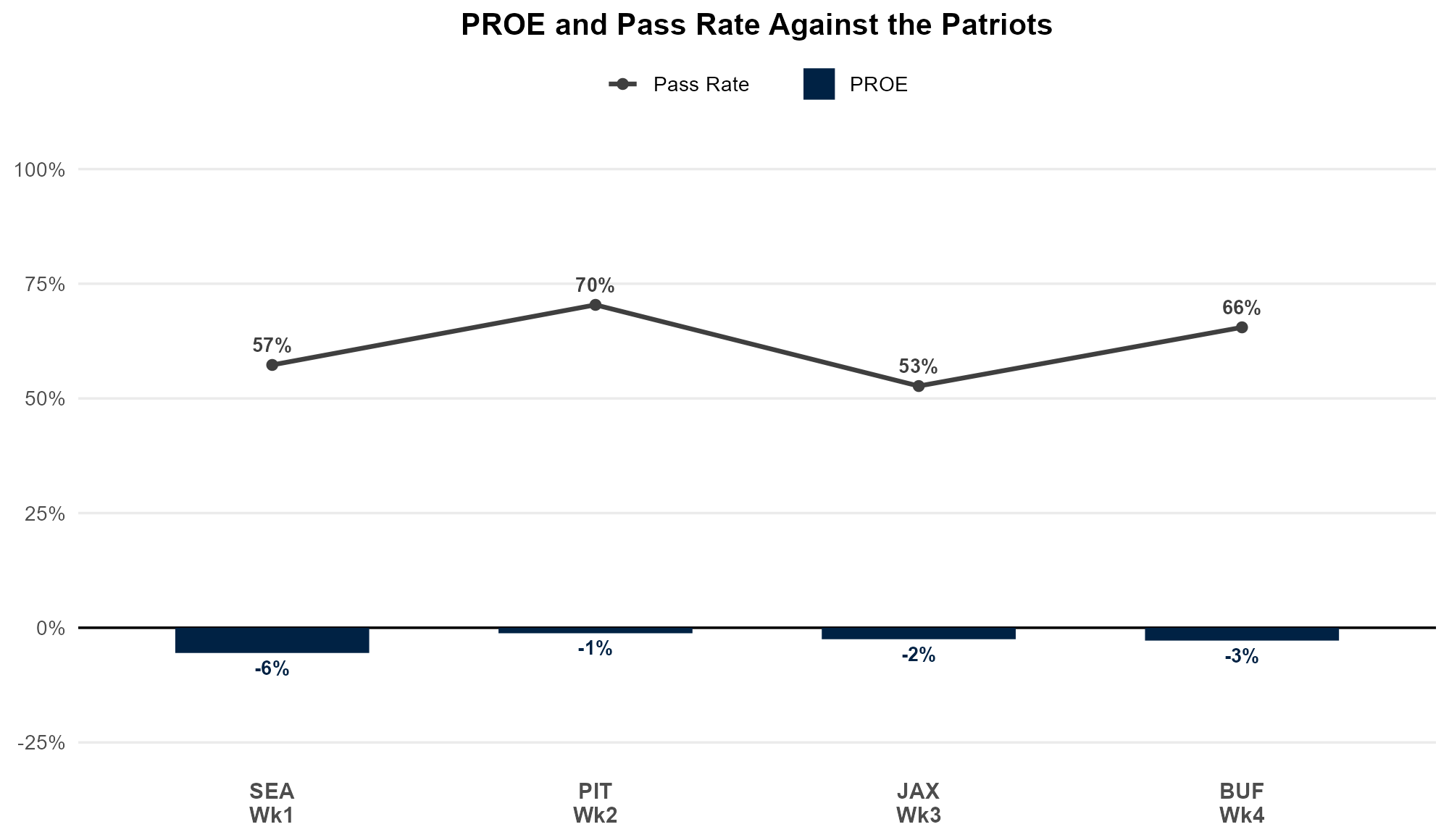
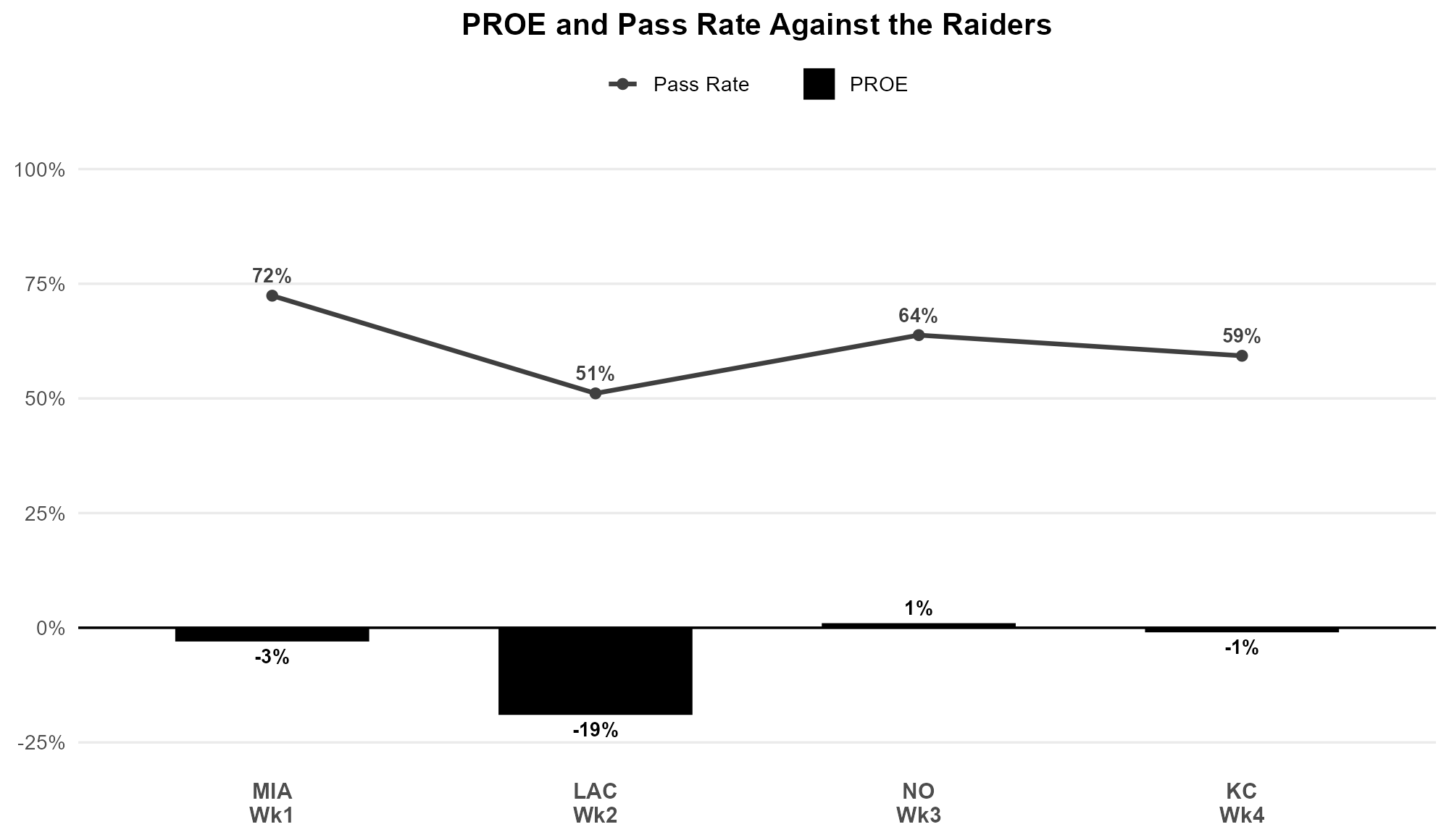
However, even if the Raiders aren't ultra-conservative here, they are very likely to favor the run game in this matchup. All four Patriots opponents have posted a negative PROE.
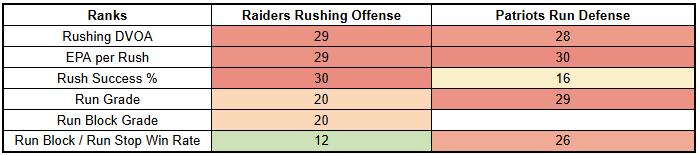
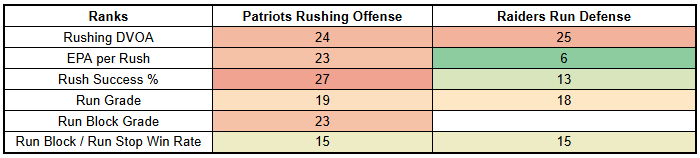
When looking at their run defense, it's not hard to see why.
And while the Raiders have been willing to pass more than expected on 1st-and-10, they've yet to post a positive PROE overall.
Ashton Jeanty continues to lead the way on the ground, but his grip on carries does appear to be slipping a bit.

Mike Washington is coming off a season-high 35% carry share against the Chiefs.

Washington has been very inconsistent per Next Gen's EPA success rate. And he's a zero in the receiving game. But Washington has been explosive.
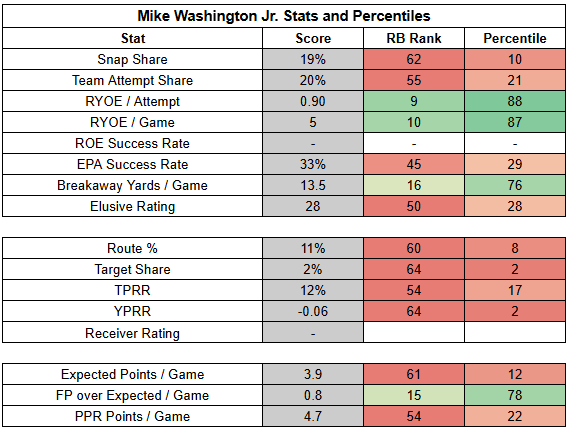
Given how unexplosive Jeanty has been and the fact that Jeanty has also been inconsistent, it's easy to understand why the Raiders are starting to mix in Washington more.
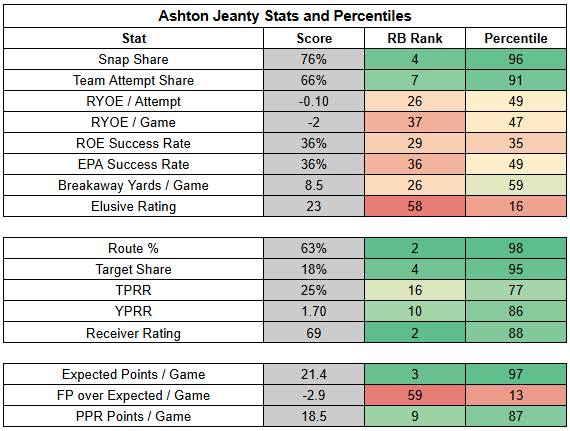
However, Jeanty's target share has driven a ton of his value this year, and that rebounded to 17% last week. With the Raiders as 3.5-point road underdogs here, Jeanty should see passing volume once again. It's also important not to get carried away with his lack of rushing work; Jeanty still saw 18.3 expected points last week, and delivered on that workload. Washington represents a medium-term threat, for sure. Jeanty needs to start running better, or he'll keep losing work. But this week, Jeanty should see a strong workload and looks capable of delivering very efficiently as a receiver, at a minimum. He's an RB1.
The Raiders' run game should help open up some play action shots this week, which could be quite valuable against a Patriots defense seeing a lot of play action and defending it poorly.
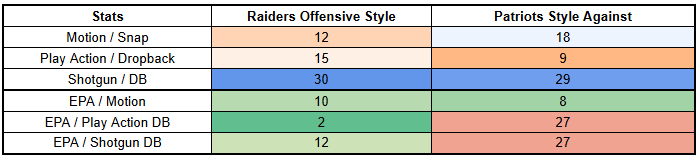
Unfortunately, play action represents a silver lining for an otherwise difficult matchup.
The Patriots have been somewhat up and down against the pass this year, but are coming off a very impressive performance against Josh Allen (by Allen's standards), in a game without Christian Gonzalez.
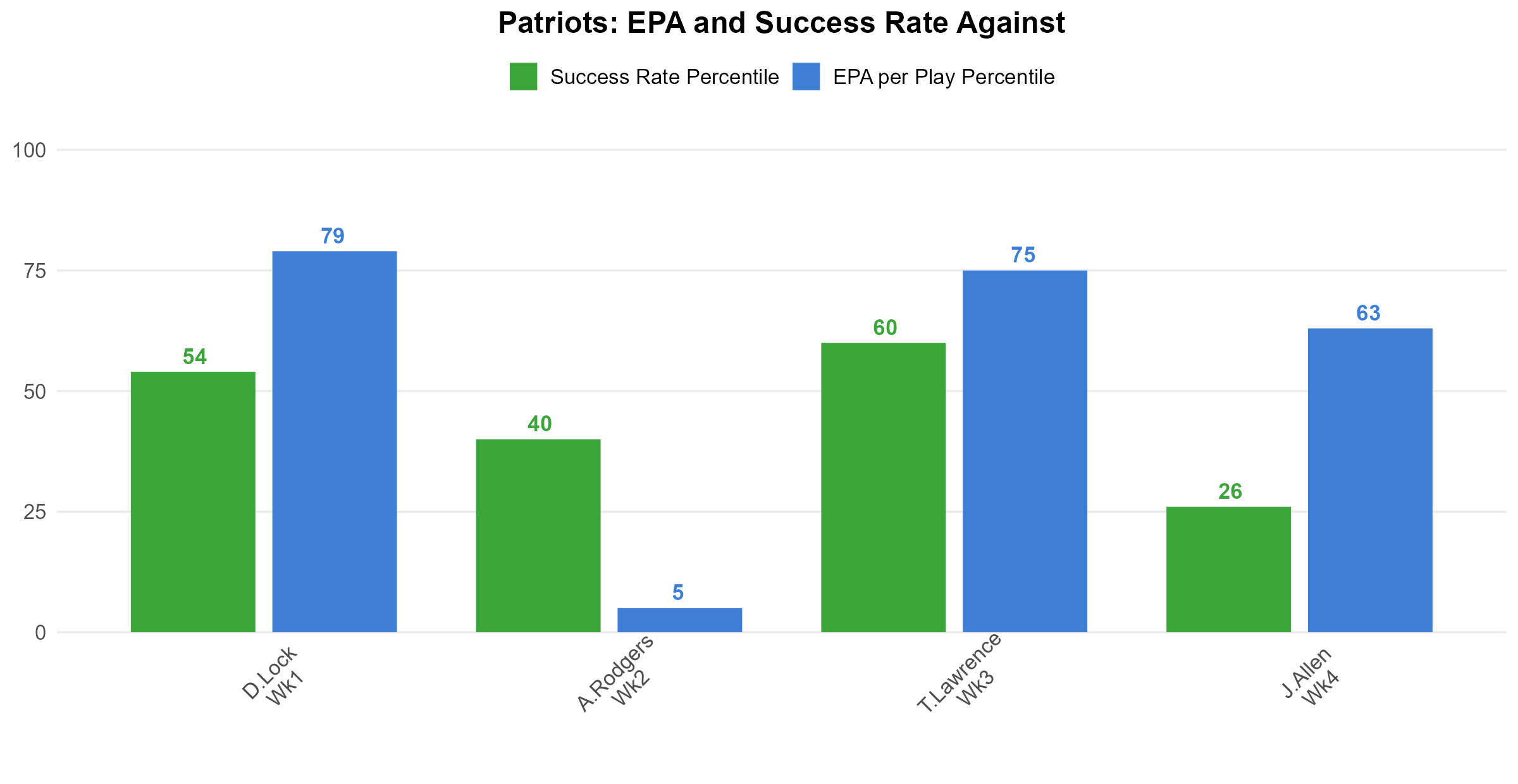
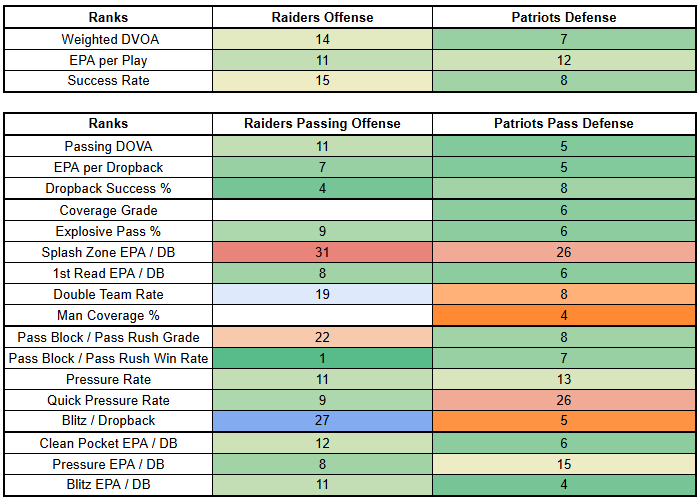
The Patriots aren't great at generating quick pressure. But otherwise, they are an impressive defense by the 2026 numbers.
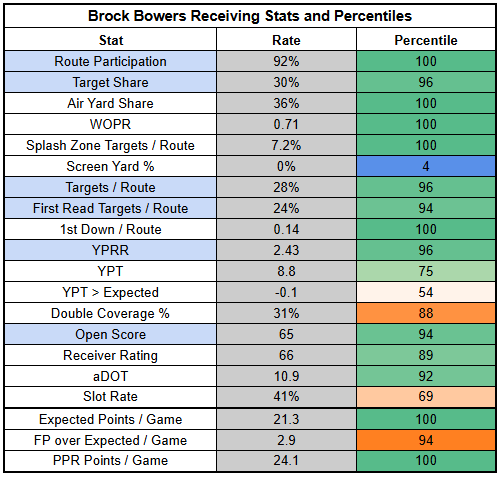
Even if Christian Gonzalez returns this week—and it looks like he might not—the Patriots are going to have their hands full with Brock Bowers. After seeing just 17% of his routes inline in Week 3, Bowers' usage there dropped. He posted just a 9% inline rate against the Chiefs, with 48% of his snaps out wide and 43% in the slot.
He wasn't quite as dominant as he was against the Saints, but Bowers turned in another impressive outing.

This week, if Gonzalez returns, having Bowers out wide could actually hurt his production. But the point here isn't that Bowers has to play outside. The takeaway is exactly the opposite. The Raiders can deploy Bowers wherever they want. He's a true chess piece. They'll move him around as needed to get him the ball. And, despite playing literal WR, Bowers has a 94th percentile open score. He makes getting him the ball easy. Bowers is an elite TE1.
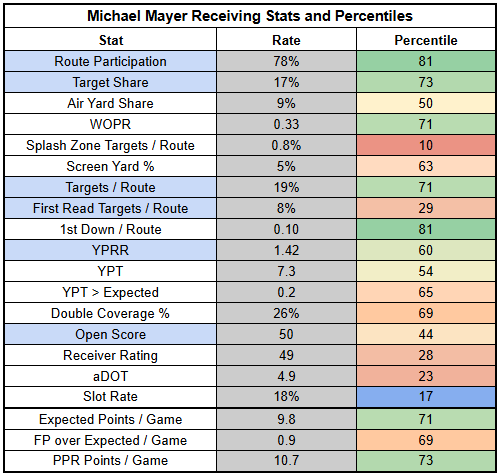
If the Raiders opt to use Bowers more as a traditional tight end, Michael Mayer could be the one who suffers. He's been playing a full-time role since Bowers' return, because Bowers is literally just a WR.

Mayer's route participation will probably drop below his current 75% floor at some point, but he also looks to be a key piece of what the Raiders are looking to do on offense. It's also hard to see the Raiders significantly reducing Mayer's playing time with their depth issues at WR. Jalen Nailor is in the concussion protocol, and Jack Bech is still on IR. Mayer is a TE2.
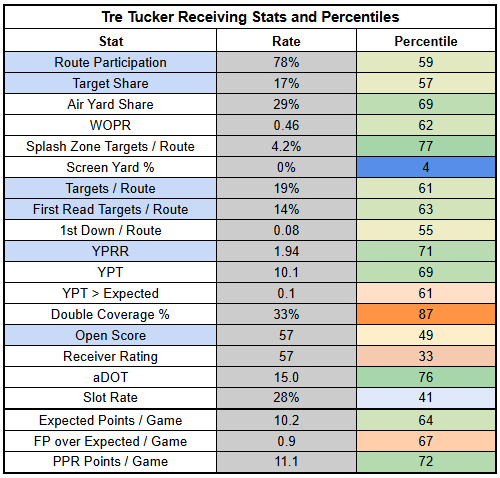
Tre Tucker is the only Raiders (listed) WR in a full-time role at the moment. And Tucker route participation is lower than ideal.

He's more interesting if Gonzalez is out. But even then, Carlton Davis has played well on the outside and could prove challenging. Tucker is a WR5.
Patriots
Implied Team Total: 24.5
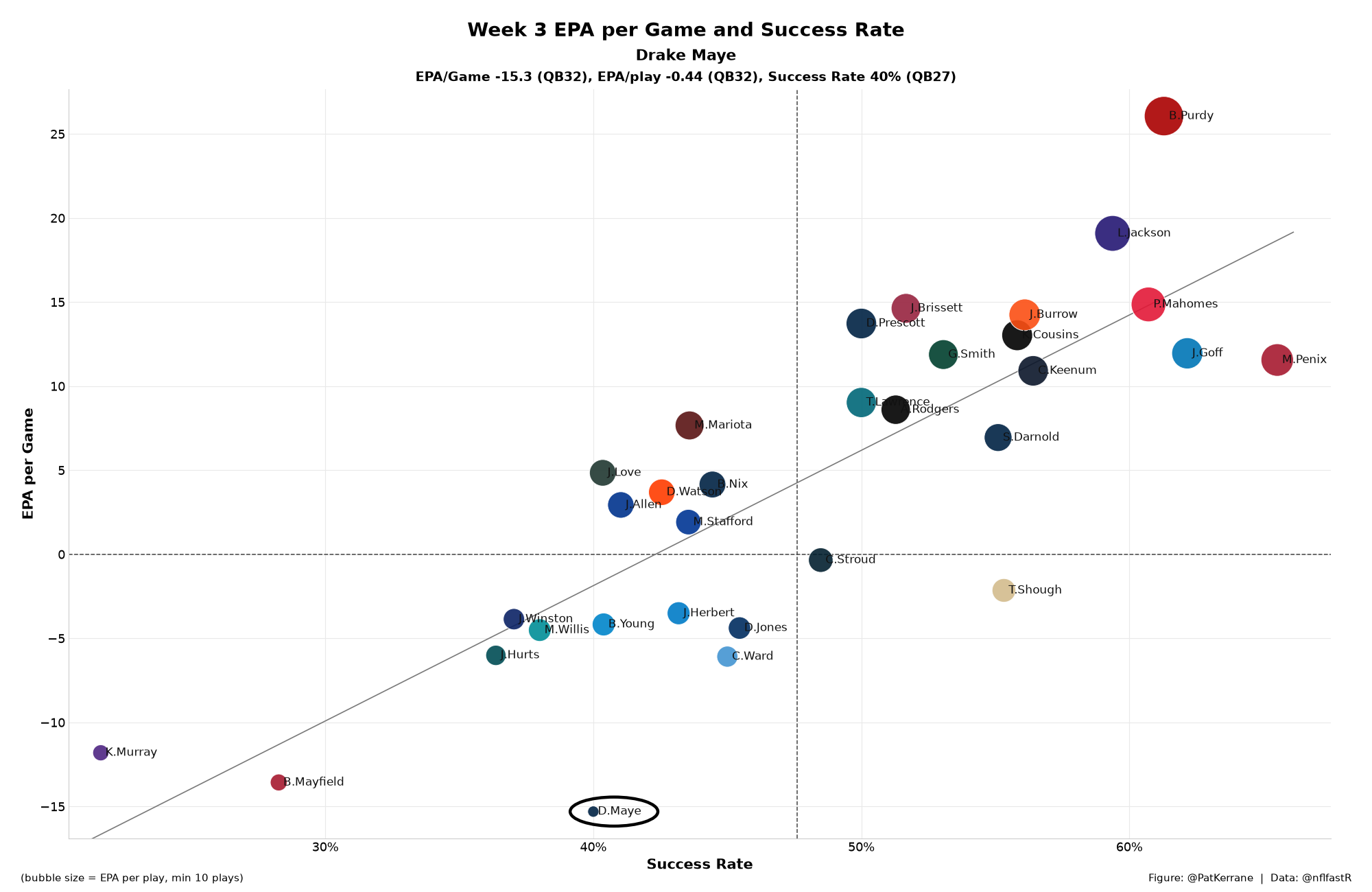
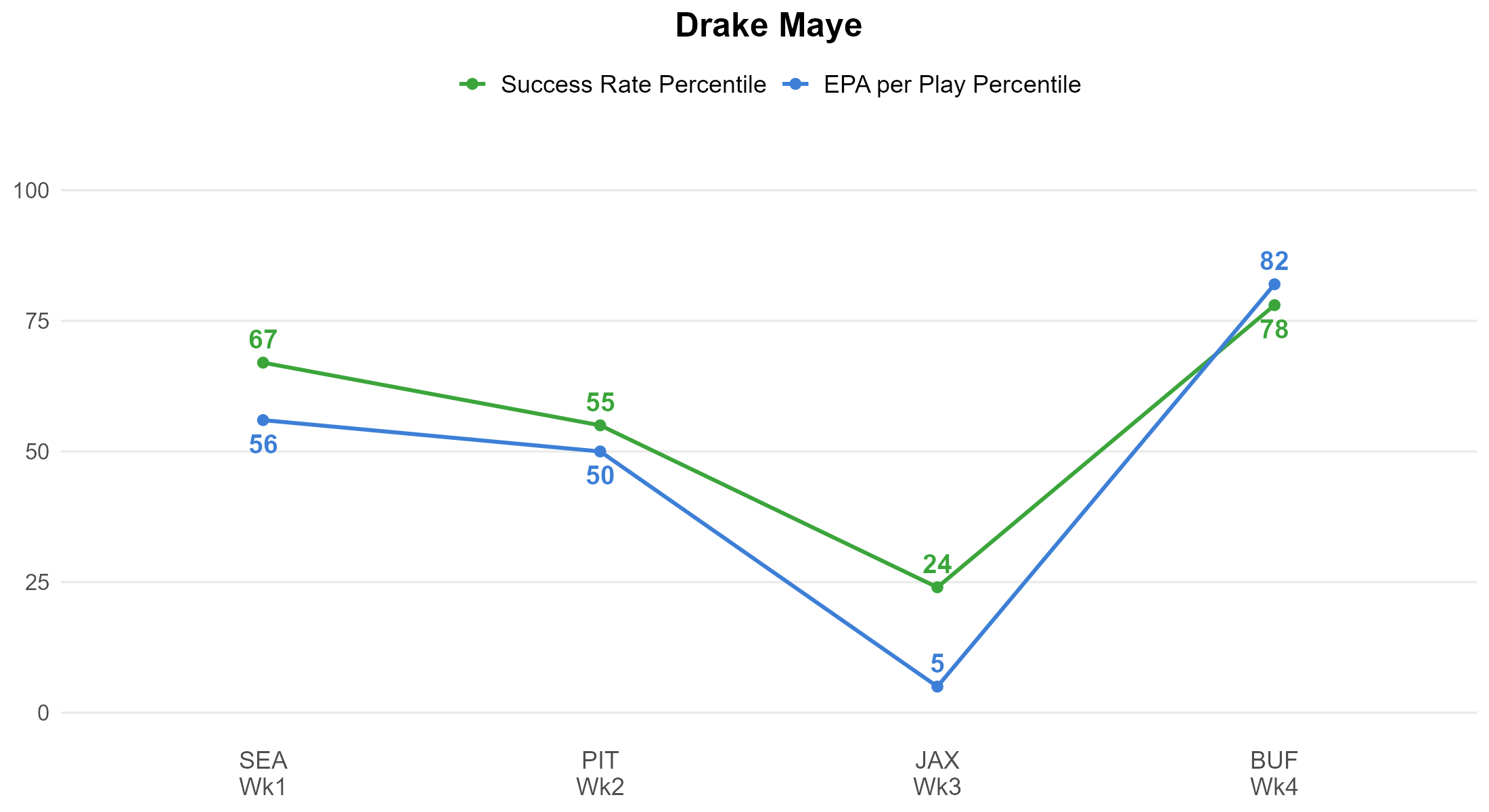
In Week 3, in Jacksonville, Drake Maye turned in the worst performance of the week. His -15.3 EPA ranked QB32.
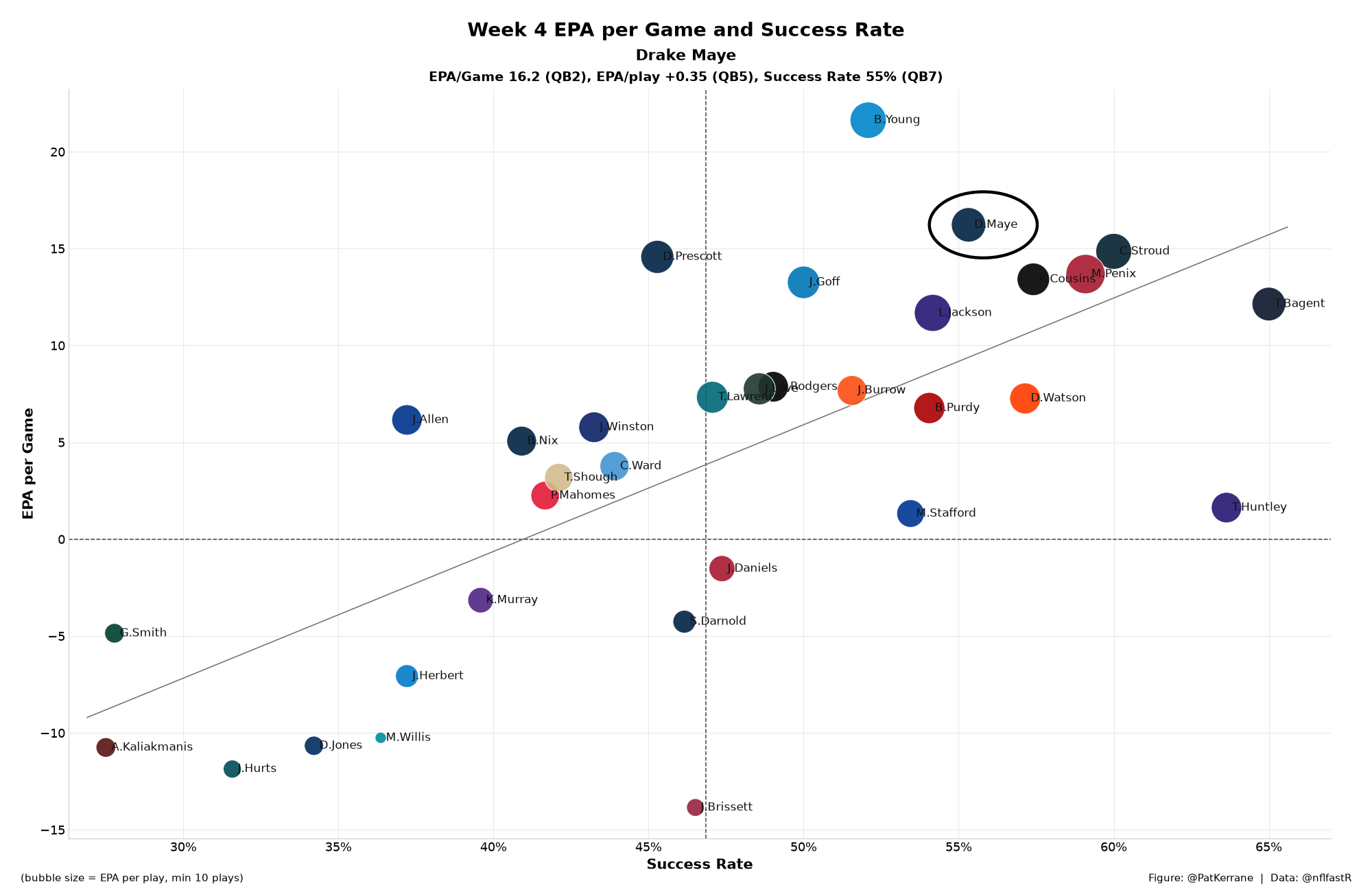
Last week, in Buffalo, Maye rebounded in a massive way. His 16.2 EPA ranked QB2, behind only Bryce Young's demolition of the Lions.
Maye now returns home to New England with mediocre efficiency. His 2.2 EPA per game (QB25) and 49% success rate (QB14) aren't terrible, but Patriots fans will be hoping that Week 4 marked a sustained turnaround.
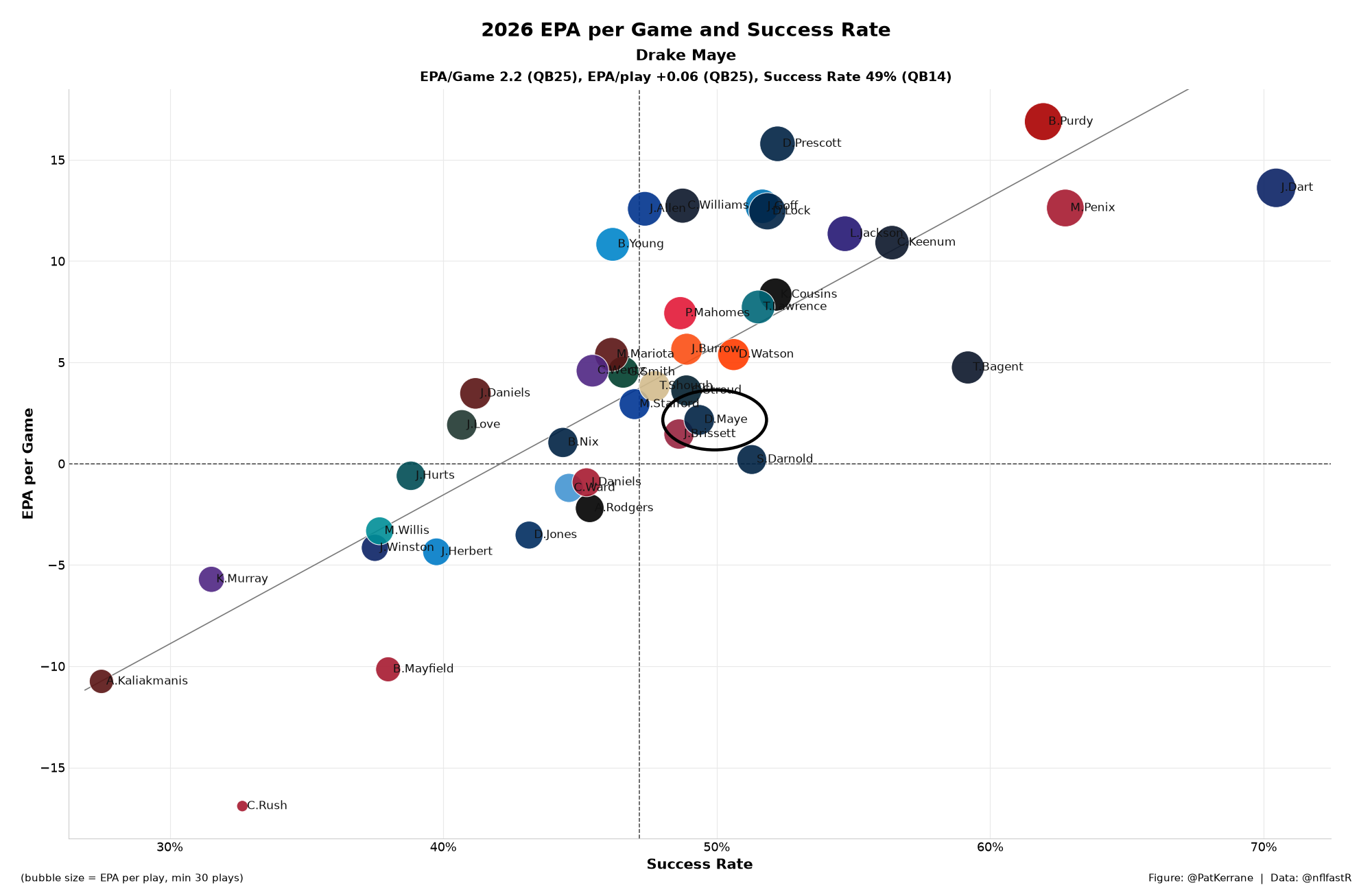
Maye's early-season performances weren't cutting it.
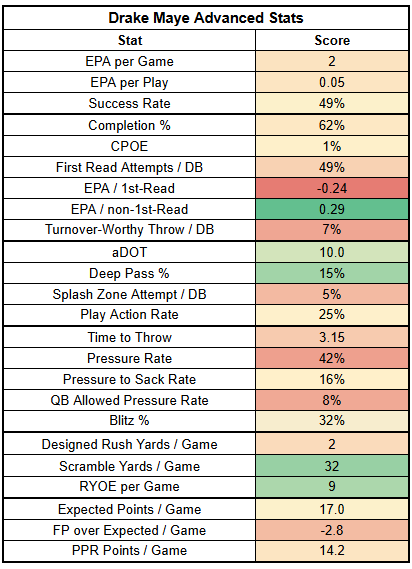
Maye's profile looks quite boom/bust this year. This helps explain the volatility of the last two weeks. Maye has a low first-read attempt rate and a high time to throw. He's holding the ball and looking to make plays, with a 10.0 aDOT and a 15% deep pass rate. Maye is also scrambling at a high rate. When this formula works, it's very fantasy-friendly. However, this is also a difficult way to make a living. It's a lot easier to consistently execute an offense that is generating open receivers early in the progression. Schematically, Maye looks to be at a disadvantage.
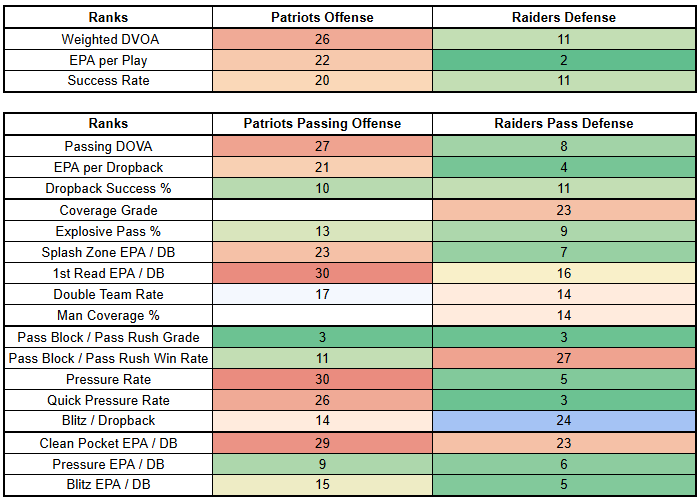
Maye now gets a Raiders defense that has been surprisingly effective. They are generating pressure consistently and quickly. Meanwhile, the Patriots offensive line has been a major issue, generating sacks and exacerbating Maye's tendency for dangerous throws.
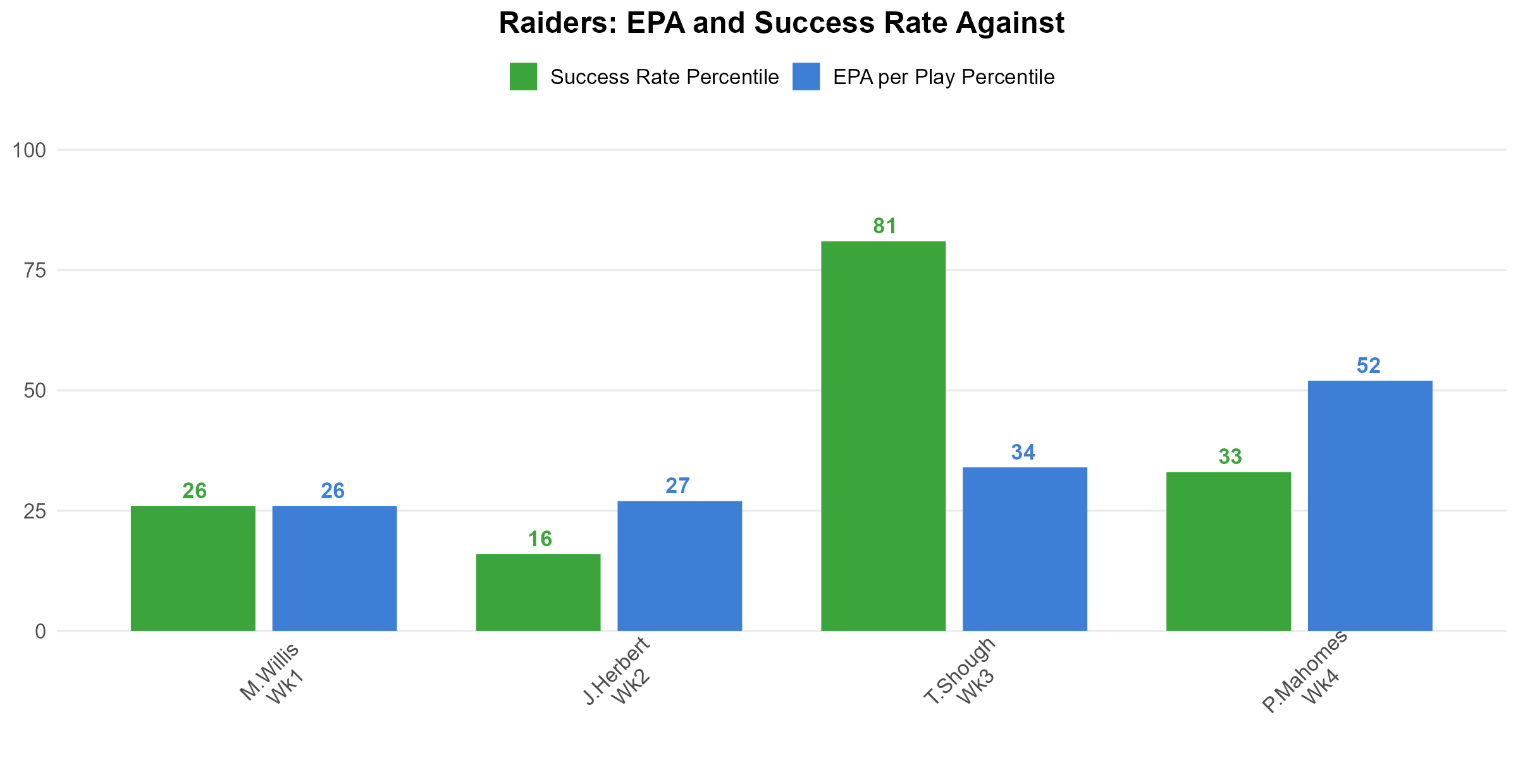
Before last week, the Raiders defense looked like potential schedule merchants. But Patrick Mahomes just posted a poor success rate against them with middling efficiency. This might not be a true high-end defense, but it isn't a weak one.
The good news is that the Raiders are not defending the run all that well. That's helpful for Maye's production in a very direct way; only Lamar Jackson (144) has more QB rushing yards than Maye's 135.
An effective run game could also take pressure off the passing game.
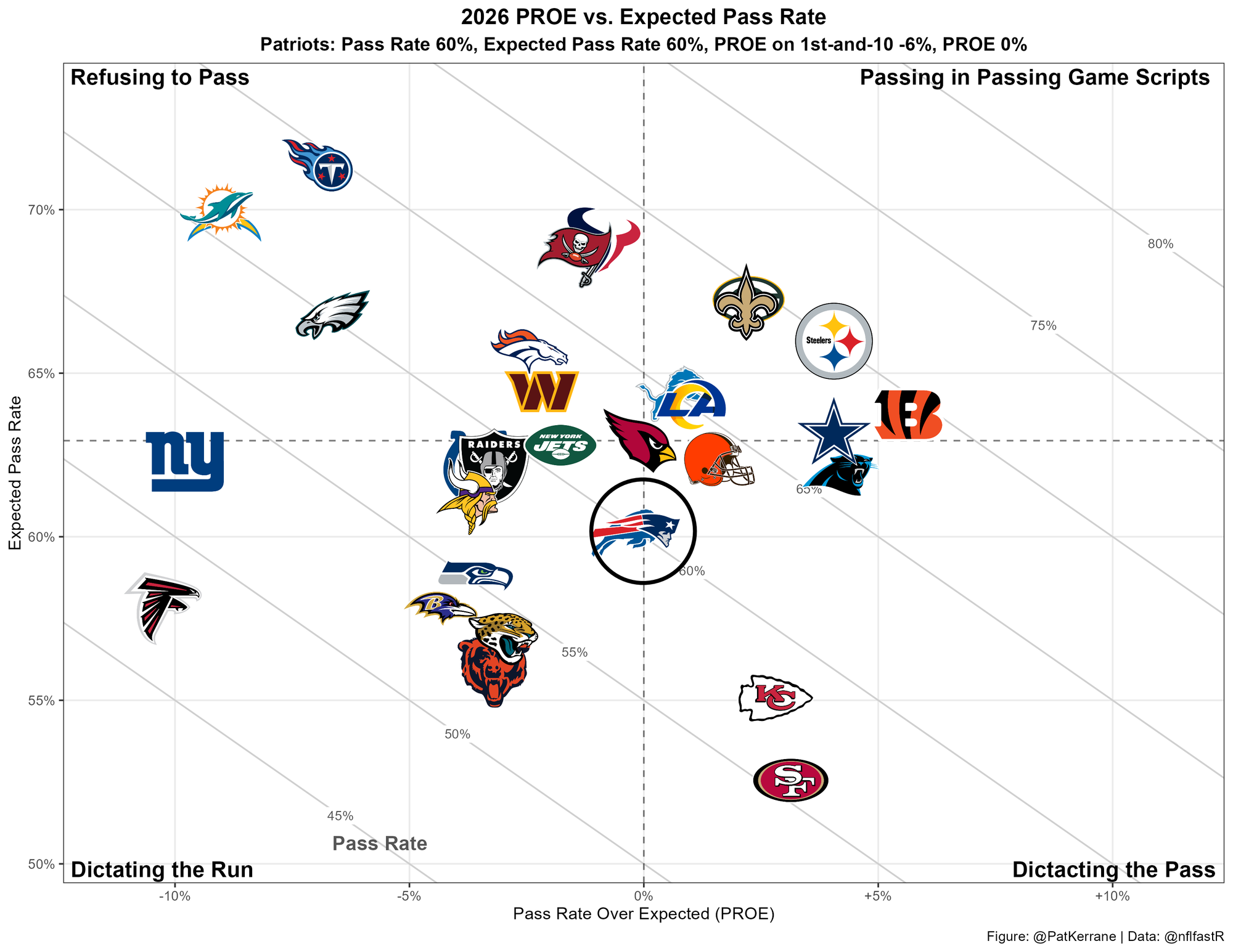
So far, the Patriots have been a balanced offense overall, but have a lean to the run on 1st-and-10.
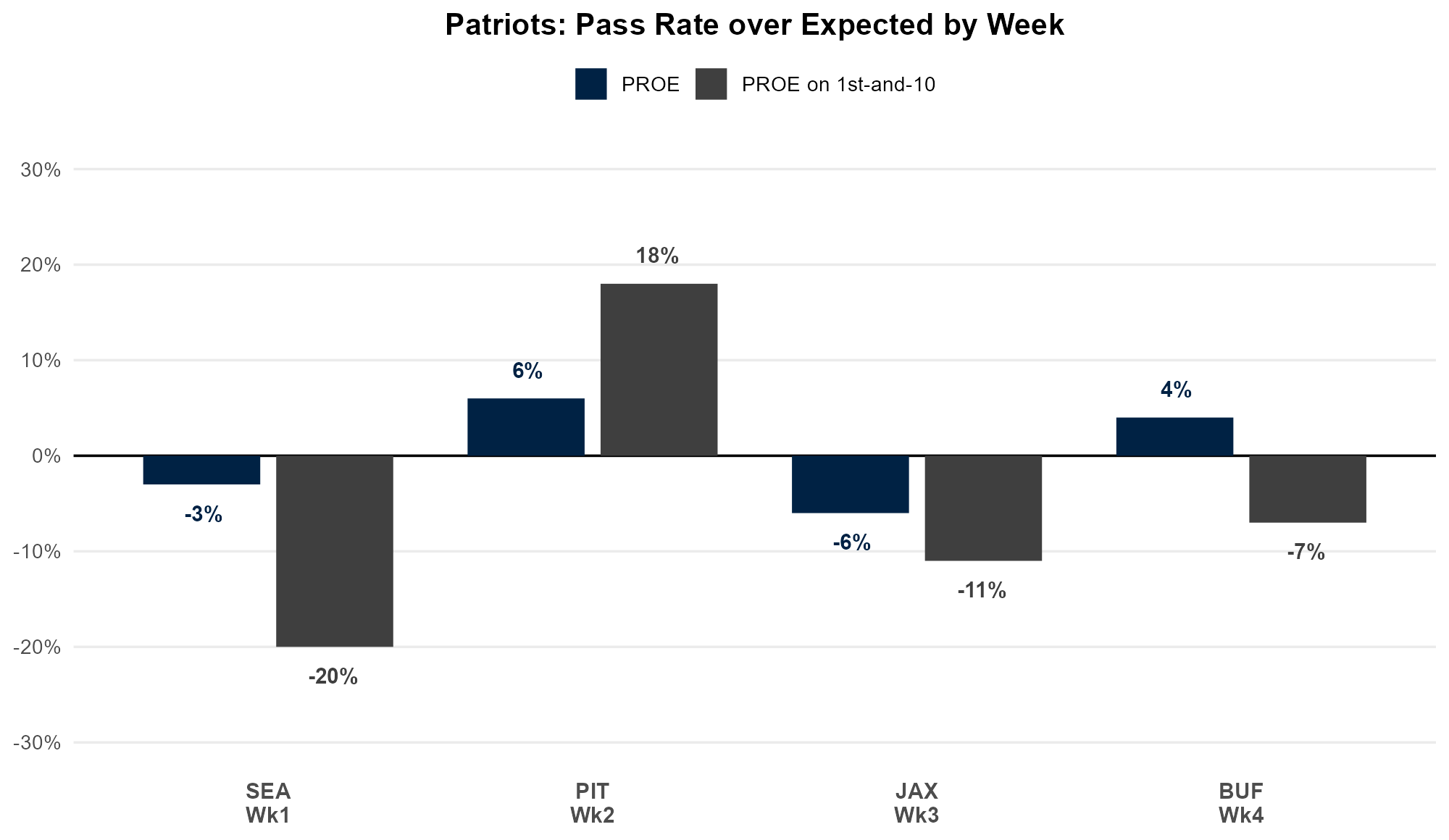
They've also been genuinely conservative on 1st down in three of four games, signaling a preference for the run in neutral situations.
Meanwhile, the Raiders profile as a bit of a run funnel.

The Chiefs just posted their first negative PROE of the season against this defense. Admittedly, we're talking about a small effect here. The Patriots will probably play things like they've already been inclined to do... but, again, that has been a balanced overall approach with an early-down lean to the run.
Rhamondre Stevenson's availability is a potential issue for the Patriots here. He appeared to suffer an injury late in the Bills game.
That could lead to TreVeyon Henderson seeing a much bigger workload than he has to this point.
Interestingly, Henderson has led Stevenson in carry share in all three games they've played together this year.

Stevenson's real lead is in the receiving game, where he's dominating routes and targets.

And this receiving role has been a huge part of Stevenson's fantasy value.
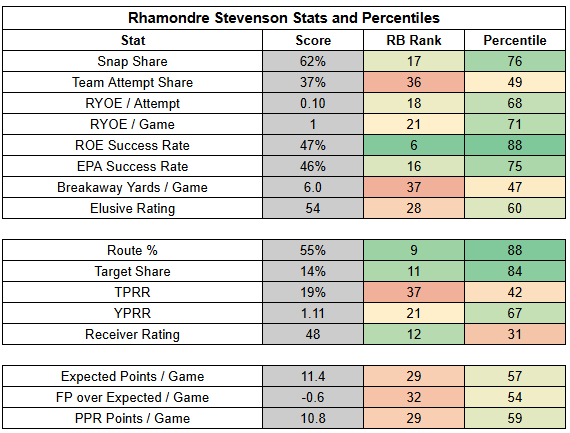
Even with a small lead in carries, Henderson's expected points workload has been significantly less valuable than Stevenson's.
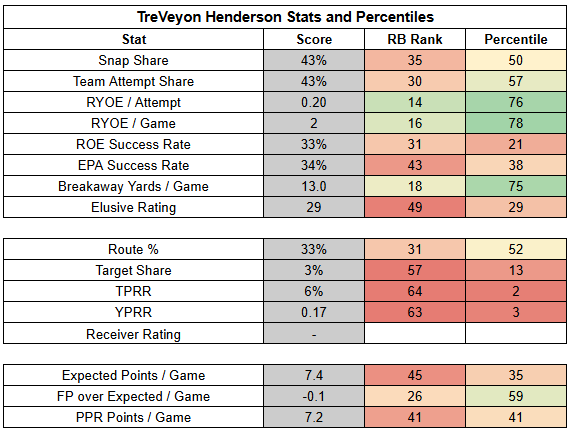
With Stevenson out, Henderson would likely have a pretty firm grip on the backfield. His role has been disappointing, but as part of a true two-way split. No. 3 RB Corey Kiner has barely seen the field.

Henderson now gets a matchup that should have the Patriots wanting to run the ball, wtih potential for a meaningful boost in receiving snaps. He's a low-end RB1 if Stevenson can't go.
However, Stevenson was limited in practice on Thursday and may suit up. If he plays, it represents a significant downgrade for Henderson. Because even if Stevenson isn't super effective, he's likely to steal valuable passing-down snaps from Henderson. With Stevenson in the lineup, both backs are RB3s.
Even if the Patriots were more naturally inclined to air it out, their WR depth would make that a difficult proposition here. AJ Brown remains on injured reserve, and Mack Hollins suffered a calf injury against the Bills, which has kept him out of practice.

Ideally, Mack Hollins would not represent a major loss for New England. But he has been the Patriots' most efficient WR this season.
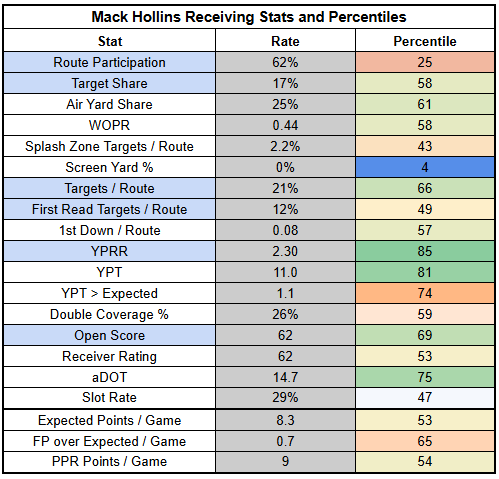
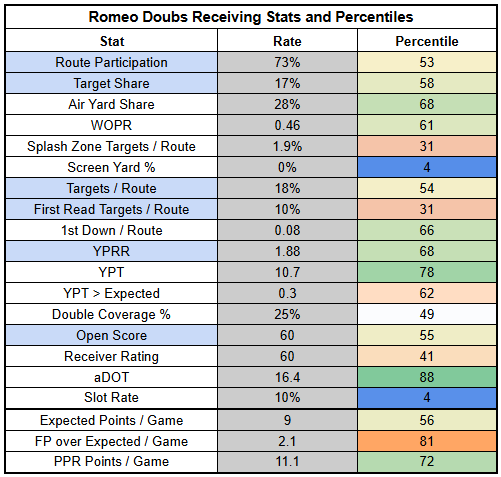
Oddly, Romeo Doubs saw a season-low 69% route participation last week, despite Hollins exiting the game. Fortunately, he turned in his most productive game of the season, scoring twice in Buffalo.

Doubs' per-route profile looks reasonable enough. And he's actually coming off season highs in both first-read target rate and targets per route run. He's sort of in a Stefon Diggs-ian part-time role, but as an outside WR rather than as a high-target-rate slot receiver. Role-wise, it's sort of a worst-of-both-worlds setup. He's going to be very boom/bust until this changes. The good news, though, is that he does appear to be developing more of a rapport with Maye. And with Hollins banged up, it'll be hard for him to play much less than this. Doubs is a WR4.
Demario Douglas' playing time also declined last week.

This was to make room for Efton Chism, who delivered with the game-winning TD catch.

Kyle Williams remained in his normal rotational role, which helped to squeeze the other WRs.

Eli Raridon's return also cut into the WR routes, and helps explain Doubs' usage as well as Douglas'.

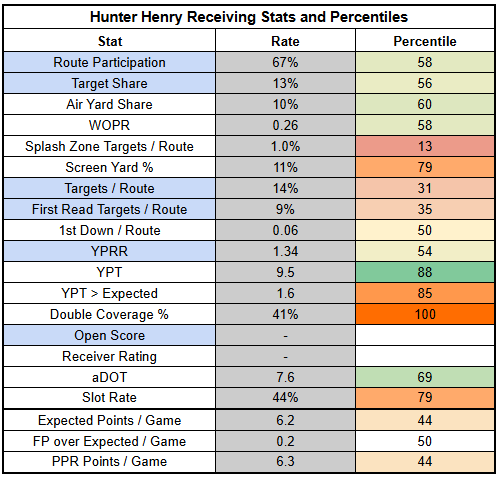
Raridon's return didn't have much of an impact on Hunter Henry's role last week. The Patriots were using Raridon to unlock 12-personnel looks more than using him as a direct replacement for Henry. Certainly, the rookie TE adds some fragility to Henry's outlook going forward. But with the Patriots likely to be balanced, if not run-first here, there should be plenty of 12 again.

Henry's role has been disappointing this year, but he's coming off his best game of the year and should be in a similar role this week. He's a high-end TE2.
Bears at Packers, 1 PM
Bears
Implied Team Total: 23.75
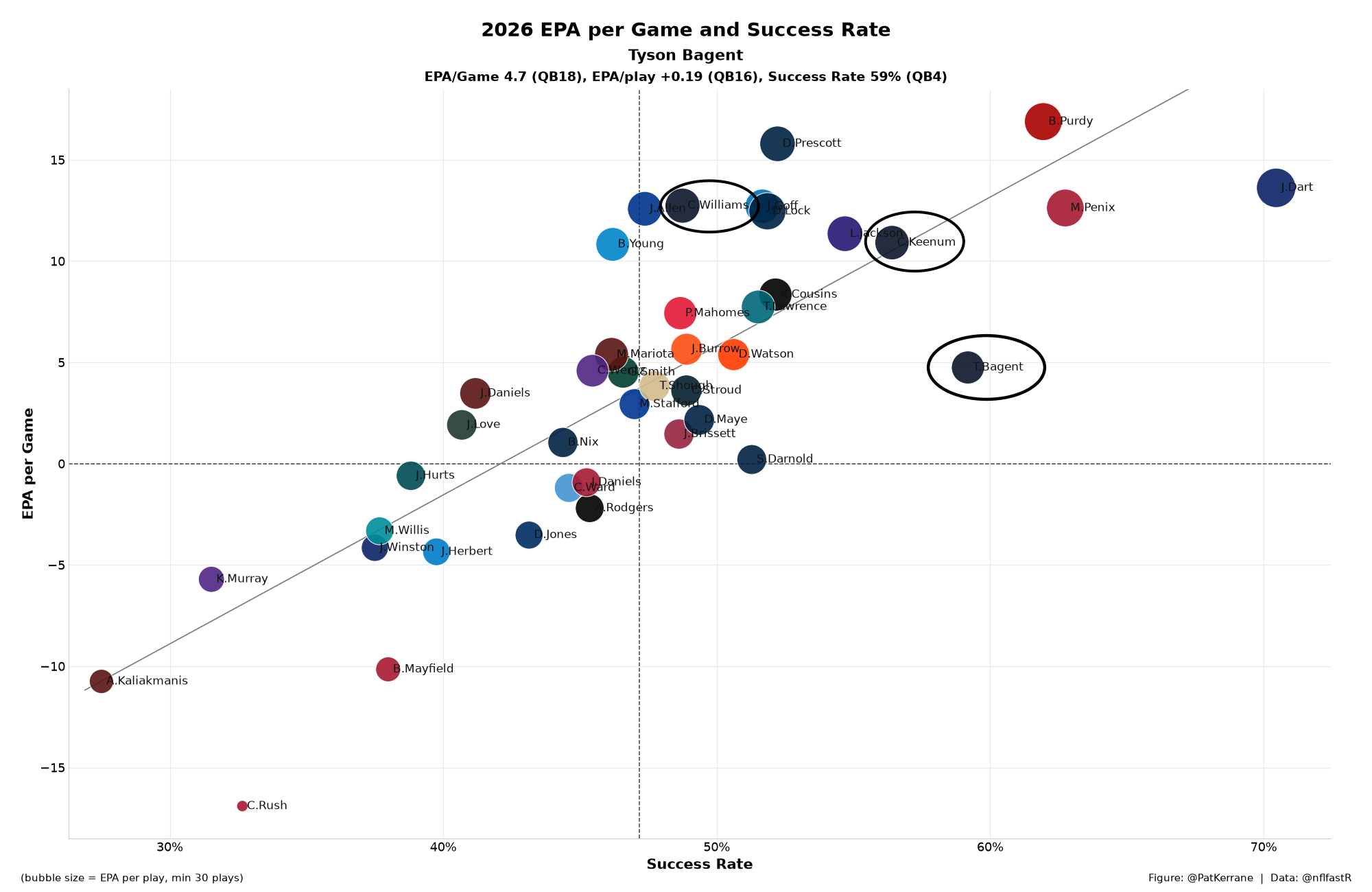
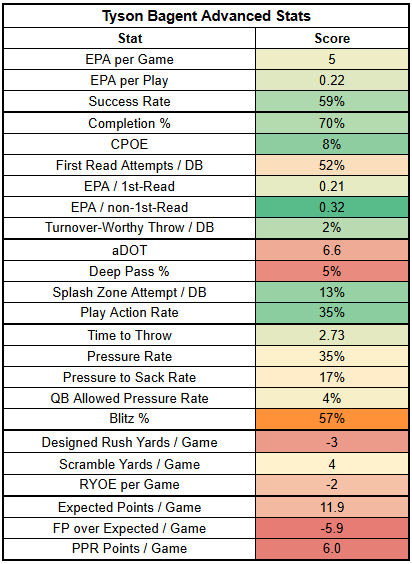
Tyson Bagent is in line for another start this week. Against the Jets, Bagent was extremely consistent. His 59% success rate currently ranks QB4. Bagent was less efficient than Caleb Williams and Case Keenum have been, but he still wasn't bad.
However, Bagent wasn't asked to do a ton last week. The Bears posted their lowest pass rate of the season, with a -7% PROE.
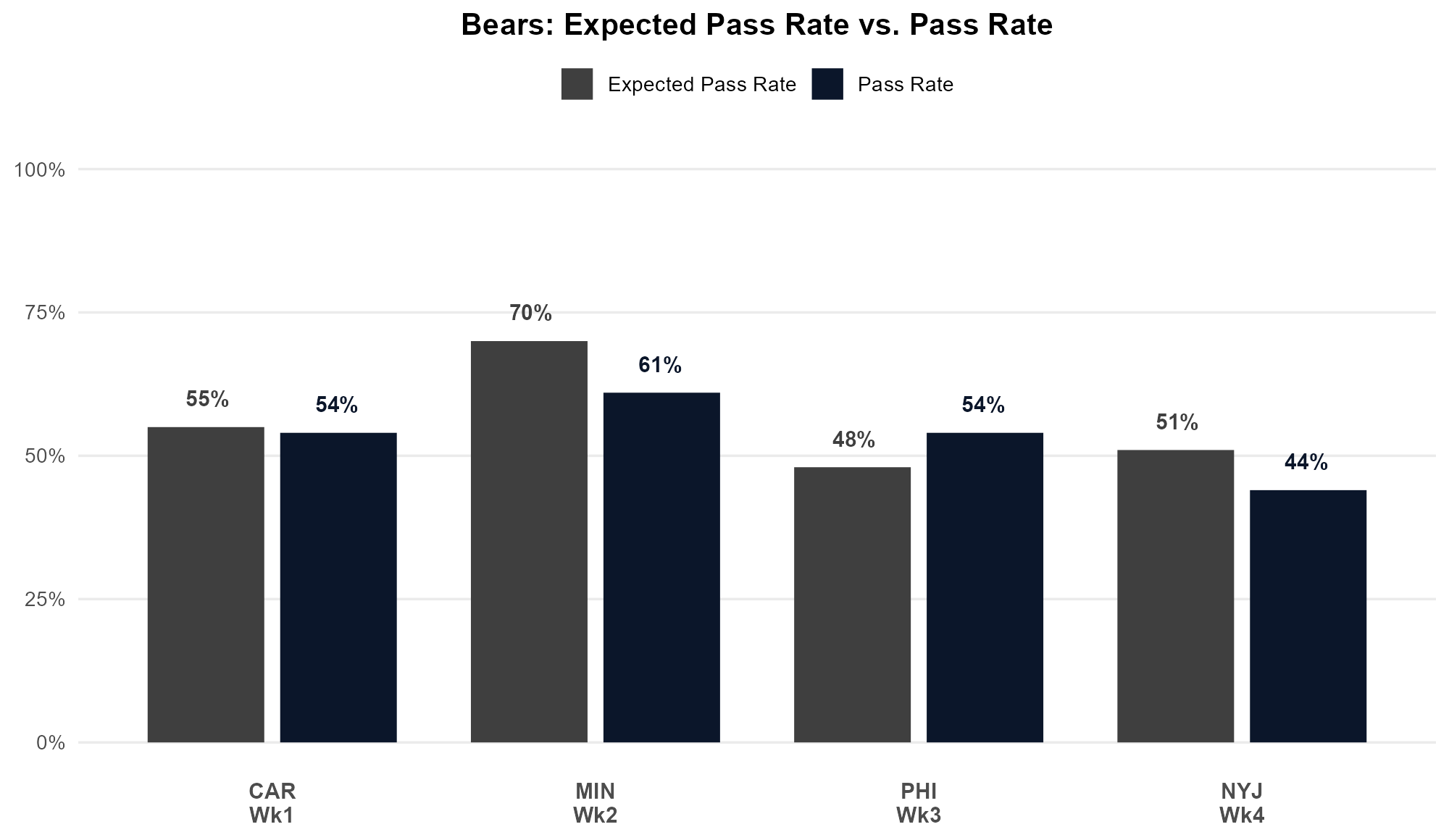
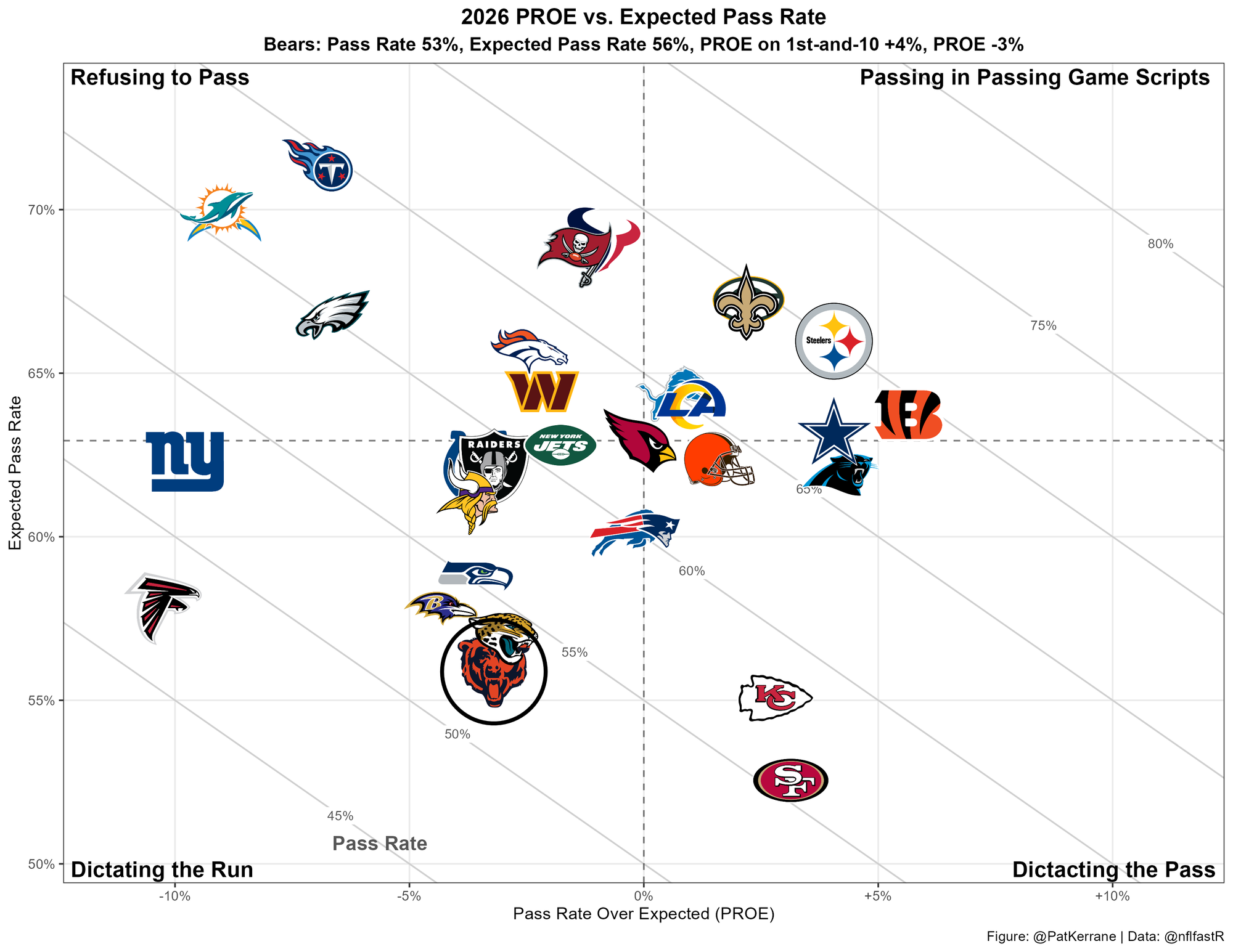
Last week's approach fits with Ben Johnson's larger philosophy this season. The Bears have yet to post an above-average pass rate, and are very much looking to establish the run.
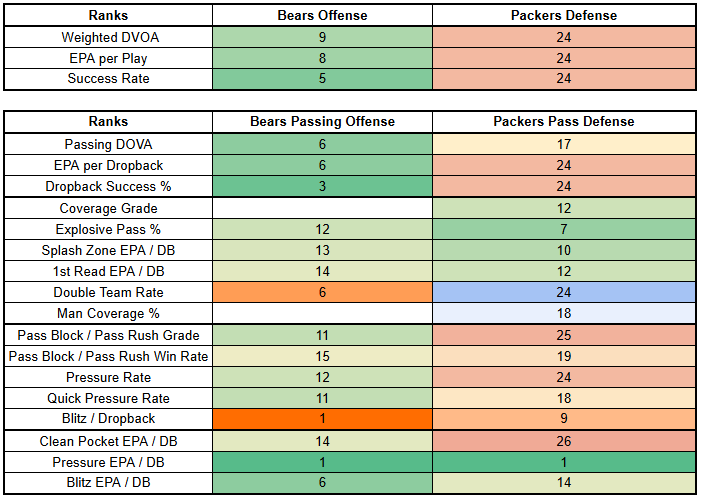
They now get a Packers run defense that should allow them to do just that.
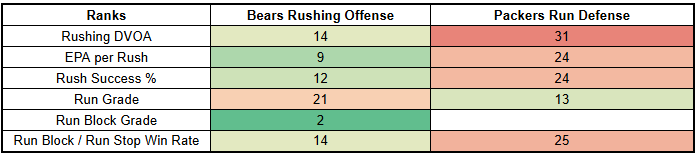
Packers opponents have generally taken this tack. The average Packers opponent has been run-heavy and slow-paced. The Bears will likely play faster than the Packers defense is used to, but still build the game plan around the run.

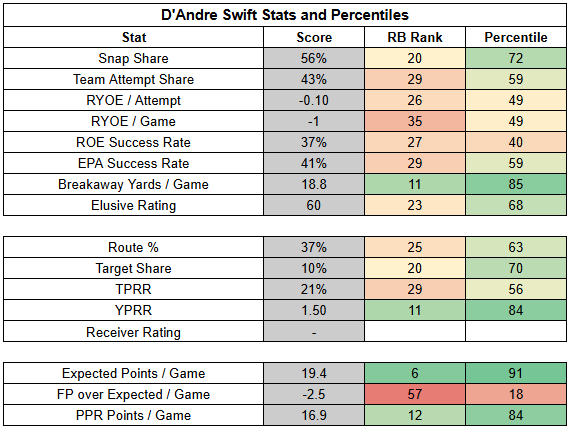
The Bears' run game is likely to have volume and efficiency on its side this week. Unfortunately, the touch breakdown is a bit volatile. D'Andre Swift was soft-benched after a fumble last week, leading to a curtailed workload.

Kyle Monangai picked up the slack in a massive way, popping off for nearly 30 PPR points on a truly elite workload.

Monangai doesn't offer much in the receiving game and is therefore the more fragile play. But we've seen him hit 20+ PPR points twice in four games, and, assuming health, he's set up nicely as the Bears' best downhill runner.
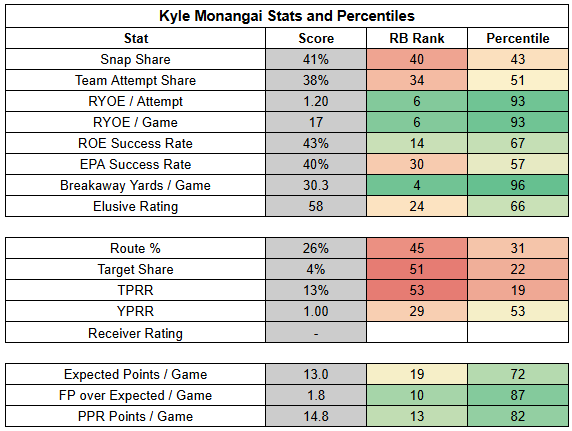
However, Monangai is dealing with turf toe, putting his status in question this week. He's in the RB3 mix if he goes. If he misses, D'Andre Swift's outlook changes in a big way.
D'Andre Swift is a more versatile back than Monangai, and his 32.4 PPR points in Week 1 remain the highest score by a Bears RB this year.
If Monangai plays, Swift will likely lose valuable rushing work... but there should be quite a bit of that here. With Monangai in the lineup, Swift is a low-end RB2.
However, if Monangai is out, Swift becomes an RB1.
We can count on the Bears to run the ball. We can also count on them to run play action off of that.
However, the Packers have defended play action quite well this year, while seeing a lot of it.
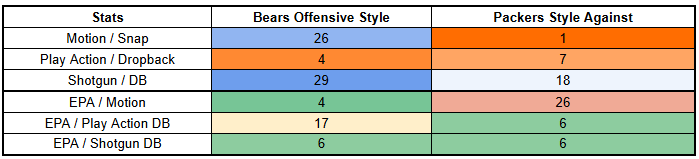
The better news is that the Packers have been generally unimpressive against the pass. They've held up well in coverage, but their pass rush is lacking.
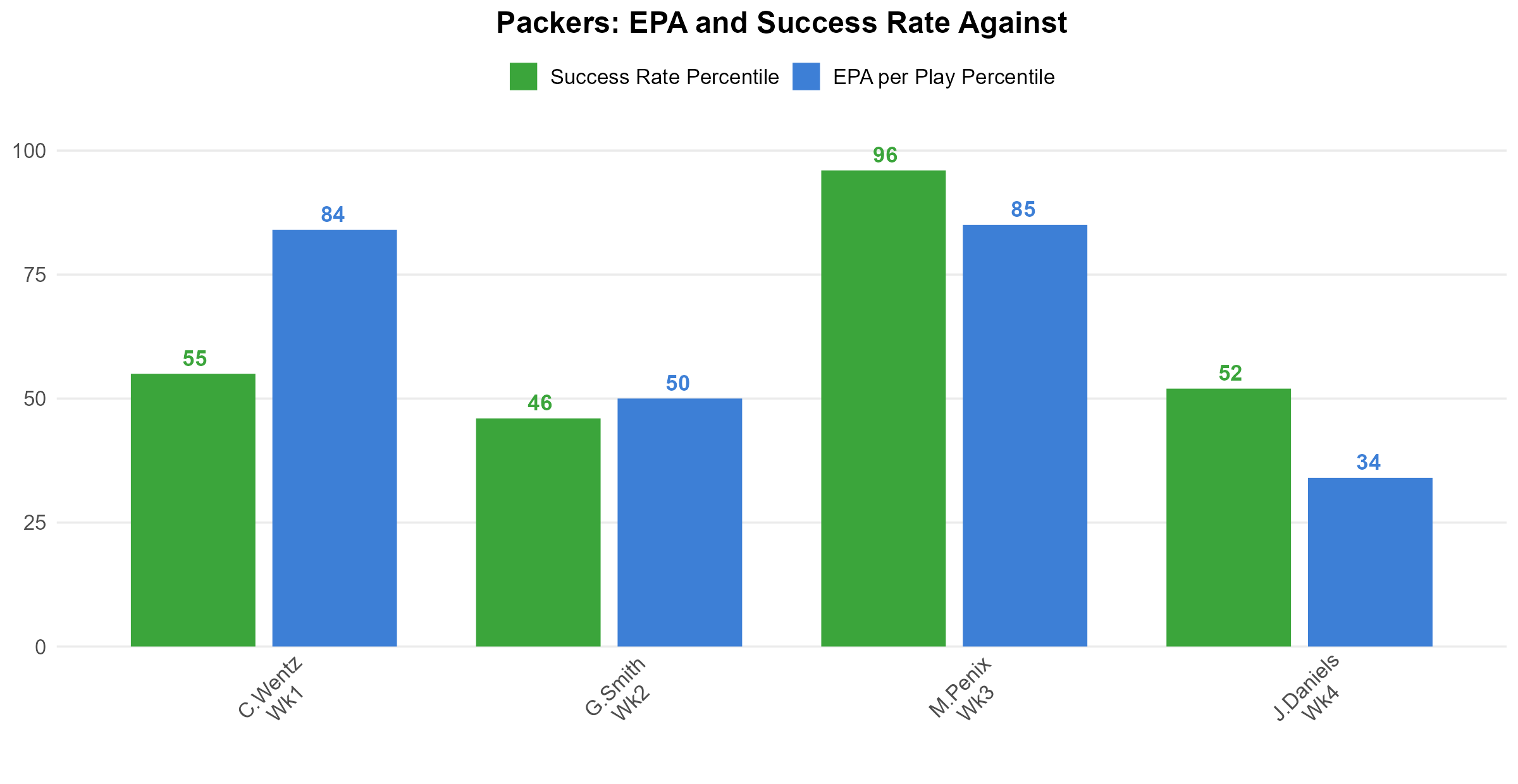
The Packers are also very likely worse than the season-long numbers suggest. They held Jalon Daniels in check last week, but Carson Wentz, Geno Smith, and Michael Penix were all 50th percentile or better in EPA per play against them. This is not a good pass defense.
If Caleb Williams was able to play this week, he would likely light up the Packers, making plays against a defense that can't get pressure quickly enough to consistently disrupt his playmaking abilities.
But while Tyson Bagent isn't anywhere near the playmaker that Williams is, he's much less of a pure point guard than Case Keenum. Against the Jets, Bagent generally executed the design of the offense, but also looked to make plays outside of structure, and did so very effectively.
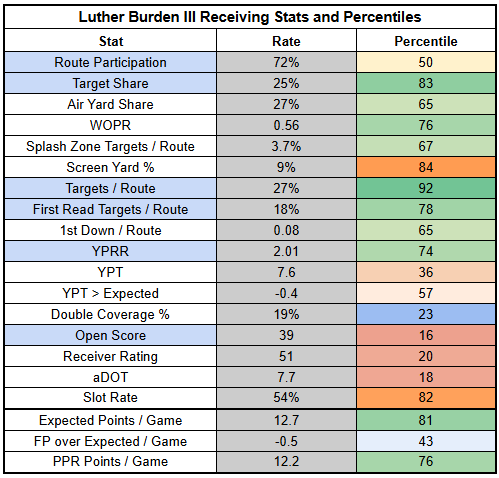
Bagent had a strong connection with Luther Burden, who earned targets well above his first-read target rate.

Burden's 18% first-read target rate is good... but his 27% TPRR is elite. He looks like a true target earner by that metric. Unfortunately, Burden also looks to be playing a specialized role in the offense as well. He's peaked at just 77% route participation, is seeing a high percentage of his yards on screens, and rates poorly in open score. He's definitely a weapon. He just doesn't look like a true No. 1 WR in the way drafters were hoping before the season. In what is likely to be a low-volume environment, Burden is a high-end WR3.
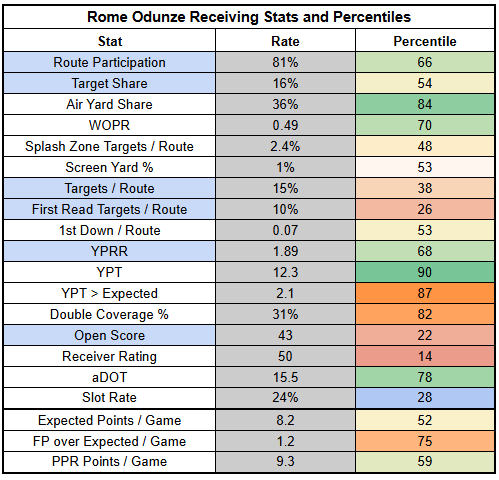
Rome Odunze is a more traditional WR than Burden and is coming off his strongest game of the season. We can count on him to be out there in a full-time role again this week.

Unfortunately, Odunze's target rate is unimpressive, which makes sense given an open score just as unimpressive as Burden's. With Burden's YAC skillset, you can justify feeding him targets; Odunze actually needs to earn downfield looks. Still, he's a WR4 as a bet on a continued connection with Bagent.
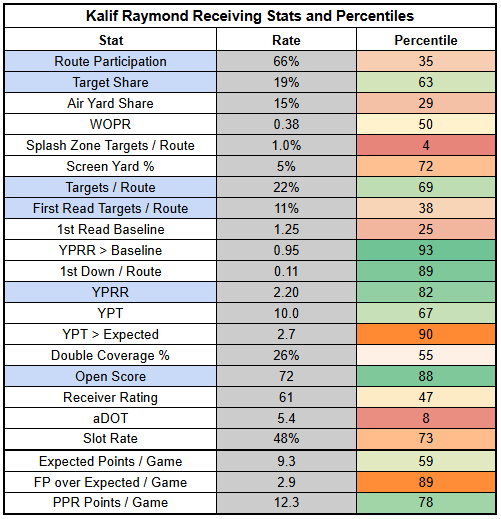
Kalif Raymond finally took a step back last week, in both playing time and involvement when on the field.

Raymond's role this season has been strong enough to keep him in the dart throw mix, though.
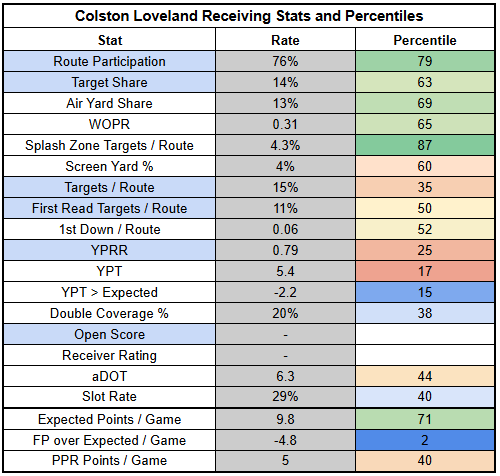
Coltston Loveland finally came alive last week, earning targets at an elite rate on the back of a game plan clearly built around him.

Still, in the context of last week's opportunity, Loveland's 11.7 PPR points feel like a bit of a letdown. And Loveland's overall numbers remain underwhelming. He's unlikely to be what drafters were hoping. But Loveland is also unlikely to be quite as bad as he was to start the season. Johnson made him a huge priority last week, which is very bullish even if it didn't directly translate to the box score. Loveland is a TE1.