Apex Hunting: Dynasty QB Floor Traps You Should Consider Selling Now

Mat Irby’s Apex Hunting Series
This spring, I’ve been scrutinizing the marketplace through KeepTradeCut’s crowdsourced dynasty ranks, searching for buy and sell candidates. But unlike most value-based dynasty articles, I’m framing these arguments strictly around upside.
Here at Legendary Upside, we have built our brand on the pursuit of upside. Pat’s flagship article about legendary upside first appeared on NBC Sports Edge in 2021. And we both emigrated from RotoViz, where using roster construction and positional volatility to find upside is of constant interest.
I’ve personally written often about the importance of chasing positional apexes. Fantasy managers tend to overweigh the perceived safety of players who consistently produce solid but unspectacular results. But championships are not won by compiling weekly RB18s and WR24s. We create the biggest weekly advantages by maximizing the number of players capable of reaching the positional apex – the very cream of the crop – and we do that by targeting the metrics most predictive of ceiling outcomes, specifically.
Here are four of my past works that sum it all up quite well:
- Stop Playing it Safe: Why Apex Drafting is the Key to Fantasy Success
- The Apex Drafting Strategy: Draft Sharks, Not Guppies
- Apex Drafting: How to Approach Keepers
- The NBA is Teaching Us A Lesson We Should Apply to Our Dynasty Leagues
If we retrain ourselves to fade players who demonstrate limited apex signals, we begin to notice plenty of dynasty assets the market values highly, sometimes aggressively, despite profiles that project more floor than ceiling. Those assets are attractive sell candidates because they have meaningful market value, but don't fit the archetype we want. In that sense, they function like cash.
This part is crucial. A player’s inclusion on this list doesn't mean we should be eager to sell! The advice here is to sell these assets at cost to find other assets with greater upside potential. It is not to treat these assets as operable cancer that must be removed no matter what. If you’re not getting fair market prices for these players, do not sell them.
At QB, we generally want to avoid players who don’t possess strong rushing ability. Rushing, for a QB, is critical for consistent, meaningful upside.
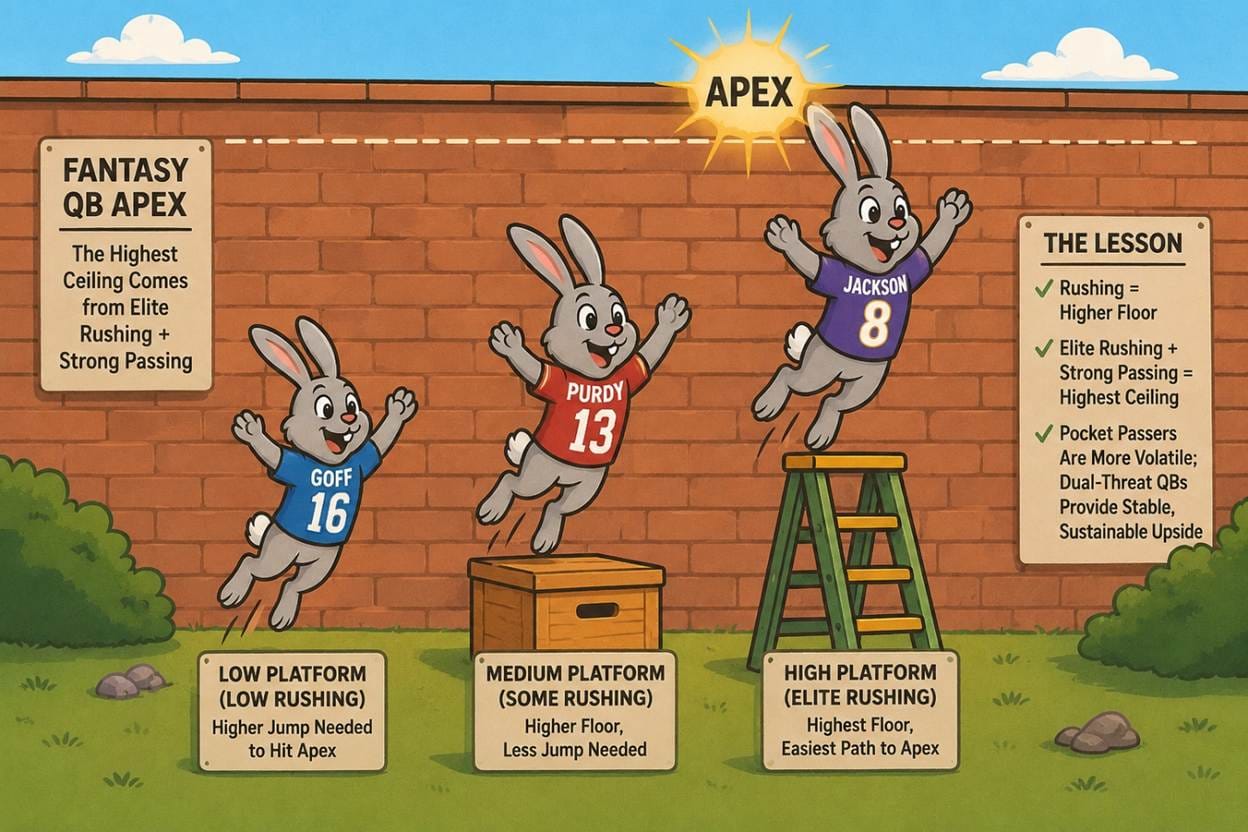
I’ve used this analogy before, but imagine three bunnies competing to touch the highest mark on a wall. Their natural jumping ability represents passing talent. However, one bunny stands on the ground, another on a box, and another on a ladder. Those platforms represent rushing ability.
A bunny starting from a higher platform naturally has a higher floor because it doesn’t need to jump as high to reach higher heights. In fantasy terms, rushing raises a QB’s baseline production. However, when rushing exists without quality passing, you get a player with floor but limited ceiling, like Justin Fields.
The apex comes when elite rushing combines with strong passing. That blend creates the highest ceiling outcomes in fantasy football. If that combination is the target, then the absence of either trait becomes disqualifying.
A pure pocket passer like Matthew Stafford or Joe Burrow may be more likely to hold a starting job all season, and I’d argue they are actually more likely to stumble into an apex season than a poor passer who runs well. But without rushing production, those seasons depend on elevated TD rates, which are less stable and less predictable. Pocket passers, then, become more volatile fantasy assets with rare but possible single-season spike upside for the truly elite. At the same time, dual-threat QBs who can also pass tend to provide both stronger weekly stability and more sustainable year-to-year upside.
Ideally, we would profit by selling players who lack both elite rushing and elite passing, but that market doesn’t exist. In practice, we have to accept exposure to one weakness or the other. And because high-end passing production is more volatile from season to season, we should sacrifice passing rather than rushing.
In other words, Jared Goff might throw 35 TDs if everything breaks right, but he is never going to add 500 rushing yards. Jalen Hurts, meanwhile, will likely threaten 500 rushing yards every season until he’s old, yet he still has a realistic path to adding 30-35 passing TDs on top. This is the bet with the greatest probability of upside. And so, fair warning, you will see a lack of rushing ability as a constant refrain throughout the article.
So, with that understood, let’s dig in.
Part 2: QB Sells
JOE BURROW (QB6)
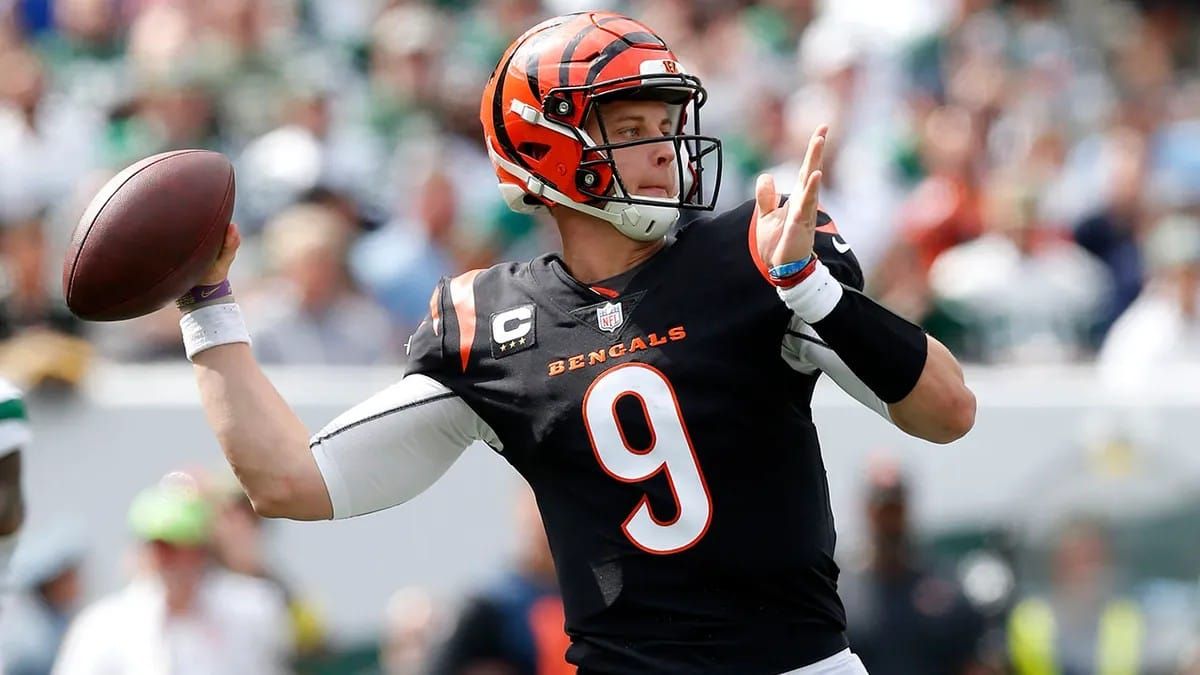
Listen. I’m not going to sit here and tell you to get Joe Burrow off your roster. At 29, in a world where special pocket passers can make it to their late thirties or early forties, Burrow may just be getting started. He’s hit the apex once already and landed just on the fringe another time – two of his only three full seasons not marred by injury. And I’m here to tell you, he’s going to hit the apex again at some point, maybe even multiple times.
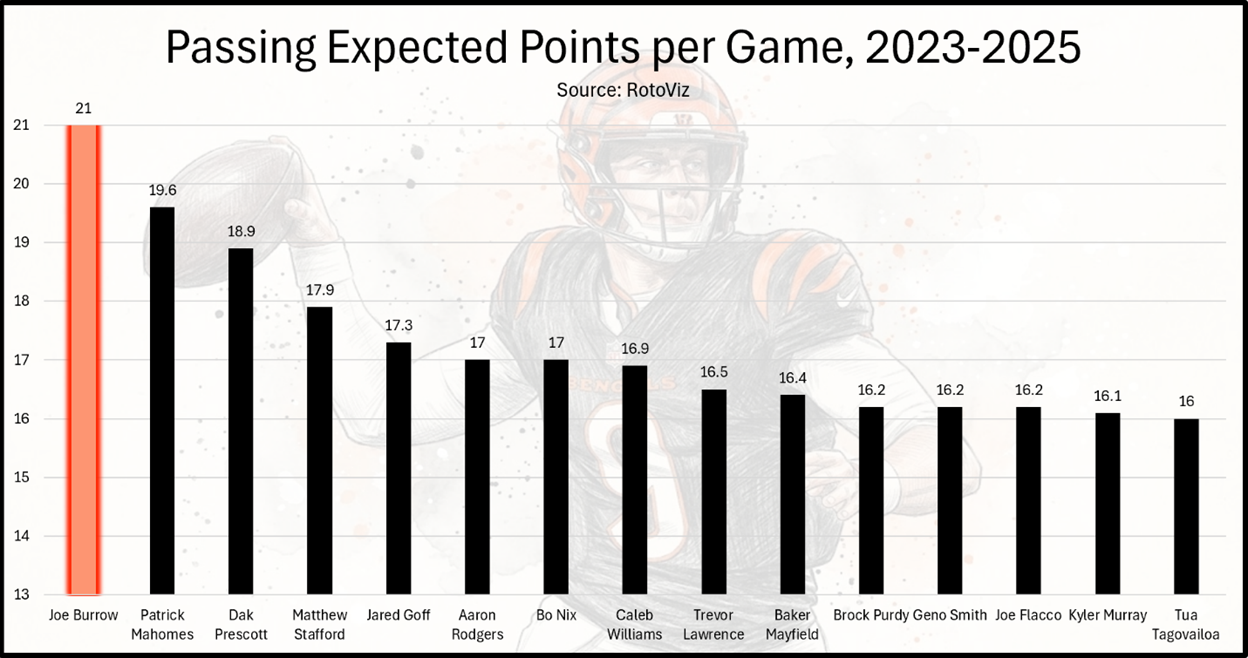
If Burrow isn’t the best pure passer in the NFL, he’s firmly in the conversation. Since 2023, he has led the NFL in passing expected points per game (paEP/G). Burrow has the fourth-best career QB rating among active NFL QBs, is third in yards per game since entering the league in 2020, and is tied for second in passing TDs per game since 2020. In 2024, his last full healthy season, Burrow ranked first in dropbacks, completions, passing yards, passing TDs, PFF Big-Time Throws (BTTs), and first downs (1Ds). When healthy, Burrow’s placement among the best real-life QBs is well-deserved.
Coming out of college, it was rumored that Burrow had a touch of rushing acumen, too. In fact, he averaged 383.5 rushing yards per season in his final two years at LSU. In the NFL, where there is already a longer schedule, he’s averaged 139.2 per year. We should view him as a pocket passer.
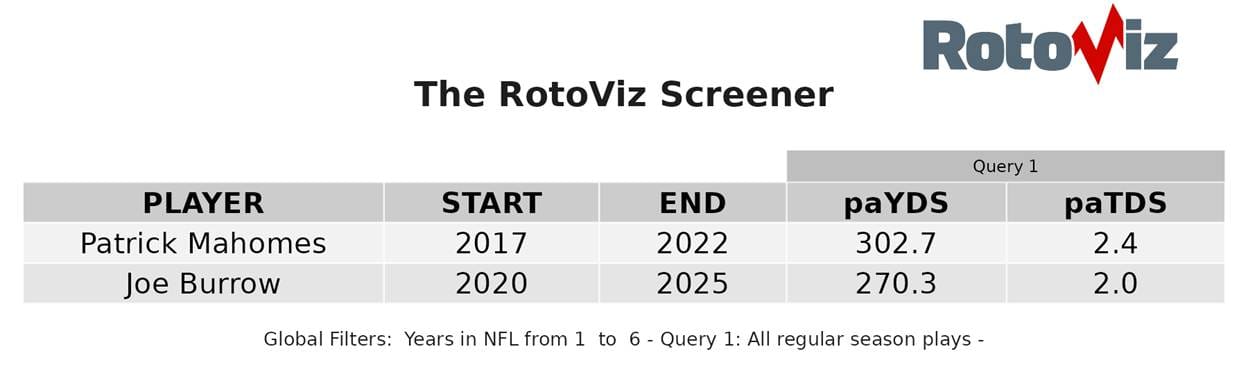
As mentioned, though, Burrow is very good. In fact, over his first six years, he has the highest expected points per game (EP/G) of any QB in their first six years since 2000, and only he and Patrick Mahomes have at least 270 passing yards and 2 TDs per game in their first six years during that span. That’s clearly elite.
Tom Brady hit the positional apex seven times over the 23 years from 2000 to 2022. Peyton Manning did it four times in the 16 seasons from 2000 to 2015. Aaron Rodgers did it seven times in 21 seasons. Drew Brees, six times in 19 years. That’s a hit rate of 30.4% for those guys this millennium. The combined hit rate for Lamar Jackson, Jalen Hurts, and Josh Allen? 54.5%. There is simply no comparison.
Even if we can’t get our hands on one of these three, there are plenty more who have the potential to combine elite rushing and very good passing: Jayden Daniels, Drake Maye, Bo Nix, Kyler Murray, and even Mahomes, who was eighth in rushing yards per game before his brutal injury, have demonstrated the potential for this rare combination before. I’d argue their pathway to upside is actually more likely and, in some cases, comes at a lower cost.