Mat Irby's Apex Score: Wide Receiver

Apex Score vs. Redraft Market ADP
Vol. 2: Wide Receivers
Last week, I introduced Apex Score using my beta RB model, which correlated to future Apex results better than any other common Primary or advanced stat in fantasy analysis (but with the caveat that this is sort of eating its young, because I’m correlating back to the very stats from the very same set of years, so this will likely degrade some over time – hopefully, not too much).
I gave a rather laborious explanation on that and showed my work. I assume that you don’t want to read that again if you already read it once – a lot of it’s pretty technical (aka, boring) – and I don’t really want to rewrite it. If you’re into it and want to see my process, go check out last week’s article.
This week, I’m tackling WRs, which meant creating a model that does the same thing for a different position. Frankly, it’s a laborious trial-and-error process. I’ve found it’s not as simple as finding a combination of stats that gives you Apex N+1 and YoY and calling it a day. There are other considerations.
For instance, I wanted more data points, so I doubled the pool. Giving 2:1 deference to the O.G. Primary Apex, I dubbed the second group the Secondary Apex. I also ran the process backward, starting with Apex players and seeing which stats they hit most often, which I called Apex Capture.
I tested for redundancies in multiple ways so stats didn’t overlap heavily because they largely tell the same story; I called this independence Separation. I also looked for players who repeated throughout the data set, checking for unique archetypes that might distort our assessment because they’re such unicorns in how they play.
Once I had my inputs, I weighted 2025 at .60 and 2024 at .40, then rescaled it to a 1-10 score with two decimal places to make it easier to consume. This became the WR Apex Score.
What I landed on at WR also beat any individual stat in Apex correlation. It wasn't quite as predictive in the Primary Apex as TGTs/G, nor as stable YoY as TGTs/G or target share, but it topped the charts in general PPR N+1.
|
Metric |
2:1 Apex N+1 |
Primary Apex N+1 |
Secondary Apex N+1 |
YoY |
PPR N+1 |
|
WR Apex Score |
0.493 |
0.386 |
0.225 |
0.722 |
0.580 |
|
Targets/G |
0.468 |
0.412 |
0.126 |
0.727 |
0.553 |
|
Target Share |
0.449 |
0.353 |
0.203 |
0.731 |
0.560 |
|
First-Read TGT % |
0.462 |
0.360 |
0.216 |
0.699 |
0.554 |
|
Rec 1Ds/G |
0.457 |
0.389 |
0.148 |
0.687 |
0.553 |
|
TPRR |
0.385 |
0.334 |
0.113 |
0.626 |
0.446 |
|
YPRR |
0.351 |
0.299 |
0.115 |
0.508 |
0.449 |
|
AY Share |
0.396 |
0.266 |
0.267 |
0.682 |
0.405 |
|
YACO/G |
0.363 |
0.298 |
0.139 |
0.575 |
0.437 |
|
YAC/G |
0.312 |
0.290 |
0.053 |
0.671 |
0.420 |
|
MTF/G |
0.312 |
0.258 |
0.117 |
0.583 |
0.378 |
|
I20 Targets/G |
0.344 |
0.272 |
0.152 |
0.517 |
0.361 |
Needless to say, this is an encouraging result. I’m excited to run through the WRs by ADP and use the Apex Score to identify targets and fades. I’m using Underdog ADP because it is still likely a better ADP than the current redraft averages, since most of that data at this stage in the game still comes from mock drafts, where no one has any stakes, so people often experiment and leave early.
Let’s dig in.
Round 1
Apex Score is Bullish On: No One
It’s tough to beat ADP in the first round, because there is only so high Apex Score can go. At WR, no one is quite up to the task, with most being pretty much right at market.

Apex Score is Bearish On: CeeDee Lamb (Apex Score: 7.94, 13th)
It’s too easy to flippantly diagnose that CeeDee Lamb’s injury was the reason for his disappointing 2025, though it almost certainly contributed. However, you couldn’t reasonably attribute any of it to missed games since Apex Score has no gross counting inputs. WR Apex inputs are all rate and per-game stats, and Lamb still couldn't finish better than 15th anywhere. He accomplished this in receiving first downs per game (rec 1Ds/G), finishing with 3.07 (15th). Lamb looks decent in all four metrics, but decent isn’t what we’re looking for at the top of the draft.
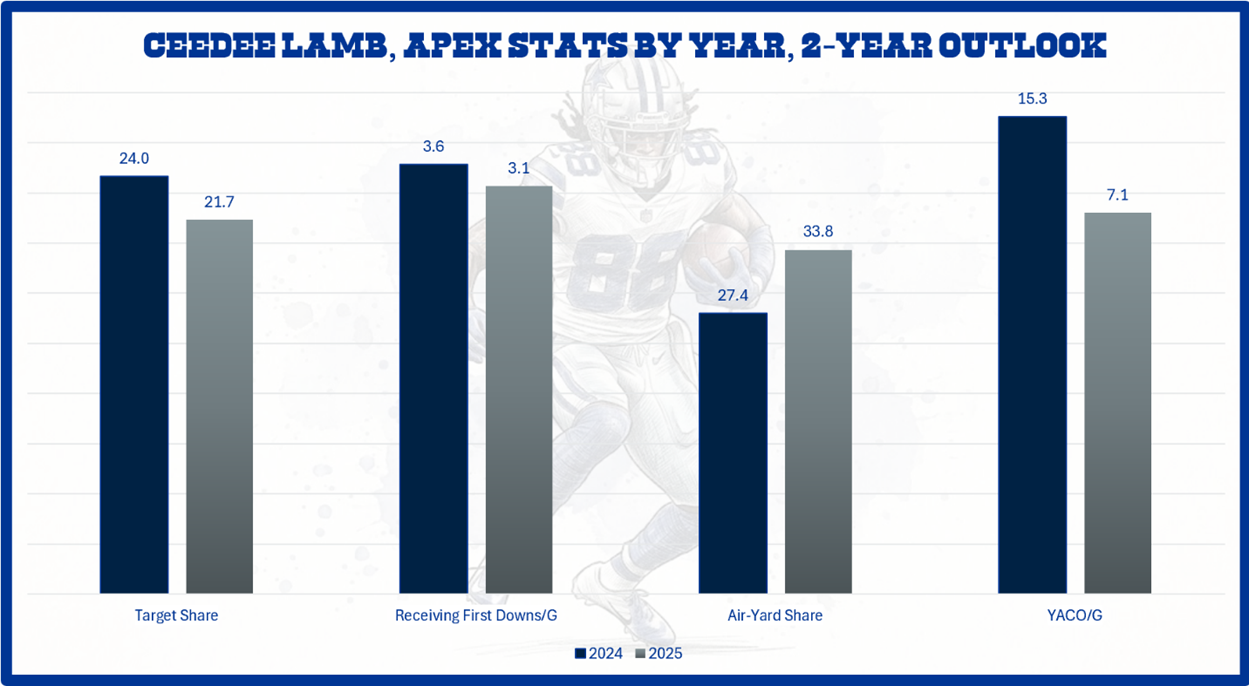
Lamb’s high-ankle sprain, suffered early in Week 3, hampered him all year. That’s one significant change for Lamb in transitioning from 2024 to 2025. Another, however, was the addition of WR George Pickens, acquired in a trade with Pittsburgh last spring.
Pickens drew roughly the same percentage of targets as Lamb, but he ranked in the top five in rec 1Ds/G and yards after contact per game (YACO/G), outscored Lamb in PPR/G, and finished one spot ahead of him in Apex Score. Pickens will return for another year, and it is reasonable to wonder who even is the Cowboys’ actual WR1. Either way, Lamb is likely not the volume monster he was when he led the NFL in PPR/G in 2023.
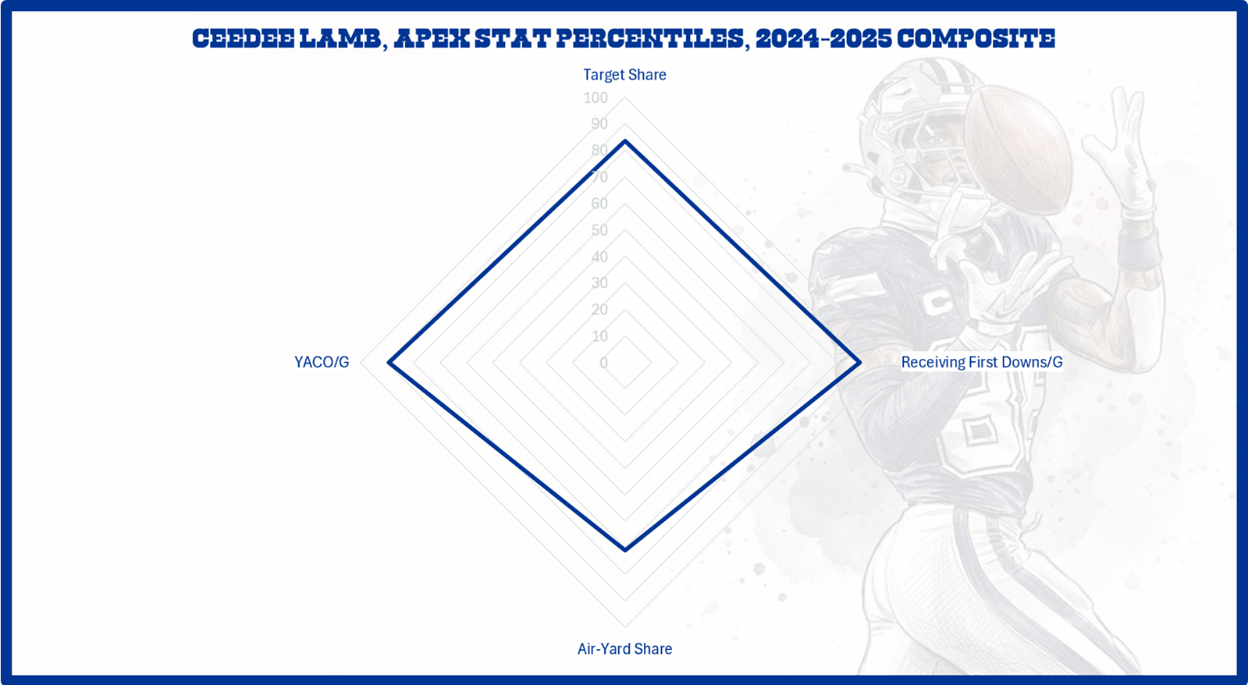
The one saving grace, if you still want to take the plunge on Lamb, is that a lingering high-ankle sprain or other injuries could easily have harmed efficiency, or even target-earning ability, so it is, in fact, possible that 2025 was not the real Lamb.