2026 Legendary RB Scenarios - Round 2

If you're looking for Part 1 of my 2026 legendary RB scenarios, or if you stumbled across this article and are wondering what legendary RB scenarios even are... start here:
 Pat Kerrane
Below are legendary and silent killer scenarios for the six RBs going in Round 2 of the FFPC Main Event, listed in order of ADP.
Quick Links:
Saquon Barkley
Legendary Scenario
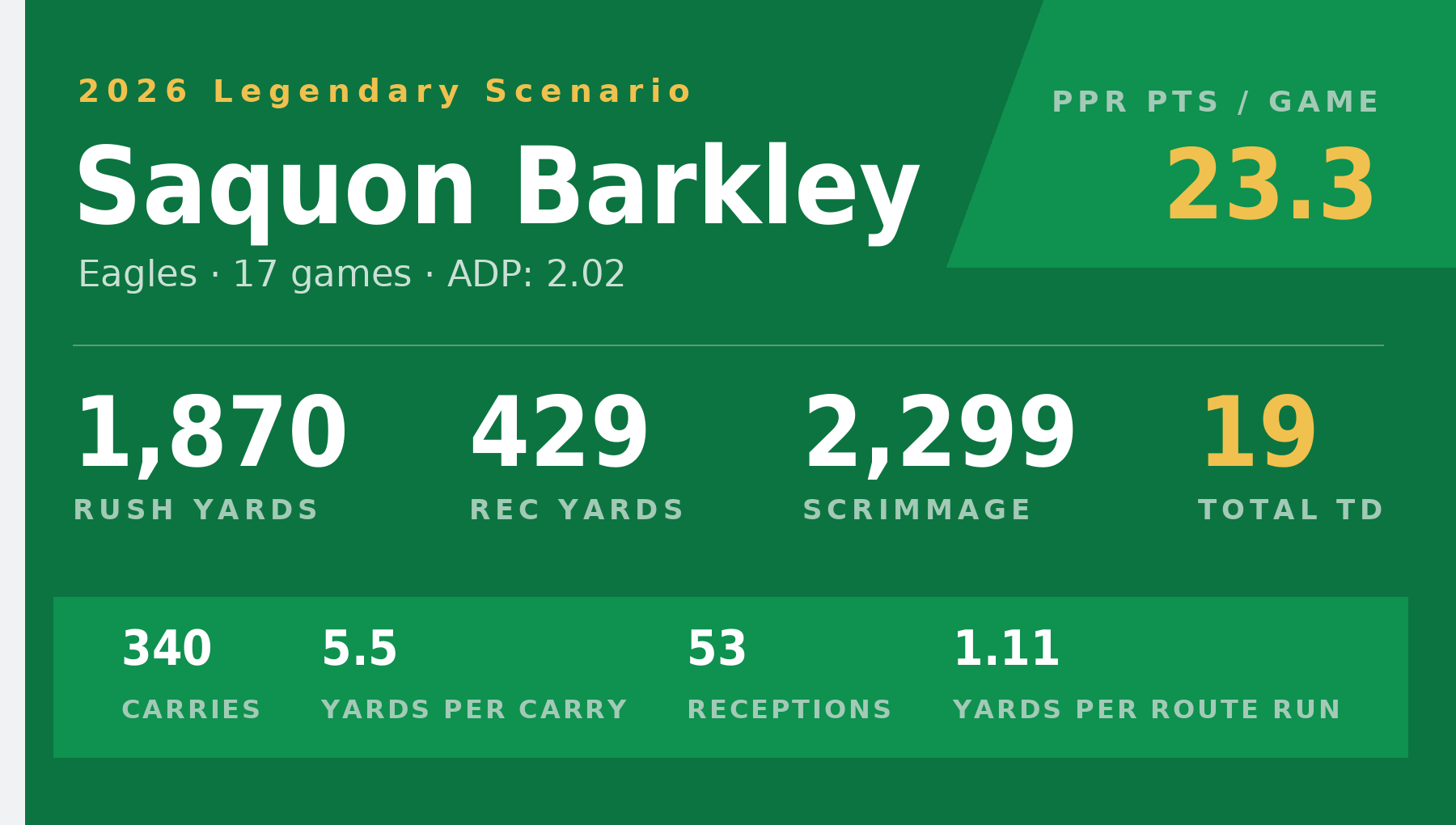
When the Eagles face the Seahawks in Week 15, the story of the week is whether they can shut down Saquon Barkley. And, ultimately, it's fair to say that they do.
Barkley handles 26 carries, tying his season high. But unlike in Week 13 when he ran 26 times for 247 yards and two TDs against the Cardinals, the Seahawks hold him to just 98 yards. He falls two yards short of his eighth 100-yard game.
Barkley does at least catch four passes for 32 yards. Still, his 17 PPR points are a disappointing way to start the fantasy playoffs for a player with a 35% advance rate.
In Week 16, Barkley doesn't fare much better. He turns 19 carries into 78 yards and a TD against the Texans, with three receptions for 20 yards. Again, his 18.8 points aren't bad, but this isn't league-winning stuff.
Then Barkley travels to San Francisco.
With the Eagles battling for the No. 1 seed and the 49ers battling for a playoff spot, both teams put everything on the line. Barkley puts the Eagles over the top.
On his third carry of the game, Barkley flows left with his offensive line before cutting and bursting through the gap between Landon Dickerson and Jordan Mailata. Barkley accelerates at a diagonal toward the sideline, then bends his run without losing speed, cruising past an Eagles sideline in full pandemonium for the 59-yard score.
This goes down as his longest run of the year, besting the 49-yard TD run he delivered in Week 2 against the Titans, and his 45-yard Thanksgiving dash in Dallas.
The return of Barkley's home run hitting ability is what ultimately makes him such a massive advance rate hit. Given that 2026 marks the third time he's hit 5+ yards per carry, Barkley drafters can't believe how discounted he was.
But the throng of just under 20,000 Barkley teams that originally hit Week 15 BBM pods has been whittled down. Entering Week 17, there are now just 67 Barkley teams in the 667-seat BBM final.
But those drafters are in luck. Barkley's 1st quarter run is just the beginning.
He scores again in the 3rd quarter from 33 yards out. And then, miraculously, gets a carry at the 4-yard line, which he punches in for a third score.
With the 49ers fighting back in a true shootout script, Barkley also racks up five receptions, totaling 230 yards from scrimmage.
Barkley totals 46 PPR points. Sure, that's 0.2 points shy of his best outing in 2024. Arguably, he left a little meat on the bone. But the timing couldn't be better. To win a fantasy championship in 2026, Barkley is as close to necessary as you can realistically expect.
On Sunday night, as the Eagles go into victory formation to close out a well-earned win, 600 BBM finalists shut off their screens. Not drafting Barkley comes with just one silver lining... there's always next year.
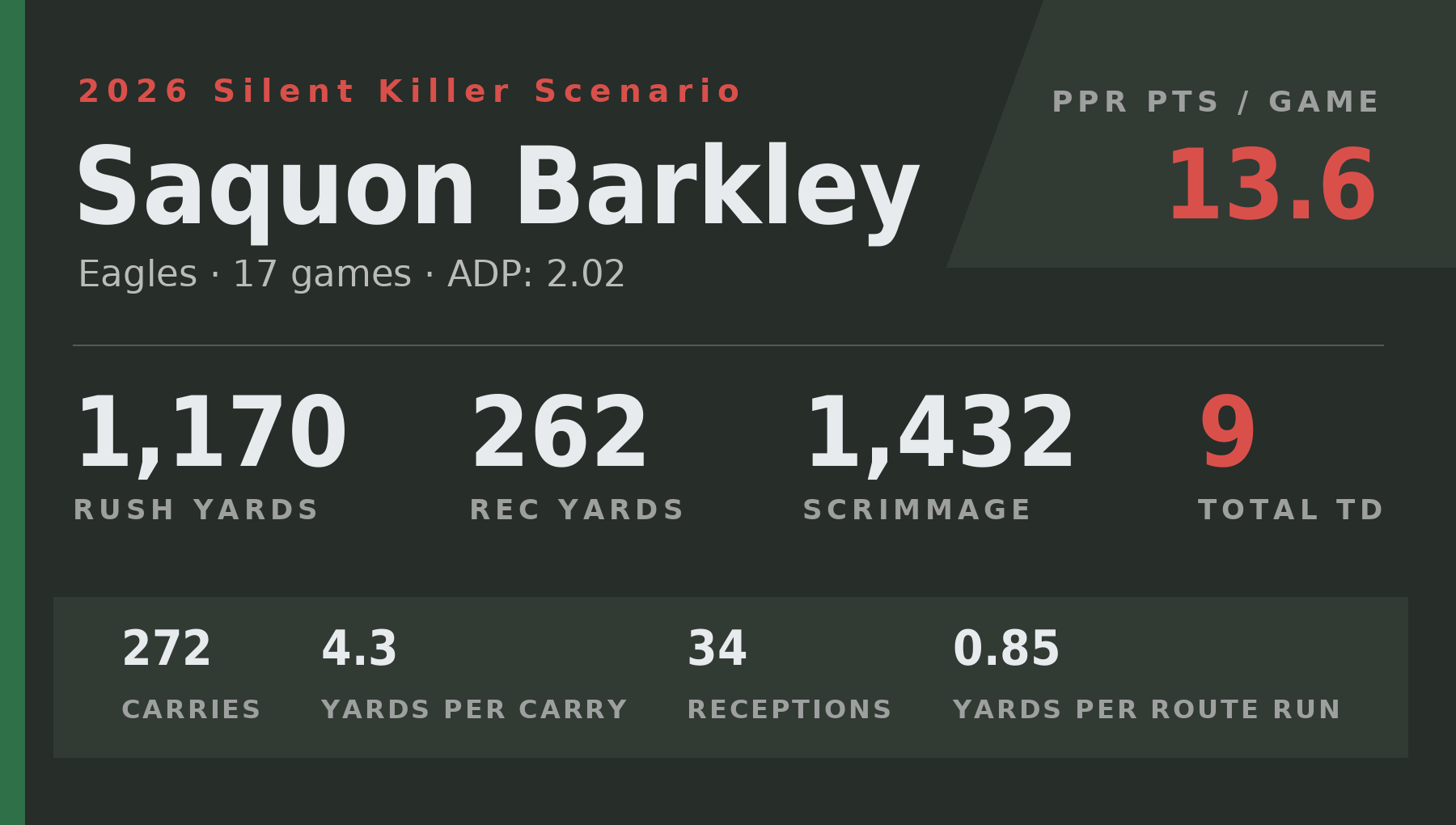
Silent Killer Scenario
In Week 9, Saquon Barkley and the Eagles host the Giants. At this point, this is less of a revenge game than a sigh-of-relief game for Barkley. The Giants are thoroughly dysfunctional by this point. Matt Nagy, shockingly, was not the correct hire for a young mobile QB. A month later, Greg Roman will be installed as the new OC, as John Harbaugh scrambles to save his job. Meanwhile, in Philadelphia, the Eagles are experiencing a bounce-back season. They are battling with the Cowboys and Commanders for the NFC East lead. A division win would be a nice way to head into their Week 10 bye.
The Eagles do indeed get the home win. Saquon Barkley is a huge reason why. Barkley hits three 15+ yard runs. The first sets up a 2-play tush-push sequence, with Jalen Hurts scoring on the second attempt. The second sets up a field goal to close out the 1st half. The third sets the Eagles up for a 1st-and-10 at the 22. Hurts hits DeVonta Smith for a TD down the right hash, catching the strong safety cheating up before the snap. All told, Barkley runs for 125 yards and gets the game ball. He's also held to just 14 PPR points.
But while Barkley's good games aren't always good fantasy games, his bad games are straight up bad in any context. And two of his worst are against the Seahawks and Texans in Weeks 15 and 16. By this point, the playoff-bound Eagles aren't super interested in 20+ carry workloads for a RB who turns 30 in a couple months. Tank Bigsby has proven to be a capable complement. And Sean Mannion is playing it smart, using Bigsby to keep Barkley fresh and, more importantly, healthy.
If Barkley had a reliable receiving role, Bigsby's involvement wouldn't hurt as much. But he posts 2.0 receptions per game, in line with the 2.2 mark in his first two seasons as an Eagle. He's not a zero in the passing game. But when Barkley disappoints on the ground, the passing game doesn't save him.
Barkley posts just 12.4 points against the Seahawks, then 9.4 against the Texans.
Barkley is better against the 49ers, but drafters feel like they're having déjà vu. Barkley once again hits three 15+ yard runs... without scoring a TD. This time he does at least catch three passes, totaling 148 yards from scrimmage. But while his 17.8 PPR points are useful, they don't move the needle in Week 17 matchups, certainly not for the capital required to draft him.
How to Play It
Among the RBs going in the late 1st - early 2nd, I don't think Barkley's situation stands out. He's in an offense unlikely to support high-end reception volume for one thing. He also has to deal with Jalen Hurts tush-push vulturing him at the goal line.
But Barkley dealt with both issues in 2024 and was still an absolute smash. The lesson then was clearly not to fade an elite runner in a high-scoring offense behind a great offensive line.
This year, the Eagles have Sean Mannion as their new offensive coordinator. Mannion has been working toward more of an under-center offensive approach and has a reputation as a creative and forward-thinking coach. He could be a massive improvement over Kevin Patullo. And the Eagles, once again, have an elite offensive line.
The key question is whether, at 29. Barkley can still operate as one of the NFL's premier runners. And, honestly, I do have some doubts about Barkley's ability to consistently deliver as a runner at a legendary level.
In his legendary scenario, I have Barkley with 53 receptions. He hasn't hit that number since posting 57 in 2022, his second-to-last season with the Giants. In 32 games with the Eagles, he's averaged 2.2 receptions per game. I have him at 3.1, which would be a big jump in a Jalen Hurts offense.
But I included that receiving bump partly because it's pretty hard to project Barkley for 20+ TDs, even in a legendary season. In 2024, Barkley totaled 15 TDs, but with just four scores from inside the 10. The tush push stuff is not a small factor... it genuinely caps his upside in a rushing-centric role.
Barkley's reduced goal line role also puts a ton of pressure on his ability to score from distance. At 29, can he still deliver 10+ TDs from outside the 10? Even with more goal line opportunities than in 2024, he probably needs to do that to approach 20+ total TDs. And... to turn in a legendary season, he probably needs to get at least close to 20 TDs while also adding receiving production.
On the other hand, it does seem a little absurd to hand-wave the possibility of Barkley overcoming a suboptimal situation when he's two seasons removed from a 2,005-yard rushing campaign with 21.9 PPR points per game. Sure, that's not technically a legendary season, but he was still an absolute smash in the mid-2nd round. He posted a 48% advance rate.
But just like we've seen exactly how Barkley can win leagues, we also know exactly how he can be a silent killer as an Eagle. Last year, with an ADP of 1.04, he averaged 14.5 PPR points per game. In delivering a 13% advance rate, he was a silent killer.
This year, my skepticism on Barkley applies more to what he'll do over the course of the entire season rather than doubting his weekly upside. Even last year, he peaked at 33.4 PPR points, despite a very underwhelming season. And in 2024, he hit 30+ points five times, with two more 30-pointers in the playoffs. The dude can win weeks.
Realistically, I think we're looking for a version of Barkley's 2024 season with a bit more receiving work. That receiving work is probably necessary to help offset efficiency that almost can't match the 5.8 yards per carry on 345 carries he posted in 2024. Either that, or we need Barkley to be a bigger factor at the goal line.
That makes Barkley more of a bet on a 20+ point type season rather than a true legendary campaign. But because of his breakaway ability behind an elite offensive line, and for the potential for the offense to rebound this season, I've been taking him in best ball.
I plan to take him less moving forward, as I look to get more of RBs going around him—with one of those other RBs being a true priority. But I'm at 11% on Underdog, and I feel good that, with the expectation that I'll probably be closer to 8.3% by the end of my drafts.
In redraft, I want more of a discount than in best ball. I have a Main Event share at the 2.07, which feels great. But Barkley is currently at the 2.02, and at that price, I'm prioritizing other options.
Best Ball Recommendation: Even with the field.
Managed League Recommendation: Target at a Discount.
Kenneth Walker
Legendary Scenario
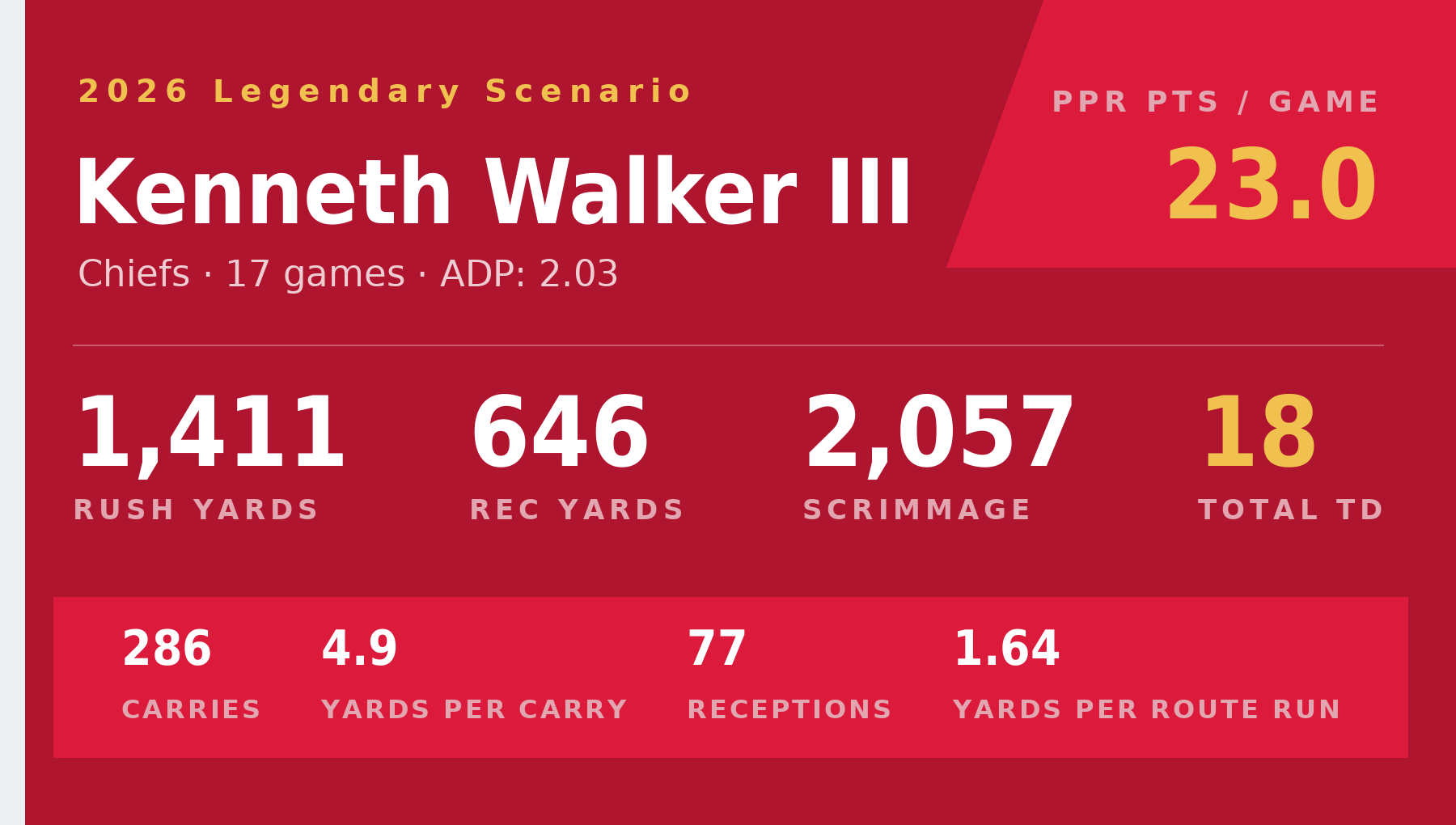
When Kenneth Walker carries the ball 24 times for 132 yards and a score against the Dolphins in Week 3, his drafters are pretty excited. The 3-for-24 receiving line is nice, but more than that, Walker is delivering on hopes that he'd be an early-down hammer. The following week's win over the Raiders reinforces that idea. Walker turns 23 carries and two receptions into 140 total yards and two TDs.
As the Chiefs head into their Week 5 bye, Walker drafters are convinced they have the Chiefs version of Saquon Barkley.
Week 6 changes their minds.
In a shootout loss to the Chargers, Walker hauls in eight receptions. And unlike his two eight-reception games in 2024, he averages more than 4.1 yards per reception. Under Andy Reid, Walker isn't just a dump-off option of last resort. He's truly a weapon in the screen game, and often an early read in the progression, boosting potential for YAC. On a career-high nine targets, Walker posts 70 yards and a score. He turns 15 carries into another 70 yards on the ground.
Following the Chargers' game, the Saquon Barkley comp becomes Giants Saquon Barkley. That comp isn't quite right, though, either, because Walker ultimately falls well short of Barkley's career-high 91 receptions in 16 games. Instead, Walker's receiving role is more similar to 2010 LeSean McCoy, who posted 78 receptions in 15 games. Although even then, Walker's 4.5 receptions per game are well below McCoy's 5.2.
But the larger point is clear. Walker isn't truly the engine of the Chiefs' offense as a runner. In the right matchups, he can be. At home against the Jets in Week 9, he does another Barkley impression. But Walker's role is much more versatile than that. After a dearth of explosive plays in 2025, Walker is the Chiefs' most explosive weapon, and they deploy him as both a runner and receiver—whatever the situation calls for.
From a receiving efficiency standpoint, in some ways, the best comp for 2026 Walker is... 2025 Walker. Walker posts 1.64 YPPR with the Chiefs, matching his final season with the Seahawks.
Walker's more versatile deployment ends up being essential for his fantasy playoff run. The Chiefs face the Patriots, 49ers, and Chargers to close the fantasy season, and, as expected, these are not low-scoring games. Without a locked-in receiving role, Walker could disappear. As it happens, he averages six receptions and 50 receiving yards per game. The shootouts win playoff matchups.
Entering Week 17, Davis Mattek lambastes his Ship Chasing co-managers for repeatedly betraying their blood oath, passing on Walker in Round 2. His spite-drafted, solo-managed Main Event is now in shouting distance of shipping the $1 million first place prize.
Walker fulfills his end of the contract. He caps off his first legendary season with a career-high nine receptions against the Chargers in Week 17. Along with 14 rushes, he totals 136 yards from scrimmage and two TDs.
34.6 PPR points, signed, sealed, delivered.
Unfortunately for Davis, passing on a stacked Patrick Mahomes (QB2 in the sprint) for Keaton Mitchell (RB39) proves too costly to overcome.
Silent Killer Scenario
December is a cold month for Kenneth Walker drafters.
On Thursday, December 3rd, the Chiefs kick off the month of football with an away game against the Rams. Andy Reid's old tricks are no match for Sean McVay's all-world defense. The Chiefs have put 11 games of tape out on a screen-heavy offense. And they still don't have a single receiver who can beat man coverage. The Rams know where the ball is going as well as the Chiefs do. Walker can't get in the end zone; but to be fair, that's true of the entire Chiefs offense. The Chiefs lose 23-6.
The defensive schedule lightens up considerably for the rest of the month, with matchups against the Bengals, Patriots, and 49ers.
And, on a positive note for Walker, the Chiefs increasingly lean on the run game, finally capitulating to their lack of receiving weapons.
But Walker isn't the only game in town. Emmett Johnson has emerged as a solid complementary runner. Walker still averages 15.1 carries per game, far more than the 13 he averaged with Seattle in 2025. But as the offense shifts more to the run, it also shifts to a more split backfield. Publicly, the Chiefs talk up the importance of keeping Walker fresh, but they're obviously intrigued by what they have in the rookie.
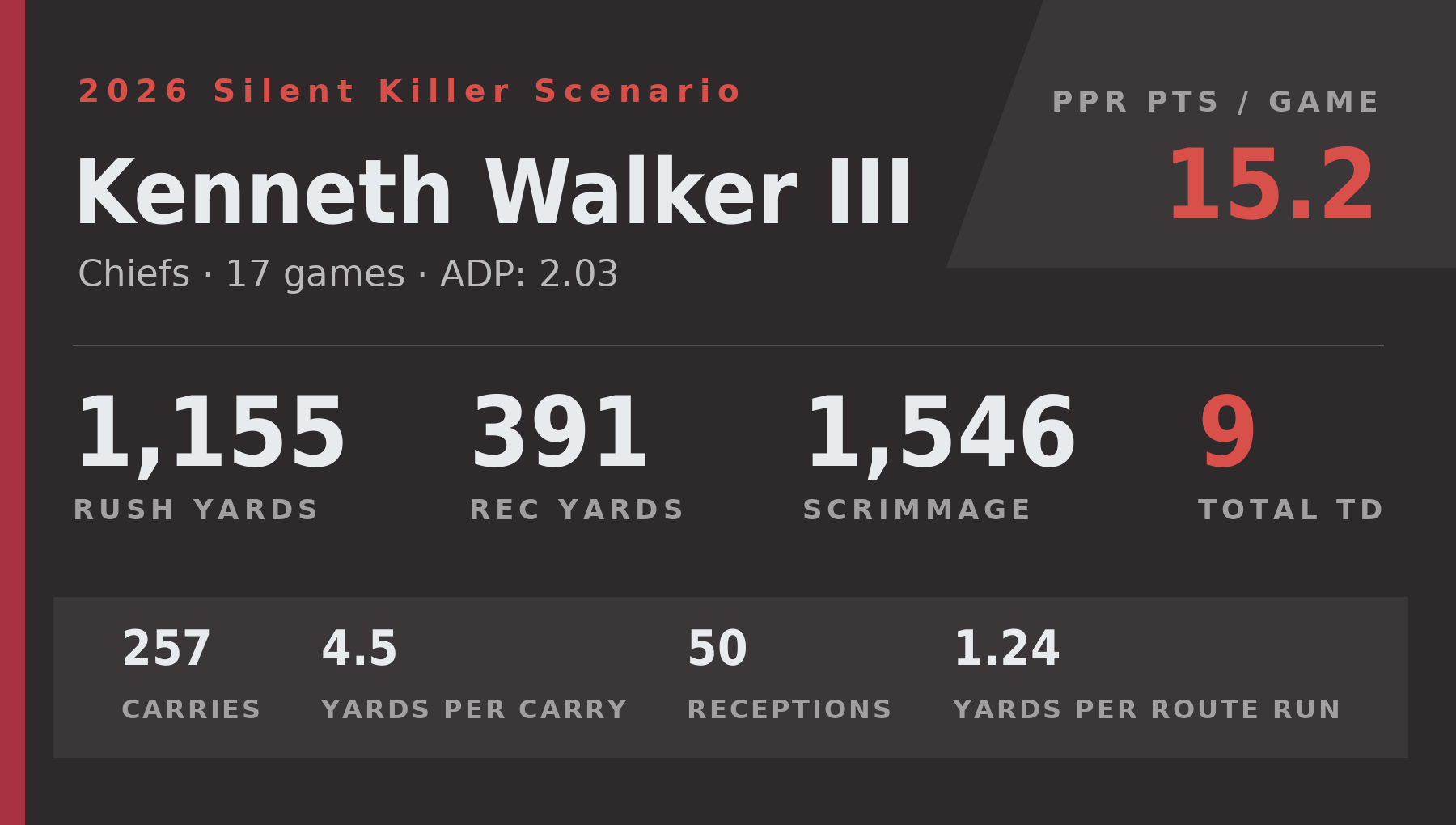
For his part, Walker runs well. But although his 4.5 yards per carry matches his career average, it's still a disappointing mark as part of an offense many were hoping would boost his efficiency.
TDs are an even bigger issue. Between the 20s, Reid has drawn up screens and pitches for his new toy. But in the red zone, he gets weird. The last straw for Walker drafters is a Travis Kelce carry turned pop pass to Cyrus Allen in the back of the end zone. The play results in a TD... but not in the way Reid intended—a Fred Warner pick-6. Warner's score is one more than Walker totals in the entire month of December.
As a result, Walker enters the new year, and Week 17, as a borderline non-factor in fantasy. He's been solidly productive, but even in the early months of the season, he wasn't a needle mover. And as a result of him cooling off in Weeks 13-16, most Walker teams have already been eliminated.
Still, Walker turns in a solid showing in Week 17. In a win over the Chargers, he runs 17 times for 83 yards and a score, with three receptions for 20 yards. His 19.3 points are useful, but don't make up for deeply underwhelming production in the previous playoff weeks.
Walker's production is compounded by a bounce-back season from Saquon Barkley, making his early-2nd round opportunity cost pretty massive. Walker's 15.2 points per game average is both pretty solid and leads to just an 11% best ball advance rate.
How to Play It
For Walker to deliver a legendary season, he needs to do something that's usually a bad bet. At 26 (in October), he needs to emerge as a true receiving threat. And I'm not talking about becoming a guy who sees decent receiving volume. I'm talking about becoming a guy who is among the leaders at the position in receptions. The 77 receptions in his legendary scenario would have matched Jahmyr Gibbs' total last year, tied for third behind Bijan Robinson (79) and Christian McCaffrey (102).
While we do sometimes see big jumps in receiving volume for RBs, that is most common for second-year RBs. Veteran role changes are often prognosticated, but rarely materialize in a massive way.
However, Walker's change in situation is uncommonly dramatic. He's moving from a run-heavy Seattle team to a Chiefs team that is consistently pass-heavy, loves the screen game, and desperately needs explosive playmakers. There's a real path to a new role.
Additionally, if Walker does develop into a receiving star, we're going to have trouble explaining why we couldn't see it coming. There were pretty clear signs.
Walker is coming off a legitimately impressive 1.64 YPRR. Among RBs with 40+ targets, that ranks behind only Bijan Robinson (1.88), Christian McCaffrey (1.81), and Jahmyr Gibbs (1.67). Moreover, in 2024, Walker was posting impressive receiving volume, with 46 receptions in 11 games. That's 4.1 receptions per game, matching Chase Brown's 2025 per-game average. It's hard to say that Walker doesn't have a path to 4+ receptions per game when he's already done that in Seattle and now moves to the Chiefs.
And, as a runner, Walker is potentially in a very advantageous situation. He moves from a committee backfield on an offense built around the run to the clear lead runner on an offense built around the pass. This creates upside for lighter boxes and more carries per game than he saw in Seattle. Frankly, even in a bad season, he should cruise past the 13 carries per game he saw last season. With a career yards per carry of 4.5, Hunt hasn't been a spectacular runner, but he's been good. And this is an offense that supported 4.9 yards per carry for both Kareem Hunt and (more impressively) Isiah Pacheco in each of their rookie seasons. Walker could plausibly match or surpass that.
Walker needs to score a lot of TDs for a legendary season but, honestly, who doesn't? And Walker doesn't need to go nuts as a TD scorer to hit 23+ points per game. With strong efficiency in a well-rounded role, he can be a legend with fewer than 20 TDs.
On the other hand, Walker's floor case looks pretty realistic, and, in some ways, a pretty good season. The issue is that as an early 2nd-round pick, Walker is going to be a drag on rosters if he scores like Javonte Williams did last year. There's a good chance he does.
But Walker's price also allows some wiggle room to the upside. If he turns in a receiving line more like 54/483/3 rather than 77/646/4 I lay out in his legendary scenario, we'd still be talking about 20.3 points per game (holding his rushing steady). Alternatively, with a rushing line of 257/1,155/8 (his silent killer rushing stats) and his legendary receiving line of 77/646/4 , we're looking at 19.4 points per game.
So, while it's a bit of a parlay to get Walker all the way to 23 points per game, he can only partially hit his upside case and still be a great Round 2 pick.
In my view, the big consideration is price. If taking Walker means drafting him ahead of Justin Jefferson, CeeDee Lamb and (in tight end premium) Trey McBride, I'm out. If it means taking him ahead of the other RBs in this range, I'm increasingly in.
Walker is a talented player in a great situation. It's not just that the Chiefs can help him score fantasy points; the Chiefs very clearly are relying on him to help get them back to a playoff-level offense. He's going to be a focal point.
I've been interested in Walker throughout the summer, but after writing him up, he's a priority for me to close drafts. I think he has a real path to a legendary season as, essentially, being what the Bengals wish they had in Chase Brown. But even if he falls short, he could easily pay off an early 2nd round cost in a big way.
I'm currently at 9% on Underdog, which feels light. He'll be a priority in my remaining drafts.
I'm even more interested in Walker in redraft, where his potential to emerge as both a consistent needle mover and high-upside weekly play makes him a clear target, despite some macro-level red flags.
Best Ball Recommendation: Target.
Managed League Recommendation: Blood Oath (Priority Target).
Omarion Hampton
Legendary Scenario
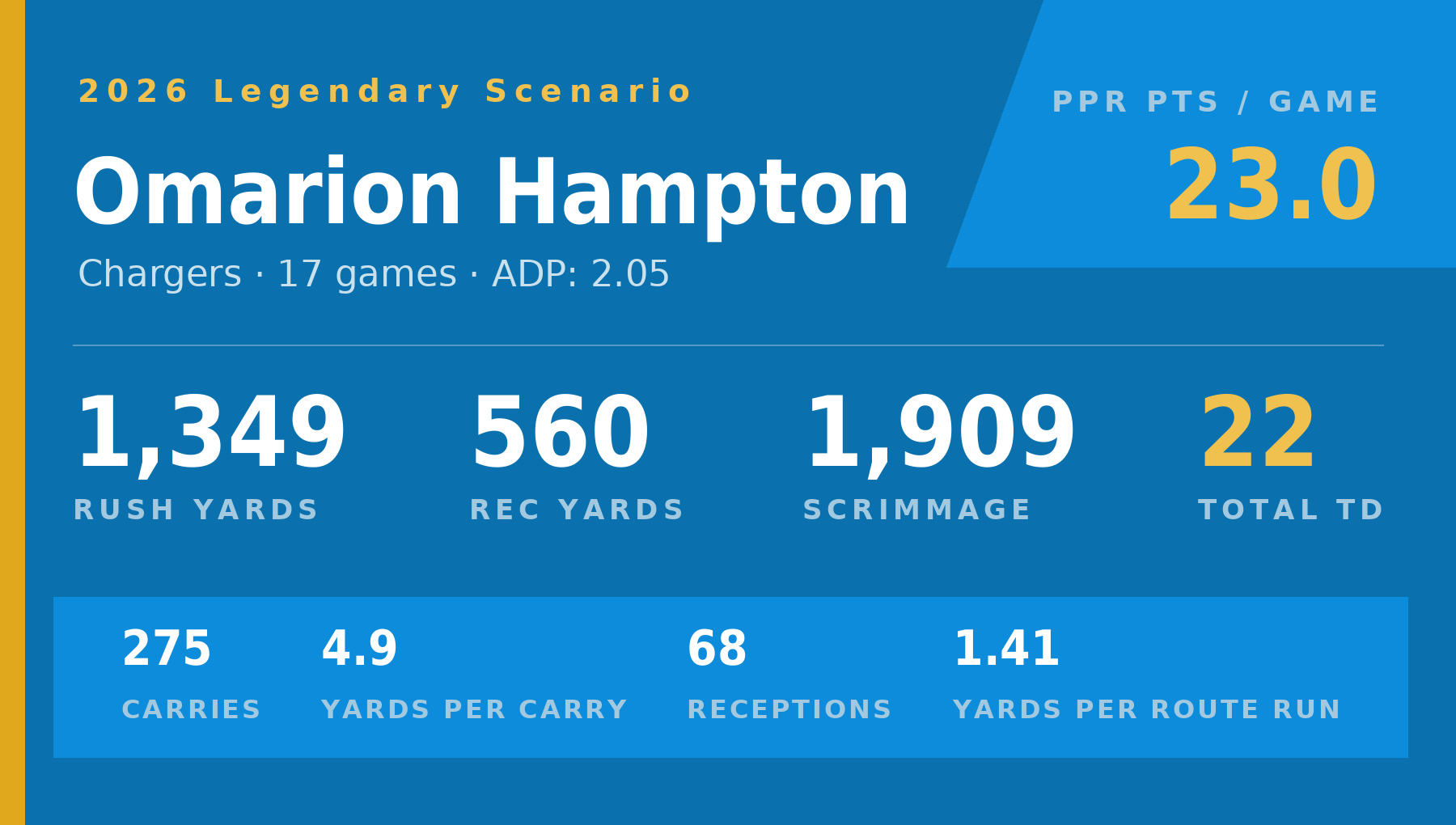
In Week 5, against the Broncos, Hampton hauls in eight receptions. He hits that number again in Week 12 against the Patriots. And in Week 15, he hits seven receptions as part of a 27-PPR-point outing. Hampton drafters delight in having drafted the Chargers version of Chase Brown.
But that's not quite right as a comp.
In Week 3 against the Bills, Hampton averages 6.8 yards per carry. He then hits 7.5 yards per carry in Week 11 against the Jets. In Week 16, in Miami, he hits 7.3 yards per carry as part of a 22-point game. Drafters begin referring to him as discount James Cook.
But that's not the right comp either.
In Week 1, against the Cardinals, Hampton totals three TDs. A 2-yard plunge, an 8-yard catch, and a 23-yard breakaway run. In Week 14, in Las Vegas, he scores twice from outside the red zone, on both a run and a catch. In Week 17, against the Chiefs, he scores three more times, adding a 36-yard sprint to two goal line scores.
Finally, after Hampton's 38.2 PPR points seal fantasy championships, his drafters finally have the comp. He's Raheem Mostert crossed with De'Von Achane.
Hampton's 1.41 YPRR is just below Achane's 2024 career high of 1.45. And his 22 TDs best Mostert's 2023 mark of 21.
With Hampton representing the culmination of the Mike McDaniel rushing project... he's hard to take off the field. With 16.2 carries per game, he doesn't have a total lock on the backfield, but he's the clear lead back, with Keaton Mitchell operating in a breather-back capacity and Kimani Vidal virtually nonexistent. And, after a brief experiment with Mitchell as a receiving complement, the Chargers turn over the bulk of targets to Hampton as well. His 343 touches are bested only by Bijan Robinson, Jahmyr Gibbs, and Christian McCaffrey.
Silent Killer Scenario
Week 3 is the first time Hampton drafters get a pit in their stomachs. Hampton has been solid to this point, averaging 16.5 points per game. And the Chargers offense looks good. Hampton is going to have some big games soon. That's the hope, anyway.
But hosting the Cowboys in Week 3, Justin Herbert is more interested in attacking downfield than in handing off. And, in an anxiety-inducing development, that includes downfield targets for Keaton Mitchell out of the backfield.
Over the summer, Mitchell was compared to a variety of backs, most commonly De'Von Achane, due to the McDaniel connection. But the connection is more to the guy that helped create the Achane role in McDaniel's imagination: Darren Sproles.
Mitchell, who posted 19 receptions with the Ravens in 26 games, isn't seeing Sproles-esque volume. After all, Sproles hit 50+ receptions in six different seasons, peaking with 86. But, stylistically, there are clear similarities, just as Ben Gretch predicted there would be.
And Mitchell's role isn't huge, but it is fun. He's seeing schemed targets and running much higher upside routes than the typical RB. All of this is really cool unless you spent a 2nd round pick on Omarion Hampton, who spends those plays on the sideline.
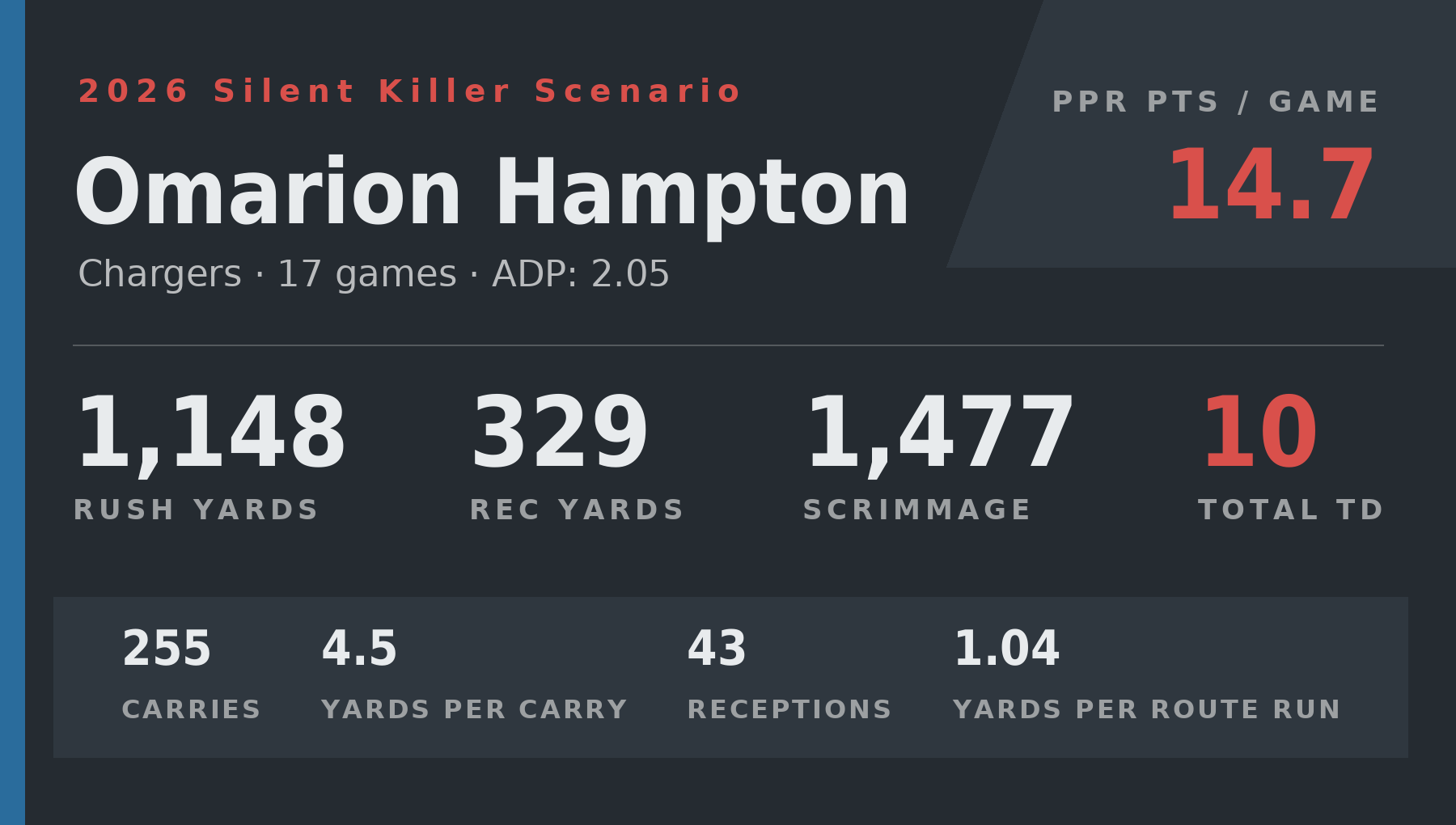
It's not like Hampton isn't also involved in the passing game. He posts 43 receptions over the course of the season. But his per-game average drops from 3.6 receptions to 2.5. And, despite seeing an increase in YPT from 5.6 to 6.1, Hampton's YPRR holds steady at 1.04, the same mark as his rookie season.
Hampton is more efficient on his targets, but he's also losing higher-upside targets, the ones with air yards, to Mitchell. He doesn't have a total lock on screens. And, ultimately, Herbert is looking to push the ball downfield. There are only so many RB targets in the offense.
When Week 17 rolls around, Hampton drafters no longer have a pit in their stomach. They're numb. After thinking they were getting an underpriced sophomore breakout, they instead landed a TD-dependent RB2... who doesn't even score a ton of TDs.
The fantasy championship game sums up the season. Hampton turns 18 carries into an efficient 85 yards, adding two catches for 18 yards. But, with Hampton held out of the end zone, he scores just 12.3 points.
In early 2027 drafts, Hampton falls to the 5th round, before eventually rising to the mid-4th on hopes of better efficiency and a higher TD rate in Year 3.
How to Play It
When you zoom out on Omarion Hampton... things look pretty sweet. Let's look at the legendary RB profile:
- A path to 4+ receptions per game.
- Hampton averaged 3.6 receptions per game as a rookie.
- CHECK
- Hampton averaged 3.6 receptions per game as a rookie.
- A path to 2+ green-zone (inside the 10) opportunities per game.
- Hampton saw 1.6 per game as a rookie and plays on a potentially elite offense.
- CHECK
- Hampton saw 1.6 per game as a rookie and plays on a potentially elite offense.
- Strongly prioritize versatile running backs with paths to high-volume receiving and goal-line roles.
- CHECK
- A path to good, ideally elite, offensive line play.
- Assuming they both return to full health, the Chargers have an elite tackle duo but concerns on the inside. Brandon Thorn has them ranked as the 17th-best line, but with upside from there.
- CHECK
- Assuming they both return to full health, the Chargers have an elite tackle duo but concerns on the inside. Brandon Thorn has them ranked as the 17th-best line, but with upside from there.
- A path to an efficient passing offense—unless the passing offense can run through the running back.
- CHECK
- Be skeptical of running backs who entered the NFL below 210 pounds—unless the running back has a clear lock on goal-line duties.
- Hampton weighed 221 at the Combine.
- RED FLAG AVOIDED
- Hampton weighed 221 at the Combine.
- Apply extra scrutiny to running backs 26 and older.
- Hampton is 23.
- RED FLAG AVOIDED
- Hampton is 23.
- Excluding rare prospect profiles, remain very price-sensitive on rookies.
- RED FLAG AVOIDED
- Prioritize second-year players and be skeptical in assuming significant role increases for non-second-year players.
- CHECK
- Prioritize running backs who have flashed the elite talent required to deliver high-end efficiency.
- ... JURY IS OUT
- Strongly prioritize running backs who have flashed elite receiving ability.
- ... RED FLAG
By the legendary RB profile, Hampton is largely a clear-cut target. But things get dicier when we move from his usage, situation, and macro-level characteristics to the actual player.
Hampton was a 1st-round pick, but even still, not an elite prospect. He was an excellent tackle breaker at UNC and handled an impressive workload, but he wasn't a great breakaway runner or receiver. He was definitely a good prospect, arguably a great one. But he very clearly was not an elite Bijan Robinson-level prospect. With that type of player, I'd be much more willing to hand-wave a concerning rookie season.
On the ground, Hampton's rookie season was somewhat promising. He posted 76 RYOE in nine games, with a solid 42% success rate. But he also saw just 13.8 carries per game, at times losing significant work to Kimani Vidal. To be fair, these workload concerns were partly the result of Hampton dealing with injuries.
As a receiver, things were a little more clear-cut. Hampton was not impressive, posting 1.04 YPRR and 5.6 YPT.
Normally, I wouldn't get hung up on this type of receiving efficiency. After all, Hampton is a 2nd-year RB with 1st-round draft capital. There's potential for him to take a big step forward as a receiver in Year 2. And, while not a high-end receiving prospect, he does profile as a capable one.
However, Hampton's path to increased receiving efficiency and volume is impacted by the addition of Keaton Mitchell—who does appear to be a part of the Chargers' plans. There's also the fact that Hampton is playing for a new offensive coordinator, who was not involved in the decision to draft him in Round 1. This isn't to say that McDaniel doesn't value Hampton... but we want him to feature Hampton.
Hampton profiles as the type of RB who needs to consolidate volume to deliver a truly legendary season. He's a bit of an Ezekiel Elliott type, which is both a good and bad thing. Like Elliott, Hampton could become a versatile workhorse in a high-end offense. But also, like Elliott, Hampton probably isn't elite at anything. If another back emerges who is more explosive or a better receiver than he is, there's real downside for work to be siphoned away.
Keaton Mitchell is not someone I've drafted much of because of brutal sticker shock. But I do see the upside there. And I think that upside directly impacts Hampton—because fundamentally, with Hampton we're betting on a good player in a great situation. And so, if his "great" situation also involves work for an explosive pass-catching RB... that's going to hurt.
And, whereas Ezekiel Elliott was fully established by the time Tony Pollard came along, Hampton is not. This is not a player where the concern is just him losing work. We need Hampton to make big leaps in his rushing workload, goal line opportunities, and receiving role to have a realistic shot at a legendary season. Meanwhile, his coach is talking like he plans to deploy a committee. That could end up being BS, but it's also completely plausible in a backfield without an established workhorse.
Ideally, Hampton would be going closer to the 2/3 turn. At that price, he'd be a pretty clear target. His upside case would start to look less like a parlay to hit 23+ points and more like an RB with multiple outs to 20+ points. And his floor would look significantly less concerning with fewer high-end players around him.
But after writing up Hampton, I find myself looking for ways to draft more of him.
Do I think Hampton is overpriced? Yes.
Do I think Hampton can still pay off in the mid-2nd? Ultimately, yes.
Even if Mitchell is a thorn in his side to begin the season, Hampton can consolidate work over the course of the year and deliver like a legendary back down the stretch. And as part of the Chargers offense, he legitimately has high-end TD upside, even if a 22-TD season is likely out of reach.
But wanting to draft more Hampton and actually drafting him are two different things. He's in a range with a number of clear targets, and requires a level of speculation that I find difficult for a player I like but don't love.
In best ball, I'm currently at 5% on Hampton and, this late in the game, I'll likely end up underweight. I'll be looking for opportunities to get closer to 8% by the close of draft season, but I'm not sure how much progress I'll make. While he's definitely in the mix with the other RBs in the mid-2nd round range, I still struggle to see him as a priority in a format where avoiding misses on an 18/20-player parlay card is a key part of the strategy.
In redraft, I'm more interested in targeting Hampton. His path to upside requires something big to happen. He needs much better rushing volume, TD production, receiving volume, receiving efficiency—and ideally multiple of those. He's more of a classic redraft home run swing.
The floor is low, but kind of so what. In the 2nd round, small losses are big losses, especially in redraft. And as a bet on a 2nd-year back in a high-scoring offense with an RB-friendly OC, I can totally see something big happening. I have to daydream just a little bit, but I can see it.