2026 Legendary RB Scenarios - Round 1

Five years ago, I wrote an article on Rotoworld called Don't Draft an Early Round RB Without Legendary Upside.
And as a follow-up to that article, I detailed whether or not that year's highly drafted RBs would turn in legendary seasons or become silent killers.
For me, writing is about getting into the zone. It's not hard once I'm there, but it's sometimes hard to travel to the place where ideas flow onto the page.
This article makes that process a little easier. I don't need to get into a flow state; I simply fire up my time machine, head to the future, observe what literally happened, and then report it back verbatim. It's a yearly tradition.
What is a Legendary Season?
Let's quickly cover what a legendary season is and why we're looking for them.
First and foremost, highly drafted RBs bust at high rates:
In my original research, I found that RB bust rates in the first two rounds were actually higher than in Rounds 3-6. This is despite RBs in Rounds 3-6 being such a drag on rosters that the range of the draft became the RB dead zone.
But the dead zone isn't where bust rates spike; it's where upside stops.
In the early rounds, bust rates are absolutely brutal... but there are also potentially league-winning players available.
And if we're going to risk losing our league with an early RB selection, the upside needs to be worth it.
With that goal in mind, I examined 36 RB seasons from 2000-2020 in which a running back hit 23+ PPR points per game, with 12+ games played. These seasons generated a profile to help us predict future legendary seasons.
Legendary RB Target Profile
- A path to 4+ receptions per game.
- A path to 2+ green-zone (inside the 10) opportunities per game.
- Strongly prioritize versatile running backs with paths to high-volume receiving and goal-line roles.
- A path to good, ideally elite, offensive line play.
- A path to an efficient passing offense—unless the passing offense can run through the running back.
- Be skeptical of running backs who entered the NFL below 210 pounds—unless the running back has a clear lock on goal-line duties.
- Apply extra scrutiny to running backs age 26 and older.
- Excluding rare prospect profiles, remain very price-sensitive on rookies.
- Prioritize second-year players and be skeptical in assuming significant role increases for non-second-year players.
- Prioritize running backs who have flashed the elite talent required to deliver high-end efficiency.
- Strongly prioritize running backs who have flashed elite receiving ability.
This profile sets a very high bar for early-round RBs. That's part of the point. If we're going to take on the risk of an early-round RB selection, we want a path to truly season-altering upside.
From 2000-2020, there were just 1.7 legendary RB seasons per year. Since then, we've had the following seasons.
In 2021, Jonathan Taylor joined the ranks by averaging 23 points per game from Weeks 1-17. In 2022, Austin Ekeler also averaged 23 points per game from Weeks 1-17, including a BBM-winning (🙌) 32.1 points in Week 17. In 2023, Christian McCaffrey put up 24.7 points per game. In previous years, I've referred to this as McCaffrey's fourth legendary campaign, but upon rechecking his career, it was actually only his third season hitting 23+ points with 12+ games played. Perhaps I was manifesting a fourth legendary campaign for CMC. He delivered on that last year.
In 2024, Saquon Barkley hit only 21.9 points per game, but did so as a 2nd-round pick while posting a 48% Underdog advance rate.
Last year, Jonathan Taylor's season wasn't quite legendary, either, but he posted a 49% advance rate from Round 2 with 21.3 PPR points per game. And he was only RB4 on the season. Jahmyr Gibbs (21.7) and Bijan Robinson (22) both nearly hit legendary seasons. Christian McCaffrey undisputably did, averaging 24.5 points per game. McCaffrey now (truly) has four legendary seasons to his name.
Silent Killers
Elite RBs require significant touch volume in a violent league. They'll always come with injury risk. But early-round RB picks also come with team-killing risk... even when they stay healthy. They can be silent killers.
Last season, Ashton Jeanty was this type of player. Jeanty played in all 17 games, but in averaging 14.5 points per game from the 1/2 turn, he turned in just a 9% advance rate. He didn't have to get hurt to become a bust.
These kinds of seasons are a recurring issue for early RB picks.
Bijan Robinson and Austin Ekeler were good examples of this idea in 2023.
Robinson played 17 games but averaged just 14.7 PPR points per game. Because he went in the 1st round of drafts, his good-not-great production hurt rosters more than you might assume. His 10.3% Underdog advance rate was just 62% of the expected rate.
Austin Ekeler played 14 games in 2023, but his scoring dropped from 22.1 PPR points per game to 13.5. Like Robinson, he was a 1st round pick, leading to an 8.3% advance rate—exactly half the expected rate.
Keep in mind that Nick Chubb posted a 6.3% advance rate in 2023 despite playing just two games. Silent killers are killers.
2026 Legendary RB Scenarios - Part 1
Below I've outlined two futures for the six RBs going in the 1st round of the FFPC Main Event. In Part 2, I'll cover the Round 2 RBs. Then, in Part 3, I'll dive into the RB dead zone to see if there is upside worth chasing.
Quick Links:
Jahmyr Gibbs
Legendary Scenario
The offseason is for optimism. Week 1 is for overreacting. Week 2 is for questioning everything we thought we just learned.
But after Week 3, we do finally start getting a feel for the new NFL season.
That's how it goes for the Jets in 2026. After beating the Titans in Week 1, Jets fans are giddy. After barely losing to the Packers in Week 2, Jets fans are angry, but in a way that feels good—a "we were the better team today" type reaction that preserves some optimism for the season to come. New York's offense looks like it can actually hang, and the defense looks like it's better than expected.
Then they play the Lions.
Not to get hyperbolic, but the simplest way to describe Week 3 is Jahmyr Gibbs grabbing the hopes of an entire fanbase by the scruff of the neck and tossing them into the abyss. (Not to get hyperbolic).
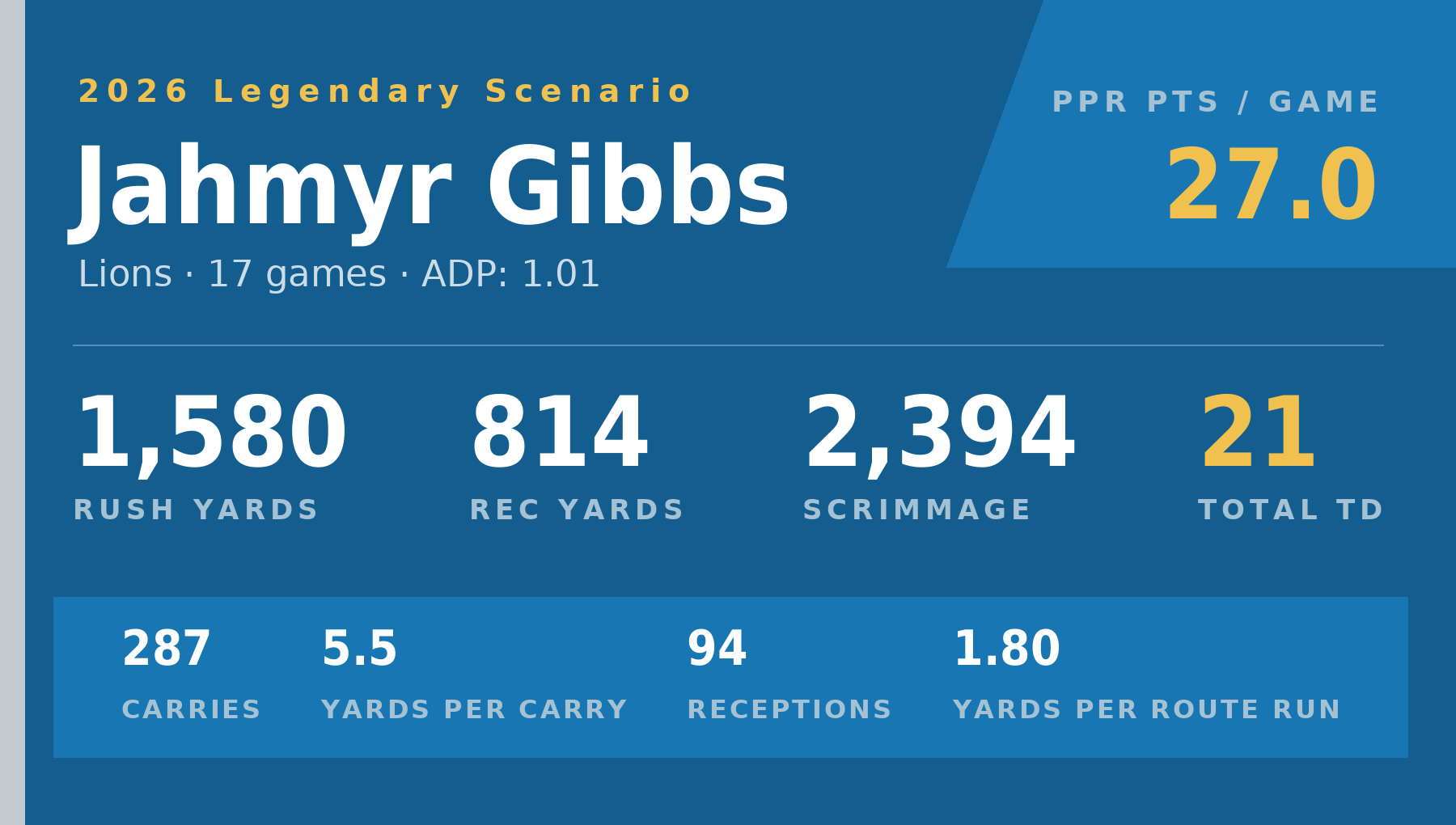
Gibbs turns 19 attempts into 181 yards and two TDs, adding another three receptions for 45 yards. By the 4th quarter, Jets fans are thinking about 2027. Gibbs drafters are dreaming about Week 17.
Gibbs' rushing-driven explosion in Week 3 is indicative of his larger 2026 production. He's a force on the ground and a true rushing workhorse. Gibbs' 287 attempts match Bijan Robinson's 2025 total. But Gibbs, playing in a more dangerous offense and with even more electric top speed, is the more efficient runner. He turns in 1,580 rushing yards and 15 TDs—five of which are from distance.
Purely as a runner, Gibbs averages 14.6 fantasy points per game, producing as a high-end RB2 before running a single route.
But that, of course, doesn't tell the whole story.
Gibbs best illustrates his truly legendary ability in Chicago on January 3rd. By this point, the Lions are one game back from the Bears in the NFC North title fight.
The Bears are able to slow down Gibbs as a runner. He runs 14 times for just 53 scoreless yards.
But Gibbs is too dynamic to fully contain. He operates as a true weapon in the passing game, posting 10 receptions for 107 yards and two TDs. Gibbs' 38 PPR points bring home fantasy championships and ultimately propel the Lions to victory. The following week, the Lions bring home the division with a win in Green Bay.
Gibbs finishes the season with 94 receptions for 814 yards and six TDs. He falls eight receptions short of Christian McCaffrey's 2025 total, but with 12.4 PPR points per game as a receiver, he's functionally a low-end WR2 in the passing game.
Gibbs' ability to deliver as both a runner and receiver makes him an incredibly powerful fantasy force. The Lions' powerhouse offense fully supercharges his profile.
Dan Campbell has thoroughly demonstrated his committment to putting up points. In his first season as offensive coordinator, Drew Petzing doesn't slow things down. And, in fact, Petzing is more willing to air it out from behind, helping the Lions consistently put up points regardless of game script.
With David Montgomery in Houston and Isiah Pacheco failing to recapture his early-career form, Gibbs is a hammer at the goal line for one of the NFL's highest-scoring offenses. Gibbs scores 13 TDs from inside the 10-yard line. And his 21 total TDs tie Christian McCaffrey's output in his legendary 2023 season. This is a new career high for Gibbs... but by only one TD.
The end result is the most dominant RB season since Christian McCaffrey averaged 29.3 points per game in 2019. Gibbs' 27.0 mark isn't quite as impressive. But it's more than enough for salty fantasy managers to complain that the only way to win in 2026 was to luck into the 1.01. In 2027, 11% of ESPN home leagues convert to auction drafts.
Silent Killer Scenario
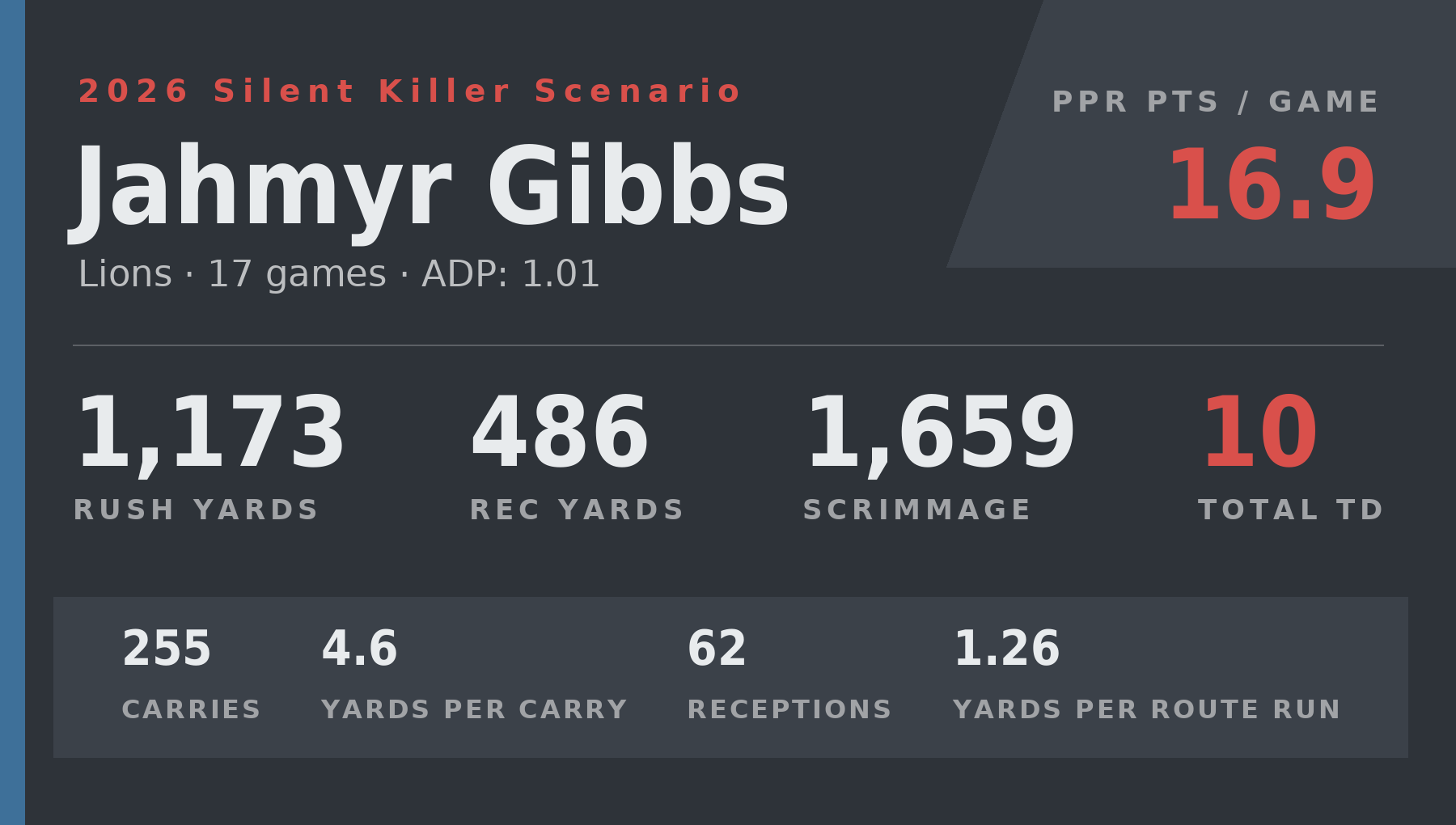
Gibbs drafters are nervous right away. At home against New Orleans in Week 1, the Lions lose. And they look quite mediocre while doing so. Gibbs sees 15 carries, which is nice. But he runs for just 69 scoreless yards. Even worse, he catches just two balls for 14 scoreless yards. His 10.3 PPR point debut is bad enough on its own. When compared to Bijan Robinson's 28 points against the Steelers, it's panic-inducing.
One silver lining for Gibbs is that Isiah Pacheco is washed. So is Kareem Hunt. The Lions clearly want to work in another RB more, but see such a dropoff when he's on the field that they can't really justify it.
However, this silver lining disappears after Week 5. Following the Lions' road trip to Arizona and entering their Week 6 bye, the Lions announce that they've worked out a trade for James Conner. Already familiar with Petzing's scheme, he quickly works into the offense.
Unlike David Montgomery, Conner operates as a backup to Gibbs, rather than forming a split. But Conner works in enough as a pass protector to hurt Gibbs' route participation a bit.
On pure passing downs, Conner is a thorn in Gibbs' side. But the bigger issue is that the passing game is built around pushing the ball downfield rather than feeding the ball to Gibbs underneath. Amon-Ra St. Brown remains an elite WR. Jameson Williams turns in a career year as a more well-rounded downfield threat. Sam LaPorta bounces back from his back injury to operate as a reliable outlet option with YAC upside. With 3.6 receptions per game, it's not like Gibbs doesn't have a receiving role; his 62 receptions rank sixth best at the position in 2026. But after posting 77 receptions in 2025 and then seeing Montgomery depart, Gibbs' receiving production is still a major disappointment. With 1.26 YPRR, Gibbs is more efficient than in his rookie season (1.10), but 2026 still represents a major step back from 2025 (1.67 YPRR).
At the goal line, Conner is a bigger issue. He combines with the washed reserves to limit Gibbs to 1.3 green zone carries per game—exactly what he saw in 2025. Gibbs punches in six short TDs as a runner and adds another as a receiver, but his goal line role is disappointing in a season when drafters thought he'd have more opportunity. With only three long TDs on his 2026 resume, Gibbs manages to hit double-digit TDs, but just barely.
In Week 17, Gibbs watches from the sideline as Ben Johnson orchestrates a 48-point outing against his former team. D'Andre Swift and Kyle Monangai each score two TDs, while Gibbs is held to one.
Gibbs does his best to fight back, turning 16 touches into 83 yards and a TD. But his 17.3 PPR points aren't able to move the needle in fantasy championship games—which most of his drafters didn't make in the first place.
How to Play It
This article requires me to consider in detail how Gibbs could stay healthy and still be a bust. And so, if his silent killer scenario felt a bit silly and at 16.9 points per game not fully a killer... I'm with you. I don't think the Lions will trade for James Conner. And I don't think Isiah Pacheco is going to slow Gibbs down. And even if one of those things actually does happen, we're probably talking more about Gibbs not fully nuking, rather than being a true silent killer.
It's not that Gibbs can't disappoint. Injuries are a constant in the NFL, and can slow players down even if they don't cost them games. The Lions backup QB is also Josh Dobbs; if Goff misses any time, we're looking at a significant downgrade in offensive potency.
However, Gibbs' upside is pretty robust. When initially constructing Gibbs' legendary scenario, I had him at 23 total TDs. After all, he already has a 20 TD season to his name. Ultimately, though, I worried that lofty (but shockingly realistic) 23 TD number would distract from the rest of his case. 21 TDs—a number Raheem Mostert hit—is less of an outlier, and more importantly, still more than enough TDs for Gibbs to dominate the season. But it's still worth noting that his TD projection here might end up being light. After all, when Gibbs scored 20 TDs in 2024, that was with David Montgomery totaling 12 TDs in the same offense. With Montgomery gone, Gibbs' TD upside is immense.
In addition, Gibbs' path to being an offensive focal point between the 20s is extremely clear. Even with just 10 TDs, he'd be live to hit 23+ PPR points per game as a bet on receptions and scrimmage yards.
Ultimately, Gibbs provides one of the cleanest paths to legendary upside of any RB in recent memory. Gibbs is a 24-year-old superstar with electric rushing ability and high-end receiving chops on an aggressive and high-powered offense. He's the clear 1.01 and a no-brainer target.
Best Ball Recommendation: Start streaming drafts to get the influencer 1.01.
Managed League Recommendation: Priority Target.
Bijan Robinson
Legendary Scenario
In Week 2, at home, against Carolina, Bijan Robinson puts together a performance that rather neatly sums up his 2026 campaign. Robinson carries the ball 20 times for 125 yards and a TD, while adding six receptions for 56 yards. It's not Robinson's highest-scoring outing of the season, but, in scoring 30.1 PPR points while only scoring a single TD, Robinson's Week 2 is a microcosm of his legendary 2026.
Robinson spends 2026 as part of a decent but far-from-elite Falcons offense. And, ultimately, that limits him to 18 TDs in 17 games, rather than some of the monster TD rates from 20+ TD scorers we've seen in the past—seasons like Jonathan Taylor's 2025 (20 TDs in 17 games) and 2021 (20 in 17), Jahmyr Gibbs' 2024 (20 in 17), Christian McCaffrey's 2023 (21 in 16), Austin Ekeler's 2021 (20 in 16), and Todd Gurley's 2018 (21 in 14).
Robinson scores 18 TDs, which is still a lot of touchdowns; it's just that TD scoring isn't ultimately the most dominant aspect of Robinson's 2026 season.
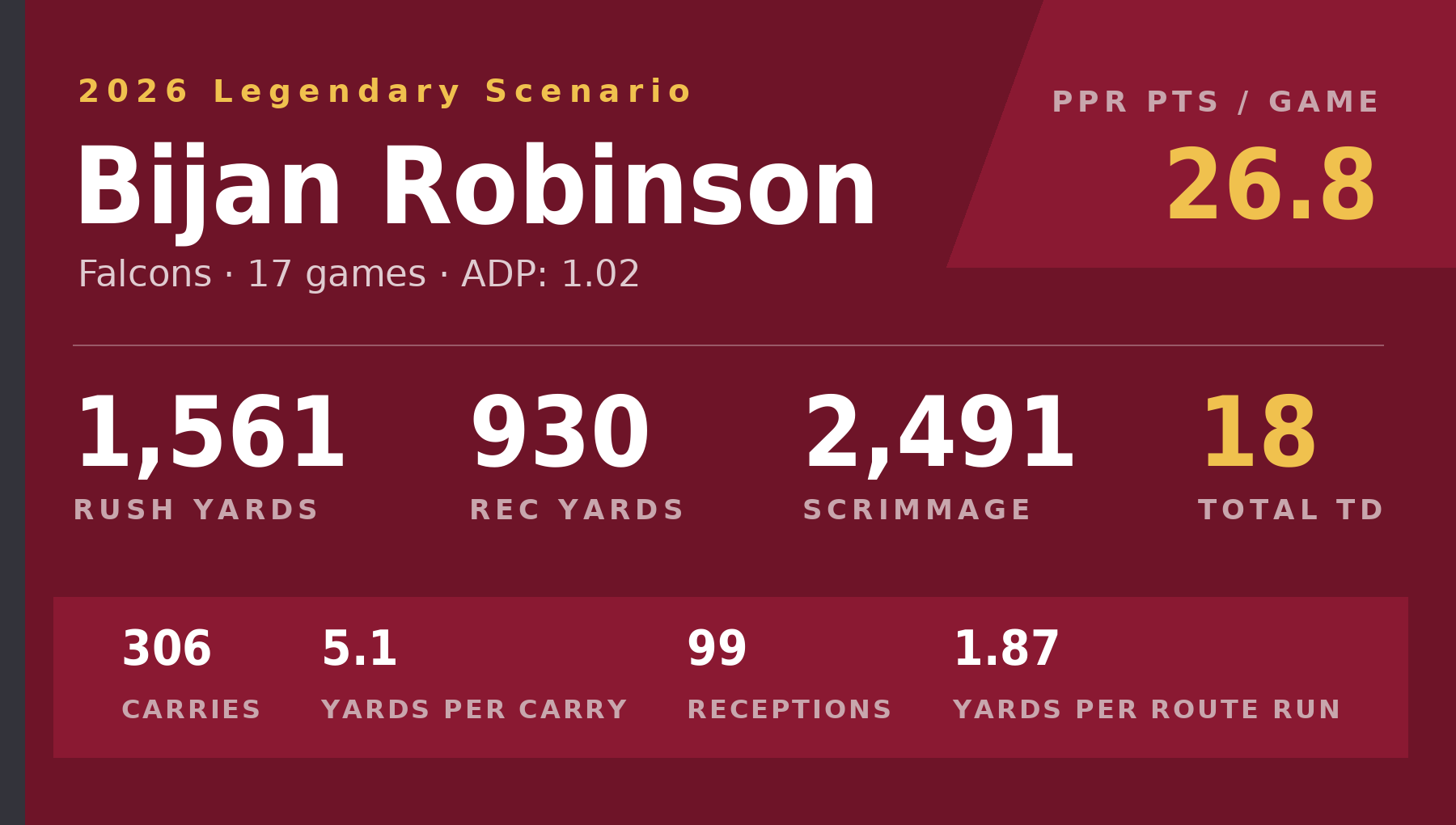
Instead, Robinson truly shines as a versatile yardage producer. His 2,491 yards from scrimmage go down as the second-best all-time, falling just 18 yards short of Chris Johnson's 2009 record.
Robinson's season doesn't look a ton like Chris Johnson's. Johnson posted 2,006 rushing yards and 503 receiving yards in 2009. Instead, it looks more like the previous No. 2 RB in yards from scrimmage, Marshall Faulk, who posted 1,381 rushing yards and 1,048 receiving yards in 1999, while scoring 17 TDs in 16 games. Robinson's ability to combine rushing volume, receiving versatility, and elite yardage efficiency cements him as all-time fantasy RB.
That would be the case even if Robinson didn't singlehandedly win fantasy playoff matchups. But he does. Although Robinson averages just 1.1 TDs per game, he doesn't steadily score. Instead, he scores in bunches, hitting the Commanders with three TDs in Week 15 and closing the fantasy season with two more TDs at home.
With Robinson putting up 32 PPR points against the Saints in Week 17, Gibbs drafters, like in 2025, ultimately regret passing on the more impactful fantasy season. Because at 26.8 PPR points per game, Robinson turns in the most impactful season since 2019.
Silent Killer Scenario
In the Falcons' season opener in Pittsburgh, it becomes clear that Kevin Stefanski believes Bijan Robinson can help keep the pressure off of Tua Tagovailoa. But that's easier said than done. Tagovailoa isn't able to recapture his early-McDaniel-era form and instead looks like the type of QB that led an NFL team to torch $99 million in dead cap just to move on from him.
To make matters worse, Robinson is being tasked with doing that as a runner. He finishes the day with 17 carries for 85 scoreless yards and only one reception for six yards. Concerningly, Brian Robinson is also involved as a runner and ends up scoring a TD from the 7-yard line after Bijan helped drive the Falcons down the field. It's not at all clear that the lesser BRob will have a consistent goal line role, but that doesn't stop fantasy managers' palms from sweating. The Week 2 narrative is set: Kevin Stefanski thinks Bijan Robinson is Nick Chubb.
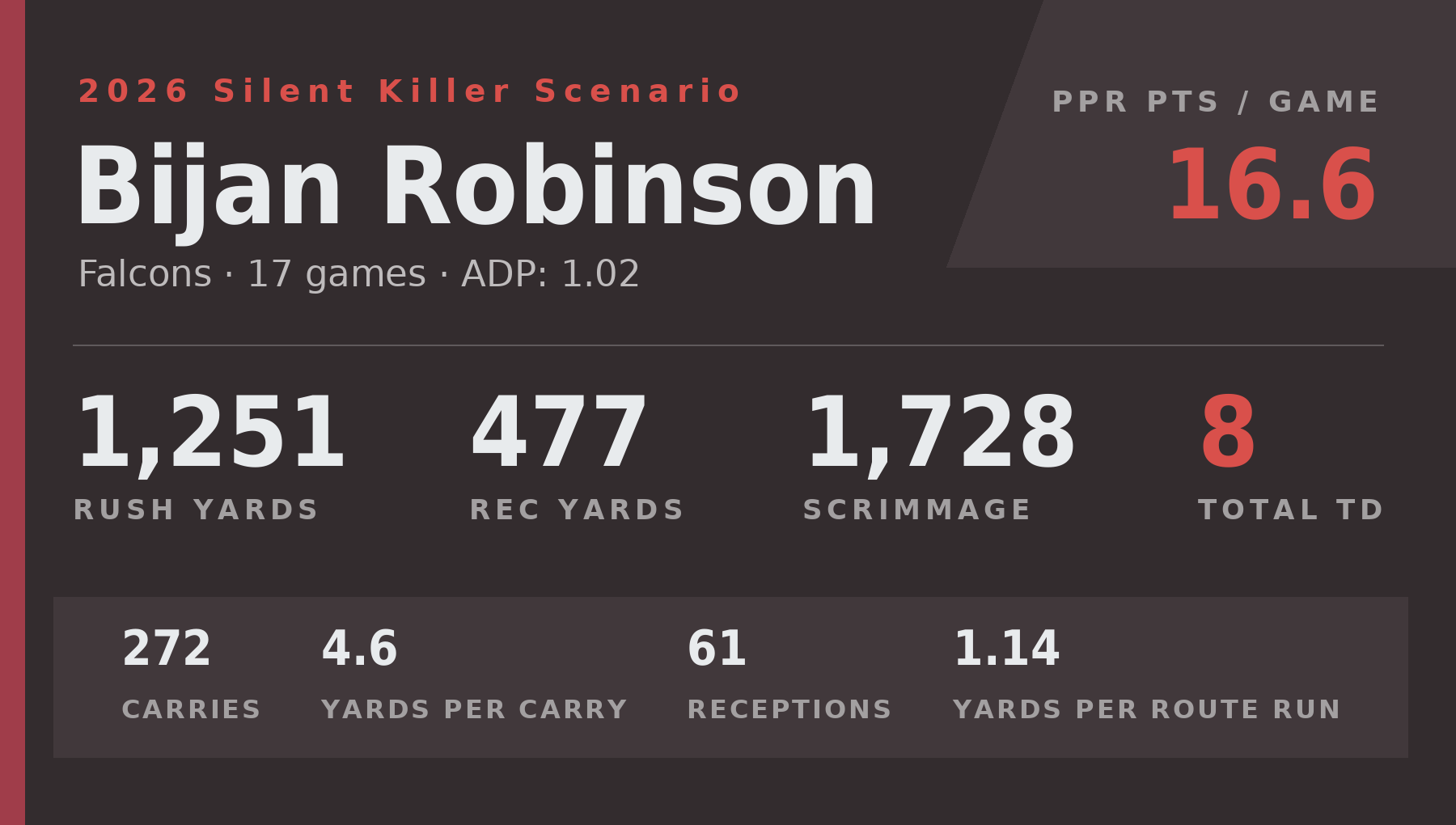
This... turns out to be an overreaction. For one thing, by Week 2, Michael Penix is the starting QB. Against the Panthers, Robinson catches four passes. And, ultimately, he ends up totaling 61 receptions in 17 games, one more than he did in his breakout 2024 season (also in 17 games). As far as comps to Stefanski's starting RB go, Robinson looks less like Chubb and more like Dalvin Cook, who averaged 3.6 receptions per game in three years with Stefanski.
Still, Robinson's new role results in one less reception per game compared to his dominant 2025 season, which puts his drafters on the back foot.
The Falcons offense is the bigger issue, though. With 4.6 yards per carry, matching his rookie-year mark, Robinson is solidly efficient on the ground. But he has a hard time finding the end zone. Penix is still working back from injury; he's only out there because letting Tua keep the job would lose Stefanski his.
Fortunately, Penix improves as the season goes on. In Stefanski's Week 14 revenge game against the Browns, Penix lights up a vulnerable secondary, while incorporating Robinson as an outlet receiver. Robinson totals 124 yards from scrimmage with six receptions and a TD for 24.4 PPR points, leaving fantasy managers hopeful headed into the playoffs.
Robinson hits 19.3 points against the Commanders in Week 15, solid enough. But Penix melts down against the Bucs the following week, leading to just an 11-point outing from Robinson. When he then turns in just 16 points in the fantasy championship game, Robinson solidifies a damaging season for drafters who were just one pick away from drafting a monster season from Gibbs, but instead ended up with a mid-range RB1.
How to Play It
In my view, Robinson's downside scenario is more realistic than Gibbs'. It requires the Falcons offense to turn in some real duds, suboptimal coaching, and bad luck around the goal line. All of those are fairly plausible. However, it's a bit of a parlay for Robinson not to at least hit 17+ points per game.
Tyler Allegeier's departure is important in this regard. This becomes clear when looking at Robinson's carries from inside the 10. In 2024, Robinson averaged 1.8 green zone carries per game. Allgeier was at 0.6. Last season, Robinson dropped to 1.0 with Allgeier at 1.1. You read that right. Last year, the Falcons used Allgeier more heavily at the goal line than Robinson. And yet, Robinson still posted 22 PPR points per game.
Brian Robinson will likely snipe some TDs, but it's very unlikely that the Falcons lean on him the way the previous coaching staff did on Allgeier. That's partly because that was a dumb thing to do and partly because Allgeier is more of a battering ram type player than Brian Robinson. And so, Allgeier's departure makes Robinson unlikely to drop as low as the eight TDs I have him for in his silent killer scenario. In a 17-game season, he's very live to set a new career high in TDs, besting the 15 he scored in 2024, as long as the Falcons offense is at least middle of the road.
It's also hard to see the Falcons reverting Robinson back to a 2024-style receiving role. Last year, Robinson was operating more like McCaffrey than Dalvin Cook, delivering an elite 1.88 YPRR. With that now on tape, it would be pretty confounding for the Falcons to switch up his deployment. Crazier things have happened, but it still seems unlikely.
And, zooming out, in Robinson we have a RB who was an elite prospect, just posted elite receiving numbers and a career year as a breakaway runner while also handling a career-high 366 touches. And he's still just 24 years old. If not for Jahmyr Gibbs somehow being an even stronger bet, we'd be talking about one of the easiest clicks at the 1.01 in several seasons.
Best Ball Recommendation: Locked-in click at the 1.02.
Managed League Recommendation: Priority target.
Christian McCaffrey
Legendary Scenario
When Christian McCaffrey touches down in Australia, he jokes to reporters that the 15-hour trip left him feeling "a little tightness." Fantasy managers don't find it funny. Back in Las Vegas, McCaffrey quickly falls to the early 2nd round of high-stakes drafts.
By Friday morning, McCaffrey's ADP has changed. He's now the consensus 1.03. Outside the FFPC draft room, groups of men in jerseys and jeans huddle around finished boards. Walk by them, and you'll hear in hushed excitement: "Take a look at this one, he flipped Bijan," "I love Gibbs, but how can you pass on 33 points?" and "It'll actually be unique to have him on this side of the board."
Because, as soon as the lights turned on in Melbourne, McCaffrey got loose.
McCaffrey's biggest play is his first reception of the game. From the 49ers' 45-yard line, he catches a swing pass out of the backfield, cuts inside, hits the safety with a spin move, bounces off and hits top gear. McCaffrey is pursued by three different Rams defenders who all appear poised to bring him down from behind, but he veers just enough to the far sideline to keep them at bay and ultimately dives in for the score.
As a runner, McCaffrey is held to 14 attempts for 60 scoreless yards. But against a dominant Rams pass rush, McCaffrey's night as a receiver is far from over; he adds another eight catches for 65 yards, totaling 120 yards from scrimmage and 33 PPR points.
McCaffrey looks somewhat rejuvenated in Week 1, but ultimately, his 2026 is a story of a great player managing to maintain greatness, rather than him recapturing an earlier form.
McCaffrey's yards per carry jumps from 3.9 in 2025 to 4.4. But that's partly the result of more discerning usage and Kyle Shanahan keeping defenses honest by deploying Deebo Samuel in the run game with McCaffrey also on the field. The efficiency increase is nice, but McCaffrey also sees 39 fewer carries.
McCaffrey also scores fewer TDs. After hitting 17 in 17 2025 games, he totals 16 in a full 2026 season.
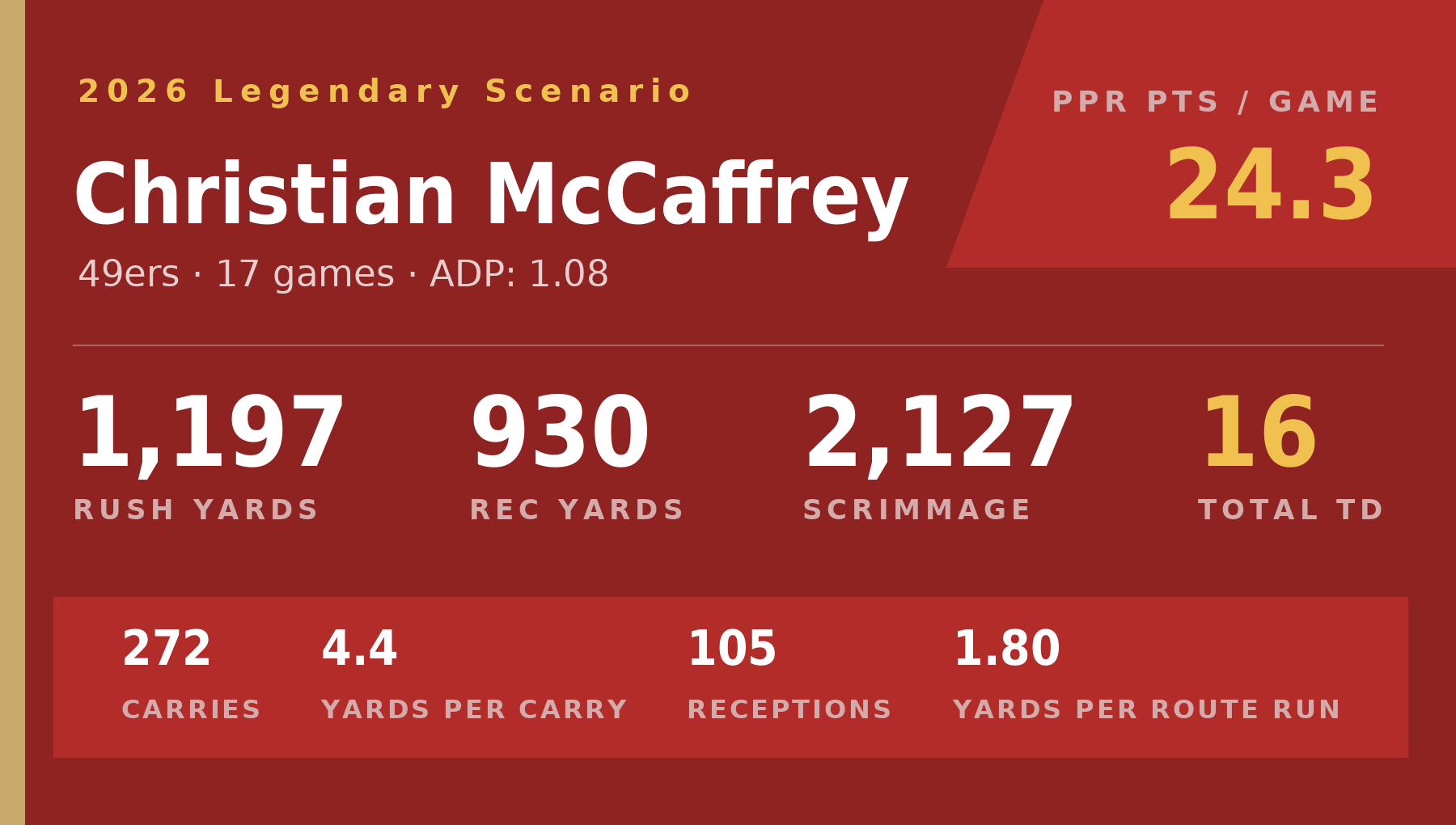
McCaffrey remains a force in the receiving game, holding roughly steady in receptions (105 in 2026 vs. 103 in 2025), receiving yards (930 vs. 924), and YPRR (1.80 vs. 1.81). In totaling 2,127 yards from scrimmage, he bests his 2025 total... by exactly one yard. McCaffrey's 10th NFL season is a very similar season to the one he authored a year earlier but, mercifully for his 30-year-old body, requires 36 fewer touches.
Over the course of the season, Shanahan makes noises about lightening McCaffrey's workload. And occasionally, he's true to his word. But the 49ers defense is a weak spot; McCaffrey is crucial to actually winning games. Fighting for a playoff spot down the stretch, Shanahan doesn't mess around. In Weeks 15-17, against the Chargers, Chiefs, and Eagles, McCaffrey averages 25 touches and 26 fantasy points.
CMC once again wins leagues. 2026 marks his fifth time hitting 23+ points per game, with an average of 25.3 PPR points per game in those legendary campaigns. He is now tied with LaDainian Tomlinson for the most legendary seasons since 2000.
Social media is flooded with posts roasting the "sharps" who were too scared to take the best fantasy RB of the modern game in the back half of Round 1.
Silent Killer Scenario
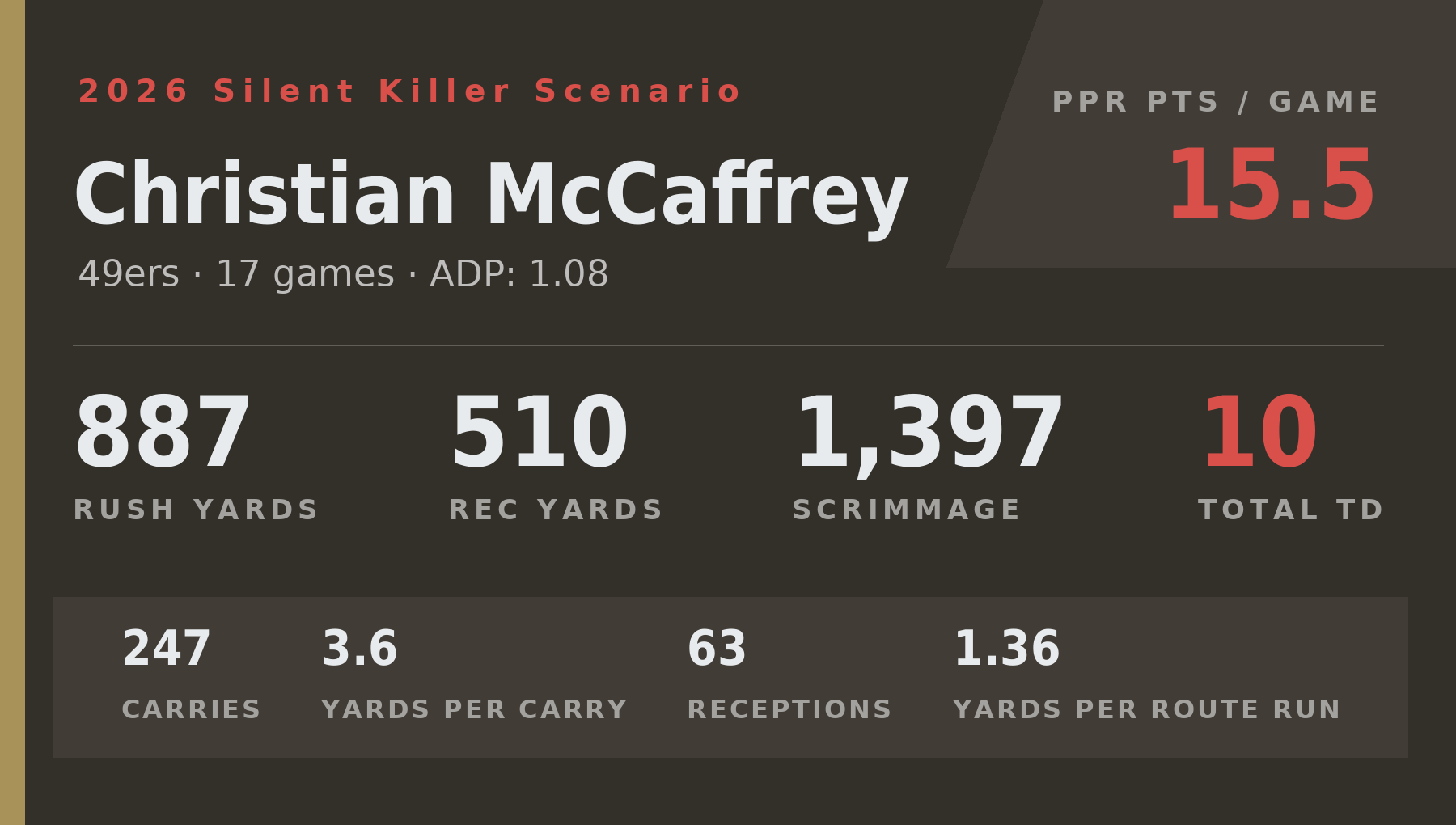
McCaffrey's season starts off decently. It's not exactly what his drafters were hoping for, but heading into the 49ers' Week 8 bye, CMC is averaging 16 carries, four receptions, and 102 scrimmage yards per game. Unfortunately, with only four TDs so far, McCaffrey is averaging a good-not-great 17.6 PPR points per game.
Drafters are hoping the 49ers will use the bye week to rest McCaffrey. In a way, that's what happens. While hosting the Raiders in Week 9, the 49ers make it clear that they plan to use more of Kaelon Black and Jordan James in the run game. And, shockingly, Shanahan actually means it this time. McCaffrey is in more of a receiving-centric role, with a reduced rushing workload. For the rest of the season, he averages 13.5 carries per game, in line with Chase Brown's 2025 mark of 13.6.
It's not hard to understand where Shanahan is coming from here. After turning in just 3.9 yards per carry and a league-low -165 rush yards over expected in 2025, McCaffrey is even less efficient in 2026, turning in just 3.6 yards per carry, matching Alvin Kamara's 2025 mark. And through seven games, his -51 RYOE is already worse than Isiah Pacheco's 2025 season total (-50).
At first, McCaffrey drafters are able to cope. After all, he's still a factor as a receiver. But as the season wears on, McCaffrey's receiving efficiency starts to go as well. The low point is the 49ers' Week 12 outing against the Seahawks, in which McCaffrey turns seven targets into just three receptions for 14 scoreless yards. In combination with a 12-for-36 rushing line, it's a rough day.
By the time the 49ers play the Rams in Week 14, McCaffrey is priced at just $6,600 on DraftKings... and he isn't chalk.
The 49ers' downfield receiving game is reasonably functional, requiring fewer McCaffrey checkdowns. But the bigger issue is McCaffrey himself. After posting 1.81 YPRR in 2025, he drops to just 1.36. That's a solid mark for a normal back. But for McCaffrey, it represents gravity finally taking hold. He's never truly phased out as a receiver, but in his final 10 games, he averages 3.5 receptions per game. Again, good for a normal RB, but not for CMC.
After dominating the fantasy landscape for nearly a decade, McCaffrey, now a mere mortal, scores 263 fantasy points in his 10th NFL season, his lowest total in a healthy season since his rookie year (231).
How to Play It
When you draft a fantasy football team, it's a fundamentally optimistic endeavor. You're dreaming on what players could be. You're seeing angles that your opponents aren't. Generally... you're not looking to spend a 1st round pick on a 30-year-old whose upside case rests on him fighting for life against an evident age-related efficiency decline.
But... what if the RB in question is one of the best to ever do it? And, crucially, what if that RB is still a receiving star, even if no longer a force in the run game?
Last year, when considering McCaffrey's ability to recapture his rushing efficiency, here's what I wrote:
Can McCaffrey recapture his rushing form after averaging just 4.0 yards per carry last year?
I'm not sure I care anymore. We're talking about an RB who has a clear path to 4+ receptions per game, who can easily hit 2+ green zone touches per game, and who will have a strong (if not elite) rushing workload when healthy. We're talking about an RB—and I don't say this lightly—who can scam his way to a legendary season.
Ultimately, McCaffrey didn't actually scam his way to his fourth legendary season. With 102 receptions and 17 total TDs, he was legitimately the engine of the 49ers' passing game, even as he turned in a brutally inefficient rushing campaign.
But that doesn't mean that McCaffrey couldn't post a scammy 23+ points per game this year. And so, like last season, McCaffrey is someone I'm willing to ride with. Eventually, he's going to burn us. But until then he's capable of putting fantasy teams on his back even as a diminshed version of himself.
And, with even slightly better efficiency as part of a more dynamic 49ers offense, McCaffrey could be even better than last year. In his legendary scenario, I didn't even get into what happens if his rushing efficiency returns. And... that's kind of the point. As an efficient runner, McCaffrey will be a nuclear smash, which everyone already knows. The more interesting thing to consider is that he can still win leagues by playing like he did last year because he won leagues last year. In 2025, McCaffrey's 33% BBM advance rate trailed only Jonathan Taylor (49%), Jaxon Smith-Njigba (40%), George Pickens (36%), and Jahmyr Gibbs (36%).
Best Ball Recommendation: Target
Managed League Recommendation: Target
Jonathan Taylor
Legendary Scenario
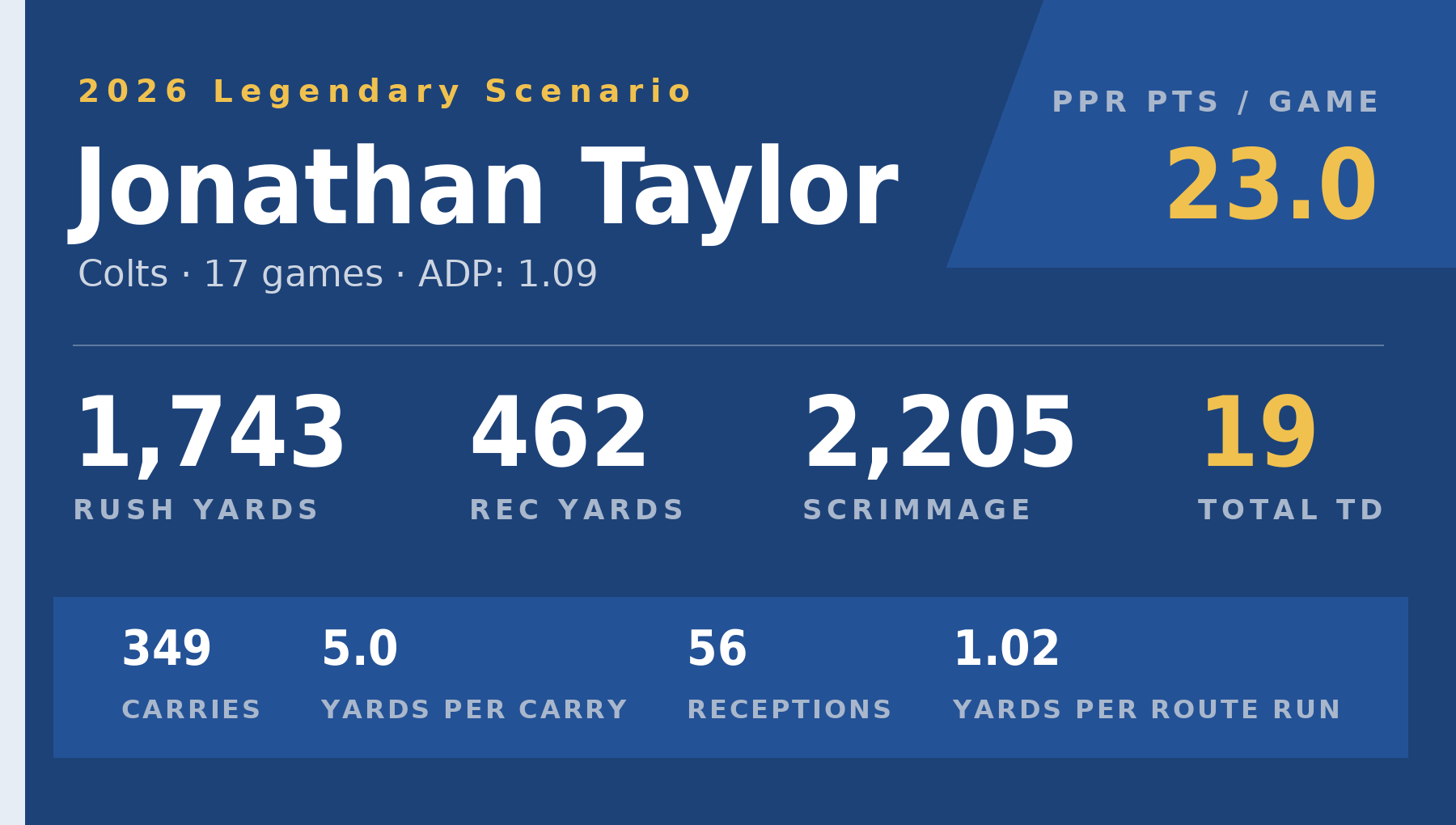
In the early going of 2026, Jonathan Taylor is a bit of a grinder. Through the first four weeks of the season, Taylor is already at 95 carries for 380 yards and three TDs. But Taylor has just 10 receptions for 70 scoreless yards. And so, with 18.3 PPR points per game, Taylor is both having a respectable season and one that looks pretty unsustainable. He's on a 400-carry pace.
Things start to shift in Week 5. Following their London trip, the Colts travel to Pittsburgh, and Alec Pierce is finally threatening defenses again. Prior to Week 5, the Colts offense has been frustratingly compressed. Tyler Warren and Josh Downs are dynamic receivers, but not field stretchers. And only Warren adds in the run game. Keenan Allen is doing a Michael Pittman impression, but while the 34-year-old can draw targets, he doesn't draw a ton of defensive attention. Instead, defenses key on Taylor. Stopping Taylor is easier said than done, but the Colts' first four opponents manage to keep him in check, at least. The Steelers do not.
Taylor scores three times against Pittsburgh, doubling his season total. He rips off a 31-yard run, delivers on a 3-yard plunge, and takes a screen pass 18 yards to the house. With 34.6 PPR points, Taylor's legendary campaign has officially kicked off. The following week, he drops 28 on the Titans for good measure.
That game ends up being a preview for one of the most dominant fantasy playoff games in recent memory. When the Taylor travels to Tennessee in Week 15, his Colts are finally in a good place for the stretch run of an NFL season. They're in great shape for a wild card spot and live to win the division. The Titans are having a different type of season.
Interim Titans head coach Gus Bradley is intimately familiar with Jonathan Taylor's game from his time as the Colts defensive coordinator. He still can't stop him. And, in fairness to Gus, the Colts are in positive field position all day. Cam Ward throws two picks, both of which Taylor converts into TDs. By the time Mitch Trubisky throws a 4th-quarter pick 6, Taylor's day is done. But not before he turns 26 carries into 180 yards and three TDs with three receptions for 36 yards. All told, Taylor's 42.6 PPR points make him a must have in head-to-head and sprint formats. And, of course, he's a best ball pod wrecking ball.
Taylor isn't quite as outrageously productive against the Bengals and Browns to close the year, but he averages 26 points per game in those two contests. And, in a division-sealing Week 18 win over the Jaguars, Taylor is again the engine of the Colts offense. After hitting 22.2 points per game in 2021 and 21.3 in 2025, he turns in an indisputably legendary season, winning fantasy championships and delivering the Colts to the playoffs for the first time since his rookie year.
Silent Killer Scenario
During training camp, the Colts couldn't believe their eyes. Daniel Jones looked back. As in, all the way back. Despite tearing his Achilles in December, there's nothing he can't do.
In Week 1, the Ravens remove those rose colored glasses.
It's not that Jones isn't healthy enough to play. But under live fire of a real NFL game, he's just not what he was in early 2025 when the Colts were an absolute wagon.
For Shane Steichen, the adjustment is fairly obvious. For most of 2025, the Colts were operating out of run looks... but passing more frequently than expected relative to the game situation. Through Week 12, the Colts posted a 2.5% pass rate over expected and a 9.6% PROE on 1st-and-10. That's a higher PROE than the Bengals (2.1%) and a higher 1st-and-10 PROE than the 1st-place Broncos (4.8%). This approach put defenses in a bind. Opponents knew they had to contend with Jonathan Taylor and the run game, but they couldn't fully focus on shutting him down. The Colts' offensive tendencies ran counter to that strategy.
2026 works out differently. The Colts look more like they did to close the season, when they posted a -6.5% PROE and a -12.3% PROE on 1st down. The product, of course, is of higher quality. Even somewhat diminished, Jones keeps the offense generally on track; he's still several levels above Riley Leonard. But the Colts are far more predictable and operate with lower play volume.
After averaging 36 dropbacks per game through Weeks 1-12 of 2025, the Colts drop to a more Packers-esque 33 per game.
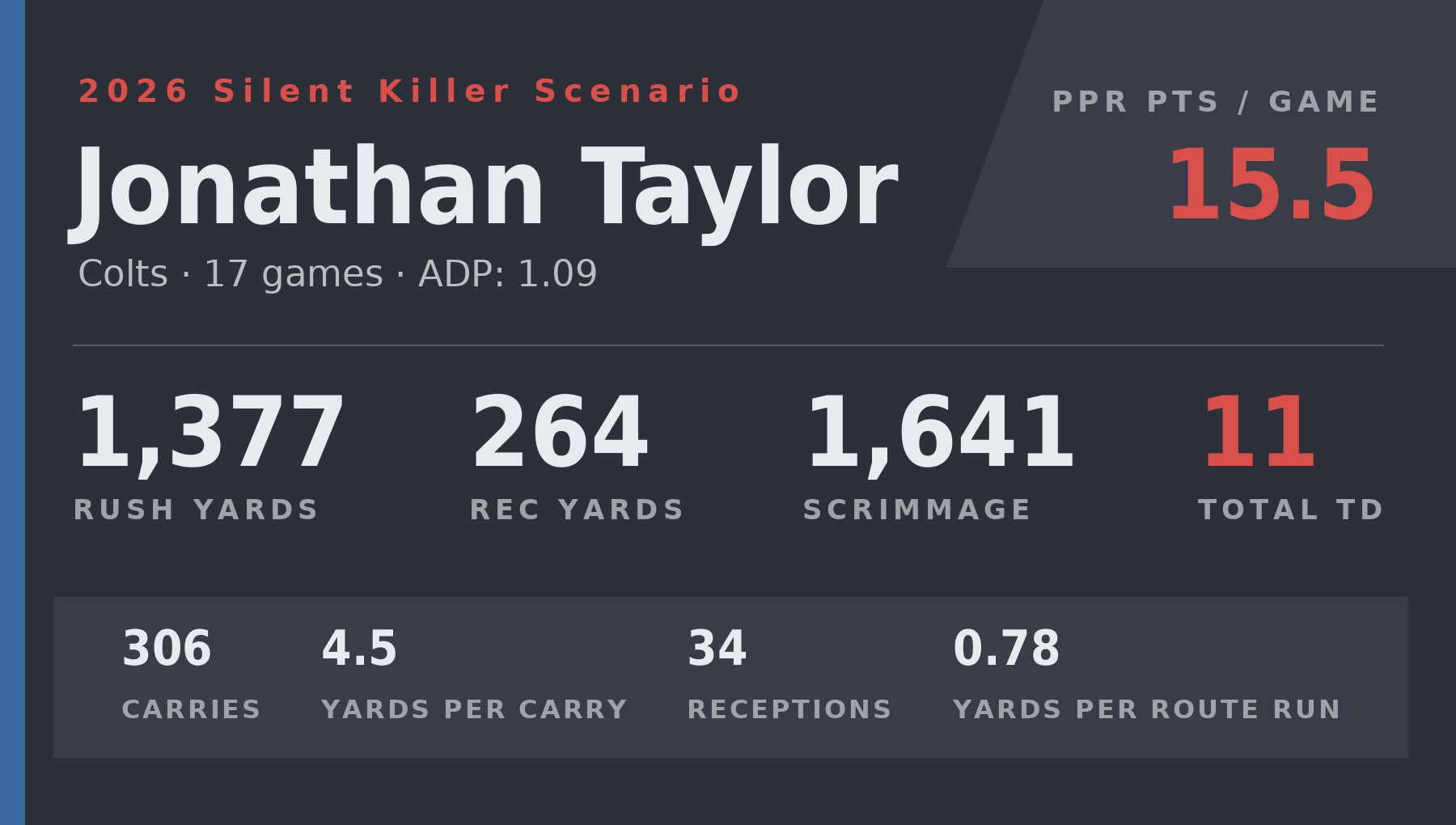
This creates major ceiling issues for Jonathan Taylor, who matches his 2024 route participation of 60% and his 2025 TPRR of 23%... but still turns in just 34 receptions and 0.78 YPRR. Under the new reality of the Colts offense, Taylor's profile is highly rushing dependent.
And with defenses now free to focus squarely on Taylor, his efficiency dips a bit. At 4.5 yards per carry, he's still good. He's just less impactful.
Taylor has his moments throughout the season, but his fantasy campaign ends with a whimper. Against a solid Browns run defense in Week 17, Taylor turns 18 carries (his yearly average) into 67 scoreless yards and one reception into 11 yards. His 7.8 points in the final seal a devestating return on 1st-round fantasy capital.
How to Play It
Taylor's floor looks pretty reasonable. Even if the Colts take a significant step back from their early-2025 form, Taylor will have a healthy workload. If anything, they may lean on him more—in the run game at least—if Daniel Jones declines.
Unfortunately, with a Round 1 ADP, Taylor's high floor can still be pretty painful for drafters. If the drafter next to you takes Amon-Ra St. Brown and then pairs him with an RB in Round 2 that straight-up outscores Taylor... that'll be tough to beat. And that's not to mention the massive disadvantage you're likely to be at relative to the Gibbs and Robinson drafters.
On the other side of the coin, Taylor's path to 23+ points per game is somewhat thin. Even with two extremely impressive seasons under his belt, it's a mark he's never reached in a full 17 games. To be fair, he got to 22.5 points per game in 2022 if you exclude Week 18. But the point remains, Taylor's profile is not prime McCaffrey-esque; he doesn't have access to an otherworldly PPR ceiling in the 25+ points per game range.
There is one thing that Taylor really does have going for him, though. Talent.
One of the key components of the legendary RB profile is targeting players who have shown the extreme talent necessary to generate legendary seasons. This is a lesson that I have sometimes ignored, to my detriment. (Saquon Barkley's 2024 still stings).
As one of the best runners of his generation behind a strong offensive line, and also operating as the clear engine of the Colts offense, Taylor has an ability to hit 20+ points per game without everything going right. He'd be a weak 1.01, but can still deliver value in the back half of Round 1.
And, from a best ball perspective, Taylor's weekly ceiling cannot be ignored. Since entering the NFL, Taylor has hit 30+ PPR points 12 times in 84 games. Six of those were last season... so it's not like he's slowing down. And Taylor now has two 50-pointers to his name. So, even though Taylor is less likely than McCaffrey to average a legendary score, he can still singlehandedly win weeks... which is pretty important in formats like BBM where three single-week rounds make up 75% of the tournament, and the final payout is ultimately determined by scoring the most points in Week 17.
Taylor's scoring profile is also important to consider in sprint formats. He's the type of player who could become necessary if he hits his ceiling at any point in Weeks 15-17.
In standalone leagues, Taylor looks like less of a priority. He's a great player and, generally, a good pick. But as a bet on elite rushing efficiency and volume, Taylor gets trickier each year. It's possible he'll age like Derrick Henry, but we've also seen elite breakaway runners decline in their late 20s. Taylor turns 28 in January.
Ultimately, in traditional redraft it looks easier to build teams with St. Brown rather than Taylor if the goal is simply to beat 11 other drafters. But Taylor is too talented to treat as an outright fade.
Best Ball Recommendation: Target
Managed League Recommendation: Target after McCaffrey and St. Brown are off the board.
James Cook
Legendary Scenario
When the Bills kick off their season in Houston, Josh Allen quickly finds himself under siege. Coming off a dominant season, the Texans pass rush is no less ferocious in 2026.
But unlike in 2025, when Allen threw for 252 scoreless yards and two picks on 34 attempts against Houston, the Bills are able to move the ball effectively through the air. James Cook is a key reason why.
With Cook operating as both an underneath outlet and with the occasional wheel route downfield, the Bills put the Texans on their heels. They now have to account for two threats out of the backfield on every dropback: Josh Allen, as a runner, and Jame Cook, as a receiver.
Cook totals five receptions in the Bills' win, and immediately vaults into the weekly overall RB1 conversation.
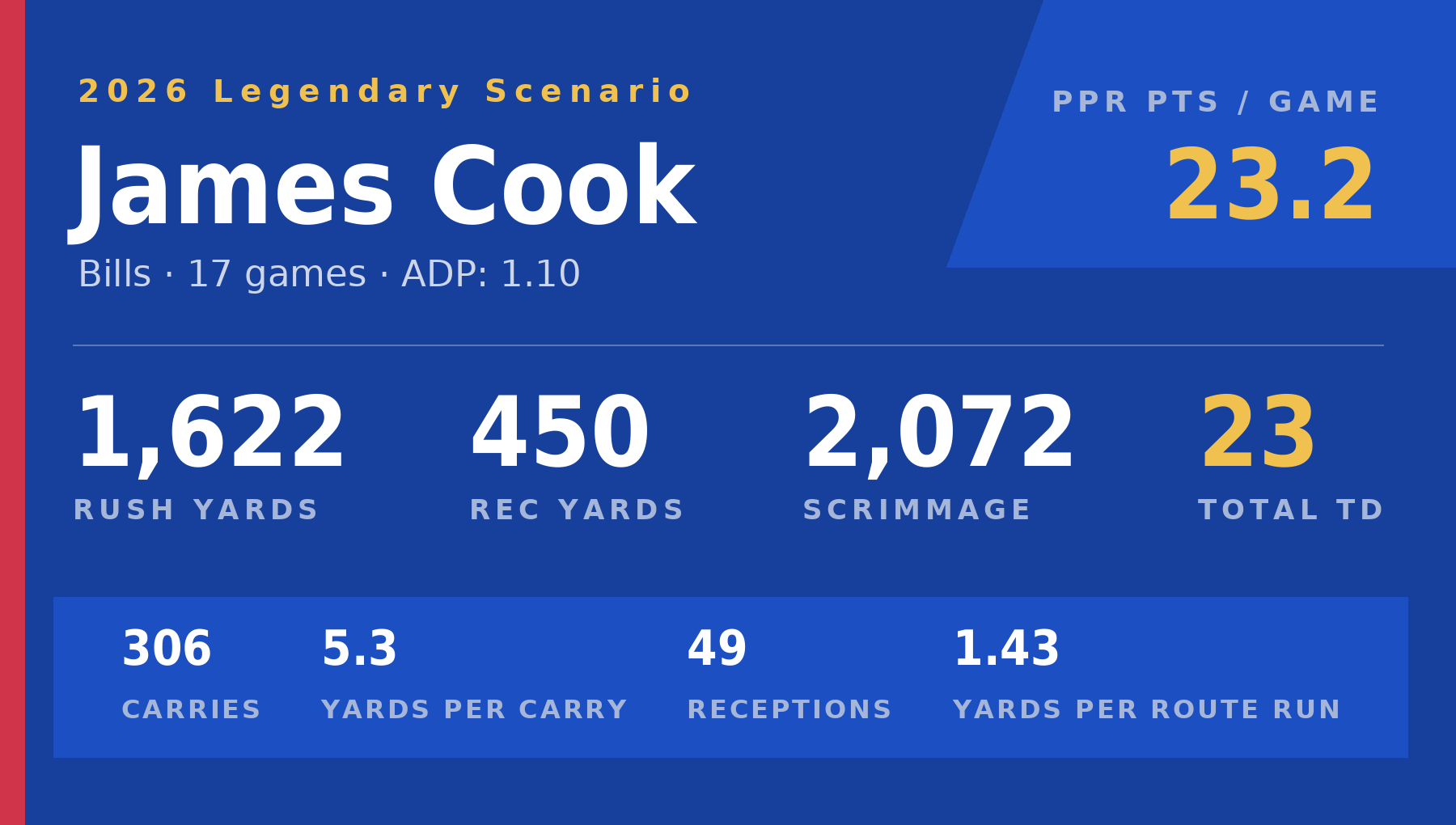
Ultimately, Week 1 overstates Cook's role in the passing game. He goes on to average 2.9 receptions per game, which is a nice jump from 1.9 in 2025 or 2.0 in 2024, but not a huge increase from his previous career high of 2.4 (2023). The good news is Cook brings his signature explosive efficiency to the receiving game as well, posting a career-high 1.43 YPRR. Cook's receiving bump is real and valuable, but he doesn't see a massive shift in usage either.
His performance against the Dolphins best illustrates why Cook's good-not-great receiving role is more than enough to make him a league winner. In Miami, Cook only sees three targets, converting for three receptions for 25 yards. But he also sees 21 carries and runs for 137 yards and three TDs.
Critically for Cook drafters, this performance is in Buffalo's second game against Miami... in Week 17. His 37.2 PPR points seal fantasy championships from the back half of Round 1.
More than his receiving ability, Cook's ability to get in the end zone is what wins leagues. Operating as a clear bell cow with receiving versatility on the NFL's best offense, Cook totals 23 TDs, tied with Terrell Davis (1998) and OJ Simpson (1975) for the eighth most all time at the position. He also becomes the first RB since LaDainian Tomlinson (31 TDs in 2006) to score 22+ TDs.
Silent Killer Scenario
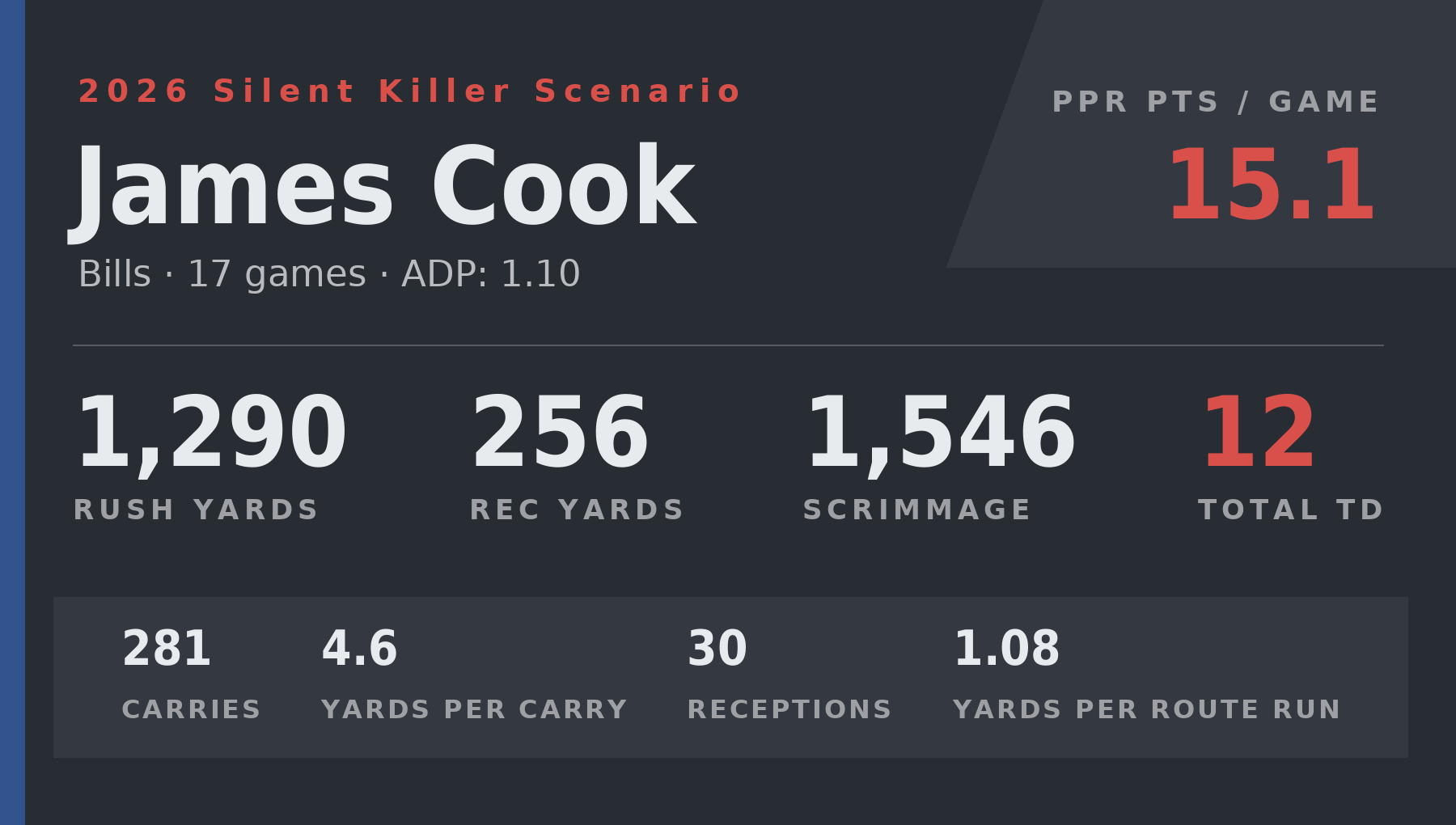
As the Bills head into their Week 7 bye, it's fair to say that Joe Brady's ideas for James Cook's deployment kind of look like... his ideas in 2025. Cook is averaging just under two receptions per game, just like he did in 2025... under Joe Brady.
Brady is happy to talk Cook up as a key passing game weapon, but the fact is that the offense is geared around Josh Allen's ability to push the ball downfield, while also challenging defenses with his legs. Cook is crucial to Buffalo's success, but primarily as a runner.
And, as a runner, Cook remains very impressive. He scores 28 PPR points in the Bills' Week 6 blowout win in Las Vegas, keeping hopes alive for a more dominant stretch after Buffalo's Week 7 bye.
Drafters get what they were hoping for. Sort of. Cook torches the Jets defense in Week 10, and then the Dolphins in Week 11. Over that two-game stretch, he totals 61 PPR points, silencing the haters.
But as the Bills head into the stretch run, the chirping starts up again. Cook's lack of a consistent receiving role becomes a real issue. The Bills face four straight playoff teams from Week 13-16 in the Patriots, Packers, Bears, and Broncos. The good news is that they go 3-1 over that stretch. The bad news is that Cook totals just seven receptions in those games and averages just 11.1 PPR points over those four contests. His 5.8 points against the Bears in Week 15 is the hardest for Cook drafters to overcome.
After completing a sweep of the Patriots in their Week 13 win, the Bills enter Week 17 with the division in hand. But they now need to clinch the No. 1 seed. They still have something to play for. Cook drafters had a tough time making the fantasy finals... but those that did are now looking at a Week 17 cupcake matchup against the Dolphins.
Cook delivers... as a runner. He turns 18 carries into 99 yards and a TD. But as a receiver, he's held to just two receptions for 20 yards. Cook's 19.9 PPR points are useful, but he's not a needle mover in the championship, which is pretty disappointing considering how hard he was to get there in the first place.
With 1.08 YPRR, Cook's receiving efficiency isn't terrible. In fact, it exactly matches his 2025 mark. It's not that he can't catch the ball. It's just that the offense isn't built to emphasize that part of his skill set.
And, ultimately, as much as his lack of a jump in receptions is discussed, rushing efficiency goes down as the bigger issue for Cook in 2026.
With 12 total TDs, he doubles his scoring output from his first season as a starter (6 in 2023). But, of course, it's a steep dropoff from his 18 TD mark in 2024, and a two TD drop from 2025 (14). Cook also turns in a very good 4.6 yards per carry, which is nonetheless a career low. With merely good, rather than elite, rushing efficiency, Cook goes down as a painful use of a 1st-round pick.
How to Play It
James Cook's legendary scenario relies on borderline absurd TD output. But as a part of a potentially excellent Bills offense and behind a potentially elite offensive line, Cook has a more realistic path to an elite TD total than most backs ever do.
It's also true that this isn't Cook's only path to a legendary season. If the Bills deploy Cook as a true high-volume receiving weapon, that would open up potential for a legendary season without requiring 20+ TDs.
However, Cook is entering his fifth season in the NFL, and peaked with just 44 receptions (2.6 per game) back in 2023. In two full seasons under OC (now head coach) Joe Brady, he's averaged 2.0 receptions per game. There's potential for Cook to catch the ball more than that, but if you're hoping for Cook to become the Bills' Chase Brown... you're asking for a literal doubling of his previous receiving volume under Brady. Chase Brown turned in 69 receptions last year to Cook's 33.
Meanwhile, if Cook's receiving role remains similar while his rushing efficiency dips from extremely good to just good, he becomes a silent killer quite easily.
Generally, efficiency is a key factor when searching for upside. We want good players. And... Cook is a good player. Unfortunately, though, Cook is coming off a season with an elite 5.2 yards per carry, which led to just 18.1 PPR points per game. Two years ago, he scored 18 TDs and still scored just 16.7 PPR points per game.
Another way to look at this is that last year Cook scored 13.2 points per game excluding TDs. That means that last year, Cook would have needed to score 28 TDs to turn in a legendary season.
Since that's not going to happen and because it'll be hard for Cook to improve on 5.2 yards per carry... we need a big increase in receiving volume to even put a legendary season in play.
I am hopeful that Cook sees more receptions this year. I just don't think he'll see a big enough jump to put a legendary season on the table.
In best ball, I'm more interested in Cook. His explosive ability in a high-end offense creates spike week upside even if he's disappointing from a season-long perspective. But even there, I'm having a hard time fully buying in. On the one hand, Cook is part of an elite offense with a great offensive line. But on the other hand, he's already at the high-end of what we can realistically expect in yards per carry. And—this really snuck up on me—Cook turns 27 in September. It's quite possible he's already peaked as a runner. On Underdog, I'm not fading him outright, but I am underweight, at 6%.
Best Ball Recommendation: Target when he falls to 1/2 turn with the expectation of building an underweight stance.
Managed League Recommendation: Fade.
Chase Brown
Legendary Scenario
When the Bengals kick off the season against the Buccaneers, they are characteristically out of sorts. Zac Taylor has the offense operating under center at a higher rate, while Todd Bowles has his defense aggressively blitzing an offense still working out the kinks. The result is a sack-filled afternoon and a quiet day for Chase Brown. The following week in Houston is even more concerning.
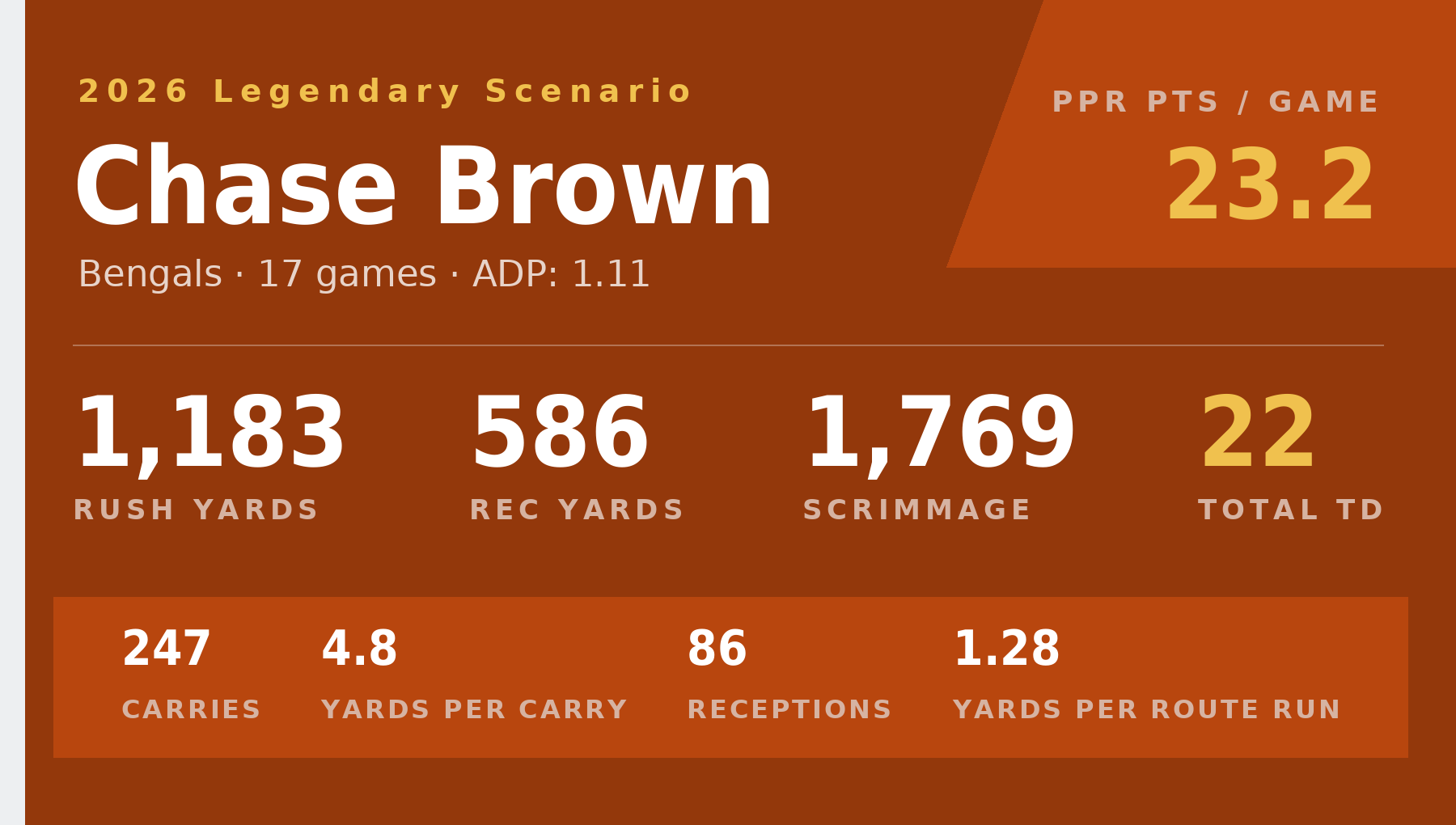
Fortunately, the Bengals show big improvements against the Steelers and Jaguars in Weeks 3-4. And in Week 5, the under-center shift finally pays dividends. In Miami, Brown turns 25 carries into 120 yards and two TDs. He also catches three balls for 15 yards. His 28.5 PPR points are a breath of fresh air for fantasy managers who were starting to lose faith in their Round 1 RB.
When the Bengals emerge from their Week 6 bye, they look more like... the Bengals. Cincinnati is now more capable of leaning on the traditional under-center game, as the Titans learn in a 28-6 Week 8 blowout loss to the Bengals. But by and large, the Cincinnati passing game returns to being the true focal point of the offense. Burrow is back to spending most of his time in the shotgun.
With the Bengals now revolving around an elite QB and WR duo, the offense—shocking, I know—puts up more points. From Weeks 10-17, the Bengals score 32 points per game, just below the 32.25 points they averaged over that same stretch in 2024.
When games are close, Chase Brown is even more involved as a receiver than he was in 2025, jumping from 4.1 receptions per game to 4.9. This is a result of him playing more on 3rd down. With the other option being a diminished Samaje Perine, the Bengals give Brown as many snaps as he can handle.
That same attitude makes Brown an absolute hammer with the lead. Brown jumps from 13.6 carries per game to 14.5, and dominates goal line work, scoring 15 TDs from inside the 10.
Brown also, finally, shows off his 4.43 speed. He jumps from 4.4 yards per carry in 2025 (his previous career high) to 4.8. And he becomes a high-end TD scorer from distance, scoring 7 total TDs from outside the green zone.
In a Week 17 shootout with the Ravens, Brown puts his full profile on display. He runs 15 times for 80 yards and a score, adding six receptions for 42 yards and another TD. His 30.2 PPR points are an exclamation point on a legendary fourth-year breakout.
After the season, the Bengals franchise tag Brown. Burrow and his top three weapons now account for over 40% of the Bengals' cap entering 2027. When the Bengals finally realize this is untenable, they trade Tee Higgins to the Rams for a 2030 1st round pick.
Silent Killer Scenario
The Bengals spent the summer emphasizing more of an under-center approach, and they weren't just messing around. That's the 2026 plan.
After years as a pass-heavy outlier, the Bengals finally conform to the league-wide trends. Their offense is now built to put defenses in more of a run/pass conflict. Their play selection is genuinely less predictable.
That isn't to say that they are now a run-heavy team. In fact, they retain a clear preference for the pass. They ultimately total 663 dropbacks, just below last year's 7th-place Saints (677). But with the Bengals dropping back 694 times in 2025, 2026 represents a significant dip in passing volume, which fantasy managers definitely notice.
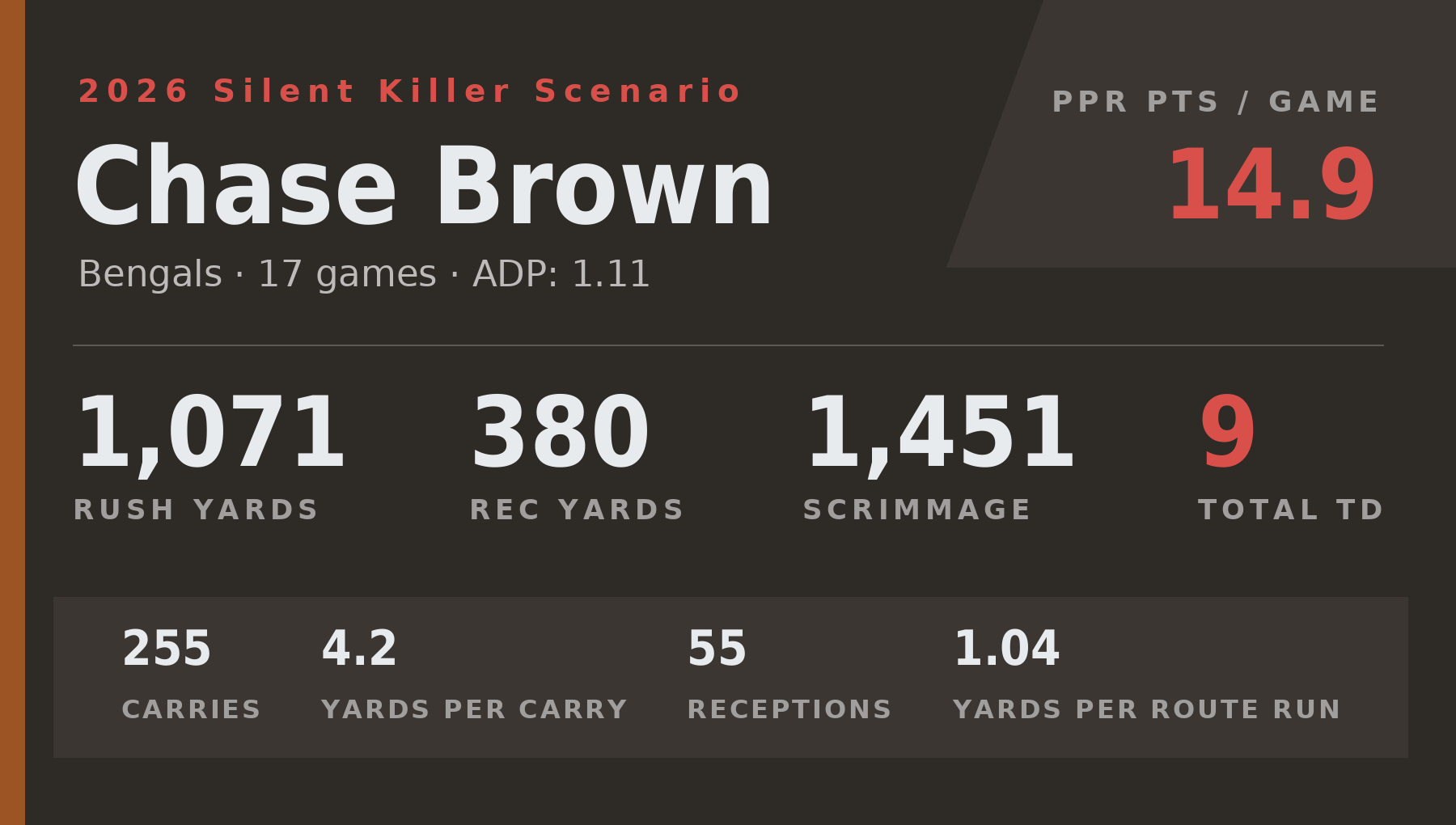
The good news is that the offense is now much more focused on Chase Brown running the ball. With more team rushing attempts and very weak rushing competition, Brown cruises to a career high 255 carries, up from 232 in 2025.
It seems like a pretty sweet setup for Brown. Week 15 against the Panthers is a good illustration of why it's ultimately a highly disappointing runout.
In Carolina, Brown carries the ball 21 times, matching his 2025 season high. On the other side of the ball, the Panthers are even more committed to the run; their backfield totals 27 carries. Previous iterations of the Bengals would have injected play volume into this type of contest. The 2026 Bengals are happy to grind out a 16-13 win.
And with Brown averaging just 3.4 yards per carry in Week 15, this truly is a grinding win. With just two receptions and 83 scoreless yards, Browns' 10.3 PPR points are a tough way to kick off the fantasy playoffs.
Over the next two weeks, Brown scores just one TD, despite being the clear lead runner on the more balanced Bengals.
The issue here is that Brown's goal line ability has proven underwhelming over the course of the year. He's capable in short yardage. But the Bengals' commitment to the run is really tested near the goal line, and they ultimately pivot to a more Burrow-centric green zone approach. Here, they resemble the 2025 Rams. Burrow tosses 40 TDs, which limits Browns' TD upside.
With just 14.9 points per game, Brown is outscored by three RBs in Round 4: Travis Etienne, Cam Skattebo, and D'Andre Swift. His production is useful in a vacuum, but at the price drafters paid, he's extremely difficult to build a winning team around him.
How to Play It
When scrutinizing Chase Brown's legendary scenario... I don't find it very credible. But that's also true when I think through his silent killer scenario. This is a player who scored 15.9 points per game in 2024, then 16.5 in 2025. He has very little competition for touches. Unless his efficiency craters in a great offense, he's unlikely to drop to the 14.9 points I outlined above.
But, ok, what if Brown does exactly what he did last year? Well... with an ADP of 23.7, Brown's advance rate was just 14% in 2025... firmly below the expected rate of 17%. And he's now significantly more expensive, particularly in redraft.
That price increase creates significant pressure on Brown to move from last year's numbers toward legendary upside. And, as a player with career highs of 4.4 yards per carry, 11 total TDs, and 1.09 YPRR... how does that actually happen?
Brown's receiving role is clearly a big part of his upside case. But in an offense with Ja'Marr Chase and Tee Higgins, are the Bengals really going to treat Brown like a McCaffrey-esque receiving weapon? Given that he's peaked at just 5.7 yards per target in his two years as a starter, that would be a genuinely head-scratching decision. It's possible he gets into the 80-ish reception range, where Bijan Robinson (79) was last year. But a 100+ reception season is, in my view, a pipe dream.
And 80+ receptions very likely means a Bengals-y offensive approach—meaning, an offense that's not going to support consistently high rushing volume on top of a high-end receiving role for Brown. Again, the Bengals have Joe Burrow and an elite WR duo. Running the offense through a solid but unspectacular runner does not make sense.
So that leaves TDs. And, in the Bengals' high-powered offense, Brown does have considerable TD upside. His receiving role also creates some very fun, if sub-legendary, seasons with somewhere between 15-20 TDs. Because, let's be honest, if Brown turns in 21-ish points from the back half of Round 1, Brown drafters are still going to be psyched. He doesn't need to hit a truly legendary season to pay off.
But the process of identifying Brown's thin path to truly legendary upside still has value. The NFL is chaotic. Things are going to go wrong. And so, when spending a 1st round pick on a player, it's really nice if they have upside in excess of what is strictly required to be a good pick. With Brown, there's clearly upside. But this isn't a player who is flashing as an emerging star. In fact, he's primarily a bet on an excellent situation. He is, more than anything, a bet on volume. And, despite being in a very similar season last year, he would have been a clear bust with last year's production at this year's increased price.
As a 26-year-old former Day 3 back, projecting a major leap forward for Brown as a receiver or in rushing efficiency is pretty dangerous... especially when, for the first time, it costs a 1st round pick to make that bet. This type of player is much more commonly of the what-you-see-is-what-you-get variety.
And Brown's redraft price requires you to take him over CeeDee Lamb and Justin Jefferson, two of the most talented skill players in the entire league. From an actual on-field talent perspective, there is no debate. Both WRs are more talented than Brown. This kind of opportunity cost is exactly what makes good-not-great Round 1 RB production so costly. You're foregoing the opportunity to grab an elite WR over Brown and then find Brown-esque RB production in subsequent rounds.
In best ball, Brown is at least a bit cheaper than in redraft. And I've tried to mix him in when he falls. But Brown isn't even that much cheaper. His best ball ADP sits in the early 2nd round. I'm at just 3%.
Best Ball Recommendation: Mix in when he falls into the mid-late Round 2.
Managed League Recommendation: Fade.
 Pat Kerrane
 Pat Kerrane